Soccer Drills for Improving Turning: 6 Games That Teach Players to Turn Away From Pressure (U10–U16)
Quick answer
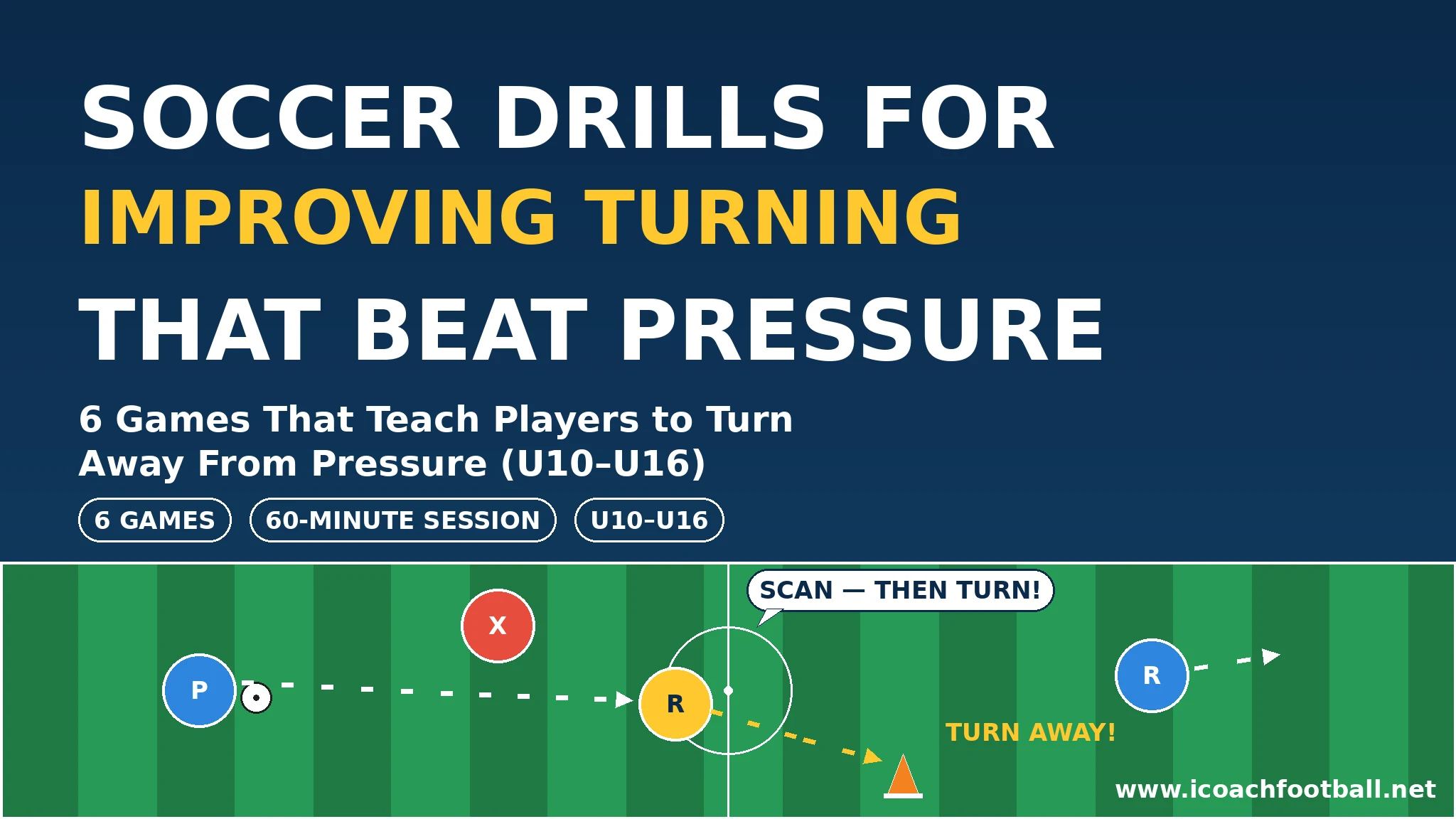
Most young players receive the ball facing their own goal — and then they are stuck. They take a touch back the way it came, the defender closes in, and the attack dies. Six games that teach the scan, the open body shape, the first touch across the body and the turn that takes a player away from pressure — hook turns, drag-backs, Cruyff turns and the half-turn — in one 60-minute session.
Suitable for: U10–U16 (ages 9–16)
Session snapshot
- Players: 12–16 (U10–U16)
- Area: 10 x 10 to 40 x 30 yards (grids per drill)
- Duration: 60 minutes
- Focus: Scanning, half-turn body shape, back-foot receive, hook turns, drag-backs, Cruyff turns, turning away from pressure, accelerating out of the turn
- Equipment: 10–12 balls, 24 cones, 4 mini goals, bibs, 1 full goal
Why these six games work
Turning is not a trick. It is a decision made before the ball arrives. The player who turns well has already scanned over both shoulders, opened their body side-on, and knows which side the pressure is coming from — so the first touch takes them away from the defender instead of into them. The FIFA Training Centre Talent Coach Programme session “Receiving between the lines” teaches exactly this: a quick over-the-shoulder scan before receiving lets players understand the positions of opponents and team-mates, and receiving the ball on the back foot with a side-on body shape helps players play forwards quickly. England Football Learning’s “Receiving and finishing to score” programme says the same thing for younger players: scan before receiving, and if players approach at an angle and position themselves on the half-turn, they can receive and turn more easily. Drills 1 and 4 below are based on / in line with the FIFA session; Drills 2, 3 and 5 are based on / in line with the England Football Learning programme; Drill 6 is the conditioned game that puts all of it under real pressure. In the UK the same work is football drills for turning — the turns and the answers are identical.
Six rules of turning
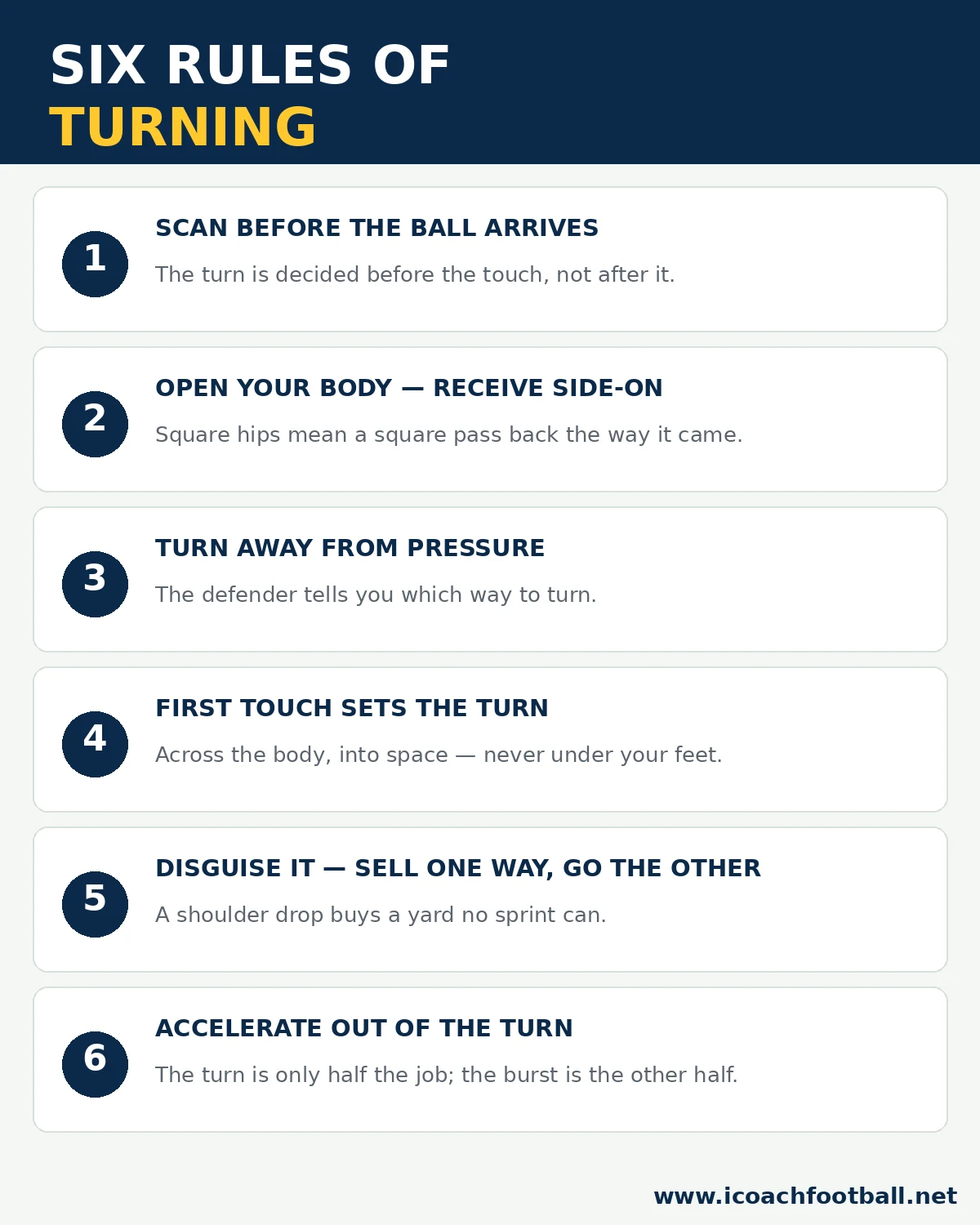
- Scan before the ball arrives. The turn is decided before the touch, not after it.
- Open your body — receive side-on, back foot ready. Square hips mean a square pass back the way it came.
- Turn away from pressure, never into it. The defender tells you which way to turn.
- First touch sets the turn. Across the body, into space — never under your feet.
- Disguise it — sell one way, go the other. A shoulder drop buys a yard no sprint can.
- Accelerate out of the turn. The turn is only half the job; the burst is the other half.
Drill 1 — Half-Turn Gates
The warm-up that sets the whole session. A gates game built on the FIFA “Receiving between the lines” principle: receive side-on on the back foot and turn through the gate on the side where the space is — based on / in line with that session.
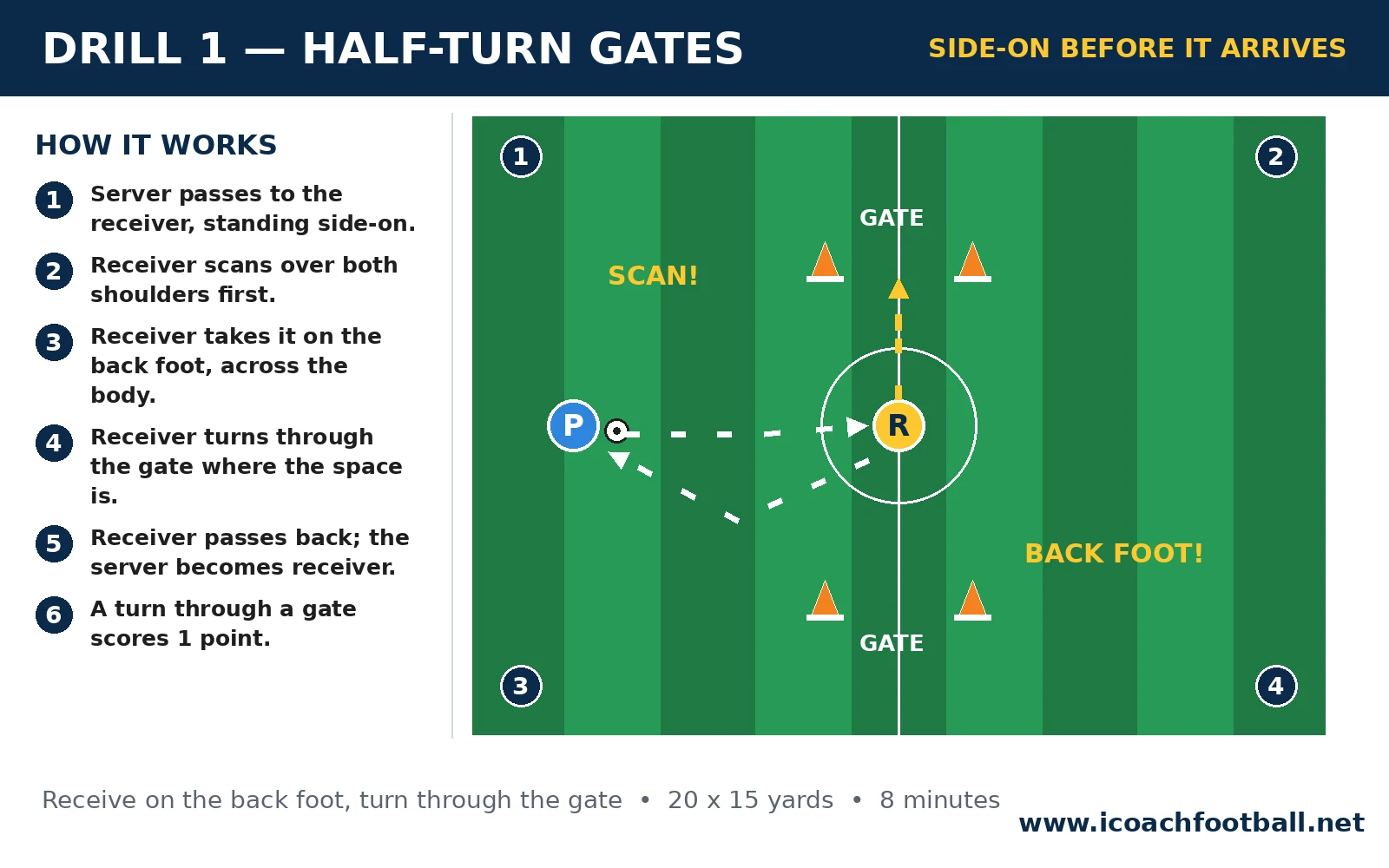
- Setup: 20 x 15 yard area, 4 gates of 3 yards across the middle. 12 players in pairs, 1 ball per pair. 8 minutes.
How to play:
- The server passes to the receiver, who stands side-on between two gates.
- The receiver scans over both shoulders before the ball arrives.
- The receiver takes the ball on the back foot, across their body.
- The receiver turns through the gate on the side where the space is.
- The receiver passes back to the server, who becomes the receiver.
- A turn through a gate scores 1 point; a square-on receive scores nothing.
- Coach’s note: “Side-on before it arrives — if your hips are square, your turn is already too late.”
- Progressions: A cone defender stands behind the receiver and points left or right — turn the other way; two balls run at once; the gates narrow to 2 yards.
Drill 2 — Hook-Turn Corridor
One habit, drilled until it is automatic. A corridor of cones where the only way through is the hook turn — inside hook one way, outside hook the other — and every turn must end with a burst of pace.
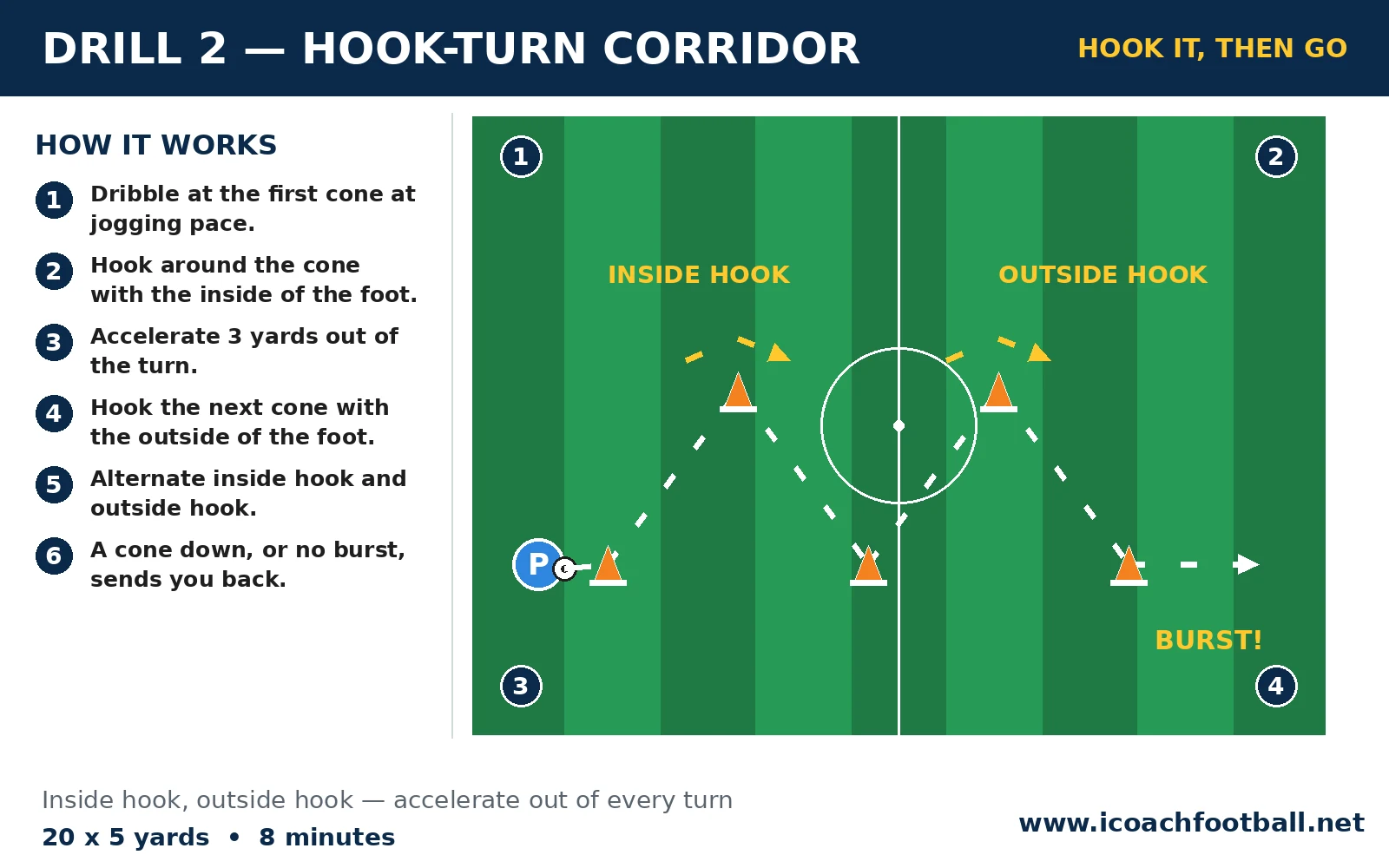
- Setup: 20 x 5 yard corridor, 5 cones down the middle, 3 yards apart. 12 players, 1 ball each. 8 minutes.
How to play:
- The player dribbles at the first cone at jogging pace.
- The player hooks the ball around the cone with the inside of the foot.
- The player accelerates for 3 yards out of the turn before the next cone.
- At the next cone the player hooks with the outside of the foot.
- The player alternates inside hook and outside hook down the corridor.
- A cone knocked over, or a turn without the burst, sends the player back to the start.
- Coach’s note: “Hook it, then go — a turn without the burst is just a dance step.”
- Progressions: The corridor narrows to 3 yards wide; the player must hook with the weaker foot at every second cone; a defender shadows the last 5 yards.
Drill 3 — Drag-Back and Cruyff Turn
The escape moves for a tight square. One attacker, one defender, one gate — the only way out is the drag-back or the Cruyff turn, sold with a shoulder drop first.
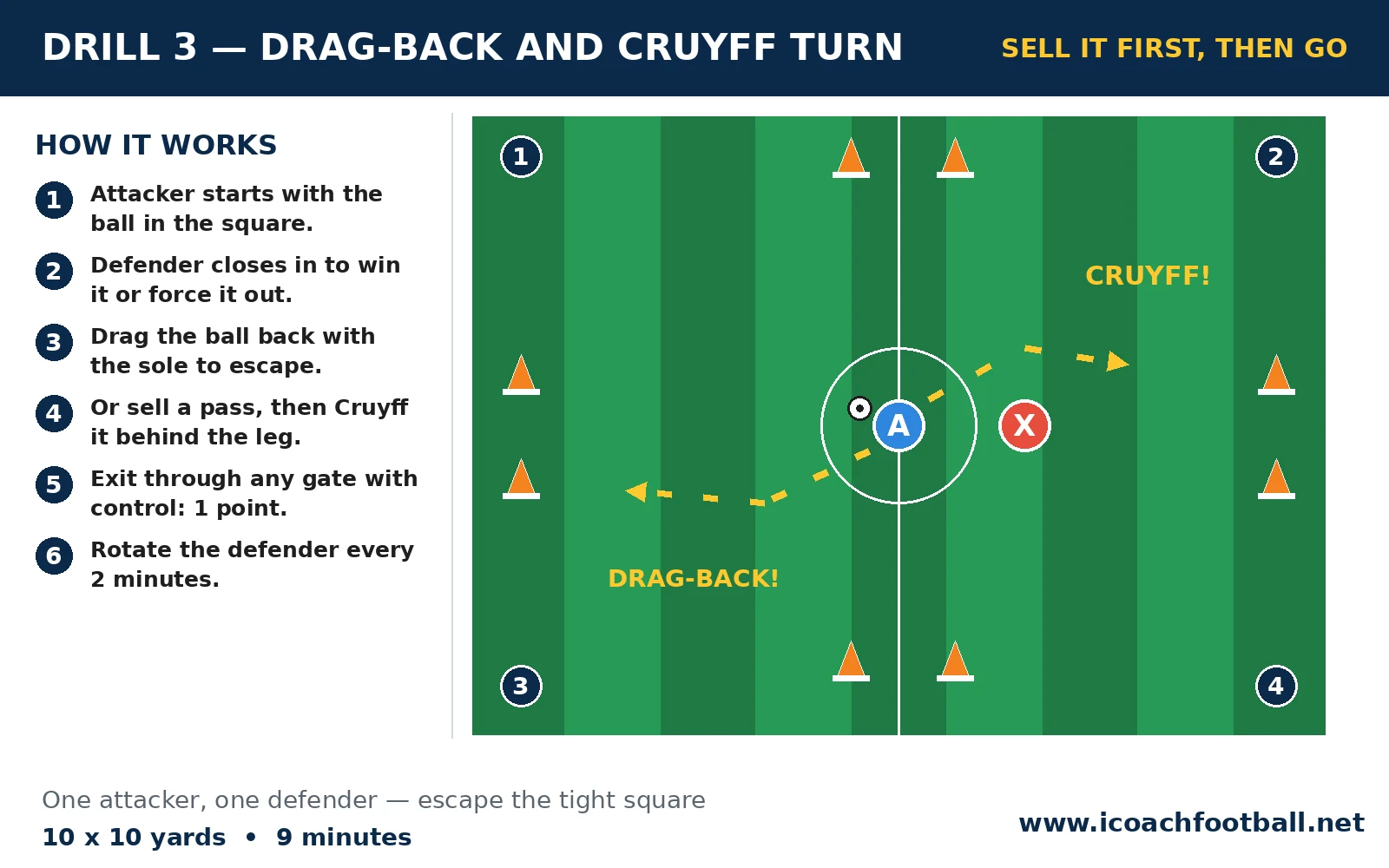
- Setup: 10 x 10 yard square, one 3-yard exit gate on each side. 1 attacker vs 1 defender. 9 minutes.
How to play:
- The attacker starts with the ball in the middle of the square.
- The defender closes in and tries to win the ball or force it out.
- The attacker drags the ball back with the sole of the foot to escape.
- Or the attacker sells a pass with the inside of the foot, then drags it behind the standing leg — the Cruyff turn.
- The attacker scores 1 point by exiting through any gate with the ball under control.
- Rotate the defender every 2 minutes so everyone learns to escape and to press.
- Coach’s note: “Sell it first — drop the shoulder, then drag it back. No sell, no space.”
- Progressions: The square shrinks to 8 x 8 yards; the attacker must use a different turn each rep; the defender may tackle after 3 seconds.
Drill 4 — Man-On: Turn Away From Pressure
The decision drill — the one whose movement cannot be read from a static picture, so it is the animated drill. A server, a receiver and a defender closing from behind: the receiver must turn away from the side the pressure closes.
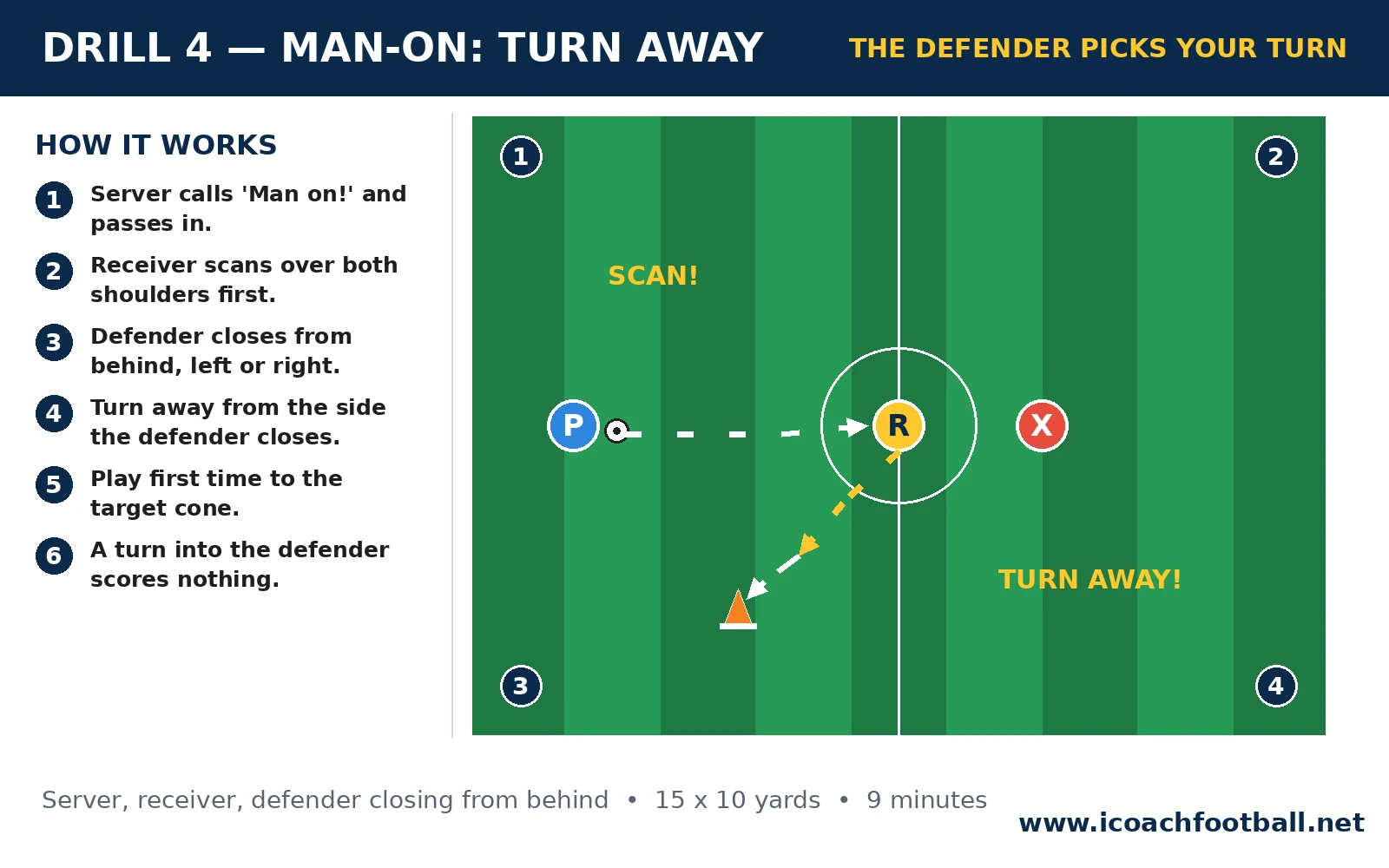
- Setup: 15 x 10 yard grid, server at one end, receiver in the middle. 1 defender starts 5 yards behind the receiver. 9 minutes.
How to play:
- The server calls “Man on!” and passes to the receiver.
- The receiver scans over both shoulders before the ball arrives.
- The defender closes from behind, from the left or the right.
- The receiver turns away from the side the defender closes — never into them.
- The receiver plays first time to the target cone on the open side.
- A turn into the defender scores nothing — the rep restarts.
- Coach’s note: “The defender picks your turn — turn away from the pressure, never into it.”
- Progressions: The defender starts 3 yards behind the receiver; the server calls “Turn!” or “Set!” and the receiver must obey; the target cone moves to the receiver’s weaker side.
Drill 5 — Turn and Finish
The striker’s turn, based on / in line with England Football Learning’s “Receiving and finishing to score” programme: receive back to goal, turn, and shoot within two touches — the half-turn receive turned into a goal.
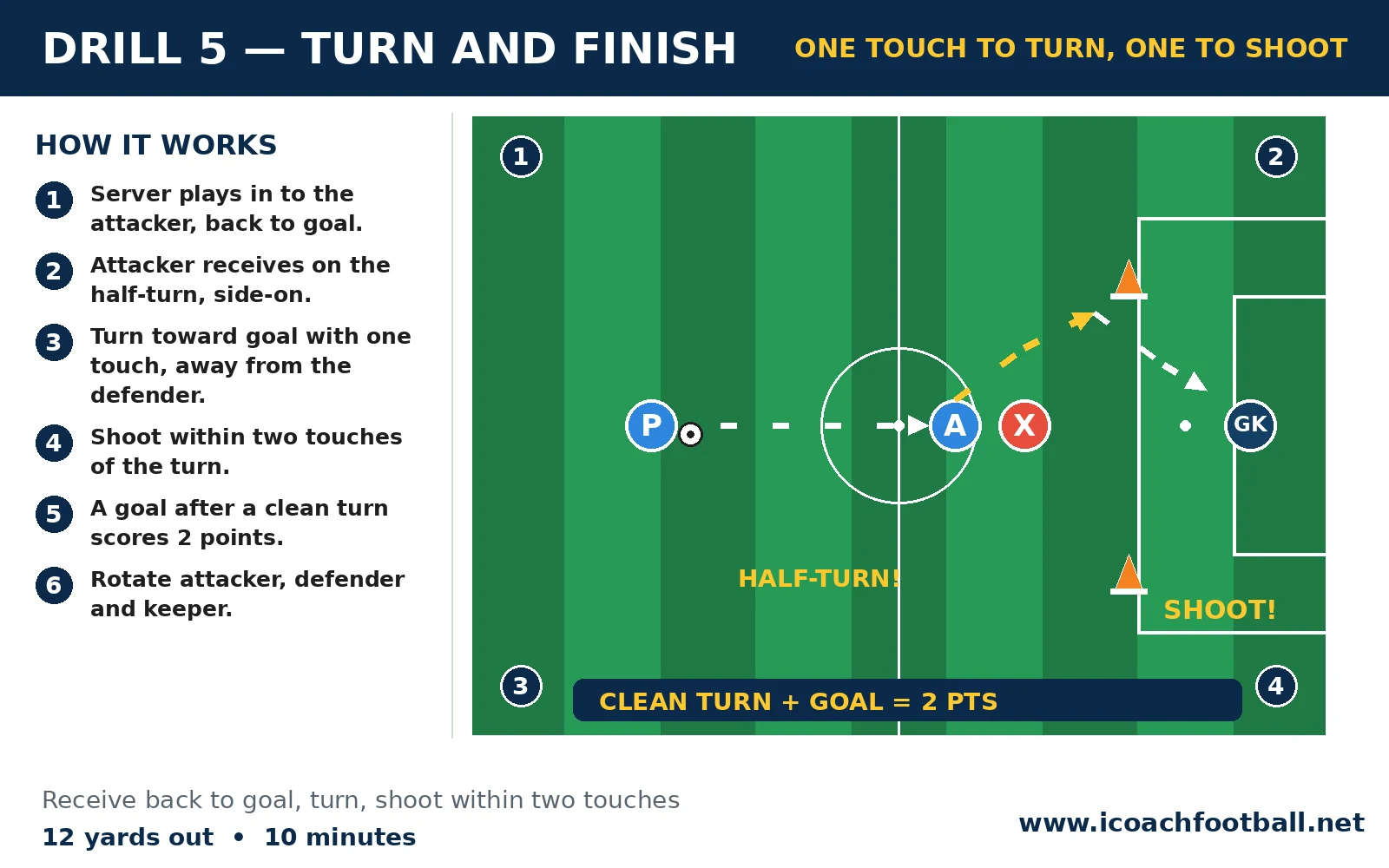
- Setup: Full goal with keeper, 12 yards from goal, 2 target cones 8 yards either side. 1 attacker vs 1 defender. 10 minutes.
How to play:
- The server plays into the attacker, back to goal, 12 yards out.
- The attacker receives on the half-turn, side-on to the goal.
- The attacker turns toward the goal with one touch, away from the defender.
- The attacker shoots within two touches of the turn.
- A goal after a clean turn scores 2 points; a goal after a messy turn scores 1.
- Rotate attacker, defender and keeper every 3 minutes.
- Coach’s note: “One touch to turn, one to shoot — if you need a third, the chance is gone.”
- Progressions: The defender starts tight on the attacker’s back; the attacker must turn to the weaker side; the shot must be first time after the turn.
Drill 6 — Turn-and-Go 4v4
The conditioned game. Four against four, and the only way to score extra is the turn itself — every turn that beats a defender or plays the team forward earns a point.
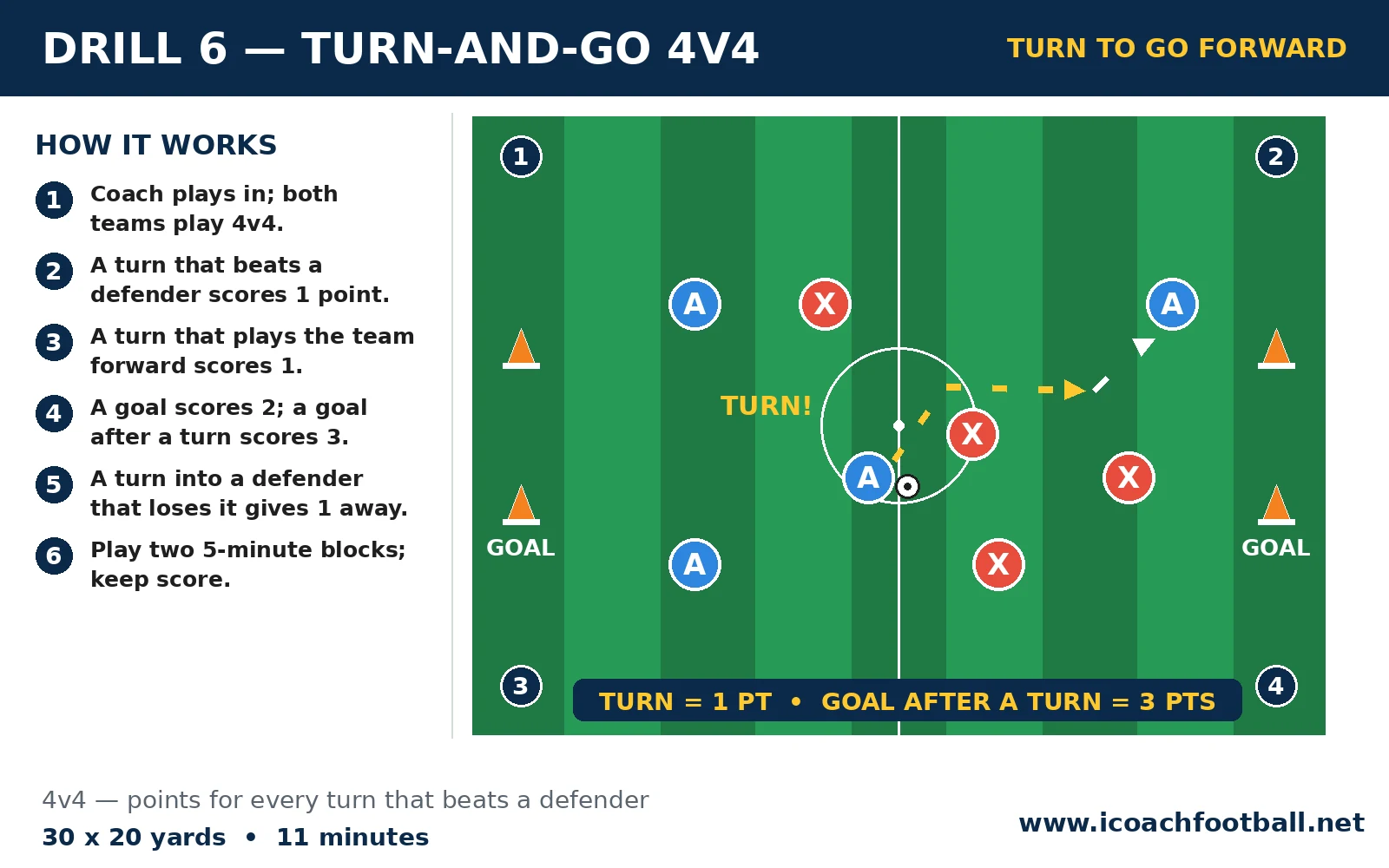
- Setup: 30 x 20 yards, two mini goals at each end. 4v4. 11 minutes.
How to play:
- The coach plays the ball in and both teams play 4v4.
- A turn that beats a defender scores 1 point for the turning team.
- A turn that plays the team forward into the final third scores 1 point.
- A goal scores 2 points, and a goal after a turn that beat a defender scores 3.
- A turn into a defender that loses the ball gives the other team 1 point.
- Play two 5-minute blocks and keep a running score across the blocks.
- Coach’s note: “Turn to go forward — a turn that goes backwards is just a keep-ball.”
- Progressions: Two-touch limit, then one-touch for the team in possession; the area narrows to 25 x 15 yards; turns only count if they beat a defender, not just change direction.
Coaching points: the five mistakes that kill turning
| Mistake | What you see | Fix |
|---|---|---|
| Receiving square-on, body closed | The player can only pass back the way it came, and the presser arrives first | Open the hips before the ball arrives — side-on, back foot ready, scan done |
| Turning into the defender | The turn runs straight into the presser and the ball is lost on the spot | Turn away from pressure — the defender’s position picks the direction, not the player |
| First touch under the feet | The ball gets caught under foot and there is nothing to turn with | A firm, close first touch across the body, into the space you intend to attack |
| Telegraphing the turn | The defender reads the turn before it happens and steps across | Disguise it — drop the shoulder, sell one way, go the other |
| Slowing down after the turn | The turn beats the defender but the player strolls, and the defender recovers | Accelerate out of the turn — 3 yards at full pace before looking up |
Age adaptations
| Age | Area | What changes |
|---|---|---|
| U10–U11 (ages 9–11) | 10 x 10-yard squares | Drills 1 and 2 only, with a cone defender who never tackles — the scan, the half-turn shape and the hook turn are taught before any live defender arrives. Celebrate the turn, not the speed, and keep the live press out until the back-foot habit is automatic — see the U11 soccer practice plan |
| U12–U13 (ages 12–13) | 15 x 10-yard grids | Full six-drill menu with a passive defender in Drills 3 and 4; the drag-back and Cruyff turn introduced in Drill 3 and the man-on decision introduced in Drill 4, both against a defender who only shadows at first — see soccer drills for U13 and the U12 soccer practice plan |
| U14–U15 (ages 14–15) | 20 x 15 to 30 x 20 yards | Live defenders in Drills 3, 4 and 5; the defender starts 3 yards behind the receiver in Drill 4; the turn-and-finish game runs with the defender tight on the attacker’s back — see soccer drills for U14, soccer drills for U15 and the U13 soccer practice plan |
| U16 (ages 15–16) | Full pitch shapes, 30 x 20 yards | No coach call on the pressure in Drill 4 — players must read the defender’s run themselves; weaker-foot turns demanded in Drill 2; the Drill 3 square shrinks to 8 x 8 yards and the Drill 6 area narrows to 25 x 15 yards |
60-minute session plan
| Time | Block | Drill |
|---|---|---|
| 0:00–0:05 | Arrival game | Free 4v4 — every player must turn with their first touch at least once before passing |
| 0:05–0:13 | The warm-up gates | Drill 1 — Half-Turn Gates |
| 0:13–0:21 | One habit, automatic | Drill 2 — Hook-Turn Corridor |
| 0:21–0:30 | The escape moves | Drill 3 — Drag-Back and Cruyff Turn |
| 0:30–0:39 | The decision | Drill 4 — Man-On: Turn Away From Pressure |
| 0:39–0:49 | Turn and finish | Drill 5 — Turn and Finish |
| 0:49–0:60 | The turn game | Drill 6 — Turn-and-Go 4v4 |
New to coaching this age? Stretch the arrival game to 8 minutes and cut Drill 5 to 7 minutes and you have the same session with more settling-in time — see our 60-minute plan for the structure (the same shape, shortened where you need it).
Keep building from here
Turning sits on top of the look before the ball arrives, so the foundation is our soccer scanning drills — the scan that decides the turn — and the half-turn receive itself is our football half-turn drills, while the choice that follows the turn is our soccer decision making drills. The move that carries the ball after the turn is our soccer dribbling drills, and the turn with a defender on your back is our soccer hold-up-play drills. The turn that ends in a goal is our 1v1 finishing drills, and the turn under a live press is our soccer drills for improving passing under pressure. The run that starts after the turn is our soccer drills for improving off the ball movement, and the player who invents a new turn is built in our soccer drills for improving creativity. The pass that starts the move is our soccer passing drills, and the team shape that gives the turn somewhere to go is our soccer possession drills. The pattern that uses the turn most is our soccer third man runs drills, and the brave player who tries the turn is built in our soccer drills for improving confidence. The turn that starts the attack from the back is our soccer playing out from the back drills, and the restart that begins it is our soccer goal kick routines. The talking that times the turn is our soccer communication drills, and the turn on the weaker foot is our weak foot soccer drills. The overload the turn creates is our 2v1 soccer drills, while the finish at the end of the turn is our soccer drills for strikers. The press you are turning away from is our counter-pressing drills, and the defending side of the same moment is our football defensive transition drills — while the rondo that teaches the same habits in miniature is our 5v3 rondo transition drill. The pass that switches the point of attack is our switching play drills, and the wide run that opens the lane is our soccer overlap and underlap drills. The other restarts have their own sessions: our soccer throw-in drills, soccer corner kick plays, football free-kick routines and soccer penalty kick drills. The foundation for younger players is our soccer drills for beginners. Protect the players as they grow: our soccer injury prevention guide shows how to build the warm-up into every session, and our 10 soccer warm-up drills give you the full warm-up library. When they are older, the road runs through our soccer drills for U13, soccer drills for U14 and soccer drills for U15 — and the girls and boys versions of this work are our soccer drills for girls and soccer drills for boys — and if you run selections one day, our soccer tryout drills show how to grade a group fairly.
FAQ
What is the best turn in soccer?
The one that takes you away from the pressure — and that depends on where the defender is. A hook turn beats a defender in front of you, a drag-back or Cruyff turn escapes one tight on your back, and the half-turn lets you receive and go forward in one move. Teach all three, and let the scan pick the turn.
How do you teach a child to turn with the ball?
One turn at a time, and never against a live defender first. Drill 1 teaches the half-turn shape in a gates game with no defender; Drill 2 drills the hook turn in a corridor until it is automatic. Only then do Drills 3 and 4 add a defender — and the rule stays the same at every age: scan, open, first touch away, accelerate.
Should players turn or play it back when pressed?
The scan decides. If the space behind is open, turn and go — that is Drill 4. If the defender is tight on your back and there is no space to turn into, protect the ball and set it back, then spin into the space. Turning into a tight defender is the turnover; setting it back to go forwards again is the smart play.
What is a half-turn in soccer?
Receiving the ball side-on, with the body already open and the back foot ready — so the player can turn and drive forward, or play forward first time, in one movement. England Football Learning puts it plainly: approach at an angle, position yourself on the half-turn, and you can receive and turn more easily. It is the foundation of every drill in this session.
How can players practise turning at home?
Ten minutes, a wall and two cones. Pass against the wall, receive on the half-turn, and turn through a cone gate — Drill 1 with no partner needed. Then add the hook turn around one cone and the drag-back at the other, alternating inside hook and outside hook. Short, daily reps beat one long session a week.
Sources
- FIFA Training Centre, Talent Coach Programme, “Receiving between the lines” — a quick over-the-shoulder scan before receiving lets players understand the positions of opponents and team-mates; receiving the ball on the back foot with a side-on body shape helps players play forwards quickly; C receives the ball side-on between the mannequins and F pulls wide to receive side-on. Drills 1 and 4 above are based on / in line with this session. https://www.fifatrainingcentre.com/media/native/practice/talent-coach-programme/Talent_coach_1.1-latest.pdf
- England Football Learning, “Receiving and finishing to score” session programme — scan before receiving; approach at an angle and position yourself on the half-turn so you can receive and turn more easily; receive on the back foot and turn to play on; week two teaches receiving under pressure with a before, during and after approach to the pass. Drills 2, 3 and 5 above are based on / in line with this programme. https://cdn.englandfootball.com/-/media/EFLearning/Session-programmes/7-11-receiving-and-finishing-to-score/Session-programme/Session-programme—Receiving-and-finishing-to-score.pdf?rev=3087cd8afa6e4f15b5f1f84c6296dce0&