Soccer Third Man Runs Drills: 6 Games to Play Up, Back and Through
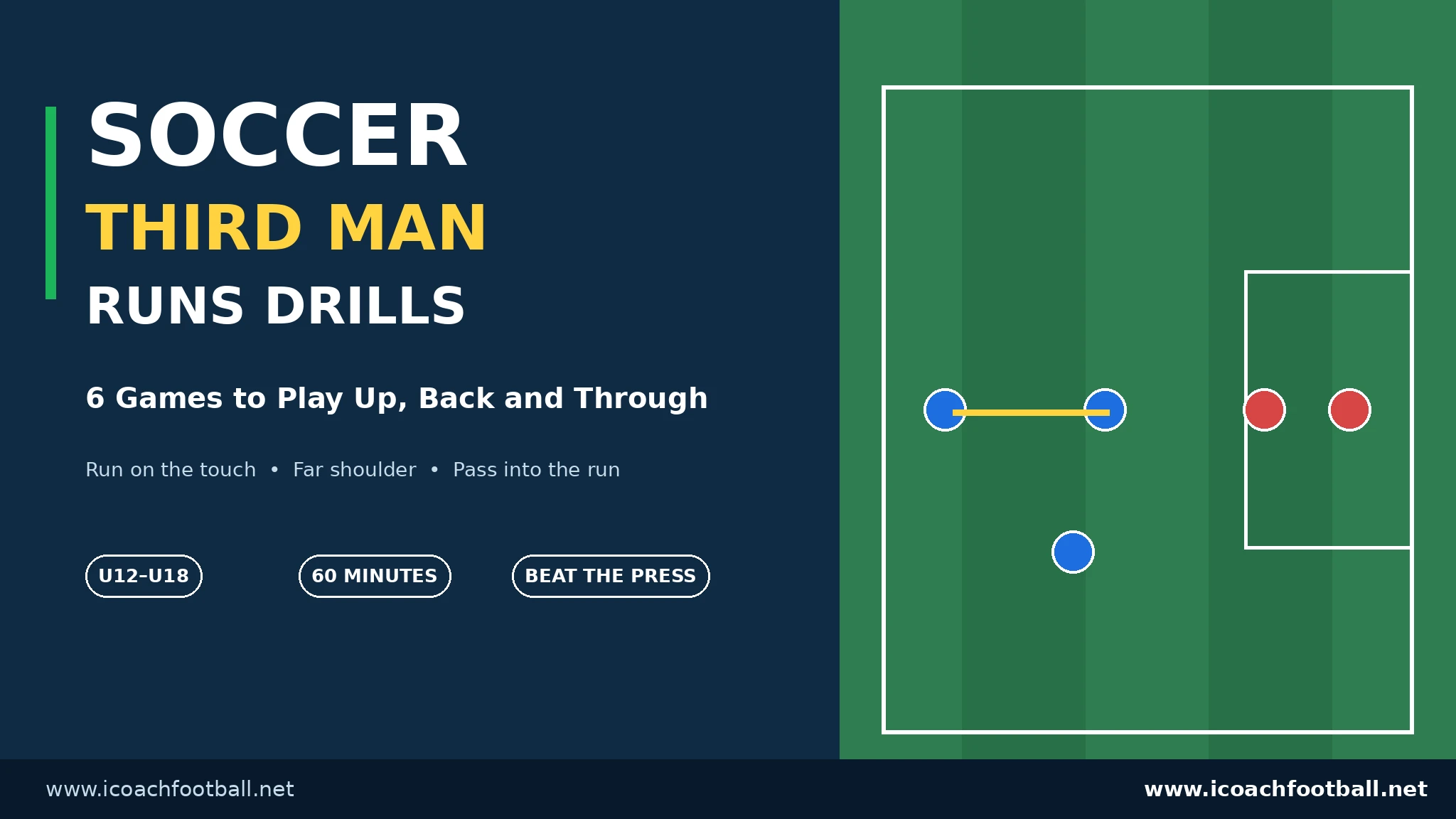
Quick answer: A third man run is the run nobody is marking. One player passes up to a teammate, that teammate lays the ball back, and a third player — already running from deep or from the blindside — receives the through pass in space. The lay-off drags a defender toward the ball. The run goes where the defender just left.
Suitable for: U12–U18
Most teams try to beat a press with the player on the ball. They dribble, they turn into pressure, and they lose it. The third man run beats the press without the ball carrier beating anyone.
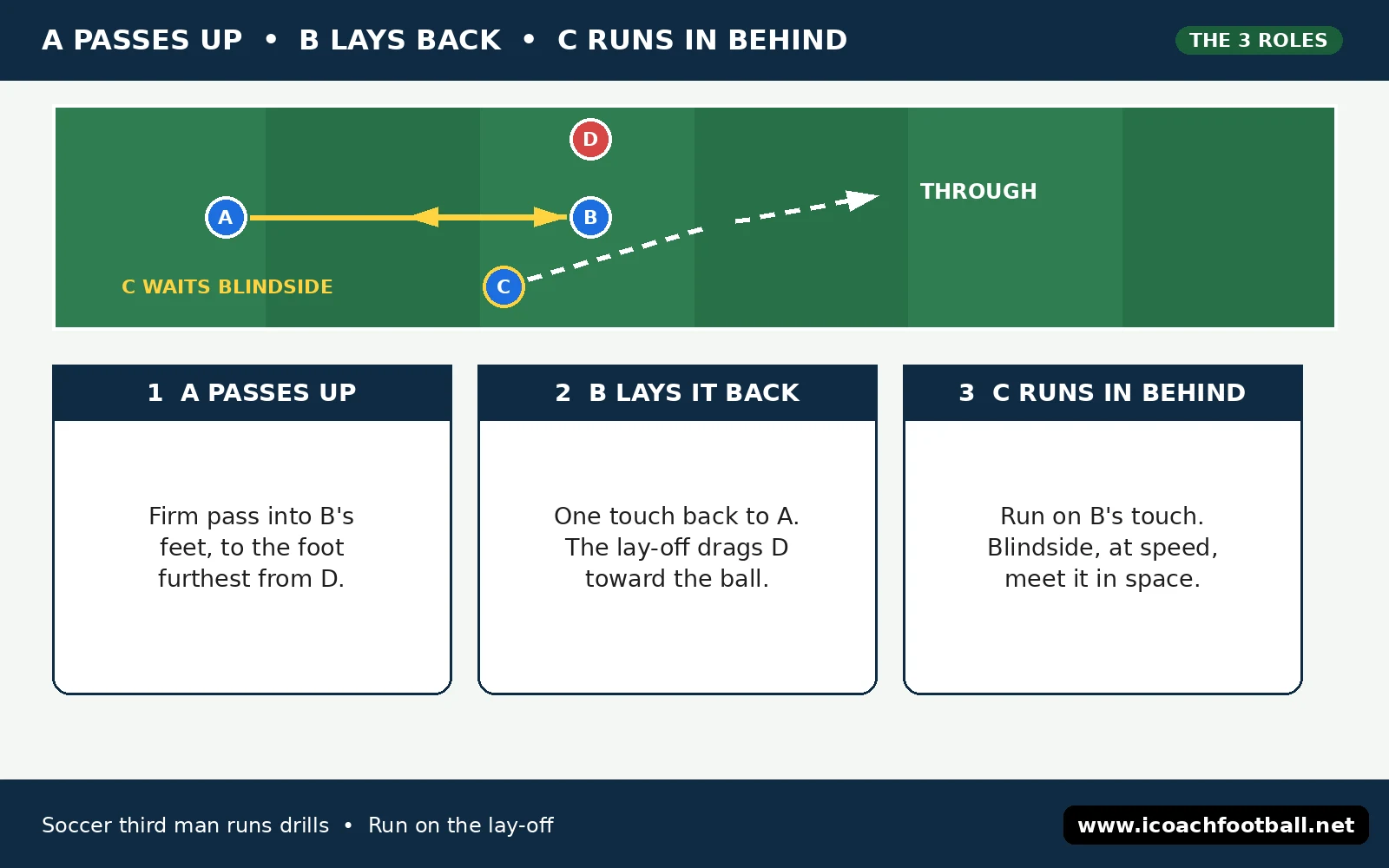
Three players do three jobs. Player A passes up. Player B lays it back first time. Player C runs in behind while the defender watches the first two passes. Coaches in the UK teach the same pattern as football third-man runs, and the timing is identical: run late, run blindside, receive at speed.
This site already teaches one third-man pattern in the diamond passing drill. These six soccer third man runs drills teach the whole idea: the unopposed pattern, the FIFA speed circuit, the blindside run under pressure, the central combination, the rondo that only rewards the third man, and a game that only counts goals the third man creates.
Session snapshot
- Players: 9–18 (threes for Drills 1–3, groups of 6–8 for Drills 4–5, two teams for Drill 6)
- Area: 20 x 15 yards for Drills 1–3, 30 x 25 yards for Drill 4, 25 x 20 yards for Drill 5, 50 x 35 yards for Drill 6
- Duration: 60 minutes (20-minute version: Drills 1 and 2 only)
- Focus: Up-back-through timing, lay-off weight, blindside runs, receiving at speed, finishing first time
- Equipment: 10–12 balls, 16 cones, 4 mannequins or poles, bibs, 2 goals for Drills 4 and 6
- Age: U12–U18 (see age adaptations)
The one rule: run on the lay-off, not on the first pass
A third man run timed to the first pass arrives too early. The defender sees it, tracks it, and the space closes. A run timed to the lay-off arrives as the defender steps toward the ball.
- A passes up. A firm pass into B’s feet, played to the foot furthest from the defender. B must be able to lay it back first time.
- B lays it back. One touch, into A’s path or to the side, with the weight of a pass, not a touch. A heavy lay-off kills the timing.
- C runs blindside. C starts behind or beside the defender’s shoulder, out of their eyeline. The run starts as B touches the ball, not before.
- The through pass goes into space. It is played ahead of C, along the ground, so C meets it at speed. A pass to feet stops the run dead.
If your players run too early, fix the trigger with these soccer scanning drills first; C must read B’s touch before moving, and that read is a scan.
| What the defender does | Third man does | Pass does |
|---|---|---|
| Steps up to press B | C runs in behind, blindside | Through pass into space ahead of C |
| Stays deep and holds the line | C checks short, then spins in behind | Lay-off to A, then a diagonal through pass |
| Follows C’s run | B turns and drives forward instead | B keeps the ball and plays A wide |
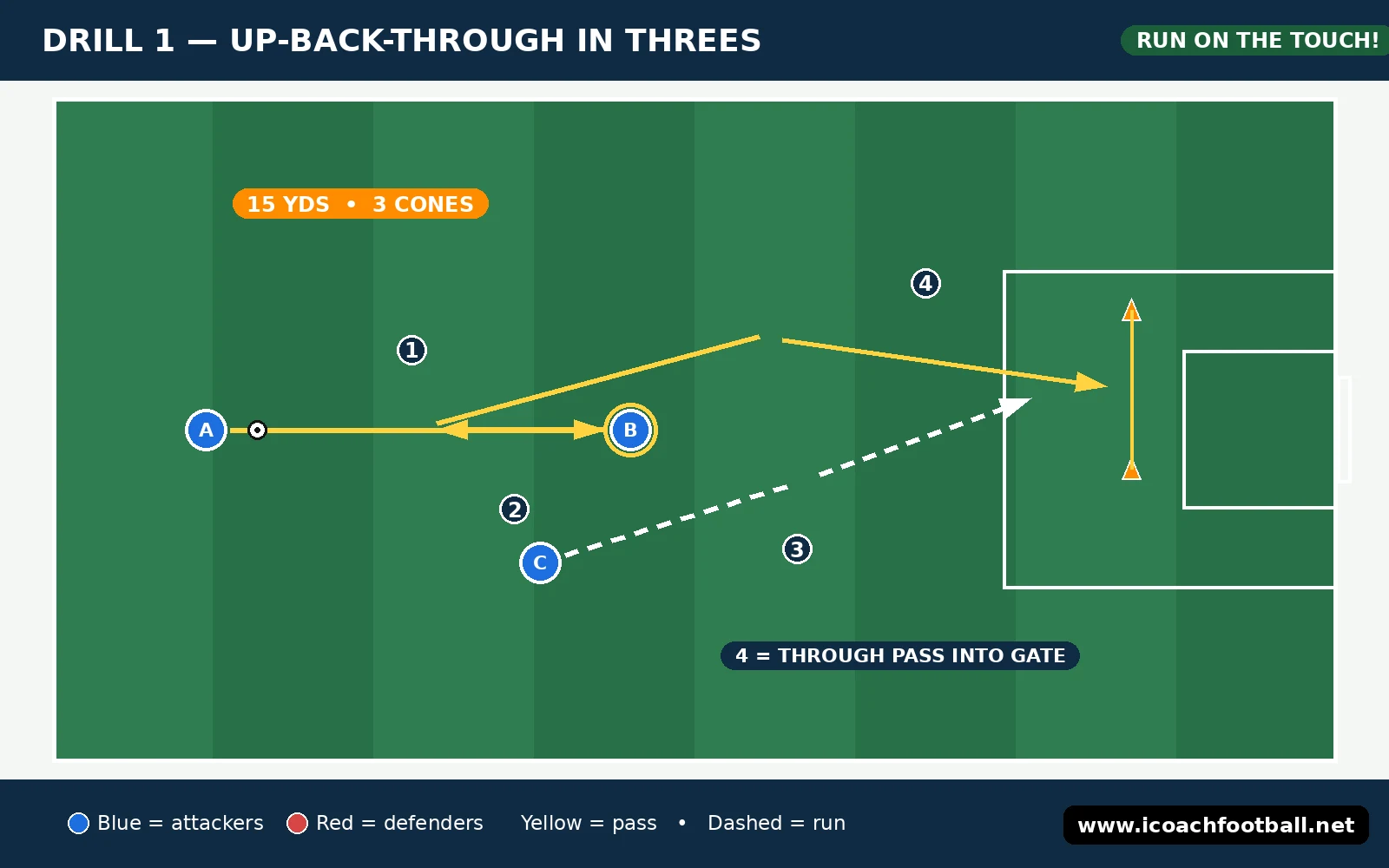
Drill 1 — Up-Back-Through in Threes
The blocked-practice start: three players, one pattern, and the same lay-off and run from both sides until the timing is automatic.
Setup:
- Three cones in a line, 15 yards apart, with a 3-yard target gate 10 yards beyond the far cone.
- Player A at the near cone with the ball, Player B at the middle cone, Player C starting 5 yards behind B on the blindside.
- Balls with A, and a cone marking C’s starting spot.
How to Play:
- Player A plays a firm pass into B’s feet as C scans the space behind B.
- Player B lays the ball back first time, into A’s path, with one touch.
- Player C starts the run as B touches the ball, sprinting blindside past B.
- Player A plays a through pass ahead of C, along the ground, into the target gate.
- Players rotate after every rep: A follows to B, B follows to C, and C dribbles back to A’s cone.
Coach’s note: The cue is “Run on the touch!” If C moves before B touches the ball, stop the rep. The lay-off is the trigger, not the first pass.
Progressions: B may turn and drive forward if no defender steps up, then C must hold the run and offer a wide option instead of running in behind.
Drill 2 — The FIFA Speed Circuit
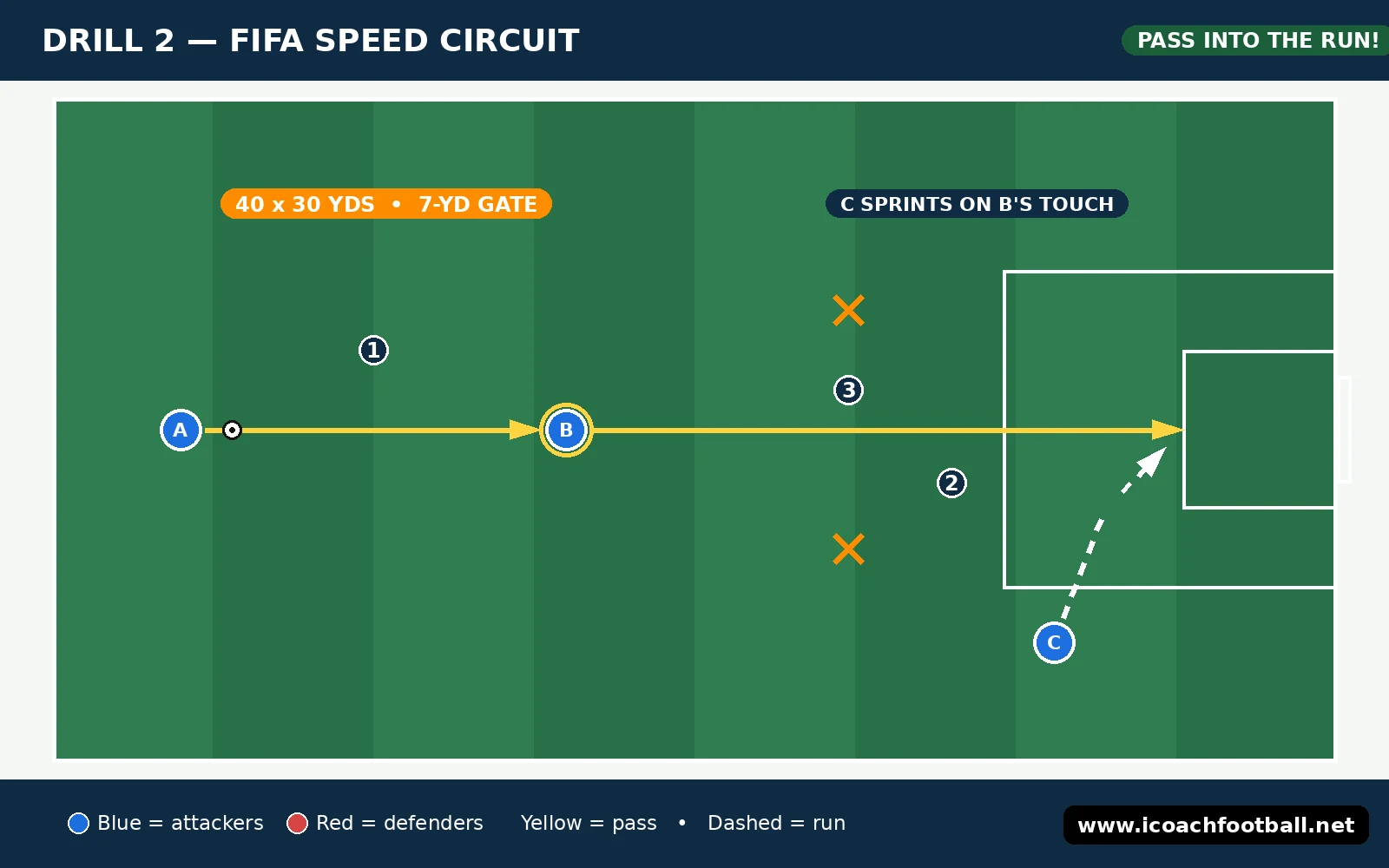
The speed circuit, based on the FIFA Training Centre speed technical coordination circuit: a deep runner times a long infield run to a vertical pass, then finishes at speed.
Setup:
- A 40 x 30 yard grid, with two mannequins 20 yards from A’s cone, one either side of a 7-yard gate.
- Player A at the near cone with the ball, Player B in the middle, Player C waiting wide behind a mannequin.
- A goal 20 yards beyond the gate, with balls at A’s cone.
How to Play:
- Player A plays an angled vertical pass wide of the gate to B.
- Player B shifts the ball forward with the first touch, half-turned toward C.
- Player C sprints infield at high speed, timed to B’s first touch, not to A’s pass.
- Player B plays a long angled pass into C’s acceleration path, beyond the mannequins.
- Player C finishes first time on goal, then jogs back and players rotate: A to B, B to C, C to A.
Coach’s note: The cue is “Pass into the run!” If C must slow down or check back for the ball, the pass was late or behind. The ball meets C at full speed.
Progressions: Add a second runner from the opposite side, then run the circuit from both ends at once with two balls, so C must scan for traffic before sprinting.
Drill 3 — Blindside Third-Man Run
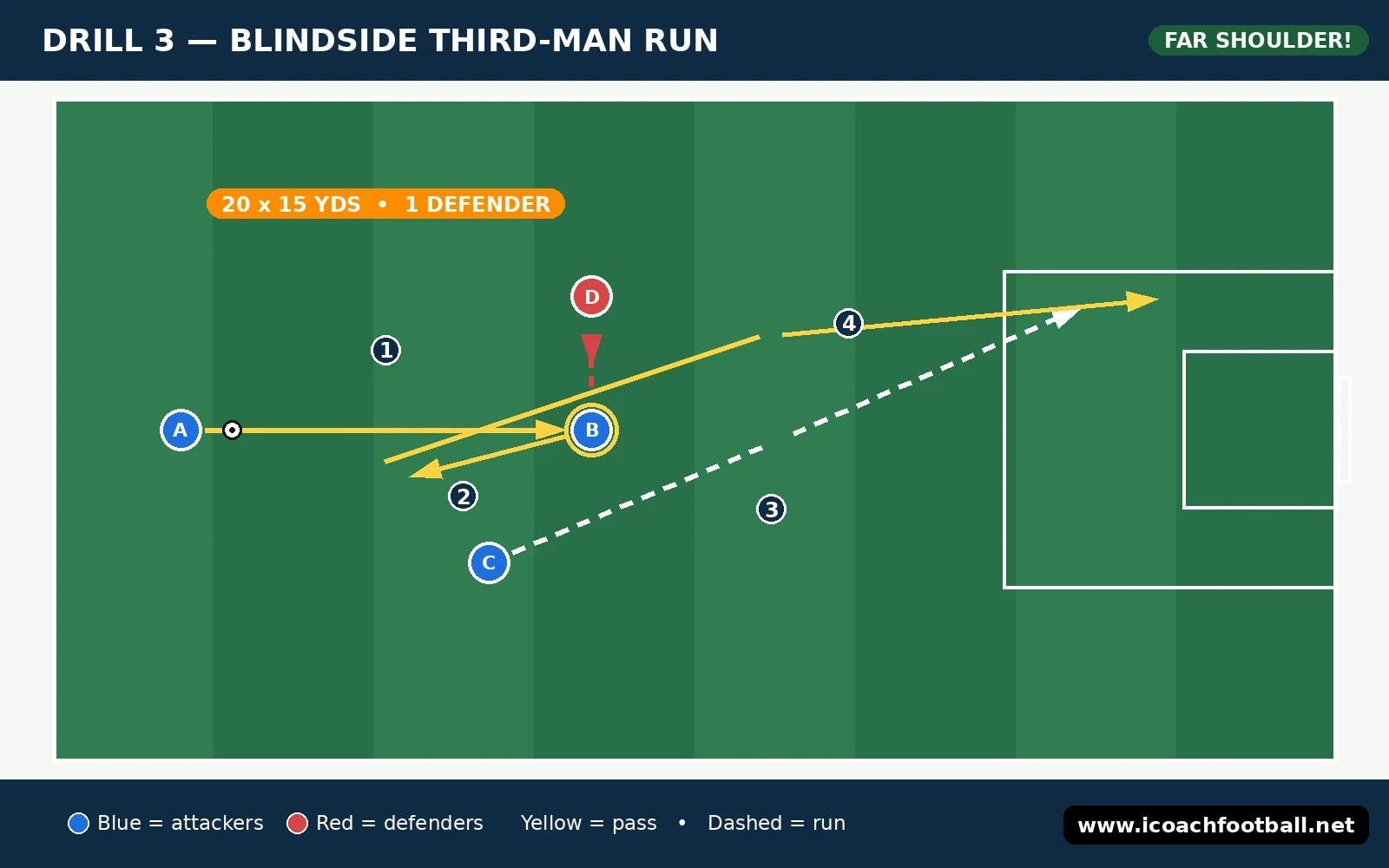
The opposed test. One defender presses the lay-off, and C must arrive from the side the defender cannot see.
Setup:
- A 20 x 15 yard channel, with a target gate 10 yards beyond the far end.
- Player A at the near end with the ball, Player B in the middle, Player C starting blindside, 5 yards behind B.
- One defender starts 3 yards behind B and presses on A’s first pass.
How to Play:
- Player A passes up to B as the defender closes down from behind.
- Player B lays the ball back first time, to the side away from the defender.
- Player C sprints blindside, on the defender’s far shoulder, as B touches the ball.
- Player A plays through the gate ahead of C, who finishes first time into a mini-goal.
- Rotate every 4 reps: the defender becomes C, C becomes B, B becomes A, and A defends.
Coach’s note: The cue is “Far shoulder!” If C runs on the defender’s near side, the defender sees the run and tracks it. The blindside is the whole point.
Progressions: The defender may intercept the lay-off, then B must set the ball to the other side and C must read the new angle and run the other way.
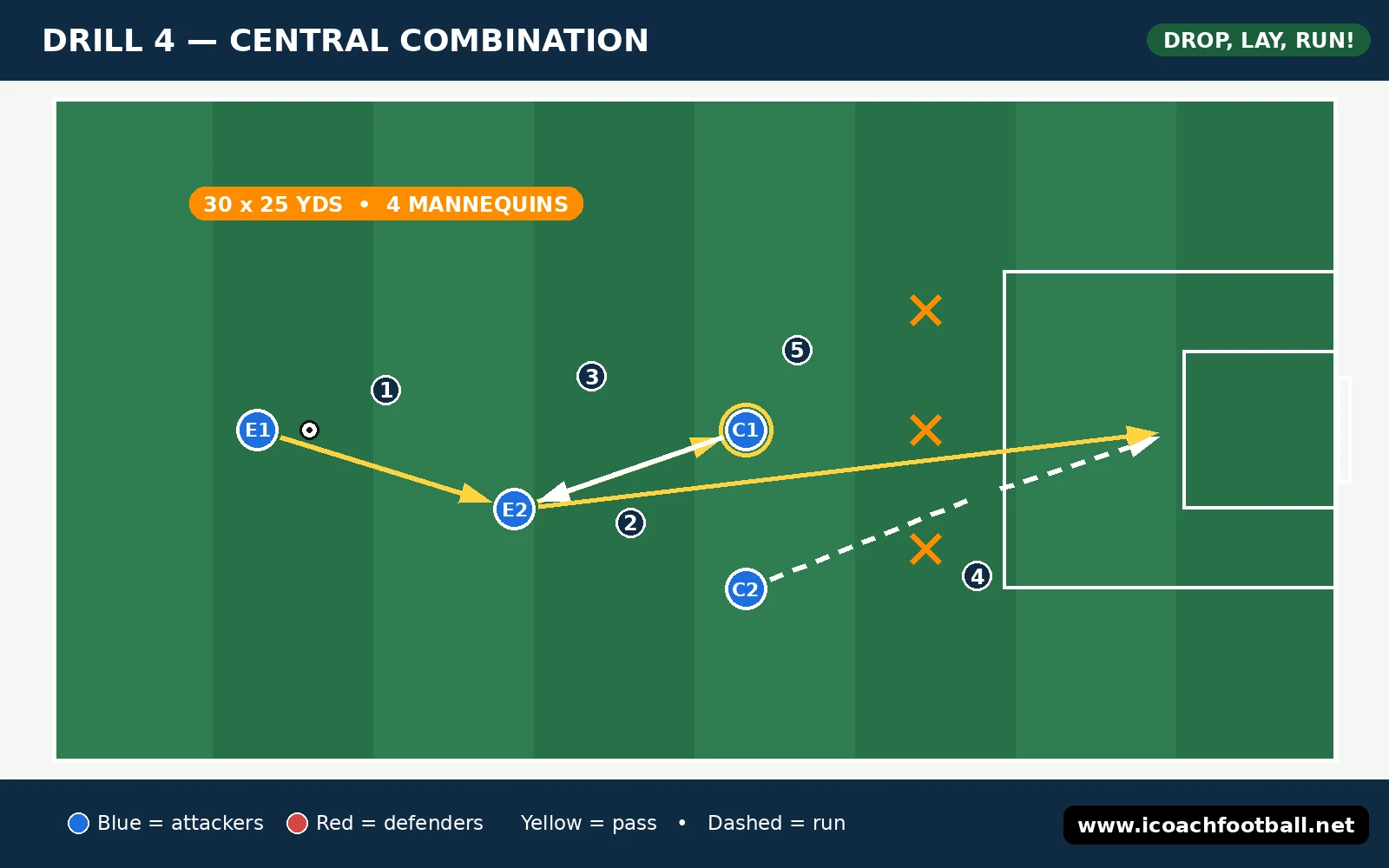
Drill 4 — Central Combination
The final-third combination, in line with the FIFA Training Centre session on combination play in the final third: two midfielders link up, the forwards set each other up, and the third man finishes.
Setup:
- Area 30 x 25 yards, with a full goal at the far end and 4 mannequins forming a back line 8 yards from goal.
- Two midfielders E1 and E2 in the centre, two forwards C1 and C2 ahead of the mannequins.
- Balls with the midfielders, and a goalkeeper in goal.
How to Play:
- Midfielders E1 and E2 play a one-two to draw the first mannequin line forward.
- E1 passes into forward C1, who drops short to receive with a defender mannequin tight behind.
- Forward C1 lays the ball back first time to E2, who has moved between the lines.
- Forward C2 times a run in behind the back line as C1 touches the ball.
- E2 plays a first-time through ball to C2, who finishes first time on goal.
Coach’s note: The cue is “Drop, lay, run!” If C2 runs before C1’s touch, the mannequin line holds. The run is triggered by the lay-off, exactly as in Drill 1.
Progressions: Add two live defenders for the back line, then let the forwards swap roles mid-rep, so C1 becomes the runner and C2 becomes the lay-off player.
Drill 5 — Third-Man Rondo
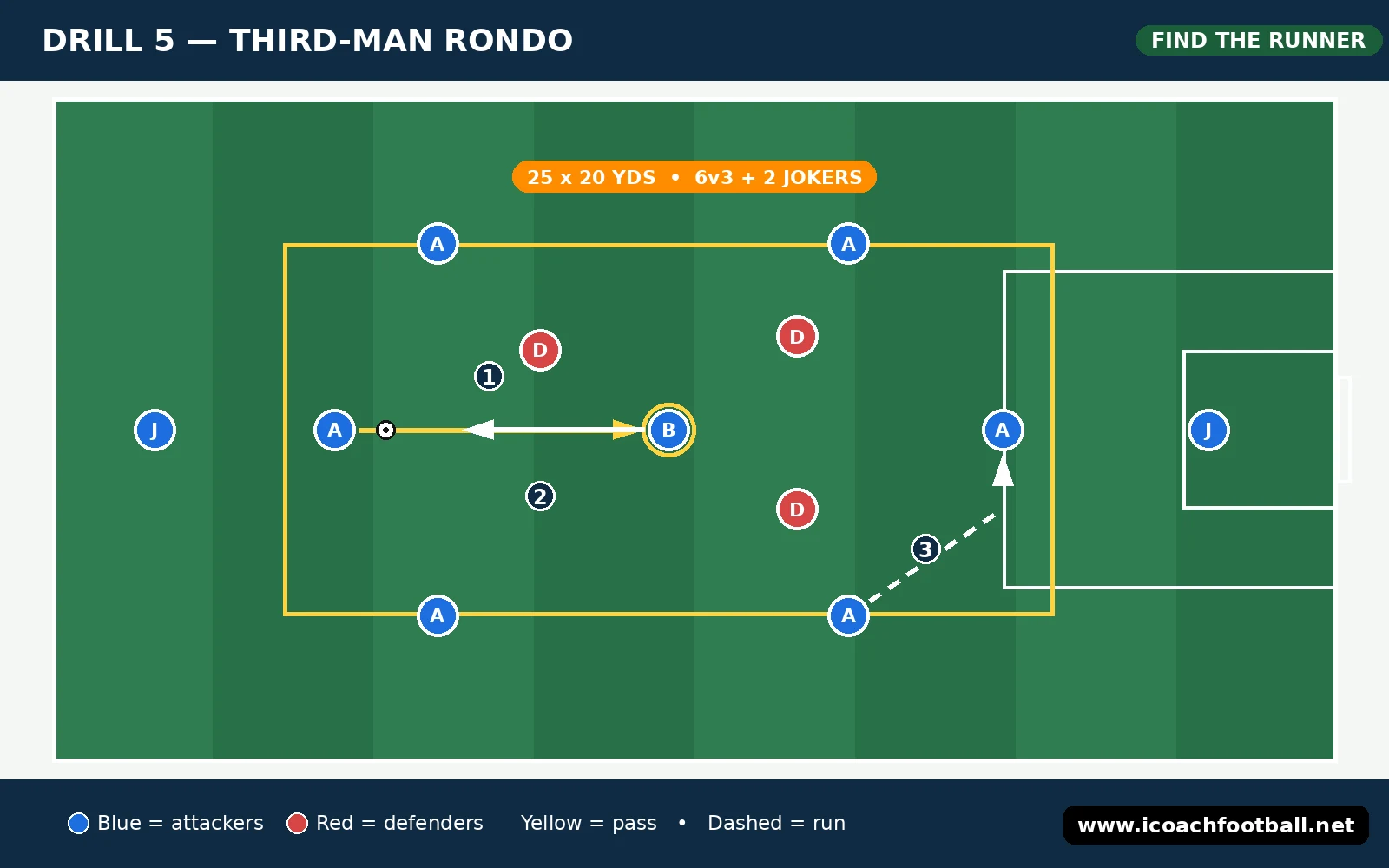
The recognition game. Possession alone scores nothing. Only a receive by a third man counts, so players must hunt the run in chaos.
Setup:
- A 25 x 20 yard box, with 6 attackers in bibs, 3 defenders inside, and 2 neutral jokers on the outside.
- A 3-yard scoring gate on each short side of the box.
- Balls with the attackers, and a 2-minute block clock.
How to Play:
- Attackers keep possession in two touches, and defenders press to win the ball.
- A goal is scored only when a third man receives a through pass after a lay-off inside the box.
- The third man must receive the ball moving forward, through a scoring gate, to count.
- A lay-off that goes sideways with no runner scores nothing, even if possession is kept.
- Rotate the defenders every block, and swap the jokers every 2 minutes so all players play both roles.
Coach’s note: The cue is “No runner, no point!” Freeze any team that keeps the ball safely sideways. The rondo must force the up-back-through, not reward safe passes.
Progressions: Limit attackers to one touch, then shrink the box to 20 x 15 yards so the lay-off and the run must be faster and closer.
Drill 6 — Third-Man Game
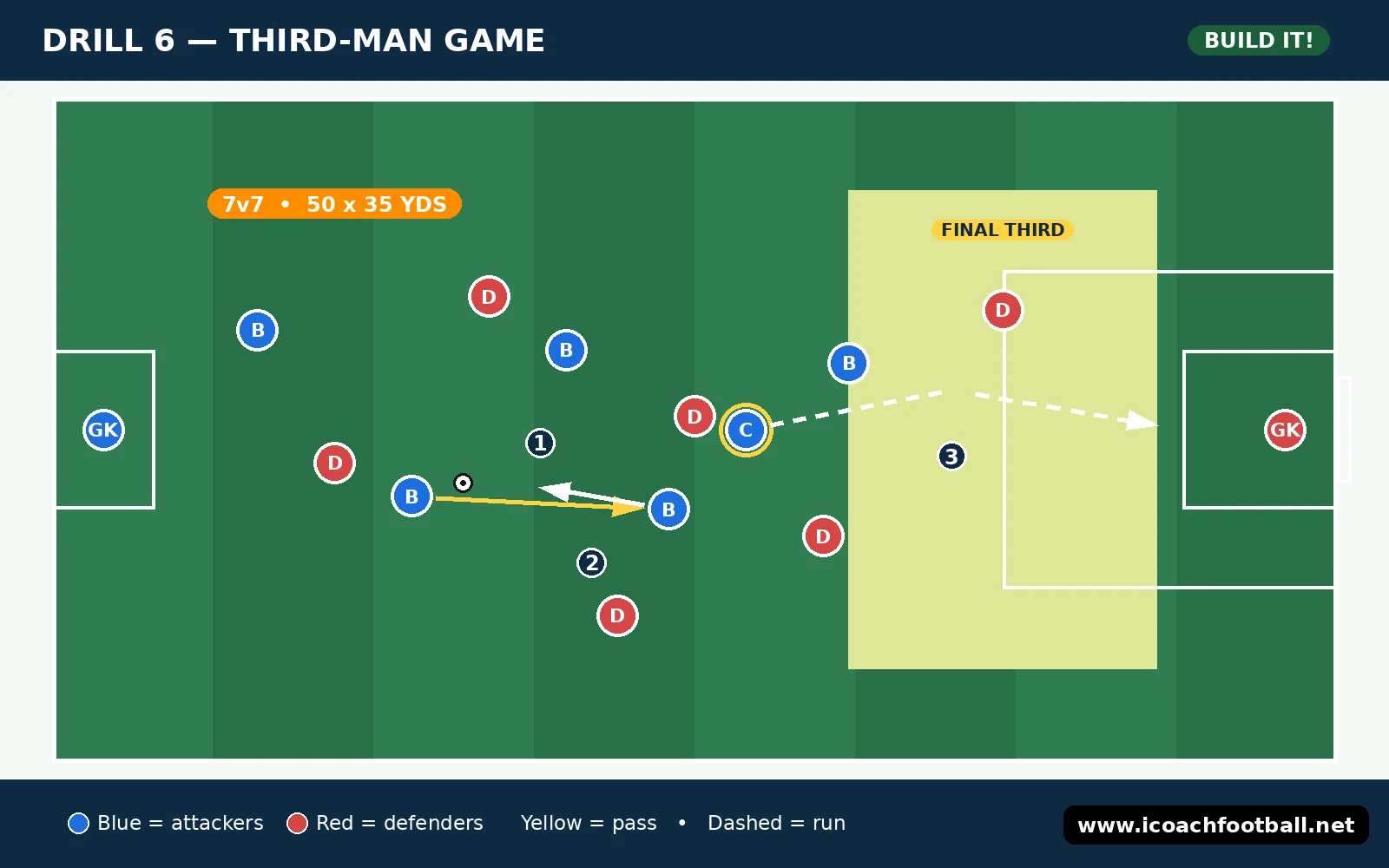
The conditioned game. Only goals created by a third man run count double, so teams must build the pattern under full pressure.
Setup:
- Area 50 x 35 yards, with a goal at each end, a goalkeeper in each goal, and a halfway line.
- Two teams of 7, with balls starting with the coach on the halfway line.
- A goal counts double only if the final pass goes to a third man running in behind.
How to Play:
- The coach plays the ball in, and teams keep possession with no touch limit.
- A team must complete an up-back-through before entering the final third to earn the double.
- A goal after a third man run scores 2 points, and any other goal scores 1 point.
- After a goal, the other team restarts from their goalkeeper, and play builds through the middle.
- Play four 4-minute blocks, keep a running score, and swap one winger and one midfielder every block.
Coach’s note: The cue is “Build it, don’t force it!” If a team launches long balls looking for a runner, freeze play. The third man run follows a lay-off, not a hopeful pass.
Progressions: The double only counts if the third man finishes first time, then the touch limit drops to two and the area narrows to 45 x 30 yards.
Coaching points
- “Run on the touch!” C moves as B touches the ball. A run started on the first pass arrives early and gets tracked.
- “Far shoulder!” The blindside run in Drill 3 stays on the defender’s far side. A run the defender can see is not a third man run.
- “Pass into the run!” The through pass in Drill 2 goes ahead of C, along the ground. A pass to feet stops the sprint.
- “Drop, lay, run!” In Drill 4, the forwards set each other up. The drop drags the line up, the lay-off releases the runner.
- “No runner, no point!” In Drill 5, safe sideways possession scores nothing. The constraint forces players to look for the run.
- “Build it, don’t force it!” In Drill 6, the pattern follows a lay-off. A long ball over the top is a different play, and the same patience is trained in these soccer passing drills.
Common mistakes
| Mistake | Fix |
|---|---|
| C runs on the first pass, too early | Drill 1 cue “Run on the touch!”; no rep counts if C moves before B’s touch |
| Lay-off is heavy or sideways | One-touch lay-off into A’s path in Drills 1–3; weight it like a pass, not a touch |
| Run is on the defender’s near shoulder | Drill 3 cue “Far shoulder!”; restart from the blindside starting cone |
| Through pass is played to feet | Drill 2 cue “Pass into the run!”; ball must meet C at full speed, ahead of the run |
| Team forces long balls in the game | Freeze Drill 6 and restart; the double only follows an up-back-through |
| B turns into pressure instead of laying back | If a defender steps up, B lays it back first time; turning is only for open space |
Age adaptations
| Age | Change |
|---|---|
| U12–U13 | Drills 1 and 2 only, unopposed, no live defender, and celebrate the timing before any finish |
| U14–U15 | Full six-drill menu with a passive presser in Drill 3 and runs from both sides in Drills 1–2 |
| U16–U17 | Live defender in Drill 3, one-touch limit in Drill 5, and the first-time finish rule in Drill 6 |
| U18 | Smaller areas in Drills 4–5, weaker-foot lay-offs demanded in Drills 1–2, and no coach call on the trigger |
60-minute session plan
Run the six games as one session with this 60-minute plan, or take any two games for a 20-minute block.
| Block | Time | Drill |
|---|---|---|
| 1 | 10 minutes | Drill 1 — Up-Back-Through in Threes |
| 2 | 10 minutes | Drill 2 — The FIFA Speed Circuit |
| 3 | 10 minutes | Drill 3 — Blindside Third-Man Run |
| 4 | 10 minutes | Drill 4 — Central Combination |
| 5 | 10 minutes | Drill 5 — Third-Man Rondo |
| 6 | 10 minutes | Drill 6 — Third-Man Game |
Once the timing is clean, use the overlap decision from these soccer overlap and underlap drills to teach the other blindside run: the third man and the overlap both arrive unseen, and the choice is which shoulder the defender has left open.
Sources
These soccer third man runs drills are based on, and in line with, the FIFA Training Centre session on combination play in the final third, which trains third-player runs, overlaps and up-back-throughs in groups of three, timed and coordinated runs off the ball, and quick combinations to penetrate a compact block, and with the FIFA Training Centre speed technical coordination circuit, in which a third player runs in behind from a deep position to finish, a long vertical combination turns forward to pass to a third player running in behind, and players are coached to play a quality pass into the path of the next player and to time their runs by scanning.
FAQ
What is a third man run in soccer?
It is a run by a third player, not the passer and not the receiver. The passer plays up to a teammate, that teammate lays the ball back first time, and the third player runs in behind — usually from the blindside — to receive the through pass in space.
When should the third man start the run?
On the lay-off player’s touch, not on the first pass. A run started on the first pass arrives too early and gets tracked. The lay-off drags a defender toward the ball, and the run goes into the space that defender just left.
What is the difference between a third man run and an overlap?
An overlap runs wide, around the outside of a teammate. A third man run usually runs centrally or blindside, in behind, after a lay-off. Both arrive unseen, but the third man run is triggered by the up-back-through, while the overlap is triggered by a teammate carrying the ball wide.
Can third man runs work for youth teams?
Yes, from U12 with the unopposed pattern in Drill 1 and no live defender. Young players learn the timing first — run on the touch, far shoulder — and only meet a live presser in Drill 3 once the shape is automatic. The same games work in football at every age, because the trigger does not change.
Why do third man runs fail in games?
Three reasons cover most failures: the run starts too early, the lay-off is too heavy, or the through pass goes to feet instead of into space. Fix them in that order with Drills 1, 3 and 2, and only then demand the pattern in the conditioned game in Drill 6.