Soccer Drills for Boys: 6 Games That Build Speed, Strength and Smart 1v1 Play
Quick answer
Boys’ teams live on duels. Every loose ball, every shoulder battle, every 1v1 is a contest — and the team that wins its duels usually wins the game. These six games train exactly that: speed to the ball, strength to shield it, and the smart decision after winning it — in one 60-minute session.
Suitable for: U10–U15 (ages 9–15)
Session snapshot
- Players: 12–16 (one boys’ squad)
- Area: 30 x 20 yards (half pitch for Drill 6)
- Duration: 60 minutes
- Focus: Speed, shielding, second balls, overlaps, recovery runs, duels
- Equipment: 12 balls, 20 cones, 4 mini goals, 2 full goals, bibs
Why these six games work
In the UK the same session is football drills for boys, and the coaching problem is the same on both sides of the Atlantic: between 9 and 15, boys grow at wildly different rates. One boy is six inches taller than his team-mates; another has not started growing yet. If every drill rewards size, the big boy wins everything and the late developer stops trying. So these six games reward quick feet, quick decisions and clean physicality — not size. The duel work follows the pattern FIFA’s Talent Coach programme sets out for individual defending: apply pressure fast, delay the attacker once close, force them onto their weaker foot, stay on your feet, and only step across when the moment is right — direct, delay, deny. The attacking side follows England Football Learning’s 1v1 session: beat your opponent, get into the final third, and score — then repeat. Nothing here is a tackle drill. Tackling is taught in our soccer tackling drills; this session is about everything around the tackle: getting there first, shielding the ball, winning the second ball, and recovering when beaten.
Duel-ready warm-up: 5 minutes
Before the first drill, run this — it prepares the body for contact without a single tackle. Coach one cue per move and nothing else.
- Jog and turn. Jog across the area; on “turn”, spin 180 degrees and jog back. Two minutes.
- Shoulder-to-shoulder pairs. In pairs, jog side by side and lean shoulder to shoulder — gentle contact, both players stay on their feet. One minute.
- Shield and spin. One ball per pair. The attacker shields the ball with their body; the partner leans in lightly. On “spin”, the attacker turns out and dribbles away. Two minutes.
Six rules of coaching boys
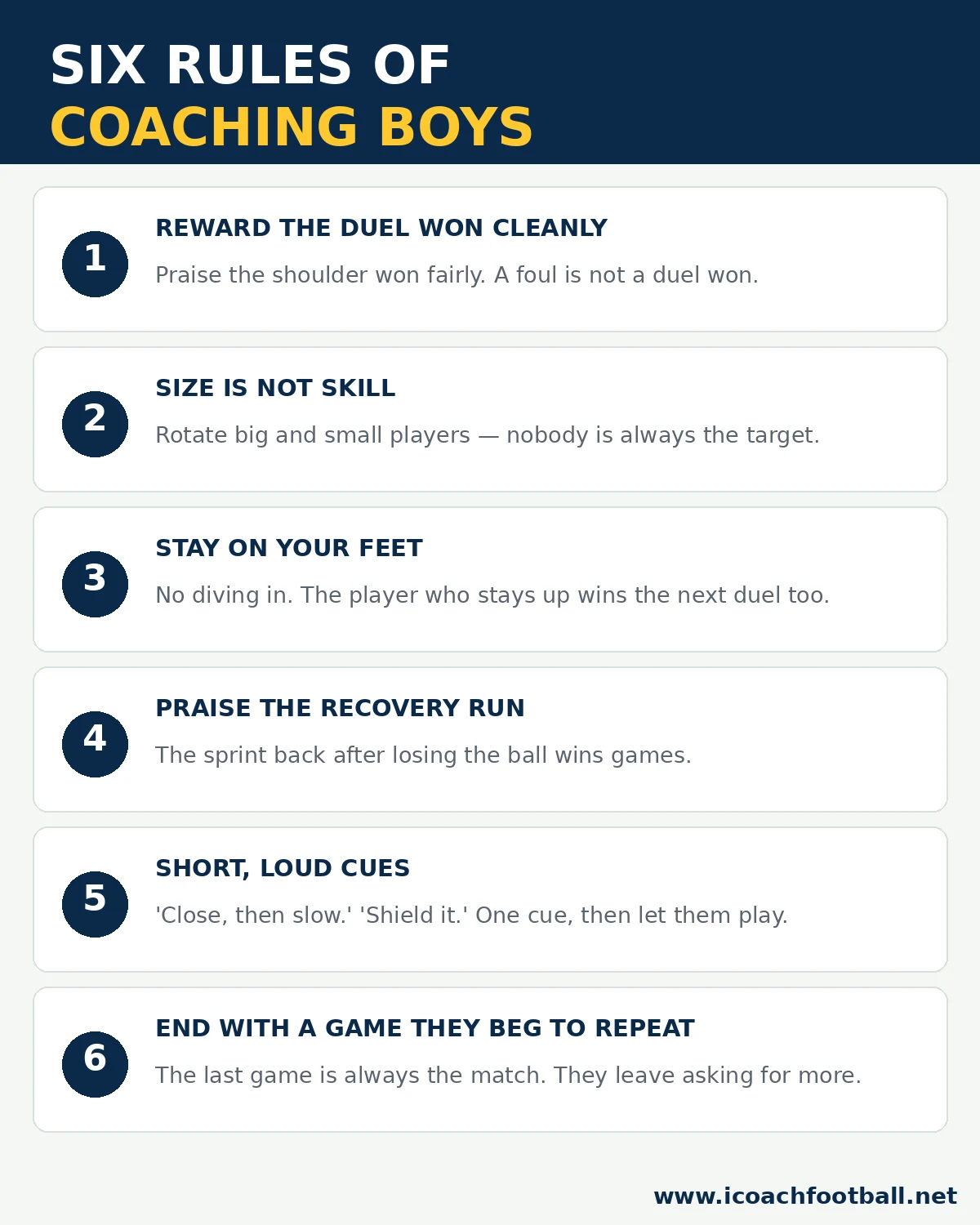
- Reward the duel won cleanly, not the foul. Praise the shoulder won fairly and the ball won on your feet. A foul is not a duel won.
- Size is not skill. Rotate the big and small players so nobody is always the target. The small player who beats the big one learns the most.
- Stay on your feet. No diving in. The player who stays up wins the next duel too.
- Praise the recovery run as loud as the goal. The sprint back after losing the ball is the habit that wins games.
- Short, loud cues. “Close, then slow.” “Shield it.” “First to it.” One cue, then let them play.
- End with a game they beg to repeat. The last game is always the match. They leave asking for more.
Drill 1 — Speed Gate Relay
Two teams race through the gates, ball at feet. The first game of the session, and the one that sets the tone: everything today is a race to the ball, and the fastest feet win.
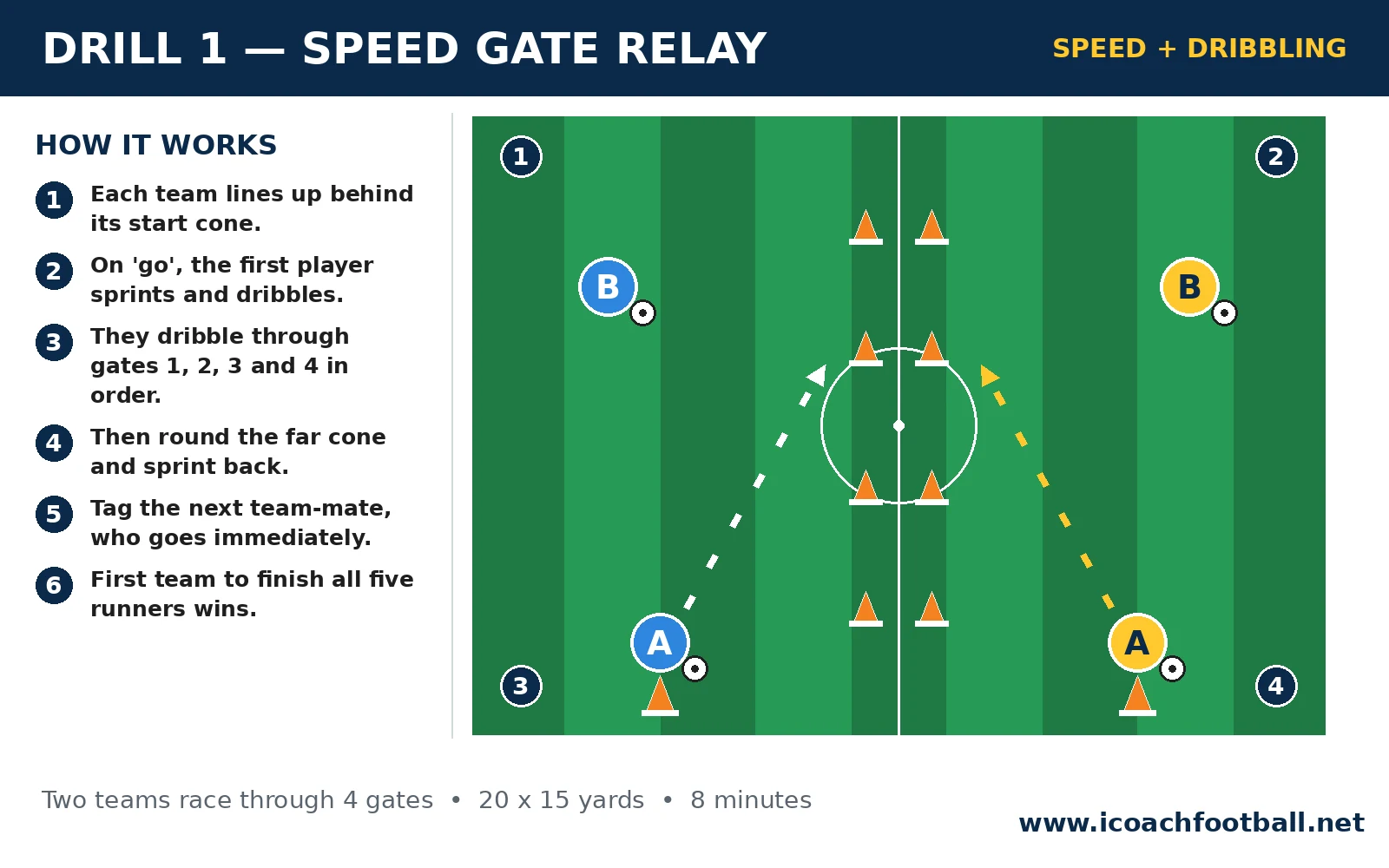
- Setup: 20 x 15 yard area. 4 gates (two cones, 2 yards apart) in a line down the middle. Two teams of 5, one ball per player. 8 minutes.
How to play:
- Each team lines up behind its own start cone at one end.
- On “go”, the first player in each team sprints and dribbles through gate 1.
- They dribble through gates 2, 3 and 4 in order, then round the far cone.
- They sprint back and tag the next team-mate, who goes immediately.
- A gate missed costs 5 seconds — the team must go back and do it properly.
- First team to finish all five runners wins — then run it again, gates moved.
- Coach’s note: “Small touches through the gates — big touches and the ball runs away from you.”
- Progressions: Gates get narrower; players must use their weak foot only; the last gate is a 1v1 against a defender.
Drill 2 — Shield and Turn
Receive with your back to goal, shield the ball with your body, turn out and play. The physical skill every boys’ striker and midfielder needs — and the one that does not depend on being the biggest player on the pitch.
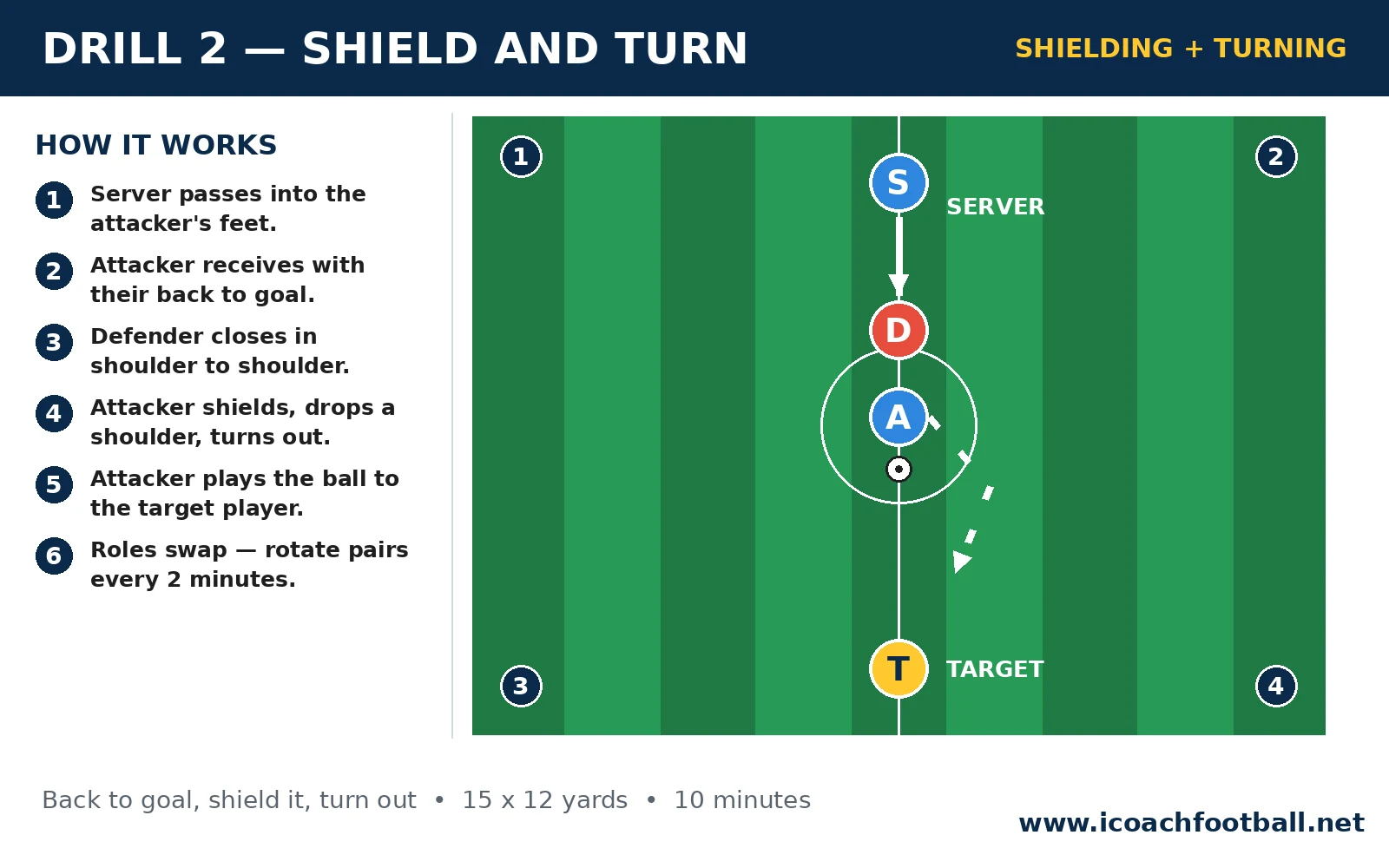
- Setup: 15 x 12 yard area. A server at one end, a target player at the other. Pairs: one attacker, one defender. 10 minutes.
How to play:
- The server passes into the attacker’s feet, who receives with their back to goal.
- The defender closes in and leans in shoulder to shoulder — no tackling yet.
- The attacker shields the ball, drops a shoulder and turns out.
- The attacker plays the ball to the target player at the far end.
- If the defender wins it, they become the attacker and the roles swap.
- After 2 minutes, rotate pairs so everyone defends the strongest player once.
- Coach’s note: “Get your body between the ball and the defender — the ball is behind you, the defender is in front of you.”
- Progressions: The defender may tackle after 3 seconds; the target moves to a different corner; two defenders press at once.
Drill 3 — First to the Second Ball
The coach serves a loose ball and two players race for it. The winner finishes. The game that teaches the single most valuable habit in boys’ football: the first five yards after the ball breaks loose decide everything.
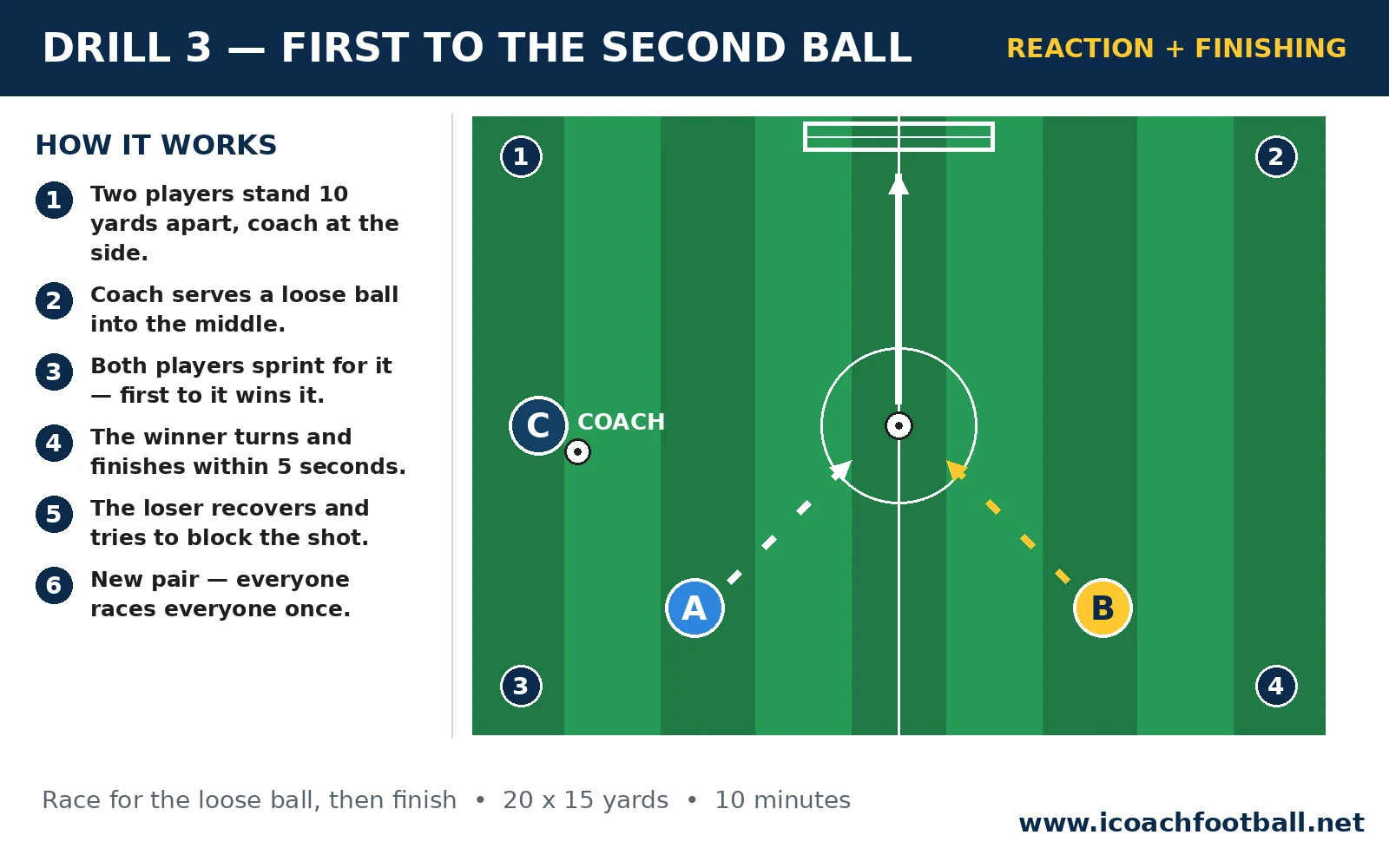
- Setup: 20 x 15 yard area. One mini goal at one end, coach at the side with balls. Pairs facing each other, 10 yards apart. 10 minutes.
How to play:
- Two players stand 10 yards apart, the coach at the side with the balls.
- The coach serves a loose ball into the middle — a bounce, a roll, a high ball.
- Both players sprint for it. First to the ball wins it.
- The winner turns and finishes at the mini goal within 5 seconds.
- The loser must recover and try to block the shot.
- After each rep, new pair — everyone races everyone once.
- Coach’s note: “First to it wins it. The sprint starts before the ball arrives — watch the coach, not the ball.”
- Progressions: Serve the ball further away; the loser becomes a second defender; the winner must score with their weak foot.
Drill 4 — Overlap and Cutback
The winger drives at the full-back, the full-back overlaps, and the cutback finds the striker at the penalty spot. The wide-play pattern that turns speed into goals — and the overlap our soccer drills for wing backs train in detail.
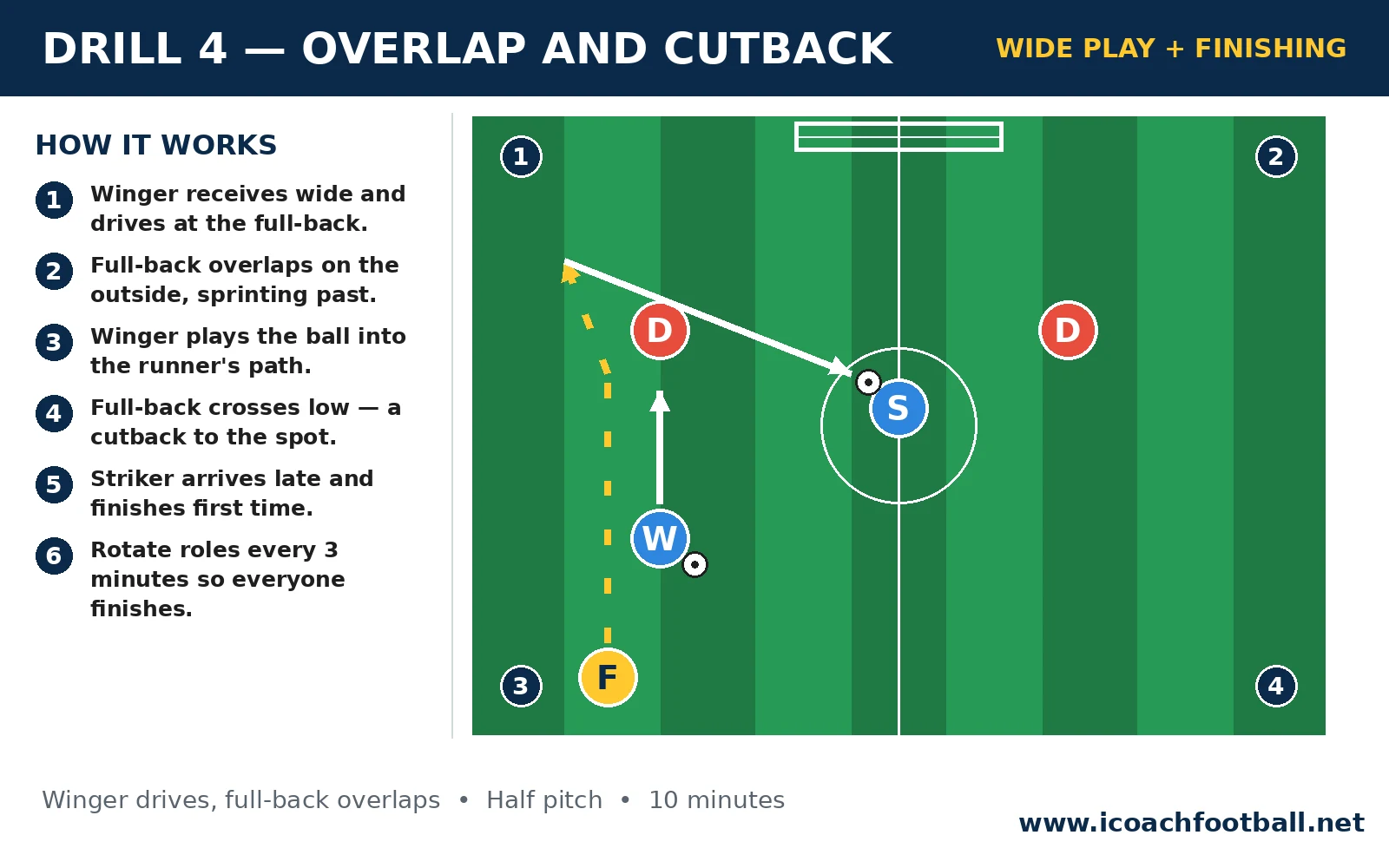
- Setup: Half pitch, one full goal. Winger wide, full-back behind, striker at the penalty spot. 10 minutes.
How to play:
- The winger receives wide and drives at the full-back.
- The full-back overlaps on the outside, sprinting past the winger.
- The winger plays the ball into the full-back’s path.
- The full-back crosses low — a cutback — to the penalty spot.
- The striker arrives late and finishes first time.
- Rotate roles every 3 minutes so every player overlaps, crosses and finishes.
- Coach’s note: “The overlap only works if the winger waits — release the ball when the runner is past you, not before.”
- Progressions: Add a recovering defender who chases the overlap; the cutback must go to the back post; the winger may cut inside and shoot instead.
Drill 5 — Recovery Race
The attacker starts five yards ahead with the ball. The defender sprints back, gets goal-side, and stops the shot. The drill that teaches the run boys hate most — and the one that saves the most goals.
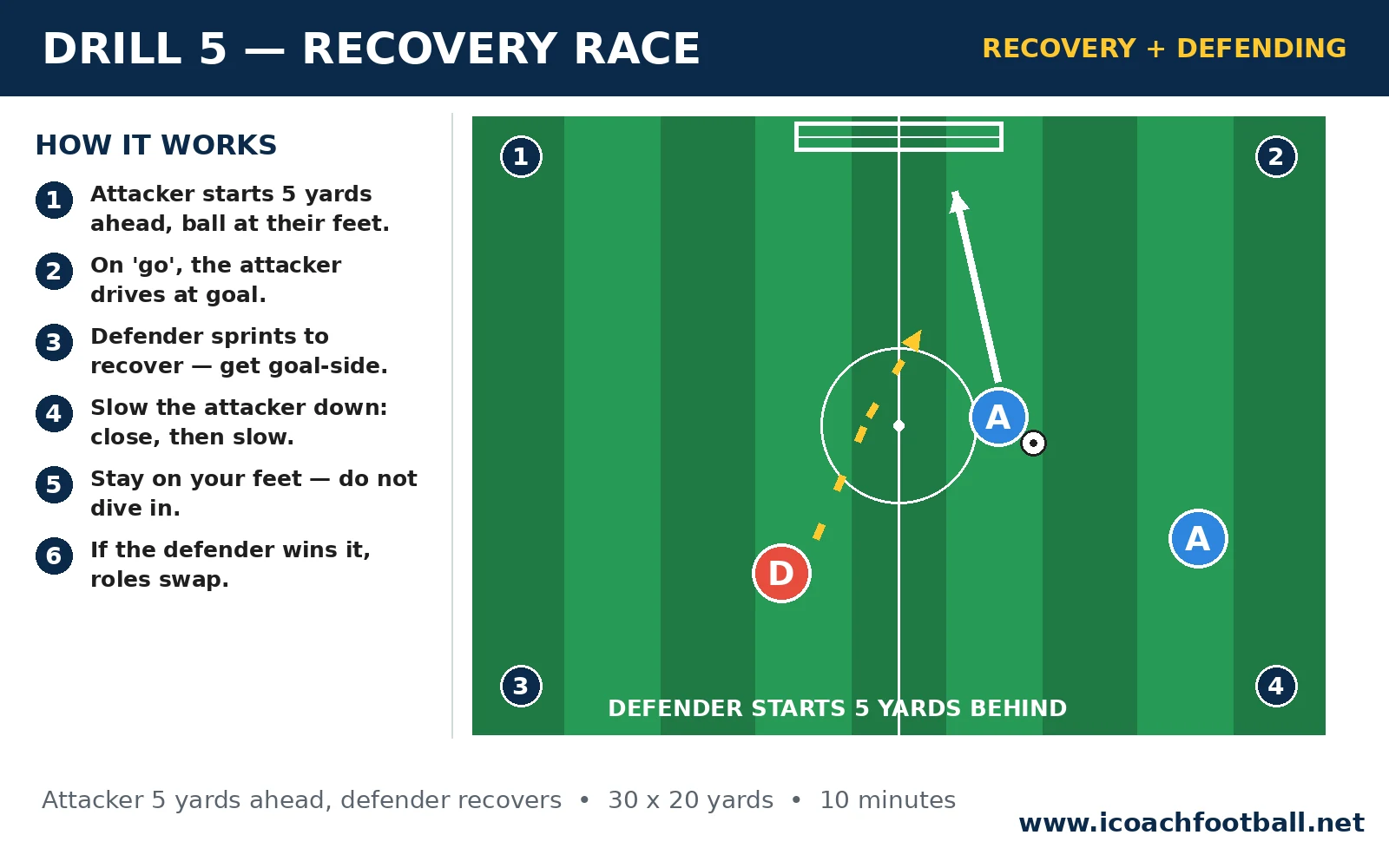
- Setup: 30 x 20 yard area. One full goal at one end. Attacker 5 yards ahead of the defender, ball at the attacker’s feet. 10 minutes.
How to play:
- The attacker starts 5 yards ahead of the defender, ball at their feet.
- On “go”, the attacker drives at goal and the defender sprints to recover.
- The defender must get goal-side — between the attacker and the goal.
- The defender slows the attacker down: close, then slow, stay on your feet.
- If the defender wins it, they play out to the coach and the roles swap.
- After 2 minutes, swap sides so the recovery run comes from the other flank.
- Coach’s note: “Do not chase the ball — chase the goal side. Get between the attacker and the goal, then slow them down.”
- Progressions: The attacker starts 10 yards ahead; a second attacker joins for a 2v1; the defender must win it within 8 seconds.
Drill 6 — The Duel Match 5v5
Five against five, but every duel counts. A duel won is a point; a goal is two. The match-real finish: the game where the scoreboard rewards exactly what the session taught.
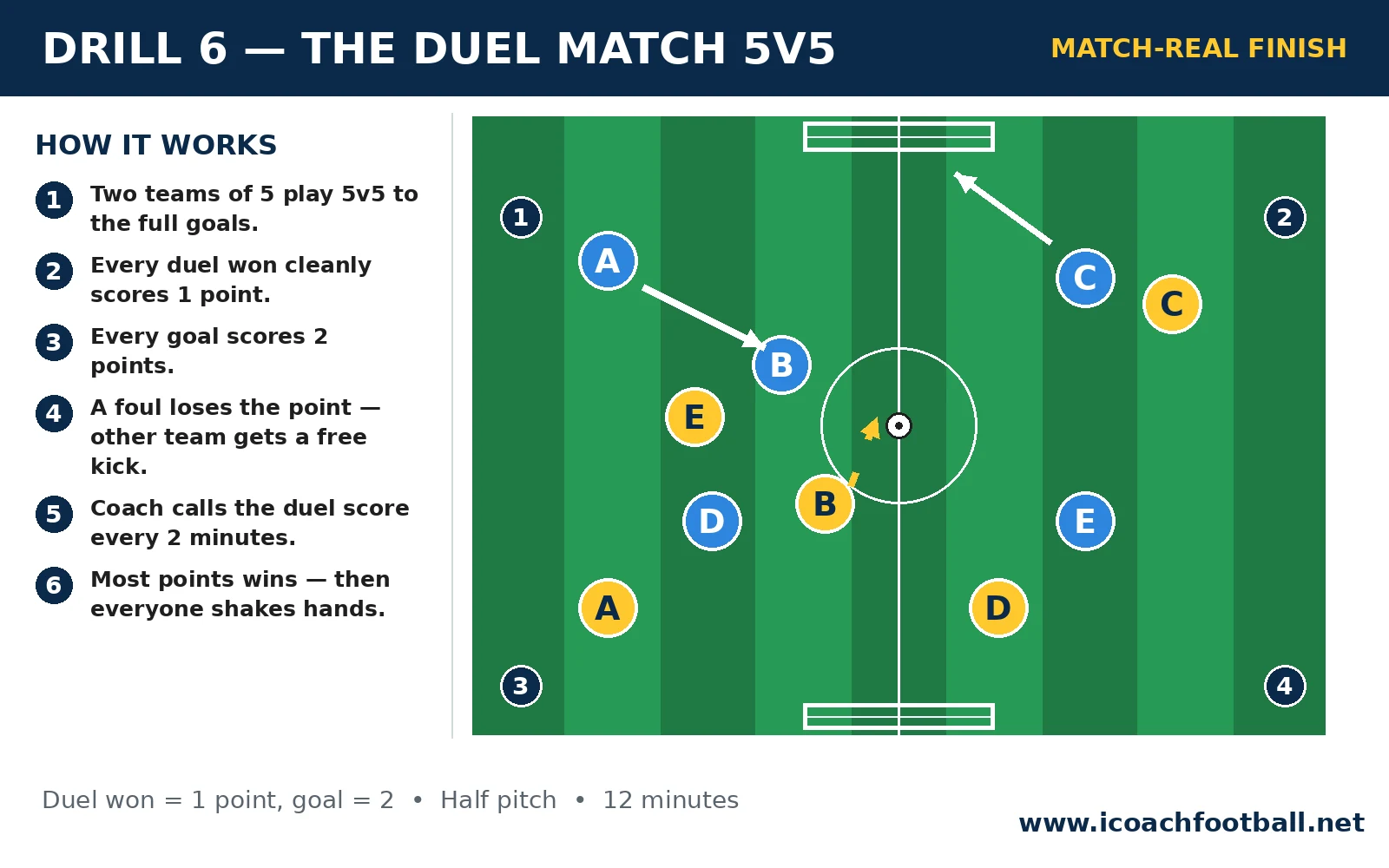
- Setup: Half pitch, full goal at each end. Two teams of 5. Coach with the balls at the side. 12 minutes.
How to play:
- Two teams of 5 play 5v5 to the full goals, no restrictions.
- Every duel won cleanly scores 1 point for that player’s team.
- Every goal scores 2 points — so a goal is worth two duels.
- A foul loses the point and gives the other team a free kick.
- The coach calls out the duel score every 2 minutes so the players hear it.
- The team with the most points wins — then everyone shakes hands.
- Coach’s note: “Win the duel, then play. The point is for the duel — the goal is the reward for what comes after.”
- Progressions: Duels won in the final third count double; goals after a duel won count 3; the losing team picks the next drill.
Coaching points: the five mistakes that lose boys’ teams
| Mistake | What you see | Fix |
|---|---|---|
| Coaching the biggest boy as the team | Every ball goes to the early developer | Rotate the target player; reward the small player who beats the big one |
| Letting every duel become a foul | Shoving, shirt-pulling, diving in | Stop the drill, name the foul, restart — a foul is not a duel won |
| No recovery runs | Players watch after losing the ball | Praise the recovery run as loud as the goal; Drill 5 every week |
| Long talks, short play | Eyes glaze over, feet stop moving | One cue, one demo, then play — talk while they run, not while they stand |
| Playing the same 11 | Late developers never get a game | Rotate everyone through every position in training; the duel match scores duels, not just goals |
Age adaptations
| Age | Ball | Area | What changes |
|---|---|---|---|
| U10–U11 (ages 9–10) | Size 4 | 20 x 15-yard grids | No tackling in Drill 2 — shielding only; Drill 3 runs from 5 yards, not 10; Drill 6 runs 4v4 with duels counted by the coach, not the players |
| U12–U13 (ages 11–13) | Size 4 | 25 x 20-yard grids | All six games as written; Drill 2 adds the 3-second tackle; Drill 5 adds the second attacker — see our U13 soccer practice plan for the next step |
| U14–U15 (ages 14–15) | Size 5 | 30 x 20-yard grids | Full contact in Drills 2 and 5; Drill 4 runs at match speed with a recovering defender; Drill 6 duels in the final third count double — see our soccer drills for U15 for the next step |
60-minute session plan
| Time | Block | Drill |
|---|---|---|
| 0:00–0:05 | Warm-up | Duel-ready warm-up |
| 0:05–0:13 | Speed | Drill 1 — Speed Gate Relay |
| 0:13–0:23 | Shielding | Drill 2 — Shield and Turn |
| 0:23–0:33 | Second balls | Drill 3 — First to the Second Ball |
| 0:33–0:43 | Wide play | Drill 4 — Overlap and Cutback |
| 0:43–0:53 | Recovery | Drill 5 — Recovery Race |
| 0:53–1:00 | Match-real finish | Drill 6 — The Duel Match 5v5 (shortened) |
New to coaching this age? Stretch the warm-up to 8 minutes and cut Drill 4 to 7 minutes and you have the same session with more settling-in time — see our 60-minute plan for the structure (the same shape, shortened for U10).
Keep building from here
These six games are the start, not the whole curriculum. The girls’ version of this session is our soccer drills for girls — the drills are the same, the coaching emphasis changes. The school version is our soccer drills for middle school players, and younger boys start with our soccer drills for elementary school and our soccer drills for 5 year olds. Tackling itself is taught properly in our soccer tackling drills, and the jockeying shape that makes Drill 5 work is trained in our 1v1 defending drills jockeying — the pair work that follows is our soccer defending 2v1 drills. Wide play continues in our soccer drills for wing backs and our soccer drills for fullbacks, and the finishers in Drill 4 grow into our soccer drills for strikers and our soccer drills for midfielders. Build the individual skills next: soccer dribbling drills for the close control Drills 1 and 2 need, soccer passing drills for the weight and accuracy Drill 4 needs, and weak foot soccer drills so both feet can play the relay. Pairs work is the next step up from duels: soccer drills for two players run the same skills in pairs, soccer drills for 3 players no goalie adds a third runner, and soccer 3v3 drills and soccer 4v4 drills run the same combinations in bigger games. New to coaching? Start with soccer drills for beginners, and when they are older, the road runs through our U10 soccer practice plan, our U13 soccer practice plan and our soccer drills for U15. Protect the players as they grow: our soccer injury prevention guide and our youth soccer fitness testing show how to measure progress without maximal testing at U12 and under, and our 10 soccer warm-up drills give you the full warm-up library. When they are older, the road runs through our football defensive transition drills — and if you run selections one day, our soccer tryout drills show how to grade a group fairly.
FAQ
Do boys need different drills than girls?
No. The drills are the same — dribbling, passing, 1v1s and finishing work for every player. What changes is the coaching around them: boys’ sessions need more structure around physical duels, because boys grow at wildly different rates between 9 and 15 and the early developer can dominate every drill. In the UK the same session is football drills for boys — the drills and the coaching problem are identical.
At what age can boys start tackling?
Shielding and shoulder-to-shoulder contact can start at U9–U10, with no diving in. The block tackle itself is best taught from U10, when players can hold their shape — our soccer tackling drills teach it step by step. Before that, teach the jockey: close the space, slow down, stay on your feet.
How do you coach a boys’ team with big size differences?
Rotate the target player, reward technique over size, and score duels as well as goals — the small player who beats the big one should hear the loudest praise. Run drills where quick feet decide the outcome, not shoulder power. And never pick a team on size alone: the late developer at 12 is often the best player at 16.
How long should a soccer practice be for a 10-year-old?
Sixty minutes, twice a week, with each game lasting 8–10 minutes. A 10-year-old’s attention span is about one game long, so change the game before they get bored — and stop the session while it is still fun, not when they are tired and fouling.
How do you stop a boys’ session turning into a foul-fest?
Name the foul the moment it happens, stop the drill, and restart — no shouting, no lecture. Score duels won cleanly and take the point away for a foul, so the players police it themselves. The fastest fix is Drill 5: a defender who has to recover goal-side cannot afford to dive in.
Sources
- FIFA Training Centre, FIFA Talent Coach Conor Marlin, “Building the foundations of collective defending”, Talent Coach Programme — individual defending begins with the direct, delay and deny principles: apply immediate pressure, delay the attacker once close, force attackers onto their weaker foot, stay on your feet as long as possible, and step across using hips and arms to force the attacker off the ball. https://www.fifatrainingcentre.com/en/practice/talent-coach-programme/zonal-defending/zonal-defending-1.php
- England Football Learning, The FA, “Moving with the ball session: 1v1” — beat your direct opponent, get into the final third and score, then repeat; players find a new opponent every two minutes. https://learn.englandfootball.com/sessions/resources/2022/Moving-with-the-ball-session-1v1