Soccer Corner Kick Plays: 6 Routines for Youth Teams

Quick answer: Pick three corner routines, give each one signal, and practise them until the runs happen without thinking. Start with the near-post flick, the far-post late run and one short corner. Delivery and timing decide more corners than cleverness does.
Most youth corners fail before the ball is kicked. Players stand still in the box, the taker hits a hopeful cross, and the tallest defender heads it clear. A corner is not a cross and a hope. It is a rehearsed run, a delivery to a named spot, and a second ball already planned.
These six soccer corner kick plays give a youth team a complete corner menu: two direct deliveries, one short corner, one second-ball shot and one crowded-box routine, plus a live game that tests them under pressure. The same plays work in football anywhere, because the box, the distances and the timing do not change. Every play states the signal, the starting spots and the delivery, so a coach can run it from the diagram and steps alone.
- Players: 12–16 (taker, 6 attackers, 4–6 defenders, 1 goalkeeper; Play 6 uses 8v7 plus goalkeepers)
- Area: One penalty area and corner arc; full half for Play 6
- Duration: 60 minutes (45-minute version: Plays 1, 3 and 6 only)
- Focus: Delivery zones, timed runs, signals, second balls, defending the first contact
- Equipment: 8–10 balls, 12 cones, bibs, 1 full-size or age-appropriate goal
- Age: U10–U16 (heading only from U12, limited — see age adaptations)
| Time | Activity | Main objective |
|---|---|---|
| 0–8 min | Delivery practice | Hit near-post, far-post and penalty-spot zones on demand |
| 8–18 min | Plays 1–2 | Timed runs to the near and far posts |
| 18–28 min | Plays 3–4 | Short corner and edge-of-the-box shot |
| 28–38 min | Play 5 | Crowded-box routine against defenders |
| 38–55 min | Play 6 | Live corner game, all routines by signal |
| 55–60 min | Reset and repeat | Best routine, both sides, no defenders first |
Organise every corner before the kick
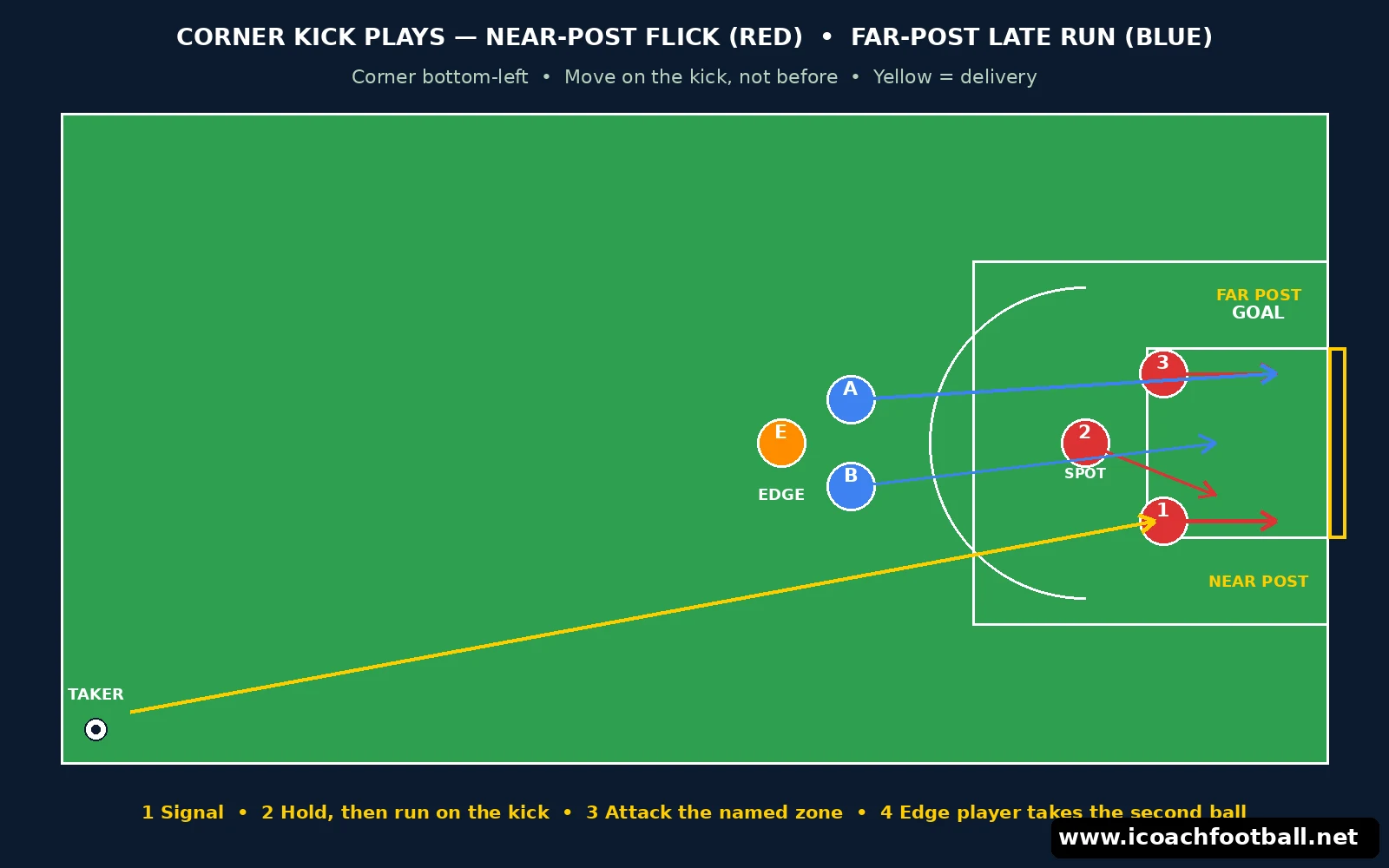
- Signals: One hand up means near post. Two hands up means far post. Arm raised, then dropped, means short corner. The taker signals while walking to the corner, then signals again just before the kick.
- Roles: Name one taker for each side, one player for each zone (near post, penalty spot, far post, edge of the box) and one player to stay back for the counter-attack. Roles stay the same on both corners so players organise in seconds.
- Zones: Near post is the 6-yard line at the front post. Penalty spot is 12 yards out. Far post is the back post. Edge of the box is the D, 18 yards out.
- Law 17 basics: The ball must be in the corner arc and stationary. Opponents must stay at least 9.15 metres (10 yards) from the arc until the ball is in play. A player who receives the ball directly from a corner cannot be offside. These points follow IFAB Law 17, linked at the end of this post.
- Cue: “Move on the kick, not before!” Early runs are easy to mark. Late runs arrive free.
Play 1 — Near-Post Flick
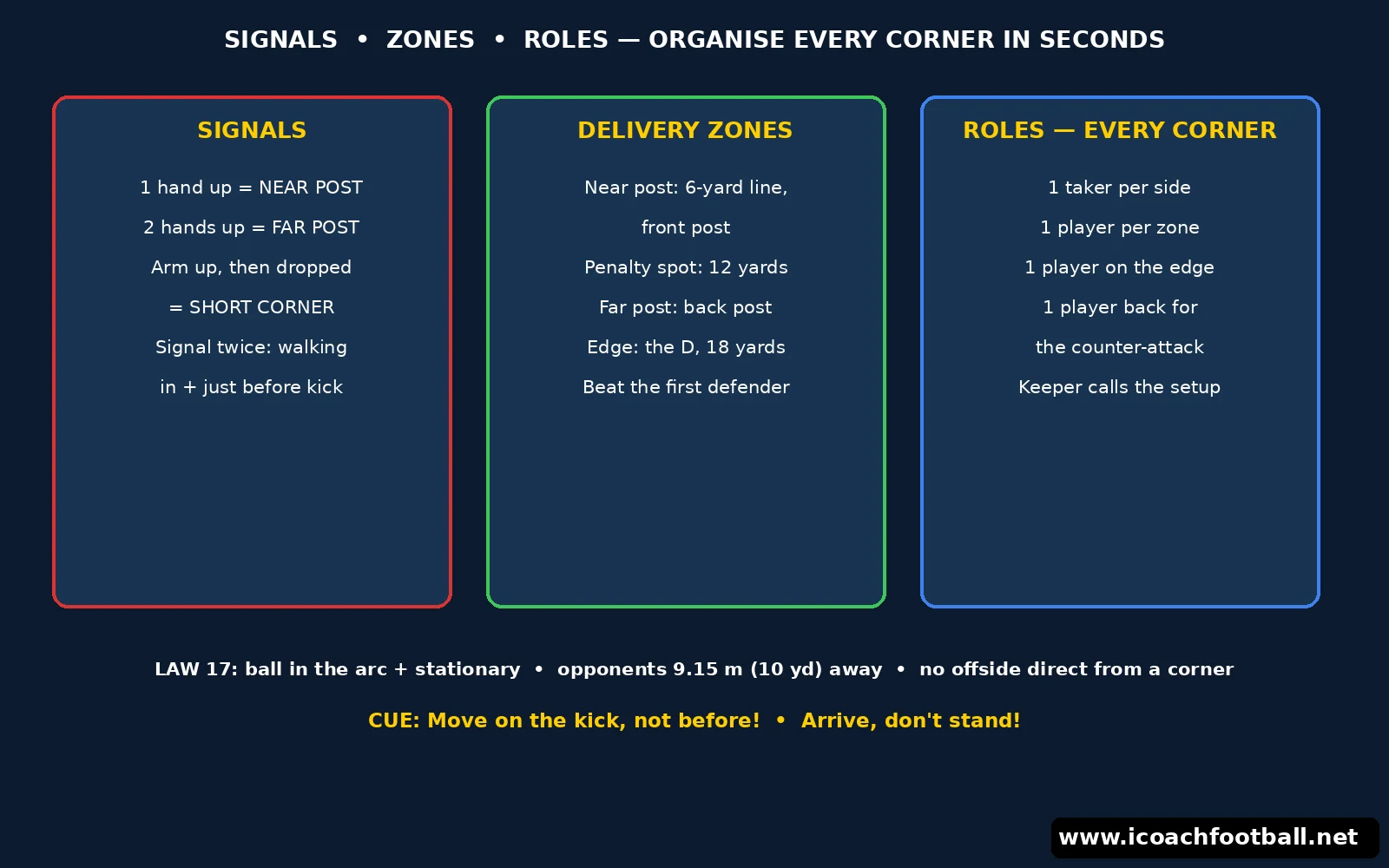
The fastest youth corner. A driven ball to the front post, flicked on for runners behind it.
- Taker at the corner.
- Flick player on the 6-yard line, 2 yards from the near post.
- Penalty-spot runner on the spot.
- Far-post player at the back post.
- Edge player on the D.
- Two defenders and a goalkeeper in practice.
- The taker raises one hand, then starts the run-up.
- The flick player steps to the near post as the taker approaches the ball.
- The taker drives the ball waist-high to the near post, beating the first defender.
- The flick player glances it on across goal with the head (U12+) or the inside of the foot.
- The penalty-spot and far-post runners attack the flick; the edge player holds for the clearance.
Coach’s note: If the delivery floats, the routine is dead. Demand pace: the ball must reach the near post before the defender can step out. The cue is “Hit it hard, hit it early!”
Progressions: Add a defender on the near post, then switch the delivery between an inswinger and an outswinger on the same signal.
Play 2 — Far-Post Late Run
The answer to a team that packs the near post. Two runners start deep and arrive late, when markers have stopped watching.
- Two late runners start on the edge of the box, level with the penalty spot.
- One near-post player holds the front post.
- One penalty-spot player starts on the spot.
- Taker at the corner, with a goalkeeper and four defenders in practice.
- The taker raises two hands for the far-post delivery.
- The late runners hold their start spots and make small side-to-side movements.
- The taker delivers a high ball to the far post as the runners start.
- The first runner attacks the far post for a header or volley; the second runner attacks the ball if it drops.
- The near-post player moves off the post to the 6-yard line for the knock-down.
Coach’s note: The run starts when the taker strikes the ball, not when the signal goes up. Late beats tall. Shout “Arrive, don’t stand!” until runners stop arriving early and waiting.
Progressions: The second runner peels to the penalty spot instead, for a cut-back header or first-time volley. The delivery skills here build on our crossing and finishing work in the wide channel game.
Play 3 — Short Corner and Cut-Back
The best corner against a team that leaves only one defender out. Play short, draw defenders out, then cut the ball back across goal.
- Taker at the corner.
- Short option 8 yards from the corner, on the goal line side.
- One runner on the penalty spot, one at the far post, one on the edge of the D.
- Two defenders out, rest in the box.
- The taker raises an arm, then drops it to signal the short corner.
- The short option shows for the ball and receives the pass to feet.
- The taker overlaps down the goal line and takes the return pass.
- The taker drives a low ball across the face of goal, or cuts it back to the penalty spot.
- The penalty-spot runner meets the cut-back first time; the far-post runner attacks the low cross.


Coach’s note: Play short only if one defender comes out. If two defenders come out, the taker goes direct to the box instead — that is the decision the taker must make before the kick.
Progressions: The short option dummies the return and lets it run to a third player arriving on the edge of the box for a shot.
Play 4 — Edge-of-the-Box Flood
Four runners flood the box and drag their markers with them. The shot comes from the player nobody followed.
- Four runners start together on the edge of the box, facing goal.
- Shooter starts 3 yards behind them, on the D.
- One near-post player holds the front post.
- Taker at the corner.
- The taker signals the flood with both hands held wide, then starts the run-up.
- All four runners sprint into the box together, to the near post, spot and far post.
- The shooter peels off behind the runners and stays on the edge of the D.
- The taker plays the ball low to the D, behind the flooding runners.
- The shooter strikes first time, low and hard, keeping the body over the ball.
Coach’s note: The runners must run hard even though the ball is not coming to them. If they jog, their markers stay and the shooter is marked. The cue is “Run like it is yours!”
Progressions: The first shooter steps over the ball and a second player, arriving from deeper, strikes it instead.
Play 5 — Penalty-Spot Crowd (the Split)
A crowded start that splits on the delivery, so markers cannot pick up a runner until it is too late.
- Four attackers stand in a tight group just behind the penalty spot, facing goal.
- One player starts in the 6-yard box.
- Two players wait outside the D.
- Taker at the corner, goalkeeper and five defenders in practice.
- The group makes small movements — a step left, a step right — so no marker can settle.
- The 6-yard player drifts towards the far post, taking a defender with them.
- The taker delivers to the penalty spot as the group splits.
- One player runs to the near post, one stays on the spot, and two run to the far post.
- The spot player attacks the ball first time; the far-post runners attack the ball if it goes through.
Coach’s note: No holding, pushing or blocking. Separation comes from movement and timing, not from fouls. If a player is held, the routine still works — the free runner is the one the defence forgot.
Progressions: Keep the same start and vary the delivery: near post one time, far post the next. The defence cannot read the routine from the setup.
Play 6 — The Corner Game
Live corners, both sides, with points for routines, second balls and clean clearances. This is where the first five plays are tested.
- 8 attackers against 7 defenders plus a goalkeeper, in and around one penalty area.
- Balls at both corners.
- Two mini-goals or cone goals on the halfway line for defender counter-attacks.
- Corners alternate sides; the attacking team calls the play by signal before each corner.
- The defence uses a mix of marking: one player on each post, the rest man-to-man, with the goalkeeper calling the setup.
- If the ball is cleared, play stays live until a goal, a second clearance or the ball leaves play.
- A goal from the called routine scores 3 points; a second-ball goal scores 2; a clean clearance scores 1 for the defence.
- After 6 corners, swap the teams and repeat from the other side.
Coach’s note: Stop after three corners and reset the organisation. Most live-corner chaos comes from players forgetting their zone, not from the routine itself. Defending corners is a skill too — our 1v1 defending drills teach the jockeying and body shape defenders need when the ball drops in the box.
Progressions: Defenders who win the ball can counter-attack into a mini-goal for 2 points, so attackers must keep one player back at all times.
Coaching points that decide corners
- Delivery first. A routine with a poor delivery is a wasted corner. Practise delivery alone for 8 minutes before any routine.
- One signal, one routine. If players are guessing, the signal is not clear enough. Simplify to three signals and no more.
- Attack the ball. The player who moves to the ball wins the header. The player who waits for it loses it.
- Second ball is a play, not luck. Always leave one player on the edge of the box, facing play, for the clearance.
- Stay back. Always leave one player level with the halfway line. A corner conceded on the counter-attack is the worst corner of all.
Common mistakes — and the fix
- Standing still in the box. Fix: no standing starts — every attacker starts outside the 6-yard box and runs in on the kick.
- Running too early. Fix: runners move only when the taker starts the run-up; freeze any runner who moves on the signal.
- Floating deliveries. Fix: delivery targets on the ground — a cone at the near post, spot and far post — and points only for balls that beat the first defender.
- Everyone in the box. Fix: one player on the edge and one back, every corner, no exceptions. Count them before the kick.
- No second-ball plan. Fix: Play 6 scoring — second-ball goals count, so players learn to stay alive after the clearance.
Age adaptations
- U10: Short corners and low deliveries only, finished with the feet. No heading. Use 7v7 goals and a smaller box so distances stay realistic.
- U11–U12: Near-post and far-post routines with the feet first. Introduce limited heading only from U12, with a lightweight ball and few repetitions, in line with the heading safety guidance in our near-post run heading drill.
- U13–U14: Full six-play menu, both sides, with defenders and the live corner game. Add inswinger and outswinger choice for the taker.
- U15–U16: Add the crowd routine against a full defence, vary signals mid-game, and let the taker choose the routine from the defensive setup rather than a fixed order.
A 45-minute session plan
| Time | Activity | Main objective |
|---|---|---|
| 0–8 min | Delivery practice | Hit all three zones on demand |
| 8–20 min | Play 1 and Play 3 | Near-post flick and short corner |
| 20–32 min | Play 2 and Play 4 | Far-post run and edge shot |
| 32–45 min | Play 6 | Live corner game, both sides |
FAQ
How many corner routines should a youth team have?
Three is enough to start: one near-post, one far-post and one short corner. Add a fourth only when all three work without thinking, under pressure, from both sides.
Should youth teams take short corners or cross every corner?
Cross most corners, and keep the short corner as a change-up. Play short when only one defender comes out, or when the box is packed and a cross has no space to land.
What is the best delivery for a youth corner?
A driven ball that beats the first defender and lands in a named zone — near post, penalty spot or far post. Height matters less than pace and placement, and the delivery must be the same every time so runners can time it.
How do you defend corners with a youth team?
Put one player on each post, mark man-to-man in the box, leave one player on the edge for the second ball and one back for the counter. The goalkeeper calls the setup and attacks any ball in the 6-yard box.
Can a player be offside from a corner kick?
No. A player who receives the ball directly from a corner kick cannot be offside, under Law 11. Once another player has touched the ball, normal offside rules apply again.
Sources and further reading
- The FA, IFAB Laws of the Game 2026-27, Law 17 — The Corner Kick: procedure, ball placement, the 9.15-metre distance and when the ball is in play. IFAB Law 17 — The routines in this post follow standard set-piece principles (early organisation, numbered zones, timed runs and second-ball cover) as used in academy set-piece sessions; the Law 17 link is the authority for the procedure, and no routine here is claimed as approved by or affiliated with FIFA, UEFA or The FA.
- For the delivery that makes these plays work, see our crossing and finishing post (the wide channel game), our near-post run heading drill, and our 1v1 defending drills, linked in the plays above.