Soccer Penalty Kick Drills: 6 Games That Turn Spot Kicks Into Goals

Quick answer
A penalty is the easiest goal in football — and the hardest to score when it matters. The kick itself takes one second. Everything that decides it happens before the run-up: the corner picked, the routine followed, the keeper ignored. These six games train exactly that: a repeatable routine, calm placement, and the nerve to do it with the whole squad watching — in one 60-minute session.
Suitable for: U11–U18 (ages 10–18)
Session snapshot
- Players: 12–16 (one squad)
- Area: One penalty area and full goal (half pitch for Drill 6)
- Duration: 60 minutes
- Focus: Routine, placement, reading the keeper, pressure, fatigue, shootouts
- Equipment: 12 balls, 8 cones, 4 target cones, 1 full goal, bibs
Why these six games work
In the UK the same session is football penalty kick drills, and the coaching problem is identical on both sides of the Atlantic: most teams never practise penalties until a shootout decides their season — then they wonder why nobody wants the ball.
A penalty is not a lottery. The research on pre-performance routines is consistent: players who pick a corner before the run-up, follow the same steps every time, and commit to the decision score more often than players who watch the keeper and change their mind. So this session trains the decision before the technique.
The finishing itself follows the pattern England Football Learning sets out in its finishing-around-the-penalty-area session: high ball speed into the pass, clinical finishing, and one-touch rebounds when the keeper saves it.
And the rules are the rules: IFAB Law 14 says the ball must be stationary on the mark, the kicker must be clearly identified, the keeper must have at least part of one foot on the goal line until the ball is kicked, and everyone else must be outside the area, behind the mark, at least 9.15 metres away. Teach the law with the drill — a player who knows the law never gives a retake away.
Spot-kick warm-up: 5 minutes
Before the first drill, run this — it settles the feet and the routine without a single pressured kick.
- Jog and stretch. Jog around the penalty area; on ‘stop’, dynamic stretch — leg swings, hip openers. Two minutes.
- Easy penalties, no keeper. Each player takes two penalties at an empty goal, aiming for a bottom corner. No power — placement only. Two minutes.
- Pick and say. Before each kick, the player says their corner out loud: ‘bottom left’. One minute.
Six rules of coaching penalties
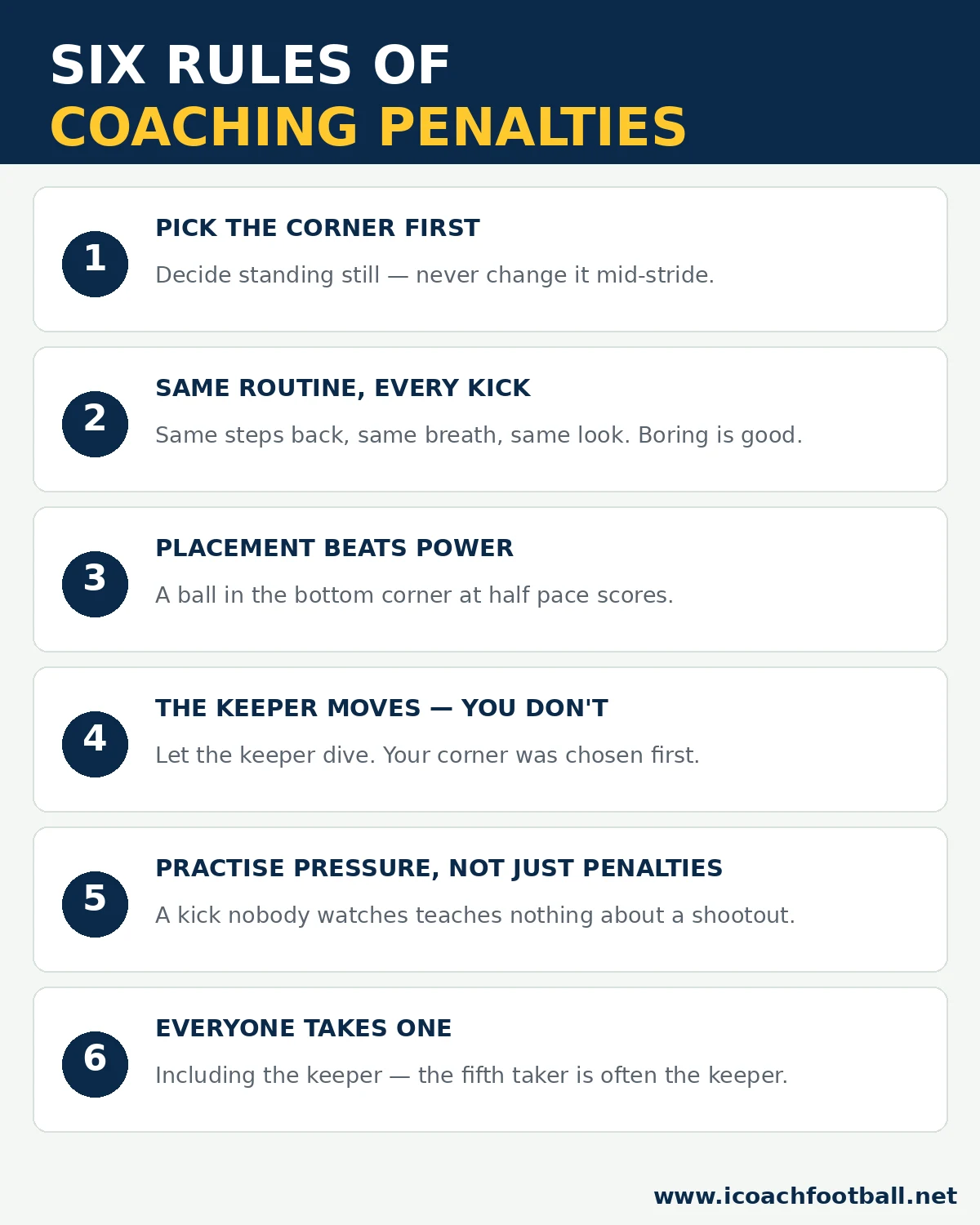
- Pick the corner before the run-up — and never change it. The decision is made standing still, not mid-stride.
- Same routine, every kick. Same steps back, same breath, same look. Boring is good.
- Placement beats power. A ball in the bottom corner at half pace scores. A ball blasted at the keeper does not.
- The keeper moves — you don’t. Let the keeper dive. Your corner was chosen before they moved.
- Practise pressure, not just penalties. A kick with nobody watching teaches nothing about a kick with everybody watching.
- Everyone takes one — including the keeper. The fifth taker in a shootout is often the keeper. Practise it now.
Drill 1 — Corner Call
Pick a corner, say it out loud, hit it. The first game of the session, and the one that builds the habit everything else depends on: the corner is decided before the run-up, never during it.

Setup: One full goal, penalty spot marked. 4 target cones: one in each corner of the goal. One ball per player. 8 minutes.
How to play:
- Players line up behind the penalty spot, one ball each.
- The coach calls a corner — ‘top right’ — and the player must hit it.
- Before the run-up, the player says the corner out loud: ‘top right’.
- The player takes the kick with the side of the foot, aiming for the cone.
- A hit on the called corner scores 1 point; a goal anywhere else scores 0.
- After 8 minutes, the player with the most points picks the next drill’s first taker.
Coach’s note: “Say it, then hit it. If your mouth says one corner and your foot hits another, the decision was not made.”
Progressions: The coach calls the corner one second before the run-up; two corners are called and the player picks one; the weak foot only.
Drill 2 — The Routine
Same walk, same breath, same strike. Every player builds a personal pre-kick routine and repeats it until it is automatic — the routine is the thing that survives pressure when technique wobbles.

Setup: One full goal, penalty spot marked. A keeper in goal. Each player takes 5 kicks. 10 minutes.
How to play:
- Each player writes their routine in three steps: place the ball, walk back, breathe.
- The player places the ball on the spot, walks back the same number of steps every time.
- The player takes one slow breath out, looks at the chosen corner, and starts.
- The run-up is the same pace and the same angle on every single kick.
- The keeper stands on the line and does not move early — the taker practises the routine, not the read.
- After 5 kicks, the player tells the coach one thing they will keep and one thing they will change.
Coach’s note: “Your routine is your anchor. When the crowd is loud and your legs are tired, the routine is the only thing you control.”
Progressions: The keeper moves early on purpose — the taker must still follow the routine; the routine must fit inside 5 seconds from whistle to strike; players swap routines and try a team-mate’s.
Drill 3 — Keeper Reads
The keeper commits early, waits late, or dives the wrong way — and the taker must still hit the corner they picked. The drill that trains both sides of the penalty: the taker’s nerve and the keeper’s read.

Setup: One full goal, penalty spot marked. One keeper in goal, takers in a line. 10 minutes.
How to play:
- The taker picks a corner before the run-up and tells the coach, not the keeper.
- Round 1: the keeper dives to one side on every kick — the taker must not change corner.
- Round 2: the keeper stands still until the last moment — the taker must trust the chosen corner.
- Round 3: the keeper reads the taker’s plant foot and dives where the foot points.
- After each kick, the keeper says which side they read and why.
- Rotate the keeper every 3 minutes so every player reads and every player takes.
Coach’s note: “Keeper: watch the plant foot, not the eyes. Taker: your corner was picked before you moved — the keeper cannot change it.”
Progressions: The keeper may move along the line before the kick (never off it — Law 14); the taker must call the corner after the keeper has moved; two keepers alternate and compare reads.
Drill 4 — Pressure Ladder
A shootout with the whole squad watching, the score on the board, and sudden death at the end. The game that teaches the single most valuable penalty skill: taking a good kick when everybody is watching.

Setup: One full goal, penalty spot marked. Two teams of 5–6, one keeper each. A scoreboard (cones or a whiteboard). 12 minutes.
How to play:
- Two teams line up behind the spot, best of 5 rounds, one kick each per round.
- Every taker must call their corner before the run-up — the team hears it.
- The whole squad watches from behind the penalty area, at least 9.15 metres back, as Law 14 requires.
- A goal scores 1 point for the team; a save or a miss scores 0.
- After 5 rounds, if the score is level, sudden death — one kick each until somebody misses.
- The losing team collects the balls and sets up the next drill.
Coach’s note: “The kick is the same kick you took in Drill 1. The only thing that changed is the audience — and the audience cannot touch the ball.”
Progressions: The taker has 5 seconds from whistle to strike; the scoreboard shows the running score so the last taker knows the stakes; the final round is taken by the youngest player on each team.
Drill 5 — Tired Legs
Sprint, then shoot. Penalties in real games come at the end of 90 tired minutes, not at the start of a fresh session — so this game trains the kick with heavy legs and a fast heartbeat.

Setup: Half pitch, one full goal. A 20-yard sprint lane marked with cones. 10 minutes.
How to play:
- The taker sprints 20 yards out and 20 yards back, as fast as they can.
- Without stopping, the taker walks straight to the penalty spot.
- The taker places the ball, follows their routine, and takes the kick.
- The keeper is fresh — the taker is the tired one, exactly like a real game.
- Each player takes 3 tired kicks, then rests while the next player goes.
- The coach records the conversion rate fresh versus tired — the gap is the lesson.
Coach’s note: “Tired legs rush. Your routine is slower than your legs want to go — follow the routine, not the rush.”
Progressions: Two sprints before the kick; the sprint ends with a turn and a first-time pass before the penalty; the whole team sprints together, then takes kicks in order.
Drill 6 — The Shootout Match
A full five-kick shootout to finish the session, rebounds live. The match-real finish: the game where everything the session taught is tested at once, with a winner at the end.
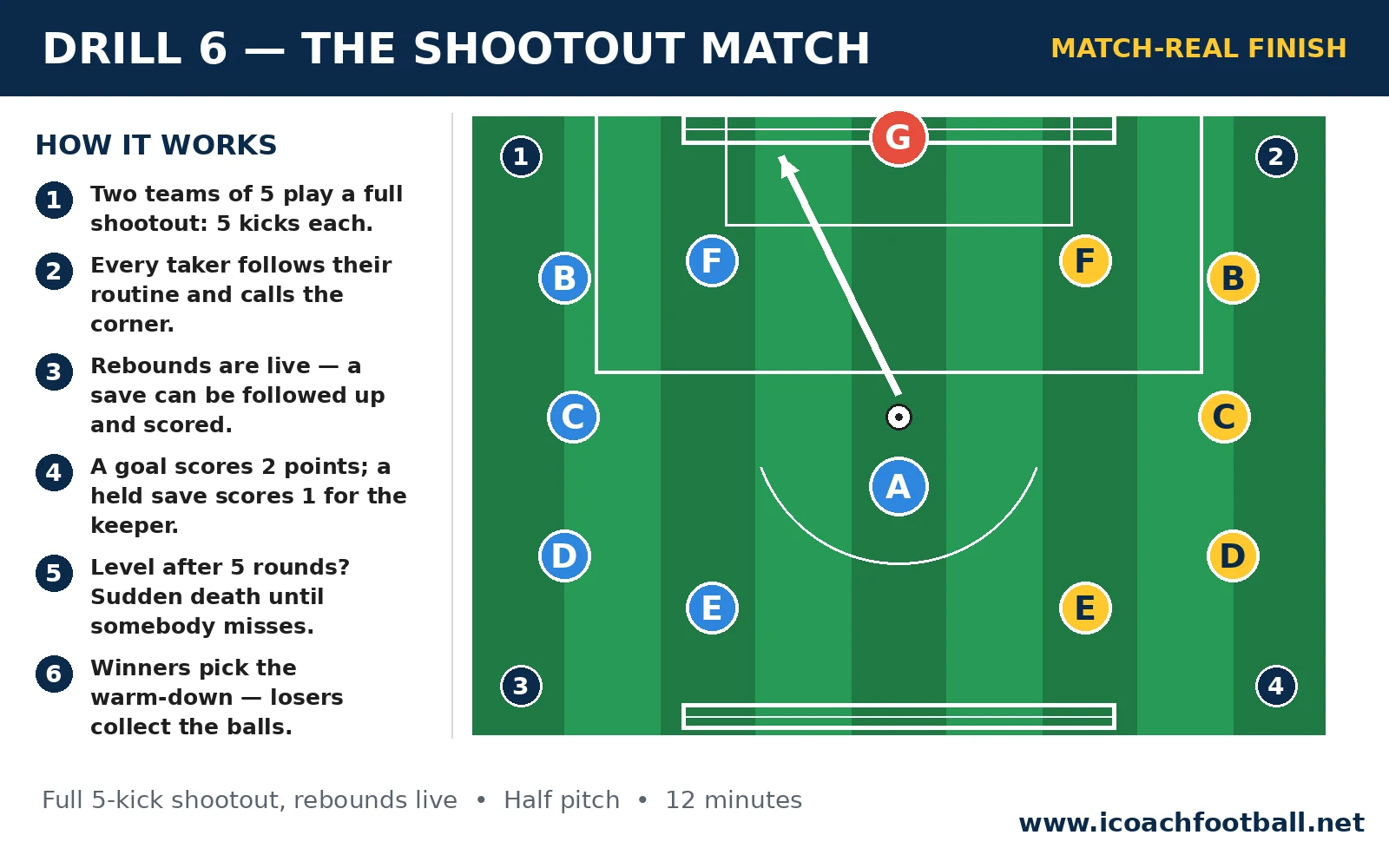
Setup: Half pitch, full goal at each end. Two teams of 5, one keeper each. Coach with the balls at the side. 12 minutes.
How to play:
- Two teams of 5 play a full shootout: 5 kicks each, alternating, best of 5.
- Every taker follows their own routine and calls their corner first.
- Rebounds are live in this training game — if the keeper saves it, anyone may follow up and score.
- A goal scores 2 points; a save that the keeper holds scores 1 point for the keeper’s team.
- If the shootout is level after 5 rounds, sudden death until somebody misses.
- The winning team picks the warm-down game — the losing team collects the balls.
Coach’s note: “In a real penalty the kicker cannot touch the ball again until another player does — Law 14. In this game the rebound is live, because the follow-up is a skill too.”
Progressions: The shootout runs after a 5-minute small-sided game so legs are tired; the keeper must save with their feet only on round 3; the fifth kick is taken by the keeper.
Coaching points: the five mistakes that lose shootouts
| Mistake | What you see | Fix |
|---|---|---|
| Changing the corner mid-run-up | The taker looks at the keeper, hesitates, and mishits | Drill 1: the corner is said out loud before the run-up, and the kick must match the call |
| No routine at all | Every kick looks different — different steps, different pace | Drill 2: three steps, written down, repeated until automatic |
| Blasting at the keeper | Power with no placement, straight down the middle | Drill 1: target cones in the corners; a hit on the called corner beats a hard shot |
| Practising only when fresh | Kicks are perfect in training, wild in the 90th minute | Drill 5: sprint first, then shoot — the conversion gap is the lesson |
| Never practising penalties | Nobody wants the ball when the shootout comes | Drill 4 and Drill 6 every month: the shootout is a trained skill, not a lottery |
Age adaptations
| Age | Ball | Spot | What changes |
|---|---|---|---|
| U11–U12 (ages 10–11) | Size 4 | The mark on their pitch (9v9 spot is closer than 12 yards) | Drills 1–3 as written; Drill 4 runs without a scoreboard and without forfeits; Drill 5 uses one 10-yard jog, not a sprint; the routine is three simple steps — see our U13 soccer practice plan for the next step |
| U13–U15 (ages 12–15) | Size 4 | 12 yards (11 metres) | All six games as written; Drill 3 adds the keeper reading the plant foot; Drill 4 adds sudden death — see our soccer drills for U15 for the next step |
| U16–U18 (ages 15–18) | Size 5 | 12 yards (11 metres) | Full pressure in Drills 4 and 6; Drill 5 runs after a small-sided game; keepers scout takers’ habits and the takers must vary their corners — see our soccer drills for strikers for the finishing that follows |
60-minute session plan
| Time | Block | Drill |
|---|---|---|
| 0:00–0:05 | Warm-up | Spot-kick warm-up |
| 0:05–0:13 | Placement | Drill 1 — Corner Call |
| 0:13–0:23 | Routine | Drill 2 — The Routine |
| 0:23–0:33 | Reading | Drill 3 — Keeper Reads |
| 0:33–0:45 | Pressure | Drill 4 — Pressure Ladder |
| 0:45–0:55 | Fatigue | Drill 5 — Tired Legs |
| 0:55–1:00 | Match-real finish | Drill 6 — The Shootout Match (shortened) |
New to coaching set pieces? Stretch the warm-up to 8 minutes and cut Drill 5 to 7 minutes and you have the same session with more settling-in time — see our 60-minute plan for the structure (the same shape, shortened for U11).
Keep building from here
These six games are the start, not the whole set-piece curriculum. The rest of the cluster is our football free kick routines and our soccer corner kick plays — the other two dead-ball weapons — and our football defending set pieces drills for the other side of the same moments, plus our soccer throw-in drills and our football throw-in routines for the restart that starts half of all attacks. The finishing that follows a saved penalty is our 1v1 finishing drills and our 7 soccer shooting drills, and the strikers who take the kicks grow through our soccer drills for strikers and our soccer drills for midfielders. Keepers train the other side of the kick in our goalie drills for youth soccer and our soccer goalkeeper communication drills — the keeper who talks wins more shootouts. The close control and the strike itself come from our soccer dribbling drills, our soccer passing drills and our weak foot soccer drills, so both feet can place the ball. Pairs work is the next step up: soccer drills for two players run the same skills in pairs, and soccer 3v3 drills and soccer 4v4 drills run them in bigger games. New to coaching? Start with soccer drills for beginners, and when they are older the road runs through our U13 soccer practice plan and our soccer drills for U15. Protect the players as they grow: our soccer injury prevention guide and our youth soccer fitness testing show how to measure progress without maximal testing at U12 and under, and our 10 soccer warm-up drills give you the full warm-up library. The boys’ and girls’ versions of the wider session are our soccer drills for boys and our soccer drills for girls — and if you run selections one day, our soccer tryout drills show how to grade a group fairly.
FAQ
How far is the penalty spot from the goal?
12 yards (11 metres) from the centre of the goal line on a full-size pitch. On youth pitches the spot is closer — use the mark on the pitch you play on, not the adult distance. In the UK the same kick is a football penalty kick — the distance and the law are identical.
Can the goalkeeper move before the penalty is taken?
Yes, along the line. Law 14 says the keeper must have at least part of one foot touching, in line with, or behind the goal line when the ball is kicked, and must not behave in a way that unfairly distracts the kicker. Moving sideways along the line is allowed; coming off the line early is not, and the kick is retaken if the offence clearly impacted the kicker.
What happens if the taker feints after finishing the run-up?
Feinting during the run-up is allowed. Feinting once the run-up is complete — a stutter step after the run-up has finished — is illegal: the kicker is cautioned and play restarts with an indirect free kick to the defending team. Teach the routine, not the trick.
How do you pick your penalty takers?
Technique first, composure second, and the practice record third. The best takers in training are the best takers in games — keep a simple record of who scores in Drills 4 and 6 across the month. Pick five, keep the order private until matchday, and always have a sixth name ready in case of injury.
Should kids practise penalties?
Yes — short, fun reps, not long pressured sessions. From U11, teach the routine and the corner call as a game. From U13, add the pressure ladder with the squad watching. Never punish a miss: the player who misses in training and takes the next kick anyway is the player you want taking the fifth kick in a shootout.
Sources
IFAB, Laws of the Game, Law 14 — The Penalty Kick: the ball must be stationary on the mark, the kicker clearly identified, the goalkeeper with at least part of one foot on the goal line until the ball is kicked, and all other players outside the penalty area, behind the mark and at least 9.15 m away. https://www.theifab.com/laws/latest/the-penalty-kick/
England Football Learning, Paul Barry, “Full Session: Finishing Around the Penalty Area” (60 minutes) — technical finishing around the goal with a goalkeeper, clinical finishing and one-touch rebounds when the shot is saved, the pattern this session’s finishing follows. https://cdn.footballdna.co.uk/wp-content/uploads/2026/09/Full-Session-Finishing-Around-The-Penalty-Area.pdf