Soccer Hold Up Play Drills: 6 Games to Receive Back to Goal, Shield and Bring Team-Mates In
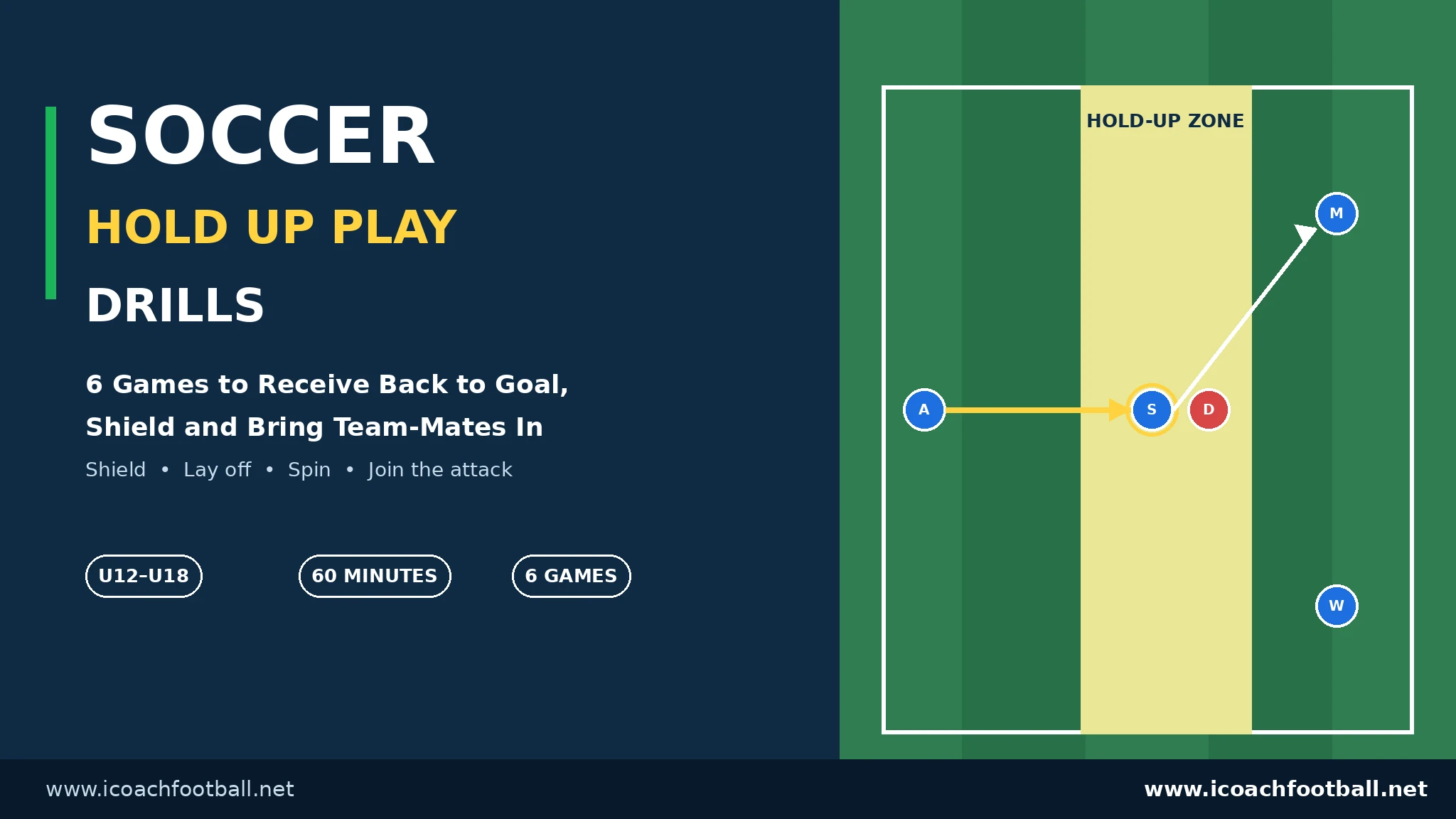
Quick answer: Hold-up play is receiving with your back to goal, shielding the ball from the defender behind you, and laying it off or spinning — so team-mates can join the attack instead of chasing a clearance. The striker needs three seconds, a low wide base, and a decision made before the ball arrives: lay it off, spin, or wait.
Suitable for: U12–U18
Most forwards lose the ball before the team arrives. The pass goes into feet, the striker stops it dead, and the defender behind takes it in one step.
A good hold-up buys the whole team time. Three seconds with a defender on your back is enough for two runners to arrive, and the attack starts facing forward instead of chasing back. FIFA’s Technical Study Group found the best centre-forwards at the U-20 World Cup did exactly this: they received back to goal, protected the ball, played a quick progressive pass, and then got into the penalty area as the move developed.
Coaches in the UK teach the same skill as football hold-up play drills, and the body shape is identical: side-on, low, ball on the far foot, arm feeling the defender. These six soccer hold up play drills build it in order: shielding, the lay-off, the spin, the target-player rondo, the long ball, and a game that only rewards a hold-up.
Session snapshot
- Players: 8–18 (pairs and threes for Drills 1–3, groups of 6–8 for Drills 4–5, two teams of 6 for Drill 6)
- Area: 4 x 4 yards for Drill 1, 20 x 15 yards for Drills 2–3, 25 x 20 yards for Drill 4, half pitch for Drills 5–6
- Duration: 60 minutes (20-minute version: Drills 1 and 2 only)
- Focus: Back-to-goal receive, shielding base, lay-off weight, spin timing, support runs, getting into the box after the lay-off
- Equipment: 10–12 balls, 16 cones, bibs, 2 full goals, 4 mini-goals
- Age: U12–U18 (see age adaptations; contact is light and controlled at U12–U13, and no player is driven into from behind)
The one rule: body first, ball second, decision already made
A hold-up is decided before the ball arrives. If the striker only thinks after the first touch, the defender is already reaching round them.
- Scan first. Look over one shoulder as the pass travels. Know where the defender is and where the nearest team-mate is before the ball reaches your feet.
- Side-on, low and wide. Knees bent, feet wider than shoulders, shoulder to the defender. The body is the wall between the defender and the ball.
- Ball on the far foot. The foot furthest from the defender controls the ball. The sole, inside or outside moves it, never a dead stop in front of the defender.
- Feel, do not push. One arm out for balance, feeling the defender’s chest and lean. Arms push and the foul is yours; arms feel and the turn is yours.
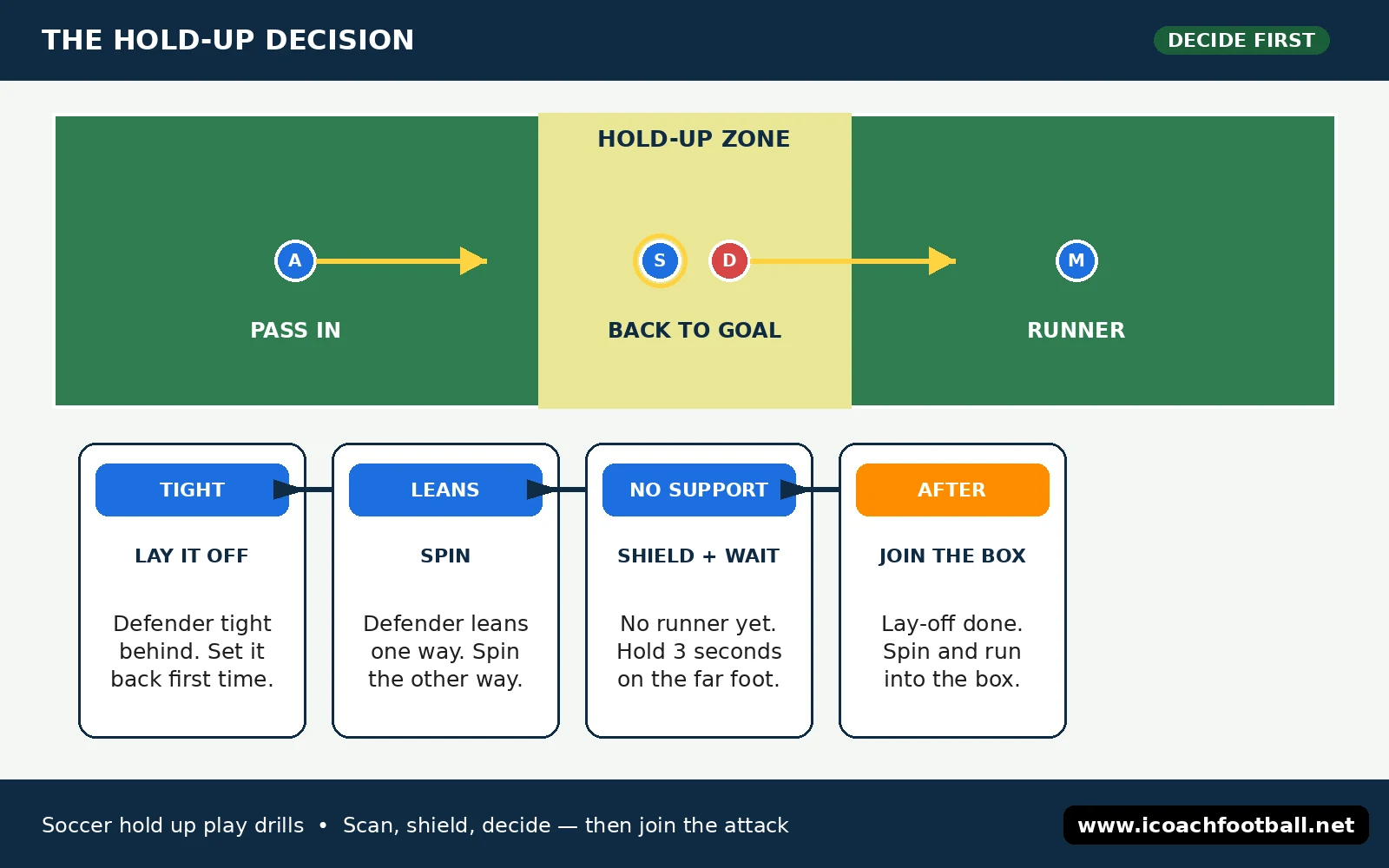
- Decide on the scan. Tight defender means lay it off. A defender leaning one way means spin the other way. No support yet means shield and wait three seconds.
If your players only stare at the ball, fix the picture first with these soccer scanning drills; a hold-up without a shoulder check is a guess, and guesses lose the ball.
| Defender does | Striker does | Next pass does |
|---|---|---|
| Tight behind, no space to turn | Lay it off first time | To a runner, forward or wide |
| Leans round one side | Spin the other way | Striker drives at goal or plays wide |
| Stays off, waits for the touch | Shield and wait | Hold for 3 seconds until support arrives |
| Reaches round for the ball | Roll it with the far foot, shield again | Keep the ball moving, never stop it dead |
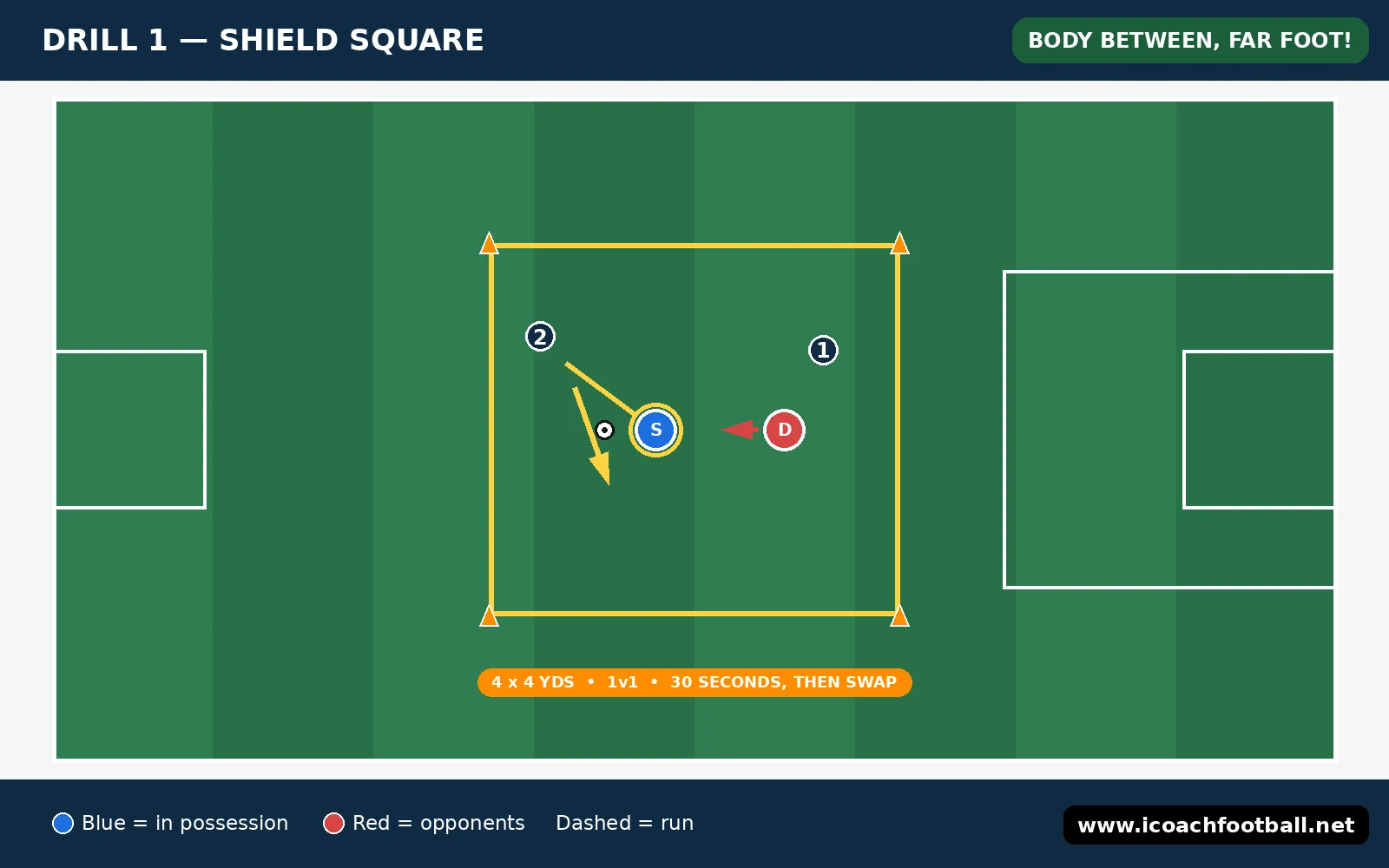
Drill 1 — Shield Square
The starting point, based on the FIFA Training Centre exercise on strength through shielding: the attacker shields the ball in a small square, body between opponent and ball, moving it with the furthest foot.
Setup:
- A 4 x 4 yard square for each pair, marked with 4 cones.
- One attacker with the ball and one defender in each square.
- Balls with the attackers, and a 30-second timer called by the coach.
How to Play:
- The attacker starts in the centre of the square with the ball at their feet.
- The defender steps in and tries to win the ball, without charging from behind.
- The attacker shields the ball, keeping their body between the defender and the ball.
- The attacker moves the ball with the far foot, using the sole to roll it away from pressure.
- After 30 seconds the players swap roles, then change partners and repeat.
Coach’s note: The cue is “Body between, far foot!” If the ball sits still in front of the attacker, stop the rep. A shielded ball keeps moving, even if only by inches.
Progressions: The defender may win the ball by poking it out of the square, then the square shrinks to 3 x 3 yards so the attacker must shield tighter.
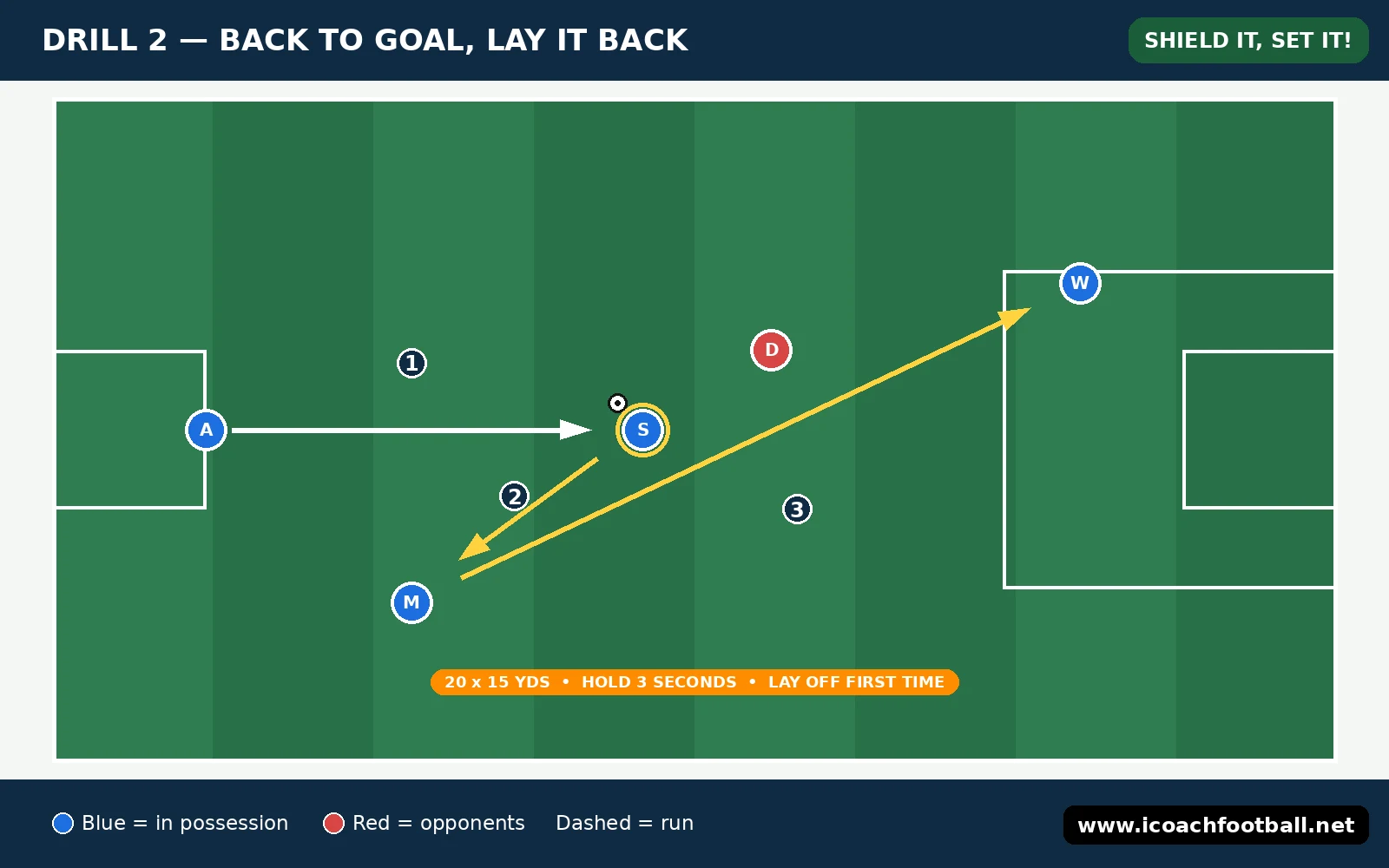
Drill 2 — Back to Goal, Lay It Back
The lay-off game. The striker receives with a defender behind, shields for a count of three, and sets the ball back to a runner who plays forward.
Setup:
- A 20 x 15 yard area with a server at one end and a 3-yard target gate at the other.
- A striker in the middle, a defender tight behind the striker, and a supporting midfielder behind the server.
- Balls with the server, and a wide player near the target gate.
How to Play:
- The server plays a firm pass along the ground into the striker’s feet.
- The striker scans over one shoulder, receives side-on, and shields the ball on the far foot.
- The striker holds the ball for a count of three while the defender presses from behind.
- The striker lays the ball back first time to the supporting midfielder.
- The midfielder plays forward first time to the wide player, who receives and returns the ball to the server.
Coach’s note: The cue is “Shield it, set it!” If the striker turns into the defender instead of laying it back, restart the rep. The lay-off is the point; the turn comes in Drill 3.
Progressions: The defender becomes live and may win a loose lay-off, then the supporting midfielder must arrive from the blindside so the lay-off has two options. The lay-off and run that follow are the same up-back-through timing trained in these soccer third man runs drills.
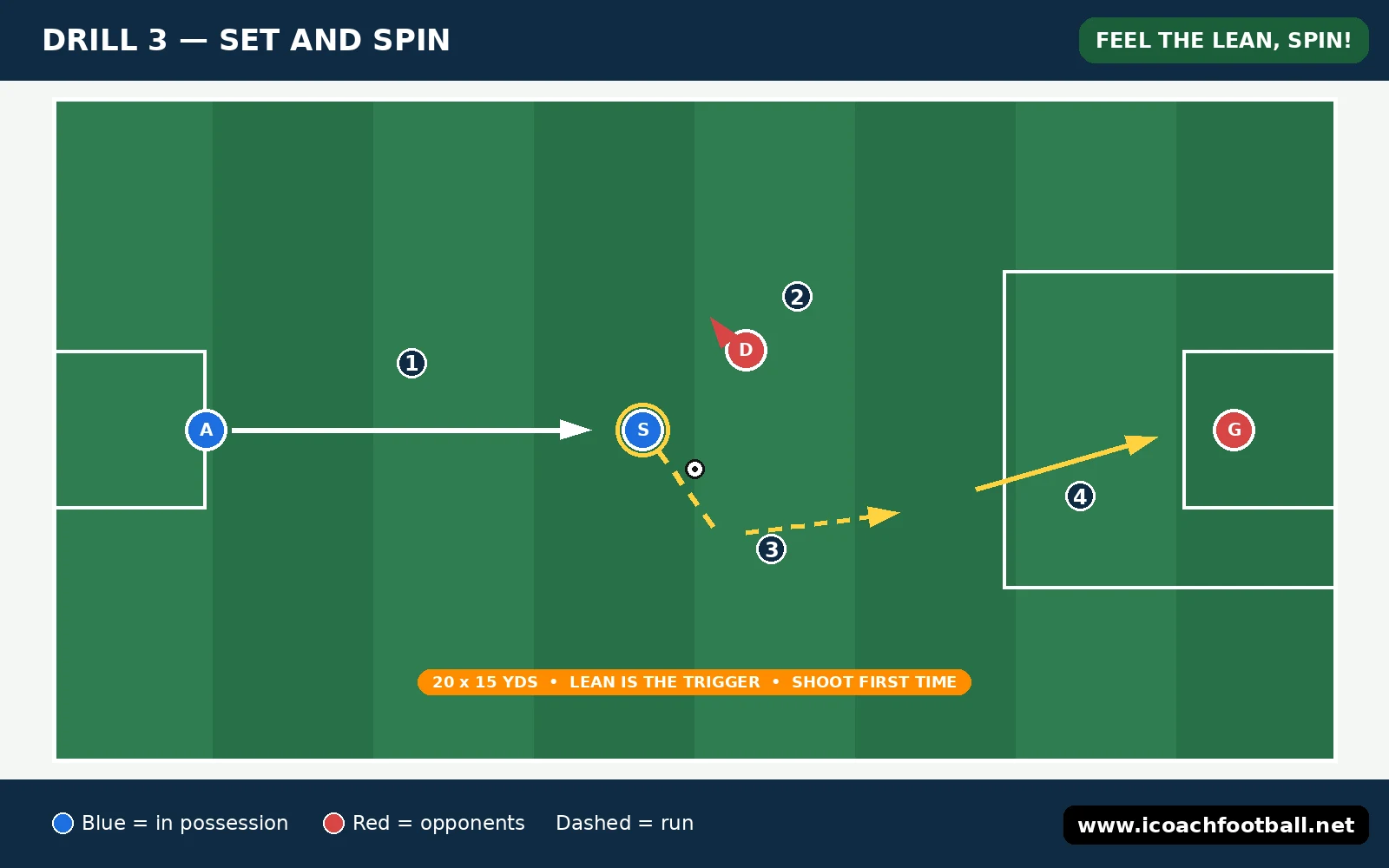
Drill 3 — Set and Spin
The turn drill. The defender leans one way to reach round the striker, and the striker spins the other way and finishes. The spin cannot be read from a still picture alone, so the animated diagram below shows it in full.
Setup:
- A 20 x 15 yard area with a small goal at the far end and a server at the near end.
- A striker 8 yards from goal with their back to goal, and a defender 2 yards behind the striker.
- Balls with the server, and a cone marking the striker’s starting spot.
How to Play:
- The server plays a firm pass into the striker’s feet as the defender closes down from behind.
- The striker receives side-on, low and wide, with the ball on the far foot.
- The striker feels the defender lean round one side, and holds the ball for one beat.
- The striker spins the other way, rolling the ball with the sole of the far foot.
- The striker shoots first time, low and across the goal, then jogs back and repeats from the other side.
Coach’s note: The cue is “Feel the lean, spin the other way!” If the striker spins before the defender leans, the defender simply follows. The lean is the trigger, not the pass.
Progressions: The defender may stay tight and refuse to lean, then the striker must lay it back to the server instead of spinning. The choice between spinning and setting it back is the same scan decision trained in these football half-turn drills.
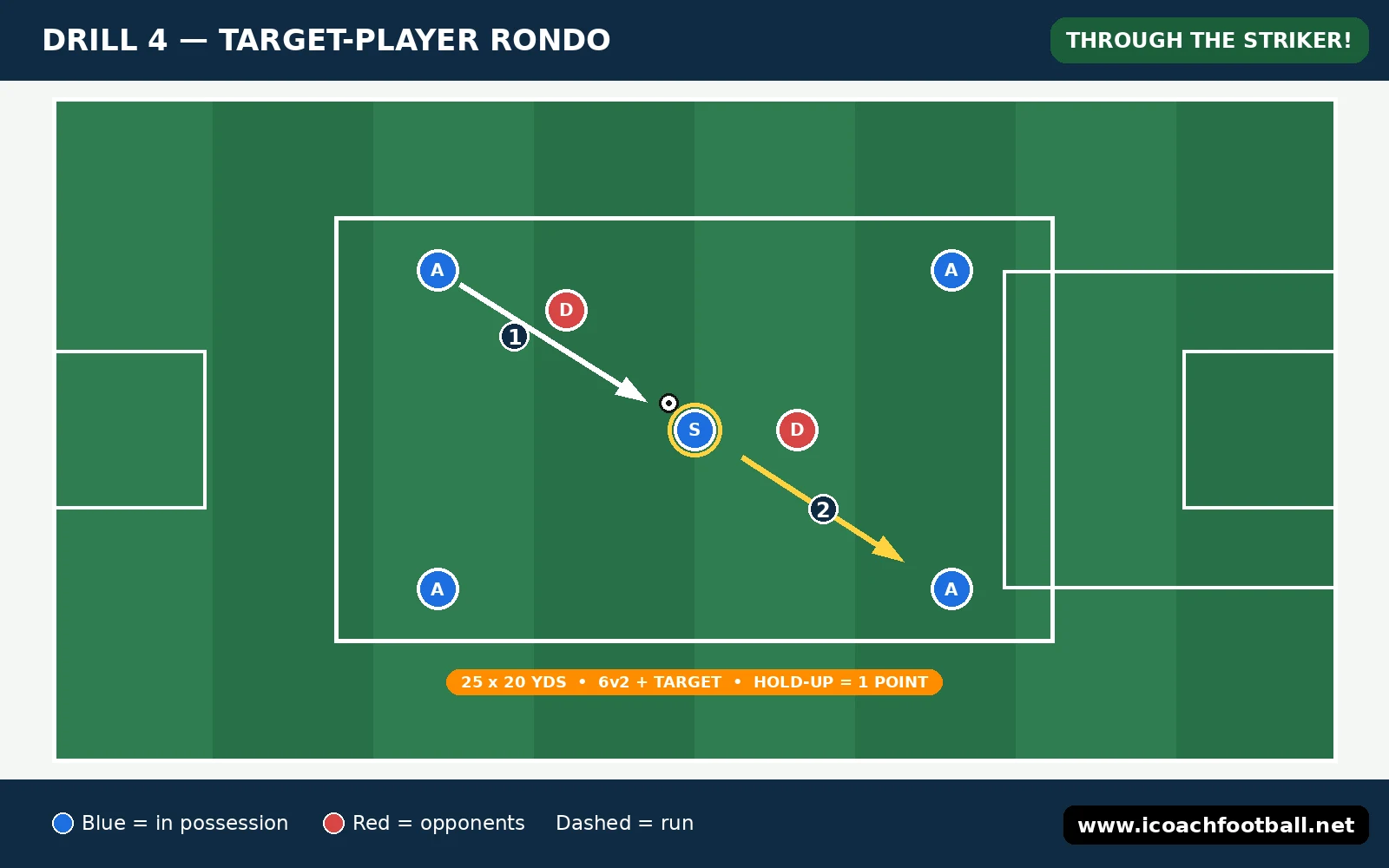
Drill 4 — Target-Player Rondo
The recognition game. Possession alone scores nothing. Only a hold-up and lay-off through the target striker counts, so every player must look for the striker early.
Setup:
- A 25 x 20 yard box, with 6 attackers on the outside and 2 defenders inside.
- One target striker in a different bib in the centre, with a ball supply on the side.
- Balls with the outside attackers, and a 2-minute block clock.
How to Play:
- The outside attackers keep possession in two touches, and the defenders press to win it.
- A pass into the target striker must be received back to goal, with a defender tight behind.
- The striker shields the ball and lays it off first time to a different outside attacker.
- A successful hold-up and lay-off scores 1 point for the attackers, and a sideways pass scores nothing.
- Rotate the target striker every 90 seconds, and swap the defenders every block.
Coach’s note: The cue is “Through the striker, not round them!” Freeze any team that keeps the ball safely on the outside. The rondo must force the hold-up, not reward safe passes.
Progressions: The striker is limited to one touch, then a defender may mark the striker and the outside attackers must find the free side to play in.
Drill 5 — Long Ball to Hold-Up
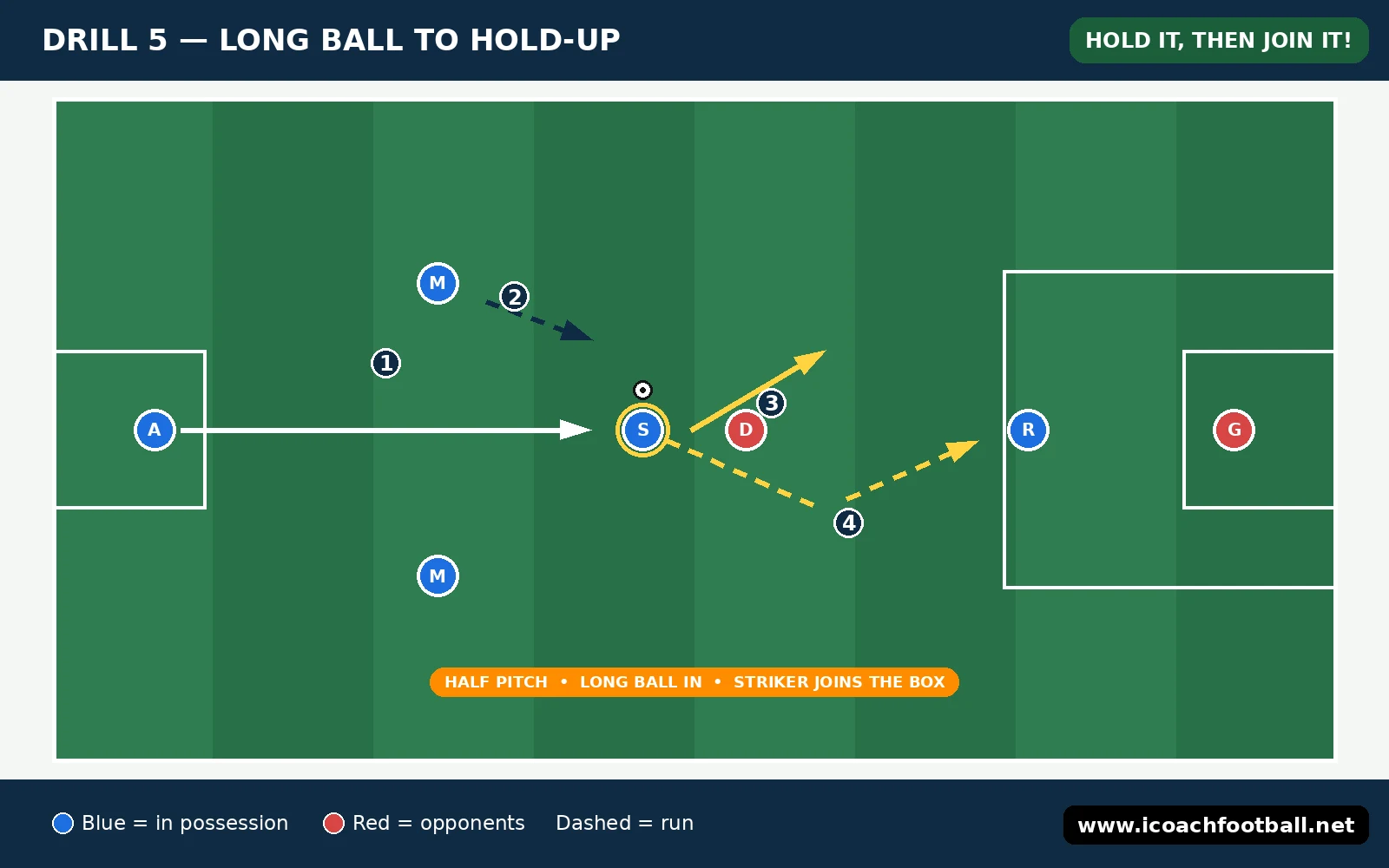
The match-realistic version. A long ball goes into the striker, the midfield runs to support, and the striker holds it until a runner arrives — then lays it off and gets into the box.
Setup:
- Half pitch, with a full goal and goalkeeper at one end and a server at the other.
- A striker and a centre-back contesting in the middle third, with two midfield runners starting 10 yards behind the striker.
- Balls with the server, and a 4-minute block clock.
How to Play:
- The server plays a long ball, along the ground or in the air, into the striker’s feet or chest.
- The striker receives back to goal, side-on, and shields the ball from the centre-back.
- The two midfield runners sprint forward as the ball travels, arriving on either side of the striker.
- The striker lays the ball off to the best-placed runner, who plays first time into the space ahead.
- The striker spins and runs into the penalty area for the return cross or cut-back, and the next ball starts from the server.
Coach’s note: The cue is “Hold it, then join it!” If the striker lays it off and stands still, stop the rep. The lay-off is only half the job; the striker must be in the box when the ball comes back.
Progressions: The long ball must go to a named side, then the centre-back may win the first ball, so the runners must press the centre-back’s first touch and win the second ball. Finishing the move after the spin is trained in these 1v1 finishing drills.
Drill 6 — The Hold-Up Game
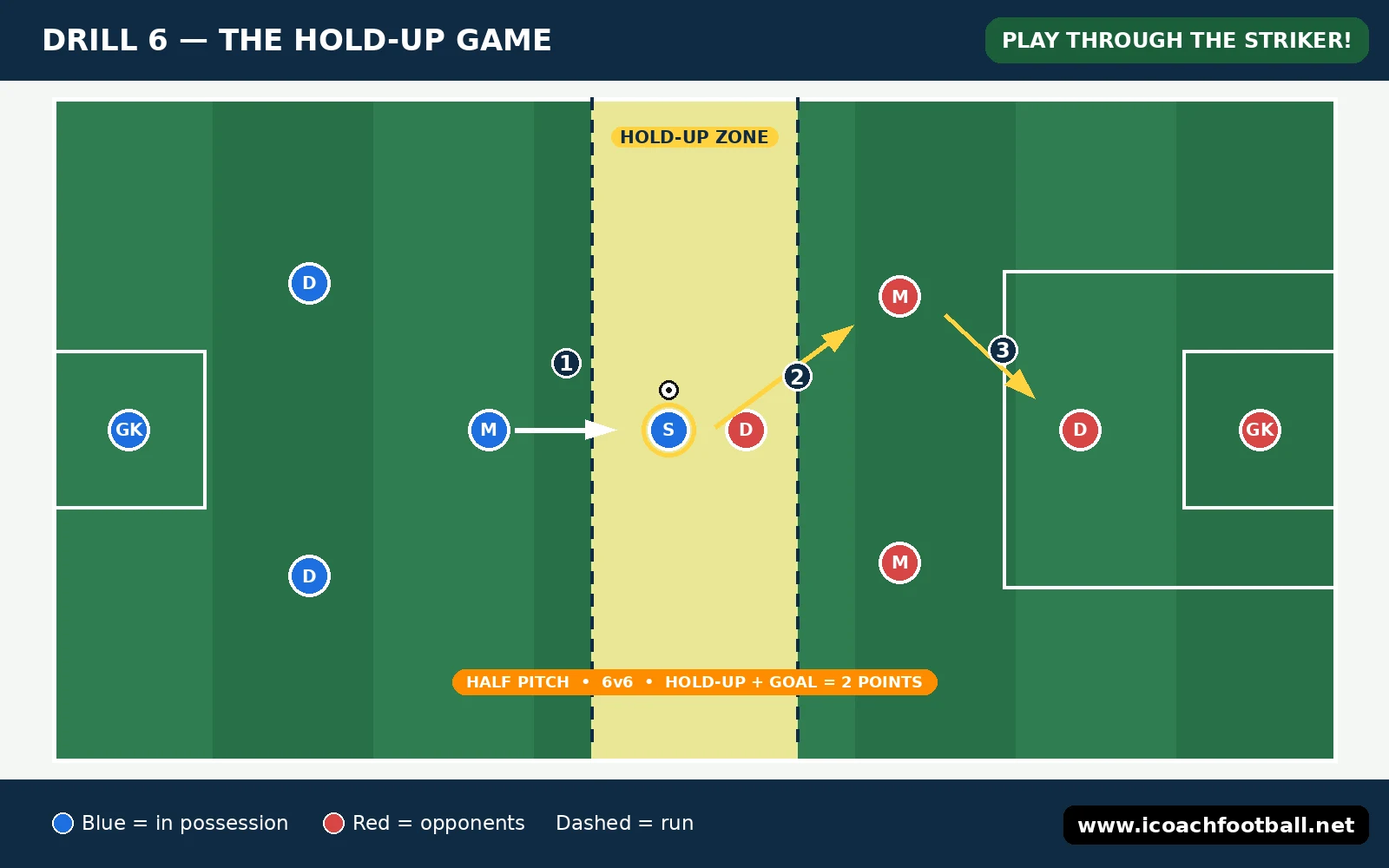
The real game. Goals only count double when the move goes through a hold-up, so teams must play into the striker under full pressure instead of going round them.
Setup:
- Half pitch, with a full goal at each end and a goalkeeper in each goal.
- Two teams of 6, with a shaded hold-up zone across the middle third and balls starting with the coach.
- A goal counts 1 point normally, and 2 points if it follows a hold-up and lay-off in the middle third.
How to Play:
- The coach plays the ball in, and teams keep possession with no touch limit.
- A team must play into its striker in the hold-up zone and complete a lay-off before entering the final third to earn the double.
- The striker may shield, lay off or spin, and must then join the attack for the finish.
- After a goal, the other team restarts from their goalkeeper, and play builds through the middle.
- Play four 4-minute blocks, keep a running score, and swap the strikers every block.
Coach’s note: The cue is “Play through the striker!” If a team launches long balls over the striker, freeze play. The double only follows a hold-up, not a hopeful pass.
Progressions: The double only counts if the striker gets into the box for the finish, then the touch limit drops to two and the hold-up zone narrows by 5 yards.
Coaching points
- “Body between, far foot!” In Drill 1, the ball stays on the foot furthest from the defender. A ball in front of the body is a ball the defender can reach.
- “Shield it, set it!” In Drill 2, the striker holds for three, then lays it back. Turning into a tight defender loses the ball the shield just won.
- “Feel the lean, spin the other way!” In Drill 3, the spin follows the defender’s lean. Spinning early lets the defender follow.
- “Through the striker, not round them!” In Drill 4, safe outside possession scores nothing. The point is only for a hold-up and lay-off.
- “Hold it, then join it!” In Drill 5, the striker must be in the box after the lay-off. A striker who stands still after setting the ball back is half a player.
- “Play through the striker!” In Drill 6, the game must reward the hold-up. The next phase is playing forward at speed, trained in these soccer passing drills.
Common mistakes
| Mistake | Fix |
|---|---|
| Striker stands square to the passer | Drill 1 cue “Body between, far foot!”; no rep counts from a square start |
| First touch stops the ball dead | Far-foot touch in Drills 1–2; the ball must keep moving on the touch |
| Striker pushes the defender off with straight arms | Arm out for balance only; feel the defender, do not push, or the foul is yours |
| Striker spins before the defender leans | Drill 3 cue “Feel the lean, spin the other way!”; the lean is the trigger |
| Striker lays off and stands still | Drill 5 cue “Hold it, then join it!”; the striker must run into the box |
| Team plays round the striker in the game | Freeze Drill 6 and restart; only a hold-up earns the double |
Age adaptations
| Age | Change |
|---|---|
| U12–U13 | Drills 1 and 2 only, light contact, no driving into a player from behind, and celebrate the shield before any spin |
| U14–U15 | Full six-drill menu with a passive presser in Drill 3 and lay-offs from both sides in Drill 2 |
| U16–U17 | Live defender in Drill 3, one-touch limit in Drill 4, and the striker-must-join-the-box rule in Drills 5–6 |
| U18 | Smaller areas in Drills 4–5, weaker-foot lay-offs demanded in Drills 1–2, and no coach call on the decision |
60-minute session plan
Run the six games as one session with this 60-minute plan, or take any two games for a 20-minute block.
| Block | Time | Drill |
|---|---|---|
| 1 | 10 minutes | Drill 1 — Shield Square |
| 2 | 10 minutes | Drill 2 — Back to Goal, Lay It Back |
| 3 | 10 minutes | Drill 3 — Set and Spin |
| 4 | 10 minutes | Drill 4 — Target-Player Rondo |
| 5 | 10 minutes | Drill 5 — Long Ball to Hold-Up |
| 6 | 10 minutes | Drill 6 — The Hold-Up Game |
Once the hold-up is clean, use the lay-off timing from these soccer third man runs drills to teach what the runner does next: the hold-up creates the free player, and the next pass must find them at once.
Sources
These soccer hold up play drills are based on, and in line with, the FIFA Training Centre exercise on strength through shielding, which trains shielding the ball with the body between opponent and ball, arms creating space, and the furthest foot moving the ball, and with the FIFA Training Centre analysis of centre-forwards linking attacks, which shows centre-forwards receiving back to goal, protecting the ball, playing quick progressive passes, and then getting into the penalty area.
FAQ
What is hold-up play in soccer?
Hold-up play is a forward receiving with their back to goal, shielding the ball from a defender, and keeping it until team-mates arrive. The striker then lays it off, spins, or waits — so the attack starts facing forward.
How do you teach a striker to shield the ball?
Start in a small square with light pressure: side-on, knees bent, body between defender and ball, ball on the far foot, one arm feeling the defender. Keep the ball moving with the sole, and swap roles every 30 seconds.
Should a striker lay the ball off or turn with it?
Lay it off when the defender is tight behind with no space to turn. Spin when the defender leans one way and leaves the other side open. Shield and wait when no support has arrived yet.
What age can players learn hold-up play?
Shielding can start at U12 with light, controlled contact. Full back-to-goal work with a live defender behind suits U14 and up, with no driving into a player from behind at any age.
How long should a striker hold the ball up?
About three seconds is enough. Longer than that, the defender settles and support stops running. Hold, decide, and lay it off or spin — then join the attack for the finish.