Soccer Drills for Improving Creativity: 6 Games That Teach Players to Invent (U9–U15)
Quick answer
Creativity is not a gift some players are born with — it is a skill you train like passing. These six games give every player a problem with more than one answer, a disguise they are allowed to try and a mistake that costs them nothing — in one 60-minute session.
Suitable for: U9–U15 (ages 8–15)
Session snapshot
- Players: 10–14 (U9–U15)
- Area: 30 x 25 yards (grids from 15 x 15 to 30 x 25)
- Duration: 60 minutes
- Focus: Disguising passes, inventing moves, finding a second option
- Equipment: 10–12 balls, 20 cones, 4 mini goals, bibs
Why these six games work
A player who only ever does what the coach told them will never invent a solution in a match. The gap is not talent — it is that training never asked them to invent anything. So this session changes the problem instead of repeating the answer. England Football Learning (The FA community) makes the same point for grassroots coaches: creativity grows when players are given the freedom to try, fail and try again — design exercises with more than one correct answer, add problems that need new solutions (overloads, different scoring rules), use games with constant transition, let players design parts of the drill, and ask open questions instead of giving the answer. The six rules and the coaching approach in this post are in line with that FA guidance. FIFA’s Training Centre session “Different game scenarios” is built on exactly the same idea: its warm-up asks players to pass in numerical order and “show me different ways to pass the ball over a short distance, using varied parts of the foot or disguise”, and its final game swaps the goal scorer to the other team so the numbers — and the problems — keep changing. Drill 1 and Drill 6 below are based on that FIFA session, in line with it. In the UK the same session runs as football drills for improving creativity — the games and the rules are identical.
Six rules of building creativity
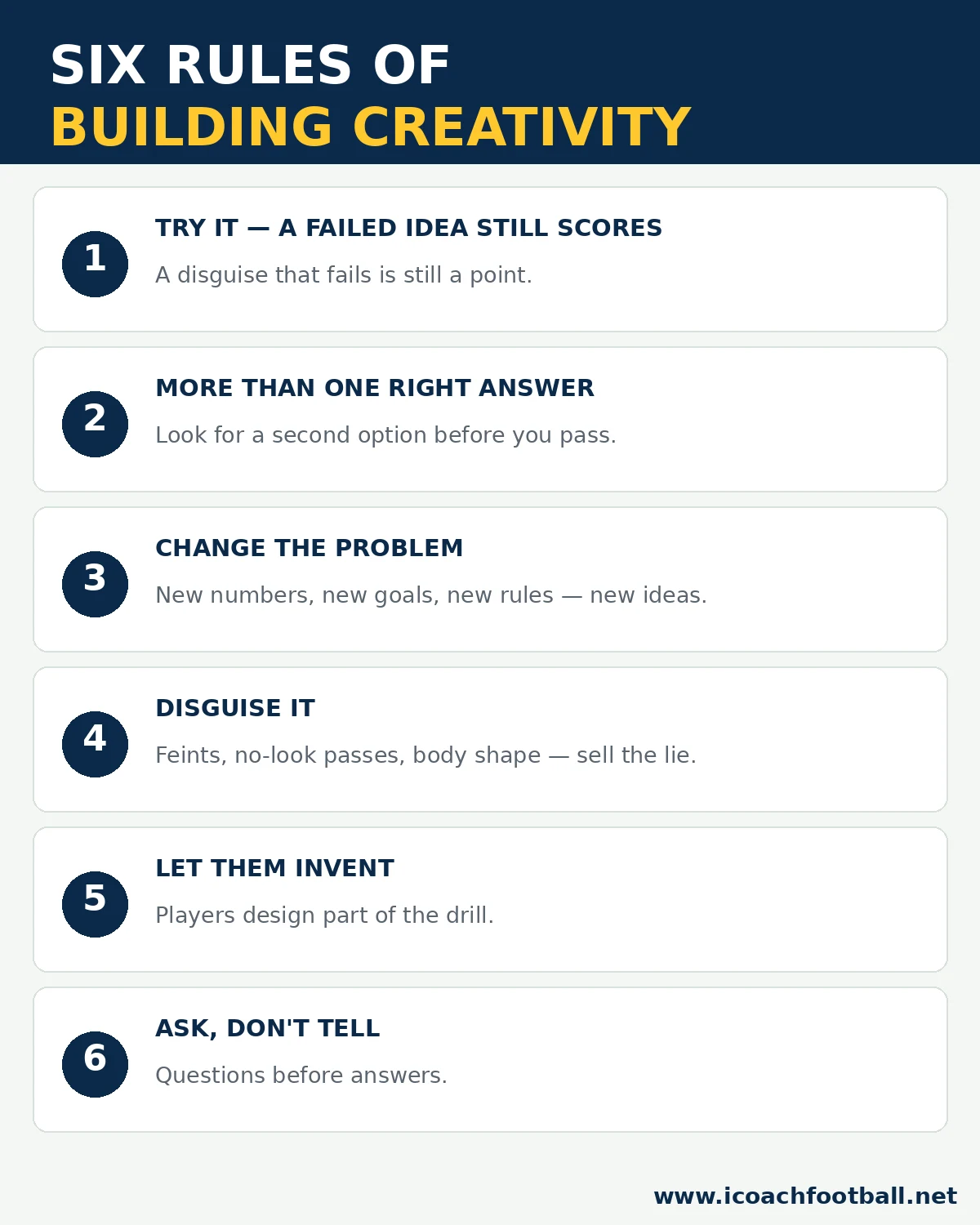
- Try it — a failed idea still scores. A disguised pass that fails is still a point.
- More than one right answer. Look for a second option before you pass.
- Change the problem. New numbers, new goals, new rules — new ideas.
- Disguise it. Feints, no-look passes, body shape — sell the lie.
- Let them invent. Players design part of the drill.
- Ask, don’t tell. Questions before answers.
Drill 1 — Disguise Pass Circle
Every player numbered, passing in order around a circle — and one pass in three must be disguised: a no-look, a body feint, an outside-of-the-foot clip. The warm-up FIFA uses to start its “Different game scenarios” session, and the fastest way to get players selling a lie with the ball.
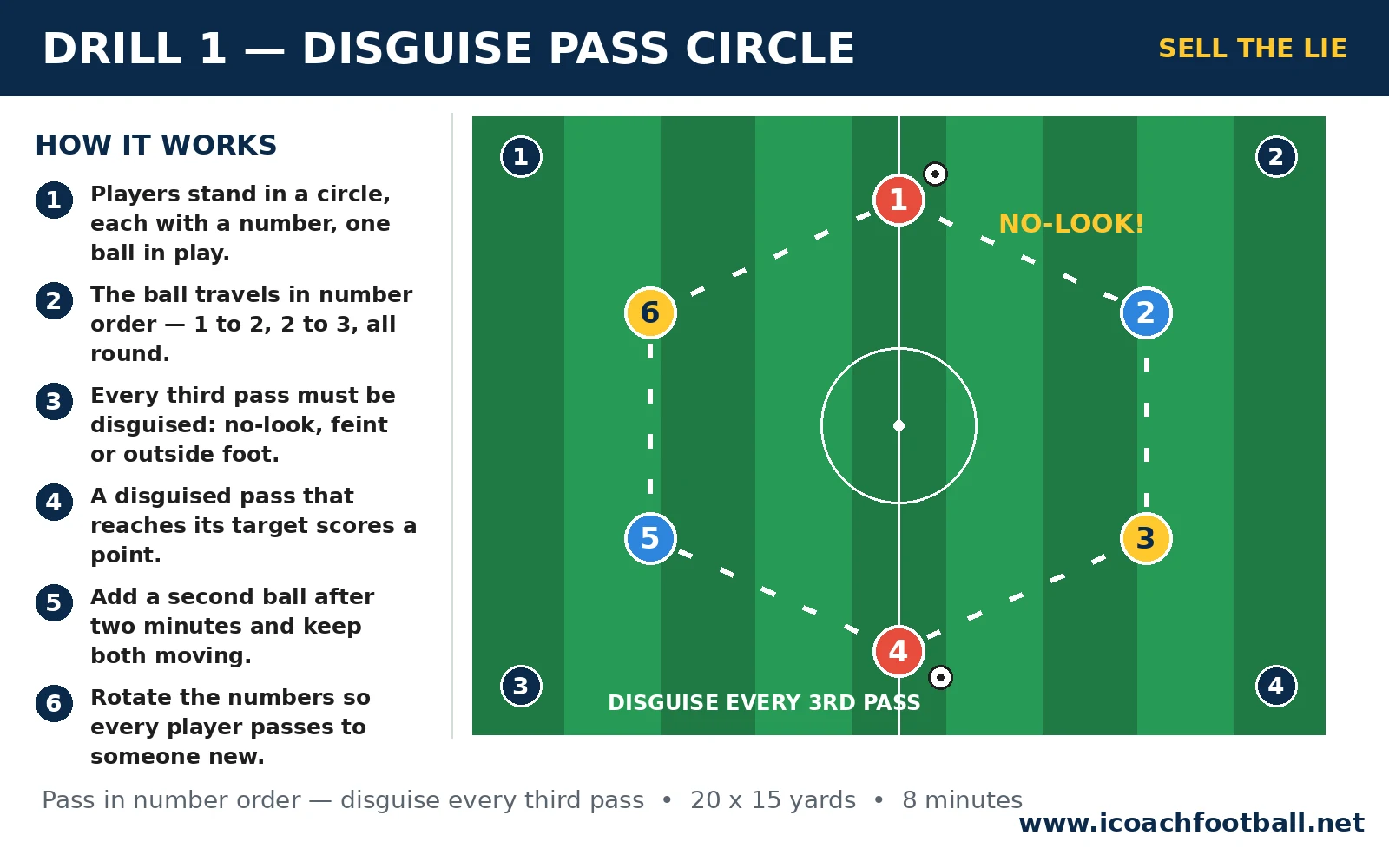
- Setup: 20 x 15 yard grid. Every player with a number, one ball per group of 6–8. 8 minutes.
How to play:
- Players stand in a circle, each with a number, one ball in play.
- The ball travels in number order — 1 to 2, 2 to 3, all the way round.
- Every third pass must be disguised: a no-look, a feint, or an outside-foot clip.
- A disguised pass that reaches its target scores a point for the group.
- Add a second ball after two minutes and keep both moving in order.
- Rotate the numbers so every player passes to a different teammate.
- Coach’s note: “Sell the lie — look left, pass right.”
- Progressions: One-touch only; the disguise must be a named move (Cruyff, no-look, drag-back); add a defender in the middle who hunts the ball.
Drill 2 — Copycat Inventors
One player invents a three-touch move, the partner copies it — then adds one touch of their own. The move grows every round, and by the end of the game every pair owns a sequence nobody else in the group has. Street football, structured.
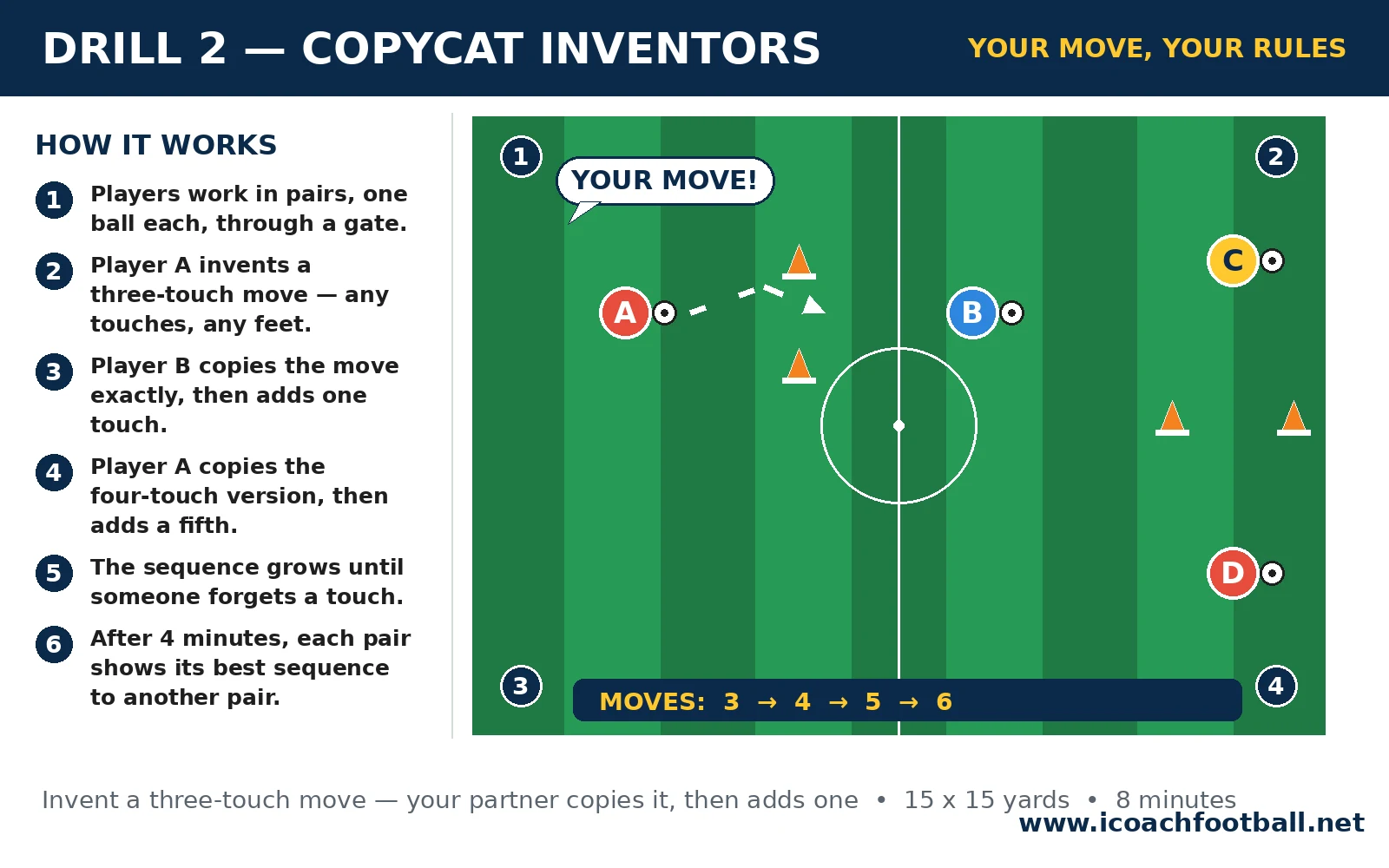
- Setup: 15 x 15 yard grid. Pairs, one ball per pair, cones marking a small gate each. 8 minutes.
How to play:
- Players work in pairs, one ball each, facing each other through a gate.
- Player A invents a three-touch move — any touches, any feet, any direction.
- Player B copies the move exactly, then adds one touch of their own.
- Player A copies the four-touch version, then adds a fifth touch.
- The sequence grows until someone forgets a touch — then start a new one.
- After 4 minutes, each pair shows their best sequence to another pair.
- Coach’s note: “Your move, your rules — make it yours.”
- Progressions: The move must end with a burst through the gate; the copy must use the weak foot for one touch; pairs race to a ten-touch sequence.
Drill 3 — Third-Man Run
The pass that beats a defence is rarely the first one. A passes to B, B lays it off first time — and C, who started the move, is already sprinting behind the defender to meet it. The timing is everything, and it is the one combination every creative team in the world uses.
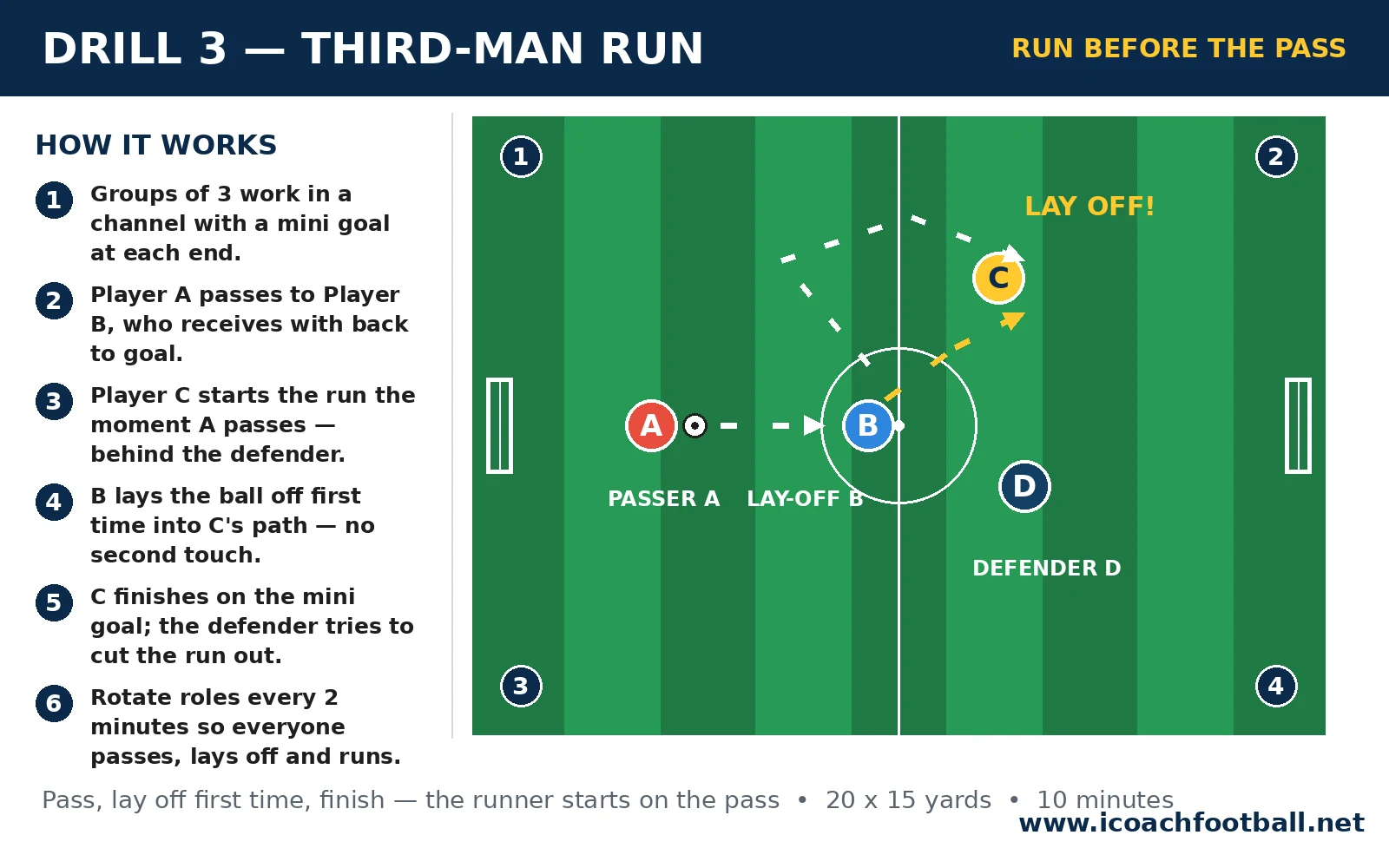
- Setup: 20 x 15 yard channel. Groups of 3, one ball, a mini goal at each end, one defender. 10 minutes.
How to play:
- Groups of 3 work in a channel with a mini goal at each end.
- Player A passes to Player B, who receives with their back to goal.
- Player C starts the run the moment A passes — behind the defender, into space.
- B lays the ball off first time into C’s path — no second touch.
- C finishes on the mini goal; the defender tries to read the run and cut it out.
- Rotate roles every 2 minutes so everyone passes, lays off and runs.
- Coach’s note: “Run before the pass — the lay-off is already late.”
- Progressions: The defender starts closer to B; C must finish first time; add a second defender and let A choose between two runners.
Drill 4 — Numbers Change Game
A 4v4 where the coach keeps changing the numbers. “Three-two!” and one team loses a player. “Four-three!” and they are back — but now the other team is short. Every change is a new problem, and the team that invents fastest wins the point.
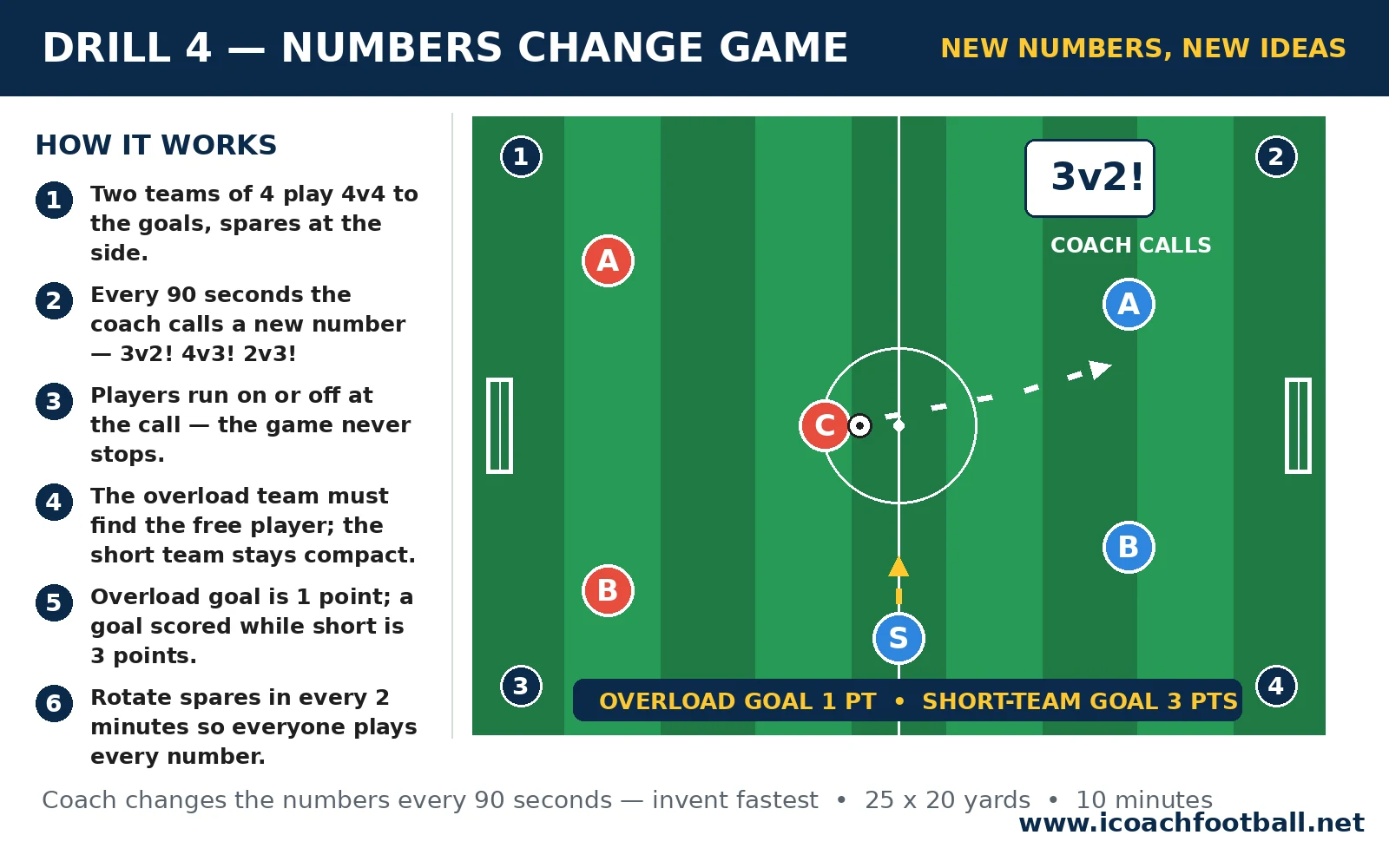
- Setup: 25 x 20 yard pitch. Two teams of 4, a goal at each end, spare players at the side. 10 minutes.
How to play:
- Two teams of 4 play 4v4 to the goals, with spares waiting at the side.
- Every 90 seconds the coach calls a new number — “3v2!”, “4v3!”, “2v3!”.
- Players run on or off at the call — the game never stops for the change.
- The team in overload must find the free player; the team short must stay compact.
- A goal scored while overloaded is worth 1 point; a goal scored while short is worth 3.
- Rotate the spare players in every 2 minutes so everyone plays every number.
- Coach’s note: “Short? Stay compact. Overloaded? Find the free player — fast.”
- Progressions: The coach changes the numbers without warning; the short team must score with a first-time finish; add a rule that every goal must follow a one-two.
Drill 5 — Four-Goal Game
Four mini goals, one at each corner, and a roaming goalkeeper who blocks one of them. The attacking team can only score in an open goal — so they have to look up, read the keeper and switch the attack before the defence settles. Four right answers, and the wrong one is still a lesson.
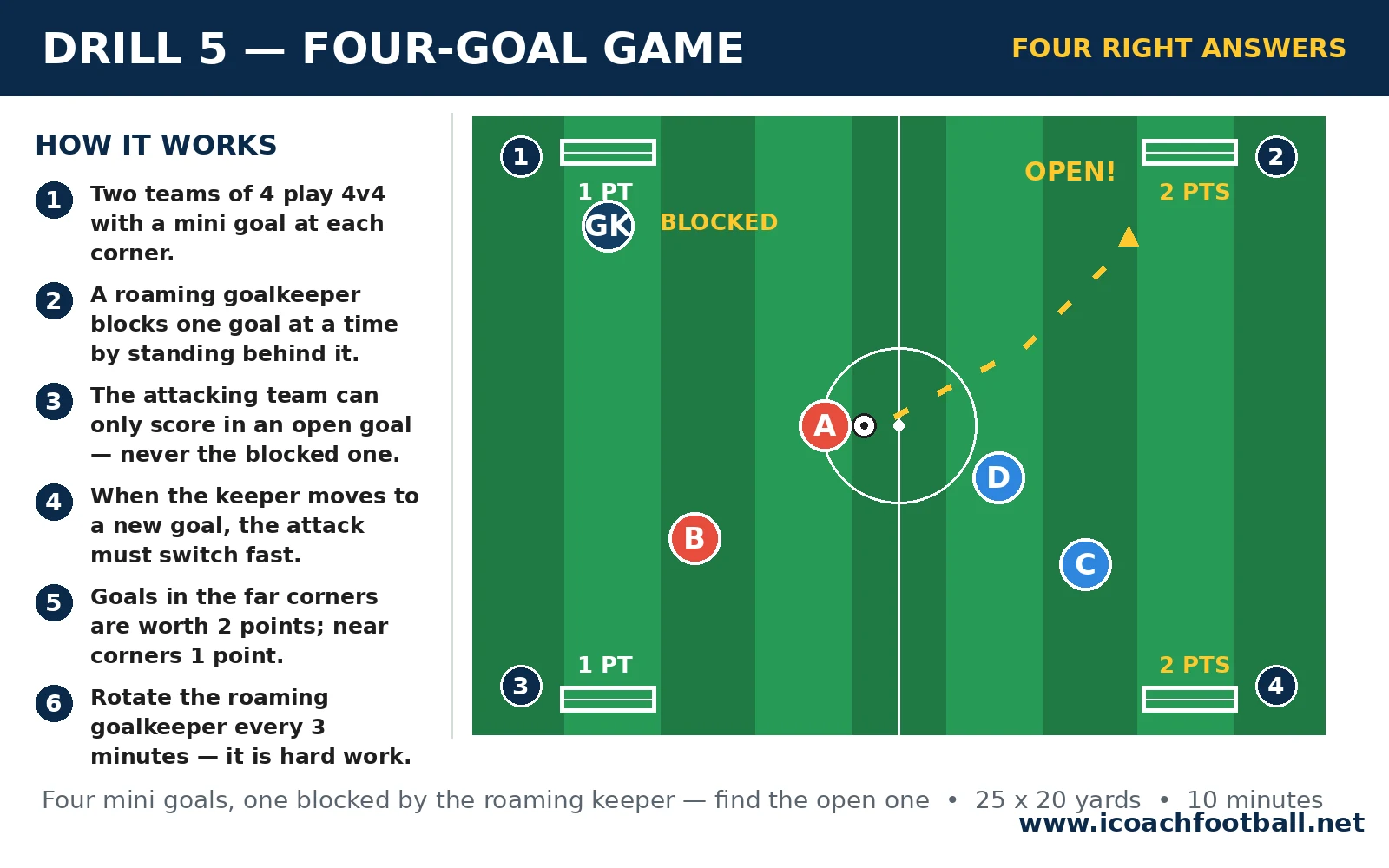
- Setup: 25 x 20 yard pitch. Two teams of 4, four mini goals (one at each corner), a roaming goalkeeper. 10 minutes.
How to play:
- Two teams of 4 play 4v4 with a mini goal at each corner of the pitch.
- A roaming goalkeeper blocks one goal at a time by standing behind it.
- The attacking team can only score in an open goal — never the blocked one.
- When the keeper moves to block a new goal, the attack must switch direction fast.
- Goals in the far corners are worth 2 points; goals in the near corners are worth 1.
- Rotate the roaming goalkeeper every 3 minutes — it is hard work.
- Coach’s note: “Look up first — the open goal is the one the keeper just left.”
- Progressions: Goals only count after a switch of play; the keeper blocks two goals; a goal must follow a disguised pass.
Drill 6 — Scorer Swaps 6v6
The final game, and the rule that changes everything: whoever scores changes teams. A 6v6 becomes 7v5, then 5v7, then 9v3 — and every player has to keep inventing, because the team, the numbers and the problem are never the same twice. FIFA’s own game from its “Different game scenarios” session.
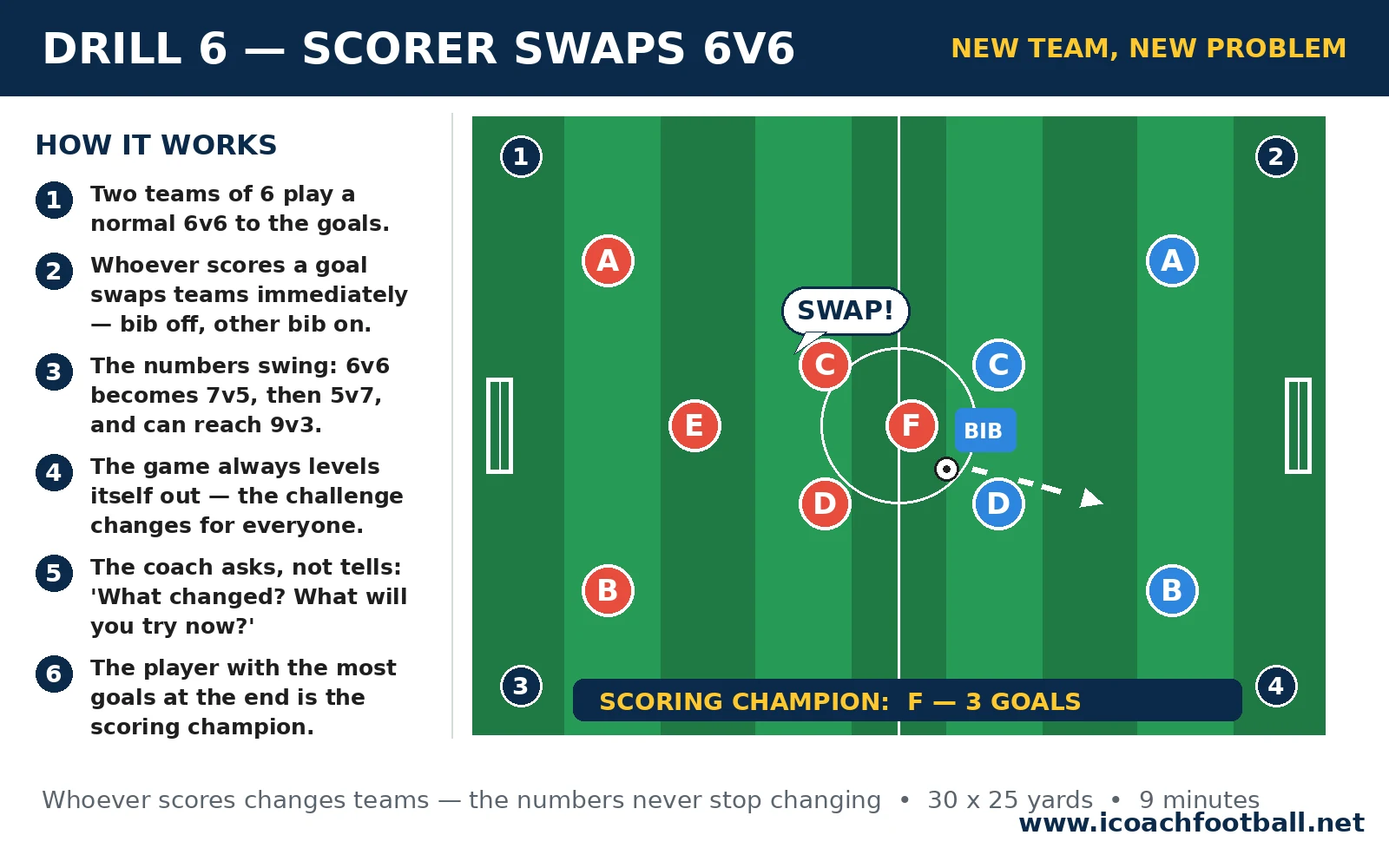
- Setup: 30 x 25 yard pitch. Two teams of 6, goals at each end, a second bib colour ready. 9 minutes.
How to play:
- Two teams of 6 play a normal 6v6 to the goals.
- Whoever scores a goal swaps teams immediately — bib off, other bib on.
- The numbers swing: 6v6 becomes 7v5, then 5v7, and can reach 9v3.
- The game always levels itself out — the challenge changes for everyone.
- The coach asks, not tells: “What changed? What will you try now?”
- The player with the most goals at the end is the individual scoring champion.
- Coach’s note: “New team, new problem — invent again.”
- Progressions: No player may score twice in a row; a goal only counts if it follows a disguised pass or a third-man run; play the last 3 minutes with no coaching at all.
Coaching points: the five mistakes that kill creativity
| Mistake | What you see | Fix |
|---|---|---|
| Correcting every failed try | Players stop inventing and play safe | Praise the attempt first — a failed disguise still scores |
| One right answer | Players wait for instructions | Design drills with two or more solutions — four goals, not one |
| Same numbers every game | Same patterns every week | Change the numbers mid-game — 3v2, 4v3, 2v3 |
| Drills with no decisions | Creativity never gets practised | Add a defender, a second goal or a time limit to every drill |
| Talking through every solution | Players copy the coach | Ask “what else could you try?” at natural breaks |
Age adaptations
| Age | Area | What changes |
|---|---|---|
| U9–U10 (ages 8–10) | 15 x 15-yard grids | Disguise Pass Circle runs without the second ball; Copycat Inventors uses two-touch moves, not three; the Third-Man Run starts unopposed — the defender only walks in; Four-Goal Game uses two goals, not four — see the U10 soccer practice plan and the U11 soccer practice plan for the next step |
| U11–U12 (ages 11–12) | 20 x 15-yard grids | The drills as written; the disguise must be a named move; the Numbers Change Game adds the 3-point short-team goal; the roaming keeper blocks one goal — see the U12 soccer practice plan |
| U13–U15 (ages 13–15) | 30 x 25-yard grids | Narrower pitches; one-touch only in the Disguise Pass Circle; the Third-Man Run adds a second defender; Scorer Swaps goals need a disguised pass or a third-man run — see soccer drills for U13, soccer drills for U14 and soccer drills for U15 |
60-minute session plan
| Time | Block | Drill |
|---|---|---|
| 0:00–0:05 | Arrival game | Free 3v3 — every player must invent one move |
| 0:05–0:13 | Disguise it | Drill 1 — Disguise Pass Circle |
| 0:13–0:21 | Invent a move | Drill 2 — Copycat Inventors |
| 0:21–0:31 | Time the run | Drill 3 — Third-Man Run |
| 0:31–0:41 | Change the numbers | Drill 4 — Numbers Change Game |
| 0:41–0:51 | Find the open goal | Drill 5 — Four-Goal Game |
| 0:51–0:60 | The swapping game | Drill 6 — Scorer Swaps 6v6 |
New to coaching this age? Stretch the arrival game to 8 minutes and cut Drill 2 to 5 minutes and you have the same session with more settling-in time — see our 60-minute plan for the structure (the same shape, shortened where you need it).
Keep building from here
Creativity sits on top of ball mastery, so start there if a player is still fighting the ball: our soccer drills for beginners build the first touch this session needs, and soccer dribbling drills give the moves Drill 2 rewards. Belief comes before invention: our soccer drills for improving confidence teach players to try a skill without fear, and the choice that follows the try is the decision itself — our soccer decision making drills train what to do after you beat a player, and soccer scanning drills teach the look-up that makes the third-man run possible. Build the passing base next: soccer passing drills for the weight and accuracy Drills 1 and 3 need, and weak foot soccer drills so both feet can play the disguised pass. The formats in this session have their own deep dives: soccer 3v3 drills for the combination play behind Drill 5, soccer 4v4 drills for the shape behind Drill 6, soccer 5v5 drills for the numbers behind the final game, and the rondo blueprint for the possession angles behind Drill 1. The combination in Drill 3 is the first step of our 1v1 to 4v4 transition drill, and the moving monkeys rondo turns the same duel into a game. The finish in Drill 5 is the same skill as our soccer drills for strikers and our 1v1 finishing drills, and the duel in Drill 3 is the same problem as our soccer drills for two players and soccer drills for 6 players — and when numbers change on the night, our soccer practice plans by number of players pick the session that fits. The numbers game in Drill 4 is the same overload problem as our soccer counter attack drills, and the switching in Drill 5 is the same skill as our switching play drills — while the build-up behind it all is our soccer playing out from the back drills, and the wide play that creates the space is our wide channel game. Talking helps invention too: our soccer communication drills teach the calls that set up a third-man run, and our soccer goalkeeper communication drills train the same awareness from the goal line. Quiet players need creativity most of all: our soccer drills for girls show how to build it in a team that has never tried. Protect the players as they grow: our soccer injury prevention guide shows how to build the warm-up into every session, and our 10 soccer warm-up drills give you the full warm-up library. When they are older, the road runs through our soccer drills for U13, soccer drills for U14 and soccer drills for U15 — and if you run selections one day, our soccer tryout drills show how to grade a group fairly.
FAQ
At what age should you start creativity drills?
At U9 — once players can control and pass the ball reliably. Before that, the invention is too big: a U8 player who is still fighting the ball cannot also disguise a pass and enjoy it. Younger players need ball mastery and fun games first, like our soccer drills for beginners, and the full creativity games in this session land best from age 8 or 9. In the UK the same session is football drills for improving creativity, and the age is the same.
How do you coach creativity without the session turning into chaos?
Keep the structure and free the choices. Every drill here has a fixed setup, a clear scoring rule and a small number of players — the freedom is inside the drill, not instead of it. The Four-Goal Game has four goals and one rule; the Numbers Change Game has one call every 90 seconds. Players invent within the rules, and the rules keep the session tight.
What if a player only ever tries the same move?
Change the problem, not the player. Ban their favourite move for one round, require a disguise on every third pass, or change the numbers so their move no longer works. The FA’s guidance makes the same point: add problems that need new solutions — overloads, different scoring rules, time pressure. A player who has one move and a new problem will invent a second one.
Should you stop play to correct a bad decision?
No — let the game teach it, then ask at a natural break. ‘What option did you see?’ teaches more than ‘you should have passed left.’ The FA’s guidance is specific here: use open questions instead of giving the answer, and avoid stopping play every time a mistake happens. Players who are corrected mid-flow stop inventing; players who are asked questions start thinking.
How do you know creativity is improving?
Count ideas, not goals. Count disguised passes attempted in Drill 1, new moves invented in Drill 2, and third-man runs tried in Drill 3 — and watch the numbers climb week to week. The goals follow a few weeks later. If nothing changes in a month, the problem is still too easy: narrow the pitch, add a defender, or change the numbers faster.
Sources
- FIFA Training Centre, “Different game scenarios” session plan (#123) — a session that starts with a warm-up where players pass in numerical order and are asked to “show me different ways to pass the ball over a short distance, using varied parts of the foot or disguise”, builds to a 4v4 winner-stays-on game, and finishes with a 6v6 where the goal scorer changes teams so the numbers keep changing. Drill 1 (Disguise Pass Circle) and Drill 6 (Scorer Swaps 6v6) are based on / in line with that session plan.
- The FA (England Football Learning community), “How & why grassroots Coaches Should Improve Players’ Creativity Through Training Sessions That Demand Risk-Taking & Problem-Solving?” — guidance that creativity is a skill that grows when players are given the freedom to try, fail and try again: design exercises with more than one correct answer, encourage risk-taking in safe environments, add problems that need new solutions (overloads, different scoring rules), use games with constant transition, let players design parts of the drill, and ask open questions instead of giving the answer. The six rules and the coaching approach in this post are in line with that guidance.