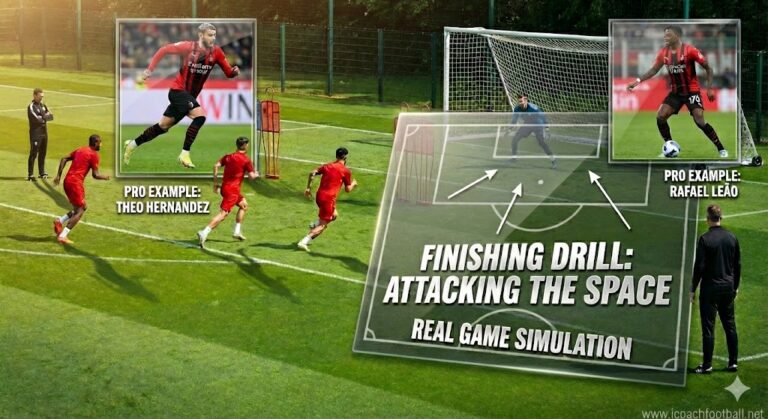
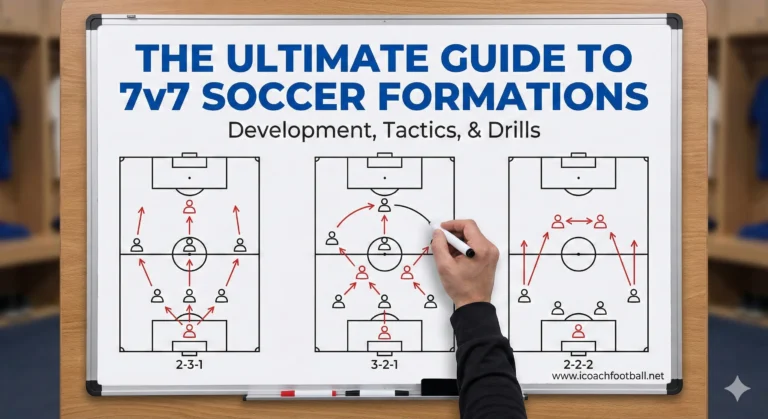
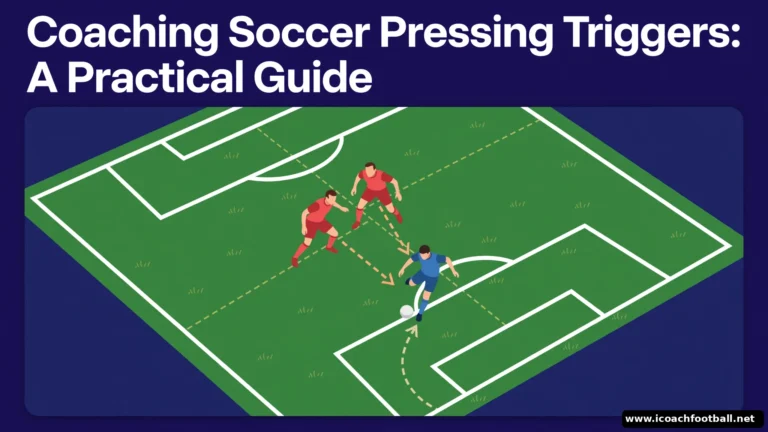
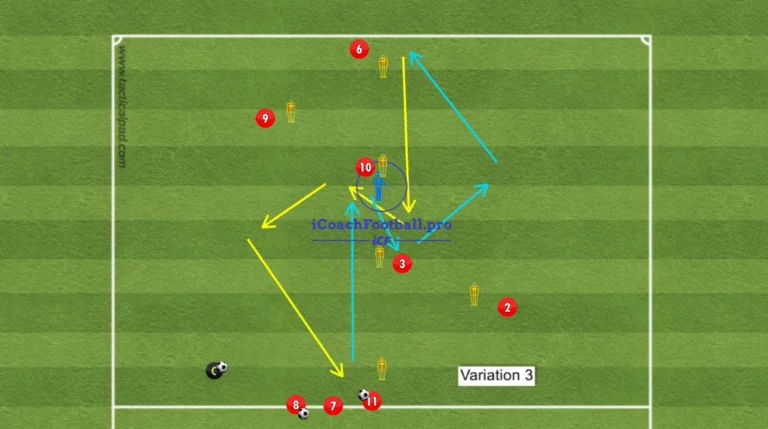
Soccer Playing Out From the Back Drills: 6 Games to Beat the Press and Build Forward
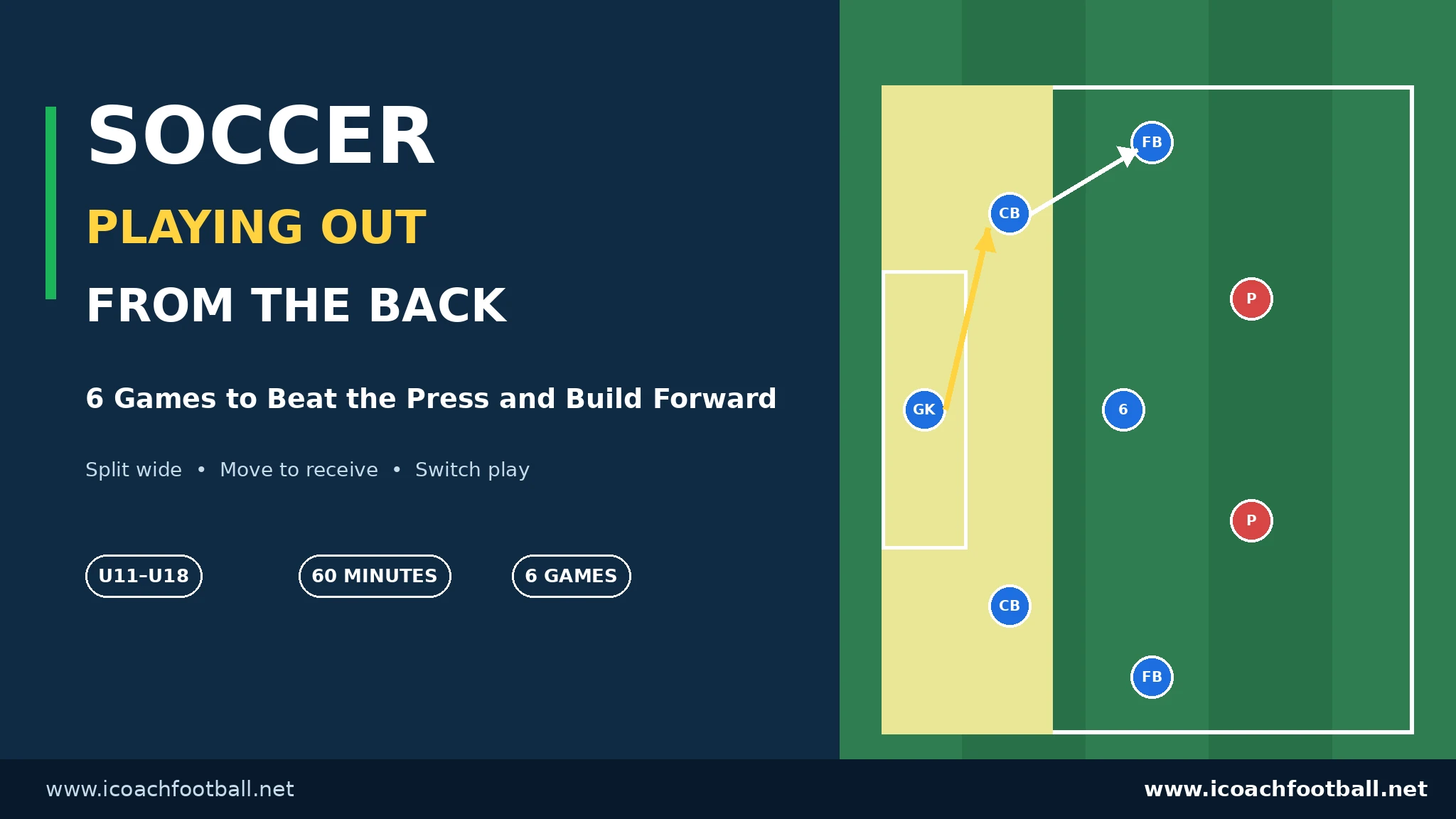
Quick answer: Playing out from the back means building the attack from the goalkeeper through the defenders instead of kicking long. Split the centre-backs wide, push the full-backs high and wide, drop a midfielder to help, and let the goalkeeper move to receive. These six games train exactly that: start in shape, invite the press, and play out through, around, or over it.
Suitable for: U11–U18
Most youth teams lose the ball before they attack. The goalkeeper kicks long, the forwards chase a contest, and possession is gone in two seconds.
Playing out keeps the ball and moves the other team. When the goalkeeper is a passing option, the team has one spare player the press cannot mark without leaving someone else free. The press steps in, the ball moves to the free player, and the attack starts facing forward.
Coaches in the UK teach the same moment as football drills for playing out from the back, and the starting shape is identical: goalkeeper active, centre-backs split, full-backs wide. These six soccer playing out from the back drills build the habit in stages: the FIFA goalkeeper build-up diamond, the split-and-wide starting shape, the bait-and-switch, beating two pressers, the around-through-over decision, and a full game that only rewards building out.
Session snapshot
- Players: 5–16 (GK + 3–4 for Drills 1–2, GK + 5–6 for Drills 3–5, two teams of 7 for Drill 6)
- Area: Penalty area for Drill 1, half pitch for Drills 2–5, half pitch for Drill 6
- Duration: 60 minutes (20-minute version: Drills 1 and 2 only)
- Focus: Goalkeeper support angles, split centre-backs, wide full-backs, scanning, patience, switching play
- Equipment: 10–12 balls, 16 cones, 4 mannequins or poles, bibs, 2 full goals, 4 mini-goals
- Age: U11–U18 (see age adaptations)
The one rule: the goalkeeper is a player, not a restart
A build-out is decided by the goalkeeper’s position before the ball arrives. If the goalkeeper stands still on the line, the spare player disappears.
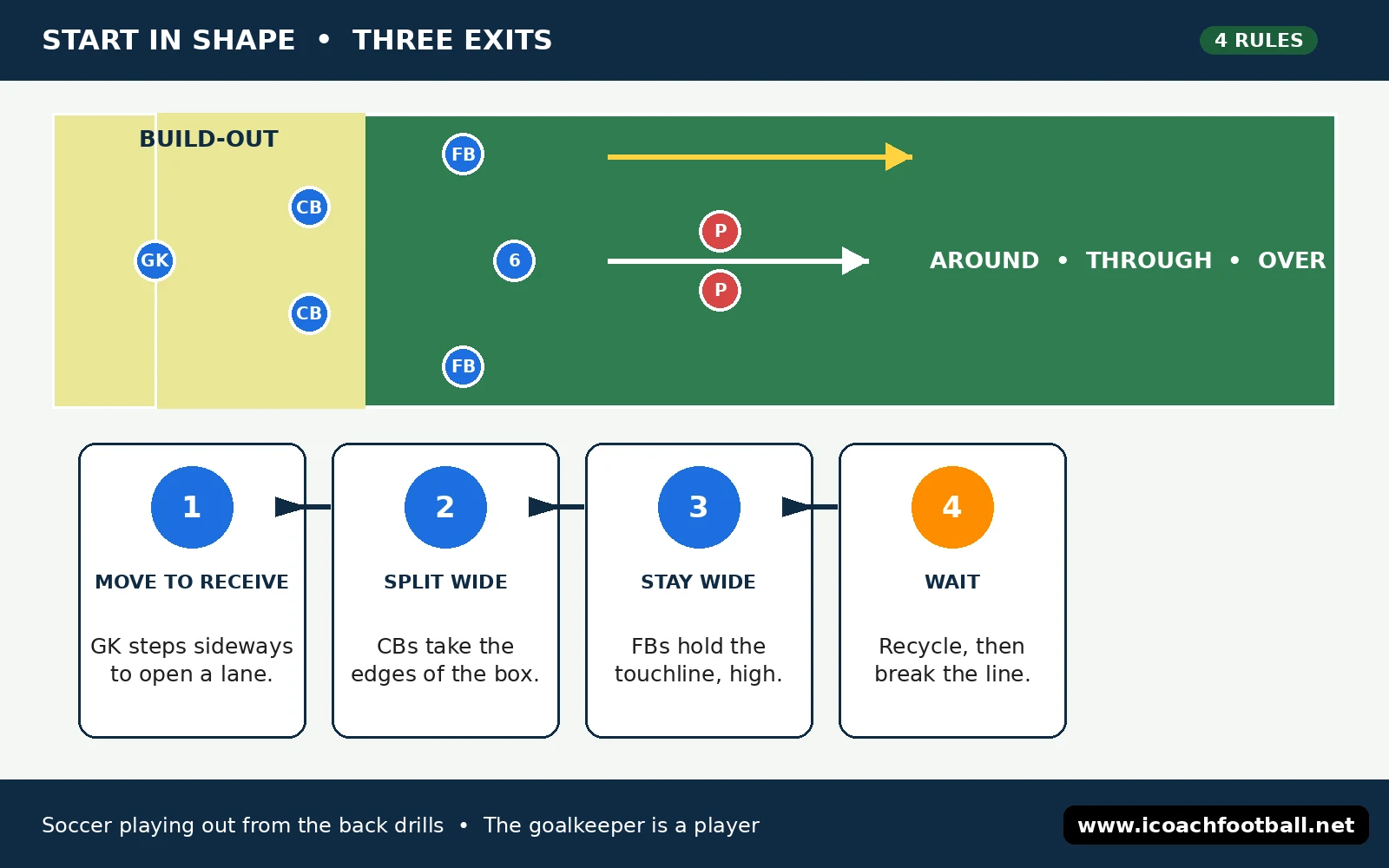
- Move to receive. Step sideways, away from the pressing striker, to open a new passing lane. The FIFA Training Centre calls this offering to receive and moving to receive.
- Split wide. The two centre-backs take the edges of the penalty area, so each can see the goalkeeper and the full-back on their side.
- Stay wide. Full-backs hold the touchline, high and wide, so the press must stretch to cover them.
- Wait for the moment. Keep the ball, recycle through the goalkeeper, and only break the first line when the press has committed. Patience creates the space.
- Play the free player. The first forward pass goes to the player the press left free, never into a marked player because the pass looks brave.
If your goalkeeper only watches the ball, fix the scan and support angle first with these soccer scanning drills; the shape below only works when the goalkeeper moves before the pass is played.
| What the press shows | Team does | First pass does |
|---|---|---|
| Two strikers press the centre-backs | Goalkeeper steps sideways and receives | Switch to the free centre-back |
| One striker blocks the middle | Full-back stays wide, midfielder drops | Play wide to the full-back |
| Press commits to one side | Recycle through the goalkeeper | Switch to the far side, in space |
| No press, defence drops off | Centre-backs carry forward | Play through the midfield line |
Drill 1 — The FIFA Goalkeeper Build-Up Diamond
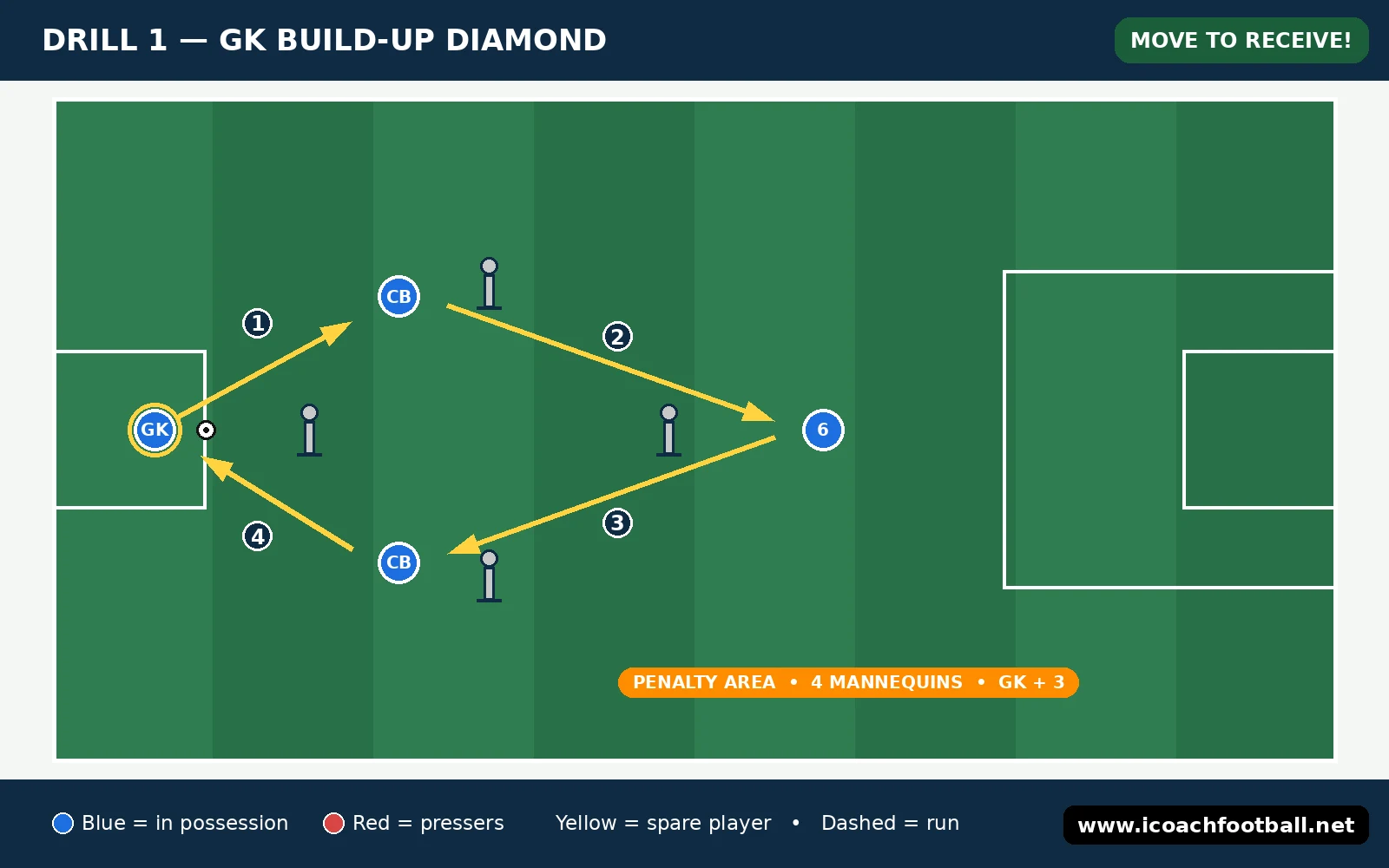
The unopposed start, based on the FIFA Training Centre goalkeeper build-up session by Dean Santangelo: the goalkeeper supports, receives and passes around mannequins, with the defenders learning the angles that beat a press.
Setup:
- Inside the penalty area, with four mannequins in a diamond on the edge of the area.
- A goalkeeper in goal, two centre-backs by the side mannequins, and one midfielder by the far mannequin.
- Balls with the goalkeeper, and a second group working with another coach if numbers allow.
How to Play:
- The goalkeeper starts with the ball and scans left and right before passing.
- The goalkeeper passes to the near centre-back, who receives side-on with an open body.
- The centre-back passes around the mannequin to the midfielder, who takes a forward first touch.
- The midfielder plays back to the far centre-back, who returns the ball to the goalkeeper.
- The goalkeeper shifts to the other side of the goal and repeats the sequence the other way.
Coach’s note: The cue is “Move to receive!” If the goalkeeper waits on the line for the return pass, stop the rep. The support angle is created by moving, not by standing in the right place.
Progressions: The return pass must be one touch, then a coach presses the centre-back lightly so the goalkeeper must choose the other side. The finer points of the goalkeeper’s feet are covered in these goalkeeper distribution drills, which train the same support angles at full speed.
Drill 2 — Split and Wide
The starting shape, in line with the FIFA Training Centre analysis of the goalkeeper’s role in the build-up phase: centre-backs split, full-backs wide, and the goalkeeper chooses the side with the free player.
Setup:
- Half pitch, with a full goal and goalkeeper at one end and two mini-goals at the halfway line.
- Back four in shape: two centre-backs at the edges of the penalty area, two full-backs wide and high.
- One holding midfielder in front of the centre-backs, and two passive pressers starting on the halfway line.
How to Play:
- The goalkeeper starts with the ball and the centre-backs split to the edges of the box.
- The full-backs push high and wide to the touchlines, and the midfielder drops to offer a central option.
- The goalkeeper scans both sides and passes to the centre-back with the clearer lane.
- The centre-back receives on the back foot and plays wide to the full-back in one or two touches.
- The full-back drives forward and scores in a mini-goal, then the next ball starts from the goalkeeper.
Coach’s note: The cue is “Split, wide, scan!” If a centre-back stands central in front of the goalkeeper, restart the rep. The split creates the angle; without it, the goalkeeper has no pass.
Progressions: The pressers may step in on the centre-back’s first touch, then the centre-back must set the ball back to the goalkeeper and the goalkeeper switches to the other side.

Drill 3 — The Bait and Switch
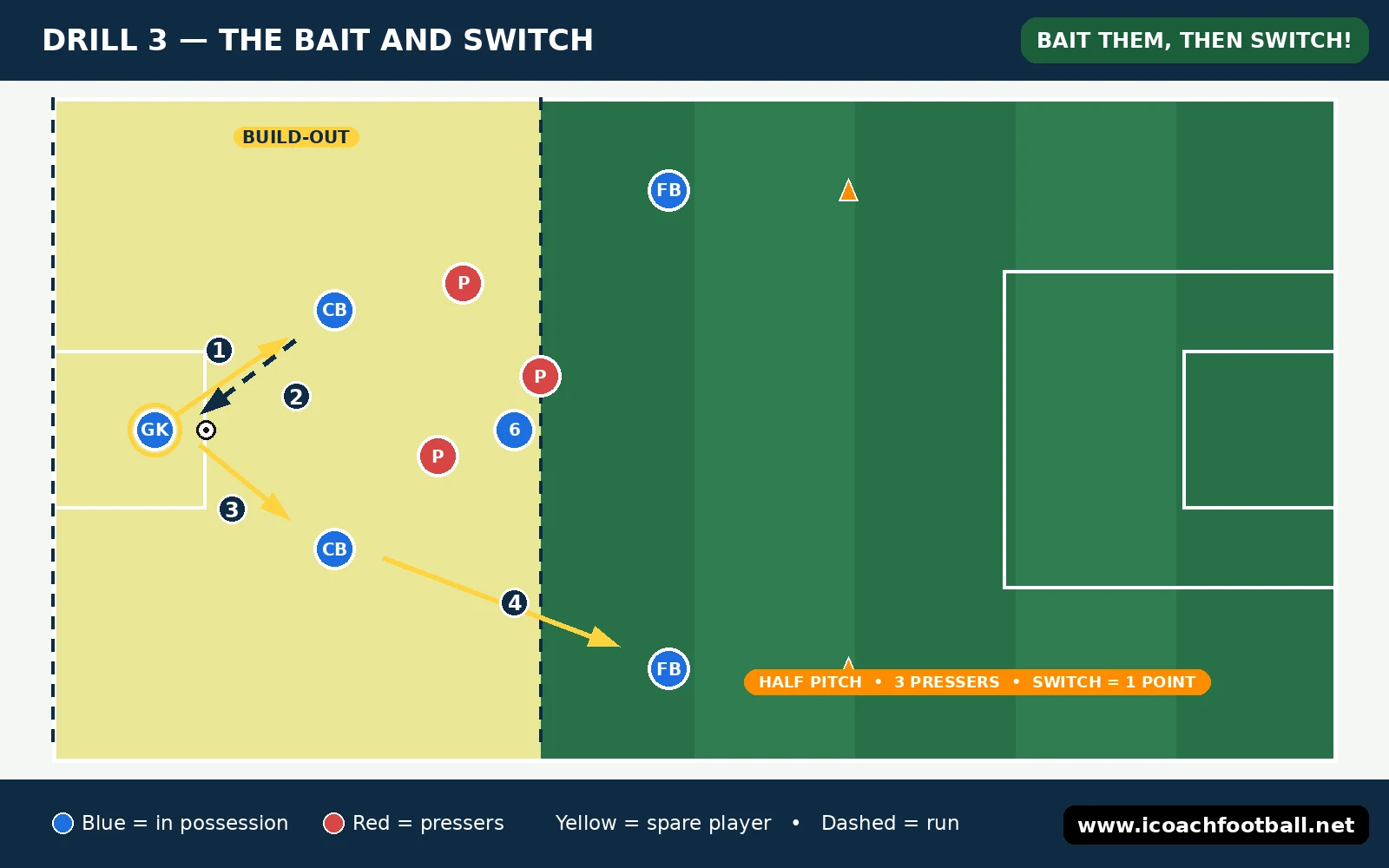
The patience test, based on the FIFA Training Centre finding that the most consistent build-up teams recycle possession rather than force a forward pass: invite the press to one side, recycle through the goalkeeper, and switch to the free side.
Setup:
- Half pitch, with a full goal and goalkeeper, a back four, and a holding midfielder.
- Three pressers in red, starting 15 yards from the ball, with a 4-minute block clock.
- Balls with the goalkeeper, and a switch target gate on each touchline at halfway.
How to Play:
- The goalkeeper plays short to the near centre-back, and the three pressers step in to that side.
- The centre-back does not force the forward pass and plays back to the goalkeeper.
- The goalkeeper moves sideways, away from the pressers, to open the lane to the far side.
- The goalkeeper switches play to the far centre-back, who receives side-on and open.
- The far centre-back plays wide to the full-back, who drives through the switch target gate for 1 point.
Coach’s note: The cue is “Bait them, then switch!” A team that plays forward into the press on the first pass scores nothing. The point is for the switch after the recycle, not for the first pass.
Progressions: The pressers may follow the switch, then the far centre-back must play first time to the full-back, so the switch is one pass, not two.
Drill 4 — Beat the Two Pressers
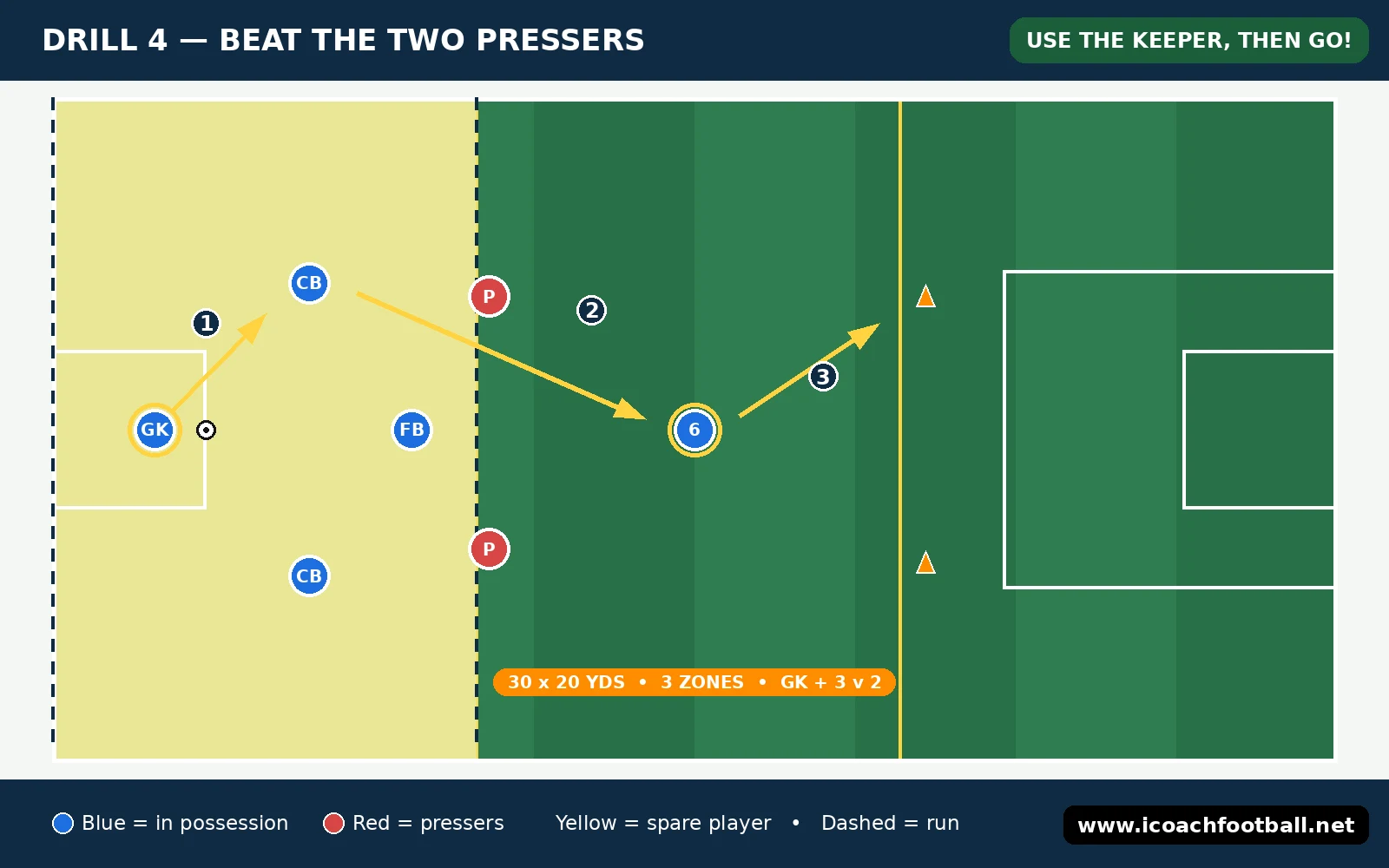
The pressure test. The goalkeeper and three defenders must play out against two live pressers and reach halfway without losing the ball.
Setup:
- A 30 x 20 yard area split into three zones, with a full goal at one end and two target gates on the halfway line.
- Goalkeeper plus three defenders against two pressers, with a holding midfielder waiting in the middle zone.
- Balls with the goalkeeper, and a 3-minute block clock.
How to Play:
- The goalkeeper starts with the ball and the three defenders split into a triangle in front of goal.
- The two pressers step in on the coach’s call, and the defenders must keep moving to offer angles.
- The ball moves through the goalkeeper at least once before it may leave the first zone.
- A defender plays forward to the midfielder, who receives on the half-turn in the middle zone.
- The midfielder plays through a target gate for 1 point, and the pressers rotate every block.
Coach’s note: The cue is “Use the keeper, then go!” If the defenders try to play out without the goalkeeper, freeze play. The spare player is the point of the drill, and skipping them hands the press its win.
Progressions: The pressers may press the goalkeeper directly, then the defenders must drop deeper and wider so the goalkeeper always has two angles. The half-turn receive that frees the midfielder is trained in these football half turn drills, where the body shape is set before the ball arrives.
Drill 5 — Around, Through, or Over
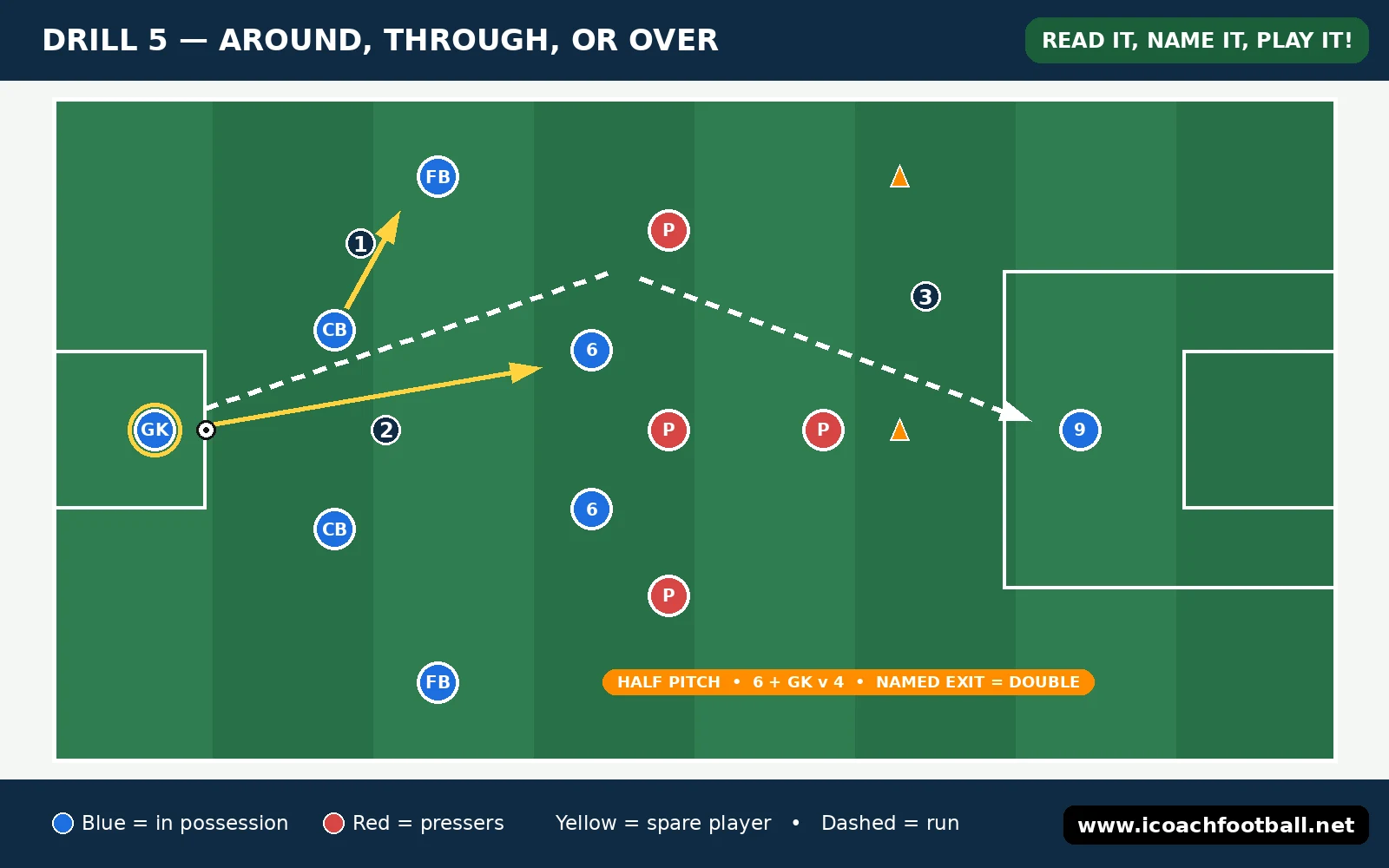
The decision game, in line with the FIFA Training Centre build-up analysis: the same starting shape produces three exits, and the press decides which one. Going around is patience, through is the reward, and over is the escape.
Setup:
- Half pitch, with a full goal and goalkeeper, a back four and two midfielders against four pressers.
- Three exit gates: wide gates on both touchlines, a central gate at halfway, and a long target zone beyond the press.
- Balls with the goalkeeper, and a 4-minute block clock.
How to Play:
- The team in possession starts in the split-and-wide shape from Drill 2, and the pressers set their trap.
- The goalkeeper scans and calls the exit: “Around!”, “Through!” or “Over!”
- Around: the ball goes wide to the full-back, who carries past the first presser and plays inside.
- Through: the ball goes through the midfield line to a midfielder on the half-turn, who turns and plays forward.
- Over: the goalkeeper clips the ball beyond the press to a forward, who holds it up while the team pushes up. A goal after any named exit counts double.
Coach’s note: The cue is “Read it, name it, play it!” If the goalkeeper plays without naming the exit, the rep does not count. Naming the decision before the pass is what makes it repeatable in a game.
Progressions: The pressers may change their trap mid-block, then the goalkeeper must switch the exit on the scan, so no exit is pre-decided.
Drill 6 — The Full Build-Out Game
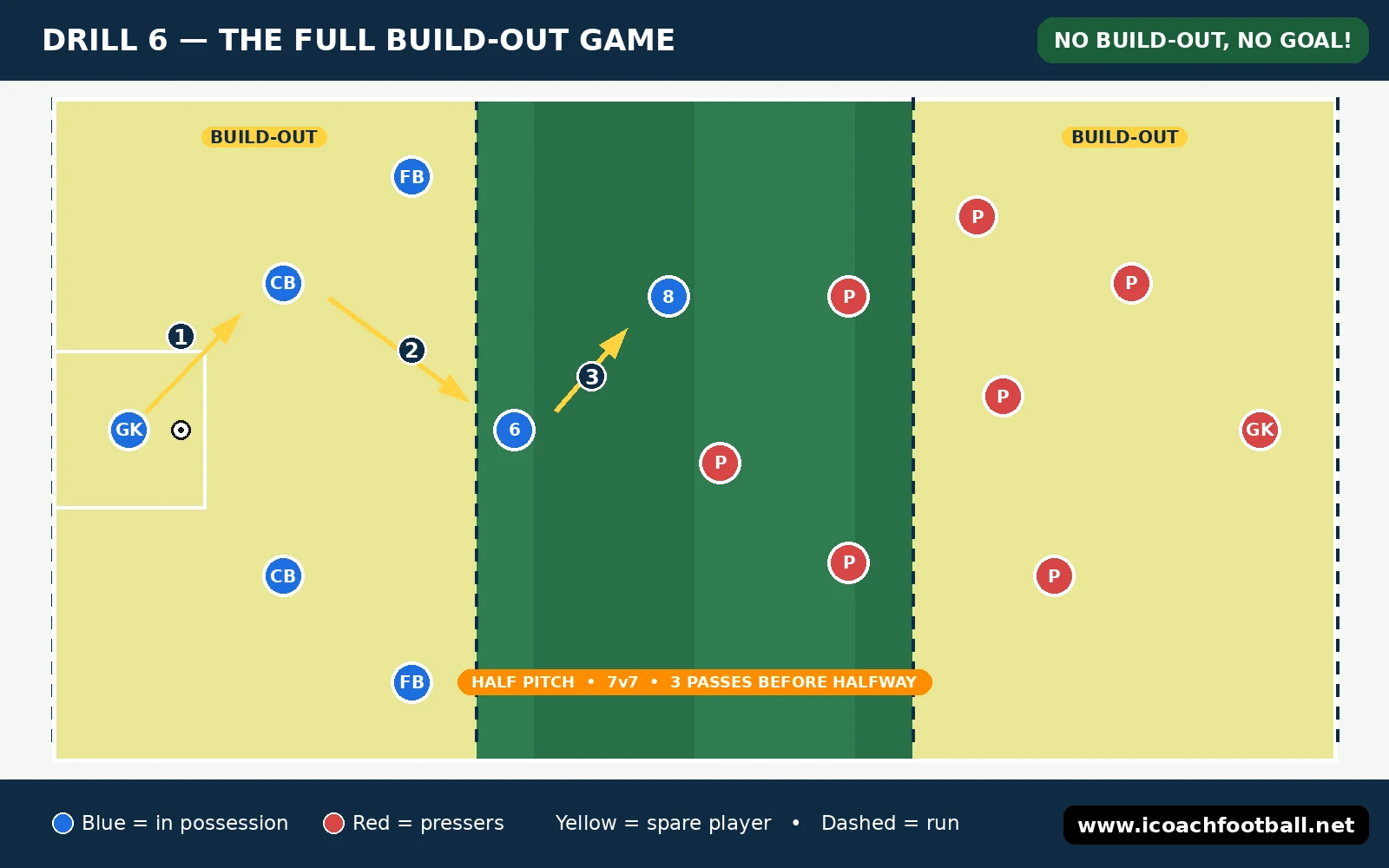
The real game. No goal counts unless the move started with a build-out from the goalkeeper, so every attack must play through the shape.
Setup:
- Half pitch, with a full goal at each end and a goalkeeper in each goal.
- Two teams of 7, with a shaded build-out zone in each defensive third and balls starting with the coach.
- A goal counts 1 point normally, and 2 points if the move started with a goalkeeper build-out through both thirds.
How to Play:
- The coach plays the ball to a goalkeeper, and both teams take the split-and-wide starting shape.
- The team in possession must complete at least three passes in its own third before crossing halfway.
- The ball must go through the goalkeeper or a centre-back on the way out, or the move resets to the goalkeeper.
- Once past halfway, teams play freely and may finish in either goal.
- Play four 4-minute blocks, keep a running score, and swap which team starts in possession each block.
Coach’s note: The cue is “No build-out, no goal!” If a team kicks long from the goalkeeper to skip the shape, freeze play. The constraint forces the scan, the split and the patience under real pressure.
Progressions: The touch limit in the build-out zone drops to two, then the build-out zone narrows by 5 yards, so the shape must be tighter and faster.
Coaching points
- “Move to receive!” In Drill 1, the goalkeeper steps sideways to open a lane. A still goalkeeper gives the press a free spare player.
- “Split, wide, scan!” In Drill 2, the centre-backs split and the full-backs stay wide. The shape creates the pass; the scan chooses it.
- “Bait them, then switch!” In Drill 3, the recycle through the goalkeeper is the weapon. Patience draws the press in and opens the far side.
- “Use the keeper, then go!” In Drill 4, the ball must go through the goalkeeper before leaving the first zone. Skipping the spare player is the mistake.
- “Read it, name it, play it!” In Drill 5, the exit is named before the pass. Around, through and over are decisions, not accidents.
- “No build-out, no goal!” In Drill 6, the constraint builds the habit. Once the ball is out cleanly, the next phase is receiving between the lines, trained in these football playing between the lines drills.
Common mistakes
| Mistake | Fix |
|---|---|
| Goalkeeper stands still on the line | Drill 1 cue “Move to receive!”; no rep counts from a still start |
| Centre-backs stand central in front of goal | Drill 2 split rule; restart any rep from a narrow start |
| First pass forced forward into the press | Drill 3 bait rule; recycle through the goalkeeper and switch |
| Defenders play out without the goalkeeper | Drill 4 rule; ball must go through the goalkeeper before leaving the zone |
| Team always plays wide, never through | Drill 5 call; name the exit, and demand the through option when it is open |
| Goalkeeper kicks long to skip the shape | Drill 6 rule; move resets to the goalkeeper, no goal counts |
Age adaptations
| Age | Change |
|---|---|
| U11–U12 | Drills 1 and 2 only, unopposed, with mannequins only and no live presser, and celebrate the split shape before any finish |
| U13–U14 | Full six-drill menu with a passive presser in Drills 3–4 and the around and through exits only in Drill 5 |
| U15–U16 | Live pressers in Drill 4, one-touch limit for the goalkeeper’s switch in Drill 3, and the over exit added in Drill 5 |
| U17–U18 | Smaller build-out zone in Drill 6, weaker-foot passes demanded from the goalkeeper in Drills 1–2, and no coach call on the exit decision |
60-minute session plan
Run the six games as one session with this 60-minute plan, or take any two games for a 20-minute block.
| Block | Time | Drill |
|---|---|---|
| 1 | 10 minutes | Drill 1 — The FIFA Goalkeeper Build-Up Diamond |
| 2 | 10 minutes | Drill 2 — Split and Wide |
| 3 | 10 minutes | Drill 3 — The Bait and Switch |
| 4 | 10 minutes | Drill 4 — Beat the Two Pressers |
| 5 | 10 minutes | Drill 5 — Around, Through, or Over |
| 6 | 10 minutes | Drill 6 — The Full Build-Out Game |
Once the starting shape is automatic, build the passing weight and timing around it with these soccer passing drills, which train the firm, accurate pass the goalkeeper and centre-backs need under pressure.
Sources
These soccer playing out from the back drills are based on, and in line with, the FIFA Training Centre goalkeeper build-up session by Dean Santangelo, in which goalkeepers position themselves to support, receive and execute passes when building from the back, scan left and right to identify the best options before receiving, use a quality first touch to move away from pressure, and keep a good distance from opponents to open safe passing angles, and with the FIFA Training Centre analysis of the goalkeeper’s role in the build-up phase, in which goalkeepers must be comfortable using both feet under direct and indirect pressure, offer to receive and move to receive when their team build possession, draw the press in to find space elsewhere, and vary distribution to break lines or go around the defensive block.
FAQ
What does playing out from the back mean in soccer?
It means building the attack from the goalkeeper through the defenders with short passes, instead of kicking long. The centre-backs split wide, the full-backs stay wide, and the goalkeeper acts as a spare passing option. The aim is to draw the press in and play out through the space it leaves.
Should youth teams always play out from the back?
No. Play out when the shape is set and a free player is available. If the press has every lane covered and no angle is open, the goalkeeper should play longer to a contest the team is set up to win. The decision is made on the scan, and Drill 5 trains all three exits.
How do centre-backs position themselves to play out?
They split to the edges of the penalty area, side-on and open, so each can see the goalkeeper and the full-back on their side. A centre-back who stands central blocks the goalkeeper’s angle and gives the press one player to cover both sides. Drill 2 sets the shape before any presser arrives.
Can playing out from the back drills work for young goalkeepers?
Yes, from U11 with the unopposed diamond in Drill 1 and mannequins only. Young goalkeepers learn to move to receive, scan both sides and pass with both feet first, and only meet a live presser in Drill 4 once the movement is automatic. The same games work in football at every age, because the starting shape does not change.
Why do teams lose the ball when they try to play out?
Three reasons cover most losses: the goalkeeper stands still, the centre-backs stay narrow, or the first pass is forced forward into the press. Fix them in that order with Drills 1, 2 and 3, and only then demand the pattern in the full game in Drill 6.