10 Essential Soccer Warm Up Drills (Fun & Injury Prevention)

Whether you are coaching a U8 grassroots team or a U19 academy squad, the warm-up is the most critical 15 minutes of your session. A poor warm-up leads to sluggish starts, poor decision-making, and a significantly higher risk of soft-tissue injuries.
But a modern warm-up is not just about “jogging a lap.” It is about physiological and tactical activation.
In this guide, we break down 10 of the most effective soccer warm-up drills. We have categorized them by age and objective, ensuring you have the right tool whether you need a fun game for kids or a high-intensity rondo for elite players.
Why Warm-Ups Matter in Soccer
✅ Reduces injury risk by increasing blood flow and joint mobility
✅ Improves coordination and reaction time
✅ Builds team chemistry through communication and movement
✅ Enhances technical execution under pressure
These drills aren’t just “getting loose.” They’re technical, tactical, and fun — perfect for players aged 10+.
The Science: The FIFA 11+ Standard
Before we dive into the specific drills, it is essential to understand the “RAMP” protocol used by top UEFA coaches to prevent ACL and hamstring injuries.
- R – Raise: Increase body temperature and blood flow (Low-intensity jogging/movement).
- A – Activate: Engage key muscle groups (Glutes, Hamstrings, Core).
- M – Mobilize: Dynamic stretching to open joints (Hip openers, Lunges).
- P – Potentiate: Increase intensity to match game speed (Sprints, Plyometrics).
Many of the drills below are inspired by the FIFA 11+ Injury Prevention Program, which has been proven to reduce training injuries by up to 50% when performed consistently.
1. 4 Balls, 6 Players – Dynamic Possession Warm-Up
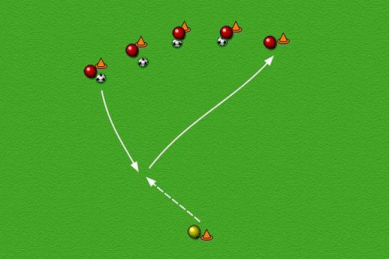
GAME ORGANISATION
- 5 Red players positions in an arc 10 meters away from a Yellow player.
- 4 of the Red players have a ball.
- 1 Red player passes their ball to the Yellow player and retreats to their starting position.
- Yellow player receives the ball and passes to the Red player without a ball.
- Repeat for 10 passes.
GAME ALTERATIONS
To make the drill easier:
Allow the player without the ball to call for it.
To make the drill more difficult:
Reduce the touches to 2 per player.
COACHES HINTS
- Do the players communicate/use each other’s names?
- Does the receiving player receive the ball on their toes and in a ready position?
- Is the ball moved at pace?
- Do the players use both feet?
2. 4 Goal Rugby – Reaction & Movement Drill

GAME ORGANISATION
- 4 vs. 4 / 5 vs. 5 / 6 vs. 6 in a 20 x 20 meter area (Reds vs. Yellows).
- Both teams defend one pair of goals and attack the others.
- Players play a competitive game by throwing the ball around to maintain possession.
- The ball cannot hit the ground, if it does possession is lost.
- When in possession the player can take a maximum of 5 steps.
- To score, the ball must be served to a team mate who either heads or volleys into one of
the designated goals.
GAME ALTERATIONS
To make the drill easier:
Players can score in any of the four goals.
To make the drill more difficult:
Designate one of the goals for headers to be scored and the other for volleys.
COACHES HINTS
- Do the players communicate and compete?
- Do the players move into space and transfer the ball quickly?
- Do the players use the correct techniques (headers and volleys)?
- Do the players have fun?
3. Dribble Wheel – Ball Control & Agility

GAME ORGANISATION
- This practice can work with any number of players.
- Start the practice with 6 players around a circle with 1 ball each.
- 1 player stands behind each player with a ball.
- Players with a ball dribble through the center area and out to a player without a ball.
- Ball is stopped in front of the outside player for a “takeover”.
- Continue practice.
GAME ALTERATIONS
To make the drill easier:
Players can dribble at any time thereby avoiding congestion in the center area.
To make the drill more difficult:
Only allow the players to use their weaker foot.
COACHES HINTS
- Do the players use all areas of the foot when dribbling?
- Do the players use both feet?
- Do the players have fun?
4. Inside Out – Footwork & Ball Mastery

GAME ORGANISATION
- Half the group positioned inside the area.
- Half positioned on the perimeter with a ball.
- On command “go” players inside call for a pass from any perimeter player.
- ‘Inside’ player receives the ball and dribbles to space to make a pass to another “outside” player.
- Aim is to receive, dribble and pass to every player involved in the practice.
GAME ALTERATIONS
To make the drill easier:
Allow the players to use only their stronger foot.
To make the drill more difficult:
Ask the “inside” players to perform a trick before passing the ball.
Use weaker foot only.
COACHES HINTS
- Do the players concentrate?
- Do the players make good decisions when passing and moving the ball?
- Is the pass accurate and well weighted?
- Do the players compete to be first to finish?
- Do the players use the correct techniques?
5. Long and Short – Passing Accuracy Under Pressure
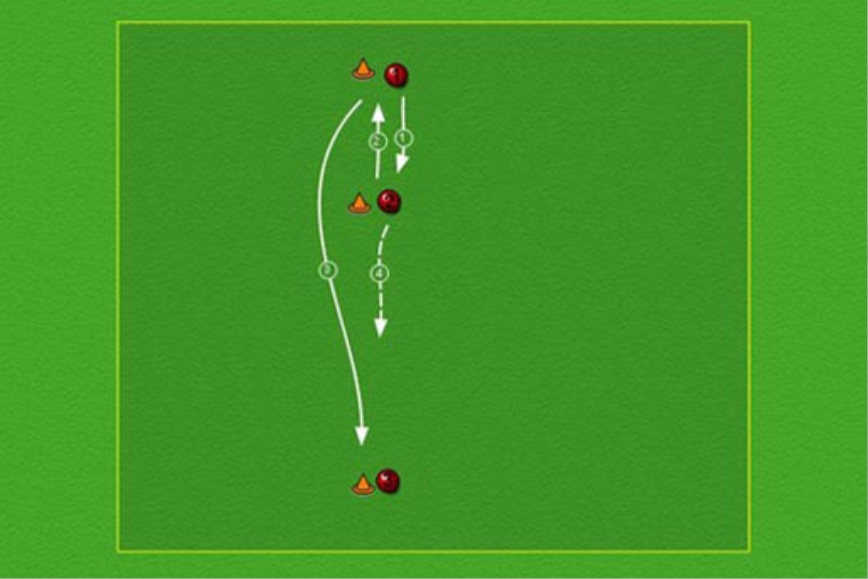
GAME ORGANISATION
- Players organized into groups of 3.
- Centre player 10 meters from one teammate and 20 meters from the other.
- Red 1 plays to Red 2.
- Red 2 plays the ball back to Red 1 who plays a long pass to Red 3.
- Red 2 makes a supporting run to Red 3.
- Red 3 passes to Red 2.
- Red 2 passes back to Red 3.
- Red 3 passes long to Red 1.
- Change positions after 1 minute.
GAME ALTERATIONS
To make the drill easier:
Players can use their stronger foot only.
To make the drill more difficult:
Players to use both left and right foot (2-touch).
COACHES HINTS
- Do players use both feet?
- Do players make well weighted passes?
- Is the passing accurate?
- Do the players have fun?
6. Pass Drop Pass – Reaction & Timing
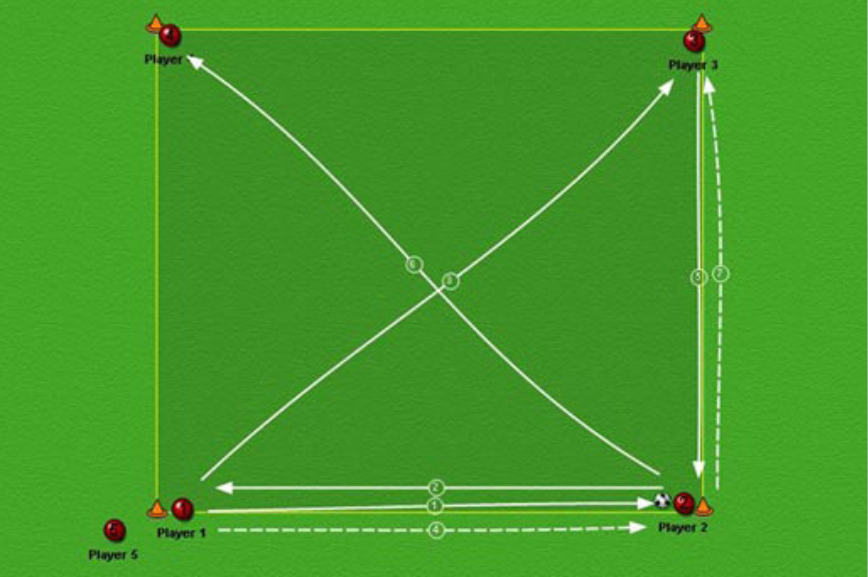
GAME ORGANISATION
- 5 players, 1 player on each corner except starting position where there are 2.
- Red 1 passes to Red 2.
- Red 2 drops ball back to Red 1 who passes to Red 3.
- Red 1 takes up Red 2’s position.
- Red 3 drops the ball back to Red 2.
- Red 2 passes to Red 4.
- Red 2 takes Red 3’s position.
- Continue around the square.
GAME ALTERATIONS
To make the drill easier:
Left footed and right footed players work together.
To make the drill more difficult:
Ask players to use their weaker foot.
COACHES HINTS
- Do the players concentrate?
- Is the pass accurate and well weighted?
- Do the players have fun?
7. Passing Triangle – Technical Foundation
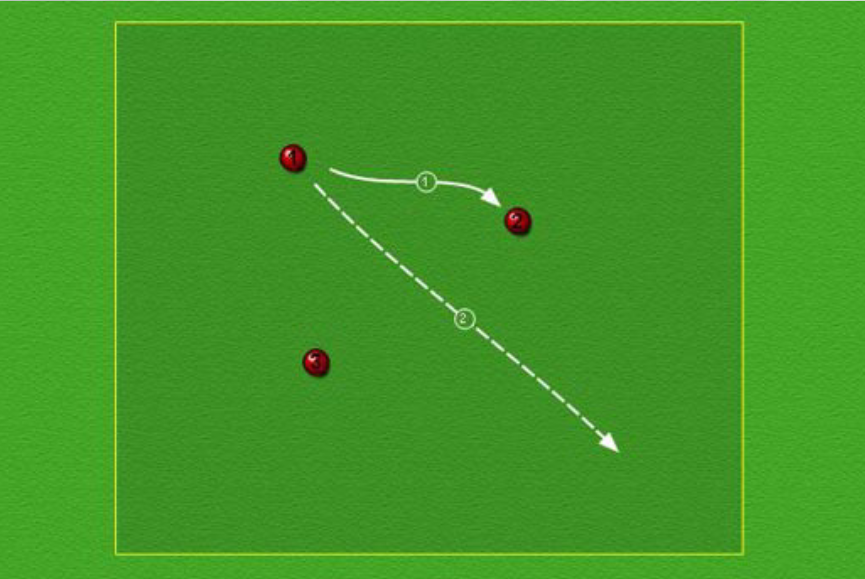
GAME ORGANISATION
- 3 players within a 10 x 10 meter area.
- With 1 ball each, player passes and then runs between the other 2 players.
GAME ALTERATIONS
To make the drill easier:
Passing player can make a run to any space and not between their team mates.
To make the drill more difficult:
Passing must be one touch.
COACHES HINTS
- Do the players control and pass accurately?
- Do the players use both feet?
- Do the players sprint between their team mates?
- Do the players have fun?
8. Roaming Goal – Dynamic Scoring & Movement

GAME ORGANISATION
- 2 players hold each end of a corner flag so it is parallel to the ground at waist height.
- The 2 players holding the flag move around the playing area – this is the “roaming goal”.
- The rest of the group pass and move and make space to attempt to pass the ball between
the “roaming goal”. - The aim is for the 2 players holding the flag to communicate with each other and move to
prevent the ball from being passed under the flag.
GAME ALTERATIONS
To make the drill easier:
Include an extra ball so 2 balls are being played.
To make the drill more difficult:
Players carrying the goal allowed to communicate and run.
COACHES HINTS
- Do the players move the ball at pace?
- Is the passing accurate and well weighted?
- Do the players pass and move into space quickly?
- Do they use both feet?
- Do the players communicate
- Do the players have fun?
9. Swap Sides
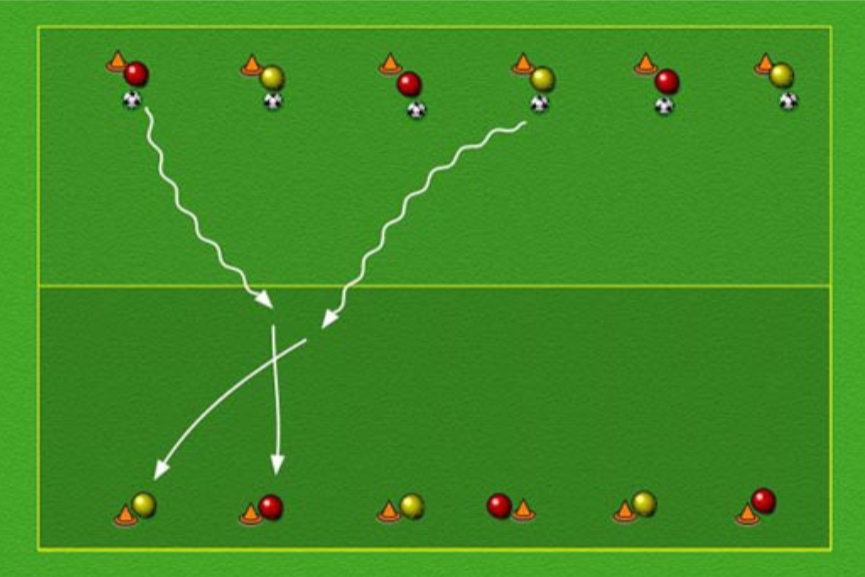
GAME ORGANISATION
- Reds and Yellows alternately spaced in each half of the area.
- Aim is for the players in possession to dribble using the inside and outside of their feet across the central line before passing the ball to a same coloured player on the other side of the area.
- Players return to their starting positions.
- Game is continuous.
GAME ALTERATIONS
To make the drill easier:
Create more space by making the playing area bigger.
To make the drill more difficult:
Coach shouts “opposite” so players in possession have to pass to a different coloured player.
COACHES HINTS
- Do the players keep the ball close and use the inside/outside of their shoe?
- Do they move at pace?
- Do they communicate and call the name of the player they are passing to?
- Do the players have fun?
10. Tails
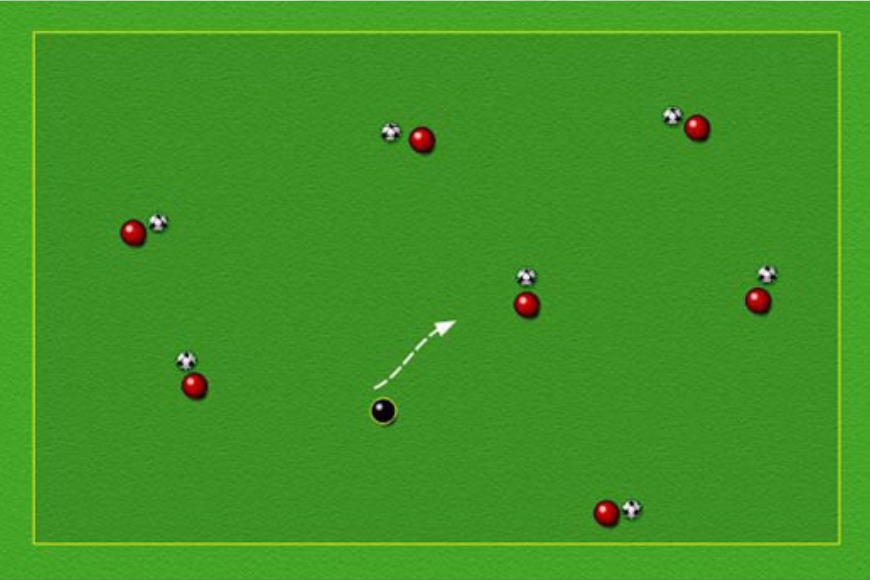
GAME ORGANISATION
This practice can work with any number of players.
Position all players within a designated area; each with a ball and a bib (“tail”) tucked
into the side of their shorts (the majority of the tail must be visible).
1 player is the chaser and attempts to pull out as many bibs as possible in 30 seconds
Player cannot “defend” their tail with their hands.
GAME ALTERATIONS
To make the drill easier:
Players have 2 tails
To make the drill more difficult:
Make the area bigger.
Add additional chasers.
Chaser must also dribble a ball.
COACHES HINTS
- Do the players use fakes and moves to beat the “chaser”?
- Do the players use both feet when dribbling?
- Do the players change direction quickly?
- Do the players have fun?
✅ Pro Warm-Up Checklist for Coaches
Total Time: 15–20 minutes — ideal for pre-match or pre-training.
⚡ High-Tempo Warm-Up Variations
Sometimes, a standard rondo isn’t enough. If your team looks lethargic or you are preparing for a high-stakes match, you need to spike the intensity immediately.
Watch the video below to see 5 High-Tempo Drills used by elite teams. Notice how these exercises combine rapid ball movement with physical sprints to bridge the gap between “warming up” and “match speed.”
📹 The Video Embed
Conclusion: Planning the Perfect Session
A great warm-up sets the tone, but it is just the beginning. Once your players are physically active and mentally focused, you need to transition smoothly into the main part of your practice.
These 10 drills combine technical development, movement patterns, and team cohesion — all while keeping players engaged. Use them consistently, and you’ll see:
- Fewer injuries
- Sharper passing
- Faster transitions
- Higher player morale
Explore our library of Soccer Warm Up Drills for more specific exercises.
Common Questions About Soccer Warm-Ups & Injury Prevention
How long should a soccer warm-up be?
proper soccer warm-up should last between 15 and 20 minutes. It should start with low-intensity running (pulse raiser), move into dynamic stretching (mobilization), and finish with high-intensity movements (potentiation) and ball work.
What is the best warm-up for U8 or U10 players?
For youth players, avoid static lines and lap running. The best warm-ups are “Tag” games or ball mastery grids (like “Chaos”). These drills improve coordination and reaction time while keeping kids engaged and having fun.
Does the FIFA 11+ program actually prevent injuries?
Yes. Extensive studies show that teams performing the FIFA 11+ warm-up routine at least twice a week can reduce injury rates by 30-50%, specifically reducing ACL and hamstring tears.
Should goalkeepers do the same warm-up as the team?
Goalkeepers should join the team for the initial “Pulse Raiser” and “Rondo” possession work to build team chemistry. However, they need to break away for the final 10 minutes to focus on specific handling, diving, and reaction mechanics.
What is the difference between a Training Warm-Up and a Pre-Match Warm-Up?
A training warm-up often includes a learning component or a specific technical focus. A Pre-Match warm-up is strictly about physical activation and psychological preparation—it should be routine, familiar, and intense to ensure players are ready for kickoff.