Soccer Tryout Drills: A Coach’s 90-Minute Evaluation Session
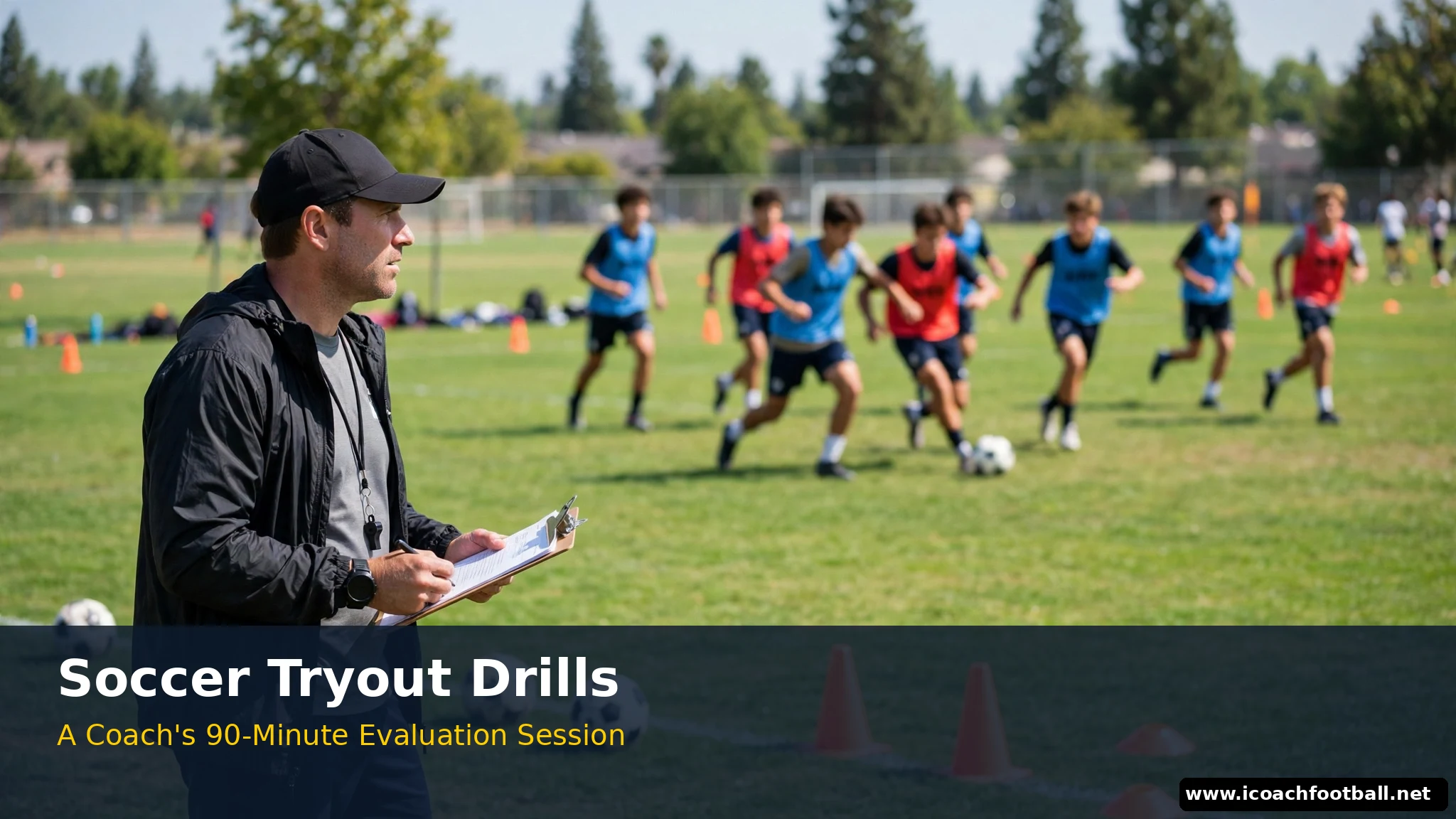
Quick answer: Run five games, not five lines of cone drills. Score each player 1–5 on technique, decision-making, athleticism and coachability after every game, and let a 4v4 small-sided game carry the most weight. One 90-minute session, run this way, gives every player a fair look and gives you selections you can defend.
A tryout fails when only the loudest, fastest players get seen. A queue of players waiting for a cone drill tells you who can dribble in a straight line. It tells you nothing about who scans, who recovers, or who helps a teammate.
The session below fixes that. Every drill is a game with an opponent, a decision and a score. In the UK the same session is usually called football trials preparation, and the structure works there too: small games, clear criteria, no single-drill cuts.
If you need a shorter structure for a regular training night, use this 60-minute session plan as the timing template, then run the 90-minute evaluation below.
- Players: 16–24 (works with 12–30; add a second 4v4 pitch above 24)
- Area: Half a pitch, split into a 30 x 20 yard main area plus two 15 x 15 yard grids
- Duration: 90 minutes, including warm-up and debrief
- Focus: First touch under pressure, 1v1 attack and defence, passing under pressure, finishing, small-sided decisions
- Equipment: Cones, bibs, numbered bibs or numbered shirts, balls, two full-size goals or four mini goals, clipboards, one evaluator per station
- Age: U11–U18 (see age adaptations)
The 90-minute plan
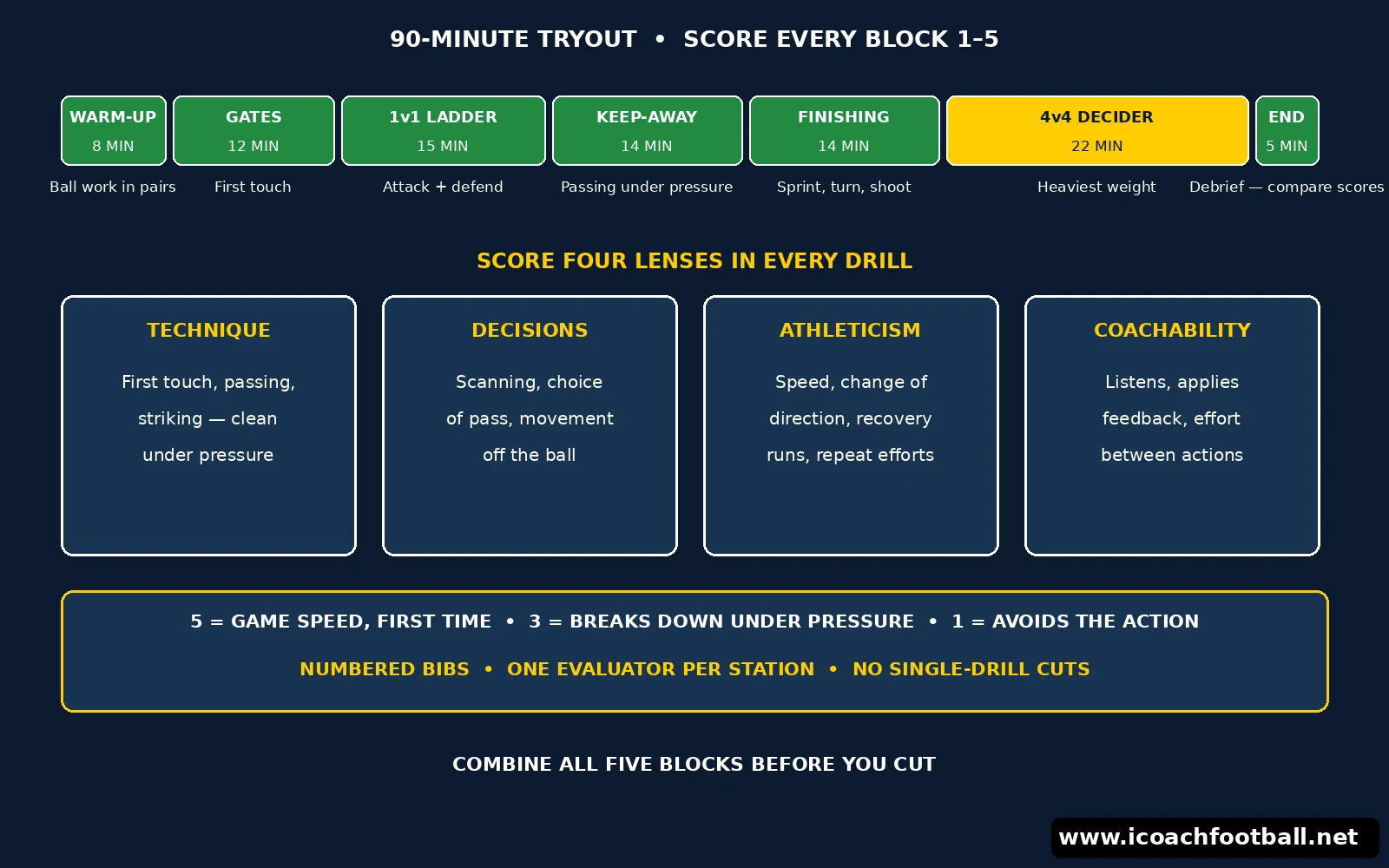
| Block | Minutes | What happens |
|---|---|---|
| Arrival warm-up | 8 | Ball work in pairs, no lines, evaluators watch movement and attitude |
| Drill 1: First-Touch Gates | 12 | Receiving under pressure, touch through a gate |
| Drill 2: 1v1 Ladder | 15 | Attack and defend in short, repeated duels |
| Drill 3: 3v2 Keep-Away | 14 | Passing and pressing in a tight grid |
| Drill 4: Finishing Under Pressure | 14 | Sprint, turn, shoot with a defender chasing |
| Drill 5: 4v4 Decider | 22 | Small-sided games, the heaviest-weighted evidence |
| Debrief and scores | 5 | Evaluators compare notes while players cool down |
How to score: the 1–5 rubric
- Score after each block, not during it. Watch first, write second. Scoring while play runs means you watch your clipboard.
- One evaluator per station. The same eyes score the same drill for every player, so the scale stays consistent.
- Use numbers, not names, on the sheet. Numbered bibs stop memory and reputation doing the selecting.
- No single-drill cuts. A player who is poor at Drill 1 can still win Drill 5. Cut only on the combined score across all five blocks.
- Score four lenses in every drill: technique, decision-making, athleticism, coachability.
| Score | What it looks like |
|---|---|
| 5 | Does it at game speed, under pressure, first time, and repeats it |
| 4 | Does it well under pressure, with one clear correction needed |
| 3 | Does it when unopposed or at low speed, breaks down under pressure |
| 2 | Attempts it but loses the ball, the duel or the shape repeatedly |
| 1 | Avoids the action, stops, or does not engage |
Drill 1 — First-Touch Gates
Receiving is the first thing to grade. A poor first touch ends every later action.
Setup:
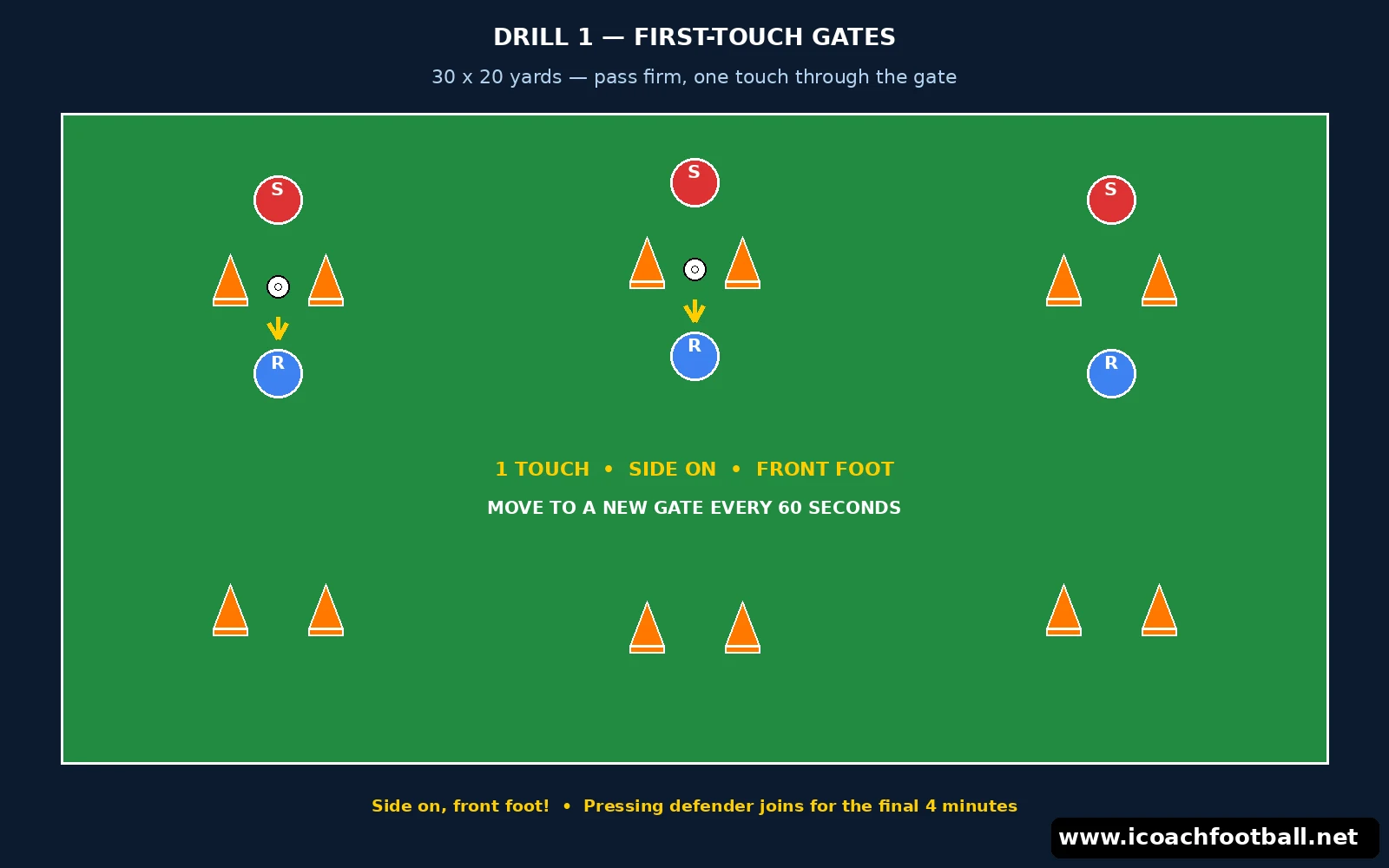
- One 30 x 20 yard area, with six gates (two cones, 2 yards apart) spread inside it.
- Players in pairs, one ball per pair, one server and one receiver at each gate.
- A coach or evaluator at each end, watching touches only.
How to Play:
- The server passes firmly to the receiver’s front foot.
- The receiver takes one touch through the nearest gate.
- The receiver turns, passes back, and the pair swaps roles.
- After 60 seconds, pairs move to a new gate.
- On the coach’s call, a defender steps in and presses the receiver for the final 4 minutes.
What to grade: First touch direction, body shape before the ball arrives, and weak-foot touches.
Coach’s note: The cue is “Side on, front foot!” A receiver facing the server square-on has already lost the next pass.
Progressions: Add the pressing defender, shrink the gates to 1 yard, or require the touch with the back foot only.
Drill 2 — 1v1 Ladder
Short duels show courage, change of direction and defending intent in seconds.
Use these 1v1 finishing drills to give attackers extra finishing options after they beat the defender.

Setup:
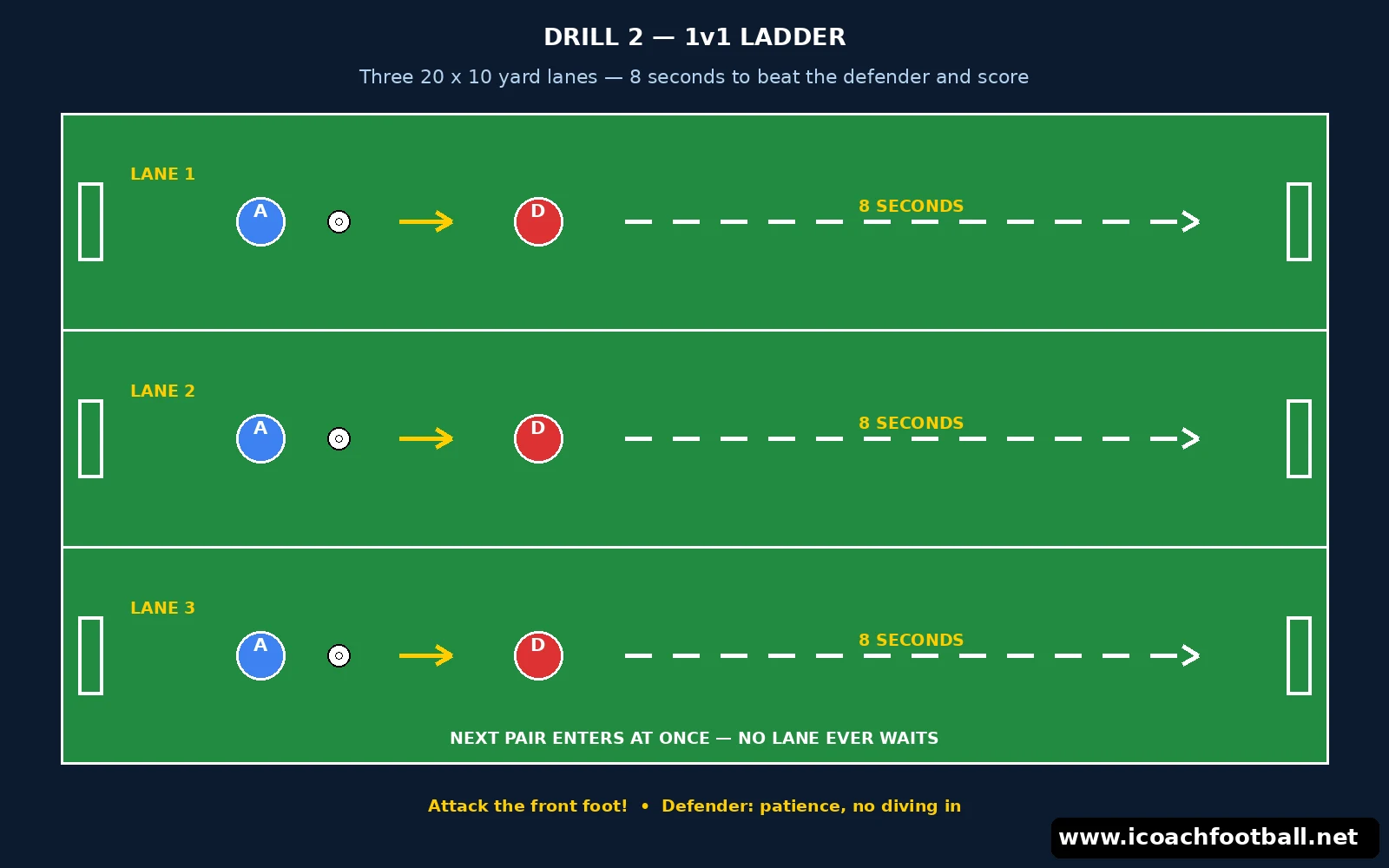
- Three lanes, each 20 x 10 yards, with a mini goal at each end.
- One attacker and one defender per lane, the rest waiting at the side in numbered order.
- One ball per lane, spare balls behind each goal.
How to Play:
- The defender passes to the attacker and closes down at once.
- The attacker has 8 seconds to beat the defender and score.
- If the defender wins the ball, they attack the opposite goal.
- The pair leaves the lane and joins the back of the queue.
- The next pair enters immediately, so no lane ever waits.
What to grade: Attacking move at speed, defending patience (no diving in), and recovery after being beaten.
Coach’s note: The cue is “Attack the front foot!” Watch the defender’s first step, not the attacker’s feet. A defender who stabs gives the duel away.
Progressions: Add a recovering second defender after 4 seconds, or require the attacker to finish with the weak foot.
Drill 3 — 3v2 Keep-Away
Possession under pressure separates players who scan from players who stare at the ball.
These soccer scanning drills build the check-your-shoulder habit this game grades.
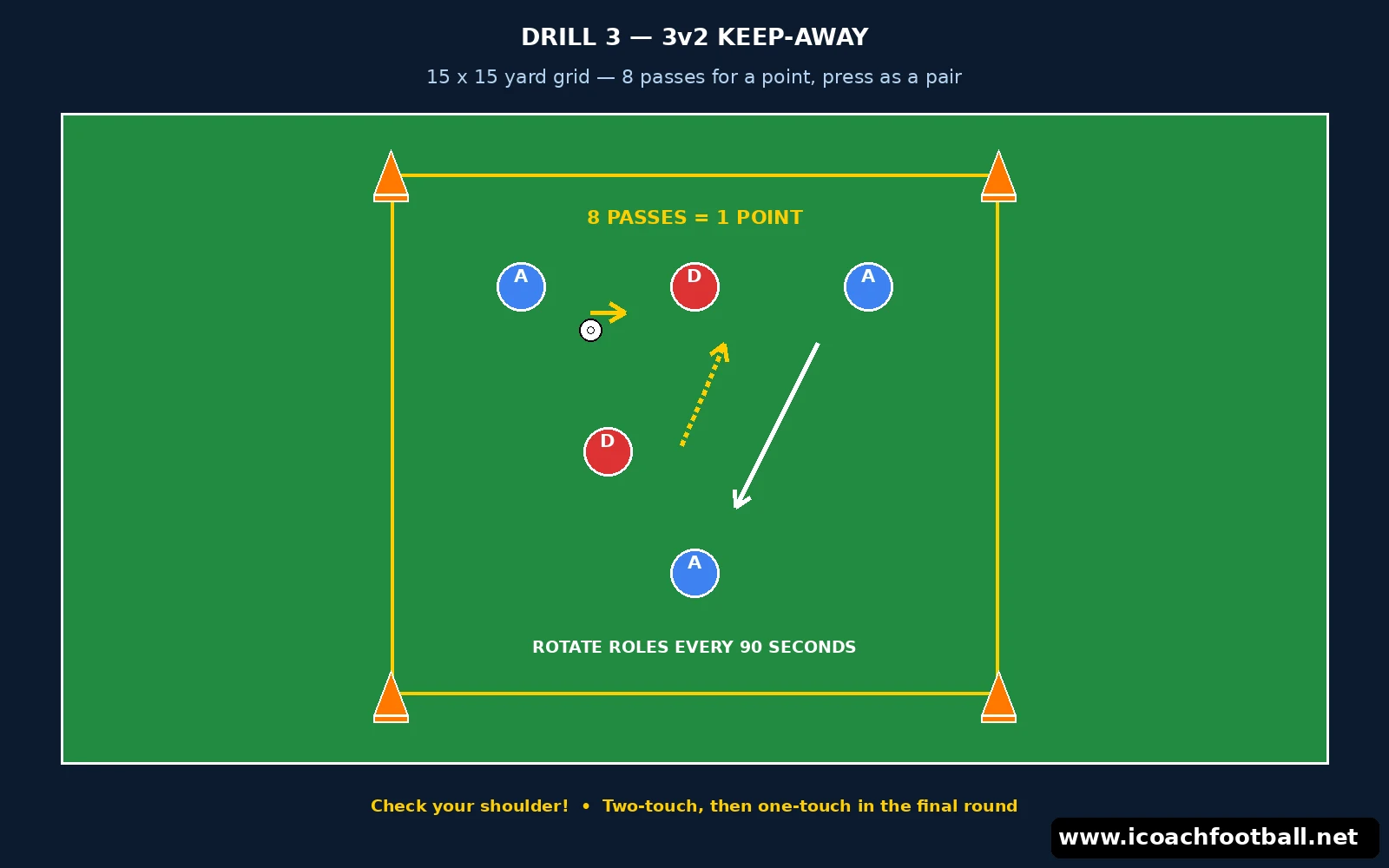
Setup:
- One 15 x 15 yard grid per six players (run two grids for 24 players).
- Three attackers in blue bibs, two defenders in red, one ball.
- An evaluator on each grid, scoring only this game.
How to Play:
- The three attackers keep the ball with two-touch play.
- The defenders press together and hunt the same passing lane.
- Eight consecutive passes earns the attackers a point.
- If a defender wins the ball, the attacker who lost it swaps in.
- Rotate all three roles every 90 seconds, so everyone attacks and defends.
What to grade: Scanning before receiving, first-touch direction away from pressure, and pressing as a pair.
Coach’s note: The cue is “Check your shoulder!” Players who receive facing their own goal with a defender behind them lose the ball before they look up.
Progressions: Go to one touch, shrink the grid to 12 x 12 yards, or add a neutral player who always joins the team in possession.
Drill 4 — Finishing Under Pressure
Finishing without pressure flatters everyone. Add a sprint and a chasing defender, and composure shows.
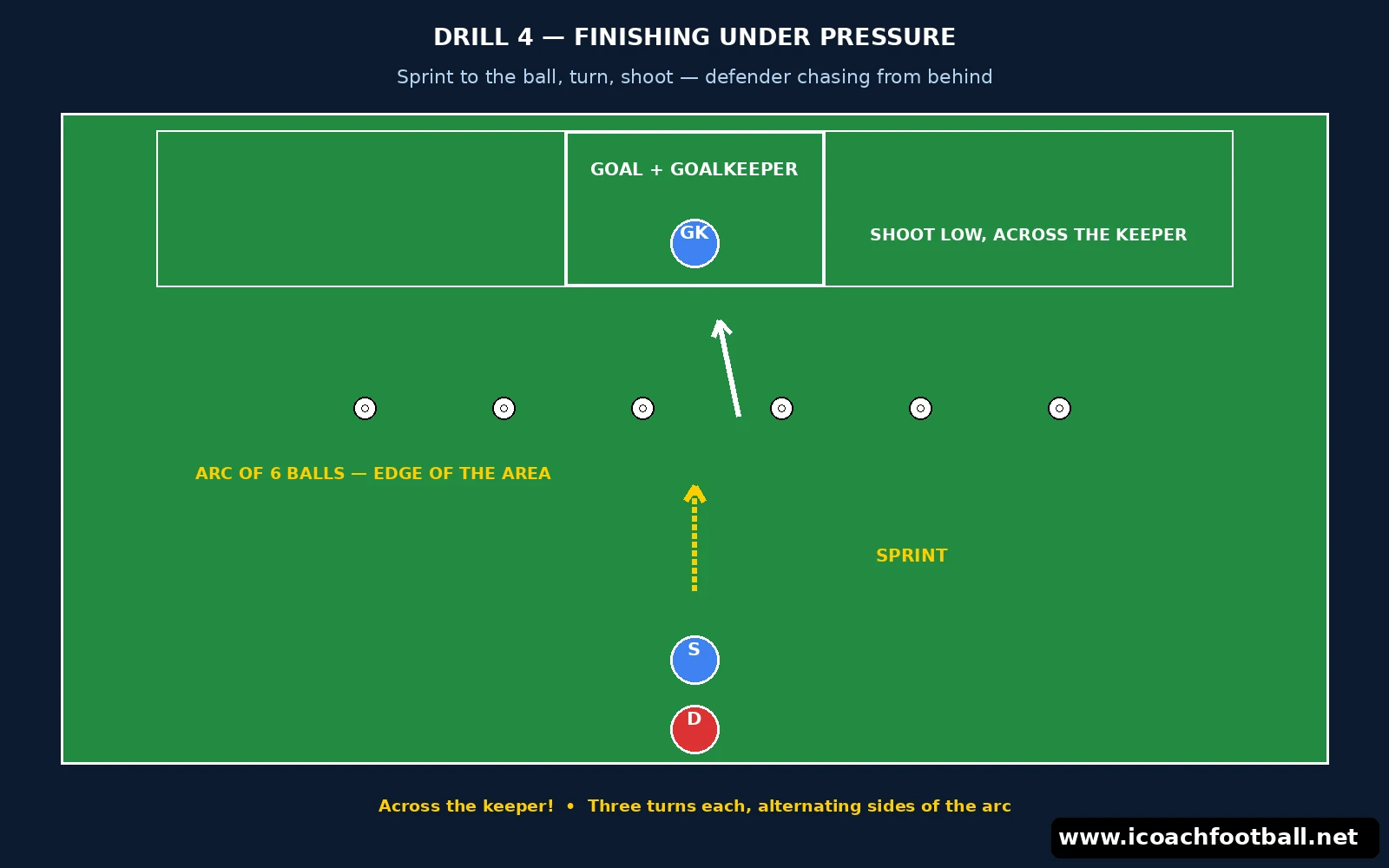
Setup:
- One full-size goal with a goalkeeper, a penalty area, and an arc of six balls on the edge of the area.
- One shooter at the arc, one defender starting 5 yards behind the shooter.
- A server at each side of the area, feeding the next ball at once.
How to Play:
- The shooter sprints from the halfway line to the nearest ball.
- The shooter turns and shoots first time, or takes one touch and shoots.
- The defender chases from behind and may block, but may not foul.
- After the shot, the shooter collects a ball and joins the serving line.
- Every player takes three turns, alternating sides of the arc.
What to grade: Shot placement over power, head up before the shot, and the sprint back after a miss.
Coach’s note: The cue is “Across the keeper!” Shots straight at the goalkeeper waste the sprint. Aim low, across the body, into the far corner.
Progressions: Serve the ball bouncing or in the air, or let the defender start level with the shooter for the final round.
Drill 5 — 4v4 Decider
This is the decider. Weight it heaviest, because it is the closest thing to a real match.
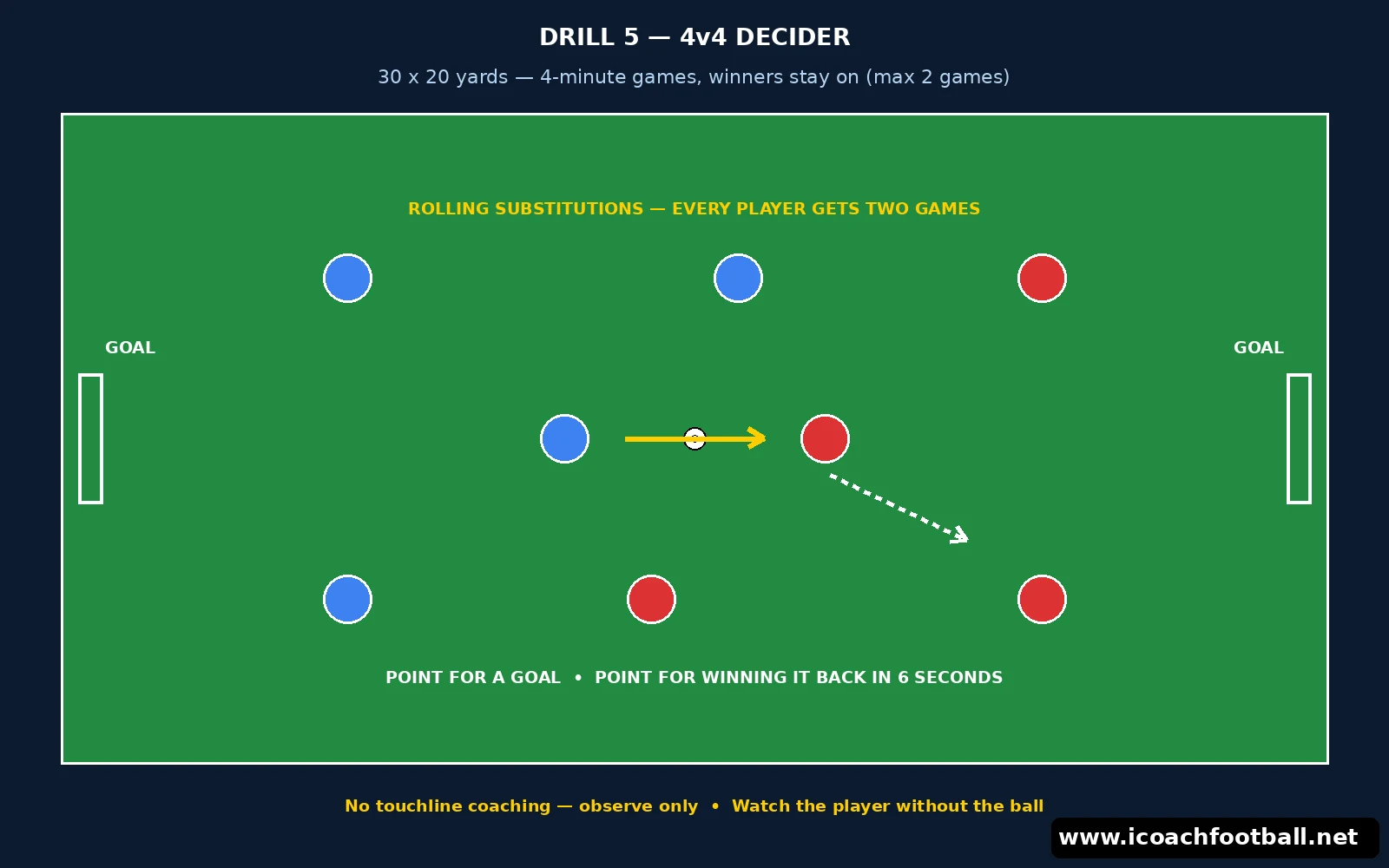
Setup:
- One 30 x 20 yard pitch, two full-size goals or four mini goals, goalkeepers if available.
- Two teams of four, numbered bibs, one evaluator per team watching off-ball work.
- Rolling substitutions: a new four enters every 4 minutes, so every player gets two games.
How to Play:
- Play 4-minute games, winners stay on for a maximum of two games.
- Restart at once with a ball from the coach when the ball leaves play.
- No coaching from the touchline during the game; observe only.
- Award a point for a goal, and a point for winning the ball back within 6 seconds.
- Between games, rotate one player per team so combinations change.
What to grade: Movement off the ball, recovery runs, communication, and decisions in transition both ways.
Coach’s note: Watch the player without the ball for 10 seconds at a time. The best tryout players keep moving, showing for the ball and covering a teammate, when nobody is watching them.
Progressions: Add a neutral player who plays for the team in possession, or require three passes before a shot counts.
Coaching points for the whole session
- Watch, do not coach. A tryout is an observation session. Coach the next training session; score this one.
- Compare like with like. Score defenders in Drill 2 and Drill 5, not on finishing alone. A centre-back who loses a shooting drill has told you nothing.
- Note effort between actions. Sprinting back, calling for the ball and helping a teammate up are selection evidence, not extras.
- Keep the tempo high. Short games, instant restarts and no speeches between blocks keep every player warm and visible.
Common mistakes
| Mistake | Fix |
|---|---|
| Long cone-dribble lines with no opponent | Replace every line with a game that has a defender and a decision |
| One evaluator trying to watch 24 players | Put one evaluator on each station and compare combined scores after |
| Cutting players after a single drill | Score all five blocks first; a slow start is not a failed tryout |
| Coaching loudly through the 4v4 | Stay silent, take notes, and let the game show you the players |
| Picking only the biggest, fastest players | Score technique and decisions separately, and note birth month before final cuts |
Age adaptations
| Age | Change |
|---|---|
| U11–U12 | Shorten the 1v1 lanes to 15 x 8 yards, use 8-second duels, and score effort and first touch heaviest |
| U13–U14 | Run the session as written, with mini goals in Drill 5 if no goalkeepers are available |
| U15–U16 | Add the second defender in Drill 2 and one-touch play in Drill 3 for the final round |
| U17–U18 | Play Drill 5 as 5v5 on a 35 x 25 yard pitch, and grade pressing triggers and rest defence explicitly |
Sources
The session is in line with the FIFA Training Centre’s small-sided games approach, which uses short 2v2 and 3v3 games with changing partners to judge technique and decisions under pressure, and with FIFA’s Talent Coach Programme, which stresses identifying talent by putting players in competitive, game-like situations and judging them on more than one skill at a time.
Frequently Asked Questions
How long should a soccer tryout last?
90 minutes is enough for five scored games. Shorter than 60 minutes and the 4v4 decider gets squeezed; longer than two hours and fatigue, not ability, decides the late games.
How many soccer tryout drills should a coach run?
Five, one per quality you need to see: first touch, 1v1, passing under pressure, finishing and small-sided play. More drills mean less evidence per drill, not better decisions.
What do coaches look for first at tryouts?
First touch and decision-making under pressure. Speed and size help, but a player who receives cleanly, scans and picks the right pass keeps the ball for the team.
Should goalkeepers try out separately?
Yes, for part of the session. Give goalkeepers the finishing drill and the 4v4 games with the group, then add a 10-minute shot-stopping block so distribution and handling are both seen.
How do you make soccer tryout cuts fair?
Score every player in every drill with numbered bibs, combine the five block scores, and cut only on the combined total. Share the criteria with players and parents before the session starts.