Soccer Drills for Girls: 6 Games That Build Confidence, Skill and Safe Landings
Quick answer
Girls’ teams need the same six skills every team needs — dribbling, passing, 1v1s, finishing — plus two things most sessions skip: a warm-up that teaches safe landing, and a coaching style that keeps players coming back. These six games do both in one 60-minute session.
Suitable for: U10–U15 (ages 9–15)
Session snapshot
- Players: 10–16 (one girls’ team)
- Area: Half a pitch
- Duration: 60 minutes
- Focus: Dribbling, passing, 1v1s, finishing, safe landing
- Equipment: 1 ball per player, 20 cones, 4 mini goals, bibs
Why these six games work
In the UK the same session is girls’ football, and the problem is the same on both sides of the Atlantic: girls arrive at very different confidence levels, and too many leave the game by 14. UEFA’s Playmakers programme — built for girls aged 5–8 and now reaching more than 200,000 girls in 46 countries — puts it plainly: first impressions count, and sessions must build confidence, creativity and friendship in a pressure-free environment. That principle does not stop at age 8. The six games below run on it: every player has a ball, nobody stands in a line, and praise goes to effort and good decisions, not just goals. The drills themselves follow the FIFA Training Centre’s grassroots pattern — small teams, a ball each, a decision every few seconds. And the warm-up is not a jog: it is the FIFA 11+ Kids landing programme, which a peer-reviewed trial on 36 preadolescent female players aged 10–12 found improves knee flexion and hip control on landing after eight weeks, twice a week — the two movement patterns most tied to ACL stress in young female players.
Safe-landing warm-up: 5 minutes from FIFA 11+ Kids
Before the first drill, run these five moves — they are the first level of the FIFA 11+ Kids programme, built for ages 7–13. Coach one cue per move and nothing else.
- Skating jumps. Jump side to side, landing on one leg, knee bent, knee over the toes.
- Single-leg stance. Stand on one leg for 10 seconds, knee slightly bent, foot pointing forward.
- Single-leg jumps. Small hops forward on one leg, landing soft with a bent knee.
- Spiderman. Hands on the ground, step one foot up beside the hand, hold, swap sides.
- Sideways roll. Roll sideways on the ground and stand up in one smooth move.
Coach’s cue: “Land like a cat — soft knees, knee over your toes, never locked straight.” Repeat the warm-up at the start of every session; the study ran it twice a week for eight weeks.
Six rules of coaching girls
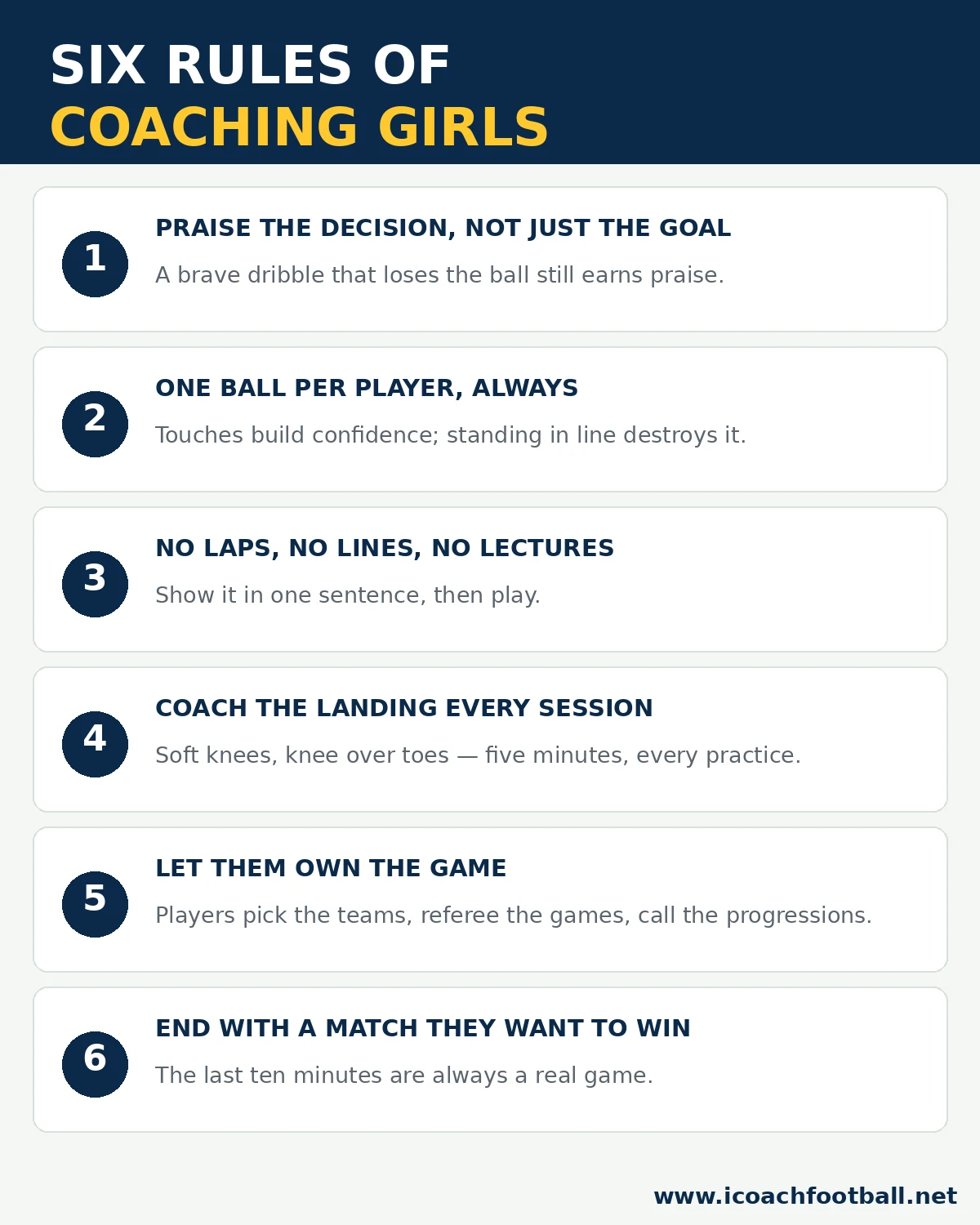
- Praise the decision, not just the goal. A brave dribble that loses the ball still earns praise.
- One ball per player, always. Touches build confidence; standing in line destroys it.
- No laps, no lines, no lectures. Show it in one sentence, then play.
- Coach the landing every session. Soft knees, knee over toes — five minutes, every practice.
- Let them own the game. Players pick the teams, referee the small games, call the progressions.
- End with a match they want to win. The last ten minutes are always a real game.
Drill 1 — Gate Dribble Relay
Pairs race through cone gates, dribbling with both feet. The confidence builder: every player succeeds in the first minute, and the weak foot only appears once the strong foot feels easy.
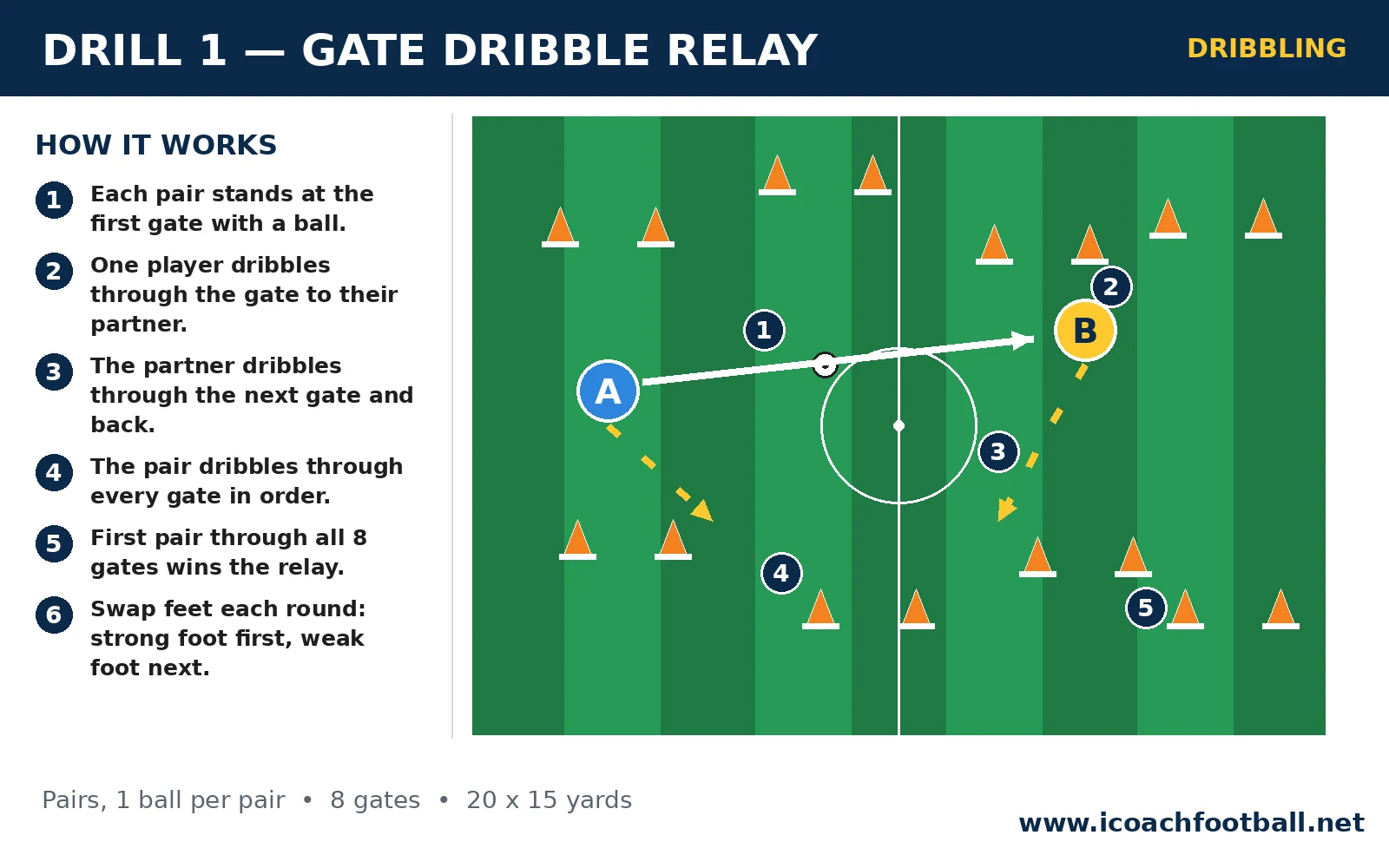
- Setup: 8 gates (two cones, 2 yards apart) in a 20 x 15 yard area. Girls in pairs, 1 ball per pair. 8 minutes.
How to play:
- Each pair stands at the first gate with a ball.
- One player dribbles through the gate to their partner.
- The partner dribbles through the next gate and back.
- The pair dribbles through every gate in order.
- First pair through all 8 gates wins the relay.
- Swap feet each round: strong foot first, weak foot when they are ready.
- Coach’s note: “Small touches, head up — the ball stays close enough to stop in one step.”
- Progressions: One-touch passing through the gates instead of dribbling; gates get narrower; add a defender pair who blocks gates.
Drill 2 — Pass and Move Triangle
Three players pass around a triangle and follow their pass. The first team habit in the session, and the one that teaches the skill every later drill needs: pass, scan, then move.
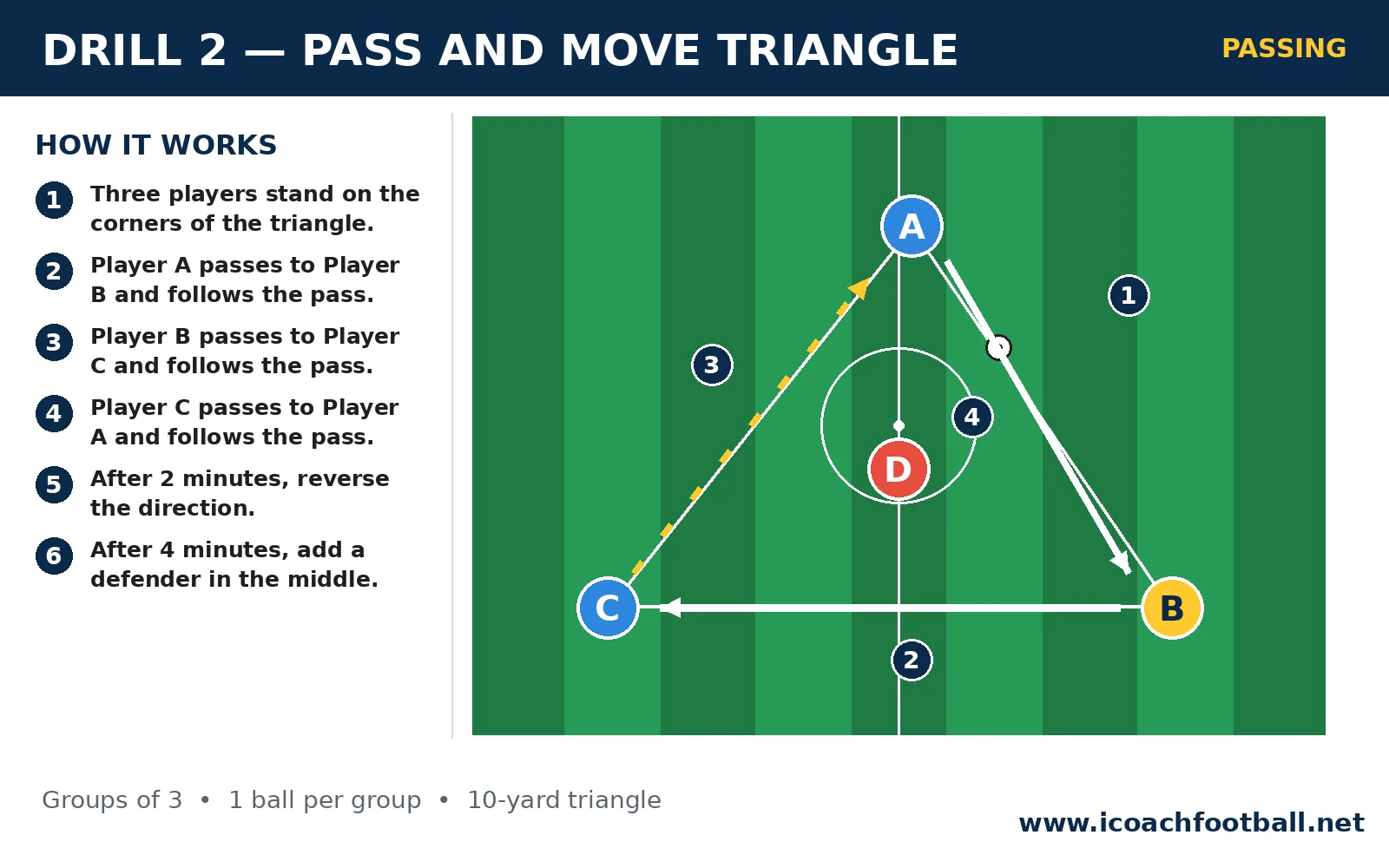
- Setup: Triangle of 3 cones, 10 yards apart. Groups of 3, 1 ball per group. 8 minutes.
How to play:
- Three players stand on the corners of the triangle.
- Player A passes to Player B and follows the pass.
- Player B passes to Player C and follows the pass.
- Player C passes to Player A and follows the pass.
- After 2 minutes, reverse the direction.
- After 4 minutes, add a defender in the middle who tries to intercept.
- Coach’s note: “Scan before the ball arrives — the pass is decided before it reaches your feet.”
- Progressions: Two-touch maximum; one-touch only; the defender becomes two defenders.
Drill 3 — Queen of the Ring 1v1
One attacker against one defender inside a circle, winner stays on. The duel that builds the confidence to take a player on — the “take them on” pattern from the FIFA Training Centre’s grassroots sessions, run as a game the girls ask to repeat.
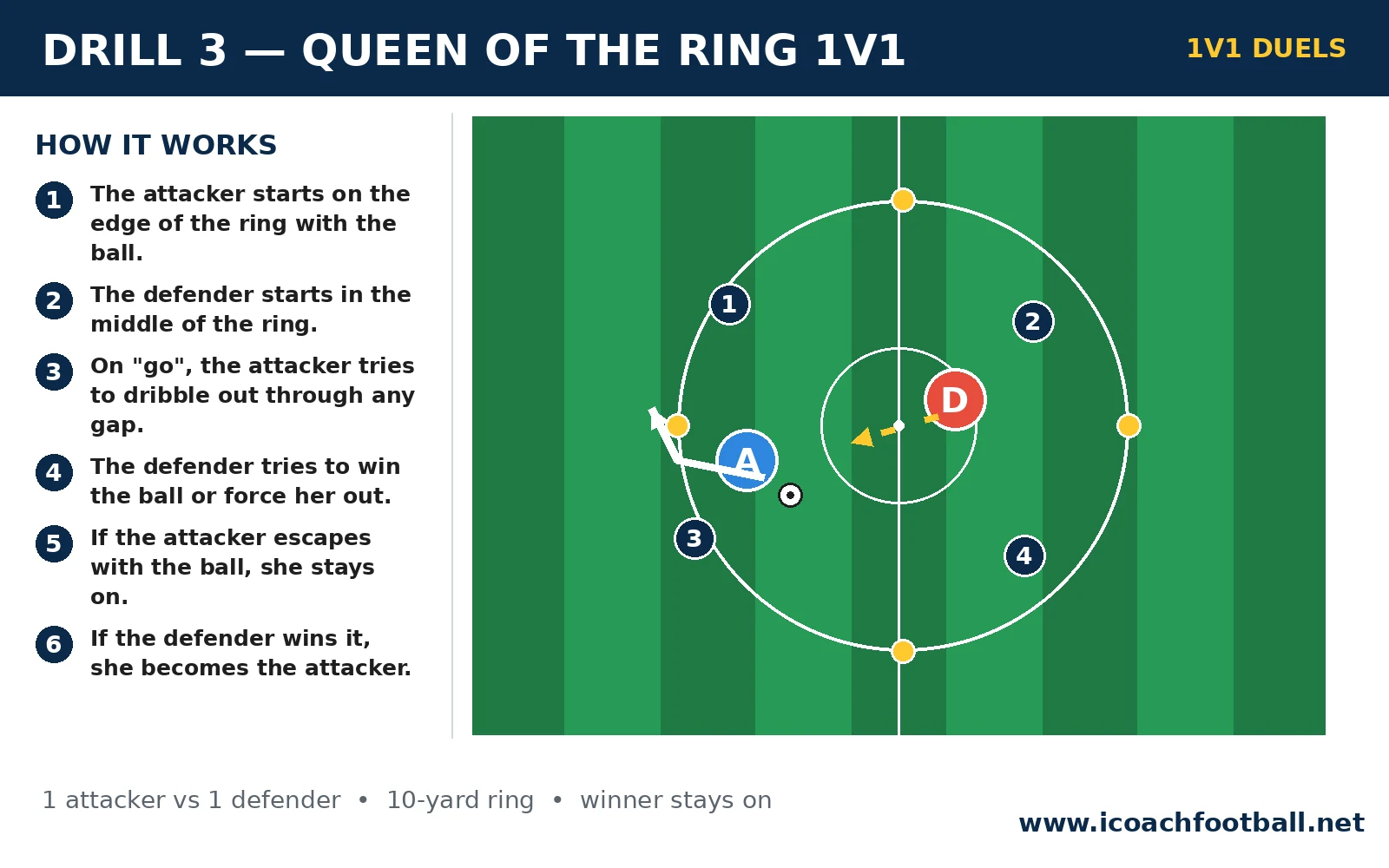
- Setup: Circle of cones, 10 yards across. 1 attacker, 1 defender, 1 ball. Rest of the team watches from outside the ring. 10 minutes.
How to play:
- The attacker starts on the edge of the ring with the ball.
- The defender starts in the middle of the ring.
- On “go”, the attacker tries to dribble out through any gap in the ring.
- The defender tries to win the ball or force the attacker out without it.
- If the attacker escapes the ring with the ball, she stays on as queen.
- If the defender wins it, she becomes the attacker and a new defender steps in.
- Coach’s note: “Attack the defender’s front foot — the side she is standing on is the side that is open.”
- Progressions: The attacker must beat the defender with a named move (scissors, step-over, drag-back); add a second defender after 5 minutes; the ring gets smaller.
Drill 4 — Lay-Off and Finish
A wide player crosses low, a striker lays it off, a runner finishes first time. The finishing pattern that turns good build-up into goals — and the drill that teaches the run into the box, not just the shot.
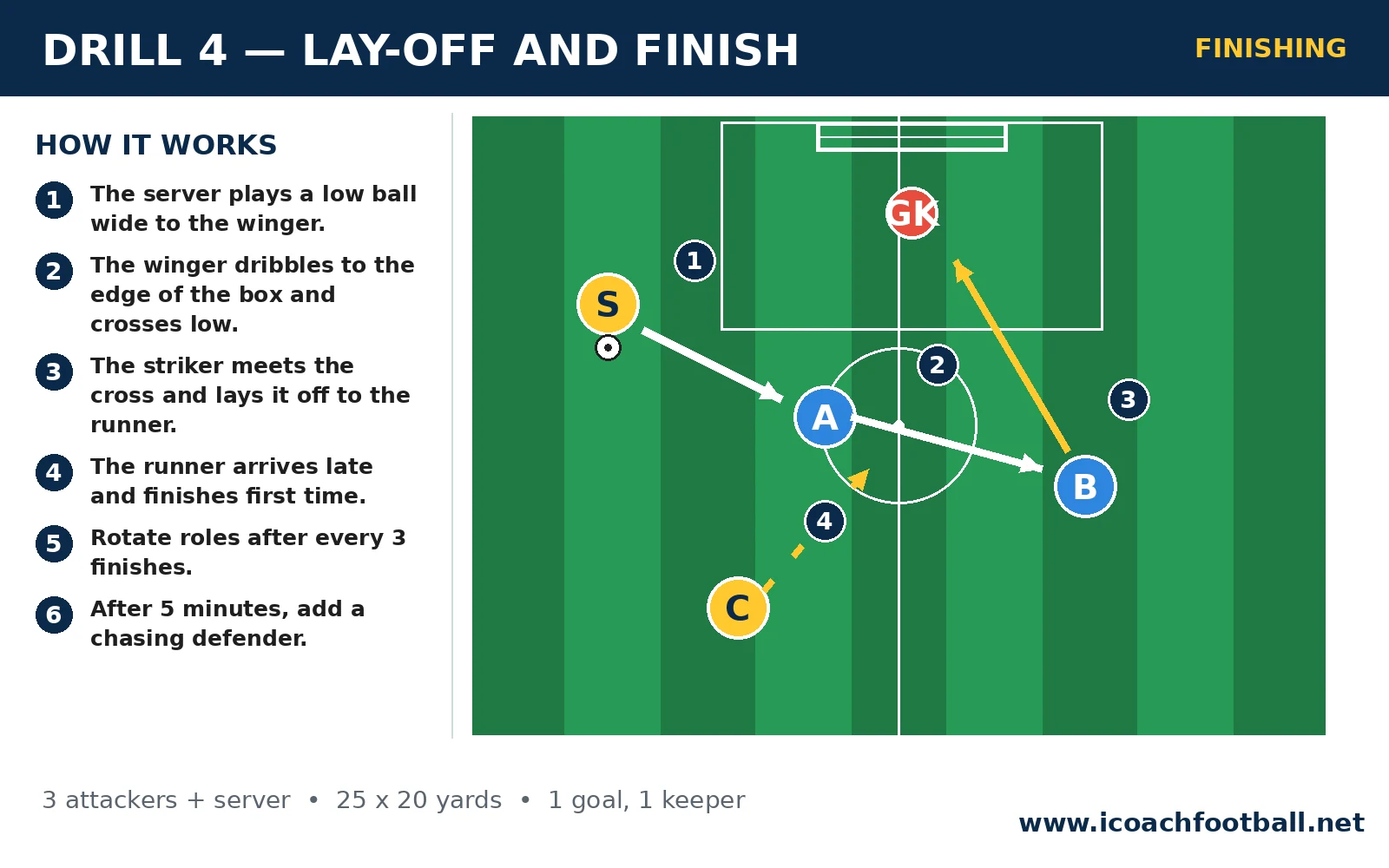
- Setup: 25 x 20 yard area, one full-size goal with a keeper. 3 attackers, 1 server, balls at the server. 10 minutes.
How to play:
- The server plays a low ball wide to the winger.
- The winger dribbles to the edge of the box and crosses low.
- The striker meets the cross and lays it off to the runner.
- The runner arrives late and finishes first time.
- Rotate roles after every 3 finishes: server, winger, striker, runner.
- After 5 minutes, the keeper comes out and the defence adds a chasing defender.
- Coach’s note: “The runner arrives late on purpose — the defence is already watching the striker.”
- Progressions: Finish with the weak foot only; the cross must be first time; add a second runner for a cut-back option.
Drill 5 — 3v2 Overload Attack
Three attackers against two defenders, with a spare player to find. The decision-making game: the overload only scores if the players see it, and the drill stops the moment they stop looking for the free player.
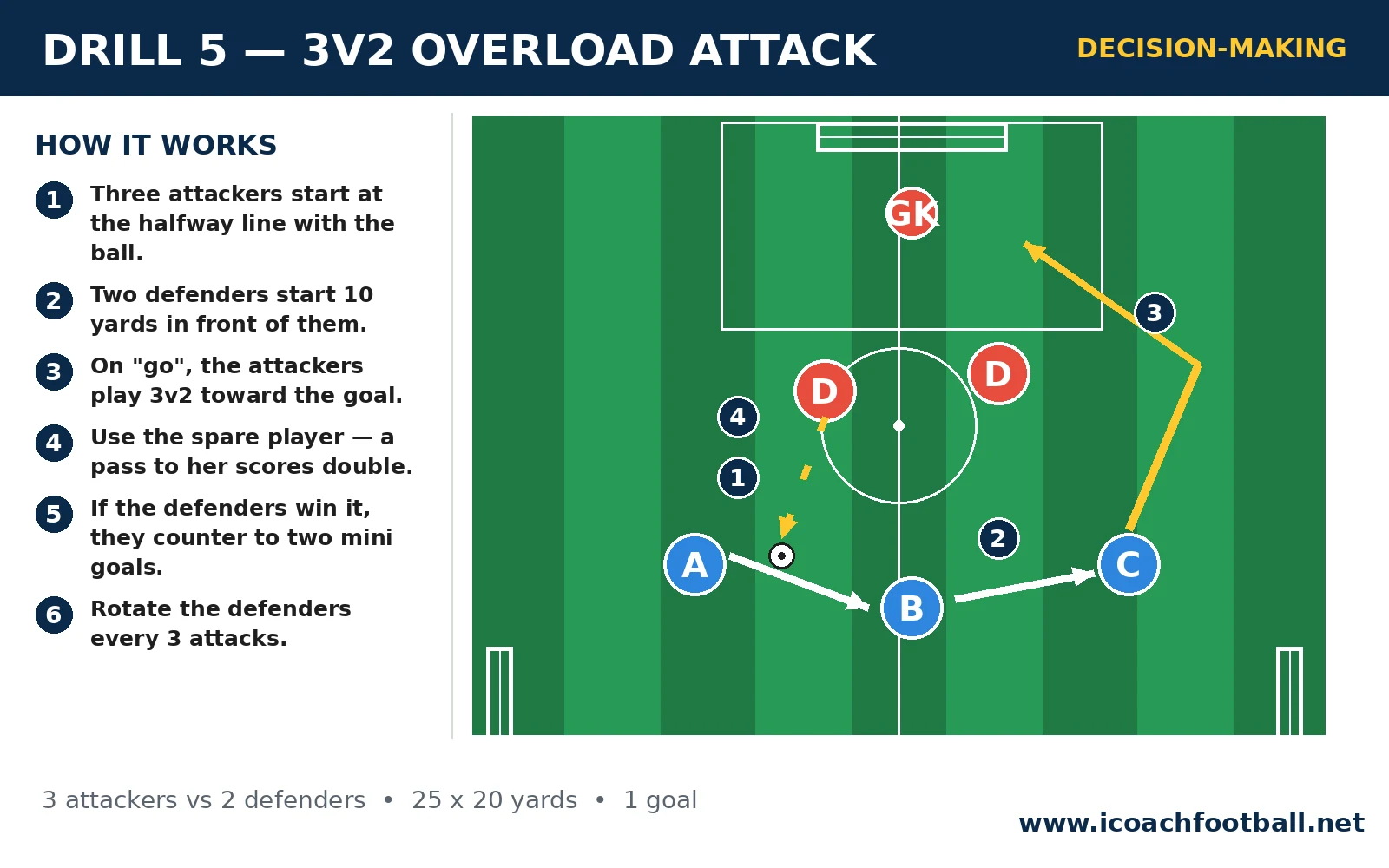
- Setup: 25 x 20 yard area, one full-size goal with a keeper. 3 attackers, 2 defenders, 1 ball. 10 minutes.
How to play:
- Three attackers start at the halfway line with the ball.
- Two defenders start 10 yards in front of them.
- On “go”, the attackers play 3v2 toward the goal.
- The attackers must use the spare player — a pass to the free player scores double.
- If the defenders win the ball, they counter to two mini goals on the halfway line.
- Rotate the defenders every 3 attacks so everyone defends and attacks.
- Coach’s note: “Find the free player first — the 3v2 is won by the pass, not the dribble.”
- Progressions: Add a recovering third defender who sprints back after 3 seconds; limit the attackers to 8 seconds; the spare player must finish.
Drill 6 — Numbers Game 3v3
The coach calls numbers, players race for the ball, and a 3v3 breaks out. The match-real finish: every player sprints, every player defends, and the game restarts every 30 seconds so nobody hides.
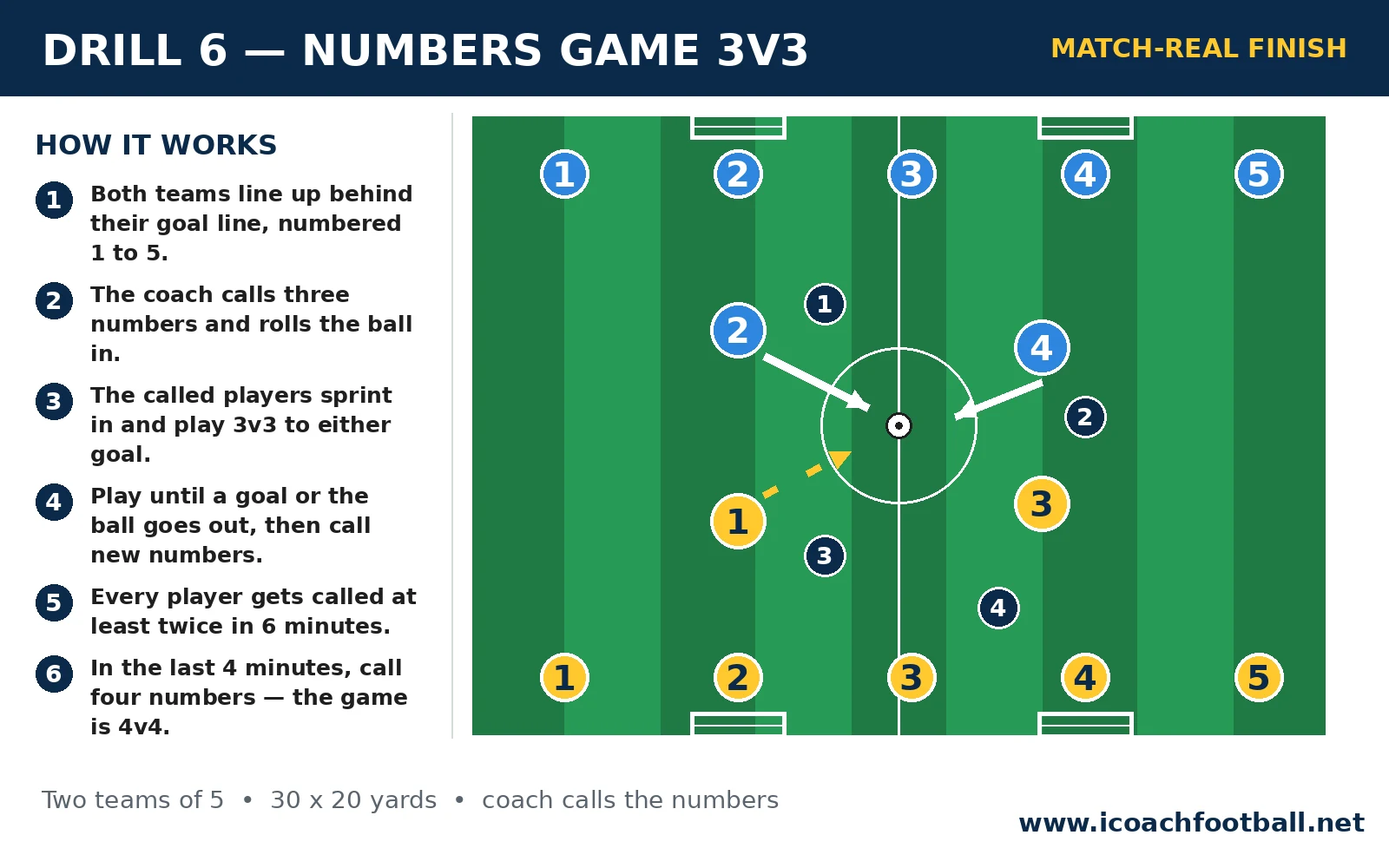
- Setup: 30 x 20 yard pitch, full-size goal at each end with a keeper. Two teams of 5, each player numbered 1–5. 1 ball with the coach. 12 minutes.
How to play:
- Both teams line up behind their own goal line, numbered 1 to 5.
- The coach calls three numbers and rolls the ball into the middle.
- The called players sprint in and play 3v3 to either goal.
- Play until a goal or the ball goes out, then the coach calls new numbers.
- Every player gets called at least twice in the first 6 minutes.
- In the last 4 minutes, the coach calls four numbers and the game becomes 4v4.
- Coach’s note: “Sprint in like it is a real game — the first player to the ball decides the attack.”
- Progressions: The coach calls two numbers for a 2v2; the called players must finish within 10 seconds; goals only count after a one-two.
Coaching points: the five mistakes that lose girls’ teams
| Mistake | What you see | Fix |
|---|---|---|
| Coaching girls exactly like a boys’ team | Same warm-up, same shouting, same load | Coach the person in front of you — praise effort, explain the why, keep the load age-right |
| Only the confident few touch the ball | Three players dominate every game | One ball per player in drills; small games of 3v3 so everyone is involved |
| Skipping landing mechanics | Straight-leg landings, knees collapsing in | Five minutes of FIFA 11+ Kids at the start of every session |
| Long talks, short play | Eyes glaze over after 30 seconds | Show it, don’t tell it — one sentence, then play |
| Winning the session, losing the player | A girl stops coming and nobody asks why | Ask her. Then change one thing she names. |
Age adaptations
| Age | Ball | Area | What changes |
|---|---|---|---|
| U10–U11 (ages 9–11) | Size 4 | 20 x 15-yard grids | Drill 1 runs with wide gates and rolling the ball allowed; Drill 2 runs 3v0 with no defender; Drill 3 runs with a bigger ring and no named move; Drill 4 runs with no keeper and a mini goal; Drill 5 runs 3v1; Drill 6 runs 2v2 with the coach calling two numbers — see our U10 soccer practice plan and U11 soccer practice plan |
| U12–U13 (ages 11–13) | Size 4 | 25 x 20-yard grids | All six drills as written; Drill 3 runs with a named move; Drill 4 runs with a keeper; Drill 5 runs with the recovering defender; Drill 6 runs 3v3 with the 4v4 finish — see our U12 soccer practice plan, soccer drills for U13 and soccer drills for middle school players |
| U14–U15 (ages 13–15) | Size 5 | 30 x 20-yard grids | Drill 1 runs one-touch through narrow gates; Drill 2 runs one-touch with two defenders; Drill 3 runs with a second defender; Drill 4 runs with a chasing defender from the start; Drill 5 runs with the 8-second limit; Drill 6 runs 4v4 with the 10-second finish rule — see our soccer drills for U14 and soccer drills for U15 |
60-minute session plan
| Time | Block | Drill |
|---|---|---|
| 0:00–0:05 | Warm-up | Safe-landing warm-up (FIFA 11+ Kids) |
| 0:05–0:13 | Dribbling | Drill 1 — Gate Dribble Relay |
| 0:13–0:21 | Passing | Drill 2 — Pass and Move Triangle |
| 0:21–0:31 | 1v1 duels | Drill 3 — Queen of the Ring 1v1 |
| 0:31–0:41 | Finishing | Drill 4 — Lay-Off and Finish |
| 0:41–0:51 | Overload | Drill 5 — 3v2 Overload Attack |
| 0:51–1:00 | Match-real finish | Drill 6 — Numbers Game 3v3 |
New to running a girls’ team? Stretch the warm-up to 10 minutes and cut Drill 3 to 5 minutes and you have the same session with more landing practice — see our 60-minute plan for the structure.
Keep building from here
These six games are the start, not the whole curriculum. Younger girls start with our soccer drills for elementary school, then move through the U10 soccer practice plan, the U11 soccer practice plan, the U12 soccer practice plan, soccer drills for U13, soccer drills for U14 and soccer drills for U15. The school-team version of this session is our soccer drills for middle school players, and girls who started at 5 begin with our soccer drills for 5 year olds. Build the individual skills next: soccer dribbling drills for the close control Drill 1 and Drill 3 need, soccer passing drills for the weight and accuracy Drill 2 needs, soccer scanning drills so receivers check before the ball arrives, 1v1 finishing drills for the duel in Drill 3, and weak foot soccer drills so both feet can play the gate relay. Pairs work is the next step up from one ball per player: soccer drills for two players run the same skills in pairs, soccer drills for 3 players no goalie adds a third runner, and the rondo pairs game turns the same skills into a keep-away competition. Then open the pitch up: soccer 3v3 drills, soccer 4v4 drills and soccer 5v5 drills run the same combinations in bigger games. Protect the players as they grow: our soccer injury prevention guide and our hamstring injury prevention drills show how to build the warm-up into every session, our 10 soccer warm-up drills give you the full warm-up library, and our youth soccer fitness testing shows how to measure progress without maximal testing at U12 and under. New to coaching? Start with soccer drills for beginners, and if you run selections, our soccer tryout drills show how to grade a group fairly.
FAQ
Are soccer drills different for girls?
The drills are the same — dribbling, passing, 1v1s and finishing work for every player. What changes is the coaching around them: a landing warm-up that protects young knees, praise for good decisions as well as goals, small games so every player touches the ball, and short explanations. UEFA’s Playmakers programme makes the same point for the youngest girls: first impressions count, and sessions must build confidence in a pressure-free environment.
What age should girls start playing soccer?
Girls can start as young as 5 — UEFA’s Playmakers programme is built for girls aged 5–8 and has introduced more than 200,000 of them to football. The drills in this post suit ages 9–15 (U10–U15); younger girls start with our soccer drills for elementary school and our soccer drills for 5 year olds.
How do you keep girls playing soccer past 14?
Give every player a real role, not a watching brief: small games where everyone touches the ball, praise for effort and good decisions, players picking teams and refereeing their own games, and a session that ends with a match they want to win. The biggest reason girls leave is feeling invisible in a session built for the confident few — the six games in this post are built so nobody hides.
How do you prevent ACL injuries in girls’ soccer?
Run a landing warm-up at the start of every session. The FIFA 11+ Kids programme — seven exercises for ages 7–13, starting with skating jumps, single-leg stance and single-leg jumps — improved knee flexion and hip control on landing in a trial of 36 preadolescent female players aged 10–12 after eight weeks, twice a week. Coach one cue: land soft, knees bent, knee over the toes. Girls’ ACL injury risk rises from around age 10–12, so the habit must be built before then.
How often should a girls’ team train each week?
Twice a week is right for U10–U15, with at least one rest day between sessions and a match at the weekend. Keep each session to 60 minutes, run the landing warm-up every time, and never add a third session just because the boys’ team trains three times — the programme that works is the one the players still enjoy in month three.
Sources
- UEFA, “Disney Lilo & Stitch bring the spirit of ‘ohana’ to UEFA Playmakers” — UEFA Playmakers, launched by UEFA and Disney in 2020, gives young girls a fun, safe and imaginative introduction to football; more than 200,000 girls aged 5–8 have taken part in 46 countries, with nearly 10,000 coaches trained; “UEFA Playmakers is often a girl’s first introduction to football, and first impressions count.” https://www.uefa.com/news-media/news/02aa-21c156416da5-79e49d927381-1000–disney-lilo-stitch-bring-the-spirit-of-ohana-to-uefa-playm/
- Kerman et al., “The Effects of FIFA 11+ Kids Prevention Program on Kinematic Risk Factors for ACL Injury in Preadolescent Female Soccer Players: A Randomized Controlled Trial”, Children, 2023 — 36 preadolescent female soccer players aged 10–12; the FIFA 11+ Kids warm-up twice a week for 8 weeks improved knee flexion and hip internal rotation on single-leg drop landing, likely reducing ACL stress; the programme is seven exercises for ages 7–13 and can be run on-field without extra equipment. https://doi.org/10.3390/children10071206
The boys’ version of this session is our soccer drills for boys — the same six-game shape, coached around duels, speed and clean physicality.