The “Switch of Play” Game: 4-Goal Drills for Vision & Scanning

The hardest thing to teach in soccer isn’t passing; it’s vision.
Most young players suffer from “Ball Watching.” They get sucked toward the ball like a magnet, creating a clump of players in one small area. When the pitch gets crowded, the solution is almost always to switch the point of attack to the weak side.
But you can’t just shout “Open up!” You need a game that makes the center of the pitch “useless” and the wings “valuable.”
In our Constraints-Led Approach, we talked about environmental constraints. This session uses the 4-Goal Setup to force players to scan horizontally and find the space away from the pressure.
⚡ Drill Profile:
- Recommended Age: U10 to Pro
- Difficulty Level: Intermediate (Requires passing range)
- Physical Intensity: Medium (More technical/tactical)
- Best Training Day: MD-3 (Tactical Day)
- Players Needed: 12-16 players (6v6 or 7v7)
The Core Concept: “Attract to Switch”
The tactical goal here is simple: Overload to Isolate.
- Attract Pressure: Keep the ball on one side to draw the defenders in.
- Scan: Recognize when the opponent has over-shifted.
- Switch: Move the ball quickly to the open space on the other side.
The “Switching Play” Warm-Up: The 3-Zone Transfer
Before jumping into the main game, use this warm-up to dial in the passing mechanics required for a long switch.
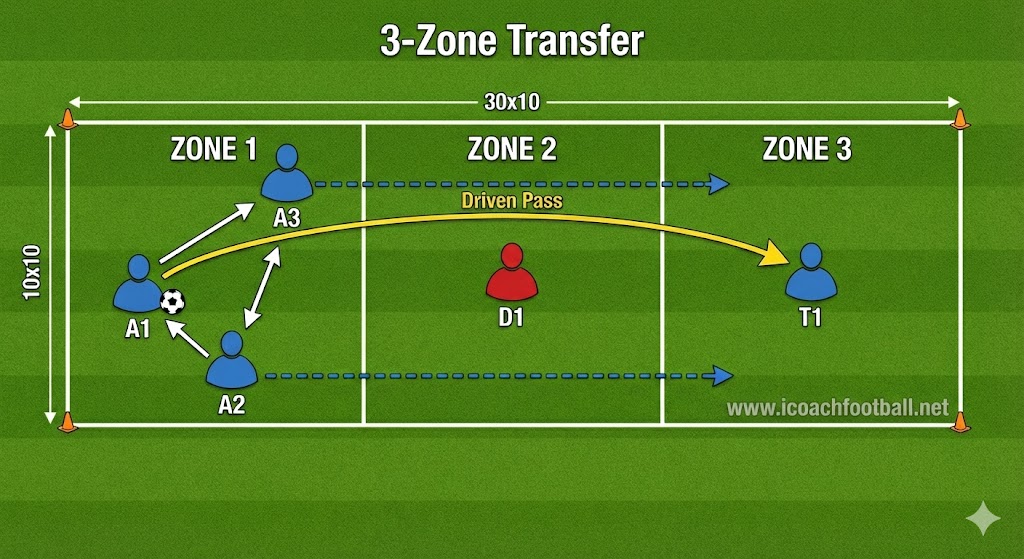
📋 Drill Profile
- Skill Focus: Long passing & Receiving across the body
- Space Needed: 30×10 yards (divided into 3 zones)
- Structure: 4v1 (Rondo Style)
The Setup: Create 3 zones. A group of 3 attackers starts in Zone 1. One defender is in the middle (Zone 2). A target player waits in Zone 3.
The Action: The 3 attackers keep possession in Zone 1. After completing 3 passes, they must look up and drive a long pass (switch) over the defender’s head to the target player in Zone 3. Then, the whole group sprints to Zone 3 to support the new ball carrier.
Coaching Point:
- “Ping vs. Float”: Teach players to drive the ball with their laces (ping) so it travels fast, rather than floating it which gives the defense time to slide.
The Drill: The 6v6 “4-Goal” Width Game
Instead of attacking central goals, teams attack wide gates.
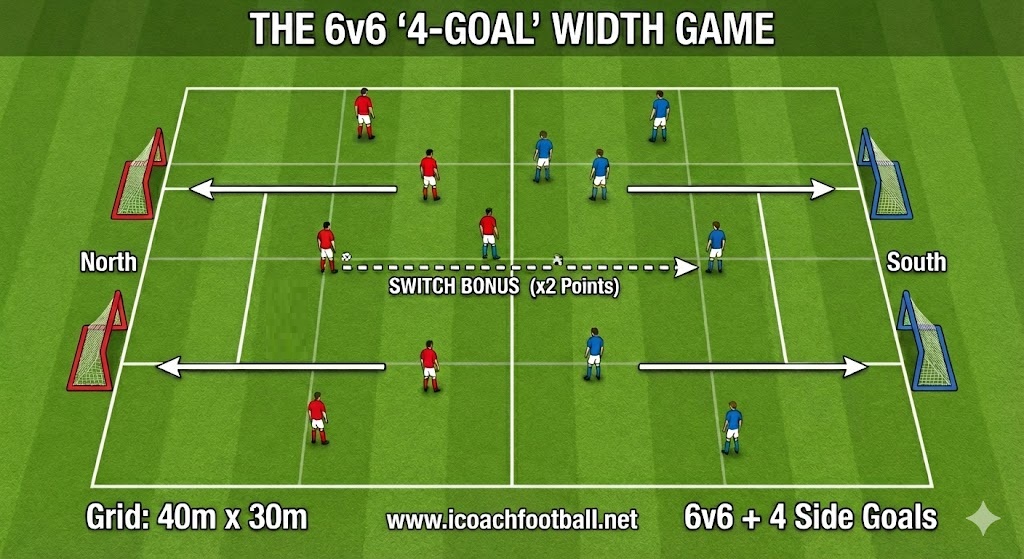
The Organization
- Grid: 40m Wide x 30m Long (Wider than it is long).
- Goals: 2 Mini Goals on the Left sideline, 2 Mini Goals on the Right sideline.
- Teams: 6v6 inside the grid.
The Rules of the Switch
- Direction: Teams can score in ANY of the 4 goals. (Or, to make it directional: Red attacks the two North goals, Blue attacks the two South goals). Recommendation: Make it directional to start.
- The Scoring Trigger: You must complete 3 passes before scoring.
- The “Switch” Bonus: If the ball travels from the Left Channel to the Right Channel (a switch of play) and leads to a goal, the goal counts Double (2 points).
Coach’s Cue: “If it’s closed here, it’s open there.”
Advanced Progression: The “Overload” Switch
Once your players master the 4-goal game, add this rule to teach them why we switch play: to create a 1v1 on the weak side.
The Rule: Divide the pitch in half vertically (Left Channel / Right Channel). If the ball is on the Left, the attacking team must have at least 4 players in that channel (Overload). This sucks the defense in. Then, they must quickly switch to the Right Channel where their 1 isolated winger is waiting to attack the goal 1v1.
Watch: The 4-Goal Game in Action
This video demonstrates how adding wide goals forces players to scan and switch the attack.
How to Coach Scanning & Vision
Coaching the Switch of Play
Key coaching points to help players see the whole picture.
Step 1: The “Pre-Scan” Teach players to check their shoulders before the ball arrives. “Scan before you touch.” If they wait until they have the ball, it’s too late.
Step 2: Body Shape Players should receive the ball with an “Open Body Shape” (facing the whole pitch), not with their back to the sideline. This allows them to see the switch immediately.
Step 3: Weight of the Pass A switch of play usually requires a longer, driven pass (ping) or a sequence of fast short passes. Slow passes allow the defense to slide across, killing the advantage.
Step 4: Support Underneath The player with the ball needs a “Drop” option (a teammate behind them) to bounce the ball backward. Playing backward is often the trigger to switch forward.
Common Questions About Width
My players keep forcing it through the middle. How do I stop this?
That’s why there are no central goals! Remind them: “There is nothing in the middle for you. The gold is on the wings.”
Can I use neutral players?
Yes. Adding 2 Neutral “Magic Men” on the sidelines is a great way to make the switch easier. They act as permanent wingers who are always open.
Is this good for fitness?
It is less intense than the Counter-Pressing Drill but involves more long-distance running for the wingers.
⚽️ Complete Your Training Week