Transition Chaos: The “6-Second” Recovery Game (Gegenpressing)

The moment you lose the ball is not a moment to rest—it is your best opportunity to score.
Jurgen Klopp famously said, “No playmaker in the world can be as good as a good counter-pressing situation.” When you win the ball back high up the pitch, the opponent is disorganized, open, and vulnerable.
But you cannot just tell players to “work hard.” You need to train the trigger.
In our The Science of Small Sided Games, we discussed the mental constraints of training. This session uses a Time Constraint (The 6-Second Rule) to force a reaction speed that is faster than the opponent can handle.
Here is the “Transition Chaos” game—a staple in elite academies from Dortmund to Liverpool.
⚡ Drill Profile:
- Recommended Age: U12 to Pro (Simplified version for U10)
- Difficulty Level: Advanced (Cognitive Speed)
- Physical Intensity: High (Anaerobic Alactic)
- Best Training Day: MD-4 (Speed/Power) or MD-3 (if duration is low)
- Players Needed: 10 minimum (6v4)
The Core Concept: The 6-Second Rule
The rules of this game are simple but brutal:
- If you lose the ball: You must win it back within 6 seconds.
- If you win the ball: You must score within 6 seconds (or 3 passes).
Why 6 Seconds?
- Physiology: It forces maximum intensity sprints (Anaerobic Alactic system).
- Psychology: It eliminates the “disappointment pause” where players put their heads down after a mistake.
- Tactics: Most teams take 6 seconds to expand into an attacking shape. If you catch them before they expand, you kill them.
Watch: The Art of the Counter-Press
The Drill: 6v4 Transition Rondo (“The Klopp Box”)
This is an overload game where the defenders are actually the “hunters.”
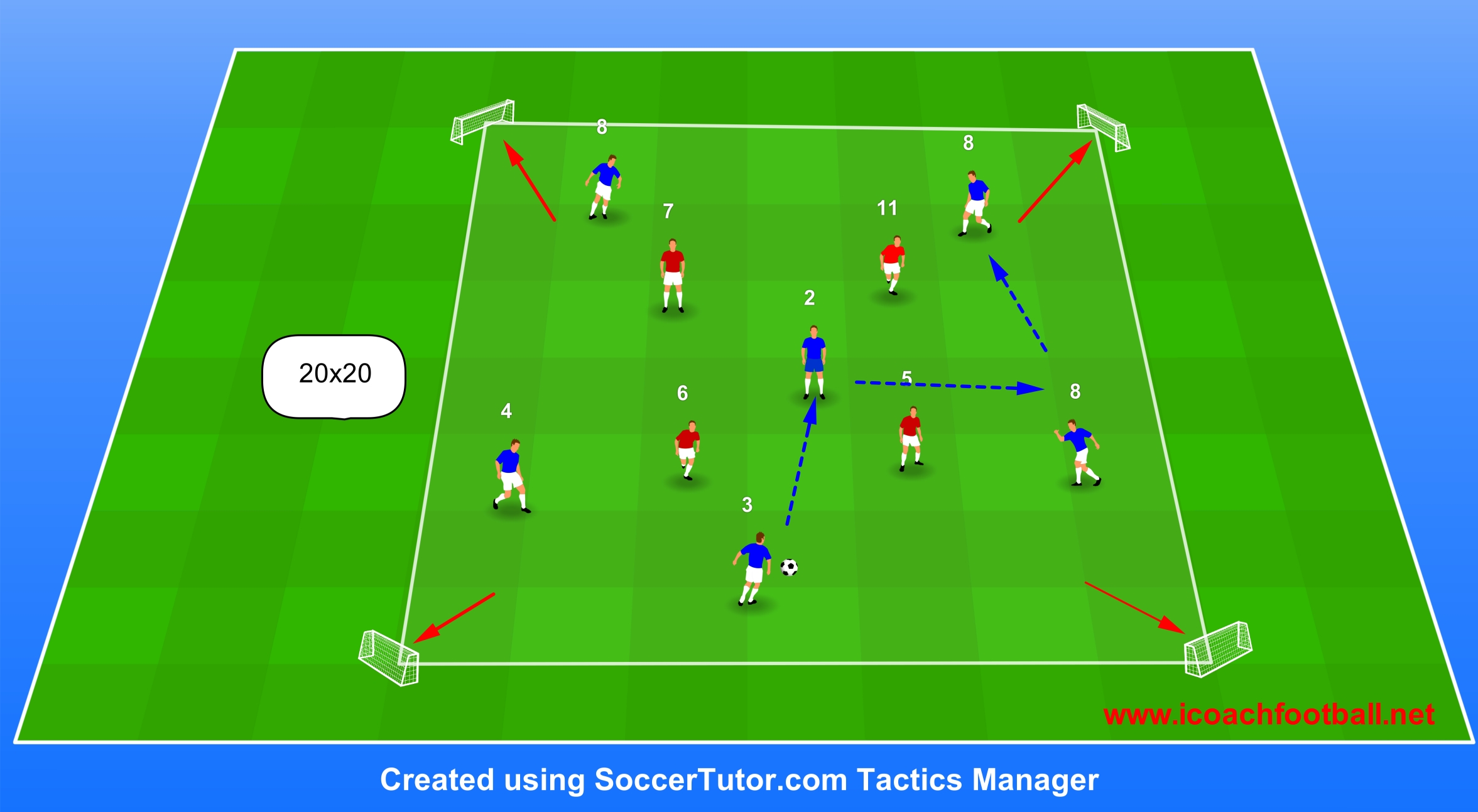
The Organization
- Grid: 20m x 20m (Tight space).
- Players: 6 Attackers (Blue) vs 4 Defenders (Red).
- Equipment: 4 Mini Goals (placed in the corners).
- Duration: 3 minute blocks x 6 reps.
The Rules of Chaos
- Possession Phase: The 6 Blues try to keep the ball (10 passes = 1 point). The 4 Reds form a tight box in the middle.
- Transition Phase: If the 4 Reds win the ball, they must score in one of the 4 Mini Goals within 6 seconds.
- Counter-Press Phase: The moment the Blues lose it, they must instantly swarm the Reds to prevent the goal.
Coach’s Trigger: If the Reds score, the Blues do 5 pushups immediately. This adds a “consequence” to losing the ball, sharpening the reaction.
How to Coach the “Wolfpack” Mentality
Coaching the 6-Second Counter-Press
Step-by-step coaching points to turn your team into pressing monsters.
Step 1: The “Hunting” Trigger Teach the defender closest to the ball to “Lock On.” They do not just jockey; they sprint through the ball carrier. This signals the rest of the pack to join.
Step 2: Cutting the Lanes While the first defender presses the ball, the second and third defenders must intercept the “panic pass.” They shouldn’t look at the ball; they should look at the receivers.
Step 3: The “Go” Word Use a specific word (e.g., “HUNT!” or “PRESS!”) that triggers the team. In this drill, shout it the millisecond possession is lost.
Step 4: Praise the Effort, Not Just the Tackle If a player sprints 20m to press and forces a bad pass, praise them loudly. You are rewarding the intent to press, which is the culture you want.
Safety & Performance: Common Questions
Does this drill leave us exposed at the back?
In a game, high pressing is high risk. That is why you must train the “Rest Defense” (the defenders who stay back). In this drill, however, the focus is purely on the front-foot reaction.
My players get tired too quickly. What should I do?
A: Reduce the block time. High-intensity pressing is exhausting. Do 90 seconds of work, then 90 seconds of rest. Quality of sprint is more important than duration.
Should I use this for U10 players?
Yes! Kids love “hunting” the ball. Simplify it: “If you lose it, get it back before I count to 5!” It builds great habits early.
⚽️ Want more high-intensity training sessions?
- Build Anaerobic Power: The “Flying Changes” 2v2 Drill
- Master Possession: The Guardiola 4v4+3 Rondo