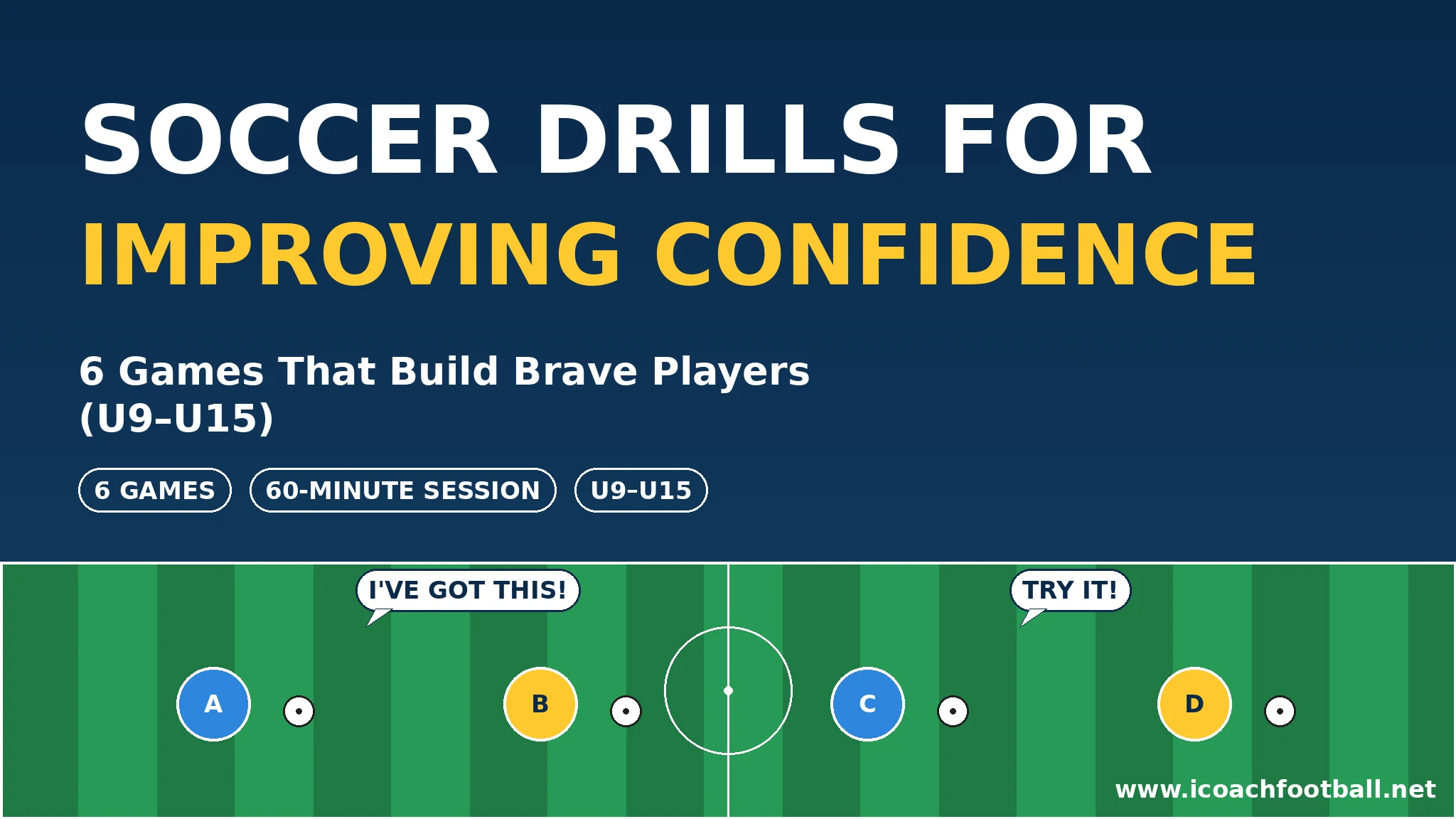
Soccer Drills for Improving Confidence: 6 Games That Build Brave Players (U9–U15)
Quick answer
Confidence is not a personality trait — it is a skill you train like passing. These six games give every player a success they can repeat, a skill they are allowed to try and a mistake that costs them nothing — in one 60-minute session.
Suitable for: U9–U15 (ages 8–15)
Session snapshot
- Players: 10–14 (U9–U15, plus a coach as catcher in Drill 1)
- Area: 30 x 25 yards (grids from 15 x 15 to 30 x 25)
- Duration: 60 minutes
- Focus: Trying skills, beating players, shooting without fear
- Equipment: 10–12 balls, 20 cones, 4 mini goals, bibs
Why these six games work
A player who will not try a skill in training will never try it in a match. The gap is not talent — it is fear of looking silly in front of teammates. So this session removes the fear first and adds the pressure later. FIFA’s Training Centre session plan “Dribbling with confidence” is built on exactly this: it starts with a “Dribble Champion” warm-up where players cross a catching space and try moves, groups players by size and ability, then builds to a 2v1 and finishes with a 3v3 where every player is asked to score. Drill 1 and Drill 5 below are based on that FIFA session plan, in line with it. The FA’s Boot Room guidance on psychological development makes the same point from the coaching side: praise effort, give players ownership and choice, use small-sided games for real decisions, and say less and watch more — because a player’s belief grows when the try is rewarded, not just the goal. The six rules and the coaching approach in this post are in line with that FA guidance. In the UK the same session runs as football drills for improving confidence — the games and the rules are identical.
Six rules of building confidence
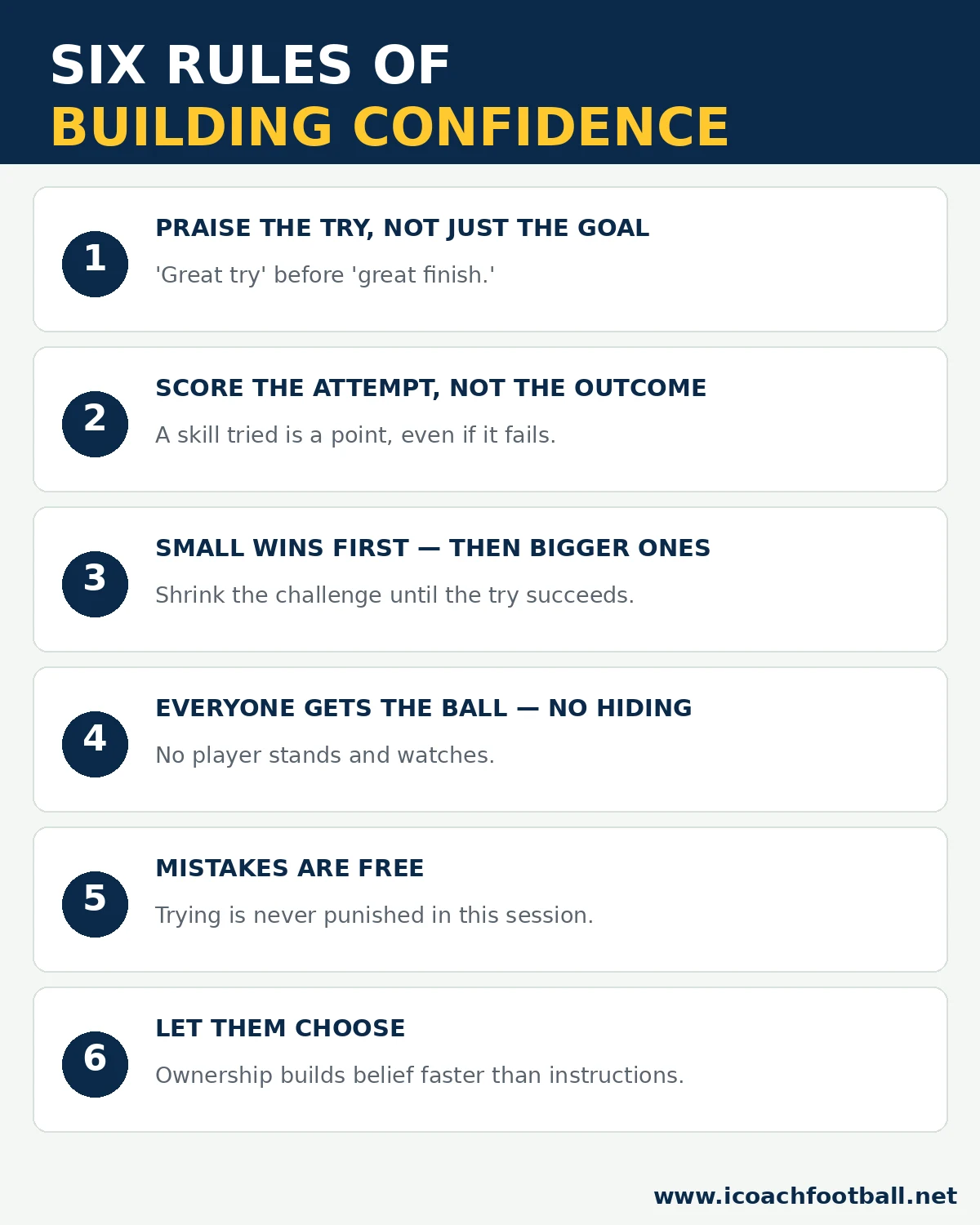
- Praise the try, not just the goal. “Great try” before “great finish.”
- Score the attempt, not the outcome. A skill tried is a point, even if it fails.
- Small wins first — then bigger ones. Shrink the challenge until the try succeeds.
- Everyone gets the ball — no hiding. No player stands and watches.
- Mistakes are free. Trying is never punished in this session.
- Let them choose. Ownership builds belief faster than instructions.
Drill 1 — Dribble Champion
Every player with a ball, two catchers in the middle, and one rule: cross the zone without being caught — and trying a move scores a point whether it works or not. The game FIFA uses to start its “Dribbling with confidence” session, and the fastest way to get shy players dribbling at full speed.
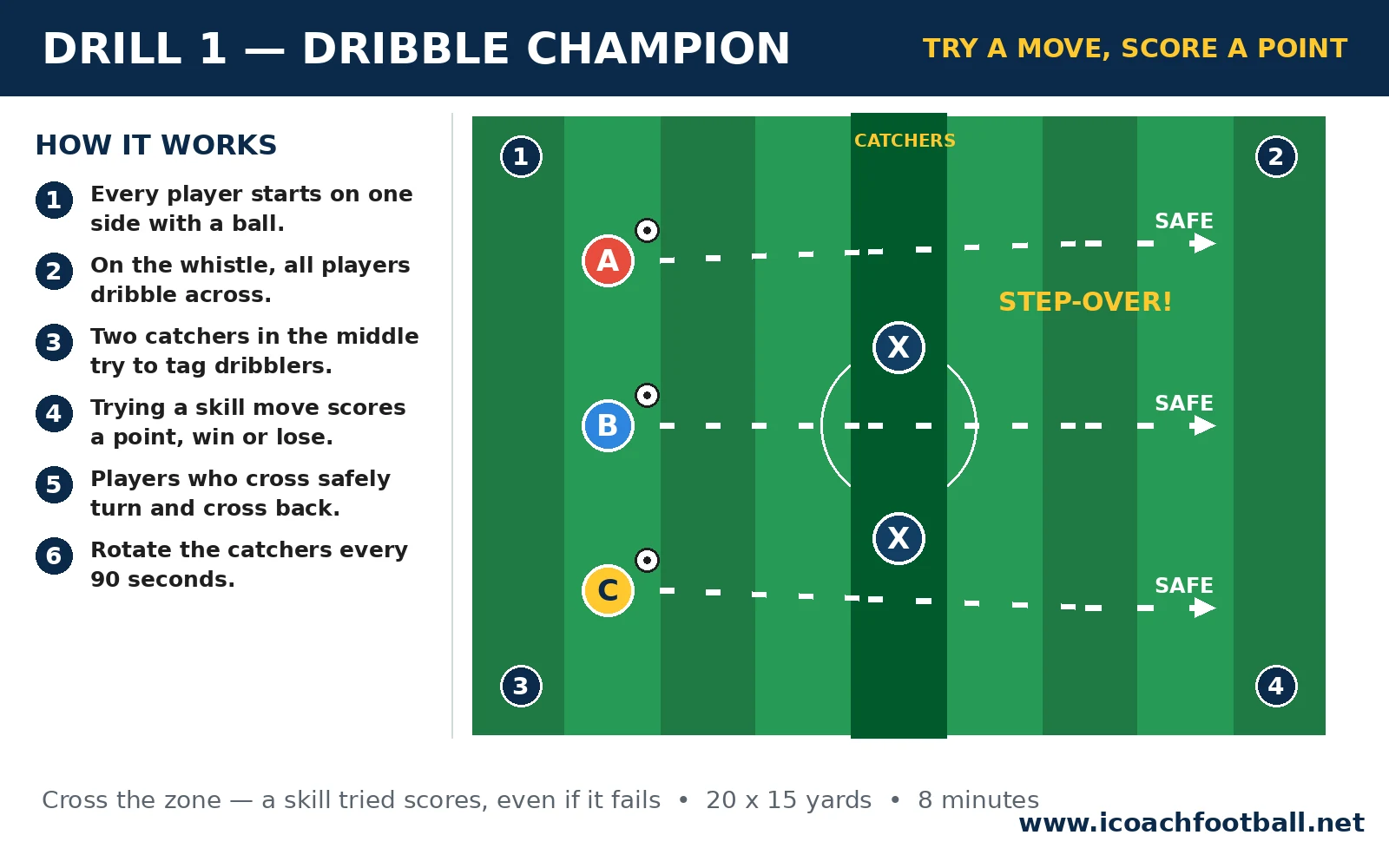
- Setup: 20 x 15 yard grid. Every player with a ball, two catchers in the middle. 8 minutes.
How to play:
- Every player starts on one side of the grid with a ball.
- On the whistle, all players dribble across to the far side.
- Two catchers in the middle try to tag the dribblers — a tagged player loses a point.
- Trying a skill move on the way across scores a point, whether it works or not.
- Players who cross safely turn and cross back on the next whistle.
- Rotate the catchers every 90 seconds so everyone chases and everyone escapes.
Coach’s note: “The point is for the try — a failed step-over still scores.”
Progressions: More catchers in the middle; make the space smaller; players must use a named move (step-over, Cruyff, drag-back).
Drill 2 — Beat Your Own Score
A ball-mastery circuit where the only opponent is your own last score. Thirty seconds of toe taps, thirty of inside touches, thirty of sole rolls — write the count down, then beat it. No comparing with teammates, ever.
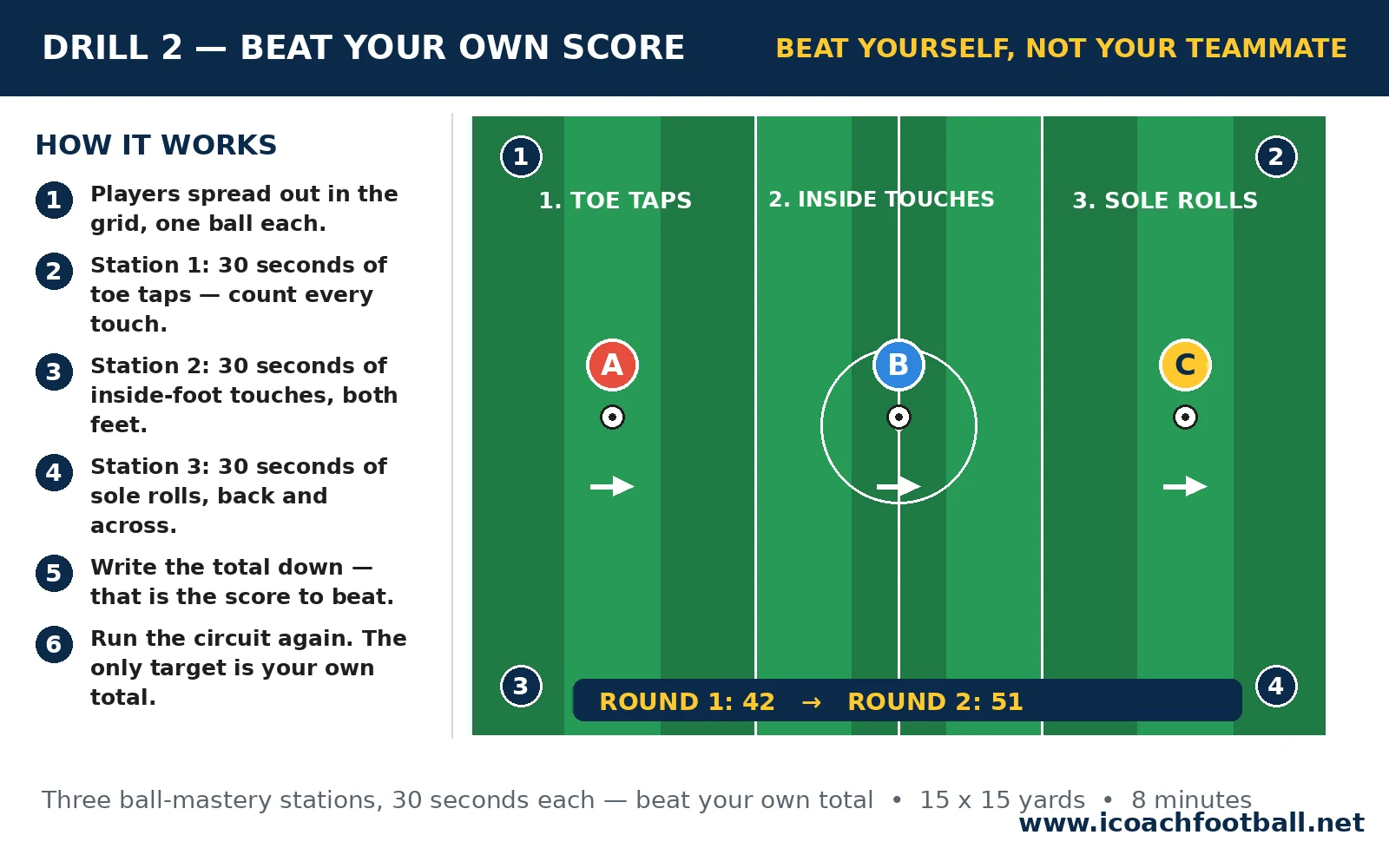
- Setup: 15 x 15 yard grid. One ball per player, cones marking three stations. 8 minutes.
How to play:
- Players spread out in the grid, one ball each, at the first station.
- Station 1: 30 seconds of toe taps — count every touch out loud.
- Station 2: 30 seconds of inside-foot touches, left and right.
- Station 3: 30 seconds of sole rolls, pulling the ball back and across.
- Every player writes their total down — that is the score to beat.
- Run the circuit again. The only target is your own first total.
Coach’s note: “Your score is yours — beat yourself, not your teammate.”
Progressions: Add a fourth station (drag-backs); time the circuit at 20 seconds for faster feet; players set their own homework target for next session.
Drill 3 — Head-Start 1v1
The attacker gets a three-second head start before the defender is allowed to engage. The shy player finally gets a touch, a decision and a moment — and discovers they can beat someone. The defender still has to win the ball, so the duel is real.
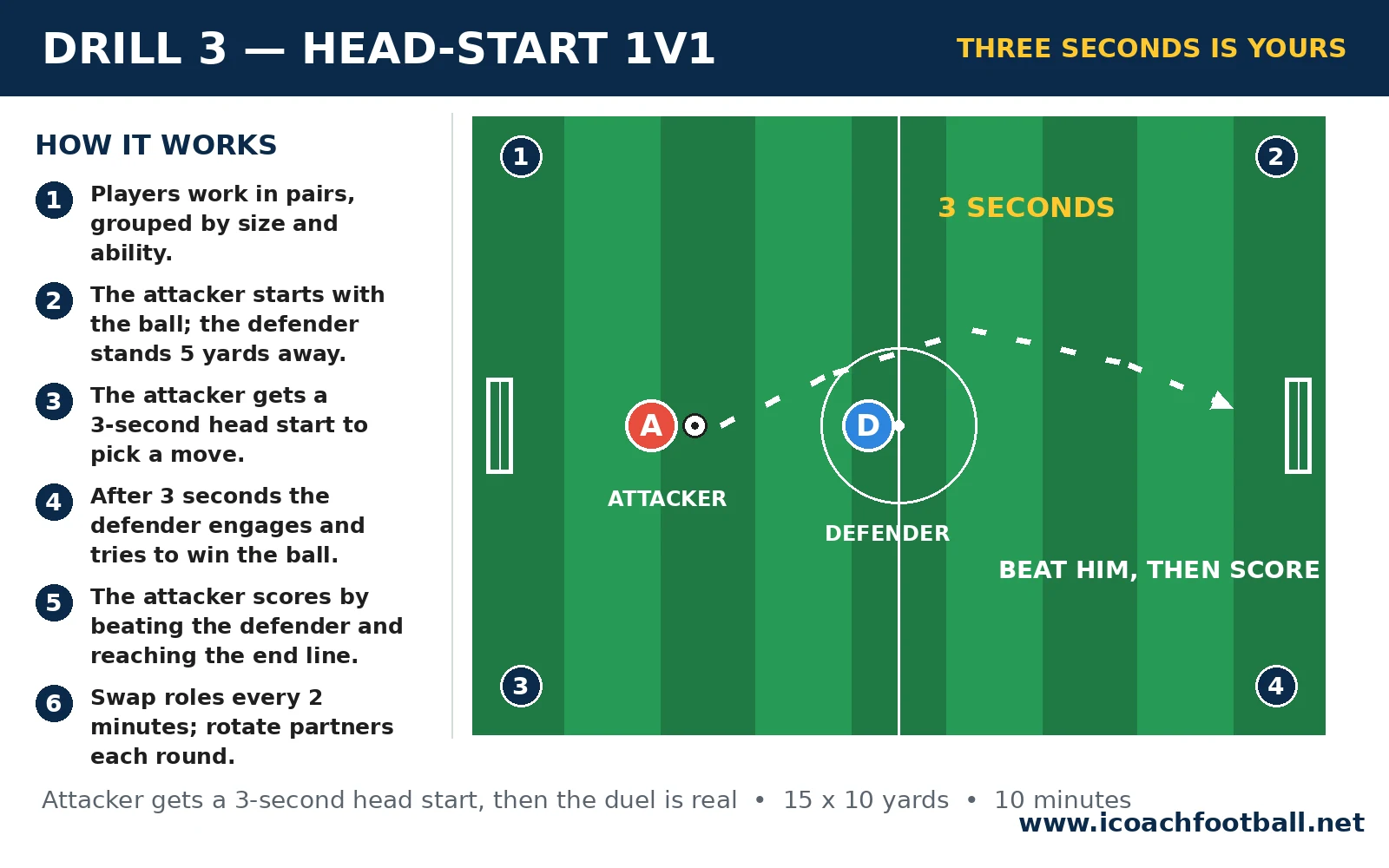
- Setup: 15 x 10 yard channel. Pairs, one ball, a mini goal at each end. 10 minutes.
How to play:
- Players work in pairs, grouped by size and ability.
- The attacker starts with the ball; the defender stands 5 yards away.
- The attacker gets a 3-second head start to dribble and choose a move.
- After 3 seconds the defender engages and tries to win the ball.
- The attacker scores by beating the defender and stopping the ball on the end line.
- Swap roles every 2 minutes and rotate partners so everyone faces different opponents.
Coach’s note: “Three seconds is yours — use them to pick your move, not to panic.”
Progressions: Cut the head start to 2 seconds; the defender starts closer; the attacker must finish on goal instead of the end line.
Drill 4 — Target Zones Shooting
Five balls at the edge of the area, zones worth 5 points in the corners and 3 in the centre — and the first rounds are unopposed, so every player banks points before any pressure arrives. Scores are tracked week to week, so progress is visible.
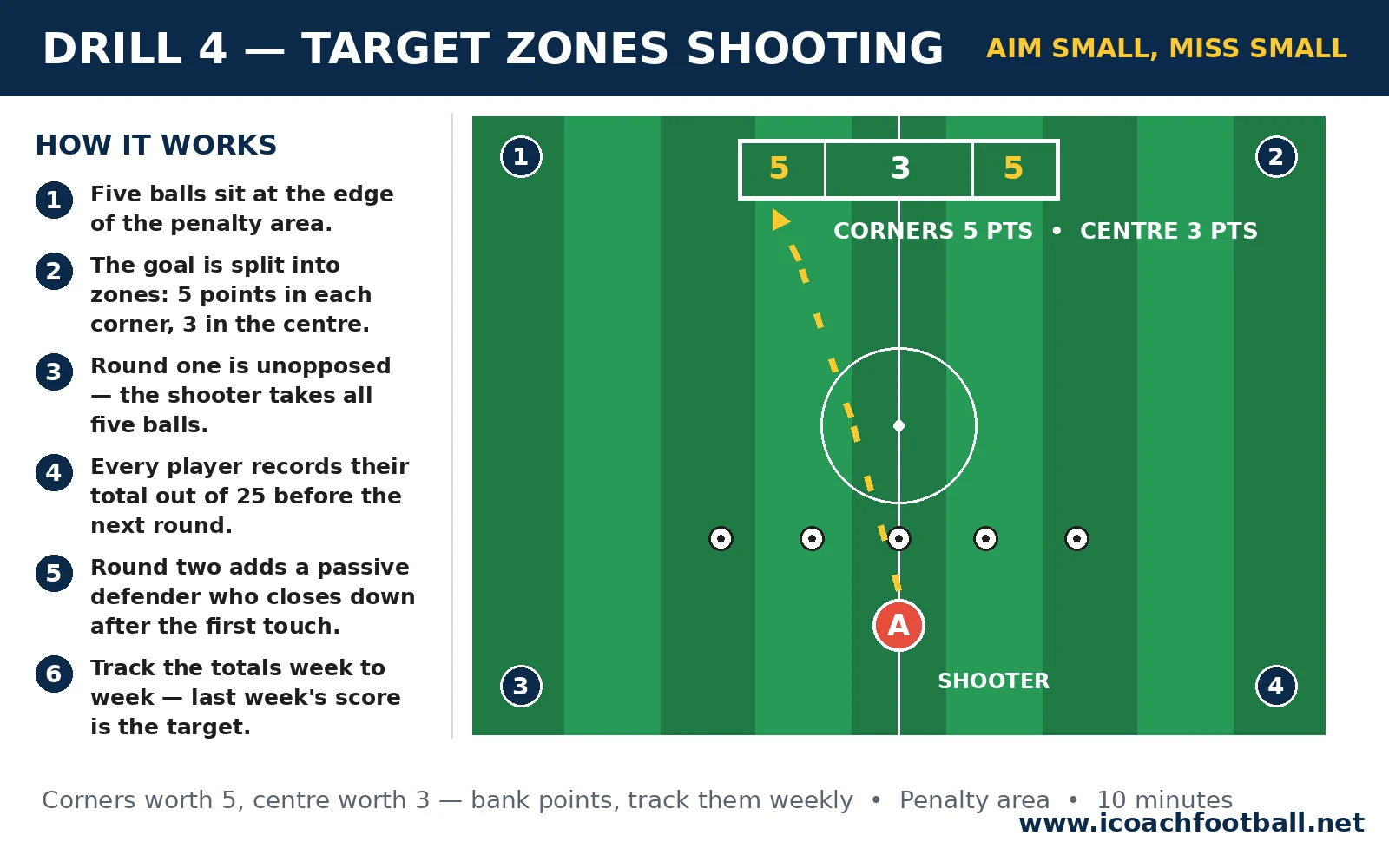
- Setup: Penalty-area size. Five balls at the edge of the area, one goal, cones marking the zones. 10 minutes.
How to play:
- Five balls sit at the edge of the penalty area; the shooter starts 15 yards out.
- The goal is split into zones: 5 points in each corner, 3 points in the centre.
- Round one is unopposed — the shooter takes all five balls in turn.
- Every player records their total out of 25 before the next round.
- Round two adds a passive defender who closes down after the first touch.
- Track the totals week to week — the score that matters is last week’s score.
Coach’s note: “Corners are worth five — aim small, miss small.”
Progressions: The defender starts closer; the shooter must use their weak foot for two of the five; add a one-touch finish from a cut-back pass.
Drill 5 — Everyone Scores 3v3
A 3v3 where the team only wins if every player scores. The star cannot win it alone, the quietest player becomes the most important player on the pitch — and the team starts setting them up. FIFA’s own question for this game: “Can you all score a goal in the same match?”
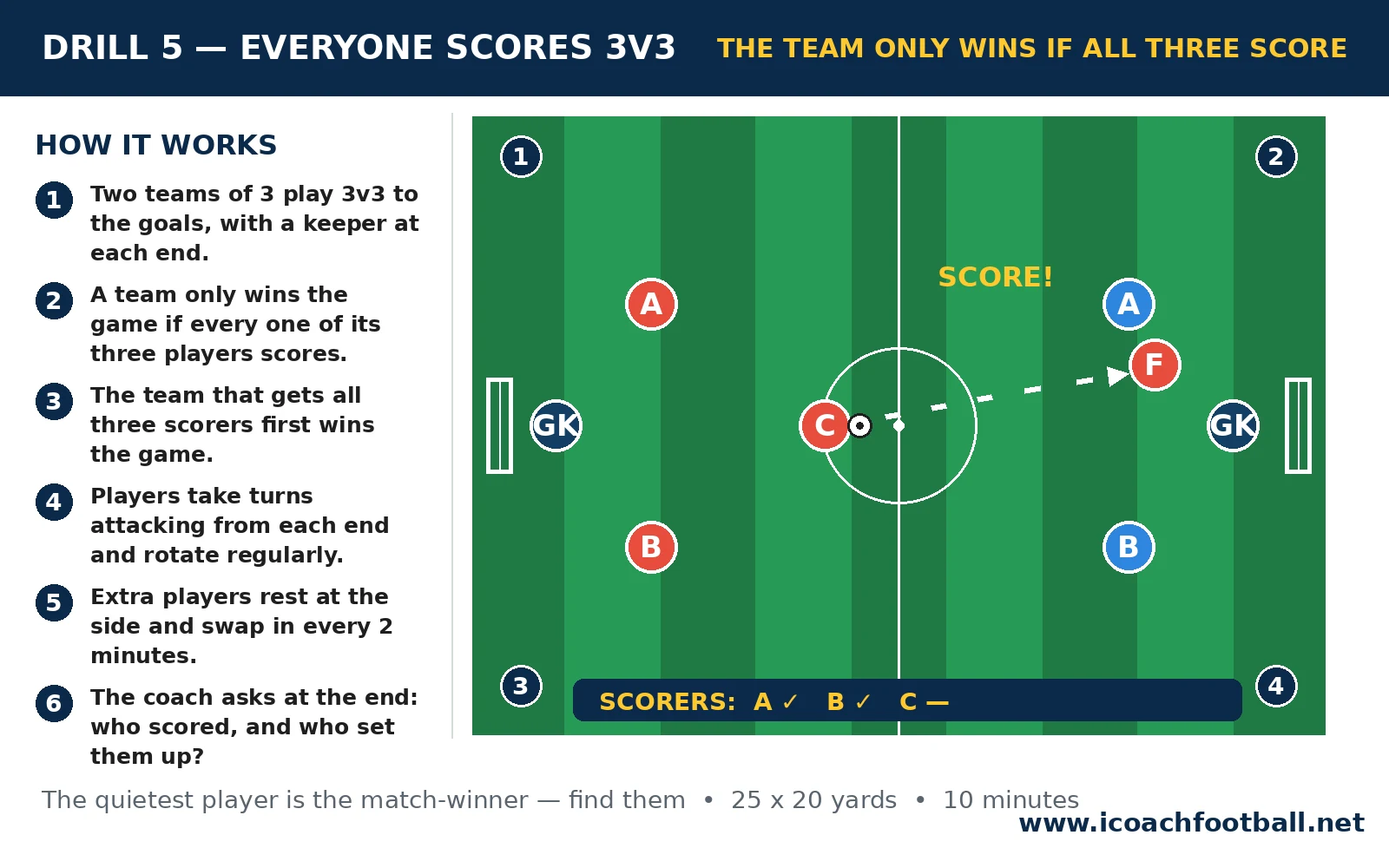
- Setup: 25 x 20 yard pitch. Two teams of 3, a goal and goalkeeper at each end. 10 minutes.
How to play:
- Two teams of 3 play 3v3 to the goals, with a goalkeeper at each end.
- A team only wins the game if every one of its three players scores.
- The team that gets all three scorers first wins — a 3–0 win with one scorer does not count.
- Players take turns attacking from each end and rotate regularly.
- Extra players rest at the side and swap in every 2 minutes.
- The coach asks at the end: who scored, and who set them up?
Coach’s note: “The quietest player is the match-winner — find them.”
Progressions: Each player must dribble past at least one opponent before their team can score; each player in a team must touch the ball before a goal counts; play with two goals per team.
Drill 6 — Brave Ball 6v6
The final game, and the only rule that matters: a goal only counts if it follows a 1v1 attempt or a skill. The team that tries the most skills wins the brave point — even if it loses the game. The coach says less and watches more, and the players own their decisions.
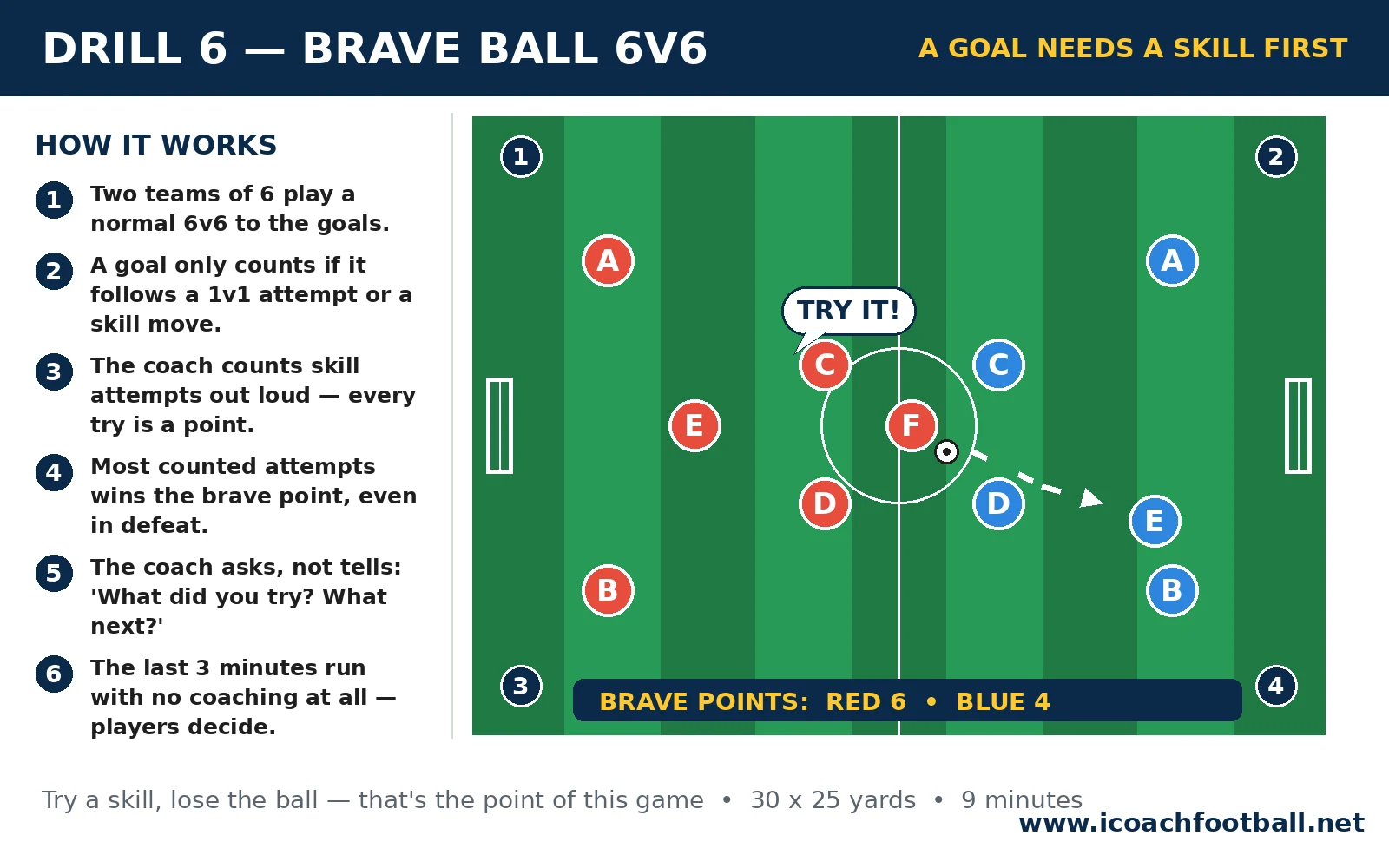
- Setup: 30 x 25 yard pitch. Two teams of 6, goals at each end. 9 minutes.
How to play:
- Two teams of 6 play a normal 6v6 to the goals.
- A goal only counts if it follows a 1v1 attempt or a skill move.
- The coach counts skill attempts out loud — every try is a point for the team.
- The team with the most counted attempts wins the brave point, even in defeat.
- The coach asks, not tells: “What did you try? What will you try next?”
- The last 3 minutes run with no coaching at all — the players decide everything.
Coach’s note: “Try it and lose the ball — that’s the point of this game.”
Progressions: The goal only counts if two different players tried a skill in the same attack; the goal must follow a weak-foot attempt; play the last 3 minutes with a one-touch rule in the final third.
Coaching points: the five mistakes that kill confidence
| Mistake | What you see | Fix |
|---|---|---|
| Praising only goals | Players stop trying skills and play safe | Praise the attempt first — name the choice, then the finish |
| Punishing mistakes | Players hide from the ball | Mistakes are free in this session — a failed try still scores |
| Comparing players | The shy one quits trying | Self-referenced scores only — beat your own last total |
| Too much coaching talk | Players freeze and wait for instructions | Say less, watch more — ask questions at natural breaks |
| Skipping the easy step | The jump is too big and the try fails | Shrink the challenge — bigger space, longer head start — until the try succeeds |
Age adaptations
| Age | Area | What changes |
|---|---|---|
| U9–U10 (ages 8–10) | 15 x 15-yard grids | Dribble Champion starts with no catcher — cross freely and try moves; Head-Start 1v1 gives a 5-second head start; shooting zones are bigger and the defender stays passive — see the U10 soccer practice plan and the U11 soccer practice plan for the next step |
| U11–U12 (ages 11–12) | 20 x 15-yard grids | The drills as written; the shooting defender closes down after the first touch; the 1v1 head start is 3 seconds; Drill 5 adds the “every player must touch the ball” rule — see the U12 soccer practice plan |
| U13–U15 (ages 13–15) | 30 x 25-yard grids | Narrower pitches; the 1v1 head start drops to 2 seconds; Everyone Scores 3v3 requires a dribble past an opponent before scoring; Brave Ball goals need a named skill — see soccer drills for U13, soccer drills for U14 and soccer drills for U15 |
60-minute session plan
| Time | Block | Drill |
|---|---|---|
| 0:00–0:05 | Arrival game | Free 3v3 — every player must try one skill |
| 0:05–0:13 | Cross and try | Drill 1 — Dribble Champion |
| 0:13–0:21 | Beat yourself | Drill 2 — Beat Your Own Score |
| 0:21–0:31 | Win your duel | Drill 3 — Head-Start 1v1 |
| 0:31–0:41 | Bank the points | Drill 4 — Target Zones Shooting |
| 0:41–0:51 | Everyone scores | Drill 5 — Everyone Scores 3v3 |
| 0:51–0:60 | The brave game | Drill 6 — Brave Ball 6v6 |
New to coaching this age? Stretch the arrival game to 8 minutes and cut Drill 2 to 5 minutes and you have the same session with more settling-in time — see our 60-minute plan for the structure (the same shape, shortened where you need it).
Keep building from here
Confidence sits on top of ball mastery, so start there if a player is still fighting the ball: our soccer drills for beginners build the first touch this session needs, and soccer dribbling drills give the moves Drill 1 rewards. The choice that follows the try is the decision itself: our soccer decision making drills train what to do after you beat a player, and soccer scanning drills teach the look-up that makes the 1v1 winnable. Build the passing base next: soccer passing drills for the weight and accuracy Drills 2 and 5 need, and weak foot soccer drills so both feet can play the brave pass. The formats in this session have their own deep dives: soccer 3v3 drills for the combination play behind Drill 5, soccer 4v4 drills for the shape behind Drill 6, soccer 5v5 drills for the numbers behind the final game, and the rondo blueprint for the possession angles behind Drill 2. The 1v1 in Drill 3 is the first step of our 1v1 to 4v4 transition drill, and the moving monkeys rondo turns the same duel into a game. The finish in Drill 4 is the same skill as our soccer drills for strikers, and the duel in Drill 3 is the same problem as our soccer drills for two players and soccer drills for 6 players — and when numbers change on the night, our soccer practice plans by number of players pick the session that fits. Talking helps belief too: our soccer communication drills teach the calls that back a brave player up, and our soccer goalkeeper communication drills train the same belief from the goal line. Quiet players need confidence most of all: our soccer drills for girls show how to build it in a team that has never tried. Protect the players as they grow: our soccer injury prevention guide shows how to build the warm-up into every session, and our 10 soccer warm-up drills give you the full warm-up library. When they are older, the road runs through our soccer drills for U13, soccer drills for U14 and soccer drills for U15 — and if you run selections one day, our soccer tryout drills show how to grade a group fairly.
FAQ
At what age should you start confidence drills?
At U9 — once players can control and pass the ball reliably. Before that, the try is too big: a U8 player who is still fighting the ball cannot also take on a defender and enjoy it. Younger players need ball mastery and fun games first, like our soccer drills for beginners, and the full confidence games in this session land best from age 8 or 9. In the UK the same session is football drills for improving confidence, and the age is the same.
What do you do with a player who refuses to try a skill in a game?
Shrink the challenge until the try succeeds. Give them a head start in a 1v1, a bigger space, or an unopposed finish — Drill 3 and Drill 4 are built for exactly this. Score the attempt, not the outcome, and never punish a failed try. A player who is laughed at or benched for trying will never try again; a player whose try is praised will try again next week.
How do you build confidence without lowering standards?
Keep the standard and shrink the step. The goal is still to beat a player and score — the route is just shorter: a longer head start, a wider pitch, a passive defender. The FA’s guidance makes the same point: challenge players with a wide range of experiences, praise effort and recognise accomplishments, and let them own their choices. Self-referenced scores — beat your own last total — keep the standard honest without comparing players.
Should you praise every touch?
No — praise the choice and the effort, not everything. ‘Great try — you took him on’ teaches; ‘well done’ on every pass teaches nothing. The FA’s Boot Room guidance is specific here: always praise effort and recognise accomplishments, and use positive reinforcement to shape behaviour. Name what was good and the player repeats it on purpose.
How long before a shy player starts taking players on?
Most coaches see the first tries within 3–4 weeks of two sessions a week — but measure attempts, not goals. Count skill attempts in Drill 6 and watch the number climb; the goals follow a few weeks later. If nothing changes in a month, the step is still too big: widen the space, lengthen the head start, or drop back to Drill 2 until the player’s own score starts climbing.
Sources
- FIFA Training Centre, “Dribbling with confidence” session plan (Grassroots 019) — a session that starts with a “Dribble Champion” warm-up where players cross a catching space and try moves, groups players by size and ability, builds to a 2v1 with 2 goals and 1 goalkeeper, and finishes with a 3v3 on 2 goals with 2 goalkeepers, asking “Can you all score a goal in the same match?” Drill 1 (Dribble Champion) and Drill 5 (Everyone Scores 3v3) are based on / in line with that session plan. https://www.fifatrainingcentre.com/media/native/test/FIFA_Session_Plan_Grassroots_019.pdf
- The FA, “How to support psychological development” (The Boot Room, England DNA) — guidance that coaches should encourage a growth mindset, praise effort and recognise accomplishments, give players ownership and choice, use small-sided games for real decisions, and say less and watch more. The six rules and the coaching approach in this post are in line with that guidance. https://www.thefa.com/bootroom/resources/coaching/how-to-support-psychological-development