Soccer Drills for Improving Passing Under Pressure: 6 Games That Teach Players to Stay Calm and Play Through the Press (U10–U16)
Quick answer
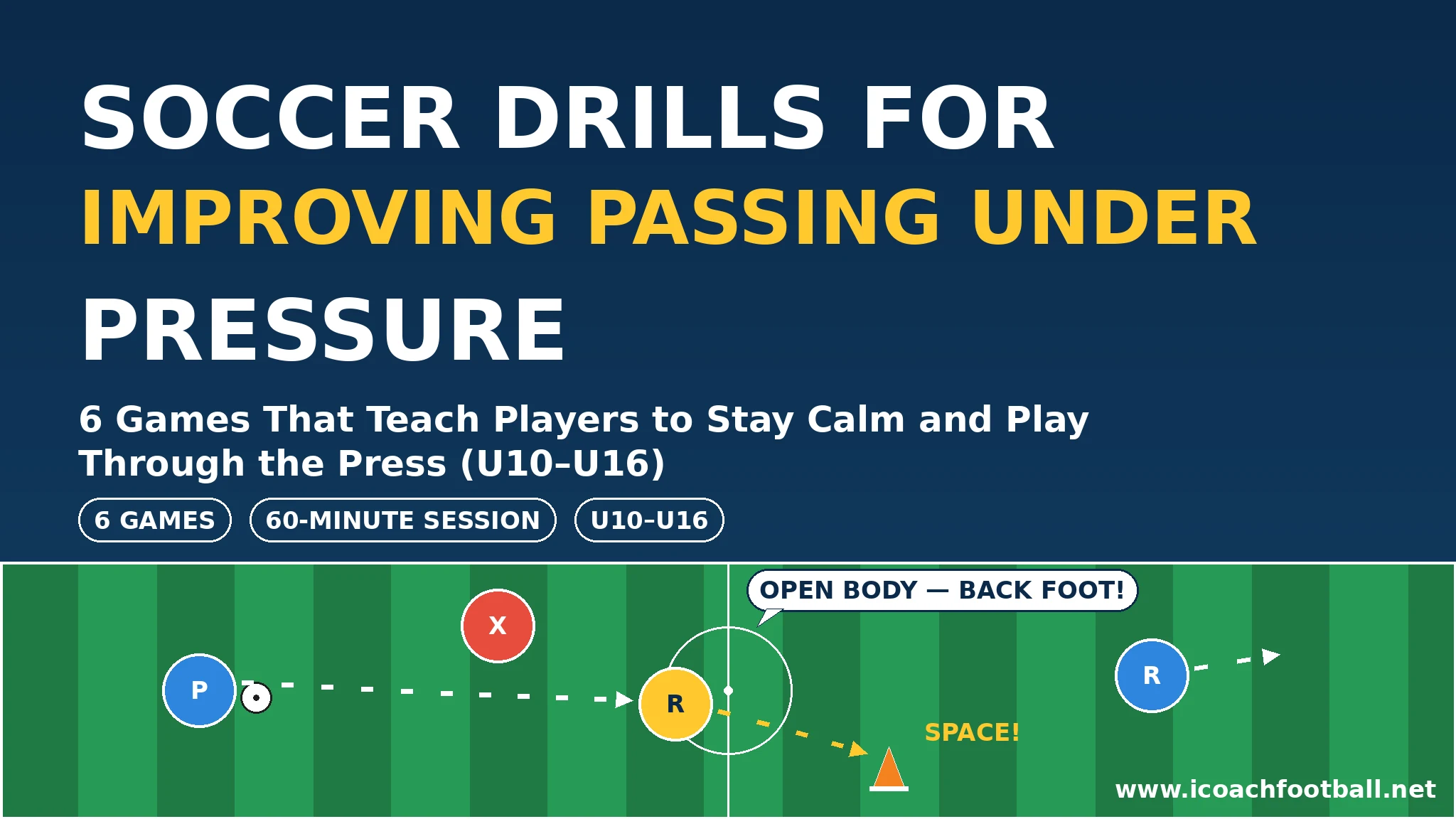
Most youth players can pass beautifully with no one near them — and give it straight away the moment a defender closes in. Pressure changes everything: the first touch gets heavy, the body turns square, the pass goes soft. Six games that teach the scan, the open body shape, the first touch away from pressure and the firm pass that plays through the press, in one 60-minute session.
Suitable for: U10–U16 (ages 9–16)
Session snapshot
- Players: 12–16 (U10–U16)
- Area: 15 x 10 to 40 x 30 yards (grids per drill)
- Duration: 60 minutes
- Focus: Scanning, body orientation, first touch away from pressure, firm passing, wall passes, playing through the press
- Equipment: 10–12 balls, 20 cones, 4 mini goals, bibs, 2 small goals
Why these six games work
Passing under pressure is not a technique problem. It is a picture problem. The player who loses the ball under pressure usually lost it before the ball arrived — they never scanned, they received square-on with their body closed, and their first touch trapped the ball under their feet where the presser wanted it. Fix the picture and the pass fixes itself. FIFA Training Centre session 51, delivered by FC Zürich Women’s Head Coach Jacqueline Dünker, teaches the same principles: under pressure, players must use firm and precise passes, excellent body orientation, continuous communication and effective off-the-ball movement that provides constant support for team-mates on the ball. A firm and close first touch stops the ball getting caught under foot; the body must be orientated so the ball can be received on either the front or back foot and moved into the space intended; and players off the ball must rotate positions so defenders cannot read the pattern. England Football Learning’s “Receiving the ball under pressure” session says the same thing from the receiver’s side: scan before receiving, use different parts of the body when receiving under pressure, and learn to move, protect and shield the ball under pressure. Drills 1, 3, 4 and 6 below are based on / in line with the FIFA session; Drill 5 is based on / in line with the England Football Learning session; the six rules and the coaching approach are in line with both. In the UK the same session is football drills for passing under pressure — the press and the answers are identical.
Six rules of passing under pressure
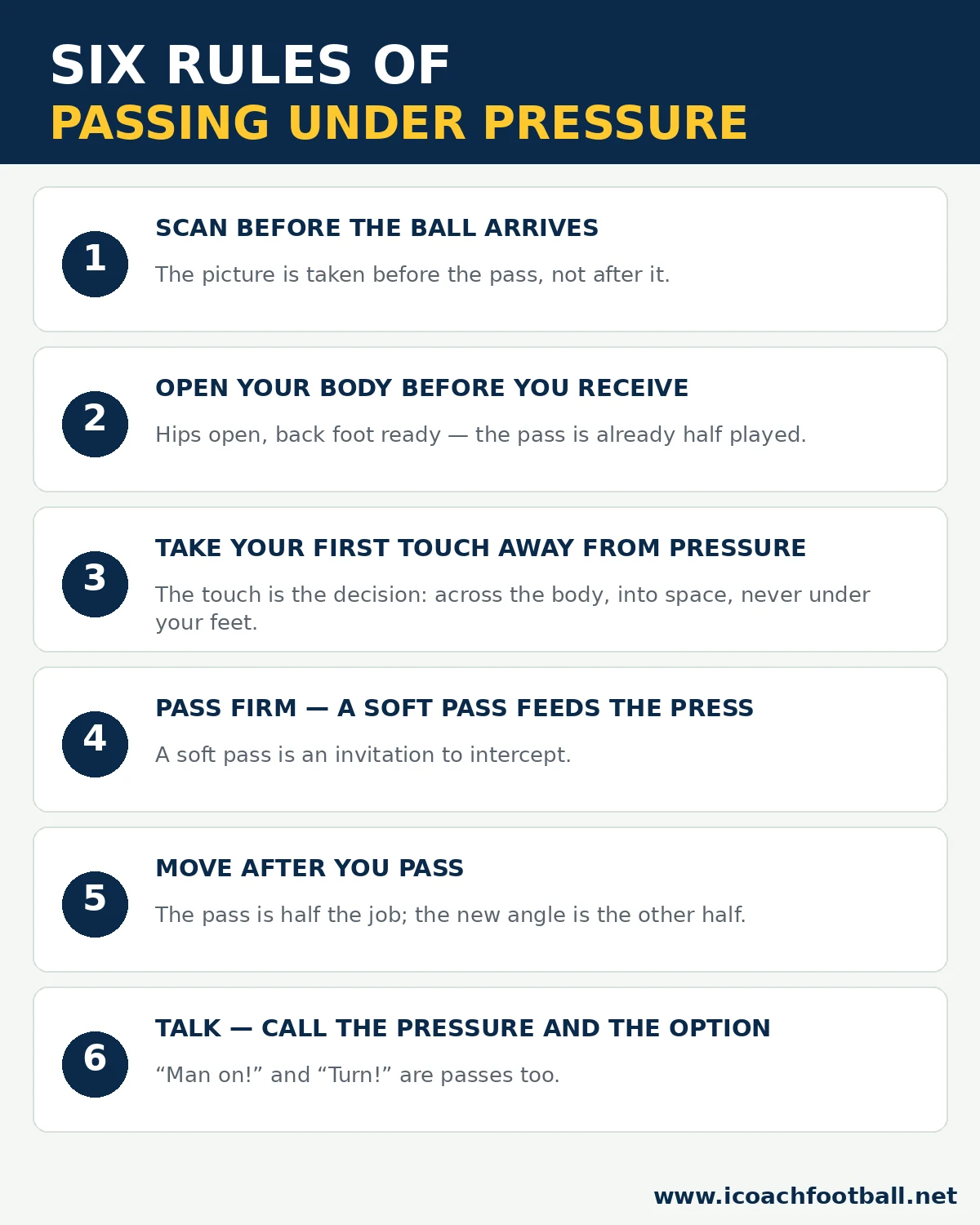
- Scan before the ball arrives. The picture is taken before the pass, not after it.
- Open your body before you receive. Hips open, back foot ready — the pass is already half played.
- Take your first touch away from pressure. The touch is the decision: across the body, into space, never under your feet.
- Pass firm — a soft pass feeds the press. A soft pass is an invitation to intercept.
- Move after you pass. The pass is half the job; the new angle is the other half.
- Talk — call the pressure and the option. “Man on!” and “Turn!” are passes too.
Drill 1 — The Pressure Circuit
The warm-up that sets the whole session. A passing circuit with a shadow defender at the middle station, so every reception has to be taken on the back foot with the body already open — based on / in line with Part 1 of FIFA Training Centre session 51.
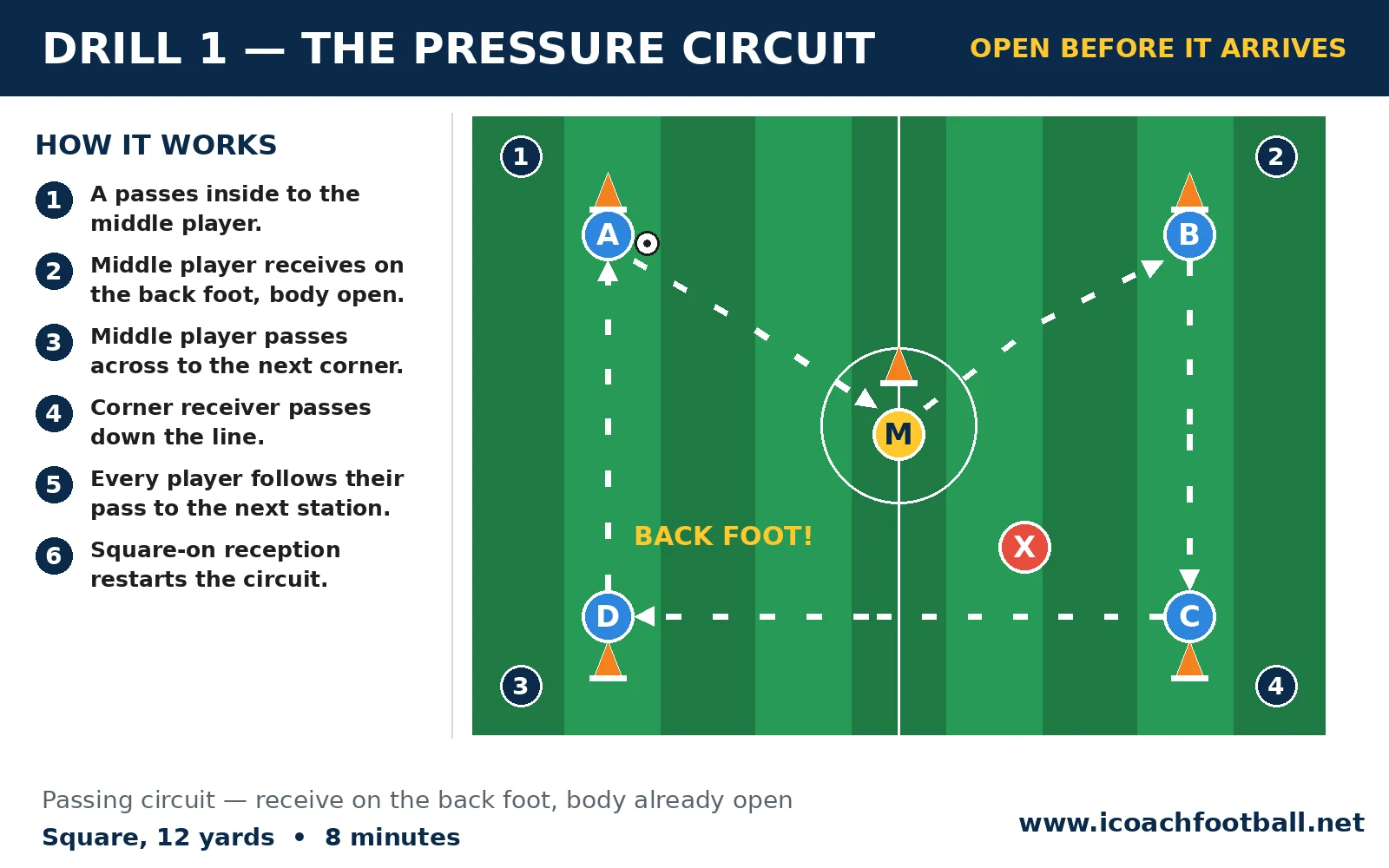
Setup: Square of 4 cones, 12 yards apart, with a middle station. 12 players, 2–3 at each corner. 8 minutes.
How to play:
- Player A passes inside to the middle player, who receives on the back foot.
- The middle player opens their body on the first touch and passes across to the next corner.
- The receiver at the corner passes down the line to the next station.
- Every player follows their pass and moves to the next station.
- A shadow defender stands at the middle station and may step toward the receiver, but not tackle.
- A pass played to a player who receives square-on restarts the circuit from station 1.
Coach’s note: “Open before it arrives — if your hips are square, your next pass is already late.”
Progressions: The shadow defender goes live and may intercept; two balls run at once; the circuit reverses direction on the coach’s call.
Drill 2 — Back Foot, Front Foot
One habit, drilled until it is automatic. The receiver must show the server which foot they want it on — back foot to turn away from pressure, front foot to play it straight back — and the first touch must take them away from the cone defender.
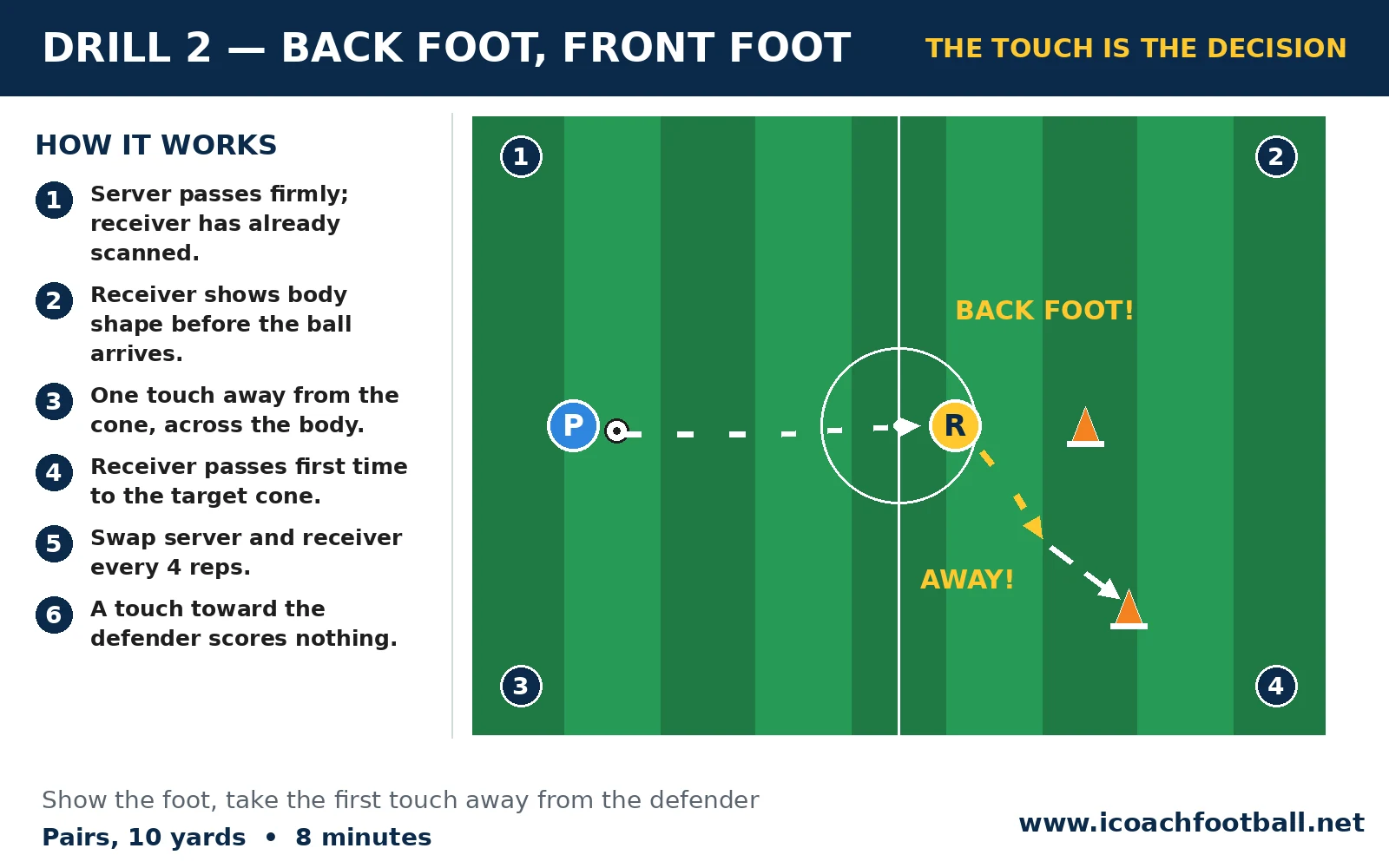
Setup: Pairs, 10 yards apart, with a cone defender 2 yards behind the receiver. 8 minutes.
How to play:
- The server passes firmly to the receiver, who has already scanned over both shoulders.
- The receiver shows their body shape before the ball arrives — open for the back foot, closed for the front foot.
- The receiver takes one touch away from the cone defender, across their body.
- The receiver plays the next pass first time to the target cone, 10 yards to the side.
- The server becomes the receiver after every 4 reps, and the cone defender swaps sides.
- A first touch that goes toward the defender scores nothing — the rep restarts.
Coach’s note: “Show me the foot before the ball gets there — the pass follows your shape, not the other way round.”
Progressions: The cone defender becomes a live defender who may step in after the first touch; the receiver must call “back foot!” or “front foot!” before the pass; the target cone moves to the receiver’s weaker side.
Drill 3 — The Wall Pass Escape
Two attackers, one presser, one gate. The only way past the defender is the wall pass — the one-two that beats a press faster than any dribble — in line with the 2v1 attack v. defence principle of FIFA Training Centre session 51, Part 3.
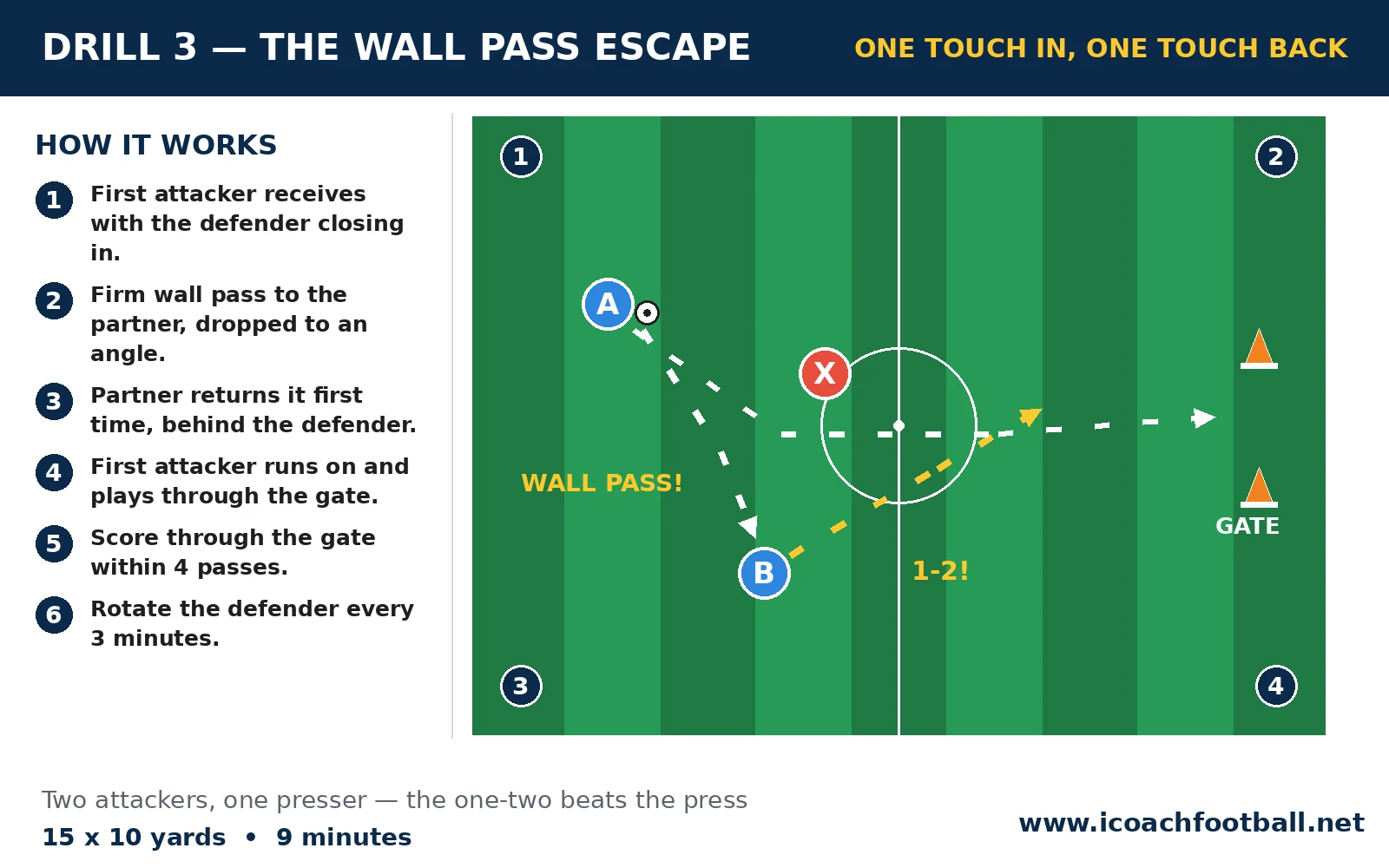
Setup: 15 x 10 yard grid, target gate at the far end. 2 attackers vs 1 defender. 9 minutes.
How to play:
- The first attacker receives the ball at the near end with the defender closing in.
- The first attacker plays a firm wall pass to their partner, who has dropped to an angle.
- The partner returns it first time, into the space behind the defender.
- The first attacker runs onto the return pass and plays through the target gate.
- The attackers must shoot or score through the gate within 4 passes.
- Rotate the defender every 3 minutes so everyone learns to press and to escape it.
Coach’s note: “The wall pass is the escape — one touch in, one touch back, and the presser is behind you.”
Progressions: A second defender joins and the attackers must wall-pass twice; the gate narrows to 3 yards; the return pass must be played with the weaker foot.
Drill 4 — Three Colours, One Press
The game that teaches the whole team to keep the ball when the press comes. Three teams in one area, the coach calls two colours to keep possession and one to press — and the press changes every 30 seconds, so nobody can switch off. Based on / in line with Part 2 of FIFA Training Centre session 51.
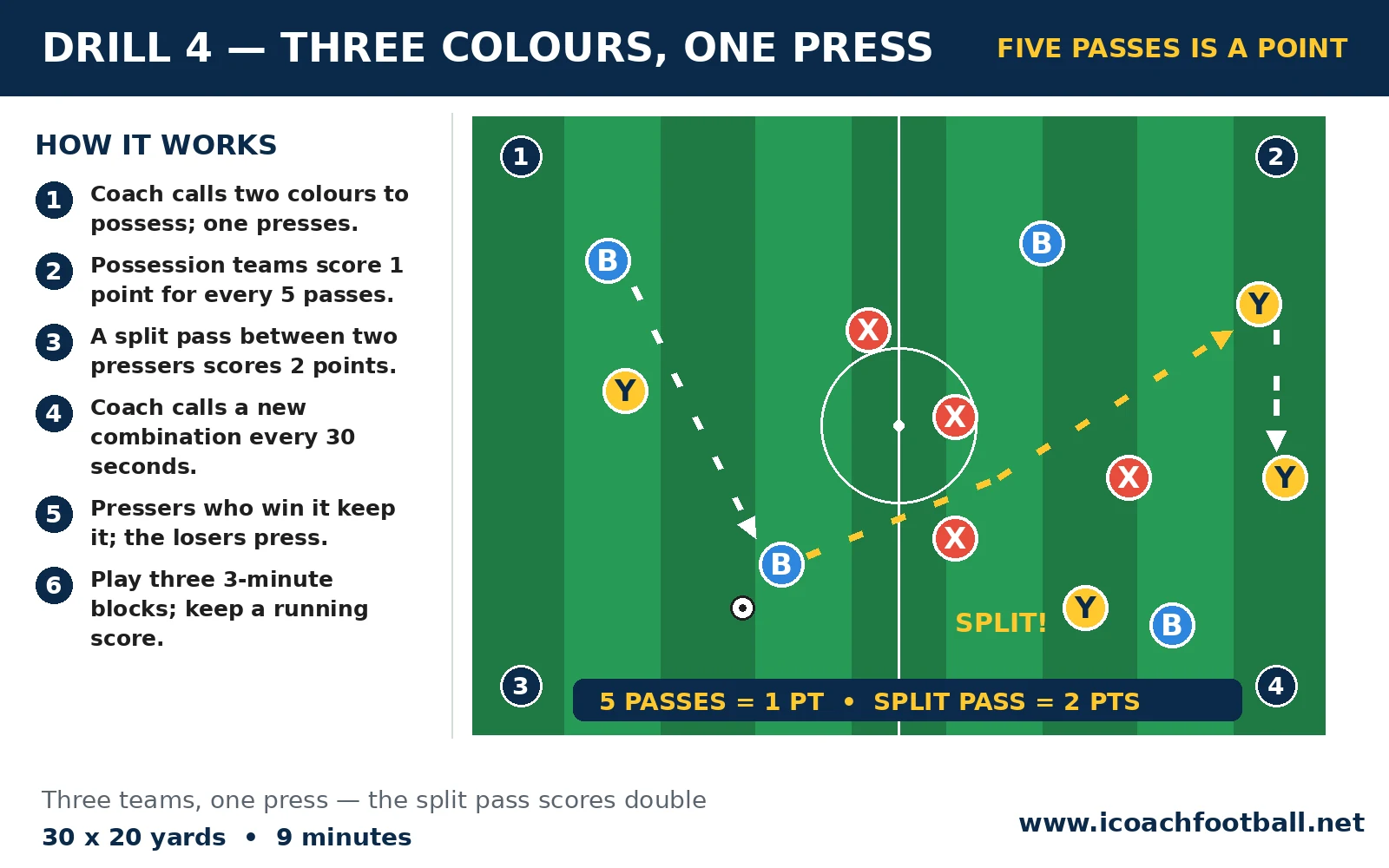
Setup: 30 x 20 yard area. Three teams of 4, different bib colours. 9 minutes.
How to play:
- Two teams called by the coach keep possession between them; the third team presses.
- The teams in possession score 1 point for every 5 consecutive passes.
- A pass that splits the press — played between two pressers — scores 2 points.
- The coach calls a new combination every 30 seconds, so the pressers become possessors.
- If the pressers win the ball, they keep it and the team that lost it becomes the press.
- Play three 3-minute blocks and keep a running score across the blocks.
Coach’s note: “Five passes is a point, a split pass is two — the press is a puzzle, and the pass through it is worth more.”
Progressions: Two-touch limit, then one-touch for the two possession teams; the area narrows to 25 x 15 yards; the pressers score a point for every interception.
Drill 5 — End Players
The receiving game, based on / in line with England Football Learning’s “Receiving the ball under pressure” session. Two against two inside a rectangle, with an end player at each end — receive under pressure, protect it, and work it from one end to the other.
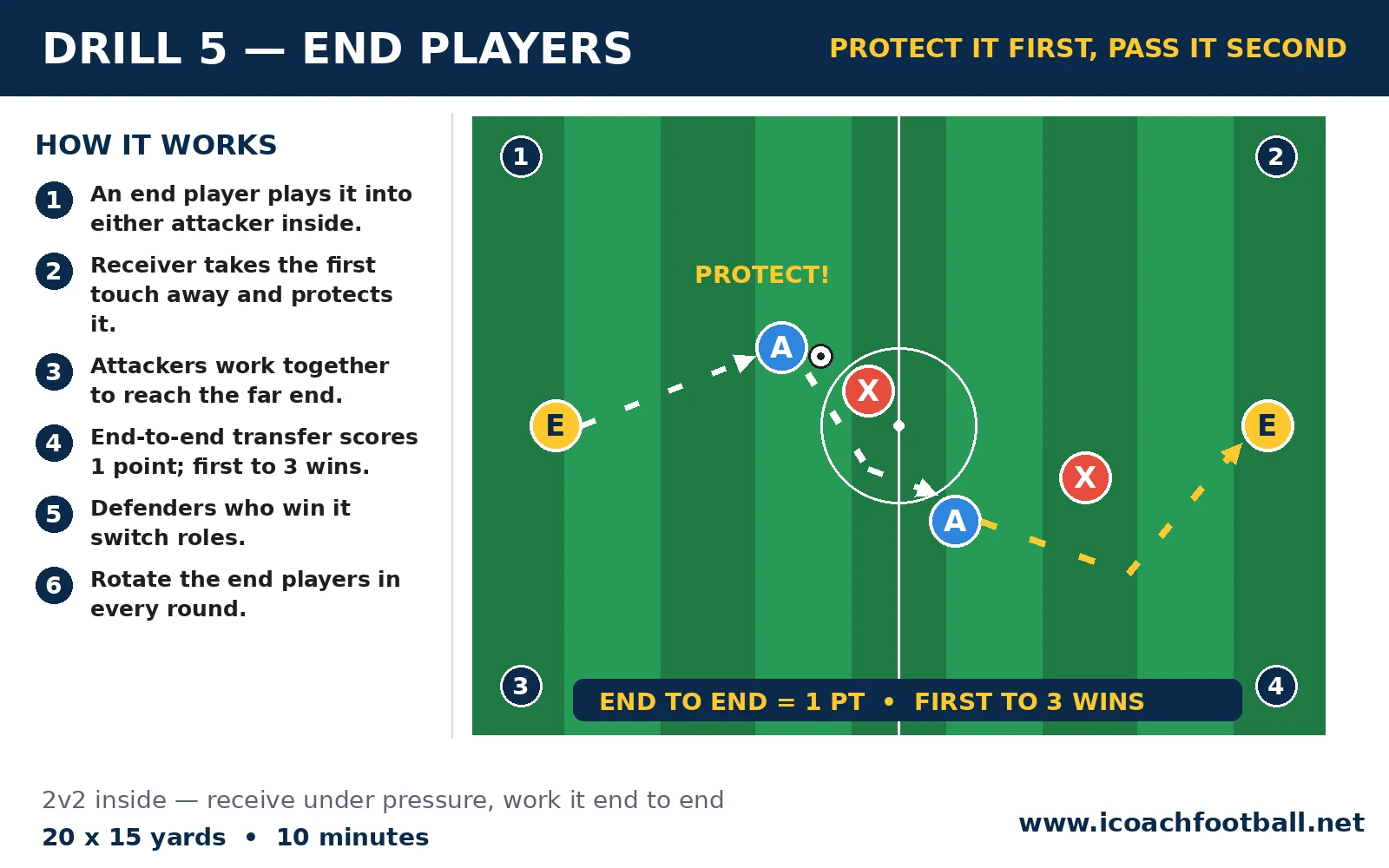
Setup: 20 x 15 yard rectangle, one end player at each end. 2v2 inside. 10 minutes.
How to play:
- An end player starts with the ball and plays it into either attacker inside the rectangle.
- The receiving attacker must take their first touch away from the defender and protect the ball.
- The two attackers work together to get the ball to the end player at the far end.
- A successful end-to-end transfer scores 1 point; the first pair to 3 points wins the round.
- The defending pair tries to stop the transfer and win the ball — if they win it, the roles switch.
- Rotate the end players into the 2v2 every round so everyone receives under pressure.
Coach’s note: “Protect it first, pass it second — the shield is what buys the pass.”
Progressions: The end players may move along the end line; the attackers must receive on the back foot to score; the defenders may press the end players too.
Drill 6 — The Press Breaker Game
The conditioned game, in line with the 4v3 attack v. defence finish of FIFA Training Centre session 51, Part 4. Four attackers against three defenders in the final third — a goal only counts if the build-up included a pass played through the press, between two defenders.
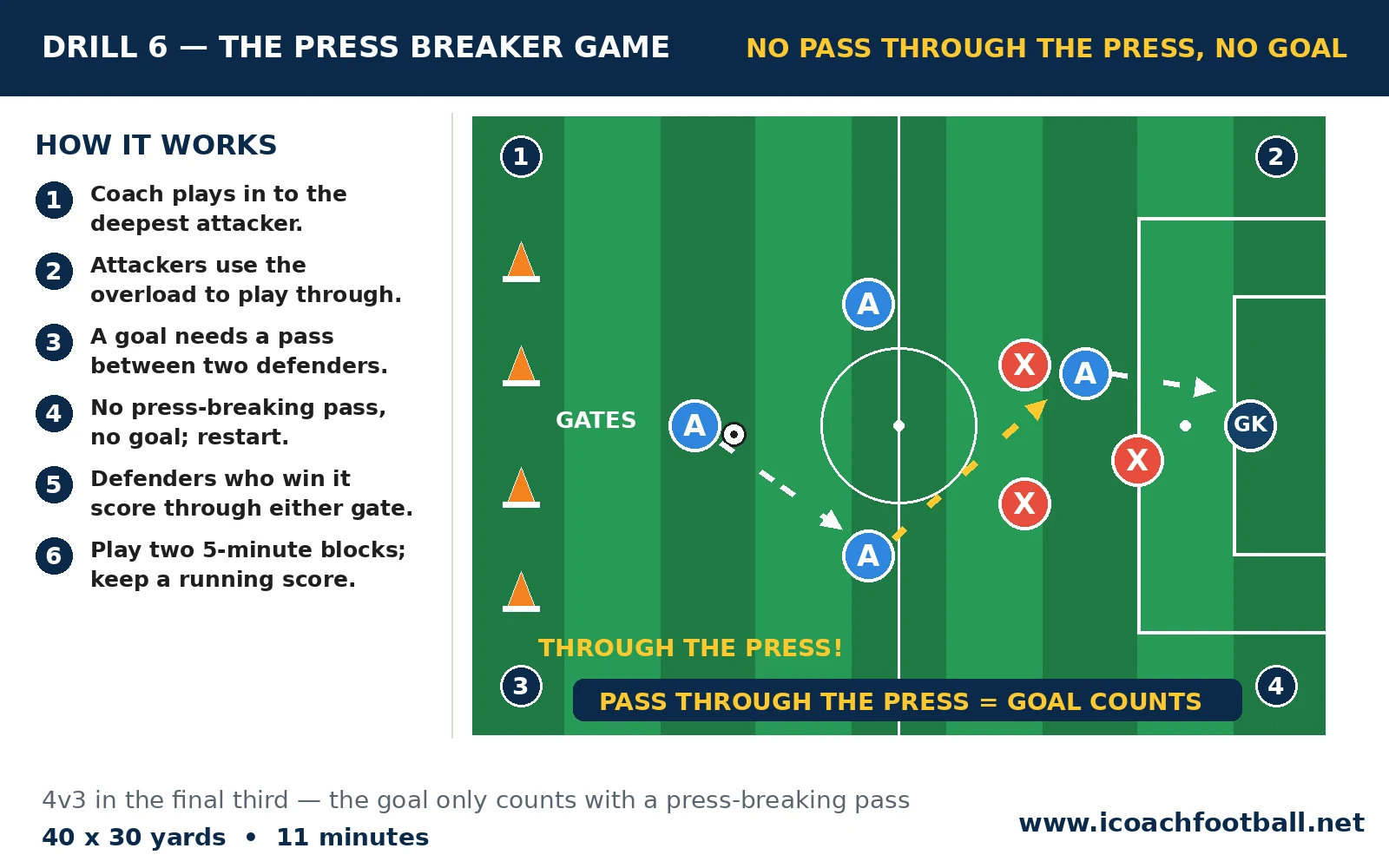
Setup: 40 x 30 yards, full goal with keeper at one end, two gates at the other. 4 attackers vs 3 defenders. 11 minutes.
How to play:
- The coach plays the ball in to the deepest attacker and the defenders press immediately.
- The attackers must use their overload to play through the press and create a shot.
- A goal counts only if the build-up included a pass played between two defenders.
- A goal with no press-breaking pass in the build-up scores nothing, and play restarts from the keeper.
- If the defenders win the ball, they score by carrying it through either gate at the far end.
- Play two 5-minute blocks and keep a running score across the blocks.
Coach’s note: “No pass through the press, no goal — the brave pass between two defenders is the one that counts.”
Progressions: The goal counts double if the press-breaking pass was first time; the touch limit drops to two; the area narrows to 35 x 25 yards.
Coaching points: the five mistakes that kill passing under pressure
| Mistake | What you see | Fix |
|---|---|---|
| Receiving square-on, body closed | The receiver has to take an extra touch to turn, and the presser arrives first | Open the hips before the ball arrives — show the server which foot you want it on |
| First touch under the feet | The ball gets caught under foot and the presser steals it on the spot | A firm, close first touch away from pressure, across the body, never into the defender |
| Passing soft or behind the receiver | The pass is intercepted, or the receiver has to check back toward the press | Pass firm, to the correct foot, ahead of the run — a soft pass feeds the press |
| Standing still after passing | The next receiver has no option, and the press closes around the ball | Move after you pass — the pass is half the job, and the new angle is the other half |
| Forcing it forward into a closed lane | The turnover happens in the worst place, with the team stretched | Play back or sideways to escape, then go forward — the safe pass is the brave pass when pressed |
Age adaptations
| Age | Area | What changes |
|---|---|---|
| U10–U11 (ages 9–11) | 15 x 10-yard grids | Drills 1 and 2 only, with a shadow defender who never tackles — the scan, the open body and the first touch away from pressure are taught before any live presser arrives. Celebrate the shape, not the speed, and keep the live press out until the back-foot habit is automatic — see the U11 soccer practice plan |
| U12–U13 (ages 12–13) | 20 x 15-yard grids | Full six-drill menu with a passive defender in Drills 3 and 5; the wall pass introduced in Drill 3 and the end-players game introduced in Drill 5, both against a defender who only shadows at first — see soccer drills for U13 and the U12 soccer practice plan |
| U14–U15 (ages 14–15) | 30 x 20 to 40 x 30 yards | Live pressers in Drills 3, 4 and 6; one-touch limit in Drill 4; the press-breaker game runs with the double-points first-time rule — see soccer drills for U14, soccer drills for U15 and the U13 soccer practice plan |
| U16 (ages 15–16) | Full pitch shapes, 40 x 30 yards | No coach call on the press in Drill 4 — players must read the pressing trigger themselves; weaker-foot return passes demanded in Drill 3; the target gate in Drill 3 narrows to 3 yards and the Drill 6 area narrows to 35 x 25 yards |
60-minute session plan
| Time | Block | Drill |
|---|---|---|
| 0:00–0:05 | Arrival game | Free 4v4 — every pass must be played within 2 touches |
| 0:05–0:13 | The warm-up circuit | Drill 1 — The Pressure Circuit |
| 0:13–0:21 | One habit, automatic | Drill 2 — Back Foot, Front Foot |
| 0:21–0:30 | The escape | Drill 3 — The Wall Pass Escape |
| 0:30–0:39 | Keep it when the press comes | Drill 4 — Three Colours, One Press |
| 0:39–0:49 | Receive, protect, transfer | Drill 5 — End Players |
| 0:49–0:60 | The press breaker | Drill 6 — The Press Breaker Game |
New to coaching this age? Stretch the arrival game to 8 minutes and cut Drill 5 to 7 minutes and you have the same session with more settling-in time — see our 60-minute plan for the structure (the same shape, shortened where you need it).
Keep building from here
Passing under pressure sits on top of the basics, so the foundation is our soccer passing drills — the technique this session puts under a live press — and the look before the pass is our soccer scanning drills, while the choice that follows the pass is our soccer decision making drills. The move after the pass is our soccer drills for improving off the ball movement, and the talking that times the pass is our soccer communication drills. The brave player who tries the press-breaking pass is built in our soccer drills for improving confidence, and the player who invents a new way through is built in our soccer drills for improving creativity. The pass that starts the attack from the back is our soccer playing out from the back drills, and the restart that begins it is our soccer goal kick routines. The pattern that uses the wall pass most is our soccer third man runs drills, and the overload the pass creates is our 2v1 soccer drills, while the finish at the end of the pass is our 1v1 finishing drills and our soccer drills for strikers. The press you are beating is our counter-pressing drills, and the defending side of the same moment is our football defensive transition drills — while the rondo that teaches the same habits in miniature is our 5v3 rondo transition drill. The pass that switches the point of attack is our switching play drills, and the wide run that opens the lane is our soccer overlap and underlap drills. The control that keeps the pass alive is our soccer dribbling drills. The other restarts have their own sessions: our soccer throw-in drills, soccer corner kick plays, football free-kick routines and soccer penalty kick drills. The foundation for younger players is our soccer drills for beginners. Protect the players as they grow: our soccer injury prevention guide shows how to build the warm-up into every session, and our 10 soccer warm-up drills give you the full warm-up library. When they are older, the road runs through our soccer drills for U13, soccer drills for U14 and soccer drills for U15 — and the girls and boys versions of this work are our soccer drills for girls and soccer drills for boys — and if you run selections one day, our soccer tryout drills show how to grade a group fairly. The receiving half of the same skill is our soccer drills for receiving under pressure. If your players can pass under pressure but the passes keep missing, the next step is accuracy — our soccer drills for improving passing accuracy train the plant foot, the locked ankle and the pass weight that turn a hurried pass into a completed one.
FAQ
What does passing under pressure mean in soccer?
Passing under pressure means receiving and passing while a defender is closing in — with less time, less space and a real chance of losing the ball. It is not about kicking harder; it is about scanning before the ball arrives, opening the body so the next pass is already half played, and taking a first touch away from the presser. In the UK the same session is football drills for passing under pressure, and the answers are identical.
How do you teach kids to pass under pressure?
One habit at a time, and never against a live defender first. Drill 1 teaches the open body shape in a circuit with a shadow defender; Drill 2 drills the back-foot first touch until it is automatic. Only then do Drills 3 and 4 add a live presser — and the rule stays the same at every age: scan, open, first touch away, firm pass. Celebrate the shape even when the pass does not come off.
How many touches should a player take under pressure?
Two at most — one to control away from pressure, one to pass. One touch is better when the picture is already seen: the scan before receiving is what makes one-touch play possible. The first touch is the decision, so a player who needs three touches has already lost the duel; the fix is the scan, not faster feet.
What is the best first touch when a defender is pressing?
Across the body, away from the presser, on the back foot — never under your feet and never toward the defender. The touch should take the ball into the space you intend to play in, so the second touch is already the pass. A firm, close first touch stops the ball getting caught under foot, which is where most press turnovers happen.
Should young players pass backwards when pressed?
Yes — the safe pass backwards or sideways is the brave pass when pressed. Playing forward into a closed lane is the turnover, and it happens in the worst place with the team stretched. The rule in Drill 6 is the same: escape the press first, then go forward. Going backwards to go forwards is how every top team plays through a press.
Sources
- FIFA Training Centre, “Jacqueline Dünker: Passing under pressure” (Session 51; FC Zürich Women’s Head Coach) — under pressure, players must use firm and precise passes, excellent body orientation, continuous communication and effective off-the-ball movement; a firm and close first touch prevents the ball getting caught under foot; the body must be orientated so the ball can be received on either the front or back foot and moved into the space intended; players off the ball must rotate positions so defenders cannot read the pattern. Drills 1, 3, 4 and 6 below are based on / in line with this session. https://www.fifatrainingcentre.com/en/practice/elite-sessions/in-possession/duenker-passing-under-pressure.php
- England Football Learning, “Receiving the ball under pressure in football” — scan before receiving; use different parts of the body when receiving under pressure; move, protect and shield the ball under pressure; work the ball from one end player to the other through a 2v2. Drill 5 below is based on / in line with this session; the six rules and the coaching approach in this post are in line with it. https://learn.englandfootball.com/sessions/resources/2022/Receiving-the-ball-under-pressure-in-football