Soccer Drills for Middle School Players: 6 Games That Turn 11–13-Year-Olds Into Confident Footballers

Quick answer
Middle school players are 11 to 13 years old, mixed in ability, short on attention and long on energy. These six soccer drills for middle school players work with that reality: no lines, no waiting, short rounds, every player touching the ball every minute — a rondo, a 1v1, a 2v1 wave and a finishing game, all inside one 60-minute session.
Suitable for: U11–U14
In football — soccer in the US — the middle school team is the hardest team in youth football to coach well. A club U13 squad is picked; a school squad is whoever turned up. Your best player has played since they were five and your weakest started last month, practice is twice a week for six weeks, and the season is over before the team settles. The six games below are built for exactly that squad, and they follow the FIFA Training Centre’s own grassroots sessions for this age: “#61: Technical activation and small-sided games” builds combination play and fast decisions in teams of five, and “#128: Use the numerical advantage” runs 1v1, 2v1 and 4v2 mini-matches that teach players to adapt to whatever the game gives them. This post is the school-team companion to our soccer drills for U13 and our soccer drills for U14 — those posts train the age group by year; this one trains the mixed squad a school coach actually gets.
Session snapshot
- Players: 12–24 (split into two or three pitches for the small games)
- Area: One half of a pitch, grids 20 x 15 to 40 x 30 yards
- Duration: 60 minutes
- Focus: First touch, scanning, 1v1s, 2v1 overloads, combination play, finishing
- Age: U11–U14 (see Age adaptations)
The six middle-school rules
Every one of these soccer drills for middle school players is built on six rules. Teach them once, then repeat them in every game until the players say them back to you.
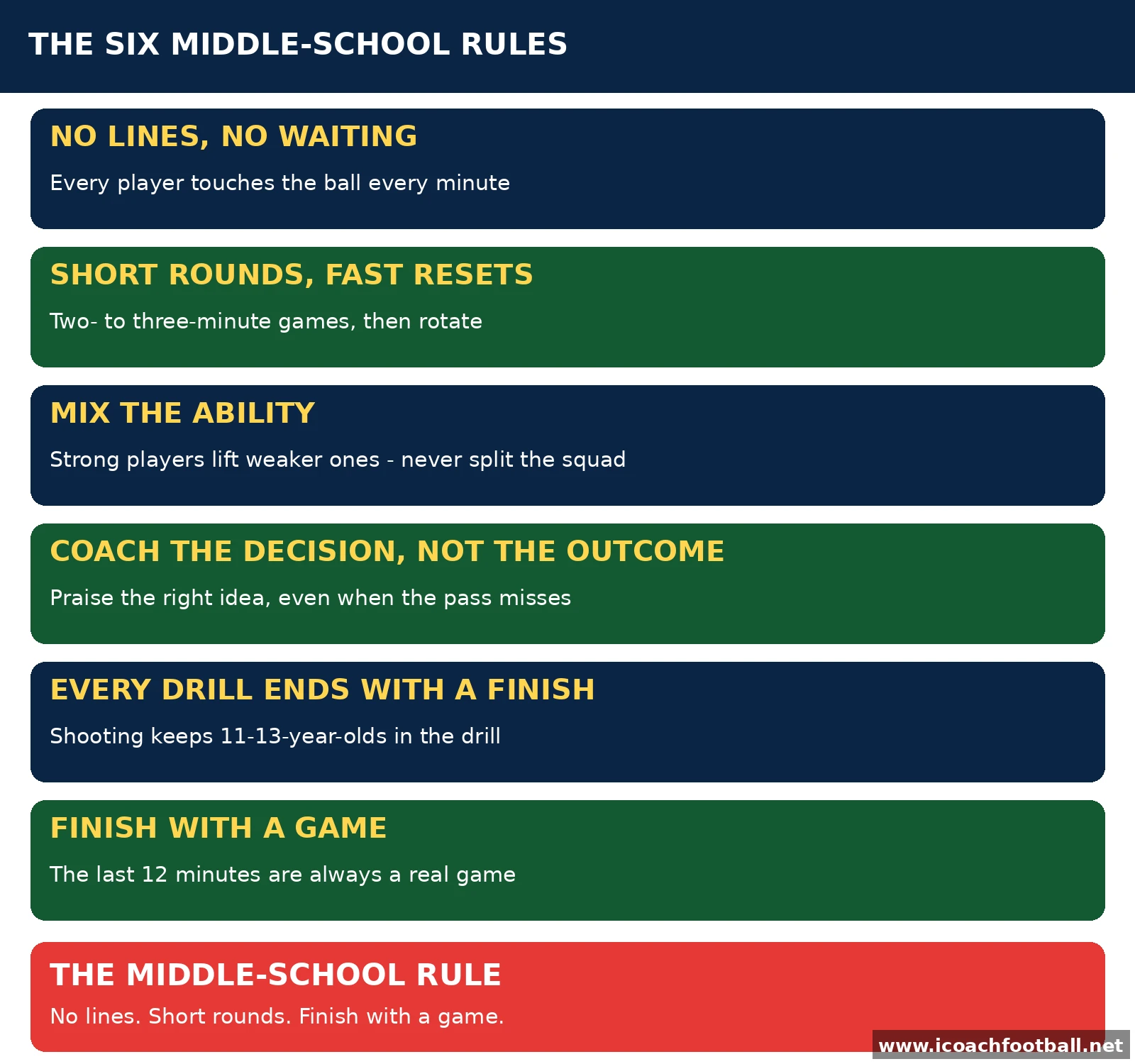
| Rule | What it means |
|---|---|
| No lines, no waiting | Every player touches the ball every minute — a drill with a queue is a drill that loses the room |
| Short rounds, fast resets | Two- to three-minute games, then rotate — the moment energy dips, change the game |
| Mix the ability | Strong players lift weaker ones — never separate the squad into a good team and a bad team |
| Coach the decision, not the outcome | Praise the right idea even when the pass misses — the pass will follow the idea |
| Every drill ends with a finish | Shooting keeps 11–13-year-olds in the drill — a game with no goal is a chore |
| Finish with a game | The last 12 minutes are always a real game — the session is remembered by how it ends |
Drill 1: The Gates Race — Pass, Move, Finish
The warm-up that is already a drill. Pairs race through a field of cone gates, passing and finishing, with the first pair to score winning two points and the other pair one if they score. Based on the FIFA Training Centre session “#61: Technical activation and small-sided games”, in which teams of no more than five race in pairs to score a goal — player one dribbles and passes to the attacker, who turns and shoots, and the players change positions each time so they all get to dribble, pass and shoot.

- Setup: A 30 x 20-yard grid with eight gates (two cones, two yards apart) scattered inside it, a mini goal at each end, players in pairs, one ball per pair, 10 minutes.
How to play:
- Each pair starts at a gate with a ball and passes through it to each other.
- On the coach’s “go”, both players dribble through the next gate and pass to each other.
- The pair that completes three gates first gets a shot at the mini goal.
- A goal scores two points; the other pair still scores one if they finish after them.
- After every race, the pairs swap roles so everyone dribbles, passes and shoots.
- First pair to five points wins, then the gates move and the race starts again.
- Coach’s note: Watch the pair that stands and waits for the perfect pass — a middle school warm-up dies the moment players stop moving, and the race only works if the ball keeps rolling; the cue is “pass and go, don’t pass and watch,” and our soccer passing drills build the one-touch habit this race needs, while our soccer scanning drills teach the shoulder check that finds the next gate.
- Progressions: The gates get narrower, so the pass must be accurate; the shot must be first time, so the turn has to be quick; the pairs become trios, so the third player must find the open gate.
Drill 2: The Four-Corner Rondo — Keep It, Then Switch It
The possession lesson. Four attackers keep the ball in a square with a target player in each corner, two defenders press, and the ball must visit all four corners before the team can score. In line with the FIFA Training Centre session “#61: Technical activation and small-sided games”, in which a 5v5 game marks three target areas inside the pitch and the team must work the ball into a target area, by passing or dribbling, to score a point.

- Setup: A 20 x 20-yard square with a cone target in each corner, four attackers inside and two defenders, one ball, 10 minutes.
How to play:
- The four attackers keep the ball inside the square, two touches maximum.
- The two defenders press and try to win it — a win scores them one point.
- The attackers score one point each time the ball reaches a new corner target.
- The ball must visit all four corners before the attackers can score a bonus point.
- When the defenders win it, they swap out and two attackers become defenders.
- First team to ten points wins, then the square shrinks by two yards.
- Coach’s note: Watch the attacker who receives with their back to the square — a player who never scans plays into the defender’s feet, and the rondo collapses into a chase; the cue is “check your shoulder before the ball arrives,” and our soccer scanning drills train exactly that habit, while our 4v2 to 3v1 pressing rondo runs the same pressure in a smaller game.
- Progressions: The defenders become three, so the square must move the ball faster; the attackers are limited to one touch, so the first touch has to go somewhere useful; the corner targets become players who must receive on the half-turn.
Drill 3: The 2v1 Wave — Two Attackers, One Defender, Then Rotate
The overload lesson. Waves of two attackers run at one defender and a keeper, finish, and the next wave starts the moment the shot is taken — no waiting, no queue, no standing around. In line with the FIFA Training Centre session “#128: Use the numerical advantage”, in which three pitches run 1v1, 2v1 and 4v2 mini-matches at the same time, each played for three minutes, so the group learns to adapt to different match situations.


- Setup: A 25 x 20-yard grid with a full-size goal and keeper at one end, two lines of attackers at the far end and a line of defenders at the side, balls with the coach, 10 minutes.
How to play:
- The coach plays the ball to the first pair of attackers.
- The two attackers combine against the one defender and try to score.
- The defender may win it and play into a mini goal at the far end.
- The moment the shot is taken, the next wave starts — no reset, no walk back.
- After every wave, the defender joins the back of the attackers’ line and a new defender steps in.
- First pair to three goals wins, then the waves run from the other side.
- Coach’s note: Watch the attacker who dribbles into the defender instead of using their partner — an 11-year-old’s first instinct is to beat the defender alone, and the 2v1 only teaches the overload if the pass comes first; the cue is “pass to beat them, dribble to finish them,” and our soccer 3v3 drills train the same give-and-go in a smaller game, while our 1v1 finishing drills train the shot the wave ends with.
- Progressions: The defender starts closer, so the decision must be faster; the attackers are limited to three passes, so the combination must be direct; a second defender recovers from behind, so the finish must come within five seconds.
Drill 4: The Channel Duel — Beat Them Wide, Finish Inside
The 1v1 lesson. A 1v1 in a wide channel from the halfway line to goal: the attacker must beat the defender on the outside, cut inside and finish — the defender shows them down the line and delays. In line with the FIFA Training Centre session “#128: Use the numerical advantage”, in which the 1v1 mini-match on its own pitch tests each player’s ability to adapt to a one-against-one situation before the group moves to the 2v1 and 4v2 pitches.

- Setup: A 12-metre-wide channel running from the halfway line to the goal, one full-size goal and a keeper, one attacker against one defender, a second defender as cover, balls with the coach, 10 minutes.
How to play:
- The coach plays the ball to the attacker at the halfway line, facing the defender.
- The attacker must beat the defender on the outside, down the line.
- The defender shows the attacker down the line — never inside towards goal.
- The attacker cuts inside at the edge of the box and finishes first time.
- If the defender wins it, they play into the mini goal at halfway.
- After every two duels, swap the defender so every player defends the channel.
- Coach’s note: Watch the attacker who cuts inside too early — a 1v1 won in the middle of the channel is worth nothing, because the defender recovers and the goal is still far away; the cue is “beat them wide, finish inside,” and our soccer dribbling drills train the feint that wins the outside, while our 7 soccer shooting drills train the first-time finish this duel ends with.
- Progressions: The attacker starts with a one-touch limit, so the feint must be the first touch; a second attacker joins as an overlapping runner, so the defender must choose; the duel runs from both channels, so every player attacks with both feet.
Drill 5: The Third-Man Finish — The Run Nobody Sees
The combination lesson. Three attackers combine to play a third-man run into a target area, then finish first time — the goal only counts if the ball went through the third man. Based on the FIFA Training Centre session “#61: Technical activation and small-sided games”, in which the 5v5 game with three target areas asks the team to work the ball into a target area to score, and the harder the team makes it for itself — fewer or smaller targets — the better the combination has to be.

- Setup: A 30 x 25-yard grid with a full-size goal and keeper at one end and a marked target area in front of the box, three attackers against two defenders, balls with the coach, 10 minutes.
How to play:
- The coach plays the ball to the first attacker, who passes to the second.
- The third attacker makes the run nobody sees — behind the defenders, into the target area.
- The second attacker plays the third man in with one touch.
- The third man finishes first time — a goal only counts if the ball went through the third man.
- The defenders may press the first pass, but they may not enter the target area.
- After every three finishes, the attackers and defenders swap roles.
- Coach’s note: Watch the third man who runs too early — a run made before the pass is played lets the defender step across and close the lane, and the combination dies on the edge of the box; the cue is “run on the pass, not before it,” and our soccer drills for U13 train the same third-man timing in a full session, while our soccer drills for U14 run it against a full 11v11 shape.
- Progressions: The target area shrinks, so the run must be precise; the finish must be with the weaker foot, so the run has to arrive at the right angle; the defenders may enter the target area, so the combination must be first time.
Drill 6: The Four-Goal Game — 5v5, Every Goal Counts
The match-real finish. A 5v5 game on four goals — two on each touchline — in which the team that finds the open goal fastest scores most. Based on the FIFA Training Centre session “#61: Technical activation and small-sided games”, in which the game application is a 5v5 played on mini-pitches with four goals located opposite each other on each touchline: each team can score in any of the four goals at first, then the game is made directional, and the players referee their own games.

- Setup: A 40 x 30-yard pitch with four mini goals, two on each touchline, 5v5 with keepers optional, balls with the coach, 12 minutes.
How to play:
- Play a normal game, but either team can score in any of the four goals.
- After a goal, the ball starts with the team that conceded.
- After three minutes, the game becomes directional — each team can only score in two goals.
- After six minutes, the game becomes diagonal — each team attacks opposite diagonal goals.
- The players referee their own game — the coach only stops play to praise a good decision.
- Play two six-minute halves, then swap the teams so every player faces a new opponent.
- Coach’s note: Watch the team that attacks the same goal every time — a team that never looks for the open goal is playing against the game, not with it, and the four-goal format only teaches scanning if the coach stops play to ask “which goal was open?”; the cue is “find the free goal first,” and our soccer 5v5 drills train the same decision in a two-goal game, while our soccer 4v4 drills train it one format smaller.
- Progressions: Every player must touch the ball before the team can score, so the game becomes a passing game; one team plays a player down, so the other must find the free goal faster; keepers are added, so the finish must beat a real shot-stopper.
Coaching points
- No lines, no waiting: Every player touches the ball every minute — our soccer drills for beginners start from the same rule, and our U11 soccer practice plan shows it in a full session.
- Short rounds, fast resets: Two- to three-minute games, then rotate — our soccer drills for U13 run the same tempo, and our soccer drills for U14 keep it at the next age up.
- Mix the ability: Strong players lift weaker ones — our soccer tryout drills grade players without splitting the squad, and our soccer drills for U15 run the same mixed groups one age up.
- Coach the decision, not the outcome: Praise the right idea even when the pass misses — our soccer scanning drills teach the shoulder check the decision starts from, and our soccer passing drills build the weight the pass needs.
- Every drill ends with a finish: Shooting keeps 11–13-year-olds in the drill — our 7 soccer shooting drills train the finish itself, and our 1v1 finishing drills train it under pressure.
- Finish with a game: The last 12 minutes are always a real game — our soccer 5v5 drills finish the same way, and our soccer 4v4 drills finish it one format smaller.
- Pass to beat them, dribble to finish them: The 2v1 only teaches the overload if the pass comes first — our soccer 3v3 drills train the same give-and-go, and our soccer drills for U16 run it at full speed.
- Beat them wide, finish inside: The 1v1 is won on the outside and finished in the middle — our soccer dribbling drills train the feint, and our soccer drills for U15 train the same duel one age up.
- Run on the pass, not before it: A run made too early closes its own lane — our soccer drills for U13 train the same timing, and our soccer drills for U14 run it against a full shape.
- Find the free goal first: The four-goal game only teaches scanning if the players look — our soccer 5v5 drills train the same decision, and our college soccer drills run it at the next level.
Common mistakes
- Standing and waiting for the perfect pass: A middle school warm-up dies the moment players stop moving — pass and go, don’t pass and watch.
- Receiving with your back to the square: A player who never scans plays into the defender’s feet — check your shoulder before the ball arrives.
- Dribbling into the defender instead of using your partner: An 11-year-old’s first instinct is to beat the defender alone — pass to beat them, dribble to finish them.
- Cutting inside too early: A 1v1 won in the middle of the channel is worth nothing — beat them wide, finish inside.
- Running before the pass is played: A run made too early lets the defender step across — run on the pass, not before it.
- Attacking the same goal every time: A team that never looks for the open goal is playing against the game — find the free goal first.
Age adaptations
| Age | Area | Touches | What changes |
|---|---|---|---|
| U11 | 20 x 15-yard grids, 30 x 20-yard pitch | Unlimited | Drill 1 runs with the gates wide, so the pass is easy; Drill 2 runs 4v0, so the attackers learn the corners before a defender arrives; Drill 3 runs 2v0, so the wave learns the combination before a defender is added; Drill 4 runs 1v0, so the attacker learns the outside beat before a defender is added; Drill 5 runs with the target area large; Drill 6 runs with keepers optional and all four goals open — our U11 soccer practice plan shows the same age band in a full session |
| U12 | 25 x 20-yard grids, 35 x 25-yard pitch | Three touches | Drill 1 runs as written, with the gates narrowed in the second block; Drill 2 runs with one defender, so the square must move the ball; Drill 3 runs 2v1 as written; Drill 4 runs 1v1 as written; Drill 5 runs with the target area at full size; Drill 6 runs with the directional rule after three minutes — our U12 soccer practice plan shows the same age band in a full session |
| U13–U14 | 30 x 25-yard grids, 40 x 30-yard pitch | Two touches | Drill 1 runs with the shot first time, so the turn has to be quick; Drill 2 runs with two defenders and a one-touch limit in the second block; Drill 3 runs with a recovering second defender, so the finish must come within five seconds; Drill 4 runs with a second attacker joining as an overlapping runner; Drill 5 runs with the target area shrunk and the finish with the weaker foot; Drill 6 runs with keepers added and the diagonal rule — our soccer drills for U13 and our soccer drills for U14 run the same age band in full sessions, and our U13 soccer practice plan shows the same age band in a full session |
60-minute session plan
These six soccer drills for middle school players fit into the hour like this:
| Block | Minutes | What to run |
|---|---|---|
| Warm-up | 0–10 | Drill 1, the gates race |
| Possession | 10–20 | Drill 2, the four-corner rondo |
| Overload | 20–30 | Drill 3, the 2v1 wave |
| 1v1 | 30–40 | Drill 4, the channel duel |
| Combination | 40–50 | Drill 5, the third-man finish |
| Match-real finish | 50–60 | Drill 6, the four-goal game 5v5 |
For a full guide to building the hour around these blocks, see our 60-minute session plan.
FAQ
What are the best soccer drills for middle school players?
The best soccer drills for middle school players are short, fast games in which every player touches the ball every minute: a gates race for passing and first touch, a four-corner rondo for scanning and keeping the ball, a 2v1 wave for the overload, a channel duel for the 1v1, a third-man finish for combination play, and a 5v5 four-goal game to finish. The six games in this post run in one 60-minute session and need nothing more than cones, bibs, balls and mini goals.
How long should a middle school soccer practice be?
Sixty minutes is the right length for a middle school soccer practice. Players aged 11 to 13 lose focus after about ten minutes in any one drill, so the hour works best as six ten-minute blocks — a warm-up, a possession game, an overload, a 1v1, a combination drill and a match-real finish — rather than two or three long drills. If your school session runs 90 minutes, run this hour, take a five-minute water break, then play a full 11v11 or 9v9 game for the rest.
How do you coach a mixed-ability middle school team?
Mix the ability in every drill and never split the squad into a good team and a bad team. Put your strongest player next to your weakest in the rondo, so the weaker player gets more touches and the stronger player has to pass to them. Keep the rounds short — two to three minutes — so a weak round is forgotten fast, and coach the decision rather than the outcome: praise the right idea even when the pass misses. The drills in this post are built for that squad, with the progressions adding difficulty for the stronger players without leaving anyone behind.
What age is middle school soccer?
Middle school soccer is played by 11 to 13-year-olds — sixth, seventh and eighth graders, roughly U11 to U14 in club terms. In the UK, the same age group plays football in school years 6 to 9, and the same drills work there: the session in this post is built for 11–13-year-olds, with the age adaptations table showing how each drill changes from U11 up to U14. If your eighth graders are turning 14, the U13–U14 column is the one to use.
How many players do you need for these drills?
Twelve to 24 players, which is exactly the size of a school squad. Drill 1 runs in pairs, Drill 2 runs 4v2, Drills 3 and 4 run in waves and duels, and Drill 6 runs 5v5 — so a squad of 12 splits into two pitches and a squad of 24 splits into three. If you only have eight players, run Drills 1, 2 and 6 as written and run Drills 3, 4 and 5 with smaller numbers — a 1v1 wave instead of a 2v1, and a 3v3 four-goal game instead of 5v5.
Sources
- FIFA Training Centre — “#61: Technical activation and small-sided games” (8-to-12 age band: a technical warm-up in which pairs race to score, a 5v5 game with three target areas to work the ball into, and a 5v5 game on four goals; key points — combination play, game understanding, speed of decision-making, teams of no more than five players). Drills 1, 2, 5 and 6 in this post are based on and in line with that session.
- FIFA Training Centre — “#128: Use the numerical advantage” (12-to-15 age band: a speed-and-reaction warm-up, a circuit of varied mini-matches — 1v1, 2v1 and 4v2 on three pitches — and a 5v5 game in which a team that concedes loses a player; key points — adapting to different match situations, deciding when to press and when to keep the ball). Drills 3 and 4 in this post are based on and in line with that session.
If you coach younger children, our soccer drills for elementary school run the same school-team idea for ages 5–11 in a 45-minute session.