The Ultimate Guide to Soccer Passing Drills: From U7 Basics to Pro Patterns

Passing is the connective tissue of football. You can have the fastest wingers and the strongest defenders, but if your team cannot move the ball efficiently from A to B under pressure, your tactics will fail.
In modern soccer, passing is not just about kicking the ball to a teammate. It is about communication (the weight of the pass), manipulation (moving the opponent), and tempo (dictating the speed of the game).
A great passing team doesn’t just happen. It is built through deliberate practice. This guide is the ultimate resource for coaches, categorizing the best soccer passing drills into three phases:
- Technical Patterns: To refine mechanics and rhythm.
- Rondos & Possession: To train decision-making under pressure.
- Functional Games: To replicate match scenarios and break lines.
We have also included Periodization Tips for every drill, so you know exactly which day of the Microcycle (MD) to use them.
The 9 Best Soccer Passing Drills & Patterns:
- The “Y” Passing Pattern (Timing & Rhythm)
- The Up-Back-Through (Third Man Run)
- Box-to-Box Long Passing (Aerial Control)
- The 4v1 Fundamental Rondo
- The Traffic Light Cognitive Rondo
- The Breakout Transition Rondo
- The 4v4+3 Juego de Posición
- The End-Zone Line Breaking Game
- The 4-Goal Switching Play Game
The “Big 3” Mechanics of Soccer Passing Patterns
Before jumping into complex grids, we must fix the biomechanics. If the technique is flawed, the tactic won’t work. Look for these three non-negotiables in your players:
- The “Punch” (Locked Ankle): A floppy foot leads to a bobbling ball. The ankle must be locked rigid, toes pointed up, striking the middle of the ball to keep it glued to the grass.
- The “Back Foot” Reception: Players should rarely receive the ball facing square. They must “open their hips” and receive on the foot furthest from the passer. This allows them to see the field and play forward instantly.
- The “Check” Movement: Standing still makes you easy to mark. Before receiving, a player must “check away” (create separation) and then sprint into the space to receive.
Phase 1: Technical Passing Patterns (Unopposed)
Best for: Warm-ups, Technical Days (MD-4), and U9-U13 Development.
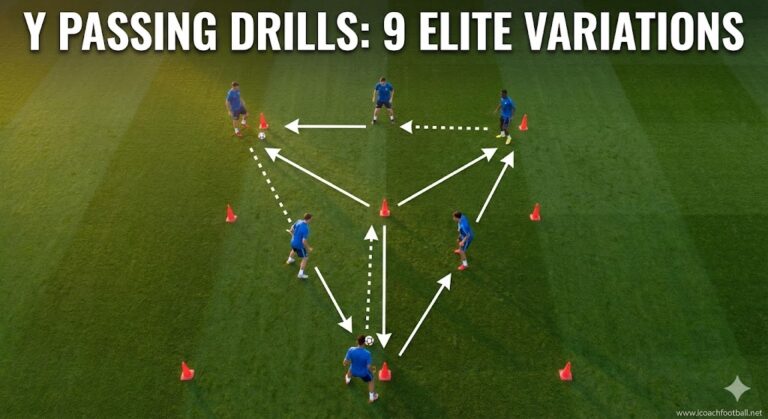
1. The “Y” Passing Pattern (Best for U10 – U14)
This classic pattern teaches the fundamental movements of playing out from the back. It focuses on the timing of the run and receiving with an open body shape.

Drill Setup:
- Grid: Y-Shape, cones 12-15 yards apart.
- Players: 5+ players (to keep lines moving).
- Duration: 10 mins (switch direction halfway).
The Action:
- Player A starts with the ball.
- Player B (Central Midfielder role) checks away from the cone, then shows for the ball.
- Player A plays a firm pass to B.
- Player B receives on the Back Foot, turns, and plays to Player C (Winger role).
- Player C dribbles the ball down the line to the start.
💡 Coaching Detail: The “Trigger” is eye contact. Player B should not move until Player A is ready to pass. If B arrives too early, they are static and easy to mark.
📅 Periodization Tip: Use this on MD-4 (Strength/Technical Day). Keep the area tight (10 yards) to force sharp changes of direction (braking/accelerating), which builds eccentric strength.
Also Read: 9 Y Passing Drills Variations | Animated Drills
2. The “Up-Back-Through” (Third Man Run)
This teaches the essential concept used by teams like Manchester City to break compact defenses. The ball goes forward (“Up”), is set back (“Back”), allowing a third player to run onto a through ball (“Through”).

The Action:
- Player A passes “Up” to Player B (Target Man).
- Player B plays a 1-touch bounce pass “Back” to Player A.
- Trigger: As B sets the ball, Player C makes a bursting run past B.
- Player A plays a first-time “Through” ball into C’s path.
💡 Coaching Detail: The weight of the “Set” pass (the ‘Back’ pass) is critical. It must be soft and inviting so Player A can hit the through ball first time without taking a touch.
3. The “Box-to-Box” Long Passing (Aerial Control)
Most youth players can pass 10 yards, but struggle to hit a driven 30-yard pass. This drill isolates that technique.

Drill Setup:
- Grid: Two 10×10 yard boxes. Distance apart: 20-30 yards.
- Players: Pairs. One player in each box.
The Action:
- Player A hits a “Driven Pass” (laces, low trajectory) or “Lofted Pass” (under the ball) to Player B.
- Player B has 1 touch to control the ball and keep it inside their grid.
- Player B returns the pass.
💡 Coaching Detail: For the driven pass, teach the “Angle of Approach.” The player should approach the ball at a 45-degree angle, not straight on. This allows the hip to swing through freely for power.
📅 Periodization Tip: Use on MD-3 (Endurance). The large distances allow players to open their legs and strike the ball with power, which recruits different muscle groups than short passing.
Phase 2: Rondos & Possession (Opposed)
Best for: Tactical Days, Reaction Speed, and Match Preparation.
4. The Fundamental Rondo 4v1 / 5v2 (Best for U8 – U12)
The Rondo is the foundation of possession soccer. It teaches players to utilize numerical advantages and maintain triangles.

Drill Setup:
- Grid: 8×8 yards (tight) or 10×10 yards (open).
- Players: 4 Attackers vs 1 Defender.
The Action:
- Attackers aim to keep possession using 1 or 2 touches.
- Defenders try to intercept the ball or force it out of the grid.
- If a defender wins it, they swap places with the attacker who gave the ball away.
💡 Coaching Detail: Emphasize the “two options” rule. The player with the ball should always have support to their left AND their right (forming a triangle).
5. The “Traffic Light” Cognitive Rondo
This adds a mental layer. Players must react to colors, forcing them to scan before receiving.

Drill Setup:
- Grid: 10×10 yards. 5 Attackers vs 2 Defenders.
- Equipment: 4 different colored cones placed on the corners.
The Action:
- Standard 5v2 possession.
- The Twist: The coach calls out a color (e.g., “RED!”).
- The player with the ball cannot pass to the player standing closest to the Red cone. They must find a different option.
💡 Coaching Detail: This fixes “Tunnel Vision.” Players usually just look at the ball. By adding an external cue (the color/coach), you force their head up.
6. The “Breakout” Rondo (Transition)
Static Rondos are good; Transition Rondos are better. This drill mimics the moment a team wins the ball and needs to escape pressure.

The Action:
- Play starts as a normal 3v1 Rondo inside a small grid.
- Once the attackers connect 5 passes, they are live to “Break Out” and score in mini-goals placed 10 yards away.
- The defender tries to win the ball and score immediately (simulating a counter).
💡 Coaching Detail: This teaches “Patience to Penetrate.” Don’t just force the ball forward. Keep it, move the defender, and then strike when the space opens.
Phase 3: Functional Games (Match Realism)
Best for: Teaching Tactics, Game Models, and Position Specifics.
7. The 4v4+3 Positional Game ‘Juego de Posición‘ (Advanced / U15+)
This is an advanced progression often used by elite academies. It teaches players to maintain possession using “Neutral” players (Jokers) who always play for the team in possession.

Drill Setup:
- Grid: 30×20 yards.
- Players: Two teams of 4 inside. 3 Neutrals (One on each end, one in the center).
The Action:
- The team in possession uses the 3 Jokers to create a 7v4 overload.
- The goal is to move the ball from one End Joker to the other End Joker via the Central Joker.
💡 Coaching Detail: Focus on the Central Joker. They must constantly scan and locate pockets of space between the defenders to link play.
More ideas:
8. The “End-Zone” Game (The Killer Pass)
Possession is useless if it doesn’t go forward. This game rewards splitting the defense with a vertical pass.

Drill Setup:
- Grid: 40×30 yards, divided into 3 horizontal zones (Defense, Midfield, Attack).
- Players: 5v5 or 6v6.
The Action:
- Normal possession game.
- Scoring: 1 point for 5 consecutive passes. 3 points for a “Line Breaking Pass” (passing from Zone 1 directly to Zone 3).
- Defenders must try to stay compact to block the through ball.
📅 Periodization Tip: This is a high-intensity Tactical Drill. Use on MD-2 (Speed) or MD-3 (Endurance) depending on the grid size.
9. The 4-Goal “Switching Play” Game
One of the most common problems in youth soccer is “Tunnel Vision”—playing down one side until stuck. This drill forces players to scan and switch the point of attack.

The Action:
- Two teams (Red vs Blue) play on a wide pitch.
- Each team defends 2 goals and attacks 2 goals (placed on the corners).
- Because there are two goals to defend, the defense cannot stay compact. They must stretch.
- Attackers must move the ball quickly from left to right to find the open goal.
💡 Coaching Detail: Encourage the “Skip Pass.” If the ball is on the left wing, can we hit a long pass directly to the right winger, bypassing the midfield clutter?
Looking for more variations? These 9 drills are the core of our curriculum, but every team has unique needs. If you want to explore our complete archive of exercises—from simple technical warm-ups to complex Barcelona-style rondos—browse our full Soccer Passing Drills Library
Common Questions About Coaching Soccer Passing Drills (FAQ)
How long should a passing drill last?
Keep it short and sharp. For technical patterns (Phase 1), 10-12 minutes is maximum before boredom sets in. For possession games (Phase 2), play in blocks of 4 minutes with 1-minute rest to maintain high intensity.
How do I fix a player with a “weak” pass?
Usually, the problem is the plant foot. If the plant foot is too far away from the ball, the player has to reach, losing power. If it is too close, they get stuck. Fix the distance of the plant foot, and the power will improve.
Should I use these drills for U9s?
For U9s, focus on the Technical Patterns (simplified) and the 3v1 Rondo. Avoid the complex Functional Games until they understand basic spacing (U11/U12).
How do you improve passing accuracy in soccer?
Improving passing accuracy requires mastering four key elements: planting your non-kicking foot directly toward your target, locking your ankle, using the inside of your foot for maximum surface area, and following through the ball. The best way to train this is through high-repetition passing patterns and small-sided possession games (rondos).
What are the 3 main types of passes in soccer?
The three most common passes are the Push Pass (using the inside of the foot for short, accurate ground passes), the Driven Pass (using the laces to send the ball quickly over mid-to-long distances), and the Lofted Pass / Chip (striking underneath the ball to lift it over defenders).
At what age should you introduce possession drills and rondos?
You can introduce basic 3v1 or 4v1 rondos as early as the U8 to U10 age groups. At these ages, the focus should be purely on passing technique, spacing, and keeping the ball. As players move into U12 and older, you can introduce advanced tactical elements like transition breakouts and positional play.
How do you teach soccer players to pass and move?
The biggest mistake youth players make is standing still after releasing the ball. To fix this, use drills that mandate movement, such as the “Up-Back-Through” pattern or “Y-Pattern.” In these drills, the rules dictate that a player must immediately sprint to a new cone or support angle the exact second the ball leaves their foot.
Summary
Great passing is a habit. It is built day by day, microcycle by microcycle. By using these drills, you are not just teaching your players to kick a ball; you are teaching them to control the game.
- Want to plan these drills into a full season? Read our guide on Weekly Microcycles.
- Need to improve your team’s fitness with the ball? Check out our Physical Preparation section.