Soccer Ball Mastery Drills: 6 Games That Build Close Control and Comfort on the Ball (U8–U14)
Quick answer
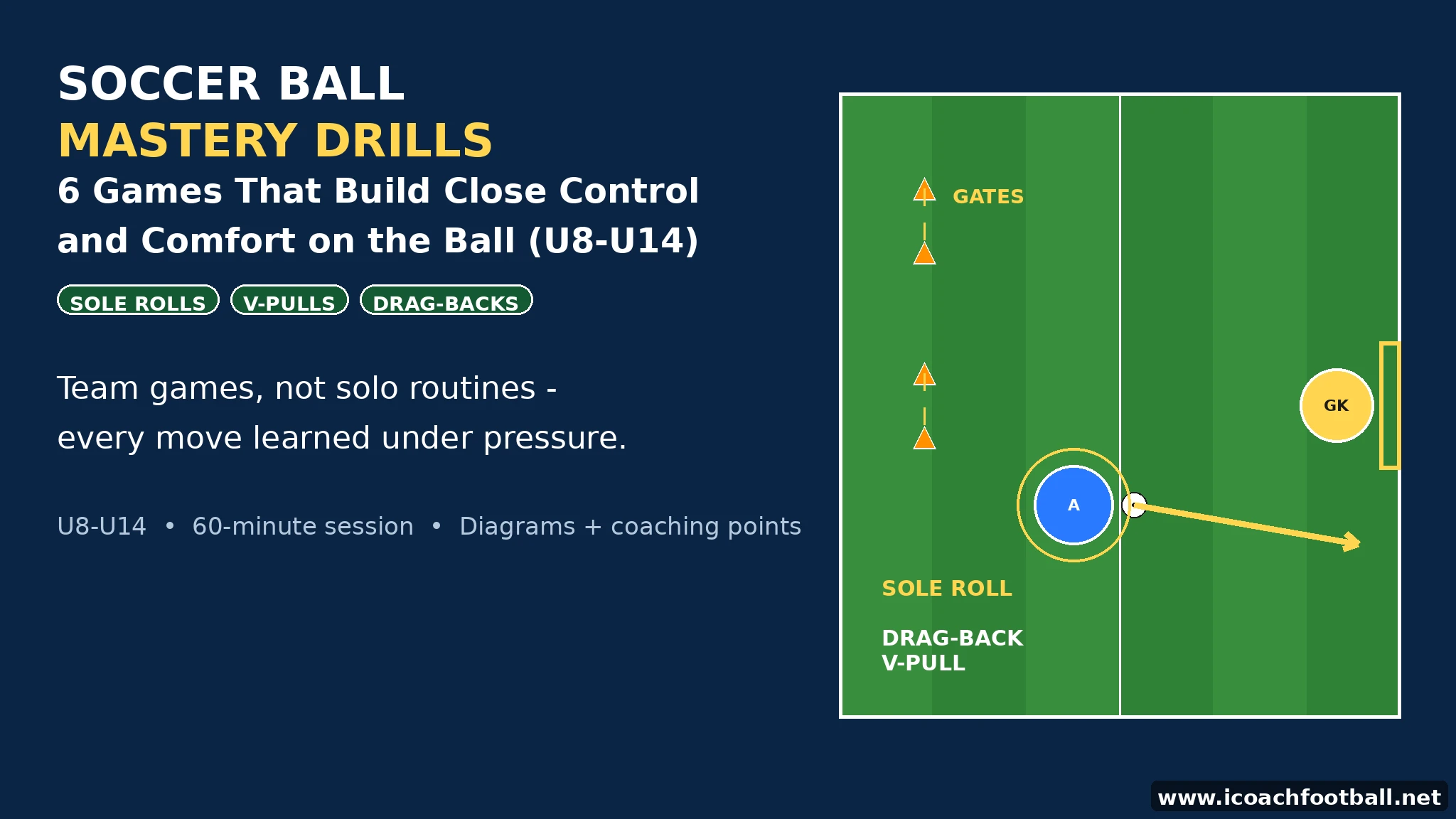
Ball mastery is close control of the ball with every part of both feet — sole rolls, inside-outside touches, V-pulls, L-turns and drag-backs, done at speed and under pressure. These soccer ball mastery drills put those moves inside team games, not solo home routines: a circuit race, a traffic-light game, a mastery rondo, a 1v1 duel, a gates game and a final match where every goal needs a mastery move first. Six games, one 60-minute session, and players leave comfortable on the ball with a defender closing in.
Suitable for: U8–U14 (ages 7–14)
Session snapshot
- Players: 12–16 (U8–U14)
- Area: 20 x 15-yard area expanding to a 30 x 20-yard game pitch
- Duration: 60 minutes
- Focus: Close control with both feet, mastery moves under pressure, beating a defender with one move
- Equipment: 12–14 balls, 20 cones, 2 mini goals, bibs
Why these six games work
Most ball mastery content online is a solo home routine — ten minutes alone in a garden, or an app selling the next level. That builds touches, but it never teaches a player to use a move when a defender is closing in.
This session is built the other way round. Every move is learned inside a team game, with pressure, decisions and scoring. The FIFA Training Centre’s ball mastery session works the same way: it starts with unopposed close control using the inside, outside and soles of both feet, then moves to dribbling past an opponent with feints and changes of direction, then a dispossess game, then a match where players can only release the ball after a minimum of four touches. Drills 1, 2, 4 and 6 below are based on / in line with that FIFA session.
The age shape follows England Football Learning. It calls agility, balance and coordination the ABCs — the fundamental movement skills that are the basis for all other movement skills — and says players aged 5 to 11 should focus on exactly those ABCs, built through game-like activities and competitions, with repetition essential at any age. From 12, the focus shifts to game-specific movements. Coaches in the UK call these football ball mastery drills — the games are identical. The framing of this post and the age adaptations below are based on / in line with that England Football material.
The golden window for this work is roughly ages 5 to 12, when motor learning is fastest. That is why the session is pitched at U8–U14: the youngest players build the touches, and the oldest players learn to use them against live defenders.
Six rules of ball mastery
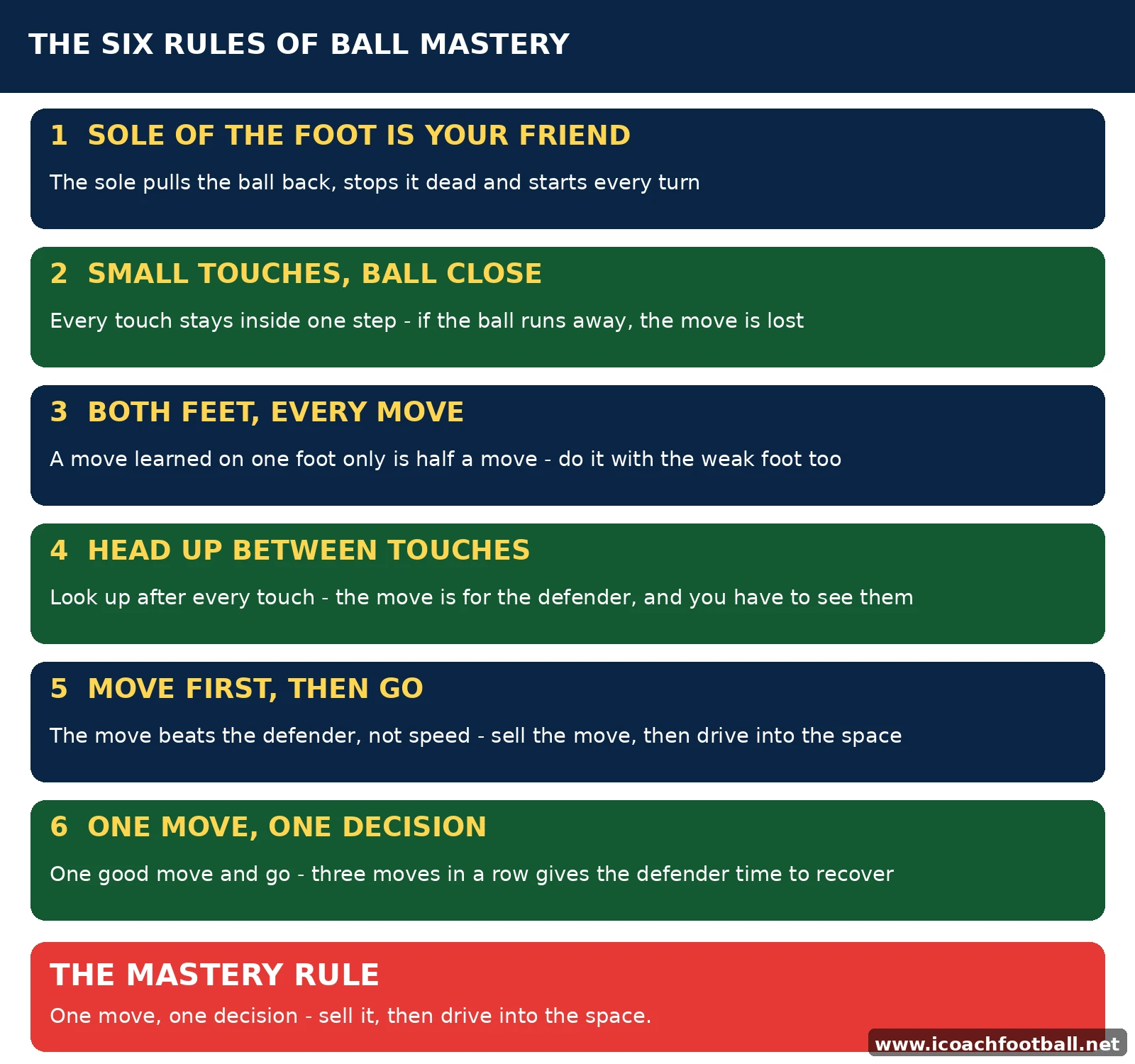
- Sole of the foot is your friend. The sole pulls the ball back, stops it dead and starts every turn.
- Small touches, ball close. Every touch stays inside one step — if the ball runs away, the move is already lost.
- Both feet, every move. A move learned on one foot only is half a move. Do it with the weak foot too.
- Head up between touches. Look up after every touch — the move is for the defender, and you have to see them.
- Move first, then go. The move beats the defender, not speed. Sell the move, then drive into the space.
- One move, one decision. One good move and go. Three moves in a row gives the defender time to recover.
Drill 1 — Mastery Circuit Race
The warm-up race. Four lanes, three stations each: sole rolls, inside-outside touches, then V-pulls at the finish cone. First team to three full rounds wins.
Setup
- 18-yard lane: start line, Station 1 at 6 yards (sole rolls), Station 2 at 12 yards (inside-outside), finish cone at 18 yards (V-pulls).
- 12 players: 4 lanes, 3 players per lane, one ball per player. 8 minutes.
How to Play
- On the whistle, the first player in each lane dribbles to Station 1.
- At Station 1, the player does 10 sole rolls — 5 with each foot — then moves on.
- At Station 2, the player does 10 inside-outside touches — 5 with each foot — then moves on.
- At the finish cone, the player does 6 V-pulls — 3 with each foot.
- The player dribbles back to the start line and tags the next player in their lane.
- The first lane to finish 3 full rounds wins, then the lanes race again with the weak foot leading.
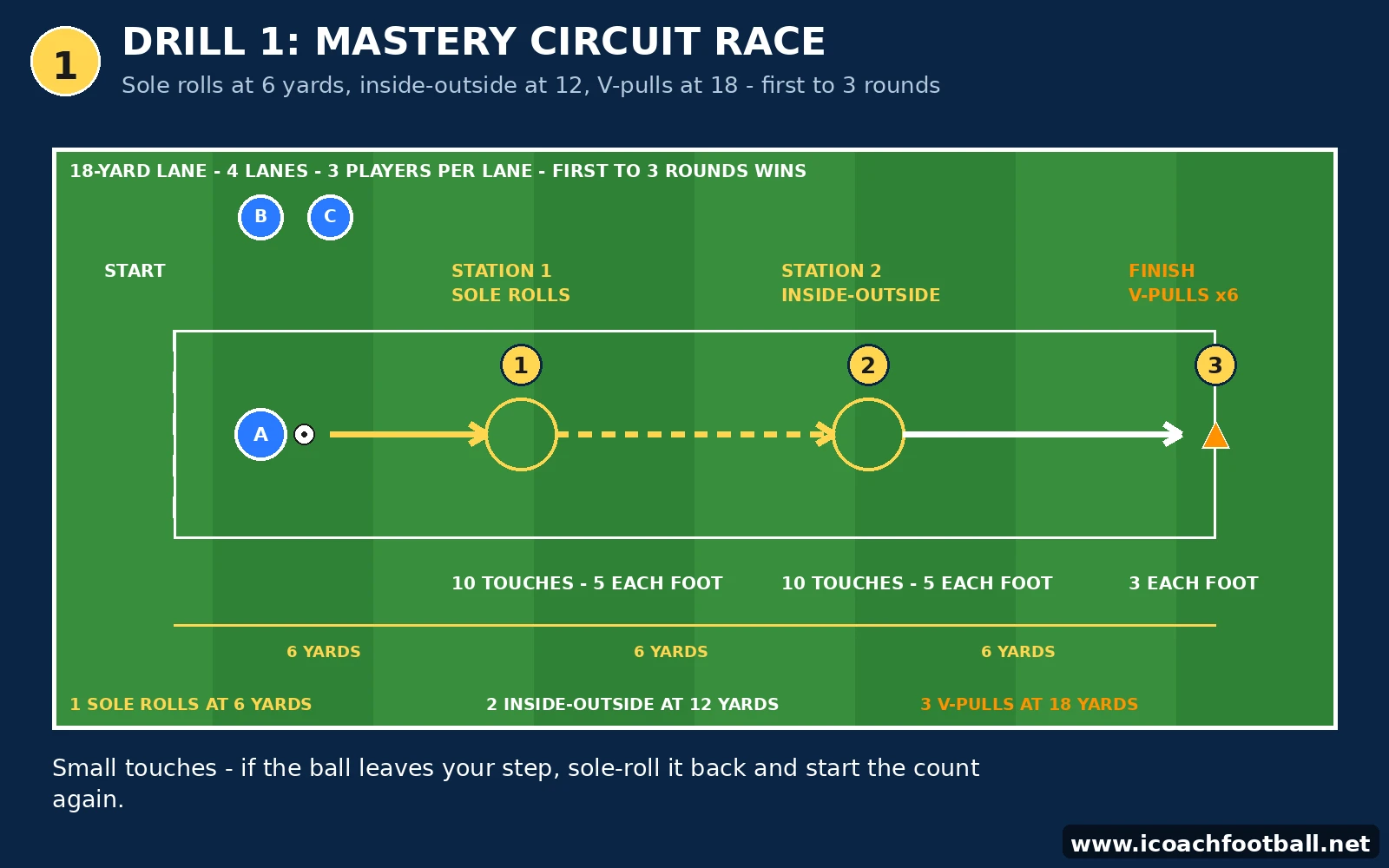
Coach’s note: “Small touches — if the ball leaves your step, sole-roll it back and start the count again.”
Progressions: The station counts rise to 12 touches; the finish cone adds a drag-back before the V-pulls; the race is run with the weak foot only.
Drill 2 — Traffic Light Mastery
The listening game. Every player has a ball in a 20 x 15-yard area. The coach calls a colour, and the colour tells the players which mastery move to do — green means dribble, amber means sole rolls on the spot, red means freeze with the sole on the ball.
Setup
- 20 x 15-yard area, one ball per player, 4 cones marking the corners.
- 12 players: all inside the area at once. 8 minutes.
How to Play
- The coach calls “green” — every player dribbles around the area, ball close, head up.
- The coach calls “amber” — every player stops and does sole rolls on the spot for 5 seconds.
- The coach calls “red” — every player freezes, sole of the foot on top of the ball.
- The coach calls a move — “toe taps”, “inside-outside” or “drag-back” — and players do 10 touches of it.
- Any player who bumps into another player, or loses their ball, does 5 toe taps on the spot.
- After 4 minutes, the coach calls two moves in a row, and the slowest player to switch leads the next call.
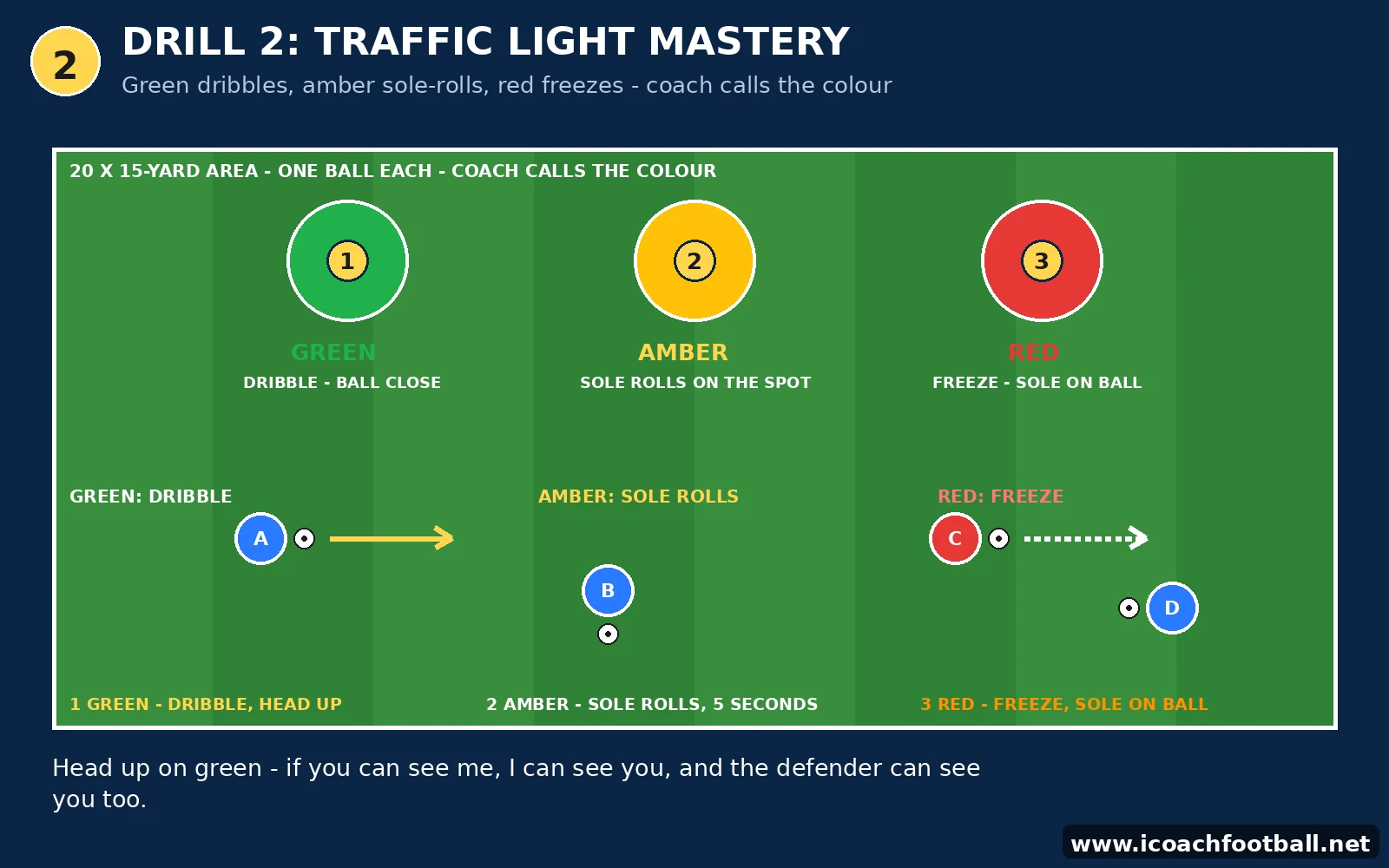
Coach’s note: “Head up on green — if you can see me, I can see you, and the defender can see you too.”
Progressions: The coach calls colours faster, every 5 seconds; a defender is added who tries to steal balls on green; players must do the called move with their weak foot only.
Drill 3 — Mastery Rondo
The rondo with a rule. Four attackers keep the ball from two defenders in a 12 x 12-yard grid — but the receiver must do a mastery touch (a sole roll or an inside-outside touch) before passing. No mastery touch, no pass.
Setup
- 12 x 12-yard grid, one ball, 4 cones marking the corners.
- 12 players: two grids, 4 attackers vs 2 defenders in each. 8 minutes.
How to Play
- The attackers pass the ball around the grid, keeping it away from the two defenders.
- The receiver must do one mastery touch — a sole roll or an inside-outside touch — before passing.
- A pass played without the mastery touch does not count, and the ball goes to the defenders.
- If a defender wins the ball, they swap with the attacker who lost it.
- After 3 interceptions, or after 60 seconds, both defenders swap out anyway.
- After 4 minutes, the two grids swap one attacker each, so every player faces a new defender.
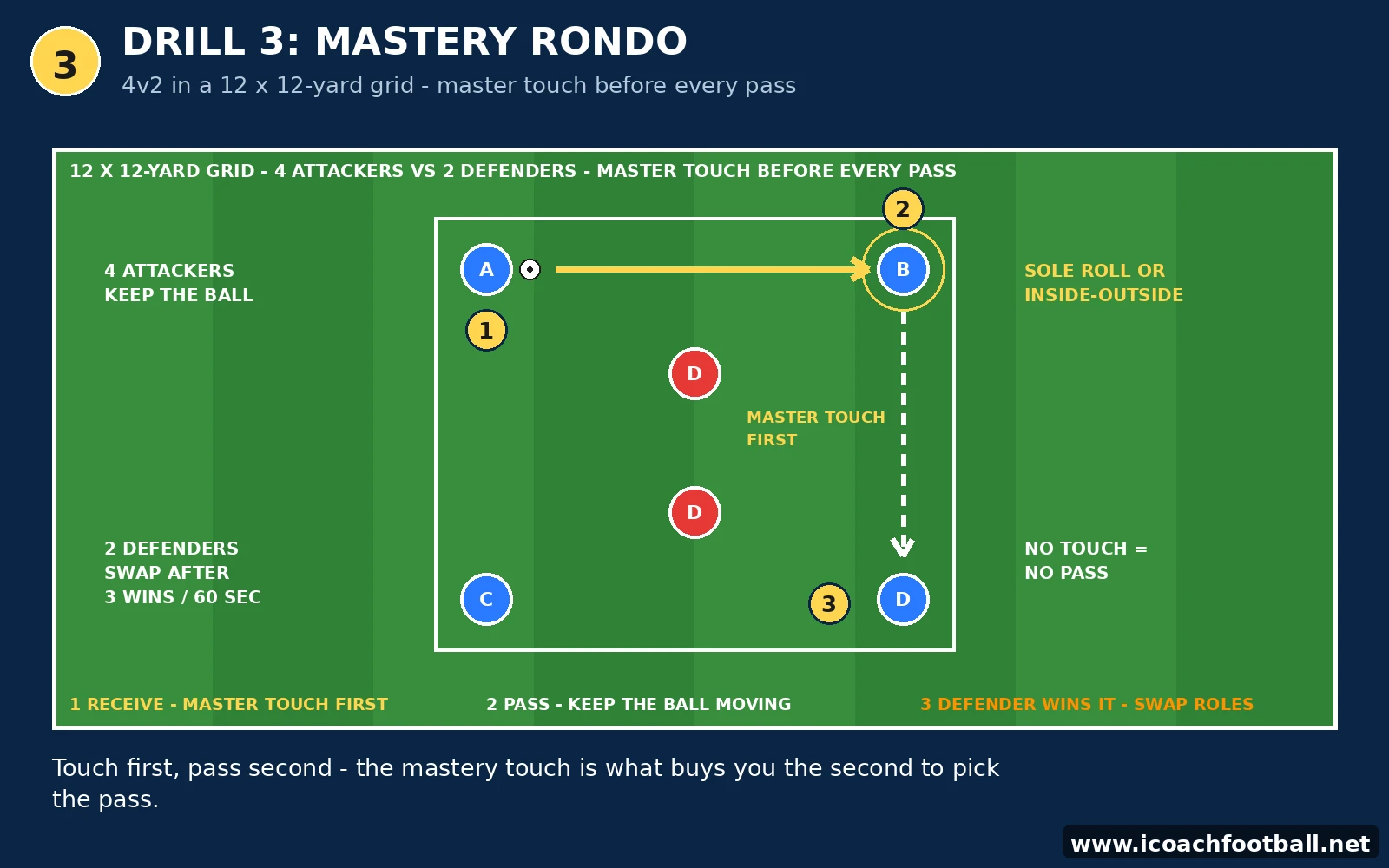
Coach’s note: “Touch first, pass second — the mastery touch is what buys you the second to pick the pass.”
Progressions: The grid shrinks to 10 x 10 yards; the mastery touch must be with the weak foot; the receiver must do two touches — a sole roll and an inside-outside — before passing.
Drill 4 — 1v1 Mastery Duel
The duel. An attacker dribbles down a 15-yard channel, does a named mastery move at the 8-yard duel line, then beats the defender and scores through one of two gates. The move is the point — a goal without the move does not count.
Setup
- 15-yard channel, 6 yards wide: attacker start line at 0 yards, defender on the 8-yard duel line, two 2-yard gates on the 15-yard end line.
- 12 players: 6 attackers, 6 defenders, in pairs. 8 minutes.
How to Play
- The attacker starts on the start line with the ball, facing the defender.
- The attacker dribbles to the 8-yard duel line, ball close, head up.
- At the duel line, the attacker does a named mastery move — a drag-back, an L-turn or a Cruyff turn.
- The attacker drives past the defender and through one of the two 2-yard gates.
- A goal through a gate scores 1 point; a goal where the move sent the defender the wrong way scores 2 points.
- Attacker and defender swap after every rep, and pairs swap every 2 minutes.
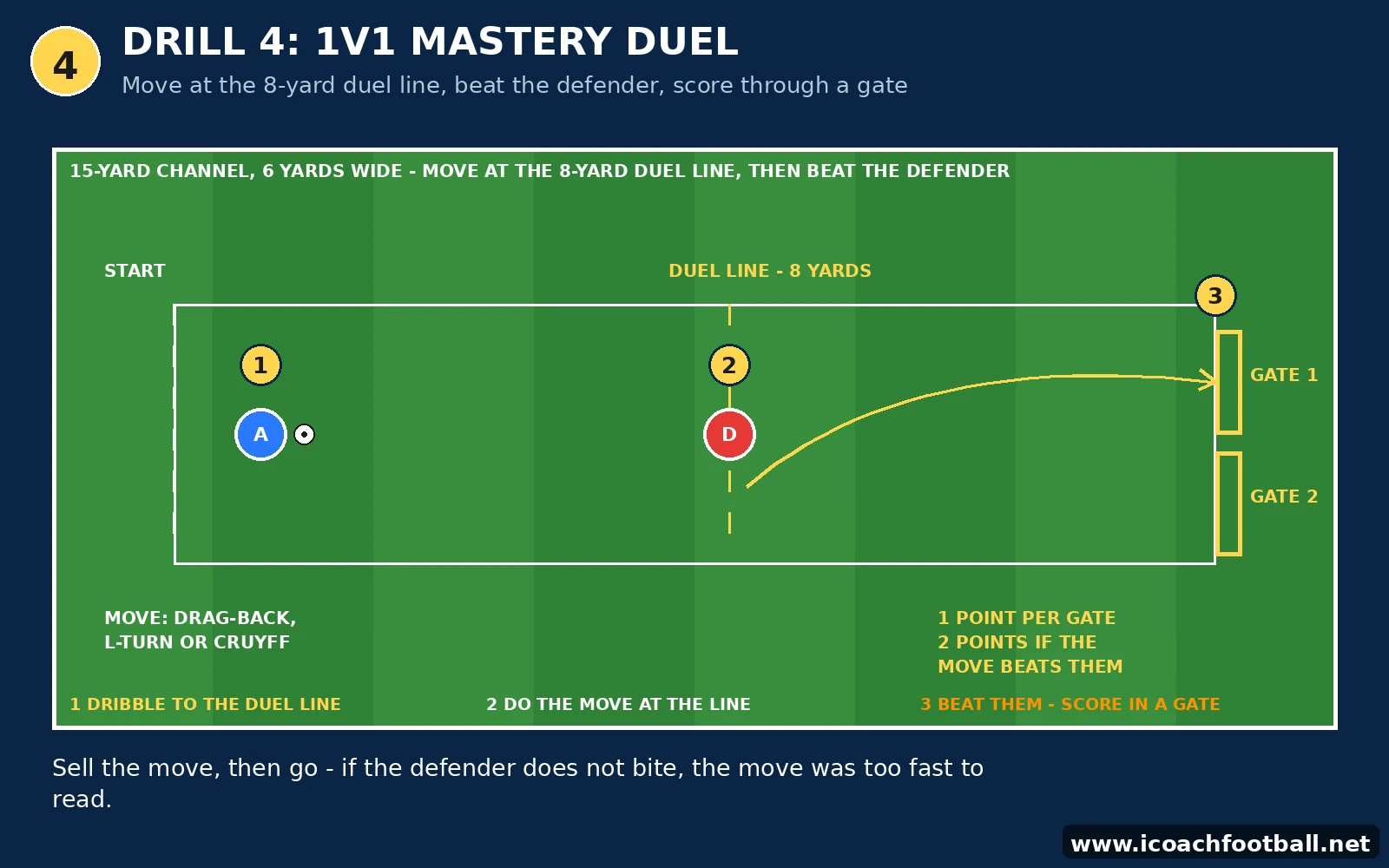
Coach’s note: “Sell the move, then go — if the defender does not bite, the move was too fast to read.”
Progressions: The defender starts live at half pace, then full pace; the attacker must use the weak foot for the move; the gates narrow to 1 yard wide for U12–U14.
Drill 5 — Gates Game
The passing game. Six gates — pairs of cones 2 yards apart — are spread across a 20 x 15-yard area. Pairs pass the ball through the gates, and the receiver must do a mastery move on receipt before the next pass. First pair to 10 points wins.
Setup
- 20 x 15-yard area, 6 gates (cone pairs 2 yards apart), one ball per pair.
- 12 players: 6 pairs, each with a ball. 8 minutes.
How to Play
- Each pair starts at a gate of their choice, one player with the ball.
- The player with the ball passes through a gate to their partner.
- The receiver does a mastery move on receipt — a sole roll, a V-pull or a drag-back — before passing on.
- Each completed pass through a gate scores 1 point for the pair.
- A pass that misses the gate, or is played without the mastery move, scores nothing.
- The first pair to 10 points wins, then the gates move and the game runs again.
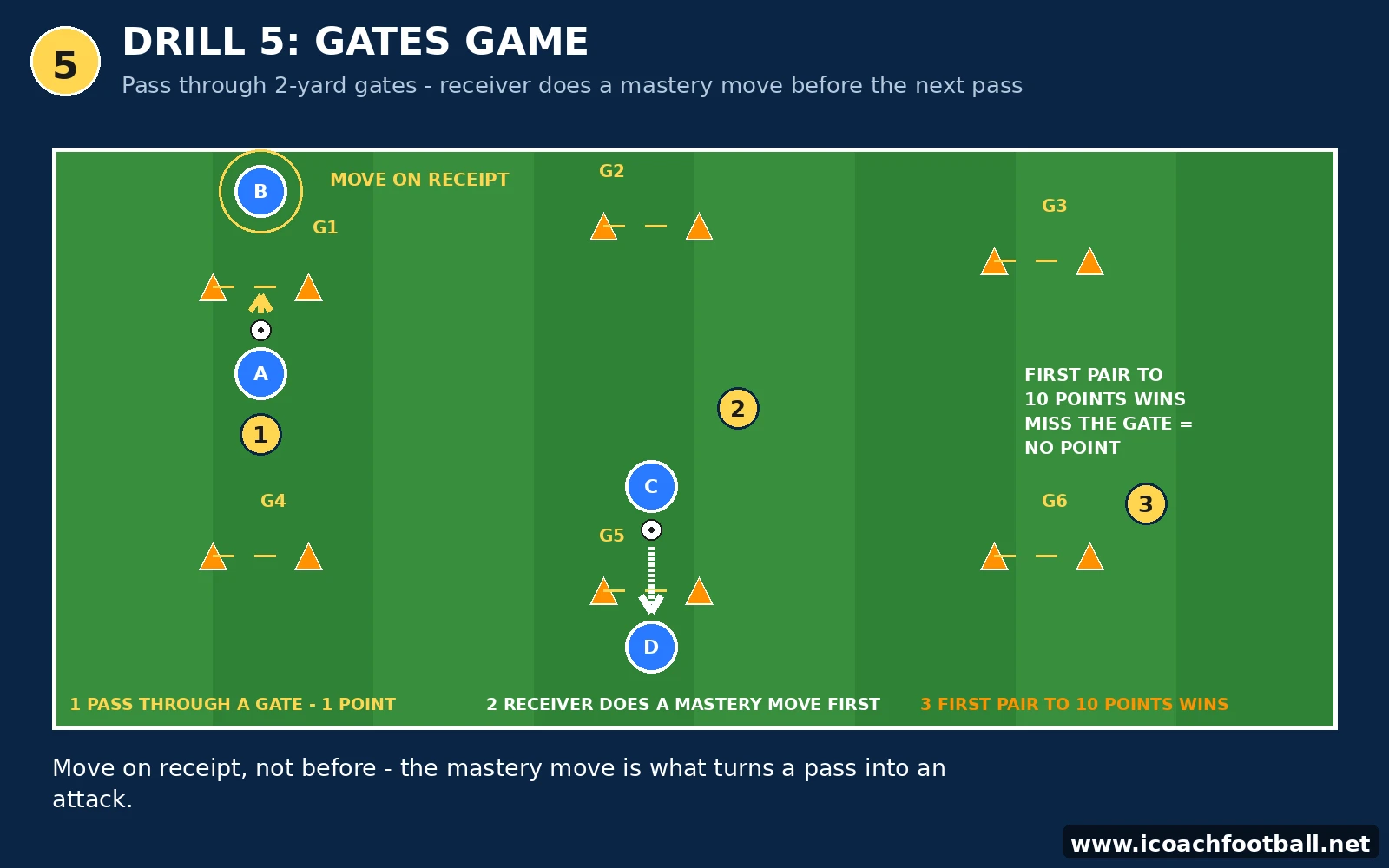
Coach’s note: “Move on receipt, not before — the mastery move is what turns a pass into an attack.”
Progressions: The gates narrow to 1 yard wide; the receiver must do the move with their weak foot; a defender is added to each gate, and the pair must beat them to score.
Drill 6 — Mastery Match
The test. A 4v4 game on a 30 x 20-yard pitch — but a goal only counts if the scorer, or the player who assisted them, did a mastery move in the final third before the goal. No move, no goal.
Setup
- 30 x 20-yard pitch, 2 mini goals, bibs, a marked final third in front of each goal.
- 12 players: 4v4 plus 2 goalkeepers and 2 rotating substitutes. 15 minutes.
How to Play
- The game starts with a pass-in from the coach — no kick-offs, no corners.
- Normal 4v4 rules apply — the ball is live everywhere on the pitch.
- Before a goal can count, the scorer or the assister must do a mastery move inside the final third.
- A goal scored without the move does not count — play restarts with the goalkeeper’s ball.
- A goal scored after a clean 1v1 beat — the move sending the defender the wrong way — counts double.
- Play 3-minute games, then swap the teams and play again.
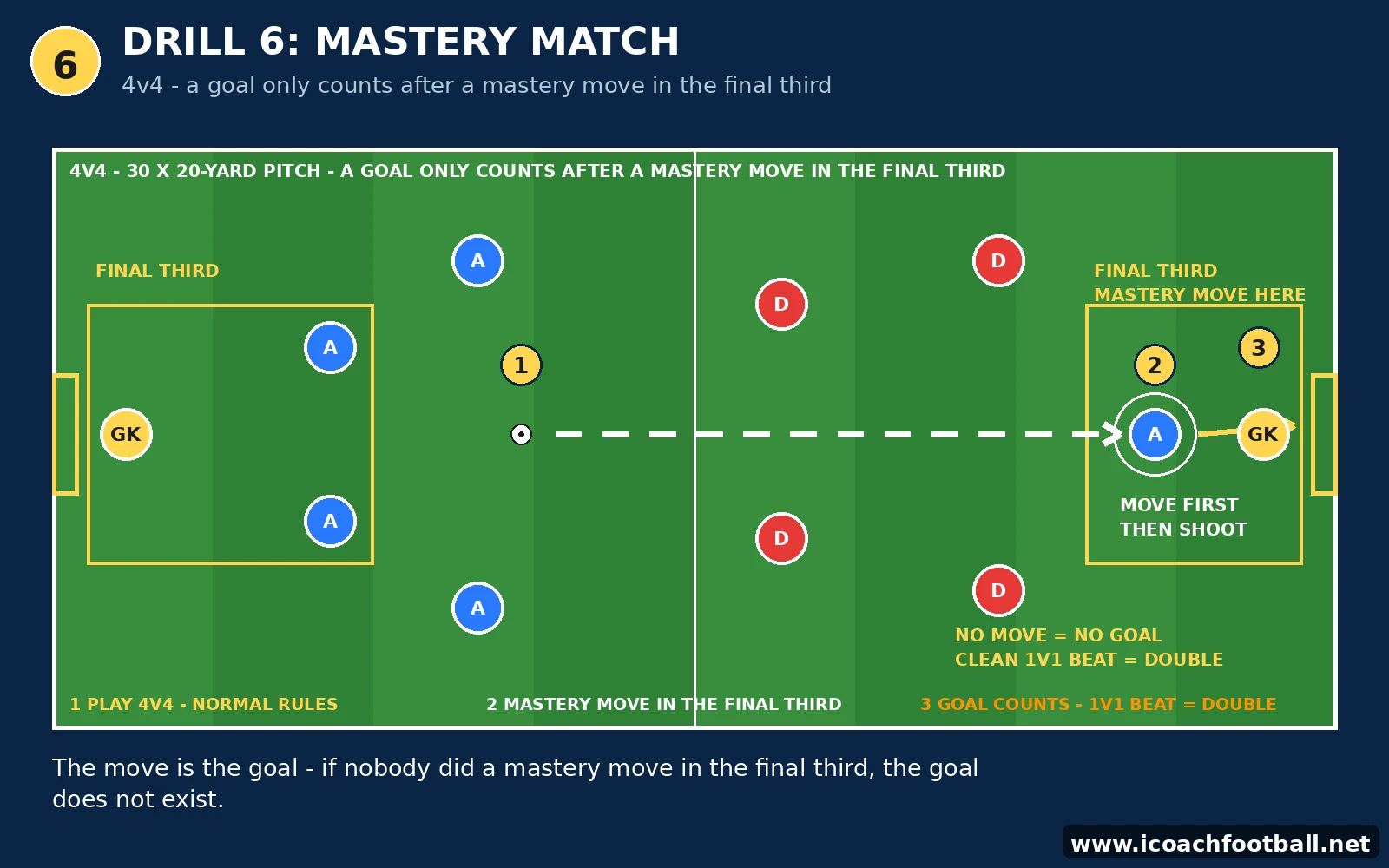
Coach’s note: “The move is the goal — if nobody did a mastery move in the final third, the goal does not exist.”
Progressions: The move must be with the weak foot; the scorer must beat a defender 1v1 before shooting; the minimum-touches rule comes in — four touches before a player may release the ball.
Common mistakes
| Mistake | What you see | Fix |
|---|---|---|
| Big touches | The ball runs 2 yards ahead and the player chases it | Sole-roll it back — every touch stays inside one step |
| Head down | The player watches the ball and runs into a team-mate | Head up between touches — call out a colour while they dribble |
| One foot only | Every move comes off the strong foot, the weak foot never touches the ball | Weak foot leads the next round — count weak-foot touches out loud |
| Three moves in a row | The player chains moves and the defender recovers and steals it | One move, one decision — sell it, then drive into the space |
| Rushing the move | The move is so fast the defender never bites, and the ball is lost | Slow down, sole on the ball, then do the move at walking pace first |
Age adaptations
| Age | Format | What changes |
|---|---|---|
| U8–U9 (ages 7–9) | 10 x 8-yard areas, size 3 ball, mini goals | Sole rolls and toe taps only — no V-pulls or Cruyff turns yet. The circuit lane is 12 yards, with stations 4 yards apart. The rondo is 3v1, and the duel defender only shadows — they never tackle. Gates are 3 yards wide. See our U8 soccer practice plan for the session shape at this age, and our U7 dribbling drills for the next step |
| U10–U11 (ages 9–11) | 15 x 12-yard areas, size 3–4 ball, mini goals | The full six moves come in, and the circuit runs at the full 18 yards. The rondo is 4v2, and the duel defender plays at half pace. Gates are 2 yards wide, and the match adds the weak-foot move. See our U10 soccer practice plan and our U11 soccer practice plan for the next steps |
| U12–U14 (ages 11–14) | Full areas, size 4–5 ball | Cruyff turns and feints join the six moves, and the duel defender plays at full pace. The rondo is 5v2 in a 12 x 12-yard grid, the gates narrow to 1 yard, and the match adds the four-touches-before-release rule from the FIFA session. Growth spurts can disrupt coordination at this age, so keep the moves simple and the repetitions high. See our U12 soccer practice plan for the session shape at this age |
60-minute session plan
| Time | Block | Drill |
|---|---|---|
| 0:00–0:05 | Arrival game | Free 2v2 — a goal only counts if the scorer did a mastery move first |
| 0:05–0:13 | The race | Drill 1 — Mastery Circuit Race |
| 0:13–0:21 | The listen | Drill 2 — Traffic Light Mastery |
| 0:21–0:29 | The rondo | Drill 3 — Mastery Rondo |
| 0:29–0:37 | The duel | Drill 4 — 1v1 Mastery Duel |
| 0:37–0:45 | The gates | Drill 5 — Gates Game |
| 0:45–1:00 | The game | Drill 6 — Mastery Match |
New to coaching this age? Stretch the arrival game to 8 minutes and cut Drill 6 to 12 minutes and you have the same session with more settling-in time — see our 60-minute plan for the structure (the same shape, shortened where you need it).
Keep building from here
Ball mastery is the foundation under every soccer skill — the touch, the turn and the finish all start from a player who is comfortable on the ball. The close control that a mastery player keeps is our dribbling drills, and the turn a mastery player makes after a drag-back is our turning drills. The weak foot that every move here must use is our weak-foot drills, and the confidence that grows when a player stops losing the ball is our confidence drills. The pass the receiver plays after a mastery touch in the rondo is our passing drills, and the picture a player takes before they move is our scanning drills. The balance underneath every mastery move is our balance and coordination drills, and the youngest players start with our U7 dribbling drills.
FAQ
What are the best soccer ball mastery drills?
The best soccer ball mastery drills put the classic moves — sole rolls, inside-outside touches, V-pulls, L-turns and drag-backs — inside team games with pressure and scoring. Start with a Mastery Circuit Race for the touches, add a Mastery Rondo where the receiver must do a mastery touch before passing, then a 1v1 Mastery Duel and a final match where a goal only counts after a mastery move. Solo home routines build touches; team games teach players to use them.
How long should ball mastery take in a session?
Ten to fifteen minutes inside a normal session is enough, two or three times a week. This session spends 8 minutes on each of six games, so the touches add up to a full hour without ever drilling one move in isolation. Little and often beats one long ball mastery block — repetition is what embeds the moves.
What age should players start ball mastery?
Players can start ball mastery as young as 5, with sole rolls and toe taps in fun races and games. The golden window for motor learning is roughly ages 5 to 12, so the biggest gains come at U8–U12. Older players still benefit — the moves stay the same, but the pressure, the defender and the decisions get harder.
How do you teach ball mastery to a 7-year-old?
Keep it short, simple and a race. Use sole rolls and toe taps only, in a 12-yard circuit with stations 4 yards apart, and turn every count into a competition — “who can do 10 sole rolls without the ball leaving their step?” Demonstrate every move yourself first, and let the duel defender shadow rather than tackle. See the U8–U9 row of the age adaptations table for the full setup.
Is ball mastery the same as dribbling?
No. Ball mastery is close control of the ball with every part of both feet — the foundation. Dribbling is what you do with that control: carrying the ball past opponents and into space. A player with ball mastery but no dribbling keeps the ball and goes nowhere; a player who dribbles without ball mastery loses it at the first touch. Train mastery first, then teach players to use it to beat defenders, as Drill 4 does here.
Sources
- FIFA Training Centre, “49) Mastering ball control” — ball mastery is a fundamental skill for young players; close control, correct body movements, effective feints and shimmies and recognising when space is opening up are all key aspects of ball mastery; players should keep their heads up, use all parts of their feet, and drive into space as soon as it appears; the session runs unopposed close control, dribbling past an opponent, a dispossess game, and an 8v8 where players can only release the ball after a minimum of four touches. Drills 1, 2, 4 and 6 are based on / in line with this FIFA Training Centre session.
- England Football Learning, “How to develop your players’ movement skills” — agility, balance and coordination (the ABCs) are the fundamental movement skills that form the basis for all other movement skills; players aged 5 to 11 should focus on their ABCs and locomotion through tag, dodge and chase games and ball work, practices on acceleration and deceleration make players more robust, and repetition is essential at any age; from 12, the focus transitions to football-specific movements. The framing of this post and the age adaptations are based on / in line with this England Football material.