Soccer Dribbling Drills: 6 Games That Build Close Control and Beat a Defender
Quick answer
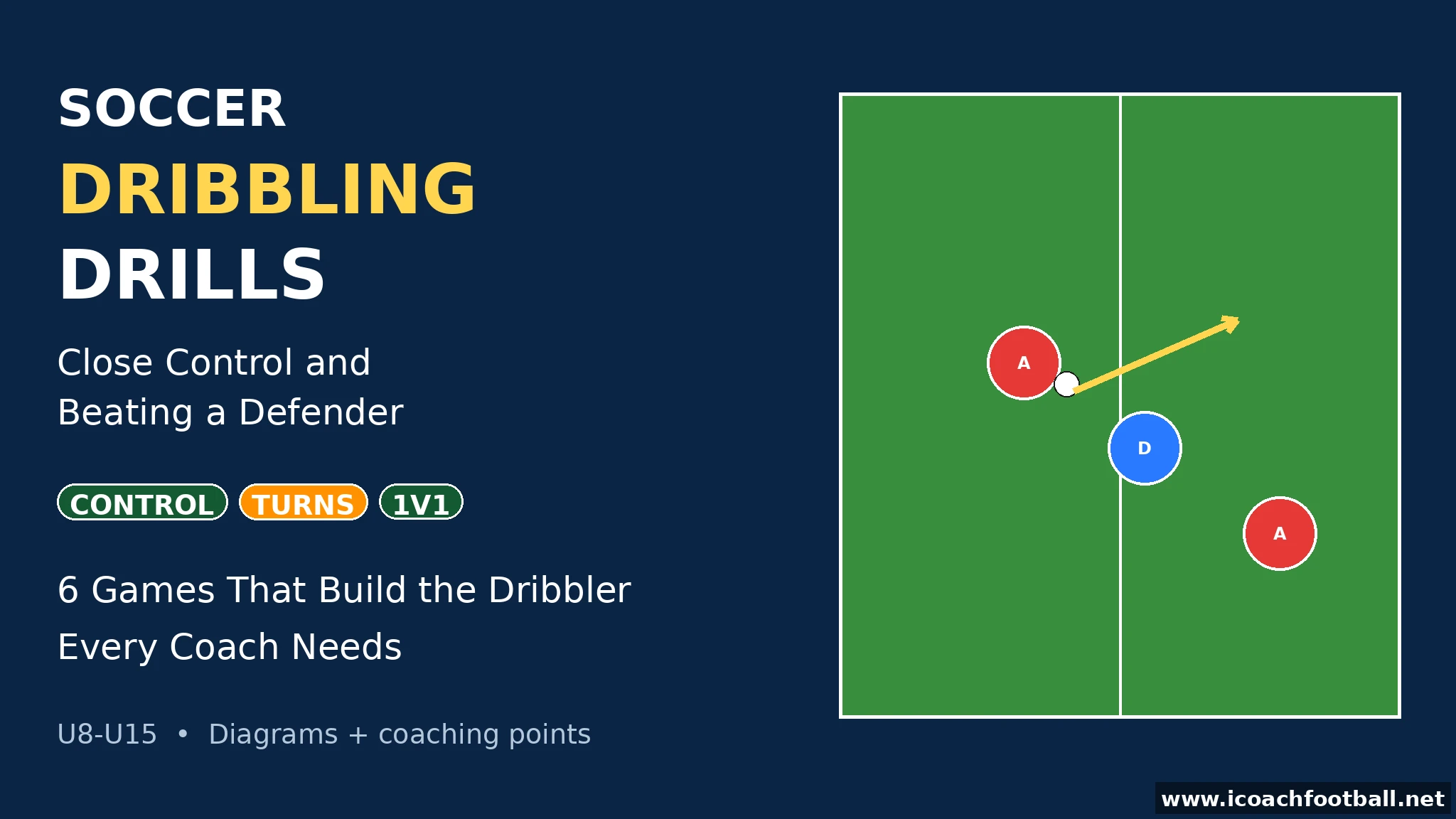
Good dribblers are not born with tricks. These six soccer dribbling drills build the four things that actually beat a defender: close control, head up, change of pace, and one clean move followed by an explosion of speed.
Suitable for: U8–U15
In soccer — football to most of the world — dribbling is the skill that turns a good player into a dangerous one. A player who can carry the ball past an opponent breaks a defensive line without a pass, and no pass can do that. The six games below run in one 60-minute session, need nothing more than cones, bibs and balls, and follow the progression the FIFA Training Centre uses in its ball-mastery sessions: control first, then turns, then beating a real defender, then using the dribble in a game. Each drill isolates one piece of the dribbling puzzle: close control, protecting the ball, the 1v1, turning, speed with the ball, and finishing the move.
Session snapshot
- Players: 8–16
- Area: Grids 20 x 20 to 40 x 30 yards
- Duration: 60 minutes
- Focus: Close control, turns, 1v1 dribbling, change of pace, beating a defender
- Age: U8–U15 (see Age adaptations)
The four dribbling rules
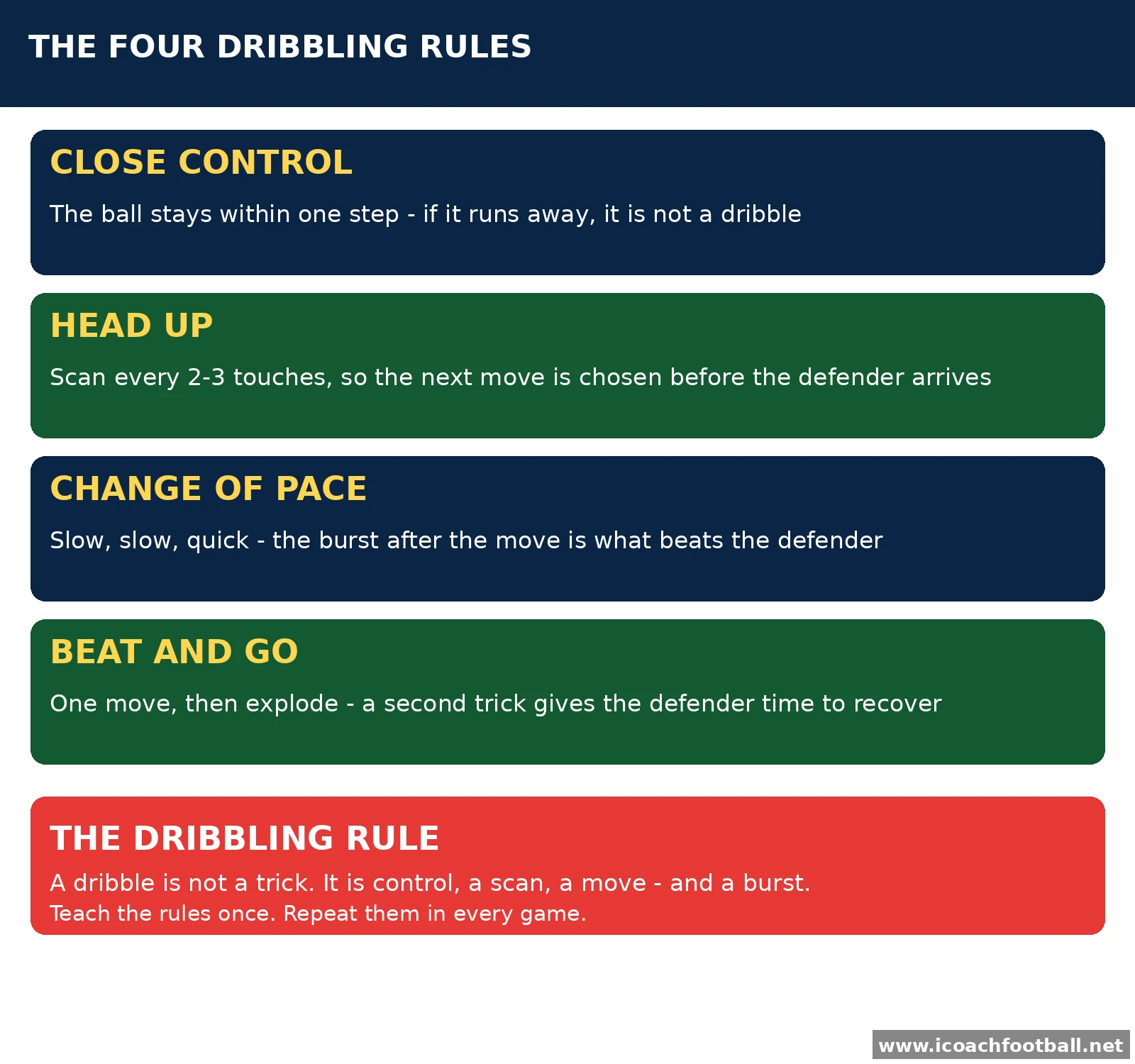
Every drill below is built on four rules. Teach them once, then repeat them in every game until the players say them back to you.
| Rule | What it means |
|---|---|
| Close control | The ball stays within one step — if it runs away, it is not a dribble |
| Head up | Scan every 2–3 touches, so the next move is chosen before the defender arrives |
| Change of pace | Slow, slow, quick — the burst after the move is what beats the defender |
| Beat and go | One move, then explode — a second trick gives the defender time to recover |
Drill 1: The Gates Game
Score a point for every gate you dribble through. No defender, no pressure — just the ball, the feet, and the habit of looking up.
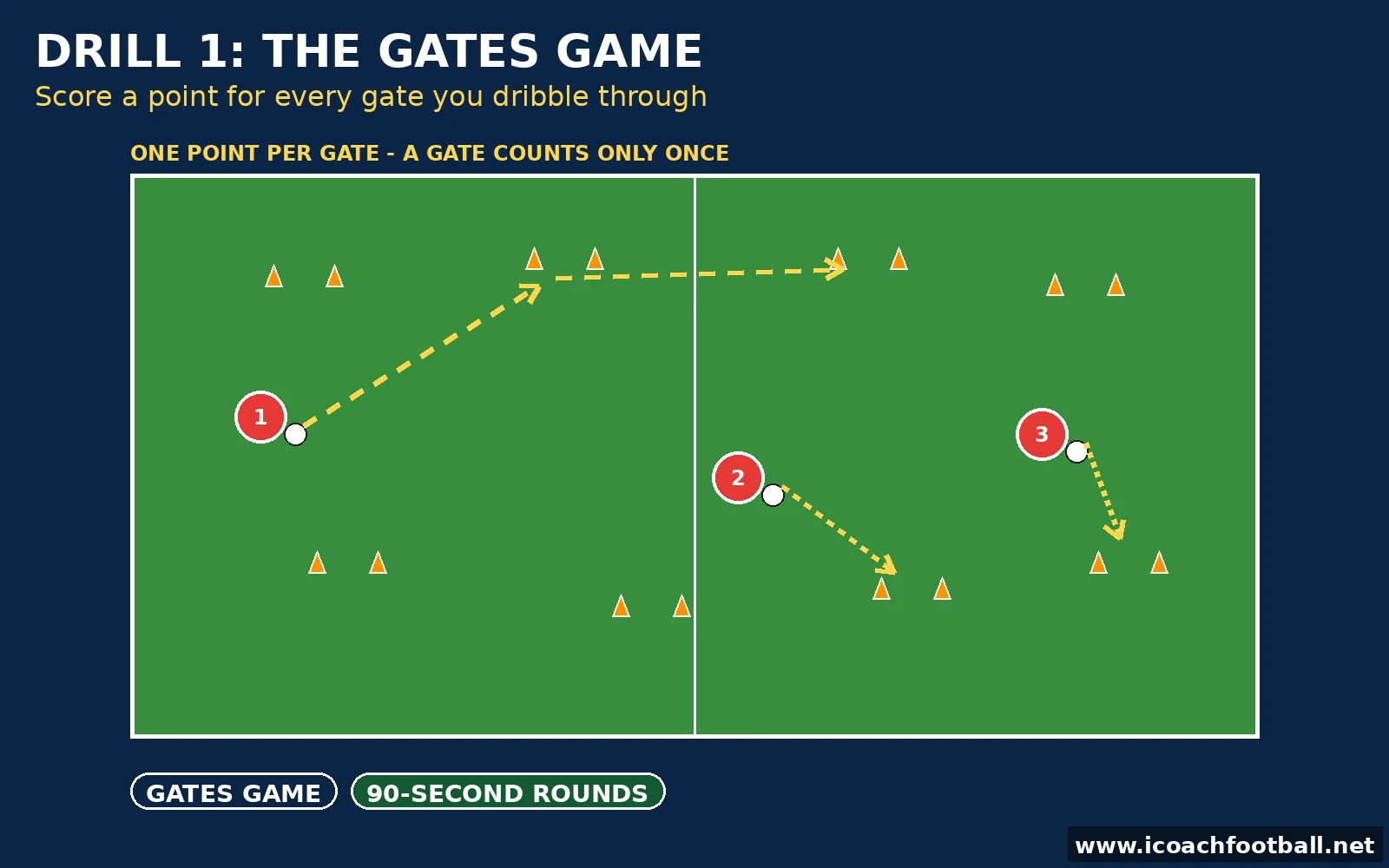
- Setup: 25 x 25 yard grid, 8 gates (two cones, 2 yards apart) scattered around, one ball per player.
- How to play:
- Every player dribbles freely inside the grid.
- Dribble through a gate to score one point.
- A gate can only be scored once — find a new one each time.
- Players count their own points out loud.
- Play 90-second rounds, then ask for the highest score.
- Coach’s note: Shout “head up!” every 20 seconds — the players who look up find the open gates, and the ones who stare at the ball do not.
- Progressions: Weak foot only; two touches maximum between gates; gates shrink to 1 yard.
Drill 2: Shark Attack
One or two sharks hunt the ball. The minnows must protect it, turn away from pressure, and survive — the closest thing to real defending without a formal 1v1.
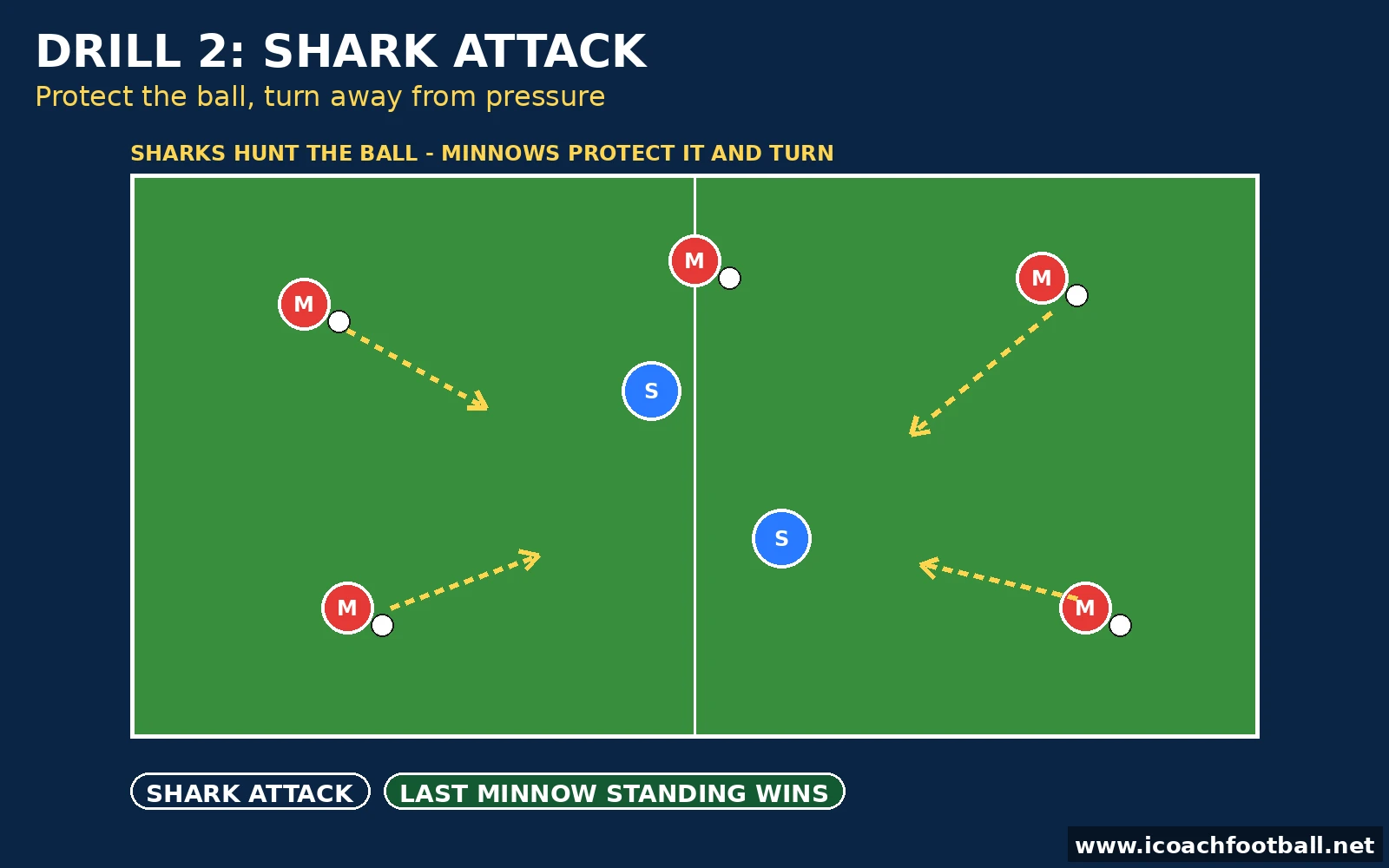
- Setup: 20 x 20 yard grid, 8–10 players with a ball each, 1–2 sharks without a ball.
- How to play:
- Minnows dribble inside the grid while sharks try to kick a ball out.
- A minnow whose ball is kicked out becomes a shark.
- The last minnow standing wins the round.
- Restart quickly and rotate the starting sharks.
- Play 3-minute rounds, then change the grid size.
- Coach’s note: The winning move is the turn, not the sprint — watch for the player who shields the ball with their body and turns into space.
- Progressions: Two sharks from the start; minnows must use their weak foot only; the grid shrinks by 2 yards each round.
Drill 3: The 1v1 Corridor
A narrow channel, one defender, one exit gate. Beat the defender with a single move, then explode through the gate — the exact moment the FIFA Training Centre’s dribbling sessions train.
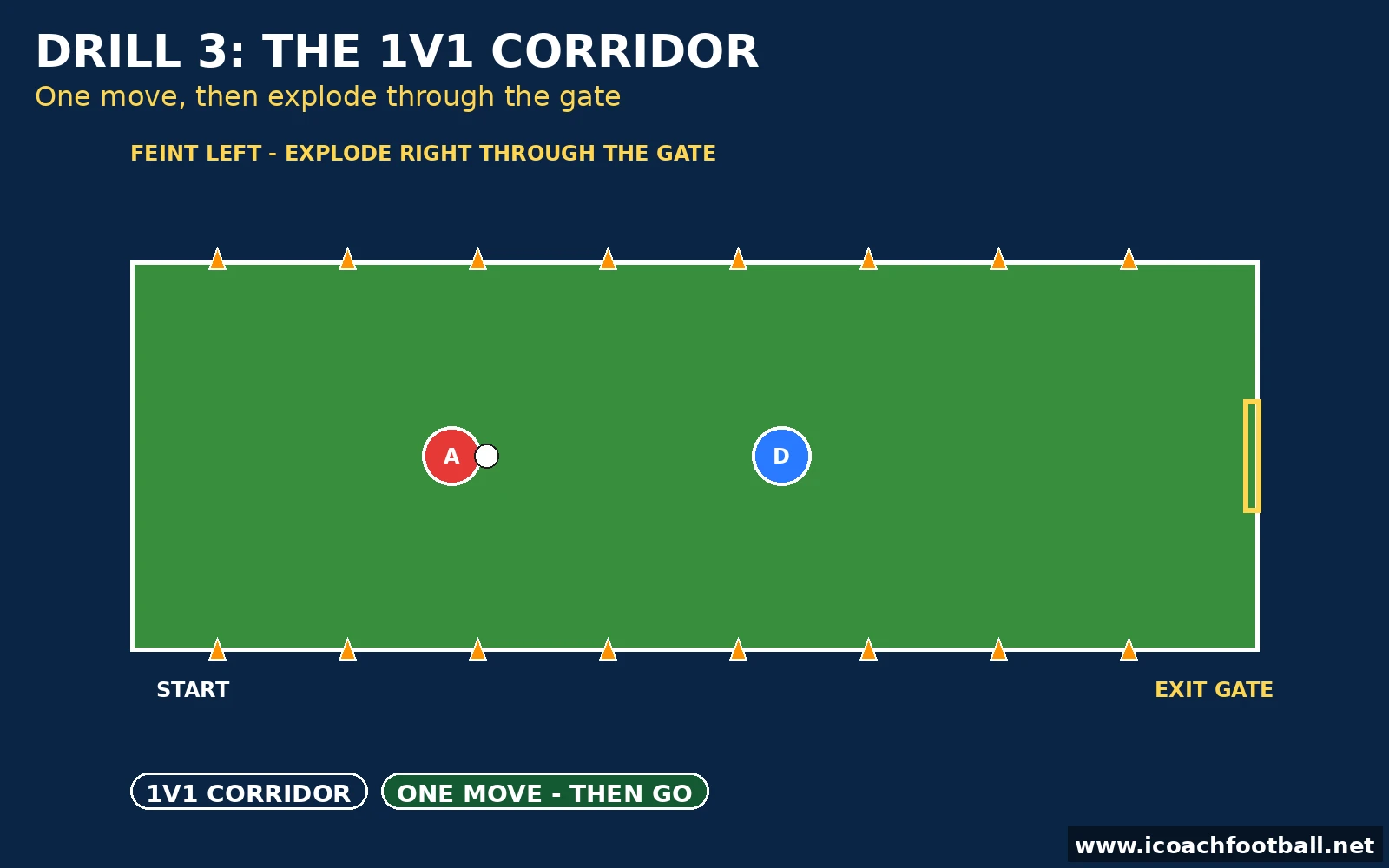
- Setup: 15 x 10 yard channel, one small gate at the far end, attacker at one end, defender in the middle, one ball.
- How to play:
- The attacker dribbles at the defender at half speed.
- Two yards out, the attacker makes one move — a feint, a drop of the shoulder, a stepover.
- The attacker explodes past the defender on the other side.
- Dribble through the exit gate to score.
- Swap roles after every rep, then rotate the defender.
- Coach’s note: The move is not the skill — the burst after it is. If the attacker does the trick and then jogs, stop the drill and say “one move, then go.”
- Progressions: Defender starts passive, then live; the gate narrows; the attacker must beat the defender with their weak foot.
Drill 4: The Turn Circuit
Four turns, four cones, one continuous loop. Players learn the turns that actually get them out of trouble — not the ones that look good on video.
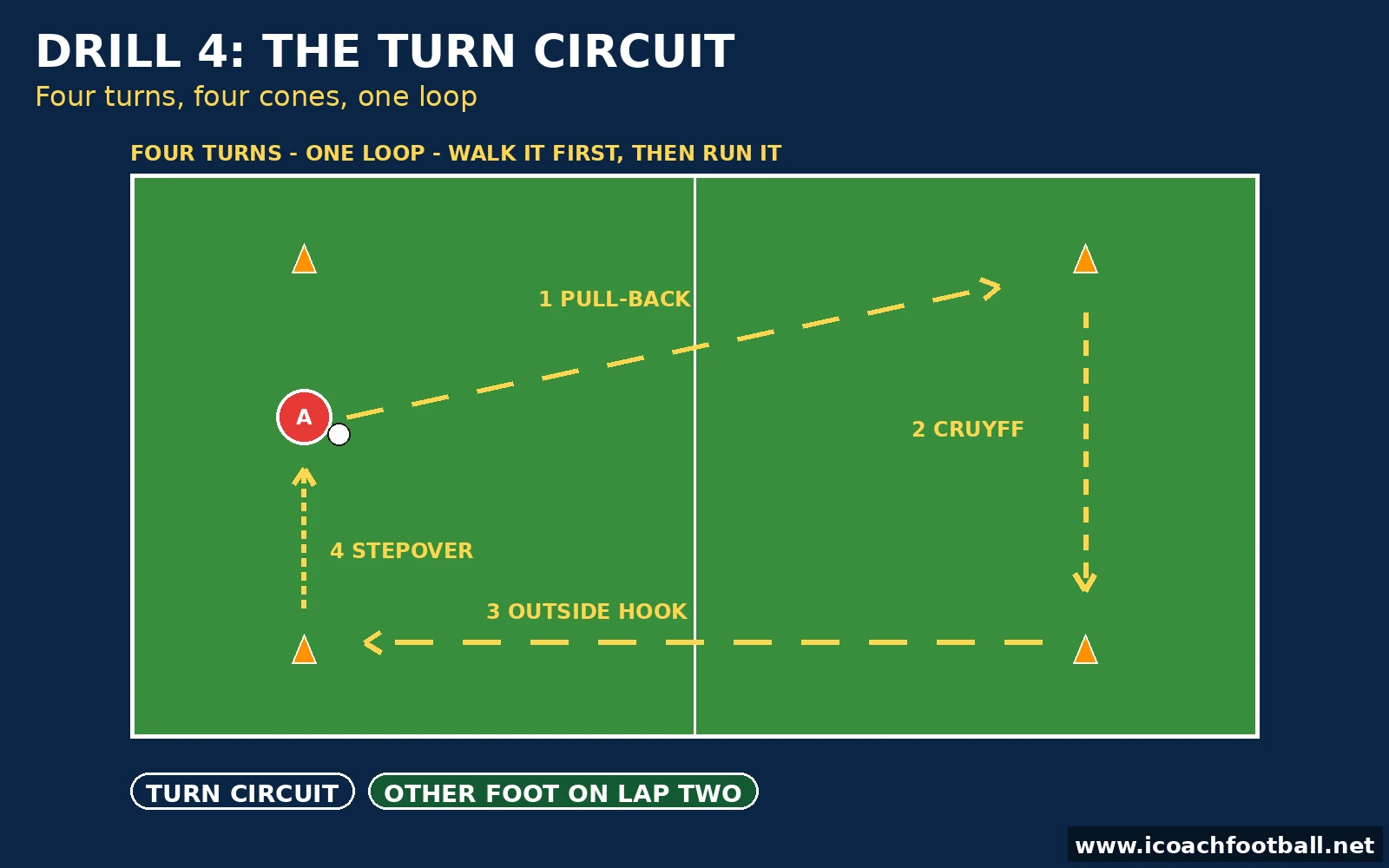
- Setup: 15 x 15 yard square, one cone on each corner, one ball per player.
- How to play:
- Players dribble around the square, one turn at each cone.
- Cone 1: pull-back turn with the sole.
- Cone 2: Cruyff turn — fake the pass, drag the ball behind the standing leg.
- Cone 3: outside hook — take the ball away with the outside of the foot.
- Complete the loop, then go again with the other foot.
- Coach’s note: Teach each turn walking first. A turn learned at walking pace works in a game; a turn learned at full speed usually falls apart.
- Progressions: Add a chasing defender who starts 2 seconds behind; time the loop; turns must be done with the weak foot on the second lap.
Drill 5: The Dribble Relay Race
Two teams, two lanes, one race. The relay forces speed with the ball — and the weak-foot lap exposes every player who has been hiding their weaker side.
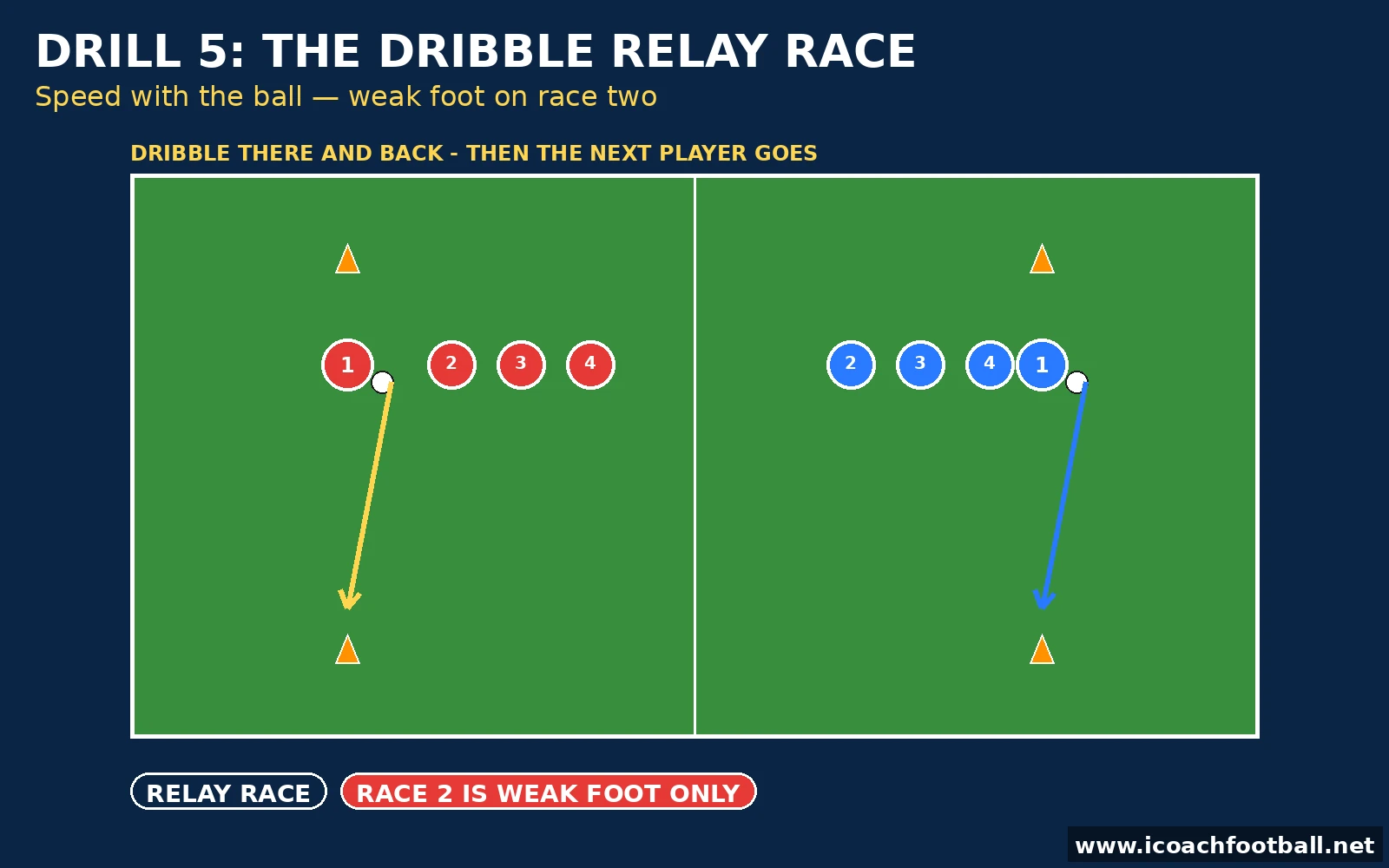
- Setup: Two 20-yard lanes marked with cones, 2 teams of 4–5, one ball per team.
- How to play:
- The first player dribbles to the far cone and back.
- They hand the ball to the next player in line.
- The first team to finish all its players wins the race.
- A dropped ball means the player goes back to the start cone.
- Run 3 races, then change the lane pattern.
- Coach’s note: The race is won in the turn at the far cone, not the sprint — a clean pull-back turn saves a full second.
- Progressions: Second race is weak foot only; third race weaves through 4 cones; the far cone becomes a 1v1 against the other team’s runner.
Drill 6: The Dribblers’ Game
The match-real finish: a small-sided game where a goal only counts if someone beat a player with the ball first. Dribbling stops being a drill and becomes a decision.
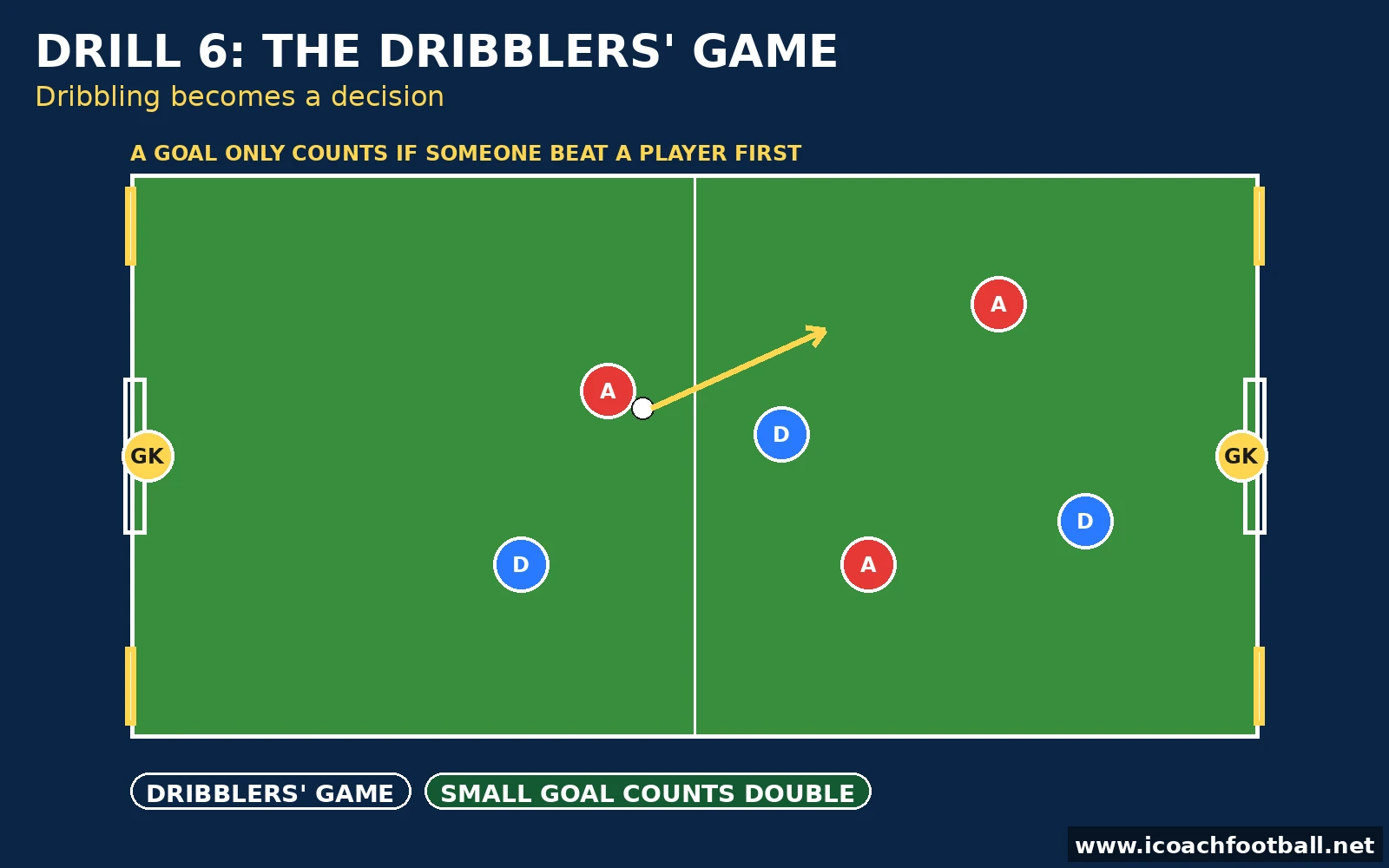
- Setup: 30 x 25 yards, 2 big goals with keepers plus 4 small corner goals, 4v4 or 5v5, one ball.
- How to play:
- Play a normal small-sided game to the big goals.
- A goal only counts if a player on the scoring team beat an opponent with a dribble in that attack.
- A goal scored in a small corner goal counts double.
- Keepers restart play quickly after every goal.
- Play 5-minute games, then rotate keepers.
- Coach’s note: The moment a player passes when they could have dribbled, freeze the game and ask “could you have gone past them?” — that question is the whole drill.
- Progressions: Every player must beat an opponent before their team can score; one-touch limit for everyone except the dribbler; small goals count only after a turn.
Coaching points
- Small touches in traffic, big touches in space: Close control near defenders, longer touches when the space opens up — one touch size does not fit every moment.
- The sole is a tool, not a crutch: Pull-backs and sole rolls protect the ball, but the player must still look up after the turn.
- Body shape sells the move: Drop the shoulder, open the hips, then go the other way — the defender reads the body, not the feet.
- Weak foot every session: Half of every dribbling drill should be on the weaker foot, or it will never catch up. See our weak foot soccer drills for a full session.
- Scan before you receive: The dribble starts before the ball arrives — a player who scans knows where the space is. See our soccer scanning drills.
Common mistakes
- Staring at the ball: The player who never looks up cannot see the gate, the defender or the space — use the gates game to make looking up the way to score.
- Too many touches: Dribbling is not juggling while running — if the ball is still under the player’s feet after five touches in open space, coach the bigger touch.
- The trick with no exit: A stepover that ends in the same place is a party trick — the move only counts if the player explodes away from the defender.
- Dribbling into a wall: Players dribble at defenders instead of into space — coach the diagonal run that opens the gap, not the straight line into pressure.
Age adaptations
| Age | Area | Touches | What changes |
|---|---|---|---|
| U8–U9 | 15 x 15 yards | Unlimited | Games only, no formal 1v1 corridor; turns taught as “spin” games |
| U10–U12 | 25 x 25 yards | Two-touch in Drill 5 | Add the 1v1 corridor, introduce the Cruyff turn, weak-foot laps |
| U13–U15 | 40 x 30 yards | One-touch finish in Drill 6 | Live defenders everywhere, full relay race, dribblers’ game with keepers |
60-minute session plan
| Block | Minutes | What to run |
|---|---|---|
| Warm-up | 0–10 | Drill 1, the gates game, small grid |
| Ball protection | 10–20 | Drill 2, shark attack |
| 1v1 work | 20–32 | Drill 3, the 1v1 corridor |
| Turns | 32–42 | Drill 4, the turn circuit |
| Speed with the ball | 42–50 | Drill 5, the dribble relay race |
| Match-real finish | 50–60 | Drill 6, the dribblers’ game |
FAQ
What age should kids start dribbling drills?
As soon as they can kick a ball — U6 and U7 players learn dribbling through games like sharks and minnows and gates. Our U7 dribbling drills are the starting point; this session is built for U8–U15, when turns and 1v1s can be coached properly.
How do I teach a child to dribble with their head up?
Make looking up the way to score. In the gates game, the players who look up find the open gates — the ones who stare at the ball run out of gates. Praise the scan, not the touch.
How many touches should a player take when dribbling?
As few as the situation allows. In traffic, small touches keep the ball close. In open space, one bigger touch into the gap beats five small ones. The rule is simple: the ball stays within one step when a defender is close, and goes into space when the defender is not.
What is the best dribbling drill for beginners?
The gates game. One ball per player, no defender, and a clear score — it builds close control and scanning at the same time, and every player gets hundreds of touches in 90 seconds.
How often should players practise dribbling?
Every session, for 10–15 minutes. Short, frequent dribbling work beats one long session a week — the FIFA Training Centre’s ball-mastery sessions are built on the same idea: repetition, perception and game-related practice, every time.
Sources
- FIFA Training Centre — “Mastering ball control” (FIFA Technical Expert Branimir Ujevic: close control, feints and shimmies, head up, use all parts of both feet). The close-control progression and the 1v1 corridor in this post are based on that session.
- FIFA Training Centre — “Dribble with a purpose” (grassroots 12–15: dribbling relay course, beating a defender, 6v6 on two big and four small goals). The relay race and the dribblers’ game in this post are in line with that session.