Soccer Drills for Receiving Under Pressure: 6 Games That Teach Players to Keep the Ball When Marked Tight (U10–U16)
Quick answer
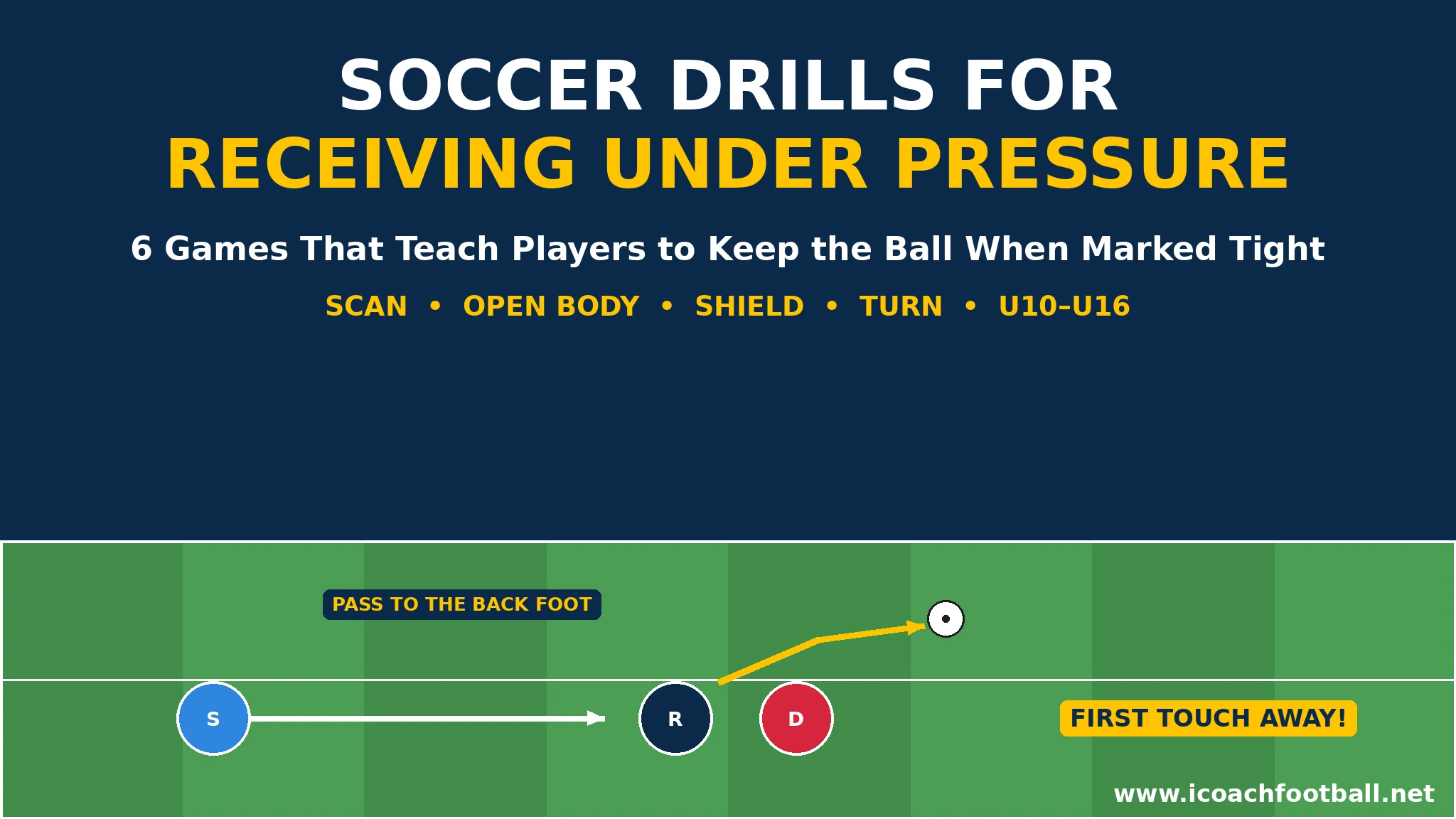
Receiving under pressure is not about a soft first touch. It is about what happens before the ball arrives: scan, show on the half-turn, meet the ball, and take the first touch away from the marker into space. These six games train that sequence step by step — body shape, movement to receive, shielding with a defender on your back, the end-player game, the turn-or-set-back decision, and a full pressed-receiver game.
Suitable for: U10–U16 (ages 9–16)
Session snapshot
- Players: 12–16
- Area: 20×15-yard rectangles, expanding to a 30×20-yard game
- Duration: 60 minutes
- Focus: Receiving under pressure — scanning, body shape, shielding, and the turn-or-set-back decision
- Equipment: 10 balls, 16 cones, bibs, 2 mini goals, 1 full-size goal
Why these six games work
Most players lose the ball at the moment of receiving, not after it. They wait for the ball, take it square-on with a dead touch at their feet, and the defender is on them before they have looked up. The fix is a sequence, and it starts before the pass is played.
The first two drills build the body and the movement: an open body shape that sends the first touch into space, and the check-in, check-out run that buys a yard. The next two drills build the survival skills: shielding with a defender on your back, and the end-player game where every reception happens under pressure. The last two drills build the decision: turn or set back, then a full game where the pressed receiver is the player the team must find.
The drills are grounded in the FIFA/UEFA coaching community. Drills 1, 2, 5 and 6 are based on / in line with the FIFA Training Centre session “Directing the ball with the first touch”, in which FIFA Women’s Football Technical Expert Jacqueline Dünker trains young players in body orientation, directional first touch and receiving under pressure — first in controlled exercises, then in a 2v2 game and a small-sided game. Drills 3 and 4 are based on / in line with The FA’s Boot Room practice “Receiving under pressure”, in which FA youth coach developer Ben Futcher trains players to scan before receiving, to move, protect and shield the ball, and to play from one end player to the other under pressure. In the UK the same session is football drills for receiving under pressure — the marker, the cues and the coaching points are identical.
This post is the receiving half of the site’s under-pressure trilogy. The pass that arrives is trained in our soccer drills for improving passing under pressure, and the shot that follows a good reception is trained in our soccer drills for improving finishing under pressure. The turn that follows a good first touch is our football half-turn drills, and the scan that makes the whole sequence possible is our soccer scanning drills.
Six rules of receiving under pressure
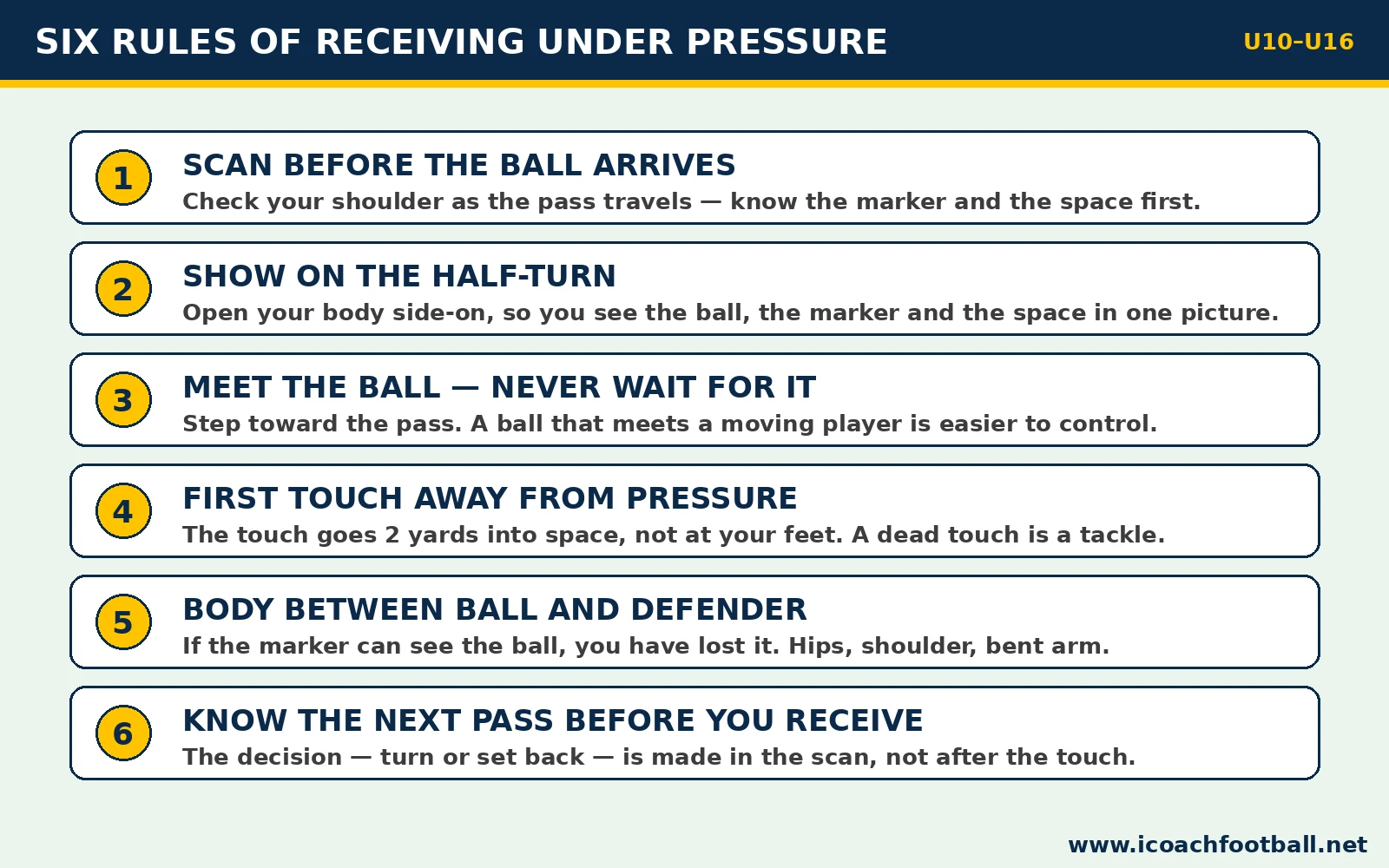
- Scan before the ball arrives. Check your shoulder as the pass travels — know where the marker is and where the space is before you touch it.
- Show on the half-turn. Open your body side-on to the passer, so you can see the ball, the marker and the space in one picture.
- Meet the ball — never wait for it. Take a step toward the pass. A ball that arrives at a moving player is easier to control than one that arrives at a standing one.
- First touch away from pressure. The touch goes into space, not at your feet. A dead touch is a tackle waiting to happen.
- Body between ball and defender. If the marker can see the ball, you have already lost it. Hips, shoulder and a bent arm keep them out.
- Know the next pass before you receive. The decision — turn or set back — is made in the scan, not after the touch.
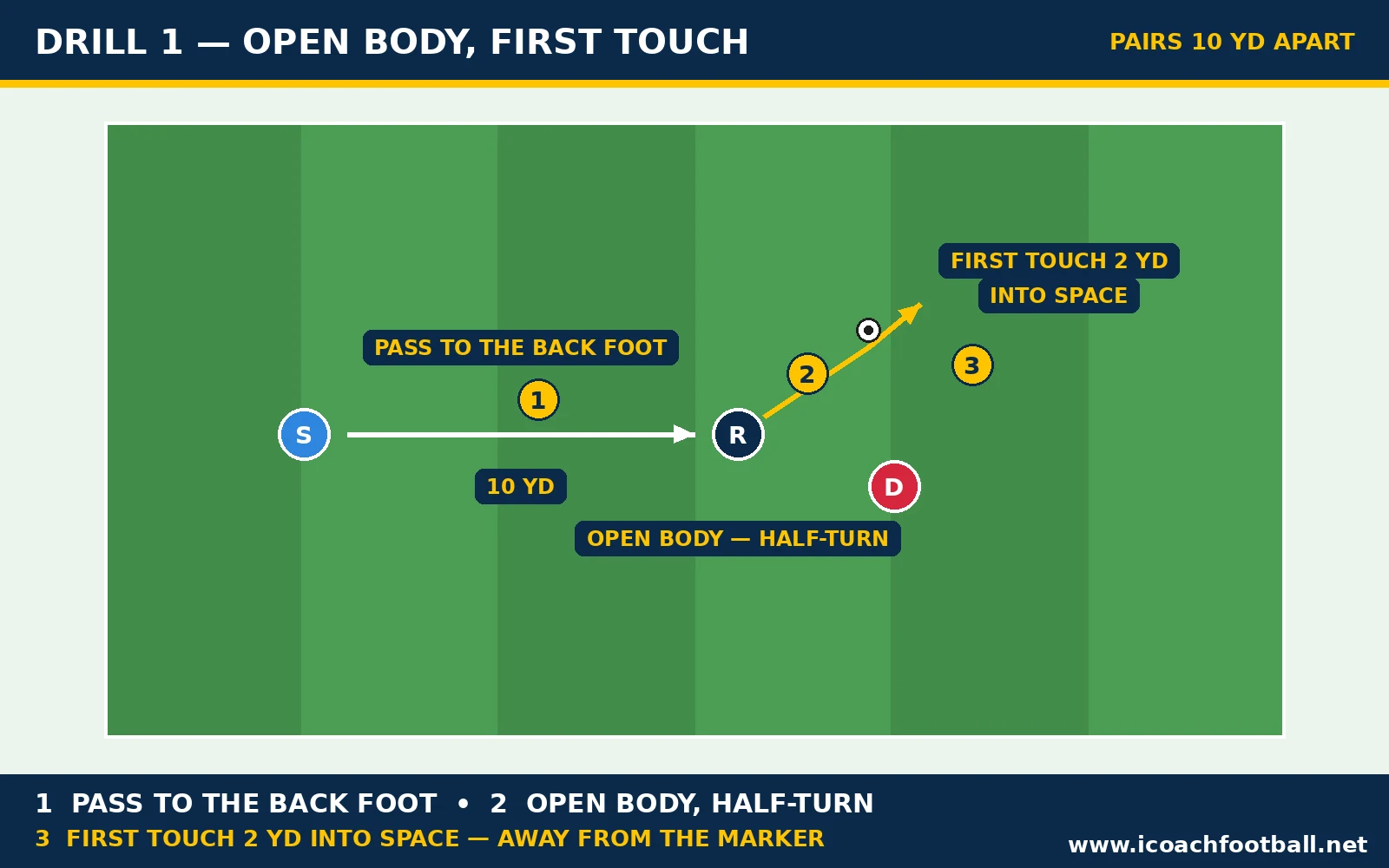
Drill 1 — Open Body, First Touch Away
The receiver practises opening the body before the pass arrives, so the first touch carries the ball away from the marker and into space.
Setup
- 20×15-yard area, pairs 10 yards apart, 1 ball per pair.
- 8 minutes, then swap roles.
How to Play
- The passer plays a firm pass along the ground to the receiver’s back foot.
- Before the pass arrives, the receiver opens the body side-on to the passer.
- The receiver takes the first touch across the body with the inside of the back foot.
- The touch moves the ball 2 yards into the space behind the receiver.
- The receiver plays the ball back first time, then resets to face the passer.
- After 6 reps, the pair swaps roles and the passer becomes the receiver.
Coach’s note: “Open body, back foot — the touch goes where your chest points, so point your chest at the space, not at the passer.”
Progressions: A passive defender stands behind the receiver; the passer varies the pace of the pass; the receiver must turn and dribble through a gate after the touch.
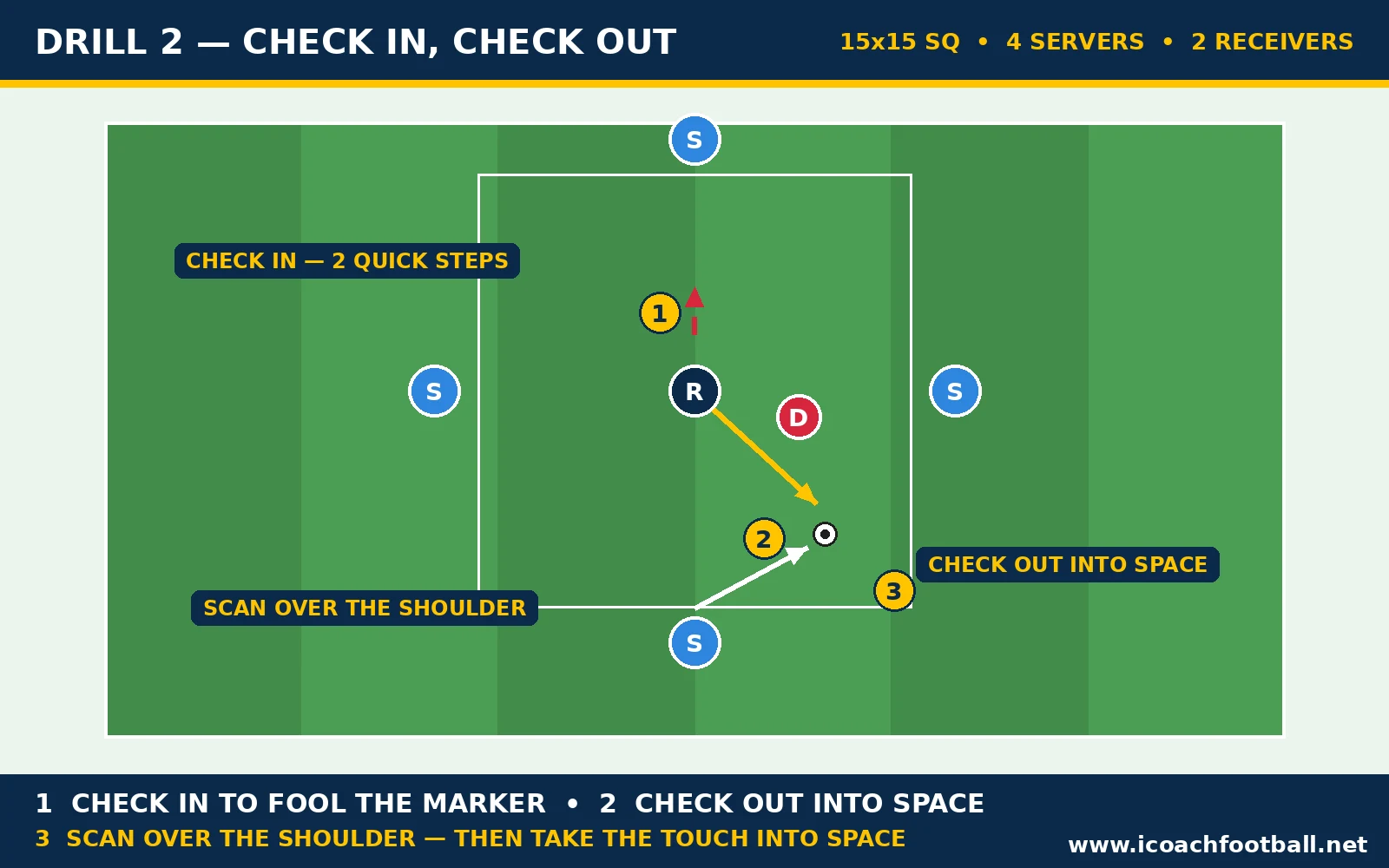
Drill 2 — Check In, Check Out
The receiver learns the movement that buys a yard — a sharp check toward the ball, then away — plus the shoulder check that tells them where the pressure is.
Setup
- 15×15-yard square, 4 servers on the outside, 2 receivers inside.
- 8 minutes, then swap.
How to Play
- The receiver stands inside the square, a server on each side with a ball.
- The receiver checks toward the server — two quick steps — then checks away into space.
- The server plays the pass into the space the receiver has just moved into.
- The receiver scans over the shoulder before the ball arrives, then takes the touch into space.
- The receiver passes to a different server, then checks in again for the next ball.
- After 2 minutes, swap — the servers come inside and the receivers go out.
Coach’s note: “Check in to fool the marker, check out to lose them — if you only ever move toward the ball, the defender follows you to it.”
Progressions: A defender follows the receiver inside the square; the receiver must call the server’s name before the pass; the first touch must be taken with the outside of the foot only.
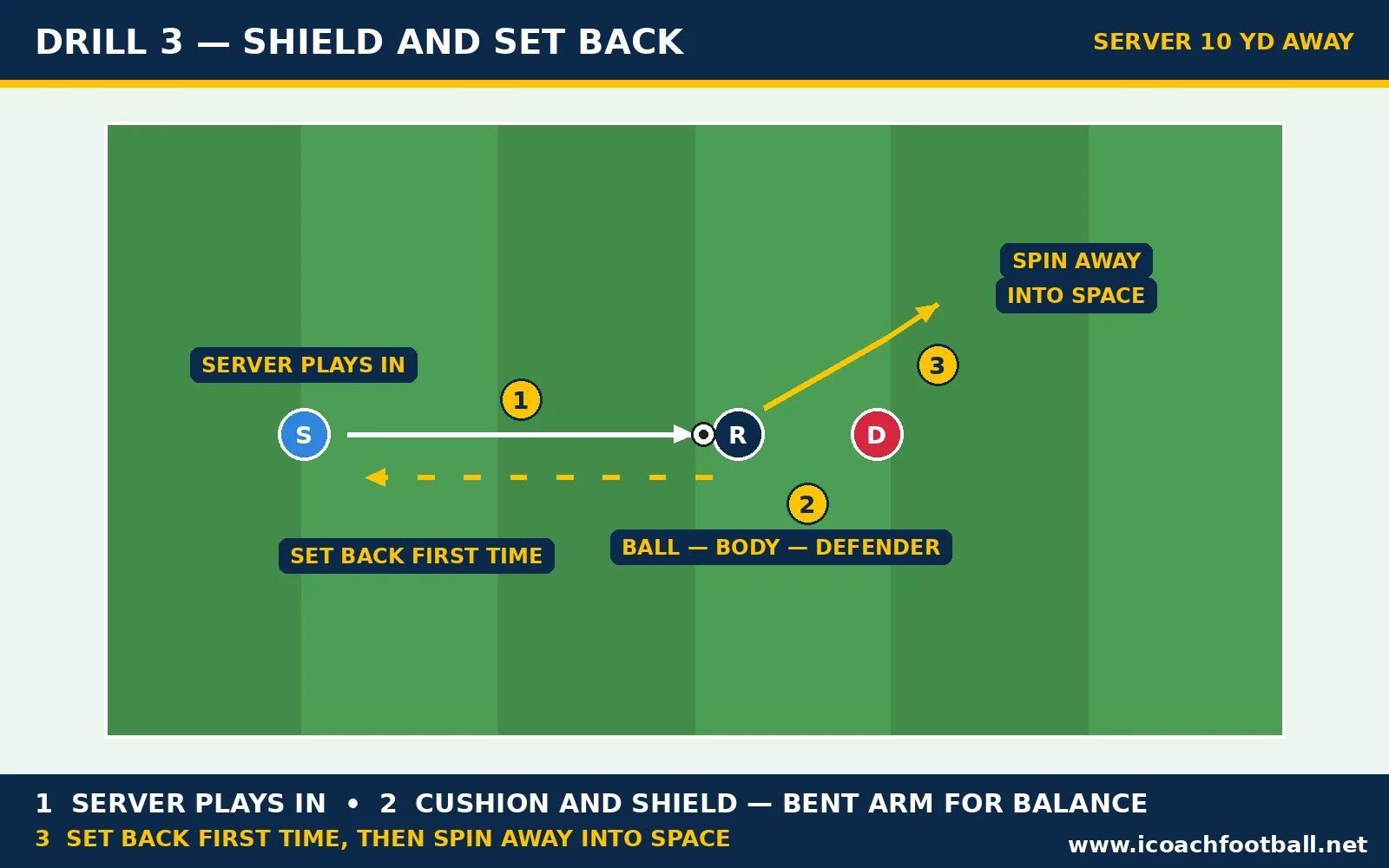
Drill 3 — Back to Goal, Shield and Set Back
The receiver takes the ball with a defender tight on their back, shields it with the body, and sets it back safely — the survival skill for a striker or a midfielder under direct pressure.
Setup
- 10×10-yard square, 1 receiver, 1 defender on their back, 1 server 10 yards away.
- 8 minutes, then rotate.
How to Play
- The receiver stands with their back to the server, the defender tight behind them.
- The server plays a firm pass into the receiver’s feet.
- The receiver cushions the ball with the inside of the foot and keeps the body between ball and defender.
- The receiver holds the defender off with a bent arm for balance — no pushing.
- The receiver sets the ball back first time to the server, then spins away into space.
- After 6 reps, rotate — the defender becomes the receiver and the receiver becomes the server.
Coach’s note: “Ball, body, defender — in that order. If the defender can see the ball, you have lost it already.”
Progressions: The defender goes live and can win the ball; the receiver may turn and score in a mini goal instead of setting back; the server plays the pass harder and from a longer distance.
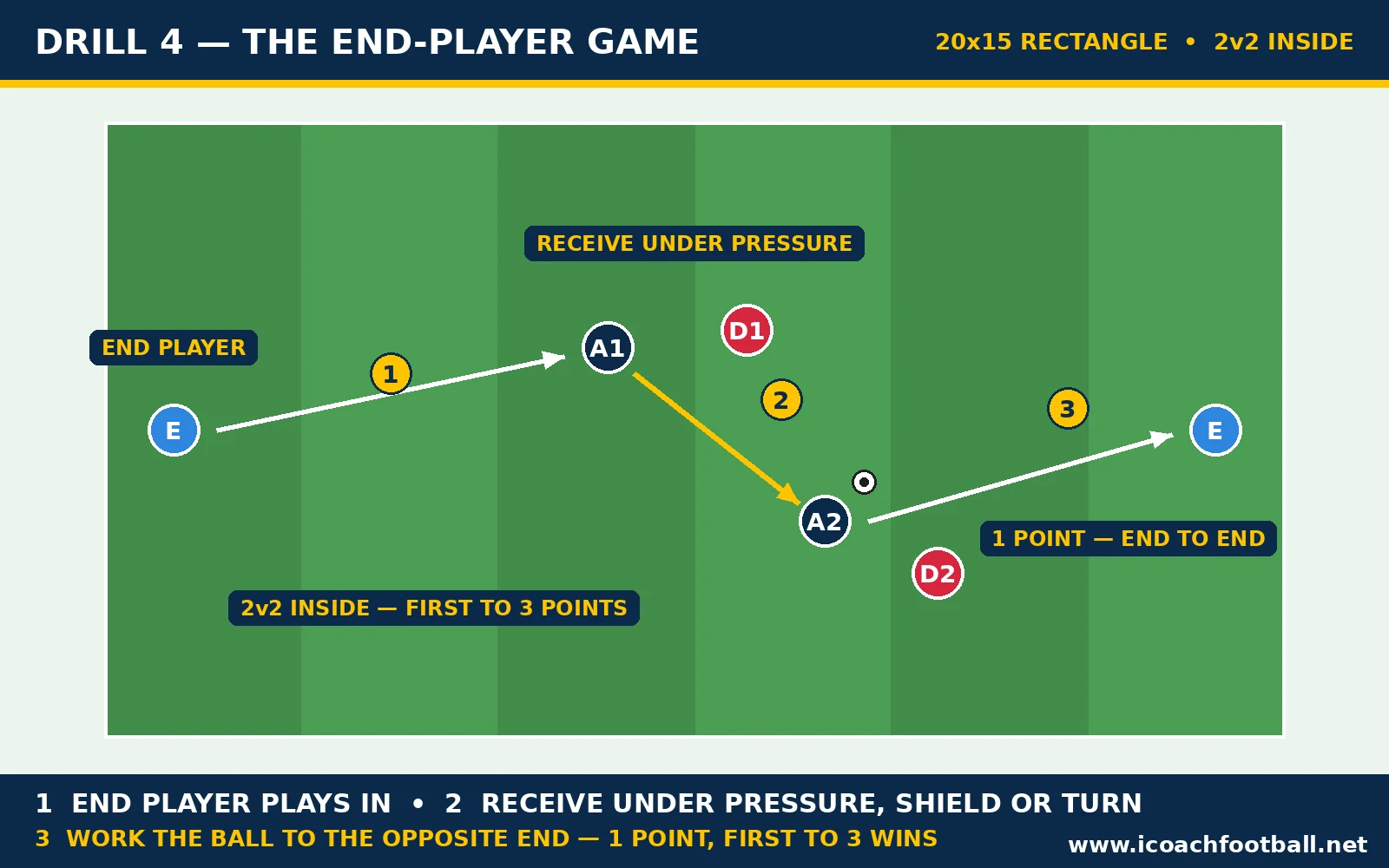
Drill 4 — The End-Player Game
A 2v2 game inside a rectangle with an end player at each end — the pair in possession must receive under pressure and work the ball from one end to the other.
Setup
- 20×15-yard rectangle, 2 end players (one at each end), 2v2 inside.
- 10 minutes.
How to Play
- One end player starts with the ball and plays it into either of the two attackers inside.
- The receiver takes the ball under pressure from a defender and shields it or turns away.
- The pair combine to work the ball toward the opposite end player.
- A completed pass to the opposite end player scores 1 point for the pair in possession.
- If the defenders win the ball, the roles switch at once and they attack the other end.
- First pair to 3 points wins — then the end players rotate inside and a new pair takes their place.
Coach’s note: “Receive, protect, play forward — if the first touch goes backward into trouble, the point is gone before the second touch.”
Progressions: Limit the pair inside to two touches; the end players must play one-touch; the defenders can press the end players too.
Drill 5 — Turn or Set Back
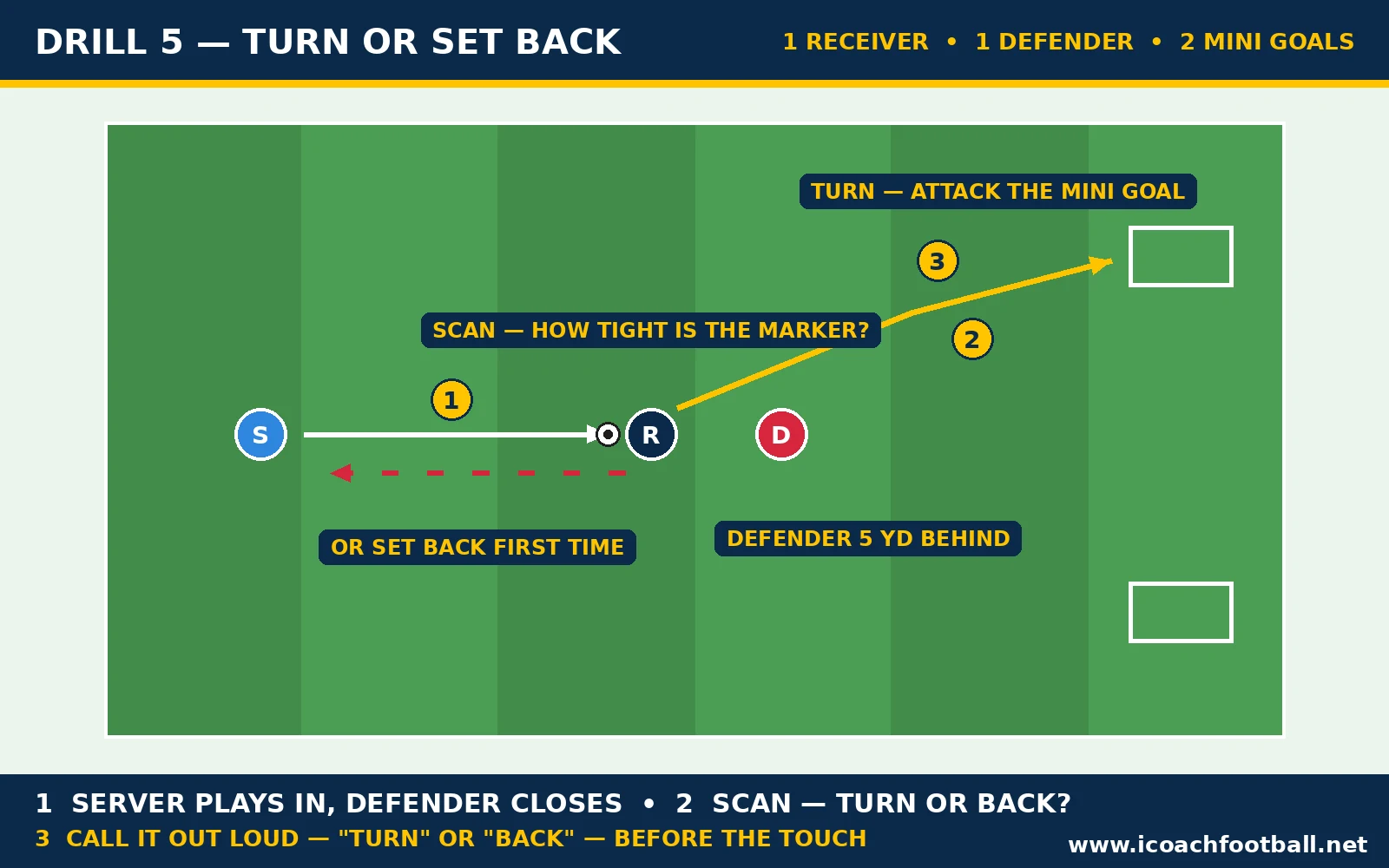
The receiver must decide in the split second before the ball arrives — turn into space if the defender is off, set it back if the defender is tight.
Setup
- 20×20-yard area, 1 receiver, 1 defender, 1 server, 2 mini goals.
- 8 minutes, then rotate.
How to Play
- The receiver stands between the server and the mini goals, the defender starting 5 yards behind.
- The server plays the pass in and the defender closes at once.
- The receiver scans over the shoulder as the ball travels to see how tight the defender is.
- If the defender is off, the receiver turns on the half-turn and attacks a mini goal.
- If the defender is tight, the receiver shields the ball and sets it back to the server.
- After each rep the receiver says one word — “Turn” or “Back” — so the decision becomes a habit.
Coach’s note: “The decision is made before the ball arrives, not after it — the scan tells you the answer, the touch only follows it.”
Progressions: The defender starts closer each round; the receiver must turn and score within 3 seconds; the server follows the pass and becomes a second attacker.
Drill 6 — The Pressed Receiver Game
The full game. A 4v4 with a neutral receiver in the middle — every team must find the pressed receiver and play through them to score.
Setup
- 30×20-yard area, 4v4 plus 1 neutral receiver, 2 mini goals.
- 15 minutes.
How to Play
- Two teams of 4 play 4v4, with one neutral receiver in a 5-yard circle in the middle.
- A team scores only after the ball has gone through the neutral receiver.
- The neutral receiver is always marked — a defender stays within 2 yards of them.
- The receiver must scan, open the body and take the first touch away from the marker.
- After 5 minutes, the neutral receiver swaps with a player from the team in possession.
- The team with the most goals after 15 minutes wins — then play again with a new neutral.
Coach’s note: “In a real game the marked player is the brave one — find them, trust them, and play through them.”
Progressions: Two neutral receivers instead of one; the neutral receiver is limited to one touch; the goals only count if the team scores within 5 seconds of the receiver’s touch.

Coaching points
- The scan is the first touch. A player who checks their shoulder before the ball arrives has already beaten the marker — a player who scans after the touch is already tackled.
- Body shape decides the direction. An open, side-on body sends the ball into space; a square body sends it straight back to where it came from, into the defender’s path.
- Meet the ball at pace. A receiver who steps toward the pass controls it with the body moving forward; a receiver who stands still takes the ball with the weight on the heels, and the next step is always too slow.
- The first touch is a pass to yourself. It should travel 2 yards into space, at a pace you can catch, and in a direction you have already chosen — not a dead stop at your feet.
- Shield with the hips, not the hands. A bent arm is for balance and feeling contact; a straight arm pushing the defender is a foul, and it tells the referee — and the defender — that you are beaten.
- Set back is a good decision, not a failure. A safe lay-off keeps the ball and resets the attack; a forced turn into a tight marker loses it. Praise the set-back as loudly as the turn.
Common mistakes
| Mistake | Fix |
|---|---|
| Waiting for the ball to arrive | Meet it — take a step toward the pass in Drill 1 until moving to the ball is automatic |
| Receiving square-on with a closed body | Open up on the half-turn in Drill 1 — chest to the space, back foot to receive |
| A dead first touch at the feet | The touch must travel 2 yards into space — Drill 2 punishes a dead touch at once, because the marker is already there |
| Turning into the defender without looking | Scan first, decide second — Drill 5 forces the receiver to call “Turn” or “Back” before the touch |
| Pushing the defender off with a straight arm | Bent arm for balance only — Drill 3 stops the rep if the arm extends, so the habit never forms |
| No scan before receiving | The shoulder check is a rule in every drill — no scan, no pass; the server waits until the receiver has looked |
Age adaptations
| Age | Format | What changes |
|---|---|---|
| U10–U11 (ages 9–11) | 10×10-yard areas, size 4 ball, passive defenders only | All six drills run with the defender starting passive and the server playing soft passes. Drill 3 uses a defender who only shadows, never tackles. Drill 4 plays 2v2 with no scoreboard — the point is the reception, not the result. The receiver calls the decision out loud in Drill 5 before every rep |
| U12–U13 (ages 11–13) | 15×15-yard areas, size 4 ball, defenders go live in the last 2 minutes of each drill | All six drills run as written, with the defender starting 5 yards off and closing on the pass. Drill 3 adds the live defender progression once the shield is clean 6 times in a row. Drill 6 runs with one neutral receiver and a 5-second rule for the goal |
| U14–U16 (ages 13–16) | Full areas, size 5 ball, defenders live from the first rep | Full pressure from the start. Drill 2 adds a live defender inside the square, Drill 4 limits the pair to two touches, and Drill 6 adds the second neutral receiver and the one-touch limit. Receivers keep a simple note of which turns worked against which markers — “turned him twice on the outside” is the edge that wins games |
60-minute session plan
| Block | Time | Content |
|---|---|---|
| Arrival game | 0:00–0:05 | Free 3v3 — every reception must be taken on the half-turn |
| Open body, first touch away | 0:05–0:13 | Drill 1 — Open Body, First Touch Away |
| Check in, check out | 0:13–0:21 | Drill 2 — Check In, Check Out |
| Back to goal, shield and set back | 0:21–0:29 | Drill 3 — Back to Goal, Shield and Set Back |
| The end-player game | 0:29–0:39 | Drill 4 — The End-Player Game |
| Turn or set back | 0:39–0:47 | Drill 5 — Turn or Set Back |
| The pressed receiver game | 0:47–1:00 | Drill 6 — The Pressed Receiver Game |
Keep building from here
The pass that arrives is trained in our soccer drills for improving passing under pressure, and the shot that follows a good reception is trained in our soccer drills for improving finishing under pressure — together the three posts cover the whole under-pressure sequence. The turn that follows a good first touch is our football half-turn drills and our soccer drills for improving turning, and the shielding that keeps the ball when the turn is not on is our soccer hold-up play drills. The scan that makes the whole sequence possible is our soccer scanning drills, the reading of the marker that tells a receiver when to turn is our soccer drills for improving anticipation, and the reactions that turn a read into a touch are our soccer drills for improving reaction time. The close control that keeps the ball tight after the first touch is our soccer ball mastery drills, the one-two that gets the receiver free again is our soccer give and go drills, and the communication that tells a receiver where the space is before the pass arrives is our soccer communication drills. Receiving under pressure is high-load work for young players — plan the week’s load with our training load calculator.
Once your players can receive the ball under pressure, the next step is keeping it — our soccer drills for improving shielding the ball teach the side-on body shape, the far foot and the turn out of pressure.
FAQ
What does receiving under pressure mean in soccer?
It means taking a pass while a defender is close enough to win the ball — usually within 2 yards, often tight on the receiver’s back. The skill is not the touch itself, but the sequence around it: scan before the ball arrives, show on the half-turn, meet the ball, and take the first touch away from the marker into space. A player who does all four keeps the ball; a player who only controls it loses it on the next touch.
How do you receive a soccer ball when a defender is tight on your back?
Get your body between the ball and the defender, cushion the ball with the inside of the foot, and keep a bent arm out for balance — never a straight arm pushing. Take the first touch to the side, away from the marker, and decide at once: turn if there is space, or set the ball back first time to the passer. Drill 3 trains exactly this, with the defender live once the shield is clean.
Should a player turn or pass back when receiving under pressure?
It depends on what the scan shows. If the defender is off by a yard or more and there is space behind them, turn on the half-turn and attack. If the defender is tight and the space behind is closed, set the ball back first time — a safe lay-off keeps the ball and resets the attack. The decision is made before the ball arrives, from the shoulder check, not after the touch. Drill 5 trains the call: “Turn” or “Back”.
What is the best first touch under pressure?
A directional touch that moves the ball 2 yards into space, away from the marker, at a pace the receiver can catch. The best surface is usually the inside of the back foot, with the body open on the half-turn — the touch goes where the chest points. A dead touch at the feet is the worst option under pressure, because the defender is already there before the second touch.
At what age should players start training to receive under pressure?
From U10, with passive defenders and soft passes, so the body shape and the scan become habits before the pressure is real. The shielding and the turn-or-set-back decision can both be trained young — what must wait is full live tackling from behind. Add live defenders gradually from U12, and full-pressure receiving games from U13, once the shield is clean and the landing after a turn is safe.
Sources
- FIFA Training Centre. “42) Directing the ball with the first touch” — FIFA Women’s Football Technical Expert Jacqueline Dünker delivers a session on body orientation when receiving, directional control and shifting the ball into space, progressing from a warm-up through control-and-shoot and a 2v2 game to a small-sided game in which players practise receiving under pressure. Verified live 2026-11-20 (HTTP 200, full text read). Drills 1, 2, 5 and 6 are based on / in line with this session’s body-orientation, directional-touch and receiving-under-pressure principles.
- The FA. “Receiving under pressure” — FA youth coach developer Ben Futcher provides a skill practice that helps players receive the ball under pressure, developing how to use different parts of the body when receiving, the importance of scanning before receiving, and how to move, protect and shield the ball under pressure. Verified live 2026-11-20 (HTTP 200, full text read). Drills 3 and 4 are based on / in line with this practice’s scanning, shielding and end-player game structure.