Soccer Practice With No Cones: 8 Simple Training Activities
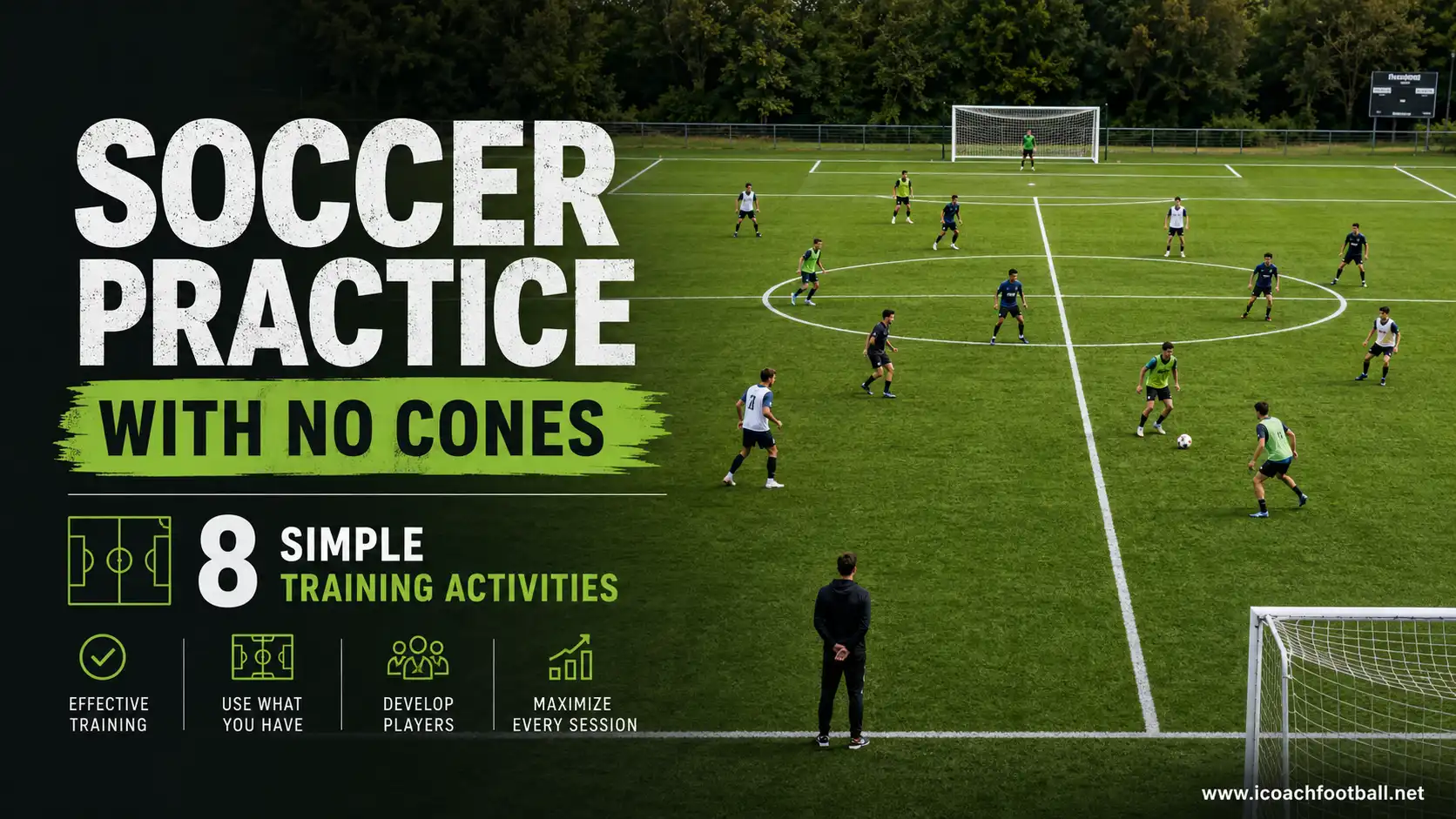
Quick answer: When no cones are available, use existing pitch markings such as the touchlines, halfway line, centre circle, penalty-area lines and goal line. These markings can create passing areas, rondos, scoring lines, possession games and competitive small-sided matches.
Forgetting the cones does not mean cancelling or reducing the quality of soccer practice. A marked field already provides boundaries, circles, lines, goals and reference points that can be used to organize an effective training session.
This complete 60-minute plan is designed for approximately 8–12 players. It uses existing pitch markings instead of cones and develops close control, passing, receiving, possession, pressing, overload attacks and transitions.
The session works best on a properly marked soccer field, small-sided pitch, futsal court or multi-sport surface. Coaches can use the touchlines, halfway line, centre circle, penalty area, goal area and other permanent markings to define each activity.
Do not replace cones with water bottles, bags, jackets or other objects that could create a tripping hazard. Use safe, visible field markings and explain each boundary clearly before the activity begins.
When equipment is limited in other ways, use our soccer practice with one ball, practice without goals or practice without a goalkeeper.
Equipment and Setup
PlayersApproximately 8–12 players
Cones requiredNone
Session duration60 minutes
Recommended agesU9 to senior
Playing areaA marked soccer field or sports court
Other equipmentBalls, bibs and existing goals when available
Complete 60-Minute Soccer Practice Without Cones
| Time | Activity | Main objective |
|---|---|---|
| 0–7 minutes | Touchline-to-Touchline Ball Mastery | Close control, turns and acceleration |
| 7–14 minutes | Centre-Circle Pass and Follow | Passing, receiving and movement |
| 14–22 minutes | 4v2 Centre-Circle Rondo | Possession, scanning and pressing |
| 22–30 minutes | 3v3 Plus Two Penalty-Area Targets | Directional possession and support |
| 30–38 minutes | Continuous 3v2 Halfway-Line Attack | Overloads, finishing and recovery |
| 38–46 minutes | 4v4 Penalty-Area Line-Ball Game | Penetration, dribbling and transitions |
| 46–53 minutes | 4v4 Goal Versus Halfway-Line Game | Counterattacking and defensive recovery |
| 53–60 minutes | 5v5 Existing-Lines Match | Game understanding and competition |
How to Organize Training Without Cones
- Use visible pitch markings: Touchlines, goal lines, penalty-area lines, the halfway line and centre circle can define different practices.
- Explain every boundary: Walk players around the area before starting so everyone understands which lines are active.
- Use different bib colors: Bibs help players recognize teams, neutrals, targets and rotating defenders.
- Adapt the player numbers: Use neutral players when teams cannot be divided equally.
- Use natural reference points: Existing goals, corner arcs, penalty spots and court markings can help players understand their positions.
- Avoid unsafe substitutes: Do not place bottles, bags, clothing or hard objects on the playing surface as makeshift cones.
The official field markings described in IFAB’s Law 1: The Field of Play provide useful reference points for organizing practices when cones are unavailable.
Drill 1: Touchline-to-Touchline Ball Mastery
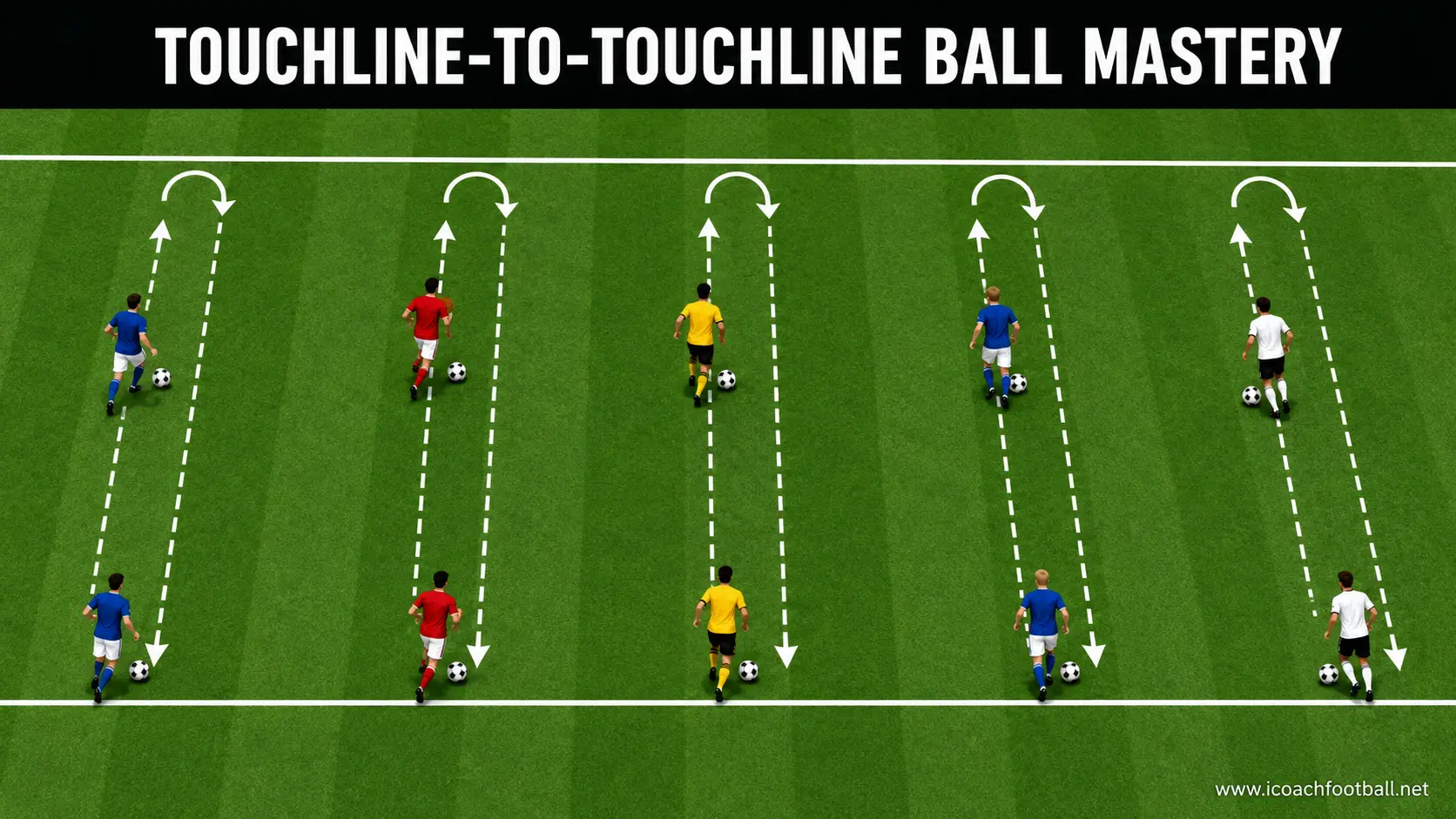
This technical activation uses two existing field lines as the boundaries. Players travel between the lines while practising close control, turns and changes of speed.
Setup
- Select two visible parallel field lines.
- Use the touchline and the outside edge of the penalty area when suitable.
- Alternatively, use two parallel markings on a sports court.
- Give every player one ball.
- Spread the players along the starting line.
- Leave sufficient space between participants.
How to Play
- Players dribble from the starting line toward the opposite line.
- At the second line, players perform the selected turn.
- Players accelerate back toward the original line.
- Change the technical action every 30–45 seconds.
- Use inside-outside touches, sole rolls, pull-push movements and drag turns.
- Players should avoid travelling in a perfectly straight line every time.
Coach’s note: Encourage frequent small touches when players are close together and a more positive touch when space opens. Players should lift their head before turning or accelerating.
Progressions: Use the weaker foot only, require a different turn at each line, introduce passive pressure or pair players so one leads and the other mirrors the movement.
Drill 2: Centre-Circle Pass and Follow
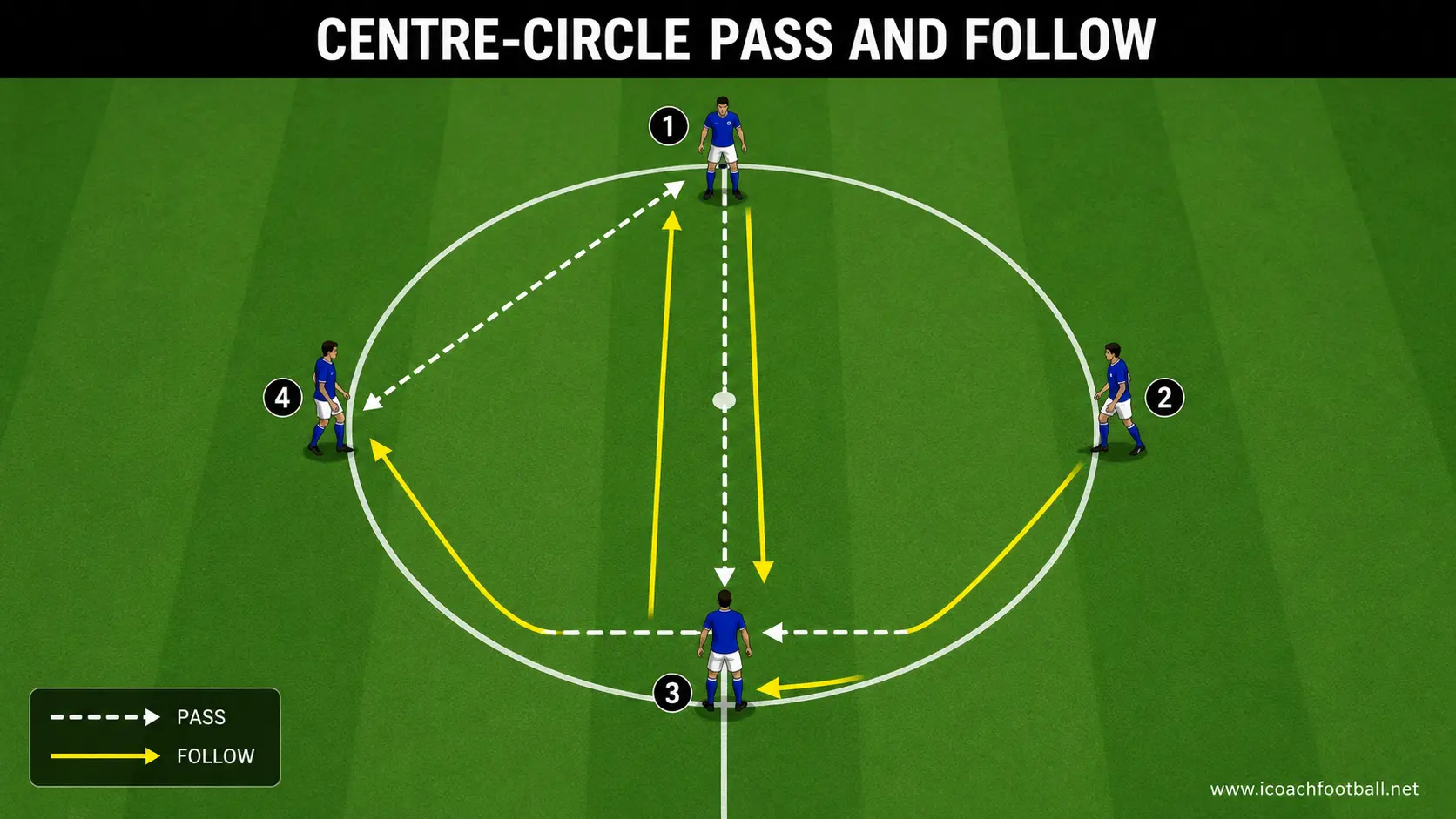
The centre circle creates a ready-made passing area. Players pass across or around the circle and move immediately after releasing the ball.
Setup
- Position all players evenly around the centre circle.
- Use one or two balls depending on the group’s ability.
- Keep the centre of the circle open.
- Use a smaller court circle for younger players when available.
- Ensure players have enough space to receive safely.
How to Play
- The first player passes across the circle to a teammate.
- After passing, the player runs through the centre and takes the receiver’s position.
- The receiver takes a positive first touch and passes to a different teammate.
- The ball should travel through different sections of the circle.
- Players cannot immediately return the ball to the previous passer.
- Change the passing direction and technical requirement regularly.
Coach’s note: Players should scan before receiving and recognize their next passing option early. The first touch should move away from pressure and prepare the next action.
Progressions: Limit players to two touches, require a one-touch pass, introduce a second ball or add a wall pass with a player positioned inside the circle.
For additional combination patterns, use our Y passing drills and third-player movements.
Drill 3: 4v2 Centre-Circle Rondo
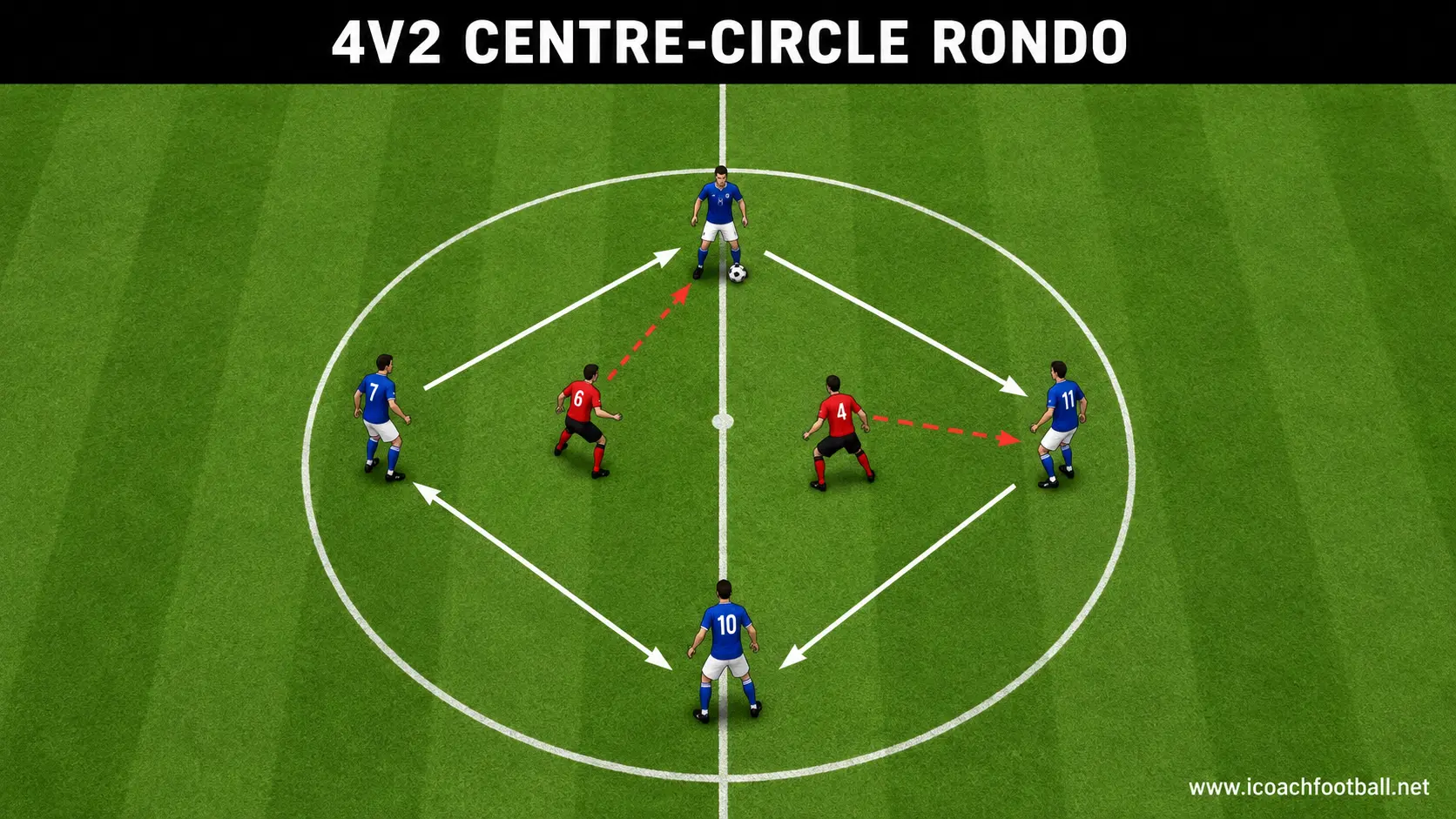
The centre circle provides a natural boundary for a possession exercise. Four players attempt to keep the ball away from two defenders while moving around the available space.
Setup
- Use the centre circle as the playing area.
- Place four possession players around or inside the circle.
- Use two players as defenders.
- Keep additional players beside the halfway line for quick rotations.
- Use one ball inside the activity.
How to Play
- The four attackers maintain possession against two defenders.
- Five consecutive passes earn one point.
- A pass between the two defenders earns a bonus point.
- When a defender wins possession, the attacker responsible for losing the ball enters the middle.
- Rotate the second defender after each round.
- Restart quickly whenever the ball leaves the circle.
Coach’s note: Attackers should use the full width of the circle and continually adjust their position. The defenders should press together and protect central passing routes.
Progressions: Limit attackers to two touches, use three defenders, require a one-touch split pass or place one attacking target inside the circle.
Continue developing possession with our advanced soccer rondo blueprint.
Drill 4: 3v3 Plus Two Penalty-Area Targets
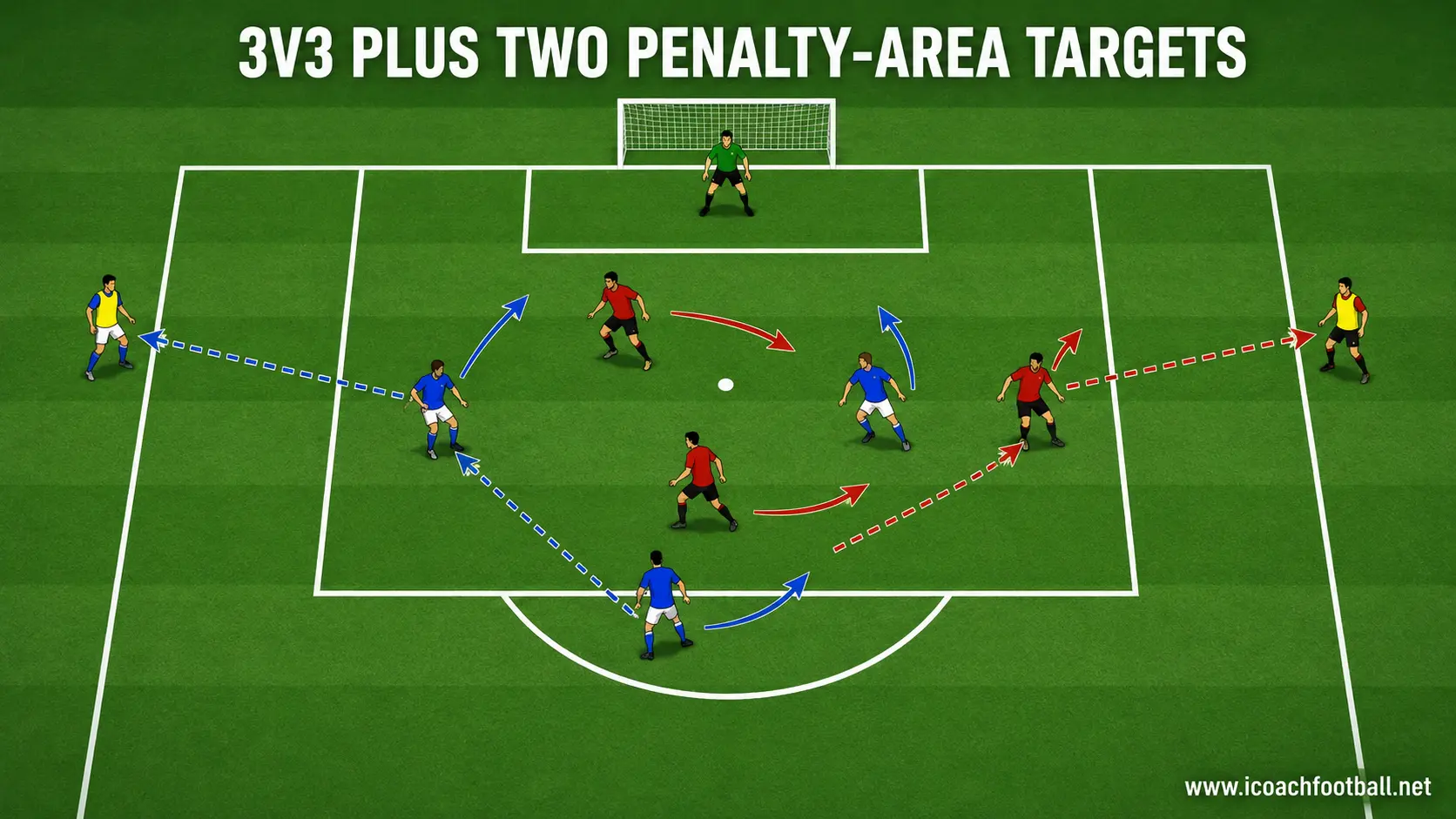
This directional possession game uses the penalty-area boundaries and two target players. The central teams must retain possession, play forward and support the target’s return pass.
Setup
- Use the penalty area as the main playing space.
- Play 3v3 inside the area.
- Position one target player outside each long boundary line.
- The targets remain outside the central playing area.
- Each team attacks one designated target.
- Rotate the target players every two minutes.
How to Play
- Each team attacks its designated target player.
- A point is scored by passing into the target and receiving the return pass.
- The target has a maximum of two touches.
- When possession changes, the new team attacks the opposite target.
- Players must stay within the visible penalty-area boundaries.
- Rotate the target players after each short round.
Coach’s note: Central players should provide width, depth and a supporting option underneath the ball. Avoid having every attacker move directly toward the target.
Progressions: Limit targets to one touch, require a third-player combination after using the target or award two points when the final pass breaks between defenders.
Drill 5: Continuous 3v2 Halfway-Line Attack
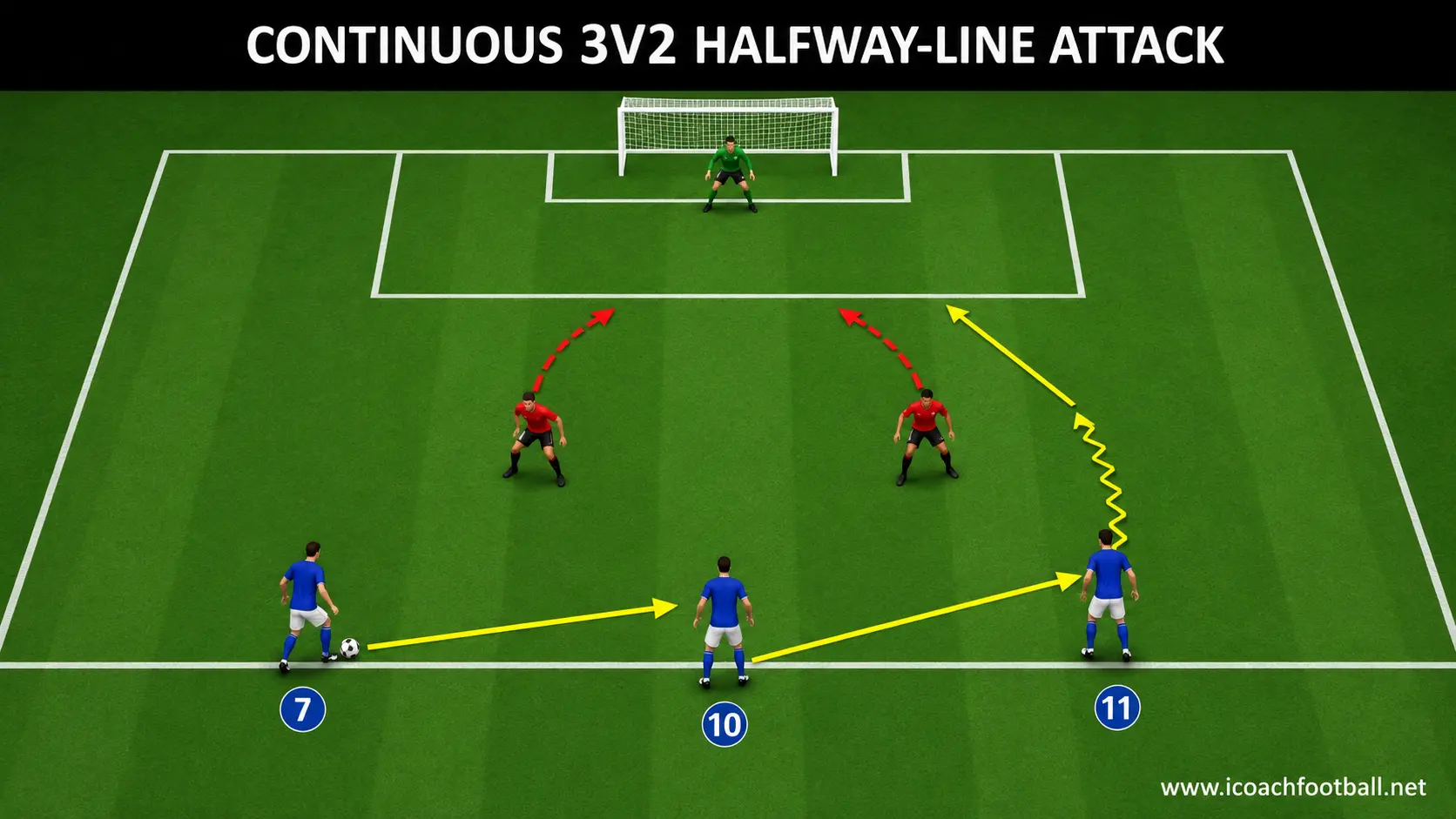
This overload activity uses the halfway line as the starting point and an existing goal as the attacking target. It develops quick attacking decisions, finishing and recovery runs.
Setup
- Use one half of a marked soccer field.
- Three attackers begin on or near the halfway line.
- Two defenders begin between the halfway line and penalty area.
- Use the existing goal as the attacking target.
- A goalkeeper is optional.
- Organize remaining players beside the halfway line.
How to Play
- The three attackers begin with the ball at the halfway line.
- They attempt to combine and score against the two defenders.
- If the defenders win possession, they counter by carrying the ball over the halfway line.
- The attack ends after a goal, counterattack or the ball leaving the field.
- Two attackers become the next defenders.
- A new group of three begins immediately from halfway.
Coach’s note: The attackers should create width and force the two defenders to protect a large area. The player on the ball must recognize when to pass, dribble or delay.
Progressions: Add a recovery defender, introduce an eight-second scoring limit, require a wall pass before finishing or award two points for a first-time finish.
Drill 6: 4v4 Penalty-Area Line-Ball Game
This game uses the goal line and penalty-area line as scoring boundaries. Teams score by carrying the ball across the opposite line under control.
Setup
- Use the full penalty area as the playing field.
- Divide eight players into two teams of four.
- One team attacks the goal line.
- The other team attacks the penalty-area line.
- The side boundaries are the existing penalty-area lines.
- Switch attacking directions after every round.
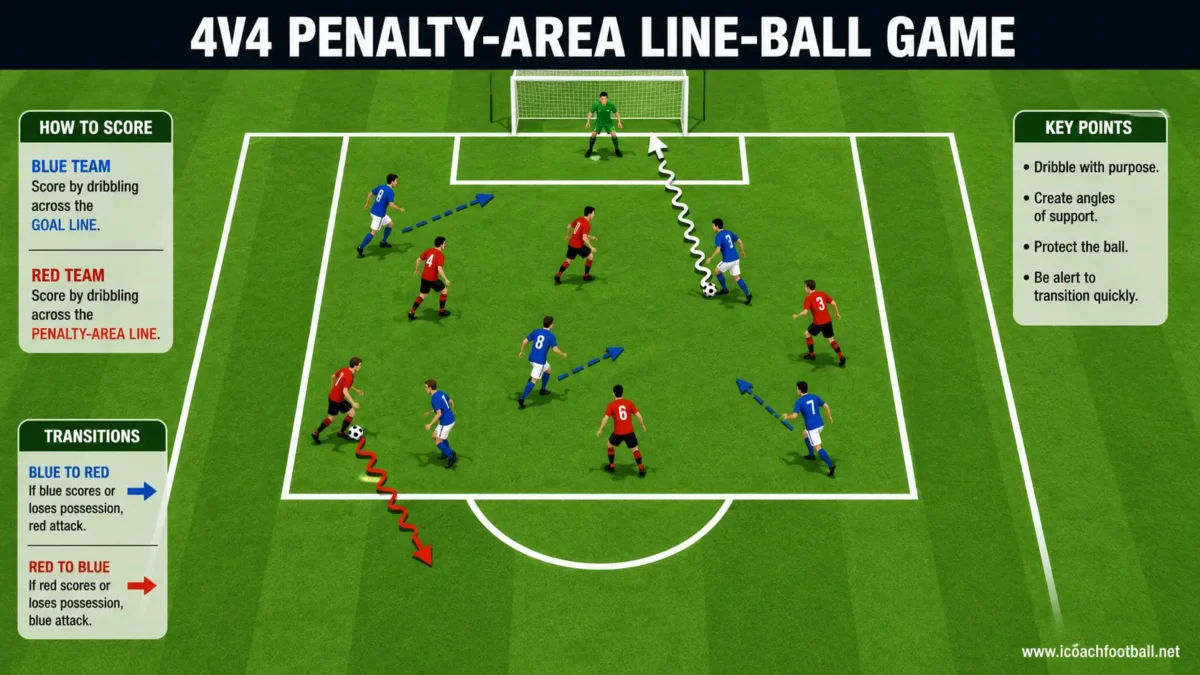
How to Play
- Each team attacks one of the two designated scoring lines.
- A point is scored by dribbling across the line under control.
- The player must keep the ball within playing distance while crossing.
- After scoring, the player leaves the ball for the opposition.
- When possession changes, the new team immediately attacks the other direction.
- Play short rounds of approximately two minutes.
Coach’s note: Players without the ball should create width and supporting angles. After a turnover, the first pass or dribble should move away from pressure.
Progressions: Require a wall pass before scoring, add a five-second transition limit or score by passing across the line to a teammate rather than dribbling.
The FA also recommends line-ball and other small-sided games as adaptable ways to engage players while maintaining a clear learning focus. Read the FA’s guidance on adding variety to sessions.
Drill 7: 4v4 Goal Versus Halfway-Line Game
This directional game gives each team a different scoring objective. One team attacks the existing goal, while the defending team scores by counterattacking across the halfway line.
Setup
- Use one half of a marked soccer field.
- Divide eight players into two teams of four.
- One team attacks the existing goal.
- The other team attacks the halfway line.
- A goalkeeper may be included when available.
- Switch team roles after each round.
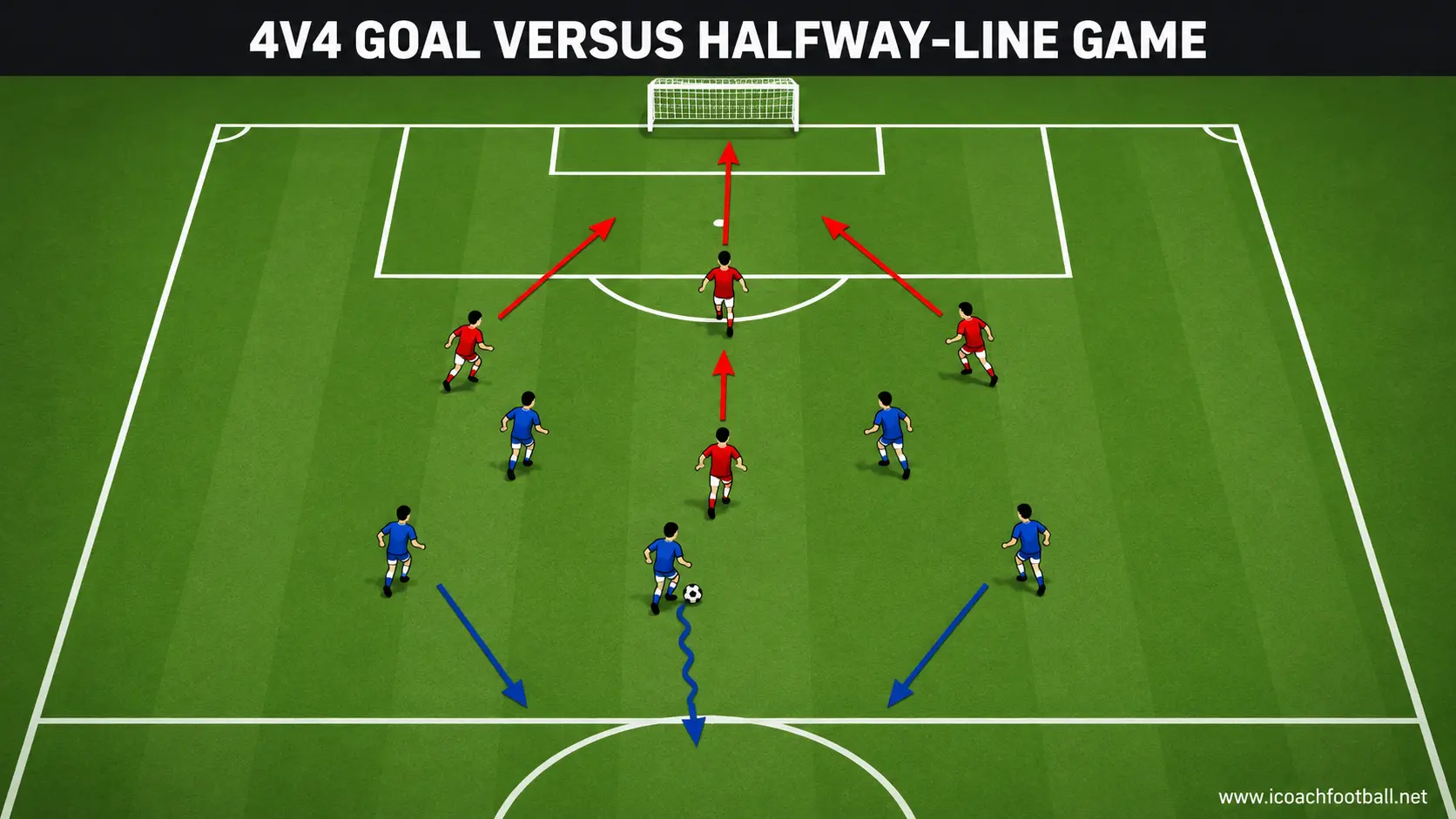
How to Play
- The attacking team attempts to score in the existing goal.
- If the defending team regains possession, it counterattacks toward halfway.
- The defenders score by carrying the ball across the halfway line under control.
- After a goal or successful counterattack, restart from halfway.
- Play rounds of two to three minutes.
- Switch the team roles after every round.
Coach’s note: The attacking team should maintain a supporting player behind the ball. This player can recycle possession and protect against the defensive counterattack.
Progressions: Add a scoring deadline, require a wide combination before shooting or award the defending team two points for crossing halfway within six seconds of regaining possession.
Drill 8: 5v5 Existing-Lines Match
Finish with a competitive match using the permanent boundaries and goals already available. The coach does not need to create additional cone lines or scoring areas.
Setup
- Use an existing marked small-sided field when available.
- Alternatively, use one half or a clearly marked section of the full field.
- Divide 10 players into two teams of five.
- Use existing goals, goal lines or line-ball scoring.
- Use the permanent touchlines as the side boundaries.
- Position substitutes safely outside the playing area.
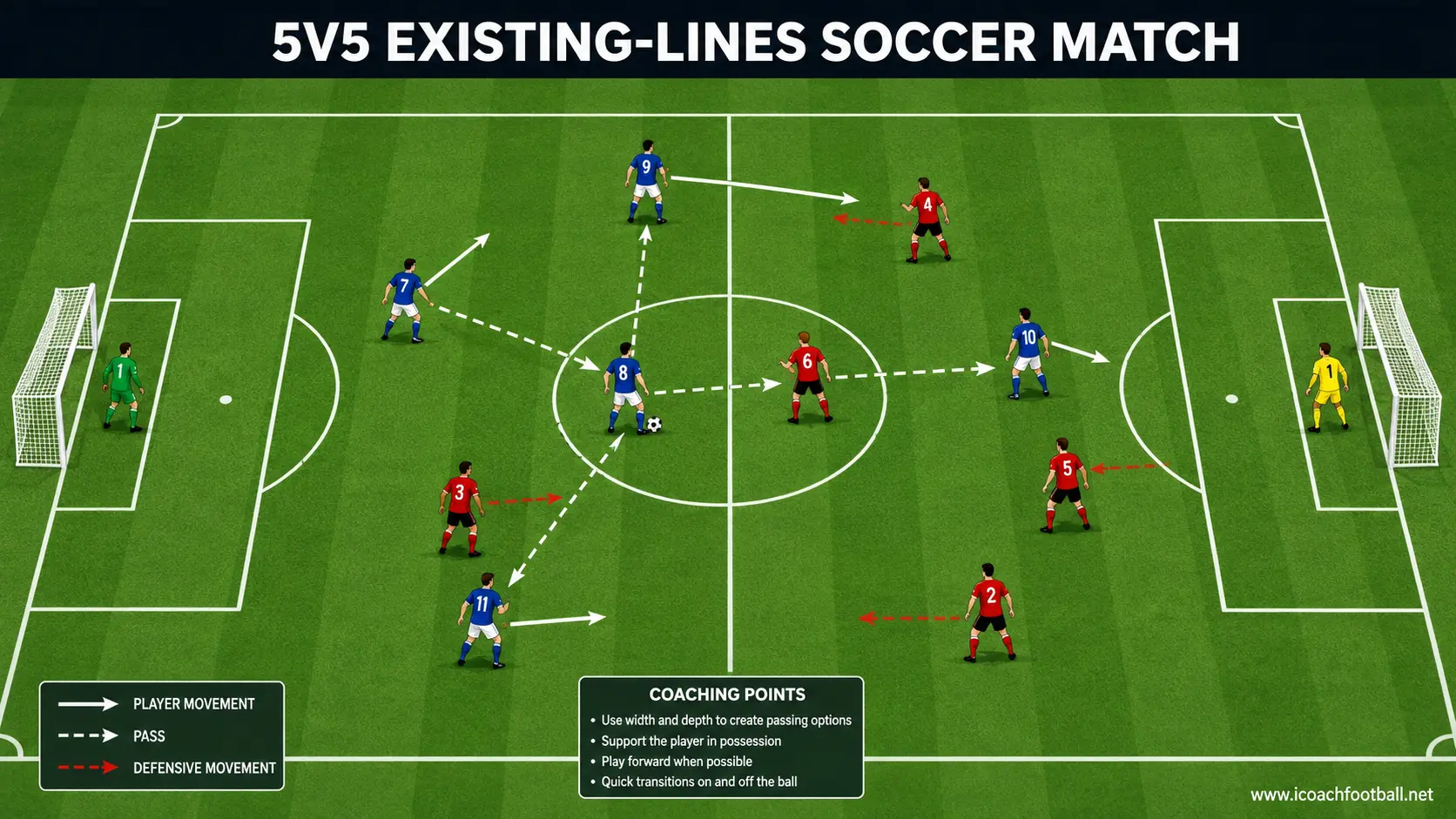
How to Play
- Play normal 5v5 using the selected permanent boundaries.
- Use kick-ins, dribble-ins or throw-ins according to the age group and surface.
- Restart immediately after the ball leaves the field.
- After a goal, the opposition restarts without waiting for the coach.
- Play three rounds of approximately two minutes.
- Keep the total score across every round.
Coach’s note: Allow the players to apply the session’s passing, possession and transition ideas. Avoid stopping the match after every mistake and use short coaching interventions between rounds.
Progressions: Award a bonus goal for completing five passes before scoring, reward goals following a switch of play or give two points for scoring within five seconds of regaining possession.
FIFA describes small-sided games as a flexible coaching tool for integrating technical, tactical and physical development. Read FIFA’s overview of small-sided games.
Find more opposed activities in our small-sided soccer games library.
How to Adapt the Session
When no field markings are available: Use obvious safe boundaries such as a fenced mini pitch or approved sports-court markings. Do not place unsafe personal items on the playing surface.
When you have fewer than eight players: Use 2v2, 3v3 or 3v3 plus one neutral. The centre circle and goal area can provide suitable smaller spaces.
When you have more than 12 players: Use parallel activities in different marked sections or create short games with rapid rotations.
When no goals are available: Use line-ball scoring, target players or controlled receptions beyond a designated pitch line.
Common Mistakes When Training Without Cones
- Using unclear boundaries: Walk players around the active area and explain exactly which permanent lines apply.
- Using dangerous makeshift markers: Avoid bottles, bags, jackets and hard objects that may cause players to trip.
- Selecting an area that is too large: Use smaller existing markings such as the centre circle or penalty area when working with small groups.
- Allowing players to ignore the lines: Stop briefly when necessary and reinforce which markings define the activity.
- Creating long queues: Use passing circuits, possession exercises and small-sided games that involve most players.
- Forcing every drill into the same space: Move between the centre circle, penalty area, halfway line and goals during the session.
- Adding too many verbal rules: Keep the organization simple because there are no visual cone reminders inside the area.
Frequently Asked Questions
Can I run soccer practice without cones?
Yes. Use permanent field markings such as touchlines, the halfway line, centre circle, penalty-area lines and goal lines to organize passing drills, rondos and small-sided games.
What are the best soccer drills without cones?
Effective options include centre-circle rondos, touchline ball mastery, pass-and-follow circles, target-player possession, line-ball games, overload attacks and conditioned matches using existing boundaries.
What can I use instead of cones?
Use safe, permanent pitch or court markings whenever possible. Avoid using bottles, bags, clothing or other loose objects that could become tripping hazards.
How do players know the boundaries without cones?
Walk the group around the playing area before starting and identify the active touchlines, goal lines, halfway line, circle or penalty-area markings.
Can I organize small-sided games without cones?
Yes. Use an existing small-sided pitch, penalty area, half field or another safely marked section. Adjust the team numbers to suit the available space.
How many players can join this no-cones session?
The session works best with approximately 8–12 players. Smaller groups can use 3v3 or 4v4 formats, while larger groups can rotate or use parallel marked areas.
How long should a soccer practice without cones last?
A complete session can last approximately 60 minutes. Use existing markings to move efficiently between technical work, possession games, overloads and competitive play.
Continue the practice-plan series: Save this no-cones session and compare it with our one-ball soccer practice, indoor practice plan and small-space soccer drills.