Soccer Drills for Improving the Diagonal Pass: 6 Games That Split Defences and Switch Play (U11–U17)
Quick answer
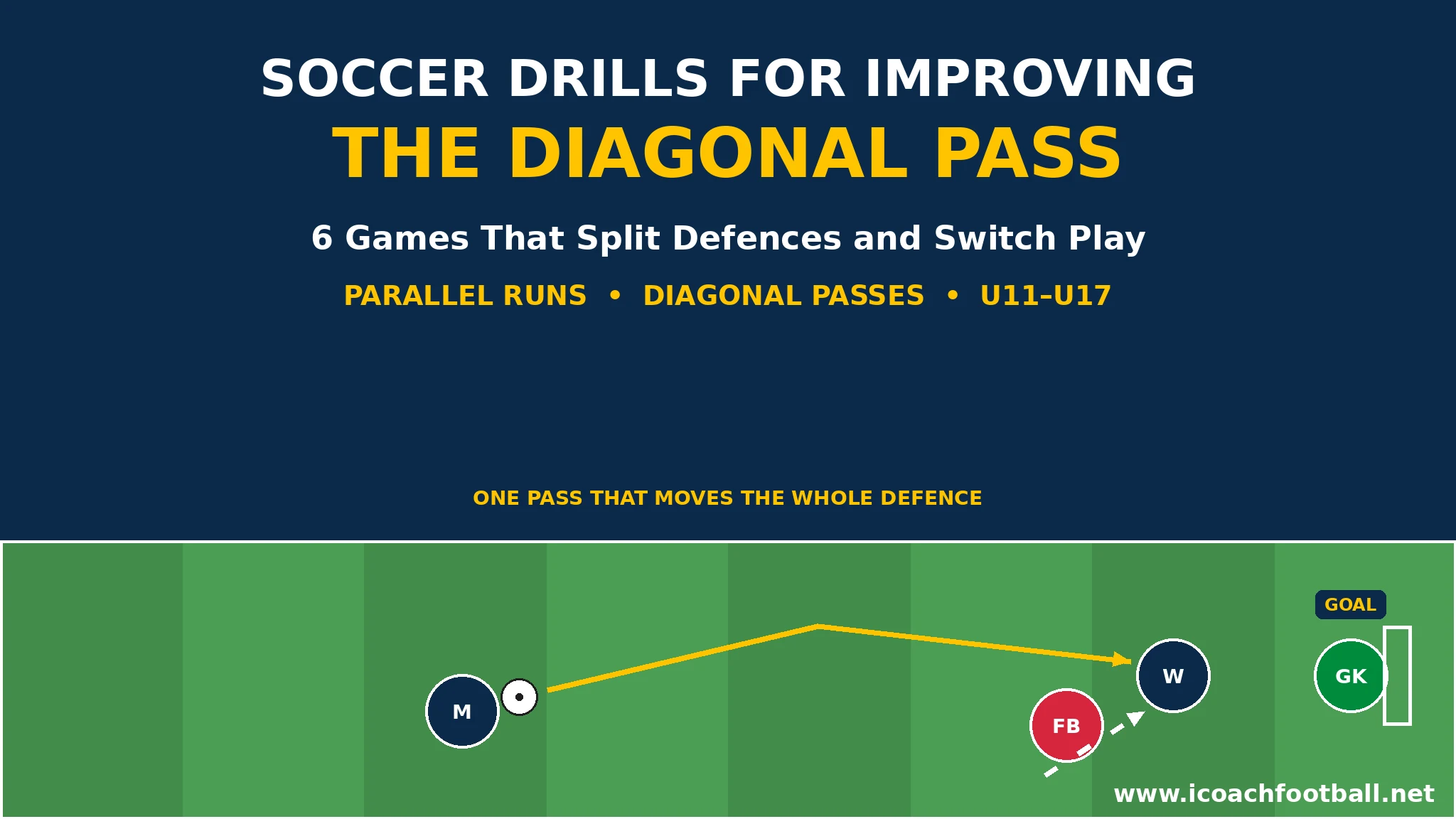
The diagonal pass is the pass that moves a defence. A square pass goes sideways and the defence slides with it; a diagonal pass goes forward and sideways at the same time, so the defence has to turn, run and re-set — and in that moment the space opens. Most youth teams never learn it: they pass sideways, the defence stays set, and every attack runs into a wall. A team that can play diagonally can switch play to the free winger, split a line with a through ball, and find the striker on the blind side of a defender. These six soccer drills for improving the diagonal pass train exactly that: a parallel-movement circuit that grooves the angle, a zone game where only diagonal passes count, a long switch to the far winger, a diagonal through ball in behind the full-back, a receive-and-go-forward drill that starts every diagonal on the back foot, and a full game where a goal after a line-splitting diagonal is worth double.
Suitable for: U11–U17 (ages 10–17)
Session snapshot
- Players: 14–18
- Age: U11–U17 (ages 10–17)
- Area: Half a pitch, with 2 full goals and 2 mini-goals
- Duration: 60 minutes
- Focus: The diagonal pass — parallel movement, weight and angle, receiving on the back foot, the long switch, and the diagonal through ball in behind
- Equipment: 14 balls, 24 cones, bibs, 2 full goals, 2 mini-goals
Why these six games work
Most attacks die the same way. The ball goes sideways, the defence slides across in a line, and nobody ever plays the pass that changes the picture. The diagonal pass is the pass that changes the picture — it travels forward and across at once, so it beats the first defender, finds a team-mate in space, and forces the whole defensive line to turn and run.
The first two drills fix the angle: a parallel-movement circuit that teaches the passer and the receiver to move together so the diagonal lane opens, then a zone game where only diagonal passes count, so the players stop playing square balls out of habit. The next two drills fix the two diagonals that win matches: the long switch to the far winger, and the diagonal through ball played in behind the full-back to a striker running on the defender’s blind side. The fifth drill fixes the reception — a diagonal pass is only as good as the first touch that follows it, and that touch has to be taken side-on, on the back foot, facing forward. The last drill puts it all into a game where a goal after a line-splitting diagonal is worth double.
The drills are grounded in the FIFA/UEFA coaching community. Drills 1, 2, 4 and 6 are based on / in line with the FIFA Training Centre session “Diagonal and vertical passing”, in which FIFA Technical Expert Anouschka Bernhard delivers a series of vertical and diagonal passing exercises: a passing circuit that gets players to pass and move diagonally, a zone-passing exercise in which players play diagonal passes into zones that team-mates are running into, a 6v6 plus 6 small-sided game with four mini-goals, and a final diagonal passing game — with the key coaching points that well-timed and parallel movements are essential for playing successful diagonal passes, that players should step or pull away from defenders to create diagonal passing lanes, that horizontal passes can slow down attacks and make things too predictable, and that players should penetrate the defensive line by making vertical and diagonal runs on the blind side of defenders. Drills 3 and 5 are based on / in line with England Football Learning’s receiving session “Receiving to play forward in central areas”, in which the receiver makes an in-and-out movement off a cone, receives the ball on their back foot, and plays it to a wide player — and whose progressions ask for a longer diagonal ball to one of the wide players, and for the receiver to control the ball with their back to the goal before playing a one-two. In the UK the same session is football drills for improving the diagonal pass — the angle, the weight and the movement are identical.
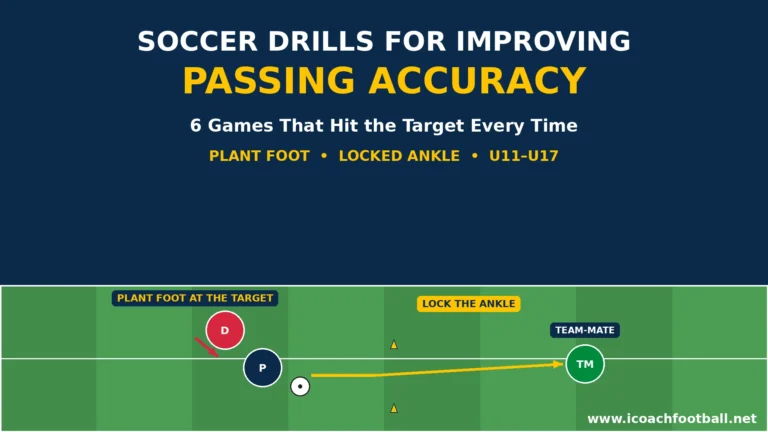
The diagonal pass is also the pass that starts the next action. Our soccer drills for improving passing accuracy train the weight and the plant foot every diagonal needs, and our soccer through ball drills train the through ball that a diagonal run creates.
Six rules of the diagonal pass
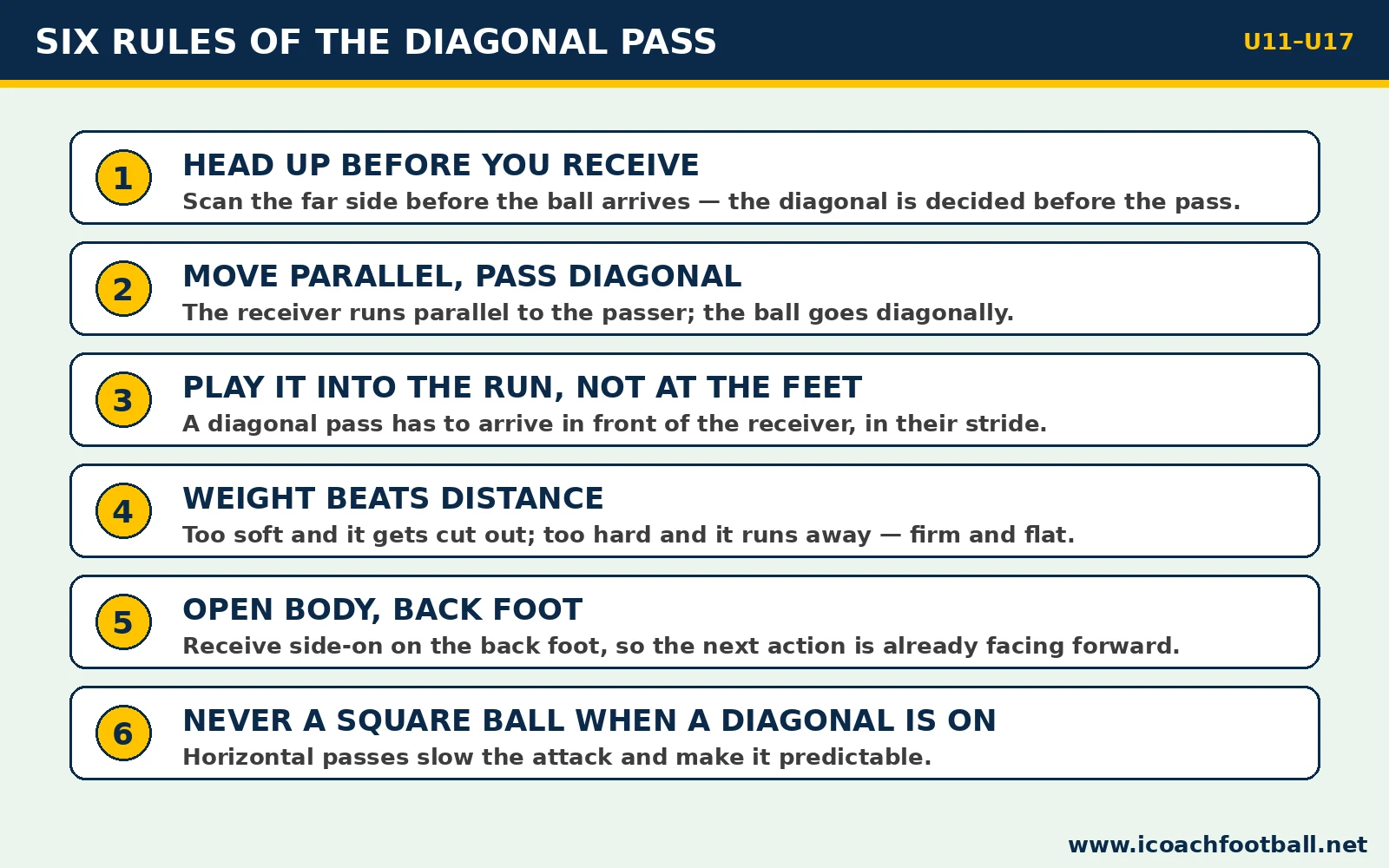
- Head up before you receive. Scan the far side before the ball arrives — the diagonal is decided before the pass, not after it.
- Move parallel, pass diagonal. The receiver runs parallel to the passer; the ball goes diagonally.
- Play it into the run, not at the feet. A diagonal pass has to arrive in front of the receiver, in their stride.
- Weight beats distance. Too soft and it gets cut out; too hard and it runs away — firm and flat along the ground, or driven and lofted when it has to travel.
- Open body, back foot. Receive side-on on the back foot, so the next action is already facing forward.
- Never a square ball when a diagonal is on. Horizontal passes slow the attack and make it predictable — the diagonal is the pass that moves the defence.
Drill 1 — The Parallel Circuit
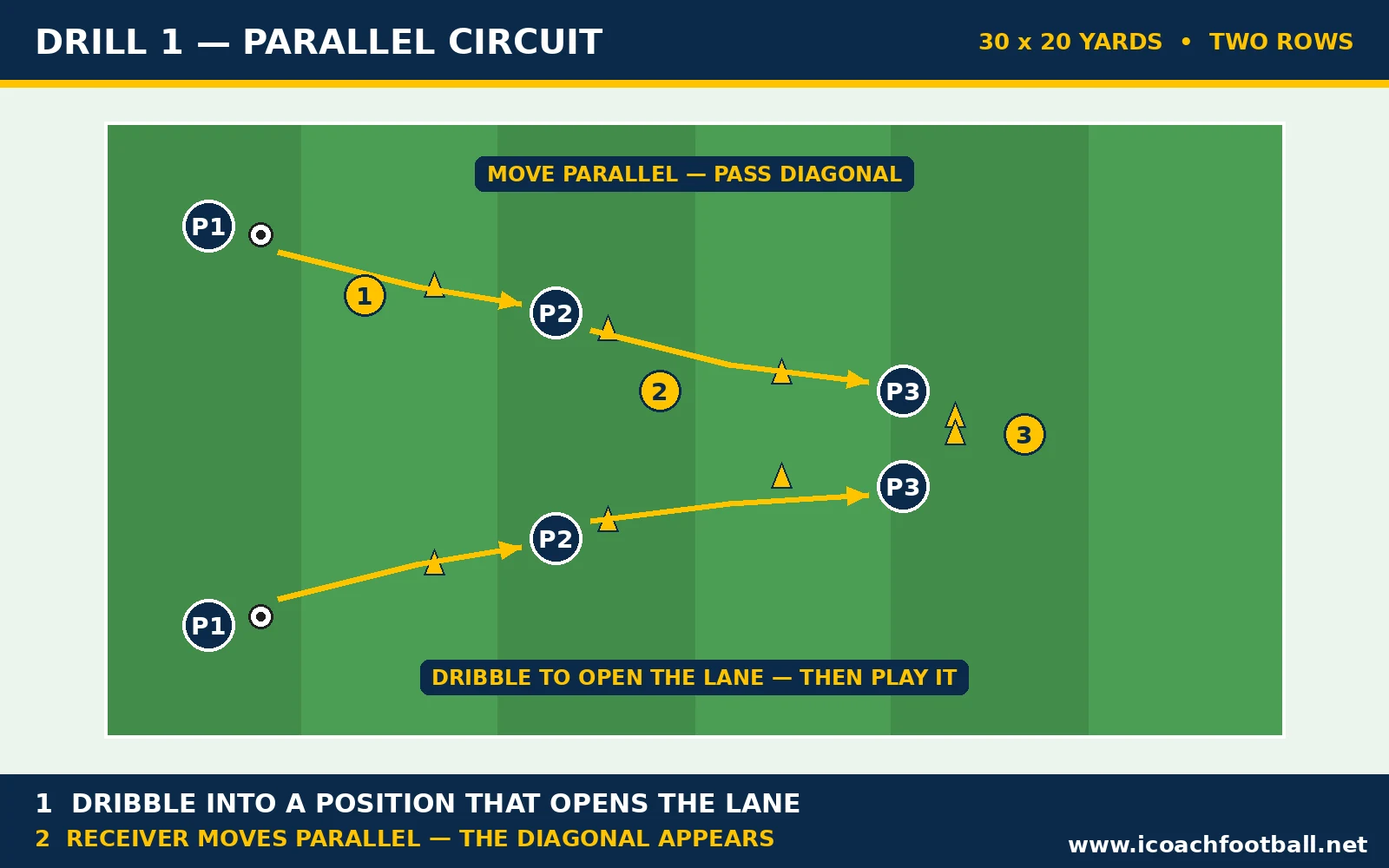
The angle drill — two rows of cones where the passer dribbles to open a lane and the receiver moves parallel to meet a diagonal pass, in line with FIFA’s first part: dribbling and running parallel to one another helps to facilitate diagonal passes between players.
Setup
- Area 30 yards by 20 yards, two identical rows of cones 5 yards apart, 1 ball per pair.
- 8 minutes, then swap rows and run it the other way.
How to Play
- The player at the top of each row dribbles into a position that opens a passing lane between the two blue cones.
- The player at the yellow cone moves into the space, so they arrive parallel to the second blue cone.
- As the receiver arrives in the space, the passer plays a diagonal pass to them.
- The receiver takes the ball in stride and dribbles to open the next passing lane.
- The next player in the row moves into the space and receives the next diagonal pass.
- The sequence repeats down the row, then both rows swap sides and run it the other way.
Coach’s note: “The pass is easy once the movement is right. If the receiver stands still and waits for it, the lane never opens — move parallel first, and the diagonal appears by itself.”
Progressions: Play the diagonal first-time, with no touch to settle it; the receiver must take the ball on the move and play the next diagonal within two touches; add a defender in the middle of each row, so the lane has to be opened against pressure.
Drill 2 — Diagonal Zones
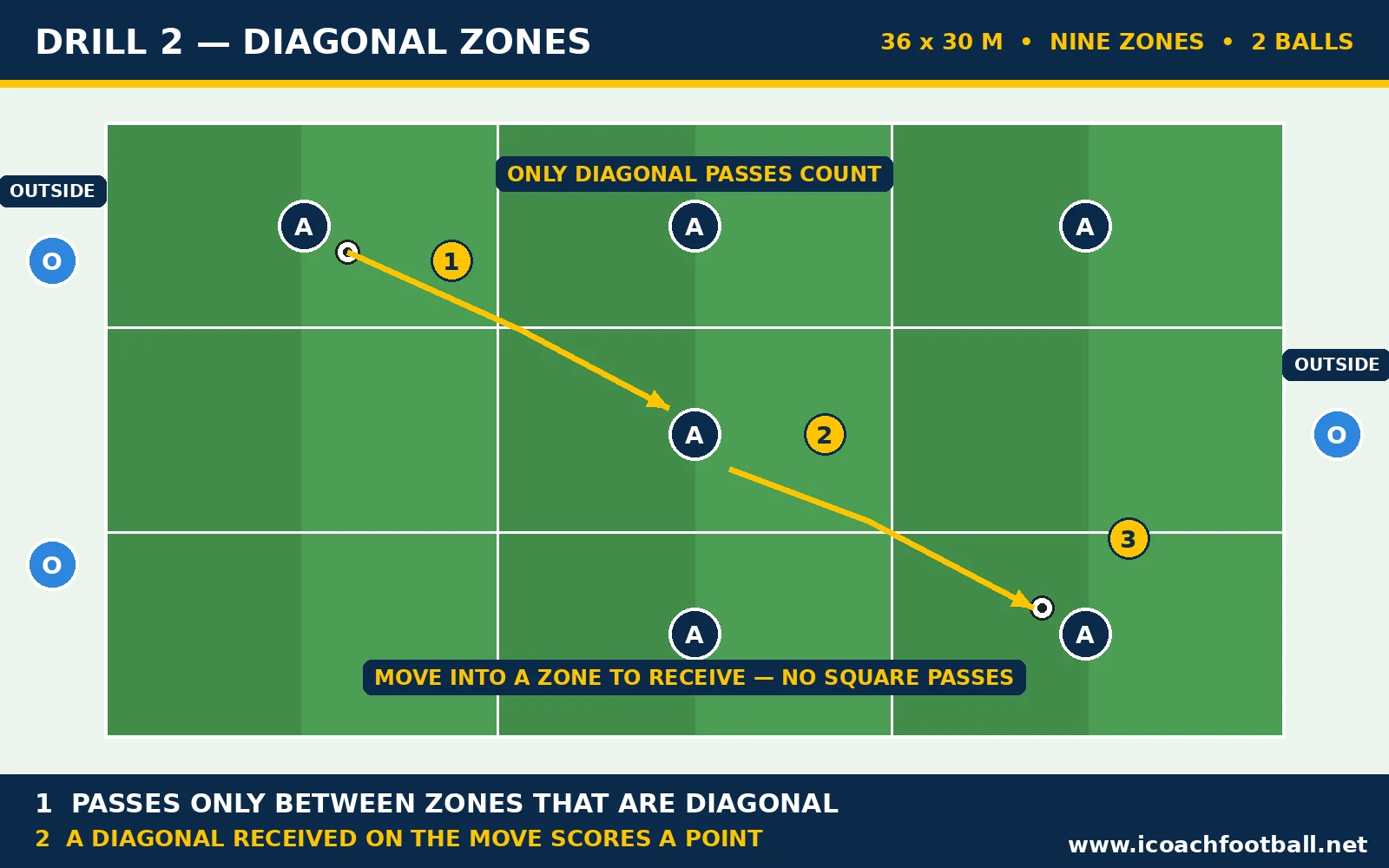
The decision drill — a nine-zone game where only diagonal passes count, so the players stop playing square balls out of habit, in line with FIFA’s second part: players pass to team-mates in zones diagonal to them, and players without the ball move into zones to make themselves available.
Setup
- Area 36 metres by 30 metres divided into nine equal zones, two teams, 2 balls per team, 3 outside players per team.
- 10 minutes, then swap the outside players.
How to Play
- Two teams spread across the nine zones, one player per zone where possible, with three outside players around the area.
- Each team keeps its two balls moving with passes between zones.
- Passes are only allowed between zones that are diagonal to each other — no square passes.
- Players without the ball move into a zone to make themselves available for a diagonal pass.
- When a pass goes to an outside player, that player enters the area and swaps places with the passer.
- After four minutes, add a point for every diagonal pass received on the move — the team with the most points wins.
Coach’s note: “Watch how many square passes they try to sneak in during the first minute. That is the habit you are breaking — the diagonal is not the fancy option, it is the only option in this game, and by the end they will be looking for it first.”
Progressions: Only diagonal passes played while on the move count for a point; one ball per team, so every pass matters; add a defender per team who can win the ball and score in a mini-goal.
Drill 3 — The Diagonal Switch
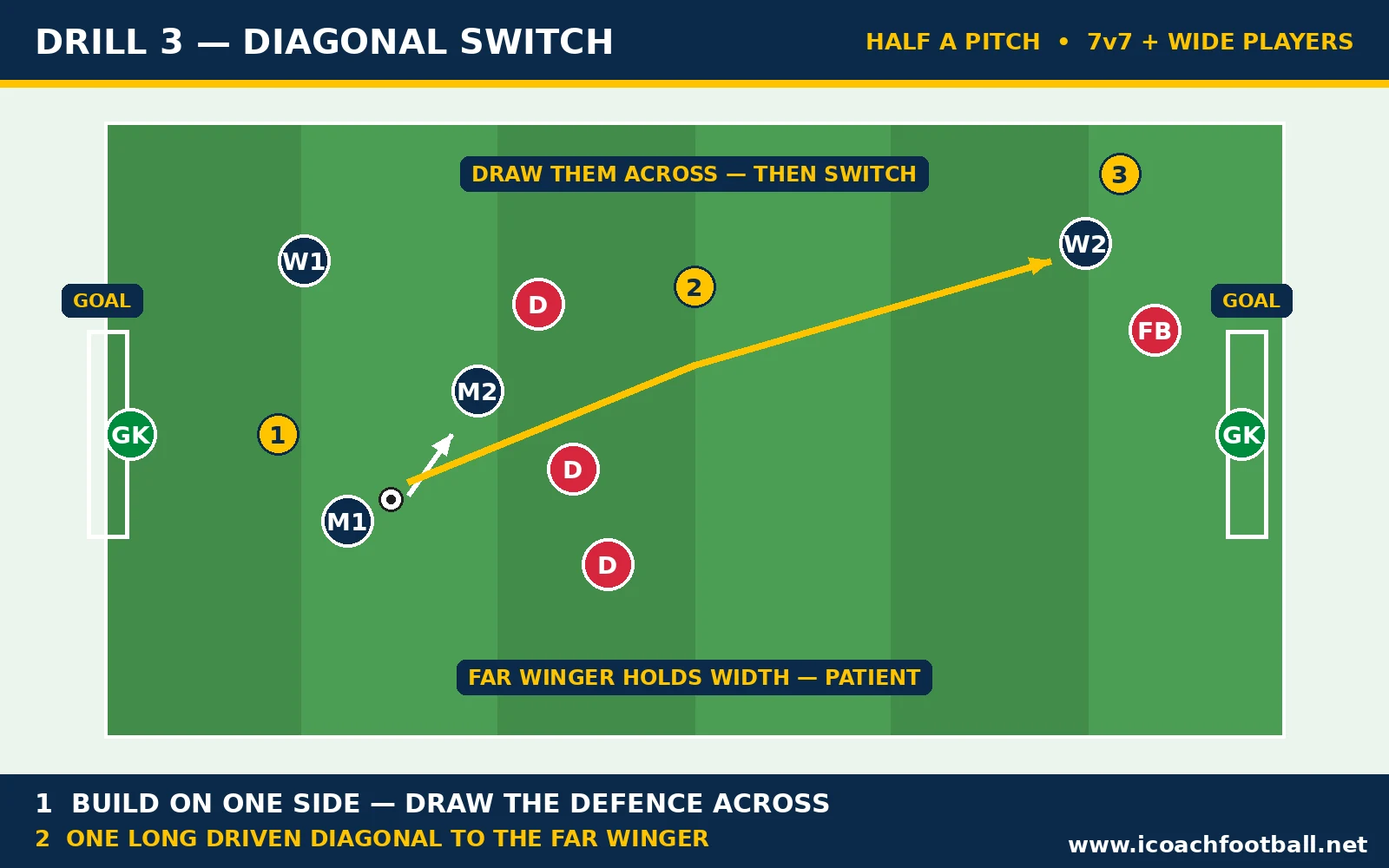
The switch drill — build on one side to draw the defence across, then play one long driven diagonal to the far winger, in line with England Football’s receiving session: the progression asks for a longer diagonal ball to one of the wide players while the receiver moves to receive the next pass.
Setup
- Area half a pitch, 2 full goals with goalkeepers, 7v7 plus 2 wide players per team.
- 12 minutes, then swap the wide players.
How to Play
- The team in possession builds on one side, drawing the defenders across toward the ball.
- The wide player on the far side holds their width and stays patient until the switch comes.
- The midfielder scans the far side, then plays a driven diagonal across the pitch to the far winger.
- The winger receives on the back foot, facing into the pitch, and drives at the full-back.
- The winger crosses or cuts inside, and the midfielders arrive in the box to finish.
- If the defence wins the ball, they counter to the mini-goals — then the other team builds and switches the other way.
Coach’s note: “The switch is not a hopeful punt. It is a pass played to a winger who has held their width for ten seconds — if the winger has drifted inside, there is nothing to switch to, so coach the patience first and the pass second.”
Progressions: The switch must be played first-time, so the passer has to be set before receiving; the far winger must take one touch forward and cross, so the attack is over in seconds; the defending team may send one player to press the switch, so the pass has to be driven, not lofted and slow.
Drill 4 — Diagonal In Behind
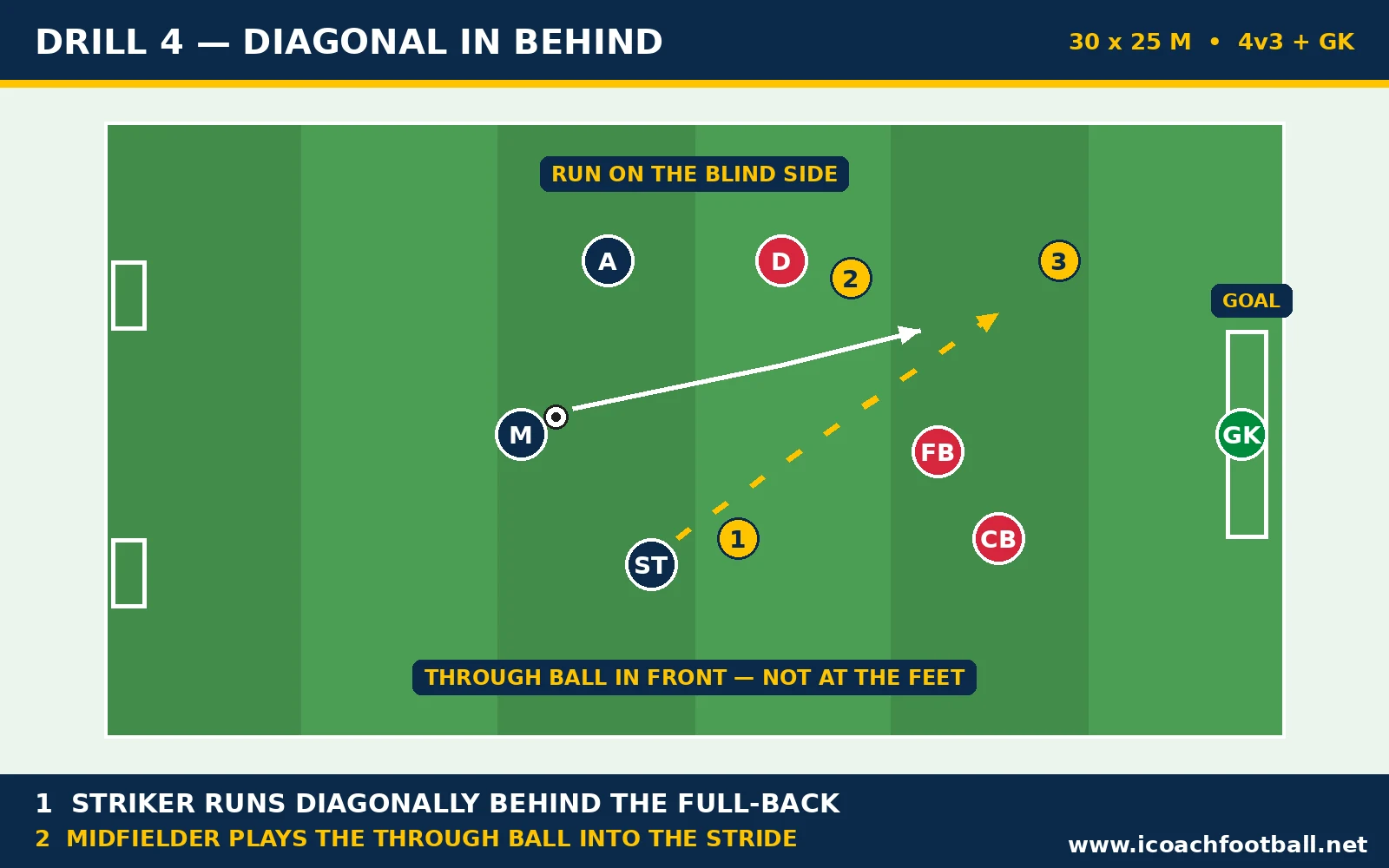
The through-ball drill — a striker makes a diagonal run on the blind side of a defender and the midfielder plays the diagonal through ball into their stride, in line with FIFA: penetrate the defensive line by making vertical and diagonal runs on the blind side of defenders.
Setup
- Area 30 metres by 25 metres, 1 full goal with a goalkeeper, 4 attackers against 3 defenders.
- 10 minutes, then swap the defending three.
How to Play
- The midfielder starts with the ball in the middle third, facing the defence.
- The striker makes a diagonal run on the blind side of the nearest defender, toward the space behind the full-back.
- The midfielder plays a diagonal through ball into the striker’s run, in front of them, not at their feet.
- The striker receives in stride and attacks the goal, with one touch to finish.
- If the through ball is cut out, the defenders play out to the mini-goals and the roles swap.
- After every rep the striker and the midfielder swap roles, so everyone practises both the run and the pass.
Coach’s note: “The run makes the pass, not the other way round. If the striker runs straight, the defender sees it coming — the diagonal run on the blind side is what opens the lane, and the pass only has to be firm and in front.”
Progressions: The striker must time the run to stay onside, so the pass can only be played after the run starts; the defender is allowed to step out and cut the lane, so the pass has to be disguised; a second striker makes the opposite diagonal run, so the midfielder must choose which lane to play.
Drill 5 — Receive and Go Forward
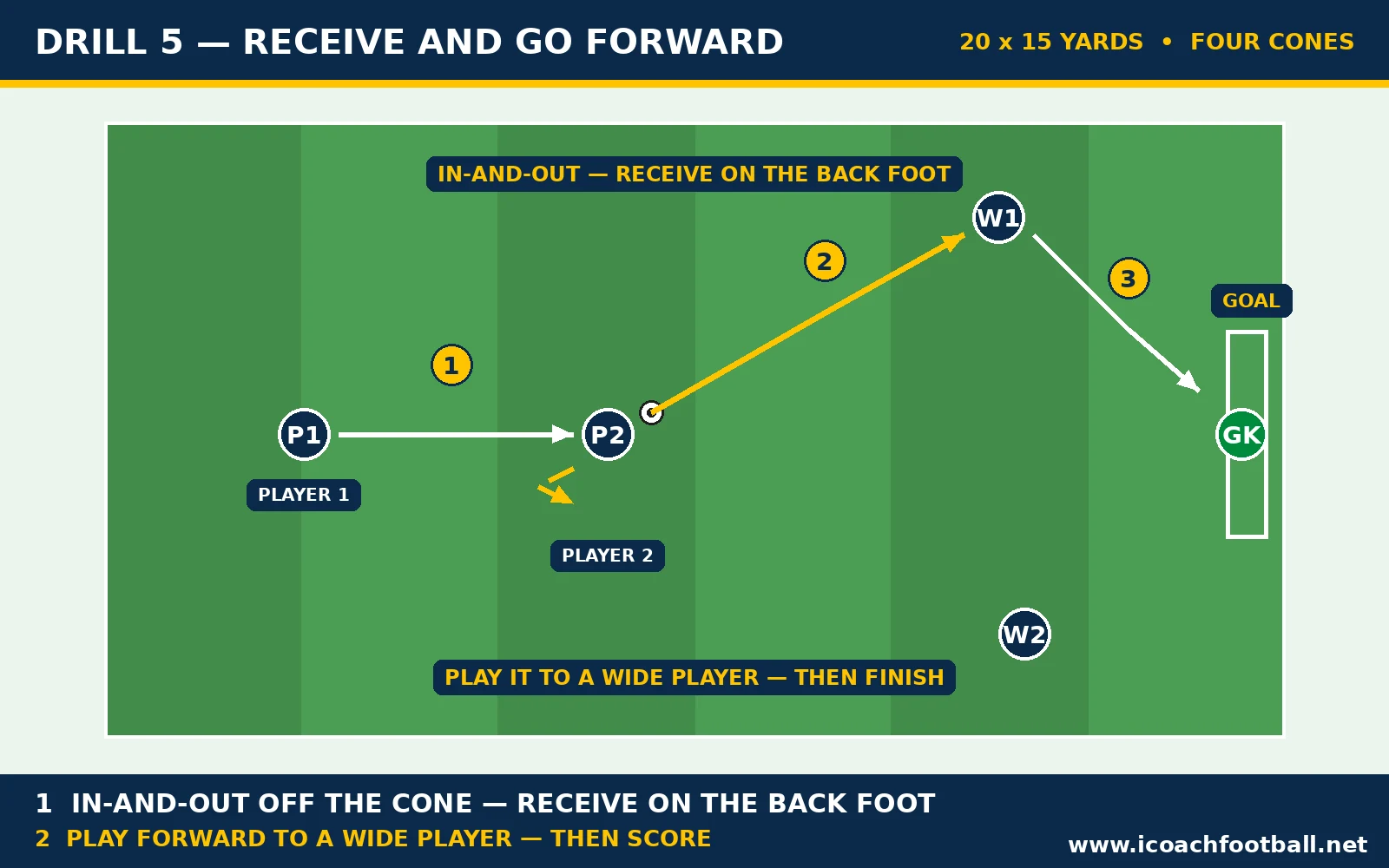
The reception drill — the receiver makes an in-and-out movement, receives on the back foot and plays forward to a wide player, in line with England Football’s receiving session: player two makes an in-and-out movement away from the cone, moves into the space to receive the ball on their back foot, and plays it to one of the wide players.
Setup
- Area 20 yards by 15 yards, 1 goal, 4 players on cones (1, 2, 3, 4), set up parallel pitches if numbers allow.
- 10 minutes, then rotate the starting positions.
How to Play
- Player one passes the ball into the space to the side of player two’s cone.
- Player two makes an in-and-out movement off the cone, then receives on the back foot.
- Player two plays the ball to one of the wide players, high and wide.
- The wide player makes the same in-and-out movement off their cone, receives, and tries to score.
- Players rotate around the starting positions and the activity starts again.
- Progress it: player two receives with their back to goal and plays a one-two with player one, or player one plays a longer diagonal ball to a wide player while player two moves to receive and shoot.
Coach’s note: “The back foot is the whole drill. If player two receives on their front foot, they are facing their own goal and the attack dies — open the body, take it on the back foot, and the next pass is already facing forward.”
Progressions: The cones become defenders, so the in-and-out movement has to beat a real marker; the wide players must finish first-time, so the pass has to be weighted perfectly; play it opposed, 3v2 with a goalkeeper, so the receive-and-go-forward has to survive pressure.
Drill 6 — The Diagonal Game
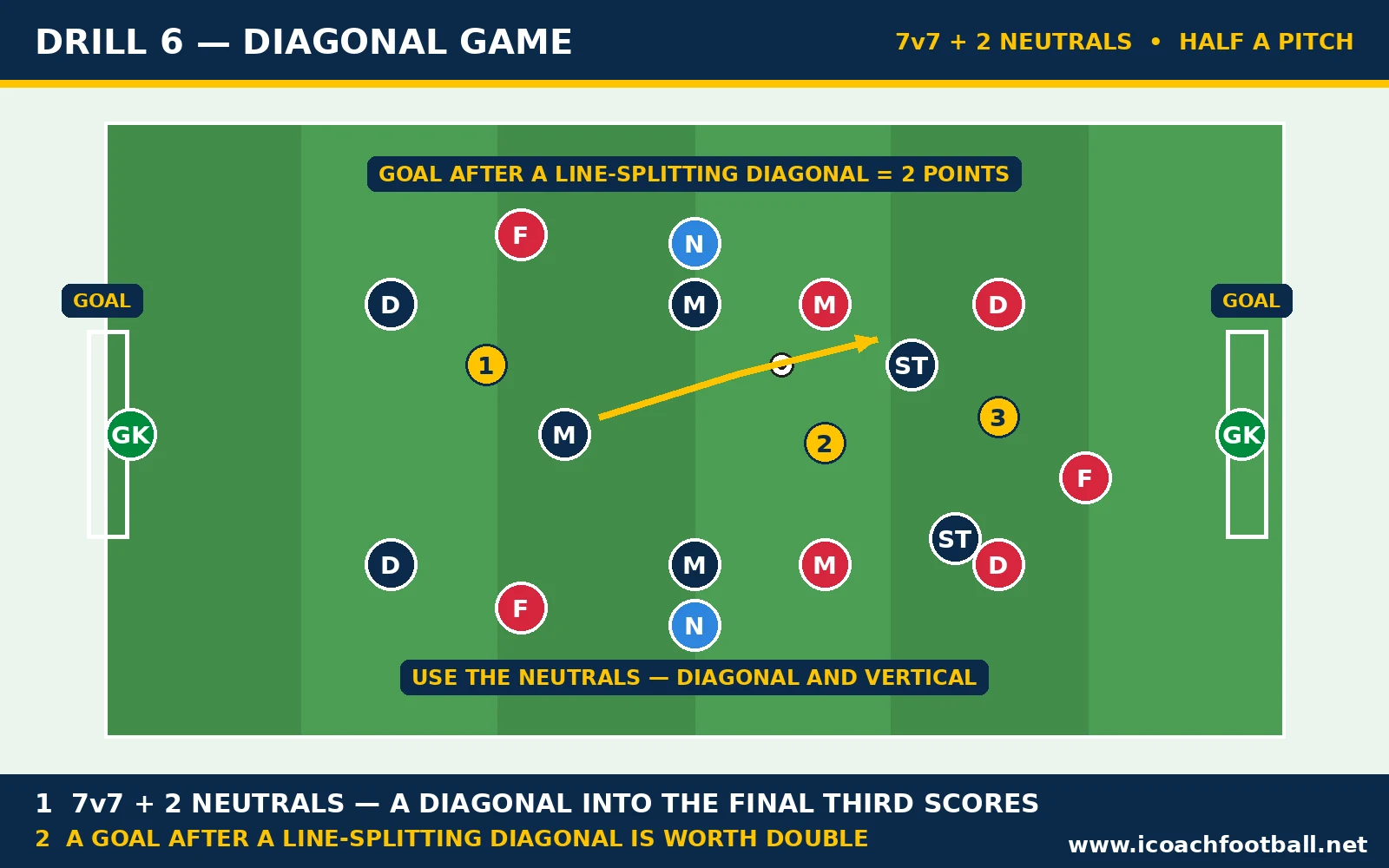
The full game. A 7v7 where a goal scored after a diagonal pass that split a line is worth double, so the diagonal becomes the most valuable pass on the pitch, in line with FIFA’s final game phase: players must create diagonal passing angles and make vertical runs to facilitate the passes.
Setup
- Half a pitch, 2 full goals with goalkeepers, 7v7 plus 2 neutrals.
- 12 minutes.
How to Play
- Two teams play 7v7 on half a pitch, with two neutral players who always play with the team in possession.
- A goal counts one point — but a goal scored after a diagonal pass that split a line counts double.
- The team in possession must use the neutrals with diagonal and vertical passes to find the overload.
- A diagonal pass that moves the ball into the final third earns the team a point, even if the attack breaks down.
- If the defending team wins the ball, they counter to the goal at the other end.
- Play for three minutes, then rotate the neutrals — the team with the most points after 12 minutes wins.
Coach’s note: “Double points for a goal after a diagonal is not a gimmick — it is permission. Most players never play the diagonal because they are afraid of losing it; the points tell them the club wants them to try it.”
Progressions: Only goals after a diagonal pass count in the final three minutes; the neutrals may only play diagonal passes, so every attack has to go through an angle; the goalkeepers must distribute with a diagonal pass, so the next attack starts with the pass this session is about.
Coaching points
- Head up before you receive. Scan the far side before the ball arrives — the diagonal is decided before the pass, not after it.
- Move parallel, pass diagonal. The receiver runs parallel to the passer; the ball goes diagonally.
- Play it into the run, not at the feet. A diagonal pass has to arrive in front of the receiver, in their stride.
- Weight beats distance. Too soft and it gets cut out; too hard and it runs away — firm and flat, or driven and lofted when it has to travel.
- Open body, back foot. Receive side-on on the back foot, so the next action is already facing forward.
- Never a square ball when a diagonal is on. Horizontal passes slow the attack and make it predictable — the diagonal is the pass that moves the defence.
Common mistakes
| Mistake | Fix |
|---|---|
| Passing square out of habit, so the defence slides across and nothing changes | Only diagonal passes count — Drill 2 breaks the habit in ten minutes |
| Playing the diagonal at the receiver’s feet, so they have to stop and the defender catches up | Play it into the run, in front of the receiver — Drill 1 only counts the rep if the receiver takes it in stride |
| Under-hitting the long switch, so it gets cut out in the middle of the pitch | Drive it, don’t loft it — Drill 3 only counts the switch if the winger receives it cleanly |
| Receiving on the front foot, facing their own goal, so the attack dies | Open body, back foot — Drill 5 stops the rep if the receiver faces backwards |
| Running straight instead of diagonally, so the defender sees the run coming | Run on the blind side — Drill 4 only counts the through ball if the run was diagonal |
| Playing the diagonal with no scan, so the pass goes to a marked player | Head up before you receive — Drill 3 only counts the switch if the midfielder scanned first |
Age adaptations
| Age | Format | What changes |
|---|---|---|
| U11–U12 (ages 10–12) | Small areas, size 4 ball, short diagonals of 10–15 yards, cones as targets | All six drills run shorter and slower — 10–15 yard diagonals, not 30 — because the passing range is not there yet and the angle is the lesson. Drill 1 runs with the coach calling the parallel movement, Drill 2 uses one ball and six zones, and Drill 3 plays the switch as a lofted pass the winger can control, not a driven one |
| U13–U14 (ages 12–14) | Full areas, size 4 ball, diagonals of 20–30 yards, players call their own lane from the second round | All six drills run as written, with the players calling their own diagonal lane from the second round. Drill 2 adds the point for a diagonal received on the move, Drill 4 adds the offside timing, and Drill 6 adds the double points for a goal after a diagonal. Players keep a simple count — “four diagonals, two in behind” is the habit that sticks |
| U15–U17 (ages 14–17) | Full areas, size 5 ball, full pressure from the first rep, defenders allowed to cut the lane | Full pressure from the start. Drill 1 runs with a defender in each row, Drill 3 requires the switch first-time, and Drill 6 plays with the neutrals only allowed diagonal passes. Players are asked to call the trigger before each rep — “far side free, switch!” — so the decision becomes a conscious skill, not a lucky guess |
60-minute session plan
| Block | Time | Content |
|---|---|---|
| Arrival game | 0:00–0:05 | Parallel circuit warm-up — dribble and play a diagonal in pairs, weak foot every third rep |
| The parallel circuit | 0:05–0:13 | Drill 1 — The Parallel Circuit |
| Diagonal zones | 0:13–0:23 | Drill 2 — Diagonal Zones |
| The diagonal switch | 0:23–0:32 | Drill 3 — The Diagonal Switch |
| Diagonal in behind | 0:32–0:41 | Drill 4 — Diagonal In Behind |
| Receive and go forward | 0:41–0:50 | Drill 5 — Receive and Go Forward |
| The diagonal game | 0:50–1:00 | Drill 6 — The Diagonal Game |
Keep building from here
The weight and the plant foot every diagonal needs are our soccer drills for improving passing accuracy, and the same pass under a pressing defender is our soccer drills for improving passing under pressure. The through ball that a diagonal run creates is our soccer through ball drills, and the run between the lines that a diagonal pass finds is our football playing between the lines drills. The midfield rotation that opens the diagonal lane is our soccer drills for improving midfield rotation, and the scan that spots the far side before the ball arrives is our soccer scanning drills. The first touch that sets the diagonal is our soccer drills for receiving under pressure, and the decision of when to play it and when to keep it is our soccer decision making drills. The movement off the ball that creates the lane is our soccer drills for improving off-the-ball movement, and the third-man run that follows a diagonal is our soccer third man runs drills. The overlap that the switch creates on the far side is our soccer overlap underlap drills, and the team tactic the diagonal switch serves is our 4 progressive drills to coach switching the play. The diagonal in behind a high line is our soccer drills for improving attacking against a high defensive line. The diagonal pass is high-repetition, high-intensity work — plan the week’s load with our training load calculator.
FAQ
What is a diagonal pass in soccer?
A diagonal pass is a pass played at an angle across the pitch — forward and sideways at the same time. It beats the first defender, finds a team-mate in space, and forces the whole defensive line to turn and run. A square pass goes sideways and the defence slides with it; a diagonal pass changes the picture. Drill 1 grooves the angle with a parallel-movement circuit, and Drill 2 only allows diagonal passes, so the players learn the difference by playing it.
When should a player play a diagonal pass instead of a square pass?
Play the diagonal when the defence has shifted to one side, when a team-mate is free on the far side, or when the lane in behind the full-back is open. Do not play it when the lane is blocked and the pass would go straight to a defender, or when a shorter forward pass keeps the attack moving. FIFA’s coaching point is the rule: horizontal passes slow down attacks and make things too predictable, so the diagonal is the pass that moves the defence. Drill 6 rewards it directly — a goal after a line-splitting diagonal is worth double.
How do you coach the weight of a diagonal pass?
Start short and flat: a 10–15 yard diagonal along the ground, firm enough to arrive in the receiver’s stride. Only add distance when the weight holds — a soft switch gets cut out in the middle of the pitch, and a hard one runs away from the winger. For the long switch, drive the ball with the laces or loft it with the inside of the foot, and aim in front of the receiver, not at their feet. Drill 3 only counts the switch if the winger receives it cleanly, so the weight is practised, not guessed.
How do you teach players to receive a diagonal pass?
Open the body and take it on the back foot — the foot furthest from the direction the ball came from — so the next action is already facing forward. Scan before the ball arrives: the receiver should know where the far side is and where the next pass is going before the first touch. Drill 5 trains exactly this: an in-and-out movement off a cone, a back-foot receive, and a forward pass to a wide player, in line with England Football’s receiving session.
How do you coach the diagonal pass to U11s?
Start shorter — 10–15 yard diagonals, not 30 — with a size 4 ball, and make the angle the lesson, not the distance. Use cones as targets the pass has to split, call the parallel movement for them until it is automatic, and count completed diagonals instead of goals. Drill 1 runs at walking pace for U11s with the coach calling the movement, Drill 2 uses one ball and six zones, and Drill 3 plays the switch as a lofted pass the winger can control, not a driven one.
Sources
- FIFA Training Centre. “Diagonal and vertical passing (Bernhard)” — FIFA Technical Expert Anouschka Bernhard’s session on vertical and diagonal passing: a passing circuit that gets players to pass and move diagonally, a zone-passing exercise in which players play diagonal passes into zones that team-mates are running into, a 6v6 plus 6 small-sided game with four mini-goals, and a final diagonal passing game — with the key coaching points that well-timed and parallel movements are essential for playing successful diagonal passes, that players should step or pull away from defenders to create diagonal passing lanes, that horizontal passes can slow down attacks and make things too predictable, and that players should penetrate the defensive line by making vertical and diagonal runs on the blind side of defenders. Verified live 2026-11-22 (HTTP 200, full text read). Drills 1, 2, 4 and 6 are based on / in line with this session.
- England Football Learning. “Receiving session: receiving to play forward in central areas” — The FA’s receiving session: the receiver makes an in-and-out movement off a cone, moves into the space to receive the ball on their back foot, and plays it to a wide player; its progressions ask for a longer diagonal ball to one of the wide players, and for the receiver to control the ball with their back to the goal before playing a one-two. Verified live 2026-11-22 (HTTP 200, full text read). Drills 3 and 5 are based on / in line with this session.