Soccer Drills for Improving Passing Accuracy: 6 Games That Hit the Target Every Time (U11–U17)
Quick answer
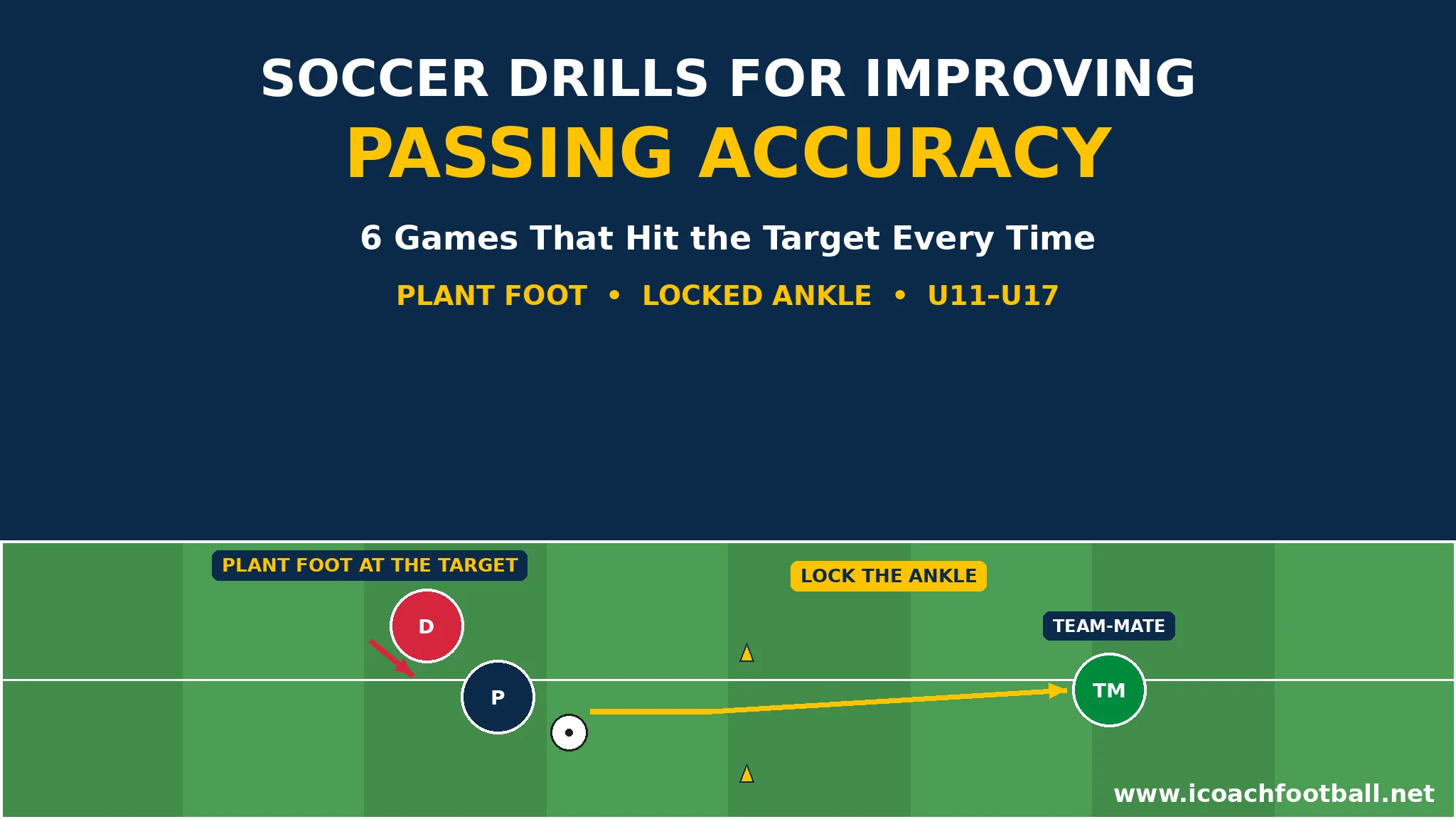
Passing accuracy is a chain, and it breaks at its weakest link: plant foot beside the ball with the toes pointing at the target, ankle locked, inside of the foot striking through the middle of the ball, and the follow-through finishing toward the target. Get all four right and the pass goes where you meant it to go, at a weight your team-mate can control. Get one wrong — plant foot pointing away, a floppy ankle, a stab instead of a swing — and the pass drifts, bounces or runs away, no matter how good the idea was. These six soccer drills for improving passing accuracy build the chain link by link: a circuit that grooves the technique, gates that score accuracy, a colour-call possession game, a line-breaking game, a 2v1 that must finish within four passes, and a target-player game where only an accurate pass counts.
Suitable for: U11–U17 (ages 10–17)
Session snapshot
- Players: 12–16
- Age: U11–U17 (ages 10–17)
- Area: 30 yards by 20 yards, with 2 mini goals
- Duration: 60 minutes
- Focus: Passing accuracy — plant foot, locked ankle, pass weight, and hitting targets under pressure
- Equipment: 12 balls, 20 cones, bibs, 2 mini goals
Why these six games work
Most inaccurate passes are not a talent problem. They are a mechanics problem that shows up under pressure: the plant foot lands pointing at the wrong target, the ankle goes soft at contact, or the player stabs at the ball instead of swinging through it. In an unopposed drill the same player passes cleanly, because they have time to set every link in the chain. Add a defender, a time limit or a moving target, and the first link to break is the one that was never grooved.
The first two drills groove the chain itself: a passing circuit that demands firm, accurate passes to keep two balls moving, then a gates game where a pass only scores if it threads a two-metre gap. The next two drills add pressure and decision: a colour-call possession game where the coach’s shout changes the teams every thirty seconds, and a line-breaking game where the pass must beat a screening defender to reach the other half. The last two drills finish the job: a 2v1 that must combine and shoot within four passes, and a target-player game where a goal only counts if the pass into the target was accurate first time.
The drills are grounded in the FIFA/UEFA coaching community. Drills 1, 3 and 5 are based on / in line with the FIFA Training Centre session “51) Jacqueline Dünker: Passing under pressure”, in which FC Zürich Women’s head coach Jacqueline Dünker trains firm and precise passing through a circuit warm-up that sharpens accuracy, a 4+4v4 colour-call possession game in a small area, and 2v1 and 4v3 attack-against-defence games that must finish within a set number of passes — its coaching points demand firm and precise passes, a close first touch, body orientation that lets the ball be received on either foot, and constant movement to open passing lanes. Drills 2, 4 and 6 are based on / in line with England Football Learning’s session programme “Passing and receiving to score” (ages 7–11), whose Week One session builds passing technique in grids with target players in end zones, whose Week Four session is passing to penetrate — its arrival activity is passing gates, its practice is breaking the line against a screening defender — and whose Week Five session is combinations to play forward, asking players to think about the weight and direction of every pass. In the UK the same session is football drills for passing accuracy — the plant foot, the locked ankle and the pass weight are identical.
This post is the accuracy half of the site’s passing pair. The decision of what to do under pressure — when to pass, when to hold, which lane to choose — is our soccer drills for improving passing under pressure (https://www.icoachfootball.net/soccer-drills-for-improving-passing-under-pressure/) — this post trains the execution, the four links that decide whether the pass you chose actually arrives.
Six rules of passing accuracy
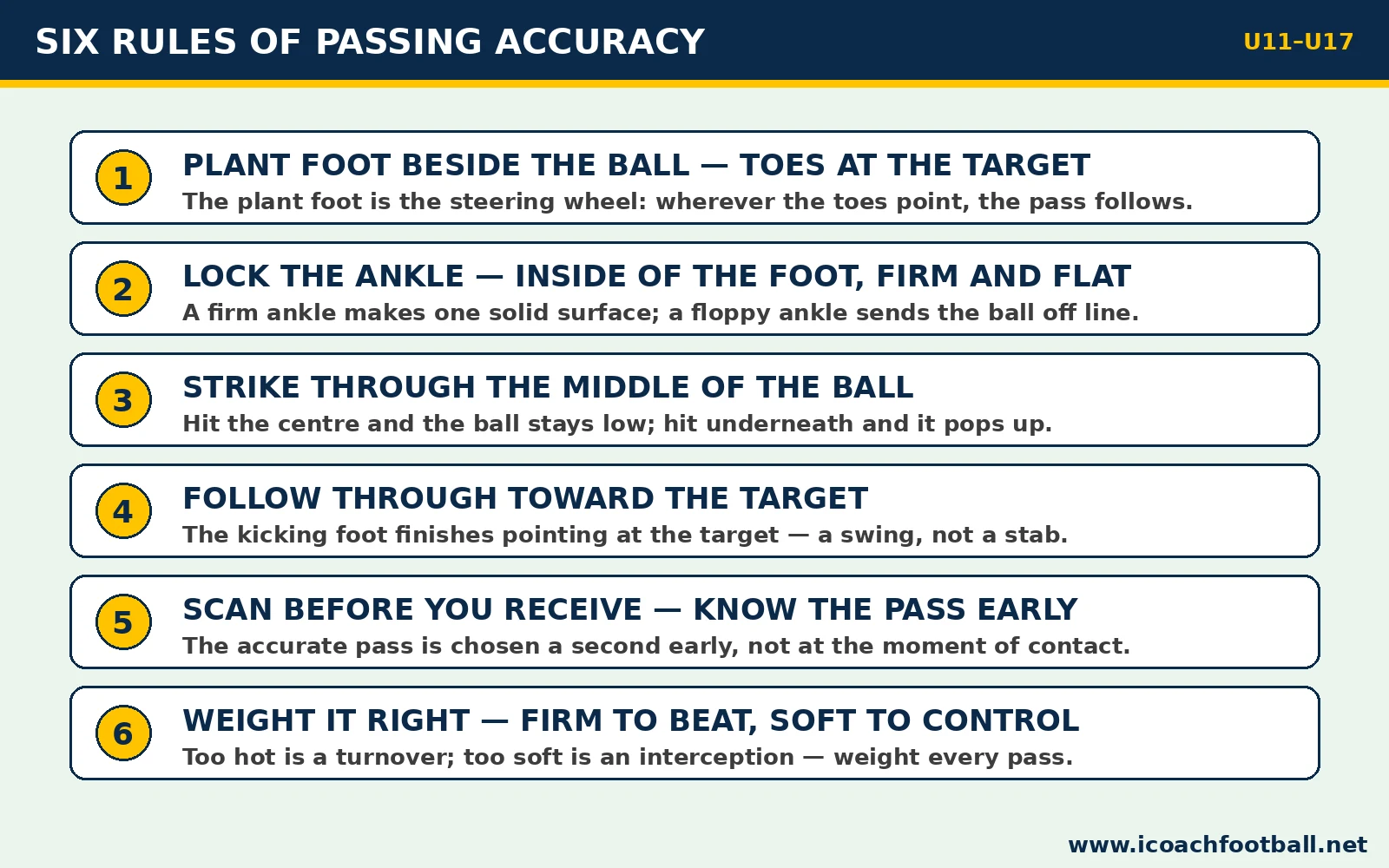
- Plant foot beside the ball — toes at the target. The plant foot is the steering wheel: wherever the toes point, the pass follows.
- Lock the ankle — inside of the foot, firm and flat. A firm ankle turns the foot into one solid surface; a floppy ankle sends the ball off at a random angle.
- Strike through the middle of the ball. Hit the centre and the ball stays on the ground; hit underneath it and it pops up and runs away.
- Follow through toward the target. The kicking foot finishes pointing where the pass was meant to go — a stab stops dead, a swing carries the ball true.
- Scan before you receive — know the pass before the ball arrives. The accurate pass is chosen a second early, not at the moment of contact.
- Weight it right — firm enough to beat the defender, soft enough to control. A pass that arrives too hot is a turnover; a pass that arrives too soft is an interception.
Drill 1 — The Accuracy Circuit
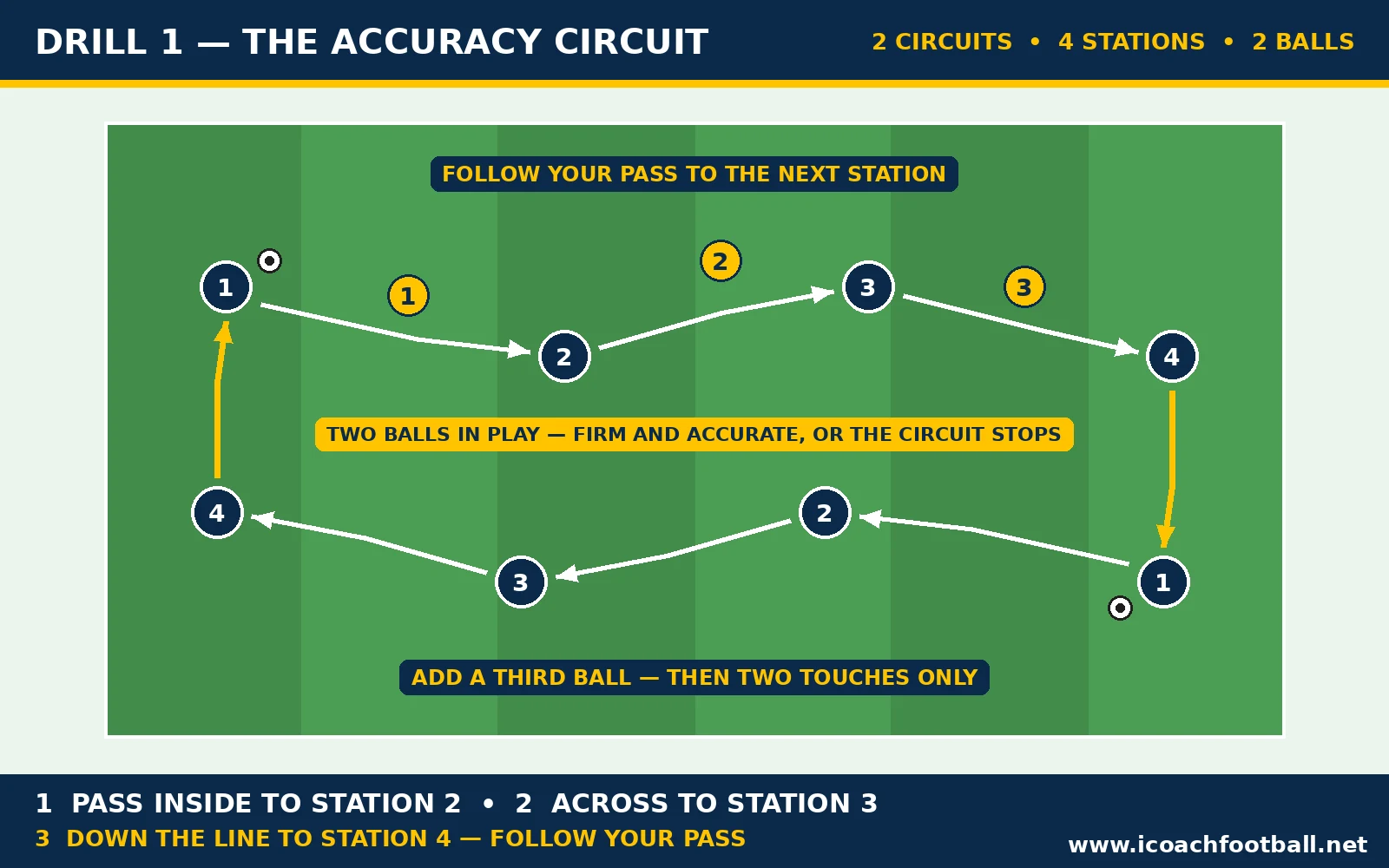
The technique drill — two balls travel around a four-station circuit, and the circuit only flows when every pass is firm and accurate, exactly as the FIFA Training Centre’s Dünker session opens its passing-under-pressure work.
Setup
- Two parallel circuits, 4 stations each, 2 players per station, 2 balls.
- 8 minutes, then reverse the direction.
How to Play
- Two circuits are marked out in parallel, 10 metres apart, with stations 1 and 4 twenty metres apart on each.
- Two players stand at every station, with one ball starting at station 1 on each circuit.
- The first pass is played inside to station 2, who passes across to station 3.
- The player at station 3 passes straight down the line to station 4.
- The player at station 4 passes to station 1 on the other circuit — and the sequence repeats.
- Every player follows their pass to the next station, so the circuit keeps flowing.
Coach’s note: “Firm and accurate, or the circuit stops. A soft pass or a wild pass is a pass your team-mate cannot use.”
Progressions: Add a third ball, so the circuit demands faster decisions; limit every player to two touches, so the first touch must set up the pass; play the circuit anti-clockwise, so both feet learn the angles.
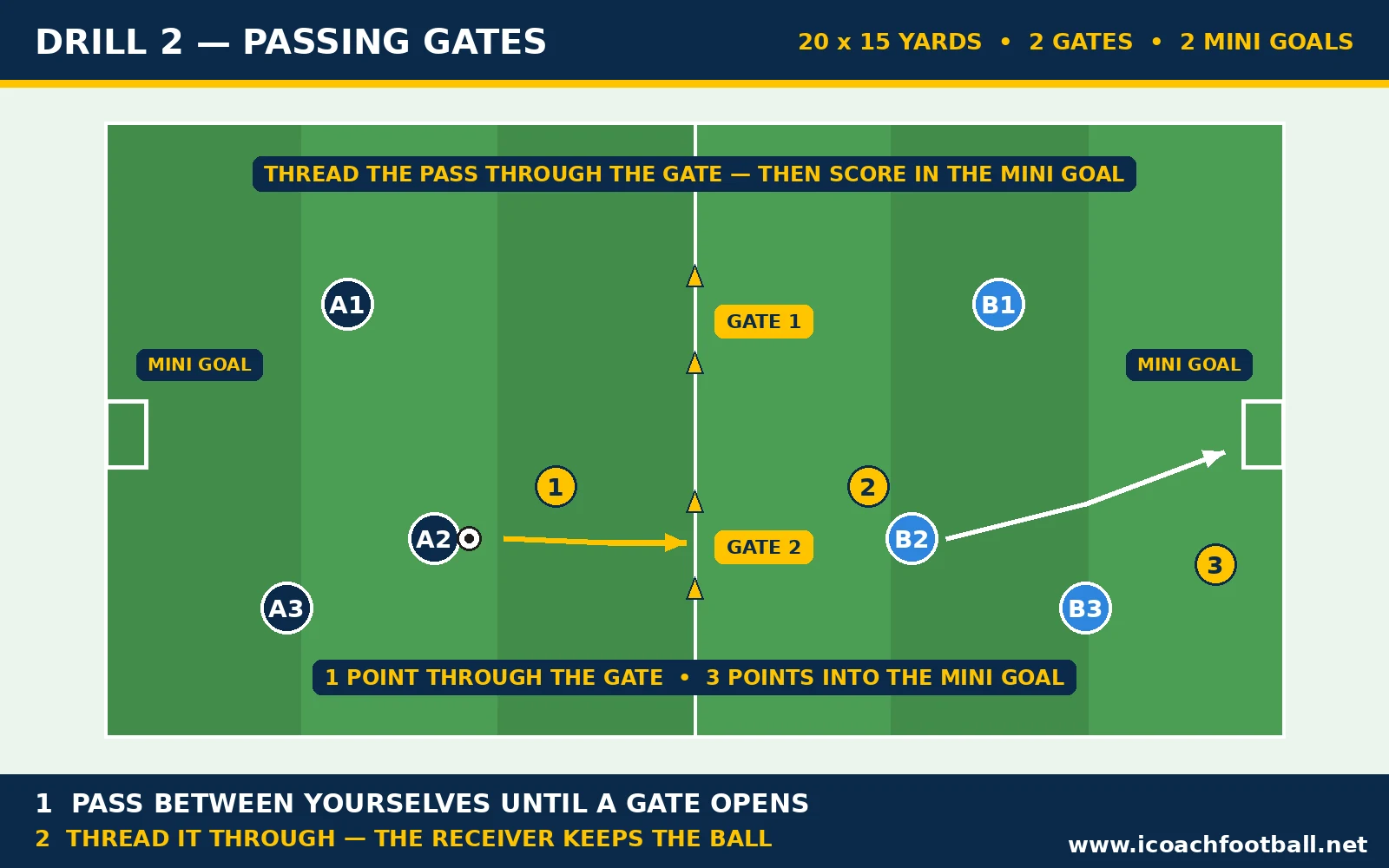
Drill 2 — Passing Gates
The target drill — teams pass between themselves, then thread the ball through a gate to the other team, in line with England Football Learning’s passing-gates arrival activity.
Setup
- Area 20 yards by 15 yards, 2 gates across the middle, 1 mini goal at each end.
- 10 minutes, then swap halves.
How to Play
- Two teams take a half each, with two gates marked across the middle of the area.
- The team with the ball passes between themselves until a gate is open.
- A player threads a pass through a gate to a team-mate on the other side.
- One point if the pass through the gate goes beyond the end line.
- Three points if the pass through the gate reaches the opposition’s mini-goal.
- The team that receives keeps the ball and tries to pass back through a gate — most points wins.
Coach’s note: “Toes at the gate before you pass. If your plant foot is pointing anywhere else, the ball will follow it, not the gate.”
Progressions: Narrow the gates to one metre, so the pass must be exact; add a defender in each half, so the gate pass must beat pressure; the gate pass must be played first time, so the scan has to happen before the ball arrives.
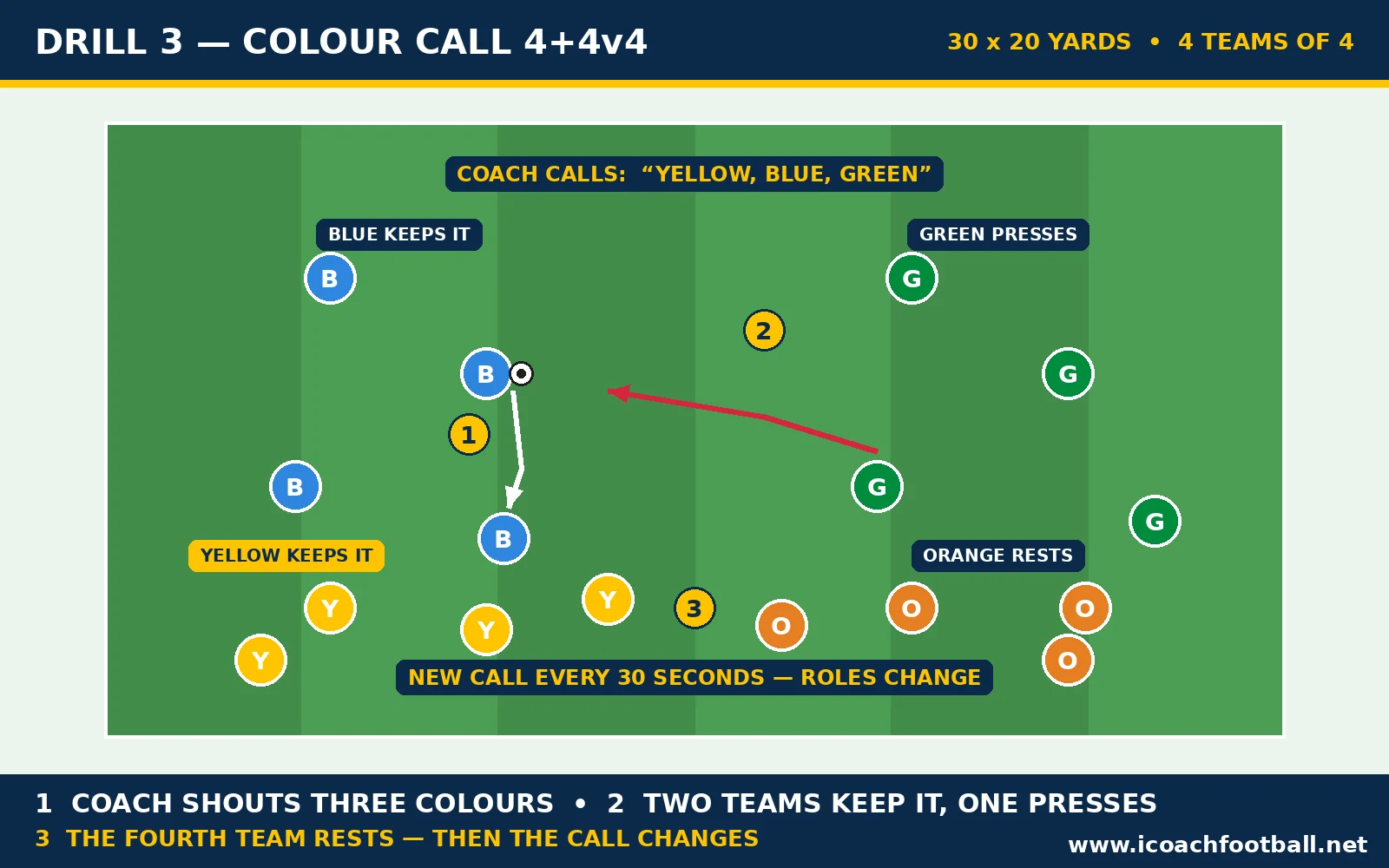
Drill 3 — Colour Call 4+4v4
The pressure drill — the coach shouts three colours, two teams keep possession together while one presses, straight from the FIFA Training Centre’s Dünker session.
Setup
- Area 30 yards by 20 yards, 4 teams of 4, each in a different bib colour.
- 10 minutes, with a new colour call every 30 seconds.
How to Play
- Four teams of four move freely inside the area, passing between themselves.
- The coach shouts three colours in any order — for example, “yellow, blue, green”.
- The first two teams called must keep possession between each other.
- The third team called must try to win the ball back.
- The fourth team is not called and does not take part — they keep moving freely.
- After 30 seconds the coach calls three new colours, and the roles change.
Coach’s note: “React to the call, then pass accurately. The team that panics after the shout is the team that gives the ball away.”
Progressions: The pressing team wins the ball and must keep it, so the roles flip mid-round; the coach calls only two colours, so the possessing teams must find each other faster; limit the possessing teams to two touches, so every pass must be firm and first-time accurate.
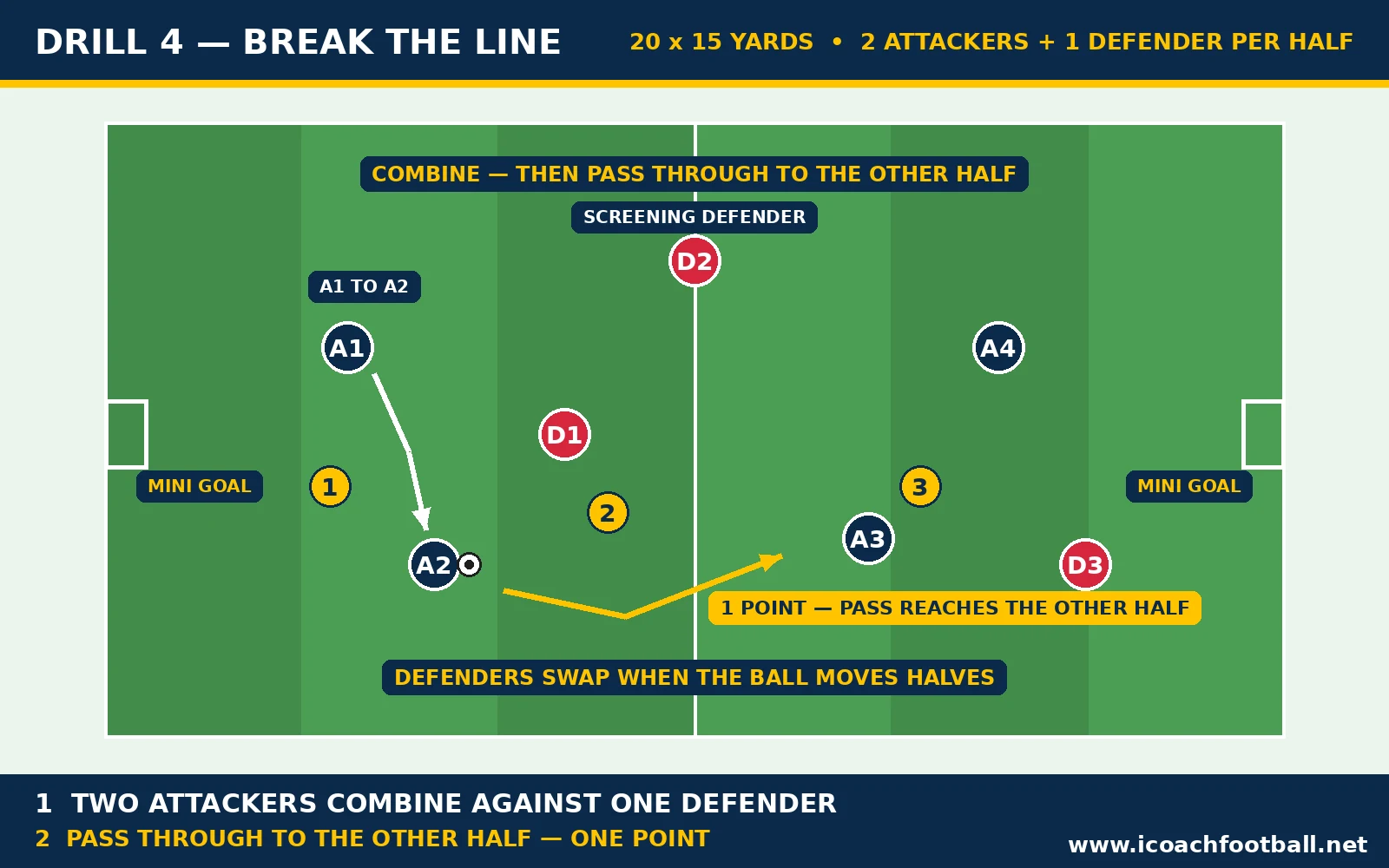
Drill 4 — Break the Line
The penetration drill — two attackers combine against one defender and must pass through to the other half, as in England Football Learning’s breaking-the-line practice.
Setup
- Area 20 yards by 15 yards, split into two halves, 2 attackers and 1 defender in each half.
- 10 minutes, then swap the halves.
How to Play
- Two attackers and one defender start in each half, with the ball in one half.
- The attackers combine to beat the defender in their half.
- They must pass through to the attackers in the other half — that earns one point.
- One defender always screens on the halfway line while the other presses.
- If the defenders win the ball, they try to score in a mini-goal.
- The defenders swap roles when the ball moves into the other half — most points wins.
Coach’s note: “Keep the ball away from the fire. Pass to the team-mate furthest from the defender, not the one nearest to you.”
Progressions: The screening defender may press, so the line-breaking pass must be timed; the pass through must be played first time, so the receiver’s body shape has to be open already; add a second ball, so both halves play at once and the scan never stops.
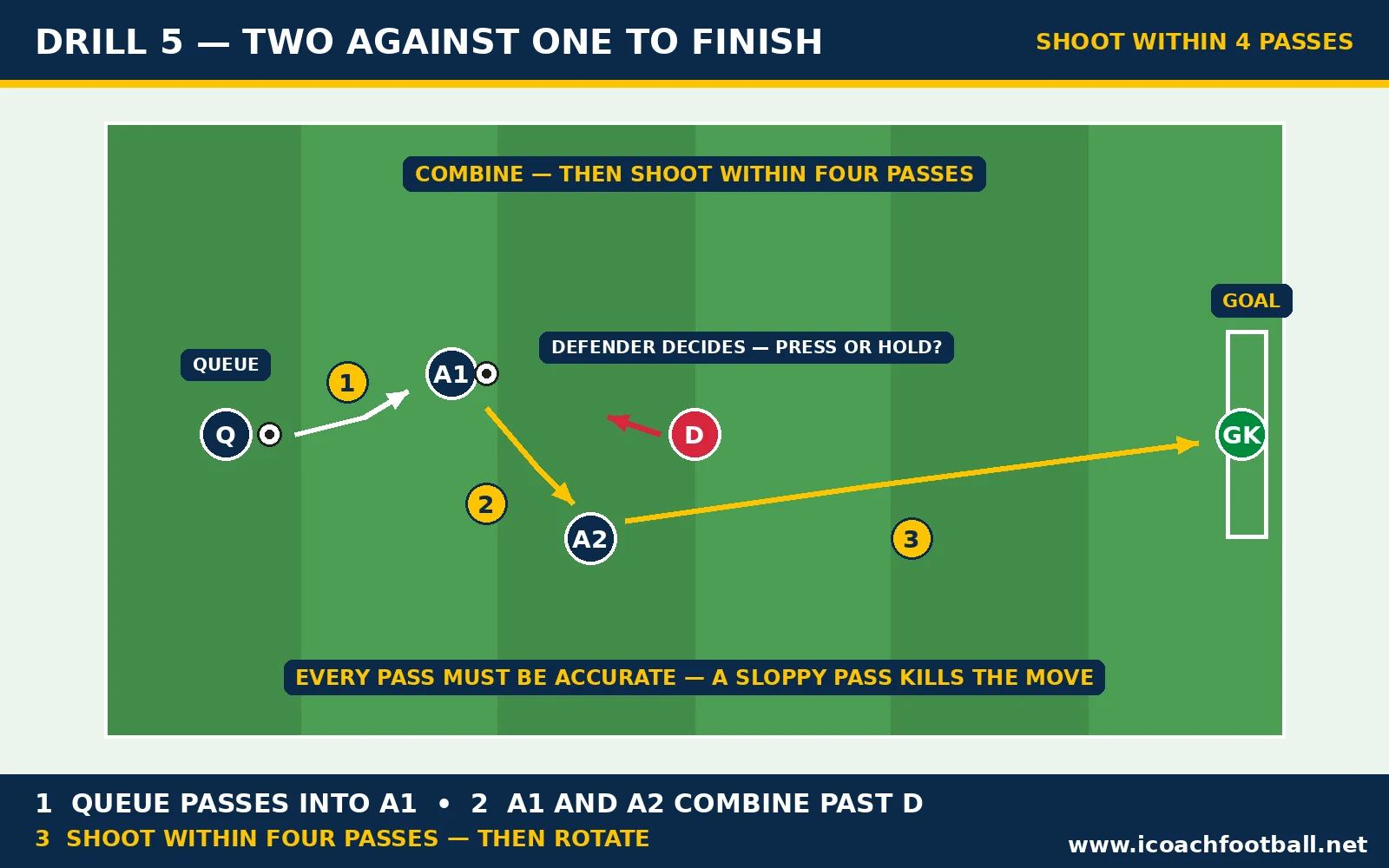
Drill 5 — Two Against One to Finish
The finishing drill — two attackers combine against one defender and must shoot within four passes, in line with the FIFA Training Centre’s Dünker session.
Setup
- Area 20 yards by 15 yards, 1 full goal with a goalkeeper, groups of 3.
- 10 minutes, rotating roles after every attack.
How to Play
- The ball starts with the first player in the queue, who passes to the closest attacker inside the area.
- The sole defender decides whether to engage and press or keep their distance.
- The two attackers must combine and work space for a shot.
- The attackers must shoot within four passes — every pass in the move must be accurate.
- Once a goal is scored, the goalkeeper saves it or the defender wins the ball, new players enter.
- Rotate the defender after every attack, so all players get each role.
Coach’s note: “Four passes, one shot. A sloppy second pass kills the move — make every pass in the combination count.”
Progressions: Play 4v2, so the combination must beat two defenders; the attackers must shoot within five passes but the second defender starts from where the ball is played; the defender reads triggers — a poor touch or a telegraphed pass — and presses on them.
Drill 6 — Target Player Game
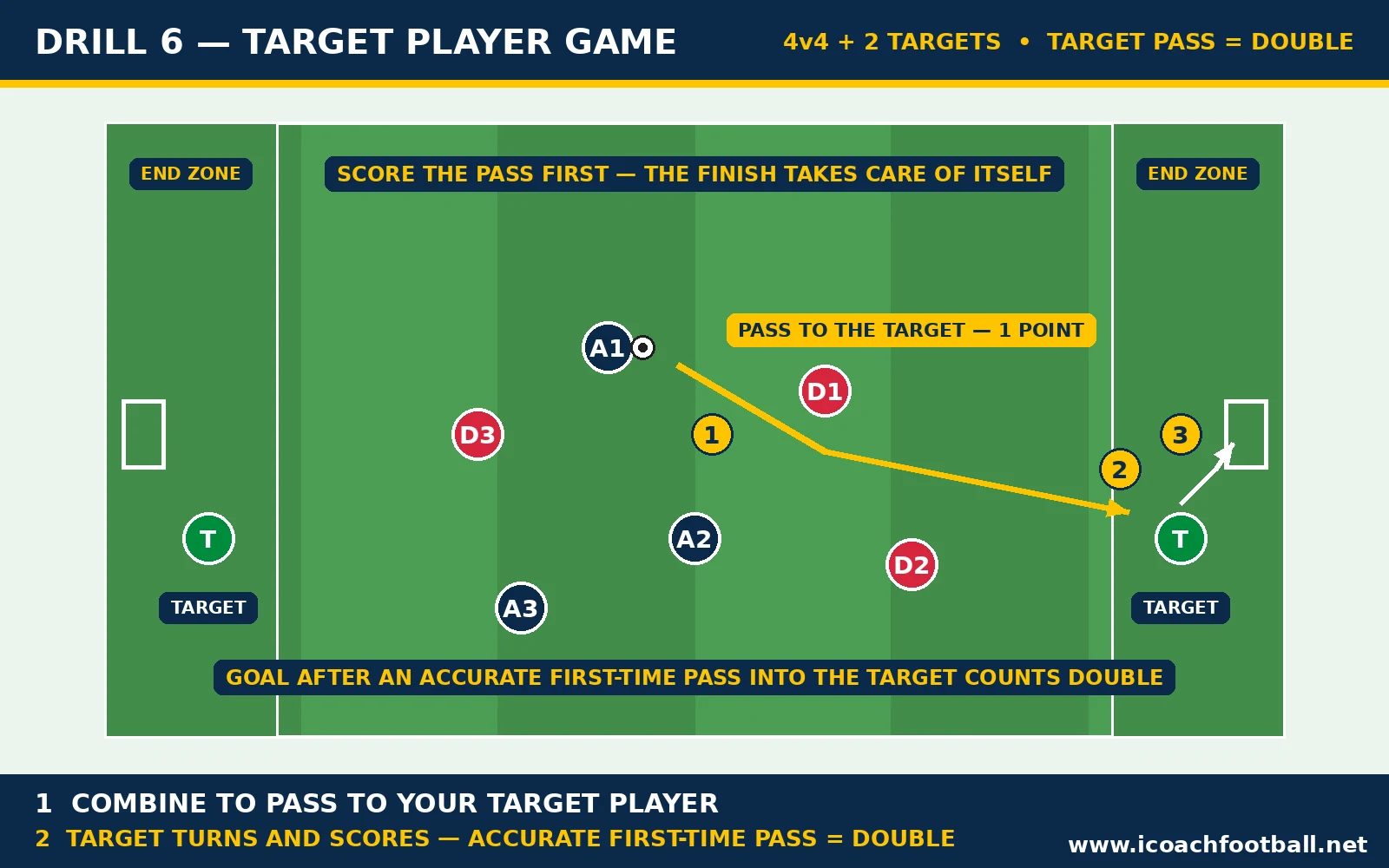
The full game. A 4v4 game with a target player in each end zone — a goal only counts double if the pass into the target was accurate first time, building on England Football Learning’s end-zone and set-up-zone practices.
Setup
- Area 25 yards by 20 yards, 2 end zones, 2 mini goals, 4v4 plus 2 target players.
- 12 minutes.
How to Play
- Two teams play 4v4, with one target player for each team standing in an end zone.
- Teams combine to pass to their target player — a clean, accurate pass into the target earns one point.
- After receiving, the target player turns and scores unopposed in the mini-goal.
- A goal scored after an accurate first-time pass into the target counts double.
- If the ball goes out, use kick-ins to restart quickly and keep the game flowing.
- Play for three minutes, then rotate the target players — the team with the most points after 12 minutes wins.
Coach’s note: “The pass into the target is the goal. Score the pass first, and the finish takes care of itself.”
Progressions: Add a defender in each end zone, so the target pass must beat pressure; the target player must lay the ball back instead of turning, so the combination continues; only first-time passes into the target count, so the scan and the weight have to be perfect.
Coaching points
- Plant foot is the steering wheel. Toes at the target before the strike — if the plant foot points away, the pass follows it.
- Lock the ankle, present the inside of the foot. A firm ankle and a flat inside surface send the ball in a straight, repeatable line.
- Strike through the middle. Contact with the centre of the ball keeps it on the ground and at a controllable weight.
- Follow through toward the target. The kicking foot finishes pointing where the pass was meant to go — a pendulum swing, not a stab.
- Scan before the ball arrives. Lift the head every two to three seconds, so the pass is chosen before the first touch, not after it.
- Weight is part of accuracy. A pass that arrives too hot cannot be controlled, and a pass that arrives too soft gets cut out — firm enough to beat the defender, soft enough to control.
Common mistakes
| Mistake | Fix |
|---|---|
| Plant foot pointing away from the target | Plant the foot beside the ball with toes at the target — Drill 2 only counts the rep if the passer sets the plant foot before striking |
| Floppy ankle at contact, so the ball comes off at a random angle | Lock the ankle with the toes slightly up — Drill 1 stops the circuit if a pass wobbles off line |
| Stabbing at the ball with no follow-through | Swing through toward the target and finish with the foot pointing at it — Drill 5 only counts the move if every pass is struck cleanly |
| Passing without scanning, so the receiver is not ready | Scan before the ball arrives and call the receiver’s name — Drill 3 adds the colour call, so the scan has to happen on the shout |
| Passes too soft, cut out by the defender | Play the pass firm enough to beat the press — Drill 4 only counts the point if the line-breaking pass reaches the other half |
| Passes too hot, running away from the receiver | Weight the pass to arrive at a controllable pace — Drill 6 only counts the double if the target can control the pass first time |
Age adaptations
| Age | Format | What changes |
|---|---|---|
| U11–U12 (ages 10–12) | Small areas, size 4 ball, gates 2 metres wide, coach calls every turn | All six drills run with wide gates and no live pressing in Drill 2, so the plant foot and ankle lock are learned before speed is added. Drill 1 uses two balls only, Drill 3 uses 45-second colour rounds, and Drill 5 allows six passes before the shot, because the technique is the lesson, not the finish |
| U13–U14 (ages 12–14) | Full areas, size 4 ball, gates 1.5 metres wide, defender presses from the second round | All six drills run as written, with the defender pressing in Drill 2 from the second round. Drill 1 adds the third ball, Drill 4 adds the screening defender pressing, and Drill 6 adds the first-time target pass for the double point. Players keep a simple count — “eight passes through the gate, six on target” is the habit that sticks |
| U15–U17 (ages 14–17) | Full areas, size 5 ball, gates 1 metre wide, full pressure from the first rep | Full pressure from the start. Drill 1 runs anti-clockwise with a two-touch limit, Drill 3 uses two-touch possession, and Drill 5 plays 4v2 with the second defender starting from where the ball is played. Players are asked to call their pass before each rep — “plant foot, lock, through the gate” — so accuracy becomes a conscious skill, not a lucky strike |
60-minute session plan
| Block | Time | Content |
|---|---|---|
| Arrival game | 0:00–0:05 | Free passing gates — every pass through a gate earns a point |
| The accuracy circuit | 0:05–0:13 | Drill 1 — The Accuracy Circuit |
| Passing gates | 0:13–0:23 | Drill 2 — Passing Gates |
| Colour call 4+4v4 | 0:23–0:32 | Drill 3 — Colour Call 4+4v4 |
| Break the line | 0:32–0:41 | Drill 4 — Break the Line |
| Two against one to finish | 0:41–0:50 | Drill 5 — Two Against One to Finish |
| Target player game | 0:50–1:00 | Drill 6 — Target Player Game |
Keep building from here
The decision of what to do under pressure — when to pass, when to hold, which lane to choose — is our soccer drills for improving passing under pressure (https://www.icoachfootball.net/soccer-drills-for-improving-passing-under-pressure/), and the first touch that sets the pass up is our soccer drills for receiving under pressure (https://www.icoachfootball.net/soccer-drills-for-receiving-under-pressure/). The one-touch pass that keeps the circuit flowing is our soccer one-touch passing drills (https://www.icoachfootball.net/soccer-one-touch-passing-drills/), and the decision the pass creates is our soccer decision-making drills (https://www.icoachfootball.net/soccer-decision-making-drills/). The scan that picks the pass is our soccer scanning drills (https://www.icoachfootball.net/soccer-scanning-drills/), and the give-and-go that beats the defender is our soccer give-and-go drills (https://www.icoachfootball.net/soccer-give-and-go-drills/). The turn that opens the passing angle is our soccer drills for improving turning (https://www.icoachfootball.net/soccer-drills-for-improving-turning/), and the half-turn that makes the pass possible is our football half-turn drills (https://www.icoachfootball.net/football-half-turn-drills/). The close control that keeps the ball moving is our soccer dribbling drills (https://www.icoachfootball.net/soccer-dribbling-drills/), and the possession the accurate pass protects is our soccer possession drills (https://www.icoachfootball.net/soccer-possession-drills/). The small-sided games where accuracy matters most are our 25 small-sided games for soccer (https://www.icoachfootball.net/25-small-sided-games-for-soccer-illustrated-with-images/), and the finish after the accurate pass is our soccer drills for improving first-time shooting (https://www.icoachfootball.net/soccer-drills-for-improving-first-time-shooting/). The session structure follows our U13 soccer practice plan (https://www.icoachfootball.net/u13-soccer-practice-plan/). Accurate passing is high-intensity, high-repetition work — plan the week’s load with our training load calculator (https://www.icoachfootball.net/training-load-calculator/).
What is the most important part of passing accuracy?
The plant foot. Place the non-kicking foot beside the ball with the toes pointing at the target before you strike — the pass follows wherever the toes point. If the plant foot lands pointing away from the target, no amount of good striking technique will save the pass. Drill 2 makes this visible: a pass only scores if it threads the gate, and a misplaced plant foot misses the gate every time.
How do you teach players to lock their ankle?
Start with the foot still, before any ball is struck. Have the player turn the passing foot out from the hip so the flat inside faces the target, toes slightly up, ankle firm — then hold that shape while you tap the inside of the foot. Once the shape is set, strike a still ball through a gate from five yards, and only add distance when ten passes in a row go straight. Drill 1 grooves the shape at circuit pace, because a floppy ankle stops the circuit.
How far apart should passing gates be?
Two metres wide for U11–U12, one and a half metres for U13–U14, and one metre for U15–U17. The gate must be narrow enough that a sloppy pass misses it, but wide enough that a good pass goes through eight times out of ten. If players are hitting the gate every time, narrow it; if they are missing more than half, widen it. Drill 2 uses exactly these widths.
Why do my players pass accurately in drills but not in games?
Because the drill has no defender, no time limit and no decision to make. In a game the player must scan, choose, set the plant foot and strike — all in about a second — and the first link to break is the one that was never grooved under pressure. The fix is to add pressure gradually: Drill 2 adds a defender in each half, Drill 3 adds the colour call, and Drill 5 adds a four-pass limit before the shot, so the mechanics are tested the way a game tests them.
How do you improve passing accuracy with the weak foot?
The same way as the strong foot, but slower and with a narrower gate. Start in Drill 1, where the circuit gives the weak foot ten clean reps in eight minutes, and keep the distance short — five yards — until ten passes in a row go straight. Then move the weak foot into Drill 2 with a two-metre gate, and only narrow the gate when the weak foot is hitting it eight times out of ten. Never let a player hide the weak foot by turning their body to use the strong one.
Sources
- FIFA Training Centre. “51) Jacqueline Dünker: Passing under pressure” (https://www.fifatrainingcentre.com/en/practice/elite-sessions/in-possession/duenker-passing-under-pressure.php) — the FIFA Training Centre elite session in which FC Zürich Women’s head coach Jacqueline Dünker trains firm and precise passing: its warm-up circuit sharpens accuracy through first touch and body orientation, its 4+4v4 colour-call game demands quick reactions and precise passing in a small area, and its 2v1 and 4v3 games must finish within a set number of passes — its coaching points demand firm and precise passes, a close first touch, body orientation that lets the ball be received on either foot, and constant movement to open passing lanes. Verified live 2026-11-21 (HTTP 200, full text read). Drills 1, 3 and 5 are based on / in line with this session’s passing-under-pressure principles.
- England Football Learning. “Session programme: passing and receiving to score (ages 7–11)” (https://cdn.englandfootball.com/-/media/EFLearning/Session-programmes/7-11-passing-and-receiving-to-score/Session-programme/Session-programme—Passing-and-receiving-to-score.pdf?rev=a8c8000078ac42f2a34c402b5a1c4cbc&) — England Football Learning’s six-week session programme on passing and receiving to score: its Week One session builds passing technique in grids with target players in end zones, its Week Four session is passing to penetrate — its arrival activity is passing gates and its practice is breaking the line against a screening defender — and its Week Five session is combinations to play forward, asking players to think about the weight and direction of every pass. Verified live 2026-11-21 (HTTP 200, full text read). Drills 2, 4 and 6 are based on / in line with this programme’s passing-gates, line-breaking and target-player principles.