Soccer Counter Attack Drills: 6 Games to Win It and Finish in 10 Seconds
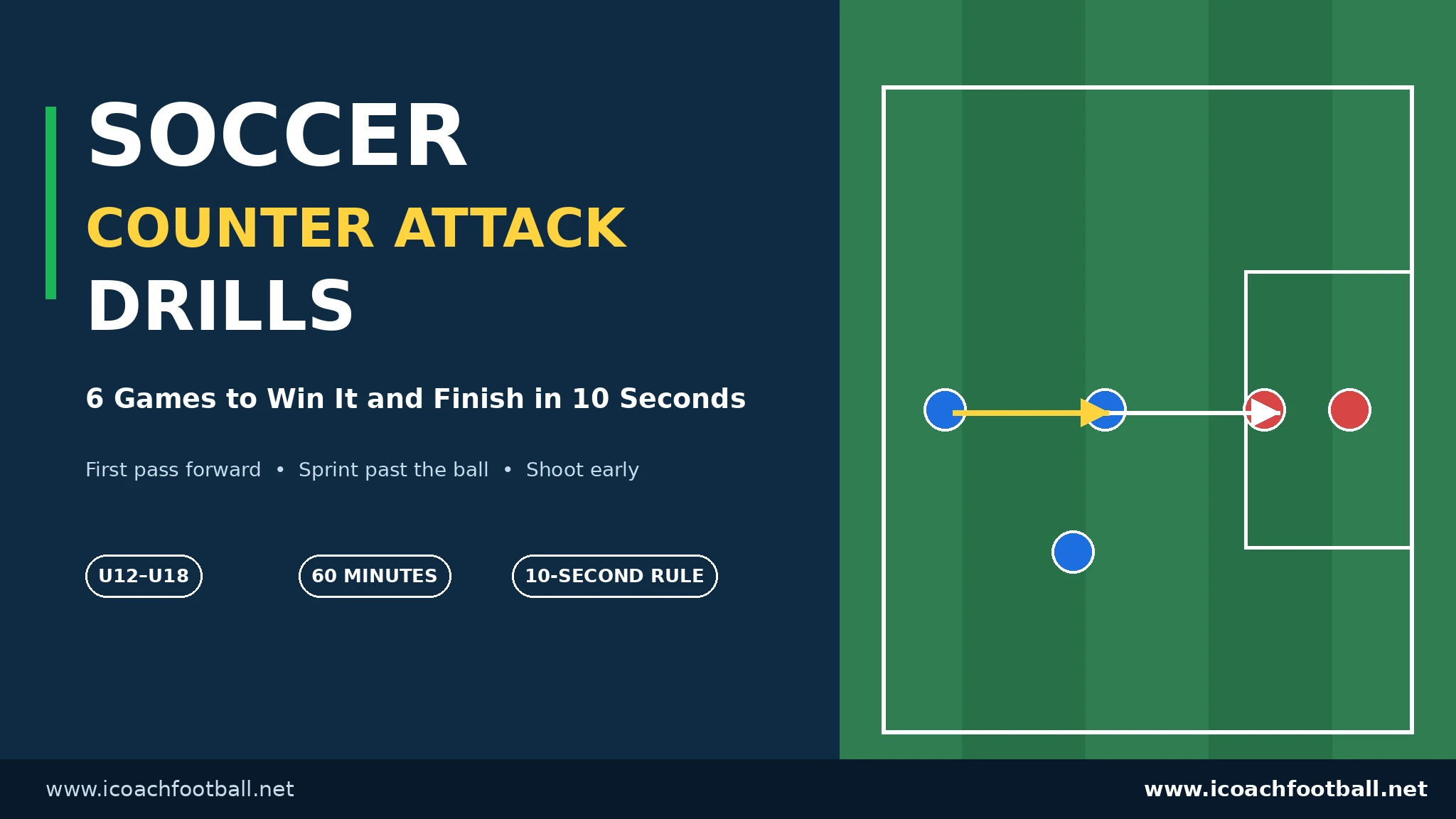
Quick answer: A counter attack is the 10 seconds after your team wins the ball. Play the first pass forward, sprint past the ball, and shoot before the other team gets set. These six games train exactly that: win it, play forward, run forward, finish early.
Suitable for: U12–U18
Most teams win the ball and then slow down. They pass sideways, they wait for support, and the other team gets nine players behind the ball. The counter is gone before it starts.
A good counter needs three things at once. The player who wins it must look forward first. Two teammates must sprint forward the instant possession changes, not after the first pass. And the finish must come early, while the defence is still running back.
Coaches in the UK teach the same moment as football counter-attacking, and the rule is identical: first thought forward, first run forward, finish inside 10 seconds. These six soccer counter attack drills build the habit in stages: the wave, the FIFA transition rondo, the wide sprint, the 4v4 shoot-on-sight game, the counter-or-keep decision, and a full-pitch game with a 10-second bonus.
Session snapshot
- Players: 8–18 (waves of 5–6 for Drills 1–3, 9–11 for Drill 4, two teams for Drills 5–6)
- Area: 40 x 30 yards for Drills 1–3, 30 x 20 yards for Drill 4, 50 x 35 yards for Drill 5, 70 x 45 yards for Drill 6
- Duration: 60 minutes (20-minute version: Drills 1 and 2 only)
- Focus: First pass forward, sprinting past the ball, wide outlets, shooting on sight, counter-or-keep decisions
- Equipment: 10–12 balls, 16 cones, bibs, 2 full goals, 4 mini-goals
- Age: U12–U18 (see age adaptations)
The one rule: 10 seconds to a shot
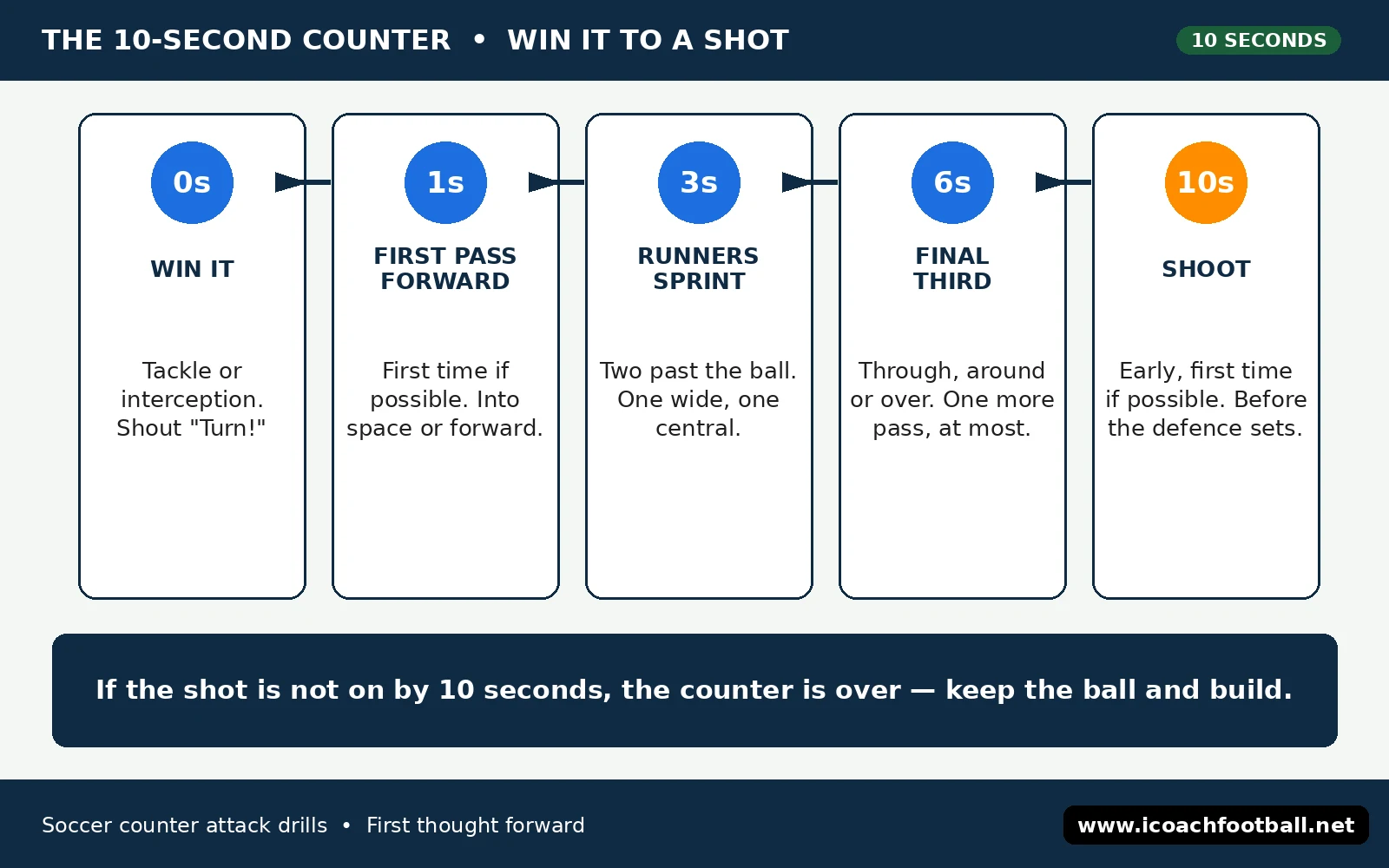
The counter has a clock, and the players must hear it. From the moment possession is won, the team has 10 seconds to shoot. That clock forces every decision in these games.
- Second 0 — win it. The tackle, interception or save happens. The nearest player shouts “Turn!” so everyone knows possession has changed.
- Second 1 — first pass forward. The ball goes forward first time if possible, into space or into a teammate facing forward. A sideways pass is only allowed if no forward pass is on.
- Seconds 2–3 — runners sprint. Two players sprint past the ball, one wide and one central. A runner level with the ball helps nobody.
- Seconds 4–6 — play into the final third. The ball moves through, around or over the recovering defenders. One more pass, at most, before the shot.
- Seconds 7–10 — shoot. The shot comes early, first time if possible, before the defence is set. A saved shot beats a perfect chance that never comes.
If your players cannot scan before the ball is won, fix that first with these soccer scanning drills; the counter starts with the picture taken before the turnover, not after it.
| What you see at the turnover | Do this | Do not do this |
|---|---|---|
| Space ahead and numbers up | Counter at full speed, first pass forward, finish inside 10 seconds | Pass sideways and let the defence recover |
| Numbers even, one defender recovering | Drive at the recovering defender, commit them, release the wide runner | Dribble sideways across the pitch |
| Numbers down and no space ahead | Keep the ball, secure it with two passes, then build | Launch a long ball and lose it straight back |
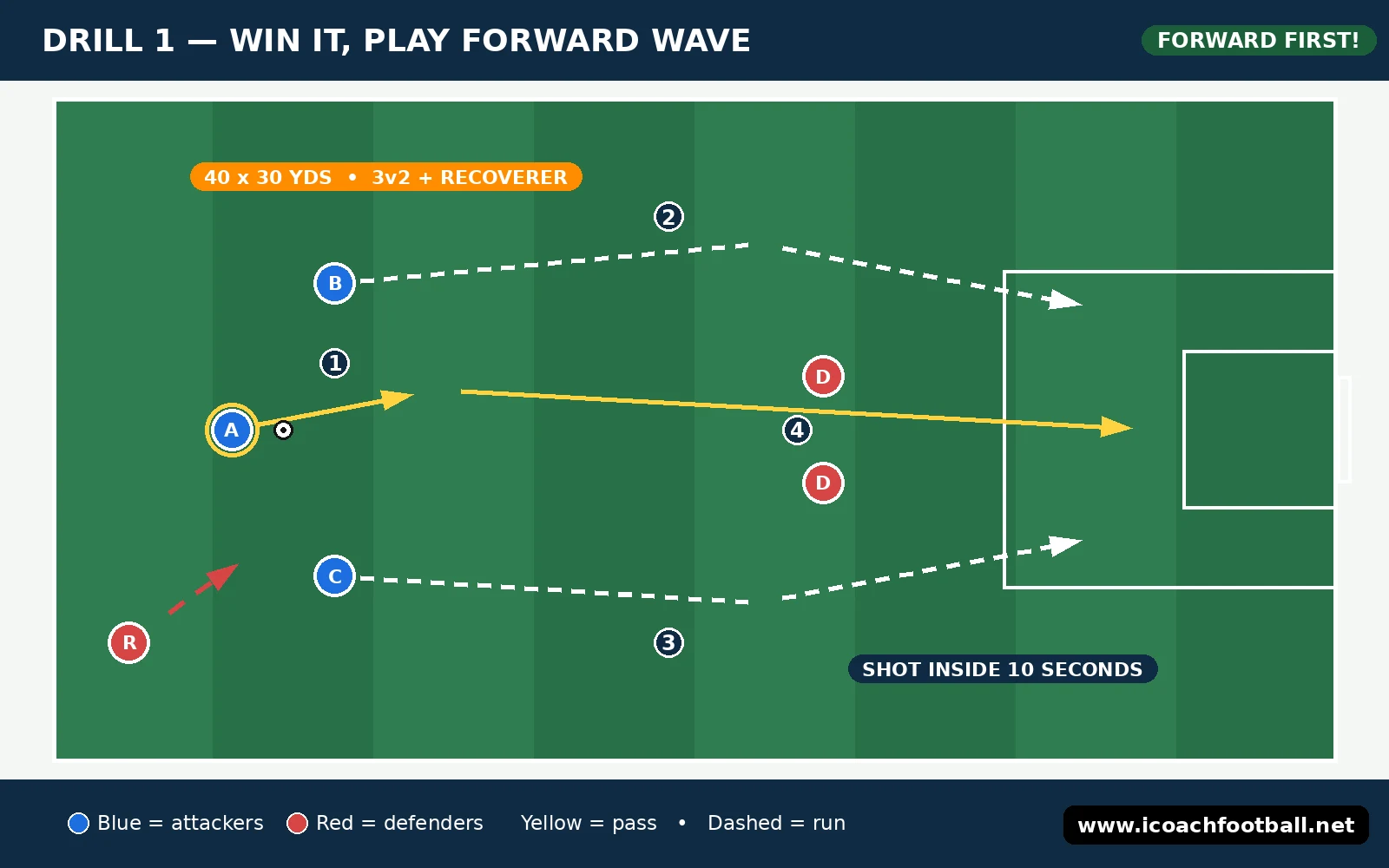
Drill 1 — Win It, Play Forward Wave
The blocked-practice start: a 3v2 wave with a recovering defender, a loud 10-second count, and a finish at the end of every rep.
Setup:
- Area 40 x 30 yards, with a full goal at the far end and a goalkeeper in goal.
- Three attackers in bibs start at the halfway line, two defenders start inside the area.
- A recovering defender starts 10 yards behind the attackers, and balls start with the coach.
How to Play:
- The coach plays a loose ball into the middle, and the nearest attacker wins it and shouts “Turn!”
- The attacker who wins it plays the first pass forward, first time, to the teammate facing the goal.
- The other two attackers sprint past the ball at once, one wide and one central.
- The ball is played through or around the two defenders within 3 passes, and the attack finishes first time.
- The recovering defender sprints back on the coach’s call, and the next wave starts as soon as the shot is taken.
Coach’s note: The cue is “First thought forward!” Count the 10 seconds out loud. If the shot comes after 10, the goal does not count.
Progressions: The recovering defender starts closer, then the two defenders may press the first pass, so the winner must play forward under real pressure.
Drill 2 — The FIFA Transition Rondo
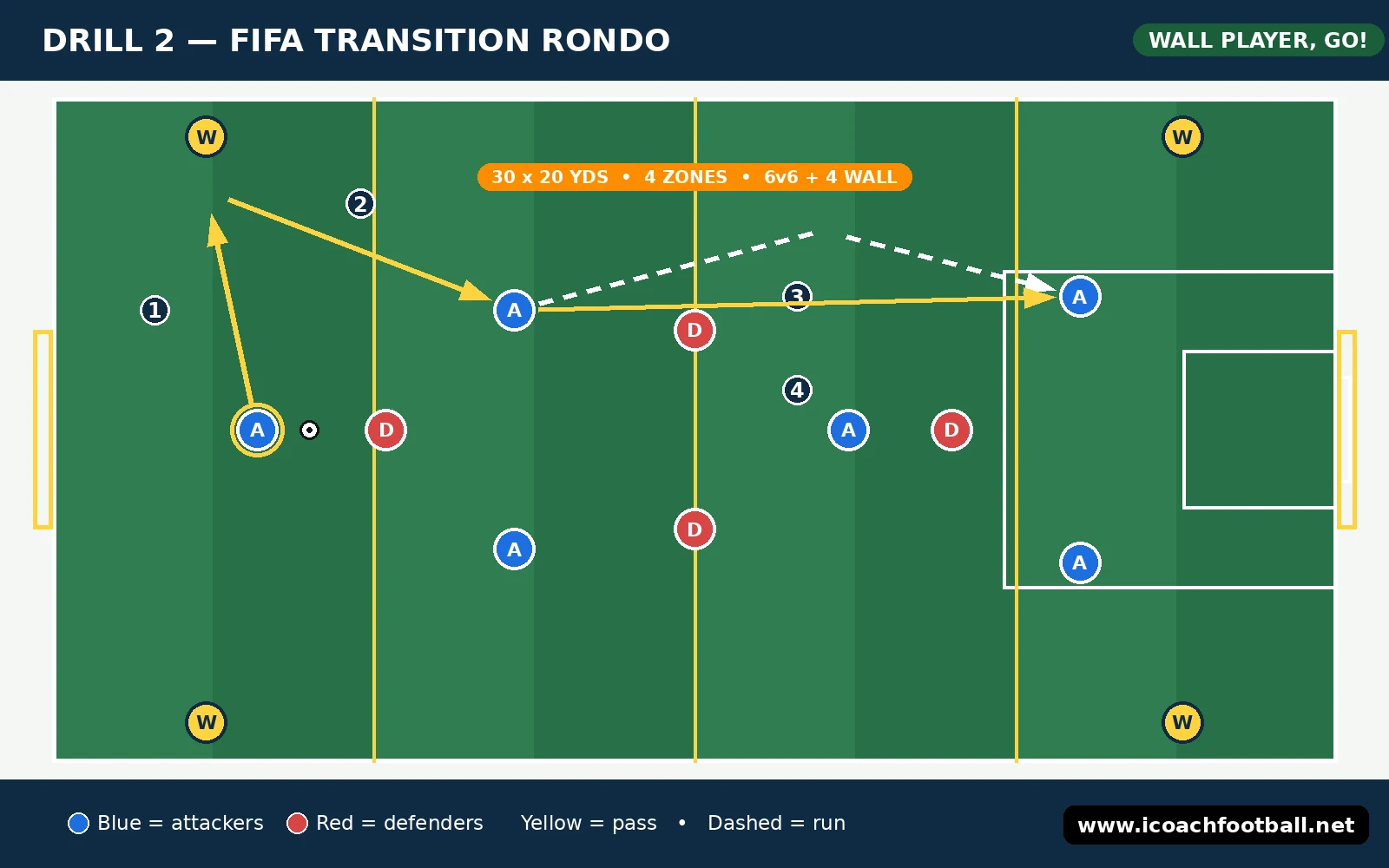
The recognition game, based on the FIFA Training Centre transition-into-attack session: win the ball in a tight zone game, link with a wall player, and score in a mini-goal before the other team resets.
Setup:
- A 30 x 20 yard area split into 4 zones, each 8 yards wide, with 2 mini-goals 4 yards behind each end zone.
- Two teams of 6 inside the area, and 4 wall players in yellow around the outside, one on each side.
- Balls with the coach, and a 3-minute block clock.
How to Play:
- The team in possession passes through the zones, trying to play a pass between the lines for 1 point.
- The defending team presses to shut the passing lanes and win the ball back.
- The moment the ball is won, the new team must play forward to a wall player at once.
- The wall player plays it back first time, and two runners sprint toward the nearest mini-goal.
- A goal in a mini-goal within 10 seconds of winning the ball scores 2 points, and play restarts from the coach.
Coach’s note: The cue is “Wall player, go!” If the team that wins it takes two touches sideways first, stop play. The wall player is the release, not a rest.
Progressions: The wall players behind the end zones may step in and press, then link with the counter once the ball is won, so the outlet is live.
Drill 3 — Sprint Channels
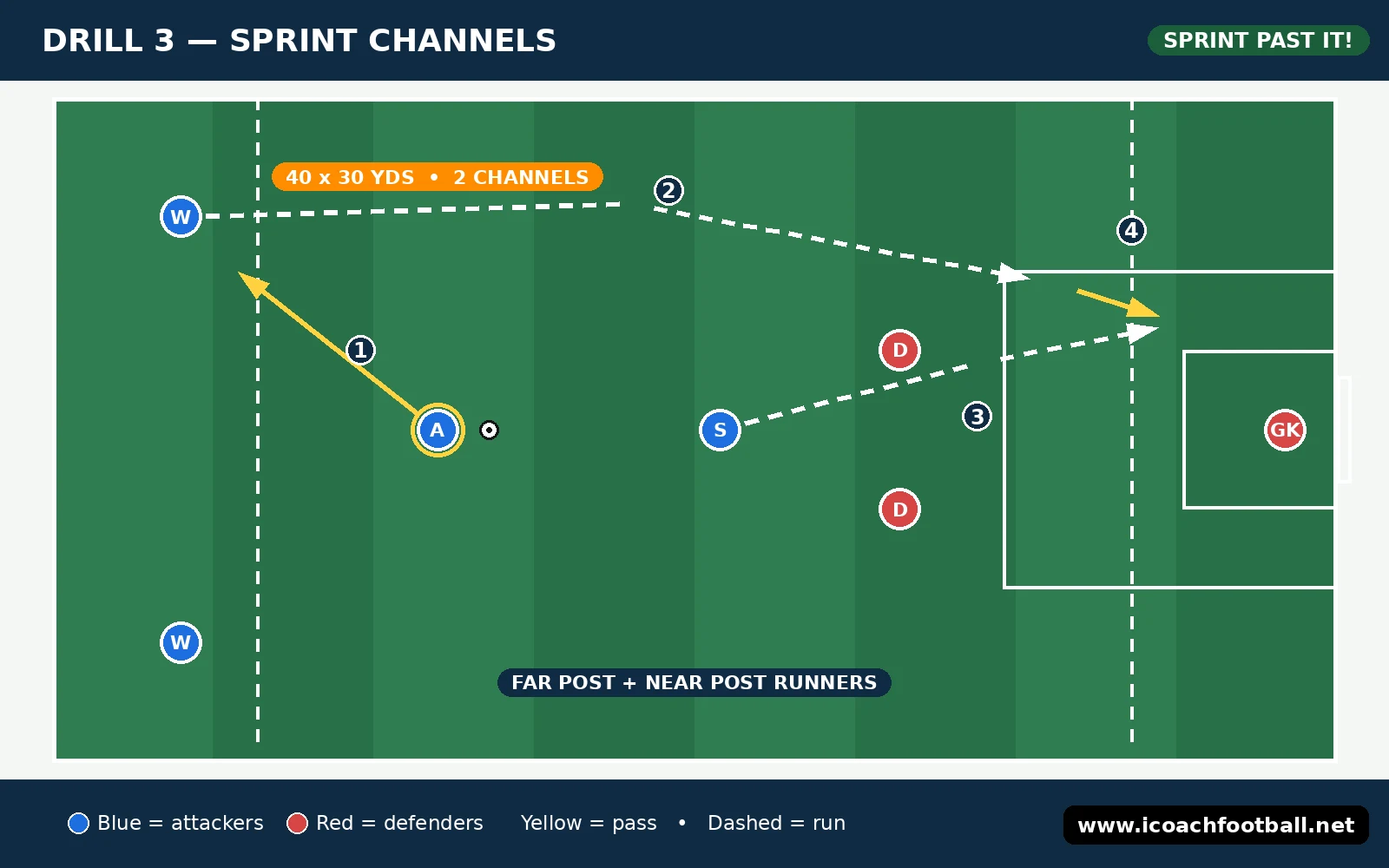
The wide counter. The ball is won centrally, the first pass goes wide, and the wide player drives the channel while a central runner attacks the far post.
Setup:
- Area 40 x 30 yards, with wide channels marked 8 yards in from each touchline and a full goal at the far end.
- A central ball-winner, two wide outlets and one striker in bibs, against two defenders and a goalkeeper.
- Balls start with the coach at the halfway line.
How to Play:
- The coach plays a ball into the centre, and the ball-winner intercepts it and shouts “Turn!”
- The ball-winner plays the first pass wide, first time, into the sprinting wide player’s path.
- The wide player drives the channel at full speed, and the striker sprints to the far post.
- The second wide player sprints to the near post, so the cross has two targets arriving at speed.
- The attack finishes first time, and the next rep starts from the opposite channel.
Coach’s note: The cue is “Sprint past the ball!” If a wide player receives the ball standing still, restart the rep. The pass must meet a runner already moving.
Progressions: A recovering defender chases the wide player, then the wide player must choose: cross early, cut inside, or play the cutback to the late runner.
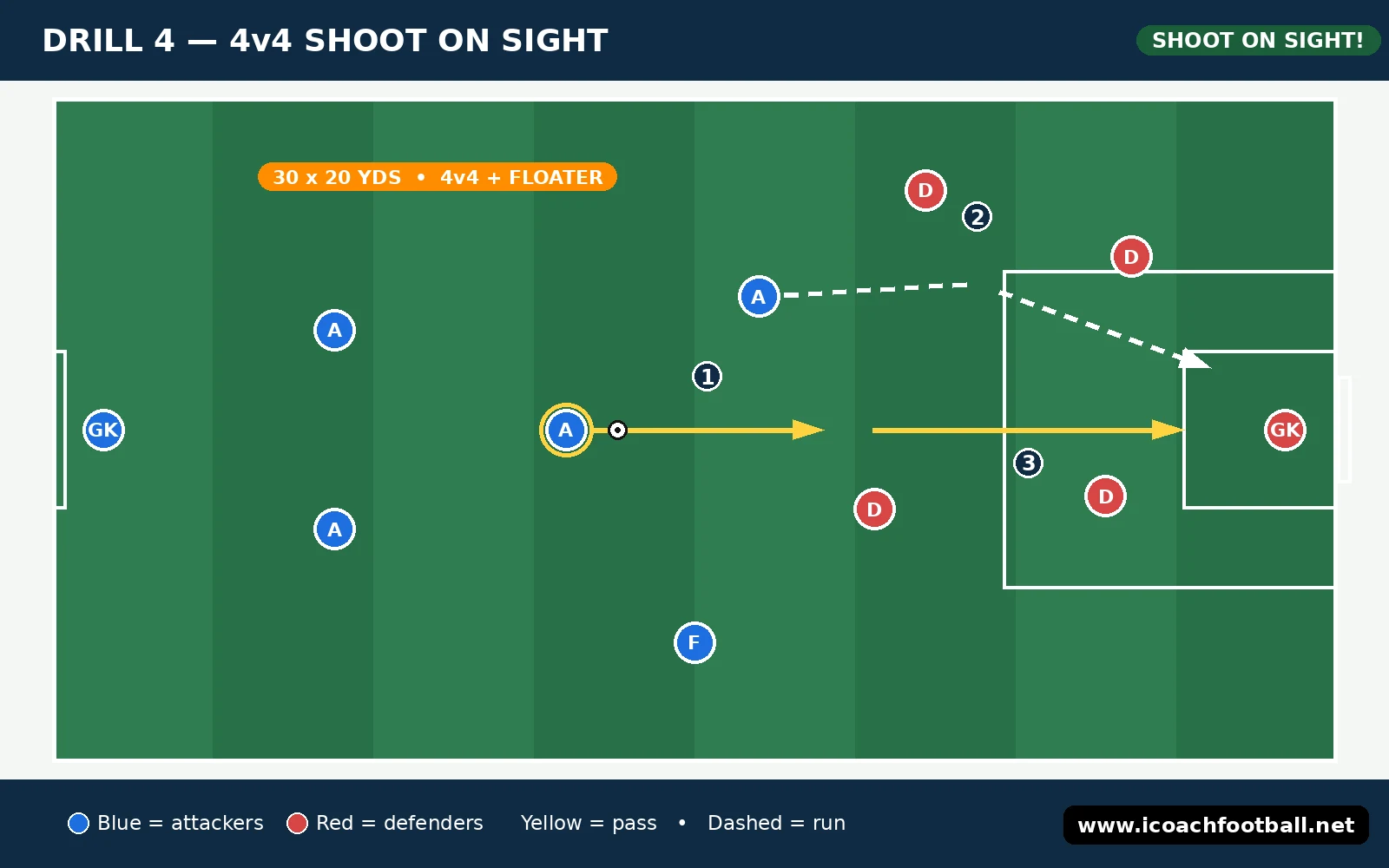
Drill 4 — 4v4 Shoot on Sight
The small game, in line with the FIFA Training Centre transitions session: a possession team must complete 10 passes, and the team that wins it must shoot on sight, fast, into either goal.
Setup:
- A 30 x 20 yard pitch, with a full goal at each end and a goalkeeper in each goal.
- Two teams of 4, plus one floater who always joins the team in possession, making it 5v4.
- Balls with the goalkeepers, and a 4-minute block clock.
How to Play:
- The blue team starts with the ball and tries to complete 10 passes, with the floater and both goalkeepers supporting them.
- The orange team presses to win the ball, staying compact and blocking the central pass.
- The moment orange wins it, they attack either goal at once, with no pass limit and no sideways reset.
- A goal scored within 10 seconds of winning the ball counts double, and the floater swaps sides.
- Rotate the floater every block, and swap which team starts in possession each time.
Coach’s note: The cue is “Shoot on sight!” If the counter takes four passes, freeze play. The unbalanced defence is the chance, and it closes in seconds.
Progressions: Limit the possession team to two touches, then one touch, so the ball is won higher and the counter starts closer to goal.
Drill 5 — Counter or Keep
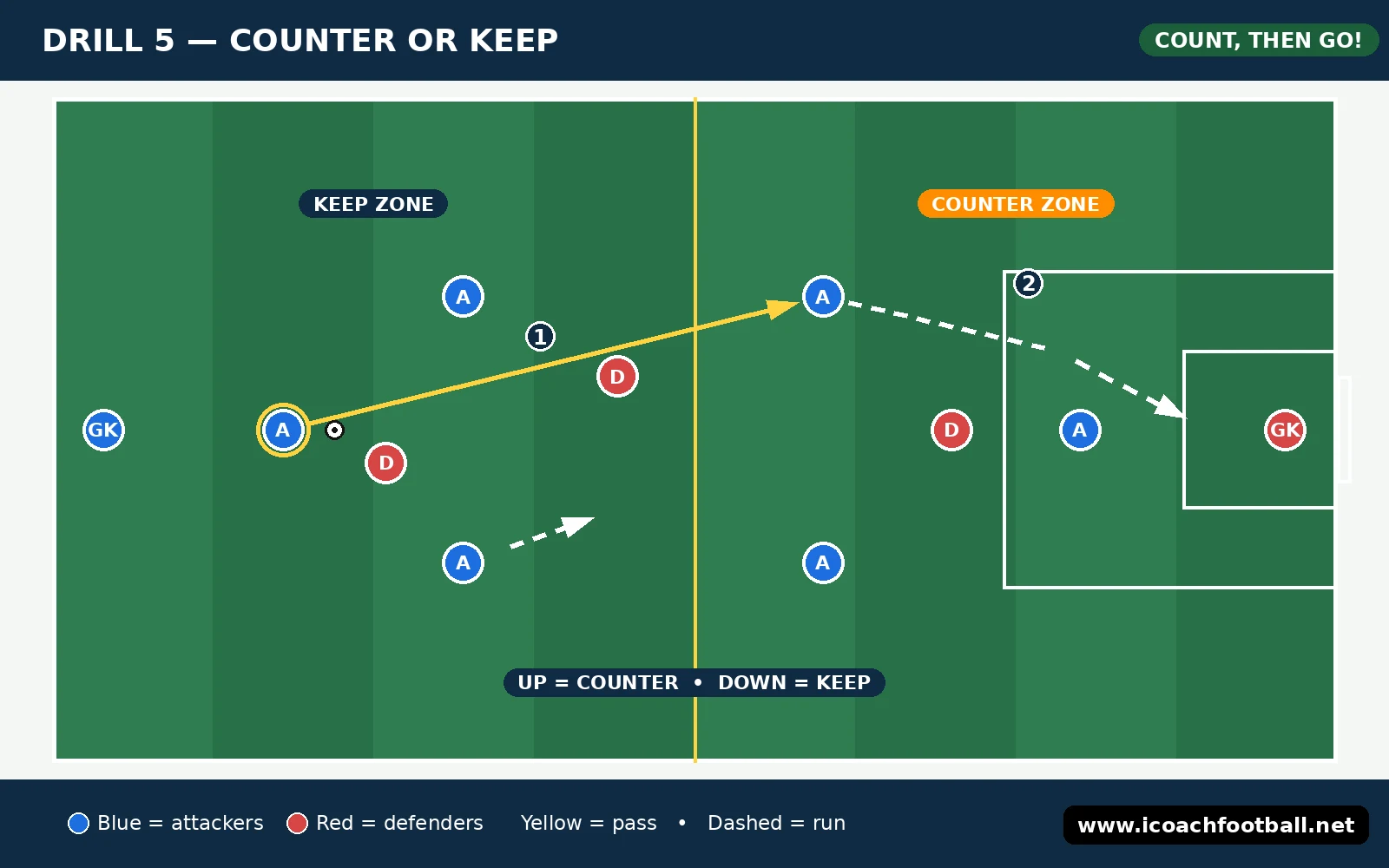
The decision game. Not every turnover is a counter. Players must read the numbers in one second: counter if numbers are up, keep if they are down.
Setup:
- Area 50 x 35 yards, with a goal at each end, a halfway line, and a 10-second shot clock on the coach’s whistle.
- Two teams of 6, with balls starting with the coach on the halfway line.
- A goal scored within 10 seconds of a turnover counts double, and a goal after a kept-ball build counts 1 point.
How to Play:
- The coach plays the ball in, and teams play freely with no touch limit.
- On every turnover, the team that wins it must decide in one second: counter or keep.
- If numbers are up or even with space ahead, they counter at full speed and finish inside 10 seconds.
- If numbers are down, they secure the ball with two safe passes and build, with no long ball.
- The coach freezes play twice per block and asks the ball-winner what they saw, before restarting from the same spot.
Coach’s note: The cue is “Count, then go!” The ball-winner scans and calls “Up!” or “Keep!” before the first pass. A counter with no numbers is just a turnover in a better shirt.
Progressions: The coach starts play with a long ball over the defence, then with a goalkeeper throw, so the turnover comes from different moments and the read must be instant.
Drill 6 — Full-Pitch Counter Game
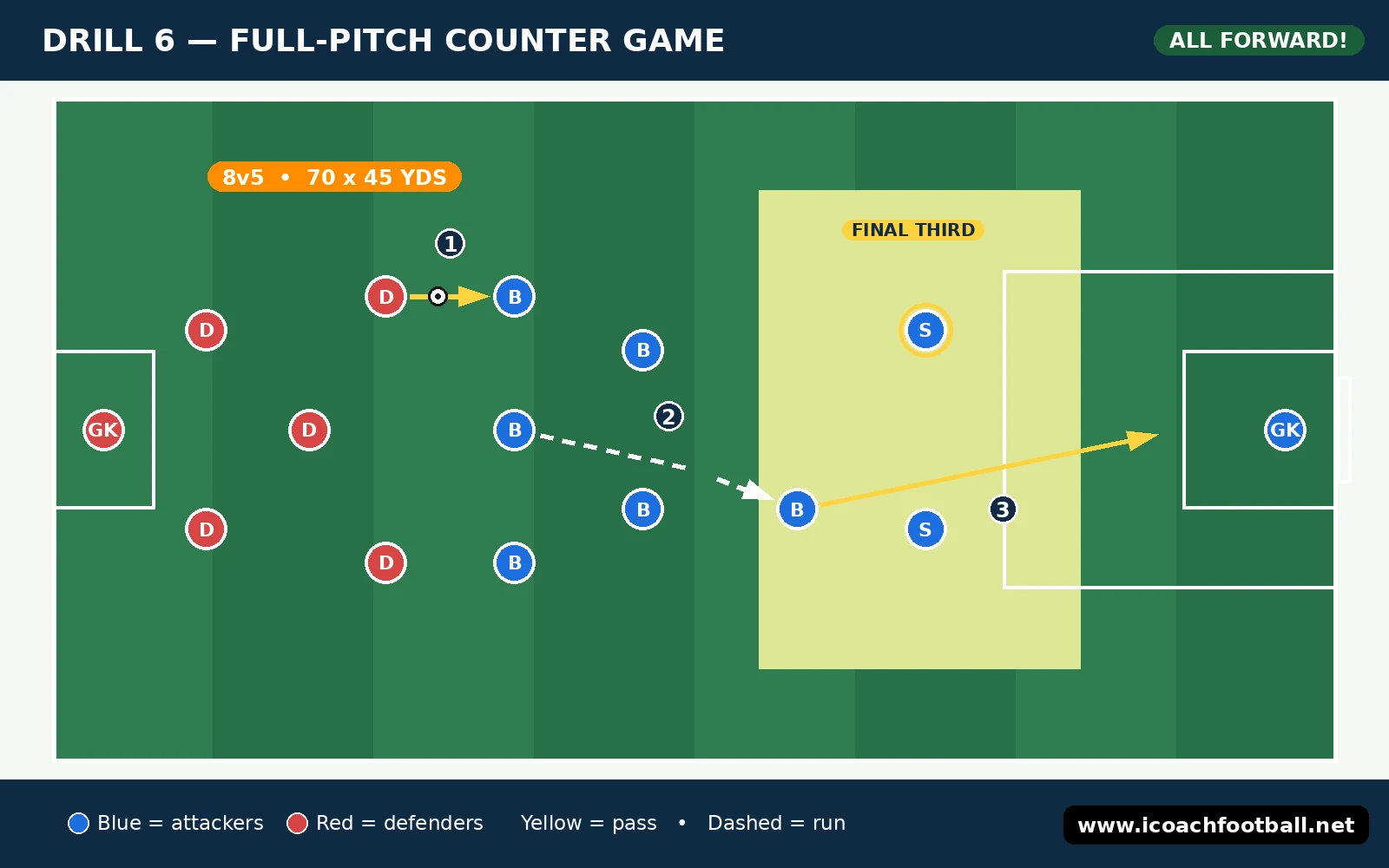
The real game, based on the FIFA Training Centre 8v5 attack-versus-defence exercise: one team builds from the back, the other wins it and launches an 8-player counter, then the roles flip.
Setup:
- Area 70 x 45 yards, with a full goal at each end and a goalkeeper in each goal.
- The building team sets up 4 defenders and 1 midfielder in front of their goalkeeper, and the counter team sets up 6 midfielders on the halfway line plus 2 strikers.
- Balls start with the building team’s goalkeeper, and a 5-minute block clock.
How to Play:
- The building team plays out from the back, trying to beat the press of the 2 strikers.
- As soon as the counter team wins the ball, all 8 players launch forward at once, with the strikers already ahead.
- The counter team must shoot within 10 seconds, and a goal from a counter counts double.
- If the building team wins it back, they must play the ball to the strikers beyond the halfway line, which triggers the next counter the other way.
- Swap the roles every block, and keep a running score across four blocks.
Coach’s note: The cue is “Everyone forward!” A counter with three players is a breakaway, not a team counter. The midfielders must sprint the full length, not jog and watch.
Progressions: The building team adds a second midfielder, making it 8v6, then the counter team must finish in 8 seconds instead of 10.
Coaching points
- “First thought forward!” In Drill 1, the winner’s first look is forward. A sideways first pass gives the defence the seconds it needs.
- “Wall player, go!” In Drill 2, the wall player is the release valve. The counter goes through them at once, not after two safe touches.
- “Sprint past the ball!” In Drill 3, the wide runners must already be moving when the pass is played. A standing receiver kills the counter.
- “Shoot on sight!” In Drill 4, the unbalanced defence closes in seconds. The shot comes early, first time if possible.
- “Count, then go!” In Drill 5, the ball-winner reads the numbers before the first pass. Countering numbers-down just hands the ball back.
- “Everyone forward!” In Drill 6, all eight counter players sprint. The same forward-running habit is trained in these soccer third man runs drills, where the runner arrives from the blindside.
Common mistakes
| Mistake | Fix |
|---|---|
| First pass goes sideways after winning it | Drill 1 cue “First thought forward!”; no rep counts without a forward first pass |
| Only the ball carrier runs, support jogs | Drill 6 cue “Everyone forward!”; every counter needs two runners past the ball |
| Wide player receives standing still | Drill 3 cue “Sprint past the ball!”; restart the rep if the receiver is static |
| Counter takes four passes and the defence resets | Drill 4 cue “Shoot on sight!”; 10-second clock, double points only inside it |
| Team counters numbers-down and loses it | Drill 5 cue “Count, then go!”; freeze play and ask what the ball-winner saw |
| Finish is delayed for the perfect chance | Drill 2, 10 seconds to the mini-goal; a shot on target beats a perfect chance that never comes |
Age adaptations
| Age | Change |
|---|---|
| U12–U13 | Drills 1 and 2 only, no live recovering defender, and count the 10 seconds out loud so the clock is heard |
| U14–U15 | Full six-drill menu with a passive recovering defender in Drill 1 and counters from both channels in Drill 3 |
| U16–U17 | Live presser in Drill 2, one-touch limit for the possession team in Drill 4, and the 8-second finish in Drill 6 |
| U18 | Smaller areas in Drills 4–5, weaker-foot first passes demanded in Drills 1–3, and no coach call on the counter-or-keep decision |
60-minute session plan
Run the six games as one session with this 60-minute plan, or take any two games for a 20-minute block.
| Block | Time | Drill |
|---|---|---|
| 1 | 10 minutes | Drill 1 — Win It, Play Forward Wave |
| 2 | 10 minutes | Drill 2 — The FIFA Transition Rondo |
| 3 | 10 minutes | Drill 3 — Sprint Channels |
| 4 | 10 minutes | Drill 4 — 4v4 Shoot on Sight |
| 5 | 10 minutes | Drill 5 — Counter or Keep |
| 6 | 10 minutes | Drill 6 — Full-Pitch Counter Game |
Once the counter is fast, train the other side of the same moment with these football defensive transition drills, so the team that loses the ball knows how to stop the very counter it has just learned to launch. For the press that wins the ball high in the first place, use these counter-pressing drills, which set the counter up before it starts.
Sources
These soccer counter attack drills are based on, and in line with, the FIFA Training Centre session on transitions, in which players must produce a quick and strong reaction whenever they win back possession, teammates immediately offer support and passing options, and after winning the ball the team with fewer players should play direct football and try to score quickly, and with the FIFA Training Centre session on transition into attack, in which players should always look forward, play forward, run forward and play quickly, the team in attacking transition should be as direct as possible to take advantage of defensive disorganisation, and wide players must stay on their toes to take advantage of transitions.
FAQ
What is a counter attack in soccer?
It is the attack in the seconds after your team wins the ball, while the other team is still spread out from its own attack. The first pass goes forward, runners sprint past the ball, and the shot comes before the defence gets set, usually inside 10 seconds.
How fast should a counter attack be?
Aim for a shot inside 10 seconds of winning the ball. That clock is the whole point of these drills. If the attack needs four passes, the defence has recovered, and the counter has become a normal build-up.
Should every turnover become a counter attack?
No. Counter when numbers are up or even with space ahead, and keep the ball when numbers are down. Drill 5 trains that one-second read. Countering numbers-down just hands the ball straight back in a worse position.
Can counter attack drills work for youth teams?
Yes, from U12 with the wave in Drill 1 and no live recovering defender. Young players learn the habit first — first pass forward, two runners past the ball, shoot early — and only meet a live press in Drill 2 once the shape is automatic. The same games work in football at every age, because the 10-second rule does not change.
Why do counter attacks fail in games?
Three reasons cover most failures: the first pass goes sideways, only the ball carrier runs, or the finish is delayed for a perfect chance. Fix them in that order with Drills 1, 6 and 4, and only then demand the pattern in the full-pitch game in Drill 6.