Soccer Drills for Elementary School: 6 Games That Work With 25 Kids, One Teacher and 45 Minutes
Quick answer
Elementary school soccer means 25 kids, one teacher, a 45-minute period and a huge range of ability. These six games work with that reality: every child has a ball, nothing lasts longer than 8 minutes, and every game ends with a goal.
Suitable for: U6–U11 (ages 5–11)
Session snapshot
- Players: 16–30 (one class)
- Area: School gym, hall or half a pitch
- Duration: 45 minutes
- Focus: Dribbling, passing, 1v1s, scoring
- Equipment: 1 ball per child, 20 cones, 8 mini goals or pop-up goals, bibs
Why these six games work
In the UK the same session is a primary school football lesson, and the problem is identical on both sides of the Atlantic: one adult, a whole class, a short period, and children who range from “plays every weekend” to “never touched a ball”. The six games below are built for that class, and they follow the FIFA Training Centre’s own grassroots sessions for ages 4–8: “#12: Improving all areas” runs 4v4 on four goals, a gate-passing exercise and a 4v4 game, and Dr Jené Baclawski’s “Dribbling as a positive start” shows why dribbling unopposed builds confidence before any pressure is added. This post is the elementary companion to our soccer drills for middle school players — that post trains the 11–13 school team; this one trains the 5–11 class, in the gym or on the field, with the same one-teacher reality.
Six rules of elementary school soccer
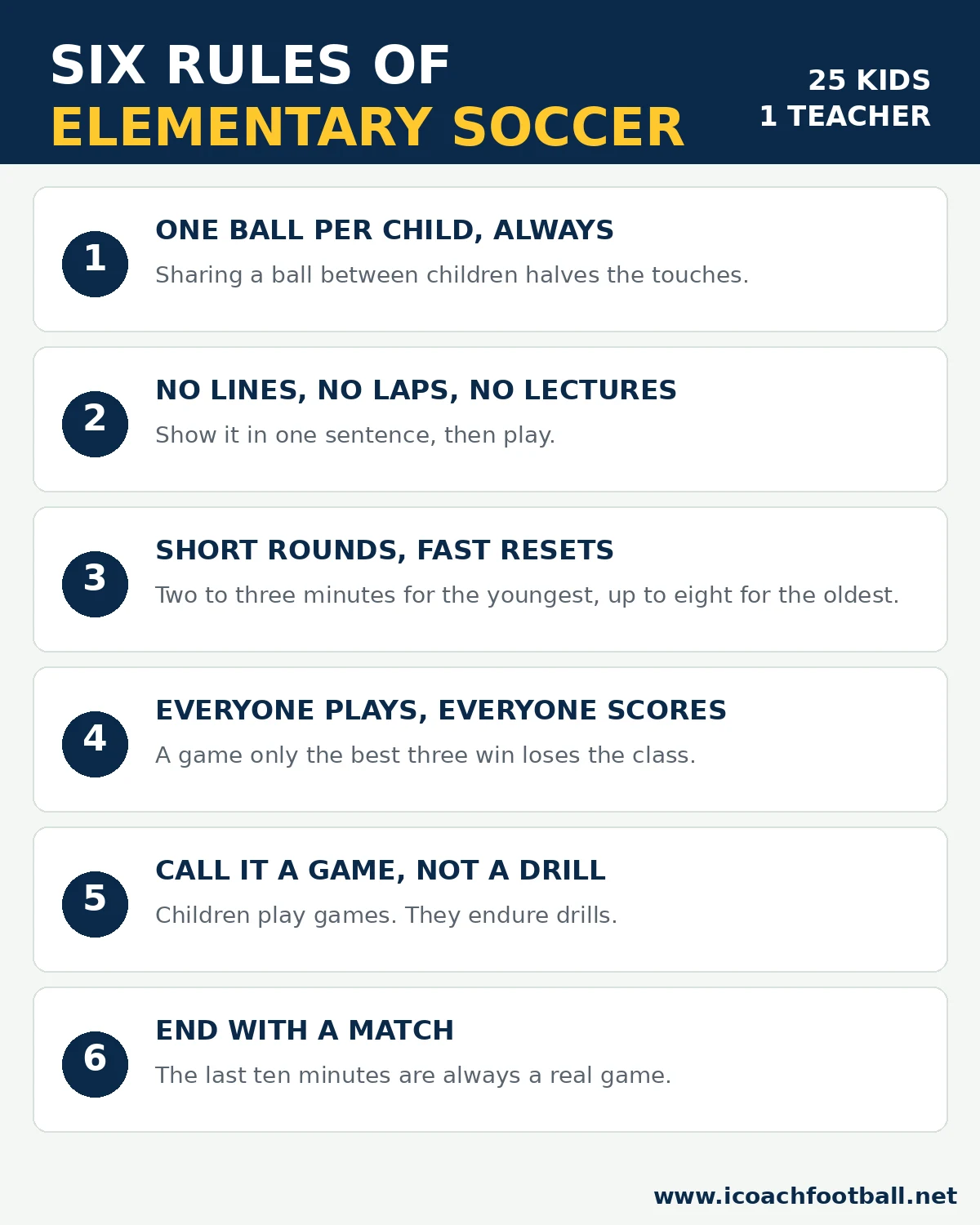
- One ball per child, always. Sharing a ball between children halves the touches.
- No lines, no laps, no lectures. Show it in one sentence, then play.
- Short rounds, fast resets. Two to three minutes for the youngest, up to eight for the oldest.
- Everyone plays, everyone scores. A game only the best three children win is a game that loses the class.
- Call it a game, not a drill. Children play games. They endure drills.
- End with a match. The last ten minutes are always a real game.
Drill 1 — Traffic Light Dribble
Every child dribbles in the area while the teacher calls the lights. Green means go fast, yellow means go slow, red means stop dead. This is the dribbling start the FIFA Training Centre recommends for ages 4–8: unopposed, plenty of touches, confidence first.

- Setup: 16–30 children, 1 ball each. 20 x 15 yard area. 3 coloured cones (red, yellow, green) held up or placed at the side.
How to play:
- Every child dribbles their ball inside the area.
- Teacher shouts “green” — dribble fast, small touches.
- Teacher shouts “yellow” — dribble slowly, ball close.
- Teacher shouts “red” — stop the ball dead under the foot.
- The last child still moving on “red” does 5 toe taps.
- After 2 minutes, add a turn: on “red”, turn and face the teacher.
- Coach’s note: “Small touches, head up — the ball stays close enough to stop in one step.”
- Progressions: Use only the weak foot on “green”; add a “blue light” that means dribble to the nearest cone and back.
Drill 2 — Sharks and Minnows
Minnows dribble across the sea while sharks try to kick their balls out. The game every elementary teacher already knows, run as a real dribbling drill with a coaching point attached.

- Setup: 20 x 15 yard “sea” with safe zones at each end. 2–3 sharks in bibs. 1 ball per minnow. 8 minutes.
How to play:
- Minnows line up on one end line, each with a ball.
- Sharks wait in the middle of the sea.
- On “go”, minnows dribble across to the far safe zone.
- A shark who kicks a ball out turns that minnow into a shark.
- Minnows who cross safely wait in the far zone.
- Play 3 crossings, then pick new sharks and start again.
- Coach’s note: “Keep the ball on the far side of your body — the shark can’t reach through you.”
- Progressions: Minnows must use only their weak foot; sharks must stay inside a marked circle; the sea gets narrower each round.
Drill 3 — Gate Passing Race
Pairs pass through cone gates and race to the finish. The passing exercise from the FIFA Training Centre’s “#12: Improving all areas” session — gates wide to start, narrower as the children improve, weaker foot when they are ready.

- Setup: 8 gates (two cones, 2 yards apart) in a 20 x 15 yard area. Children in pairs, 1 ball per pair. 8 minutes.
How to play:
- Each pair stands at the first gate with a ball.
- One player passes through the gate to their partner.
- Both players move to the next gate.
- The pair passes through every gate in order.
- First pair through all 8 gates wins the race.
- Swap passing foot each round and move the gates.
- Coach’s note: “Pass to the foot that is open — a pass behind your partner kills the race.”
- Progressions: One-touch passing only; gates get narrower; add a defender pair who blocks gates.
Drill 4 — Pass and Move Square
Four corners, one ball, pass and follow your pass. The first team game in the session, and the one that teaches the habit every later drill needs: pass, then move.

- Setup: 15 x 15 yard square, 1 cone per corner. Groups of 5 (4 corners + 1 in the middle). 1 ball per group. 8 minutes.
How to play:
- Four players stand on the corners, one player in the middle.
- Corner players pass clockwise around the square.
- After passing, run to the next corner clockwise.
- The middle player tries to intercept the pass.
- If the middle player wins it, they swap places with the passer.
- After 2 minutes, the middle player changes and the square shrinks.
- Coach’s note: “Pass, then run — the square only works if the passer moves.”
- Progressions: Two-touch maximum; one-touch only; the middle player becomes two defenders.
Drill 5 — Treasure Hunt 2v2
Two teams race to collect treasure cones and score goals. A 2v2 duel in the FIFA grassroots pattern — small teams, a ball, and a decision to make every few seconds.
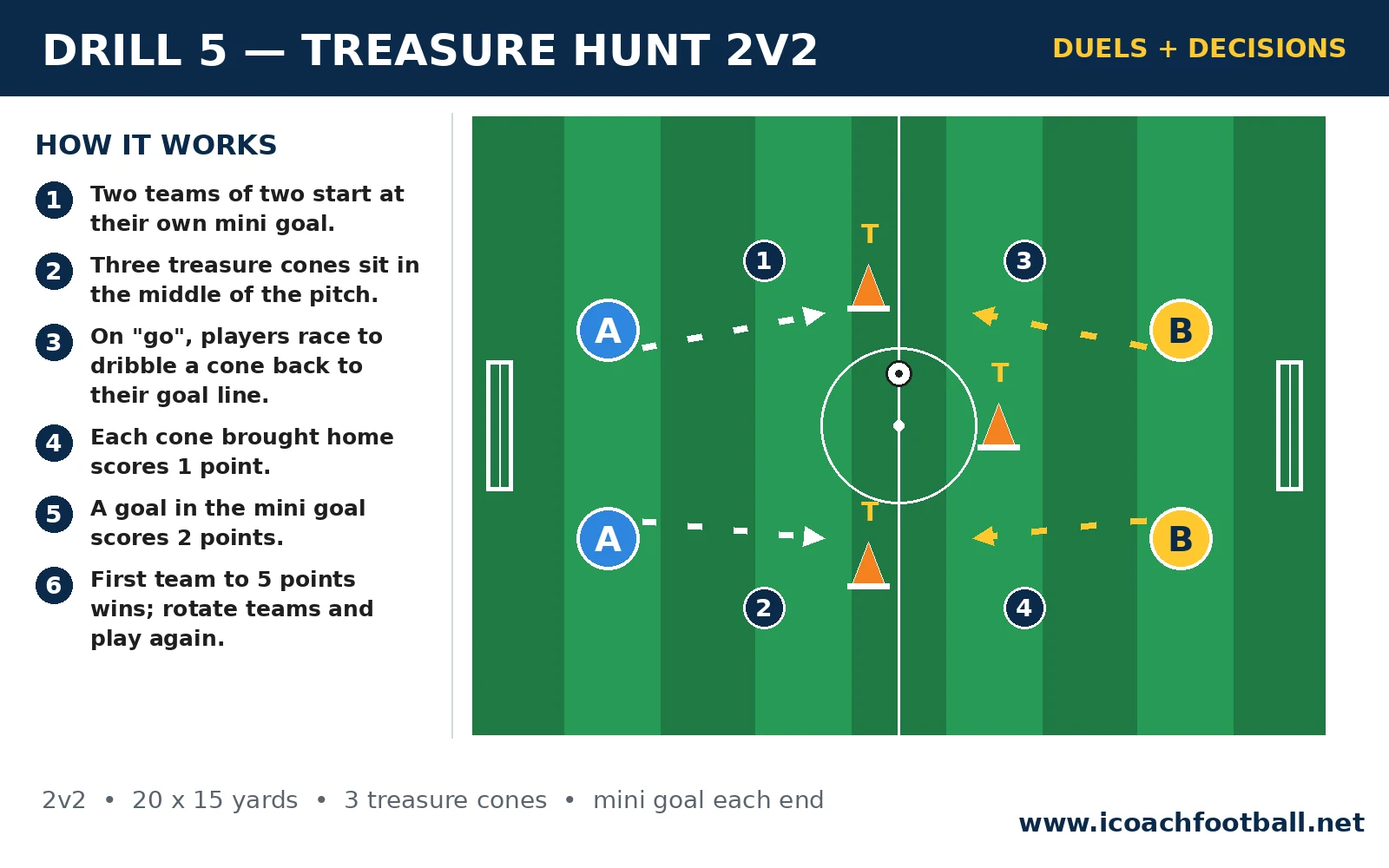
- Setup: 20 x 15 yard pitch, mini goal at each end. 3 “treasure” cones in the middle. 2v2, 1 ball. 8 minutes.
How to play:
- Two teams of two start at their own mini goal.
- Three treasure cones sit in the middle of the pitch.
- On “go”, players race to dribble a cone back to their goal line.
- Each cone brought home scores 1 point.
- A goal in the mini goal scores 2 points.
- First team to 5 points wins; rotate teams and play again.
- Coach’s note: “The treasure is the bait — the player who watches the cone forgets the ball.”
- Progressions: Add a third player per team (3v3); cones must be collected with the weak foot only; goals only count after a cone is collected.
Drill 6 — Four-Goal Game
A 4v4 game on four goals — two on each touchline — in which either team can score in any goal. This is the warm-up game from the FIFA Training Centre’s “#12: Improving all areas” session, and it is the best finishing game for a big class: four goals means nobody waits for a turn to shoot.


- Setup: 30 x 20 yard pitch, 4 mini goals (2 on each touchline). 4v4, 1 ball. 10 minutes.
How to play:
- Play a normal game, but either team can score in any of the four goals.
- After a goal, the other team starts with the ball.
- After 3 minutes, each team may only score in two goals.
- Rotate teams every 3 minutes so everyone plays new opponents.
- Players referee their own game — the teacher only stops play to praise a good decision.
- Play two 5-minute halves, then count the goals.
- Coach’s note: “Stop the game once and ask: which goal was open? Then let them find it themselves.”
- Progressions: A team must complete 3 passes before it can score; a team must score in all four goals to win a point; add goalkeepers for the oldest group.
Coaching points: the five mistakes that kill elementary sessions
| Mistake | What you see | Fix |
|---|---|---|
| Kids chasing the ball in a pack | 25 children around one ball | One ball per child — the pack disappears |
| Lines and waiting | Half the class standing still | Split into small games — no game with a queue |
| Talking too long | Eyes glaze over after 30 seconds | Show it, don’t tell it — one sentence, then play |
| Only the best kids scoring | The same 3 children score every game | Everyone must touch the ball before a goal counts |
| Heading the ball | Young players heading in games | No heading at U11 and under — keep the ball on the ground |
Age adaptations
| Age | Ball | Area | What changes |
|---|---|---|---|
| U6–U8 (ages 5–8) | Size 3 | 15 x 10-yard grids | Drill 1 runs 2 minutes with big spaces; Drill 2 runs with 1 shark only; Drill 3 runs with wide gates and rolling the ball allowed; Drill 4 runs 4v0 with no middle player; Drill 5 runs 1v1; Drill 6 runs with all four goals open and no goalkeepers — see our U6 soccer practice plan and U7 soccer practice plan |
| U9–U10 (ages 8–10) | Size 4 | 20 x 15-yard grids | All six drills as written; Drill 2 runs with 2 sharks; Drill 3 runs with narrower gates; Drill 4 runs with one middle player; Drill 6 runs with the two-goal rule after 3 minutes — see our U8 soccer practice plan, U9 soccer practice plan and U10 soccer practice plan |
| U11 (ages 10–11) | Size 4 | 25 x 20-yard grids | Drill 1 runs with weak-foot rounds; Drill 2 runs with 3 sharks in a narrower sea; Drill 3 runs one-touch; Drill 4 runs with two middle players; Drill 5 runs 3v3; Drill 6 runs with goalkeepers and the four-goal point — see our U11 soccer practice plan and soccer drills for U13 for the next step up |
45-minute session plan
| Time | Block | Drill |
|---|---|---|
| 0:00–0:05 | Warm-up | Drill 1 — Traffic Light Dribble |
| 0:05–0:13 | Dribbling game | Drill 2 — Sharks and Minnows |
| 0:13–0:21 | Passing | Drill 3 — Gate Passing Race |
| 0:21–0:29 | Passing game | Drill 4 — Pass and Move Square |
| 0:29–0:37 | Small-sided game | Drill 5 — Treasure Hunt 2v2 |
| 0:37–0:45 | Match-real finish | Drill 6 — Four-Goal Game |
Running an after-school club instead of a class period? Stretch each block to 10 minutes and you have the full 60-minute session — see our 60-minute plan for the structure.
Keep building from here
These six games are the start, not the whole curriculum. For the same class a year older, our soccer drills for middle school players run the 11–13 school team in one 60-minute session, and our soccer drills for U13 take the same age group into club football. Younger children start with our soccer drills for 5 year olds, then move through the U6 soccer practice plan, the U7 soccer practice plan, the U8 soccer practice plan, the U9 soccer practice plan, the U10 soccer practice plan, the U11 soccer practice plan and the U12 soccer practice plan. Build the individual skills next: soccer dribbling drills for the close control Drill 1 and Drill 2 need, soccer passing drills for the weight and accuracy Drill 3 and Drill 4 need, soccer scanning drills so receivers check before the ball arrives, 1v1 finishing drills for the duel in Drill 5, and weak foot soccer drills so both feet can play the gate race. Pairs work is the next step up from one ball per child: soccer drills for two players run the same skills in pairs, soccer drills for 3 players no goalie adds a third runner, and the rondo pairs game turns the same skills into a keep-away competition. Then open the pitch up: soccer 3v3 drills, soccer 4v4 drills and soccer 5v5 drills run the same combinations in bigger games, and soccer drills for 12 players show how to run them with a full class. If the weather turns, our indoor soccer drills for kids move the same session into the hall, and our rainy day soccer practice plan is the backup when the field is unplayable. New to coaching? Start with soccer drills for beginners, and if you run selections, our soccer tryout drills show how to grade a big group fairly.
FAQ
What are the best soccer drills for elementary school?
The six in this post cover the full elementary skill set: traffic light dribbling for close control, sharks and minnows for dribbling under pressure, a gate passing race for accuracy, a pass-and-move square for the pass-then-move habit, a treasure hunt 2v2 for duels and decisions, and a four-goal game to finish. Run them as the 45-minute plan above.
How long should an elementary school soccer session be?
Forty-five minutes is the right length for an elementary school soccer session — that is one class period, and it matches the attention span of 5 to 11-year-olds. No single game should last longer than 8 minutes for the youngest children; the six games in this post run 5 to 10 minutes each. If you run an after-school club, stretch each block to 10 minutes for a full 60-minute session.
How do you run soccer with 25 kids and one teacher?
Give every child a ball, split the class into small games, and never run a drill with a queue. One ball per child kills the pack-chasing problem, small-sided games of 2v2 and 4v4 mean everyone is involved, and short two-to-three-minute rounds mean a weak round is forgotten fast. The six games in this post are all built for one adult and a full class.
What size soccer ball do elementary school kids use?
Size 3 for ages 5 to 8 (U6–U8) and size 4 for ages 8 to 11 (U9–U11). Use a size 4 for the whole class only if the youngest children are 8 or older. Keep the ball on the ground: there is no heading at U11 and under, following US Soccer guidance, so none of the drills in this post use headers.
Can these drills run in a gym or hall?
Yes. All six games run indoors on a gym floor or in a hall — use a low-bounce futsal ball or a soft indoor ball, mark the areas with flat cones or tape, and use pop-up goals or wall targets instead of mini goals. Our indoor soccer drills for kids show the same skills in a hallway-sized space.
Sources
- FIFA Training Centre, “#12: Improving all areas” — grassroots session for ages 4–8: a 4v4 game on four goals, a gate-passing exercise, and a 4v4 game on two goals; key points — maximum four players per team, rotate teams against different opponents, short matches with rest breaks. https://www.fifatrainingcentre.com/en/practice/grassroots/4-to-8/improving-all-areas.php
- FIFA Training Centre, “Jené 3: Ages 4-8: Dribbling as a positive start” — Dr Jené Baclawski, Grassroots Coaching Essentials: dribbling unopposed builds confidence, freedom and creativity, then 1v1 and 2v2 duels test the skills in game-like scenarios; key points — continuous contact with the ball, simple instructions, praise. https://www.fifatrainingcentre.com/en/practice/grassroots/grassroots-and-youth-football-essentials/grassroots-coaching-essentials/jene-3-dribbling-as-a-positive-start.php
Coaching a girls’ team next? Our soccer drills for girls run the same six skills — dribbling, passing, 1v1s and finishing — with a FIFA 11+ Kids safe-landing warm-up and a 60-minute plan for U10–U15.