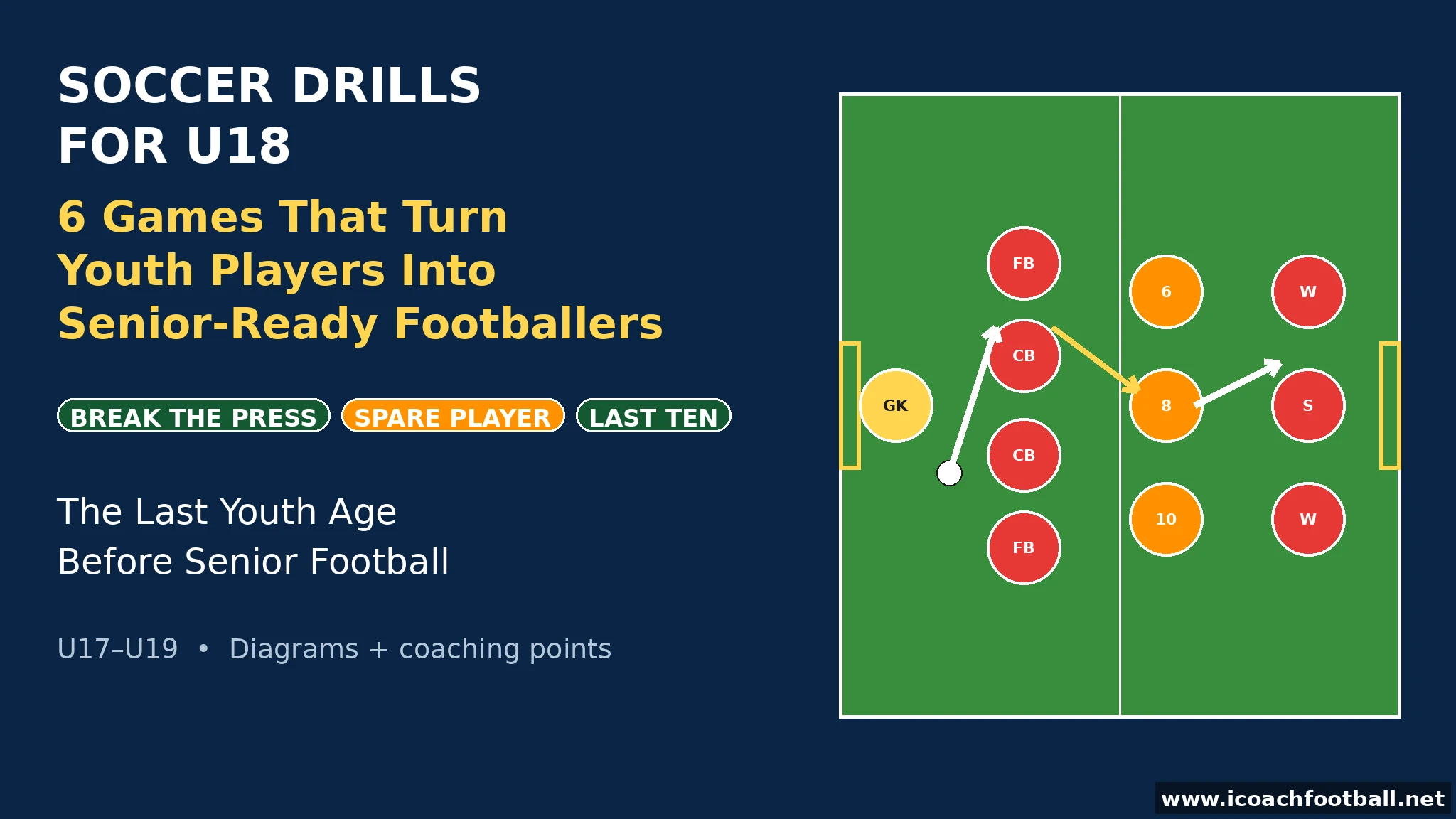
Soccer Drills for U18: 6 Games That Turn Youth Players Into Senior-Ready Footballers
Quick answer
U18 is the last youth age — the step into senior football. These six soccer drills for U18 teach a 17- and 18-year-old team to break a real press, use the spare player, win physical duels, play at senior speed, defend their own box — and win the last ten minutes of a game at full intensity.
Suitable for: U17–U19
In soccer — football in the UK and most of the world — U18 is where the game stops being forgiving. Opponents are stronger, faster and better organised, and a slow decision is punished in seconds. The six games below follow the structure FIFA Training Centre uses in its elite sessions: progress through the thirds against a press, create and exploit overloads, then play the game at senior speed.
Session snapshot
- Players: 18–22 (two teams of 11 for the full game; 12–16 for the small games)
- Area: A full pitch for the game; grids 25 x 20 to 45 x 35 yards for the drills
- Duration: 60 minutes
- Focus: Breaking the press, overloads, physical duels, senior speed of play, box defending, and game management
- Age: U17–U19 (see Age adaptations)
The six U18 rules
Every one of these soccer drills for U18 is built on six rules. Teach them once, then repeat them in every game until the players say them back to you.

| Rule | What it means |
|---|---|
| Play through the press | A long ball skips the midfield and skips the learning — break the first line as a unit |
| Use the spare player | An overload is only an advantage if the free player gets the ball — find them every time |
| Win your duel, then play | Shield it, protect it, then lay it off — the pass comes after the duel is won |
| One touch is senior speed | At senior level the ball moves faster than any player — two touches is the maximum |
| Defend your box first | Nothing matters if the ball keeps going in your net — the box is defended as a unit |
| Manage the last ten | The final minutes are won with the head — protect a lead, chase a goal, control a draw |
Drill 1: Break the Press
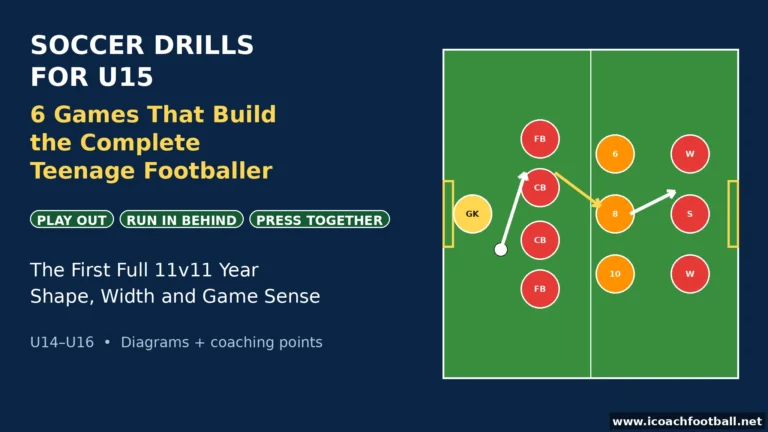
The press-break lesson. The unit builds from the keeper through the central channel against two high pressers, and a goal only counts after the ball has broken the first pressing line. Based on the FIFA Training Centre exercise “Progressing through the thirds”, in which the goalkeeper starts a build-up that must play through the central channel to break through the opposition’s high press — the unit of keeper, two centre-backs, the No. 6 and a No. 8 breaks the first line as a unit, receiving on an open body shape and deciding together whether to play through or around the press.
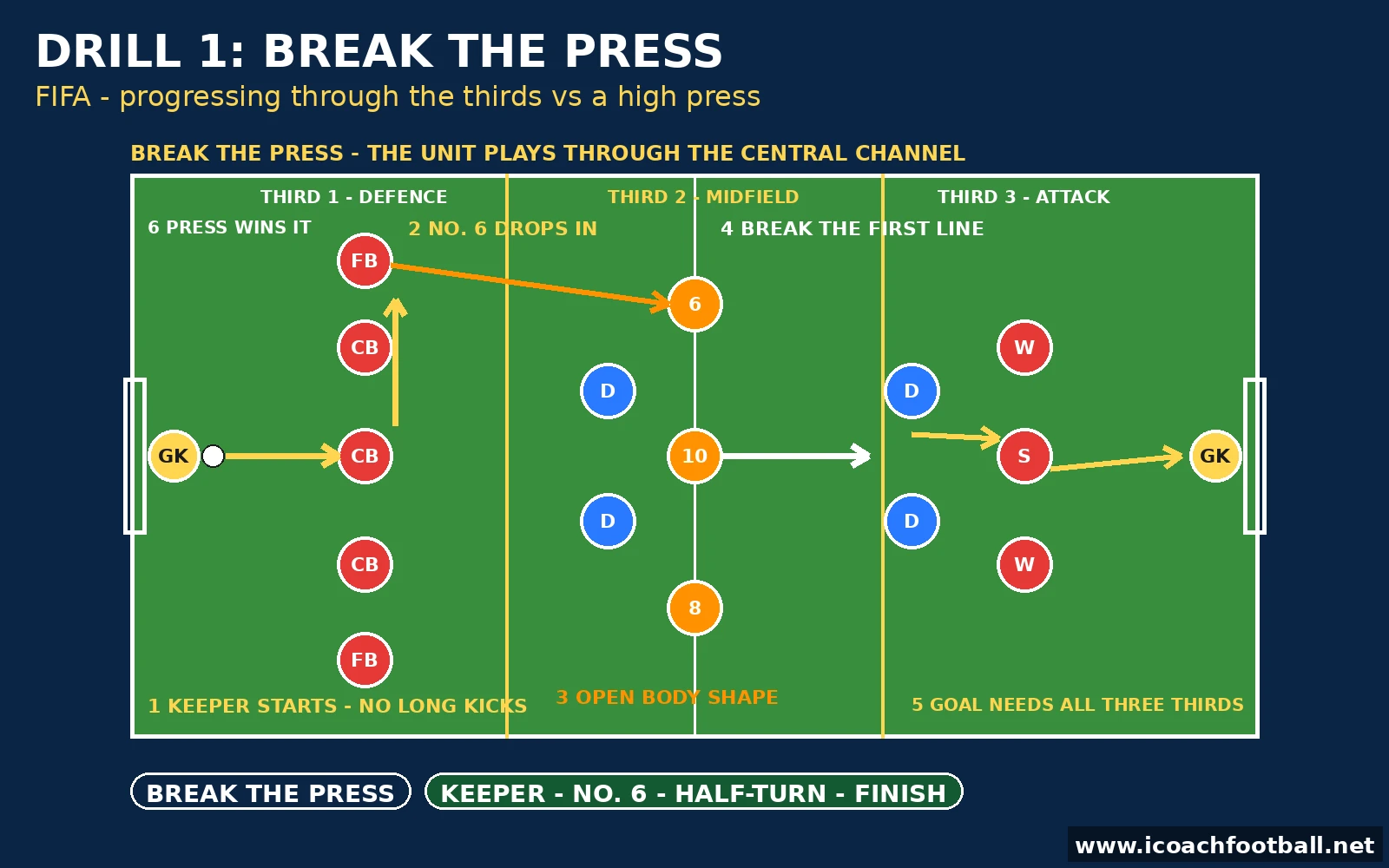
Setup: A 45 by 35 yard pitch split into three zones, two full-size goals with keepers, 8v8 plus 2 neutrals who always join the team in possession, size 5 ball.
How to play:
- The keeper starts every attack — no long goal kicks, the ball goes to a centre-back.
- The two pressers hunt the first pass; the No. 6 drops in to give the centre-backs a third option.
- The centre-backs receive on an open body shape — half-turned, so they can see the press and the next pass.
- The ball must break the first pressing line through the central channel before it goes wide.
- A goal only counts if the ball has touched all three thirds — defence, midfield, attack.
- If the press wins it in the first third, the pressing team scores in the mini goals behind them.
Coach’s note: Watch the first receiver’s body shape — a centre-back who receives square-on can only play backwards; the cue is “play through the press,” and our soccer passing drills build the one- and two-touch habit this build-up needs, while our soccer drills for midfielders train the No. 6 drop this press-break depends on.
Progressions: The pass into midfield must break a line with the receiver’s first touch; the pressers may start from the keeper’s first touch, so the build must be faster; the neutrals are removed, so the unit must solve the press alone.
Drill 2: Use the Spare Player
The overload lesson. A wave game builds a 4v3 in the final third, and the spare player is the one who finishes. Based on the FIFA Training Centre session “Creating and exploiting overloads (Clement)”, in which a passing sequence turns into a 2v1 in the final third, a wave game presents a series of overload scenarios, and an 8v7 exercise creates 4v3 overloads — attackers interchange positions and make intelligent runs to create the overload, then use the spare player at all times and create 2v1s inside it.

Setup: Half a pitch with a full-size goal and a keeper, 8 attackers against 7 defenders plus a keeper, 2 wide neutrals, balls with the coach.
How to play:
- The coach plays the first wave in — the attackers build from the back against a set defence.
- The attackers interchange positions until a 4v3 appears in the final third.
- The spare player is found every time — a pass to the free player is worth a point on its own.
- Inside the overload, create a 2v1 — isolate one defender, then use the runner beyond them.
- The wave ends in a finish within ten seconds of the overload appearing.
- After each wave the teams reset — the next wave starts from the coach, not from a goal kick.
Coach’s note: Watch the pass into the overload — a team that finds the spare player late has already lost the advantage; the cue is “use the spare player,” and our soccer drills for U17 train the same overload one age down, while our football late runs into the box drills train the late arrival that finishes it.
Progressions: The spare player must finish first time; the wave starts with the defenders already pressing, so the overload must be created under pressure; the neutrals are removed and the 4v3 must be created by a run, not a pass.
Drill 3: Win the Physical Duel
The physical lesson. A striker receives with a defender on their back, shields shoulder to shoulder, protects the ball and lays it off — then spins for the return. At U18, senior defenders lean on you; a striker who cannot hold them off never gets a touch.

Setup: A 25 by 20 yard channel in front of a full-size goal with a keeper, 1 striker, 1 defender, 1 supporting midfielder, 1 recovering defender, balls with the coach.
How to play:
- The coach plays to the striker, who is marked tight by the defender.
- The striker shields the ball shoulder to shoulder — low base, arm feeling the defender, ball on the far foot.
- The striker holds it for a count of three, then lays it back to the supporting midfielder.
- The midfielder plays forward first time and the striker spins for the return.
- The recovering defender sprints back, so the finish must come within five seconds.
- Swap roles so every player shields, supports and recovers.
Coach’s note: Watch the striker’s base — a player who stands tall gets pushed off the ball; the cue is “win your duel, then play,” and our soccer drills for strikers train the finish that has to follow the lay-off, while our soccer tackling drills train the defender’s side of the same duel.
Progressions: The defender may only be beaten on the outside; the lay-off must be first time; the recovering defender starts five yards closer, so the combination must be one touch.
Drill 4: Play at Senior Speed
The speed-of-thought lesson. One- and two-touch passing in a tight grid, with a third-man run arriving on every lay-off. At senior level the ball moves faster than any player — a team that needs three touches is a team that gets pressed.
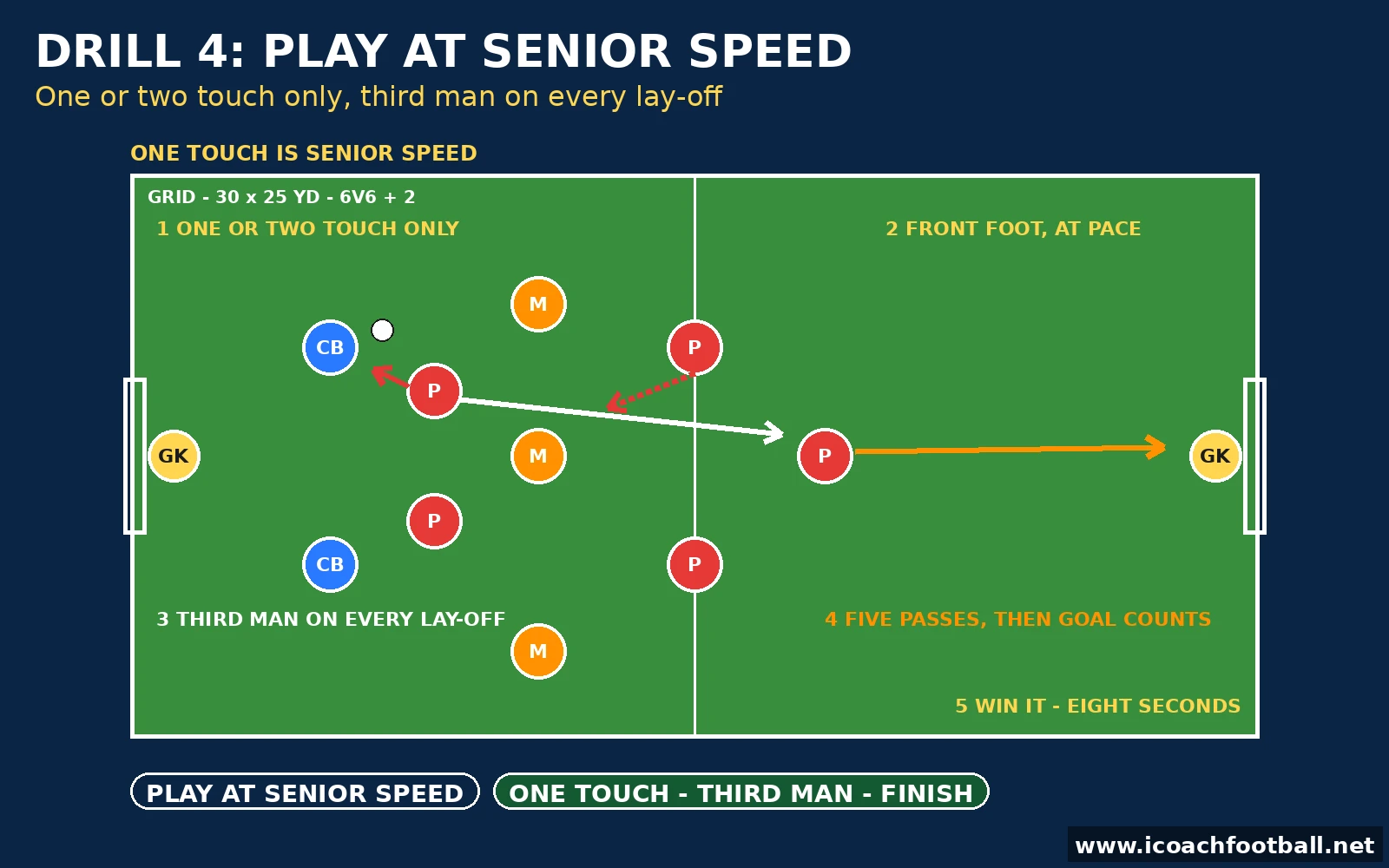
Setup: A 30 by 25 yard grid with four mini goals, 6v6 plus 2 neutrals who always join the team in possession, size 5 ball.
How to play:
- The team in possession plays one or two touch only — a third touch gives the ball away.
- Every pass must be played to the receiver’s front foot, at pace, so the next pass can be first time.
- The third man arrives on every lay-off — the run is timed to the pass, not after it.
- A goal only counts after five consecutive passes — no long ball to skip the build.
- Win it back and the team has eight seconds to score in a mini goal.
- After five minutes the teams swap — the pressing team must now play at speed.
Coach’s note: Watch the third touch — a player who takes three touches has stopped the ball and stopped the game; the cue is “one touch is senior speed,” and our soccer possession drills build the patience to keep the ball, while our soccer dribbling drills train the one moment when a touch to beat a player is the right call.
Progressions: The grid shrinks to 25 by 20 yards; the neutrals are removed; the third-man run must end in a first-time finish.
Drill 5: Defend Your Box
The box-defending lesson. The back four holds its line against crosses and cutbacks, the keeper calls every mark, and every clearance starts a counter. Senior football punishes a box that is defended by individuals — this one is defended as a unit.

Setup: One full-size goal with a keeper and the penalty box, 6 attackers, 5 defenders plus a keeper, 2 wide servers, balls with the servers.
How to play:
- The server crosses from wide — the back four holds its line and the keeper calls the marks.
- The near-post defender attacks the first ball; the far-post defender covers the second.
- The midfielders track runners from deep — no unmarked arrival at the edge of the box.
- Every clearance must go to a team-mate, not into the stands — a clearance to a team-mate starts the counter.
- Each attack gets five reps, then the teams swap — attackers become defenders.
- Count the goals conceded: a defence that concedes none in five reps wins the drill.
Coach’s note: Watch the keeper’s call — a back four with no voice is four players standing in a box; the cue is “defend your box first,” and our soccer drills for center backs train the partnership this drill depends on, while our football defending set pieces drills train the marking side.
Progressions: The server may cut it back instead of crossing, so the line must read the cutback; the edge-of-the-box player must shoot first time from every clearance; add a second-ball rule: every clearance is a live ball.
Drill 6: Win the Last Ten
The match-real finish. The full 11v11 game in a 4-3-3, played as three eight-minute scenarios at full intensity — protect a lead, control a draw, chase a goal — and the score at the end of each scenario is the score that counts.
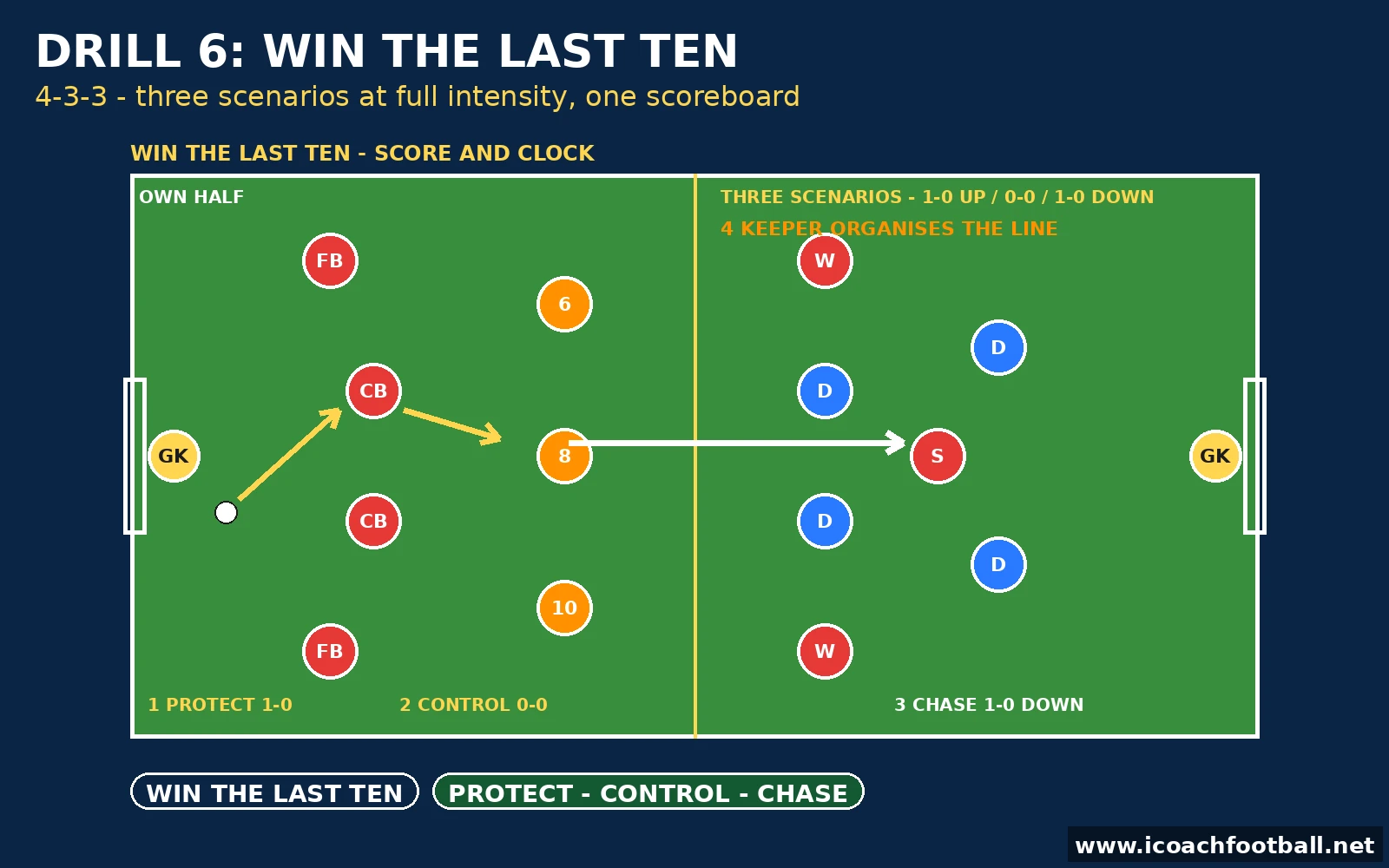
Setup: A full pitch with two full-size goals and a keeper in each, 11v11 in a 4-3-3 shape, size 5 ball, a scoreboard the coach updates.
How to play:
- Scenario one: your team leads 1-0 with eight minutes left — protect it, keep the ball in their half, no risks.
- Scenario two: it is 0-0 — control the game, break the press, no goal conceded.
- Scenario three: your team trails 1-0 — chase it, push the full-backs on, the keeper joins the build.
- The keeper organises the line in every scenario — the back four moves on their call.
- A goal only counts after a pass through midfield — a long ball over the top does not count.
- Play two-minute water breaks between scenarios, then ask the players what changed.
Coach’s note: Watch the shape when the ball is lost in scenario one — if the team is still stretched, the counter runs straight through them; the cue is “manage the last ten,” and our soccer goalkeeper communication drills train the keeper’s calls this game depends on, while our soccer 11v11 drills and our soccer 9v9 drills build the same habits at the next sizes down.
Progressions: Scenario one starts 1-0 up with only five minutes left; scenario three starts 2-0 down; the keeper must play out short every time — no long goal kicks.
Coaching points
- Play through the press, not over it: A long ball skips the midfield and skips the learning — our soccer passing drills build the one- and two-touch habit this build-up needs, and our soccer drills for U17 train the same press-break one age down.
- Use the spare player every time: An overload is only an advantage if the free player gets the ball — our soccer drills for U16 run the same six-game structure two ages down, and our soccer 8v8 drills train the same overload on a smaller pitch.
- Win your duel before you pass: A pass made before the duel is won is a pass made under pressure — our soccer dribbling drills train the move, and our soccer tackling drills train the challenge on the other side of it.
- Scan before you receive: A midfielder who checks over their shoulder knows whether the third-man lane is open before the ball arrives — our soccer scanning drills teach that shoulder check.
- Width is a weapon: Full-backs who stay wide stretch the press; players who drift inside hand it back — our soccer drills for fullbacks train the overlap, and our soccer drills for wingers train the 1v1 that starts it.
- The switch is the fastest way across: A diagonal ball crosses the pitch in two seconds; a dribble takes ten and a press takes the ball — our switching play drills train the diagonal ball, and our soccer 6v6 drills train the same switch on a smaller pitch.
- Press as a team, not as individuals: One player pressing is a chase; three players pressing with the lanes cut is a trap — our coaching soccer pressing triggers trains the trigger, and our counter-pressing soccer drills train the six-second rule.
- Win it, score in eight: A counter that takes twelve seconds is just possession — our soccer counter attack drills train the first pass after the win.
- Set pieces are free goals: A corner is the cheapest chance in the game — our soccer corner kick plays build the full routine book, and our football defending set pieces drills train the marking side.
- The 11v11 shape is 4-3-3: Keeper, back four, midfield three, front three — and our 11v11 formations and our 9v9 soccer formations pick up the same shape one size down; our 5v5 soccer formations and our football 7v7 drills build the same habits on smaller pitches, and our soccer drills for midfielders train the No. 6 and No. 8 in the middle of it.
Common mistakes
- Receiving square-on: A centre-back who receives facing their own goal can only play backwards — open the body shape before the ball arrives.
- Finding the spare player late: A team that finds the free player two passes too late has already lost the advantage — the spare player gets the ball first.
- Standing tall in the duel: A striker who stands upright gets pushed off the ball — low base, ball on the far foot, arm feeling the defender.
- Taking three touches: A player who takes three touches has stopped the ball and stopped the game — one touch is senior speed.
- Silent box defending: A back four with no keeper’s call is four players standing in a box — the keeper calls every mark.
- Chasing the game too early: A team that throws everyone forward at 0-0 gives away the goal it was trying to score — manage the last ten, don’t just play them.
Age adaptations
| Age | Area | Touches | What changes |
|---|---|---|---|
| U16–U17 | Three zones, 45 by 35 yards | Three touches | Drill 1 builds with the press passive for the first five minutes; the duel in Drill 3 is 1v1 only, no recovering defender; the grid in Drill 4 stays 30 by 25 yards; the box in Drill 5 is defended with one routine only — our soccer drills for U17 run the same six-game structure one age down |
| U18 | As written | One–two touches | Full live pressing in Drill 1, the spare player in Drill 2 must finish first time, the recovering defender in Drill 3 sprints from five yards, the grid in Drill 4 is 30 by 25 yards, both crossing and cutback threats in Drill 5, and all three scenarios in Drill 6 |
| U19–adult | Full pitch | One–two touches | Drill 1 must break the line with the receiver’s first touch; Drill 2 runs without neutrals, so the 4v3 must be created by a run; Drill 3 adds a second recovering defender; Drill 5 adds the second-ball rule on every clearance; Drill 6 runs at full intensity with the keeper playing out short every time — our U14–U18 soccer training sessions show the same age band in a longer format, and our soccer drills for center backs and our soccer drills for strikers train the two ends of the same 4-3-3 |
60-minute session plan
These six soccer drills for U18 fit into the hour like this:
| Block | Minutes | What to run |
|---|---|---|
| Warm-up | 0–10 | Drill 1, break the press, walking pace then half speed |
| Overloads | 10–20 | Drill 2, use the spare player |
| Physical duels | 20–30 | Drill 3, win the physical duel |
| Senior speed | 30–40 | Drill 4, play at senior speed |
| Box defending | 40–50 | Drill 5, defend your box |
| Match-real finish | 50–60 | Drill 6, win the last ten |
For a full guide to building the hour around these blocks, see our 60-minute session plan.
FAQ
What should U18 soccer training focus on?
Five things at once: breaking a real press, using overloads, winning physical duels, playing at senior speed, and game management — the habit of reading the score and the clock. U18 is the age where players move from learning skills to applying them like adults, so every one of these soccer drills for U18 ends with a decision, not a repetition.
How long should a U18 soccer practice be?
60 to 90 minutes. This session is 60 minutes — ten minutes per block — which fits a school-night slot. With 90 minutes, run each drill for 15 minutes and give Drill 6 a full 20-minute game with all three scenarios at the end.
What formation should a U18 team play?
The 4-3-3: a keeper, a back four, a midfield three and a front three. It teaches the lines players will use as adults, gives the wingers width and the No. 6 a clear job, and it is the shape Drill 6 uses. Our 11v11 formations guide walks through the 4-3-3 and the 4-2-3-1 for this age.
How do you prepare U18 players for senior football?
Give them senior problems: a real press to break, a physical duel to win, a game to manage with the clock running. Drill 6 runs three scenarios — protect a lead, control a draw, chase a goal — and the players decide how to play each one. Ask them what changed between scenarios instead of telling them; players who decide learn faster than players who are told.
How often should U18 players train?
Two to three team sessions a week plus a match, with at least one full rest day. At this age the jump in training load is the biggest injury risk in youth football — add minutes gradually, keep one session light, and watch for the player who is suddenly slower in the second half.
Sources
- FIFA Training Centre — “Progressing through the thirds” (1.3b: an opposed, small-sided exercise in which the goalkeeper starts a build-up that must play through the central channel to break through the opposition’s high press; the unit — keeper, two centre-backs, the No. 6 and a No. 8 — breaks the first pressing line as a unit, receiving on an open body shape and deciding together whether to play through or around the press). Drill 1 in this post is based on and in line with that exercise.
- FIFA Training Centre — “Creating and exploiting overloads (Clement)” (FIFA Training Centre Manager Matt Clement: a passing sequence that turns into a 2v1 in the final third, a wave game of overload scenarios, and an 8v7 exercise that creates 4v3 overloads in the final third; attackers interchange positions and make intelligent runs to create the overload, then use the spare player at all times and create 2v1s inside the overload). Drill 2 in this post is based on and in line with that session.
The step after this session is the age up: these soccer drills for U19 run the same six-game structure one age older — beating a senior press, creating 2v1s, overload waves, switching zones, winning second balls and managing the last 15 minutes.