Preparing Players for Football Trials: 7 Drills and What Scouts Actually Grade

Quick answer: Prepare for a trial by rehearsing what scouts grade, not by cramming new tricks. Train first touch under pressure, scanning before receiving, decisions in small-sided games, and the response to a mistake. Four weeks of short, sharp sessions, a light trial week, and a calm trial day will show a player at their best.
A trial is not an exam with a secret syllabus. Scouts watch a player in games and judge what they would become with coaching, not only what they already do.
Most preparation advice tells players to practise skills in isolation. That misses the point. A scout rarely remembers a cone drill. They remember the player who received on the half-turn, played forward, and sprinted back when the pass went wrong.
In the US the same process is usually called soccer tryouts, and the preparation is identical: small games, clear habits, and behaviour a coach can trust.
If you are running the trial, these soccer tryout drills provide a 90-minute evaluation session for every player.
- Players: 1 player preparing, or a full squad (drills scale to 8–20)
- Area: Half a pitch, plus one 20 x 15 yard grid and one 15 x 15 yard grid
- Duration: 4 weeks, 2–3 sessions a week, 45–60 minutes each, plus trial day
- Focus: First touch, scanning, 1v1, pressing, finishing, decisions under pressure, coachability
- Equipment: Cones, bibs, balls, two mini goals, one full-size goal, mannequins or poles if available
- Age: U11–U18 (see age adaptations)
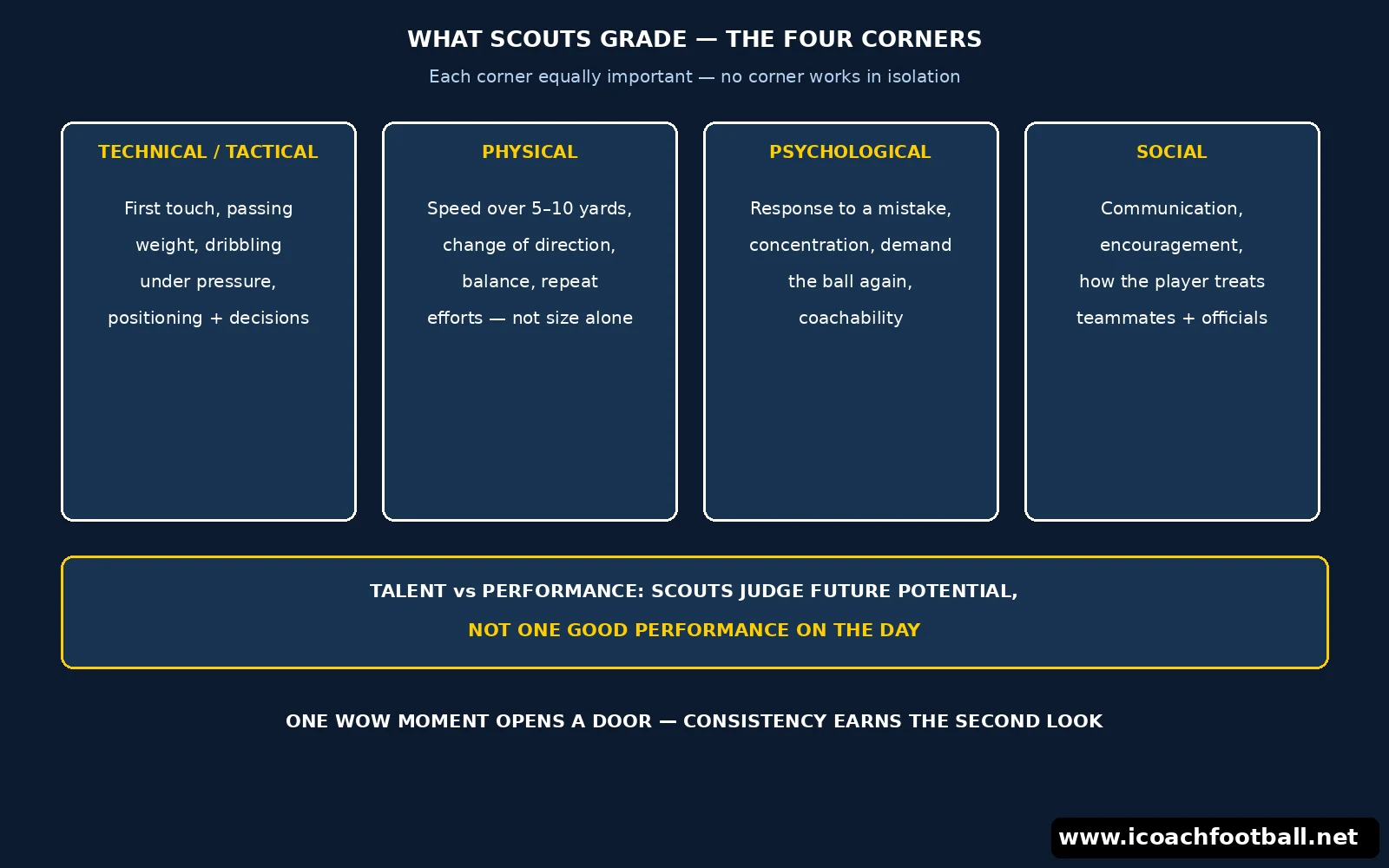
What scouts actually grade
Scouts do not grade a highlight reel. They grade future potential, and they separate talent from one good performance on the day.
- Technical/tactical: First touch, passing weight, dribbling under pressure, positioning and decisions.
- Physical: Speed over 5–10 yards, change of direction, balance, and repeat efforts — not size alone.
- Psychological: Response to a mistake, concentration, and willingness to demand the ball again.
- Social: Communication, encouragement of teammates, and how the player treats opponents and officials.
- The “wow” moment: One exceptional action can open a door, but it never replaces the other four corners. Consistency gets the second look.
| What scouts see in 10 seconds | What it tells them |
|---|---|
| Body shape before receiving | Whether the player scans and plans the next pass |
| First touch direction | Whether the player plays forward or into pressure |
| Reaction to losing the ball | Whether the player recovers or switches off |
| Response to a coach’s instruction | Whether the player is coachable |
| Movement without the ball | Whether the player understands the game |
The 4-week preparation plan
| Week | Focus | Sessions |
|---|---|---|
| Week 1 | Scan and receive | Drills 1–2, plus a small-sided game every session |
| Week 2 | Win duels and press | Drills 3–4, plus a small-sided game every session |
| Week 3 | Finish and decide | Drills 5–6, plus a small-sided game every session |
| Week 4 | Trial rehearsal | Drill 7 twice, light loads, no new drills |
| Trial week | Sharp, not tired | One 30-minute sharp session 3 days out, rest the day before |
- Do not cram. New drills in trial week create hesitation. Rehearse familiar drills so decisions are automatic.
- Keep loads light in Week 4. Short sprints and small games keep a player sharp. Long, tiring runs leave heavy legs.
- Play one normal match if possible. A match is the closest rehearsal to a trial game. Treat it as practice for scanning, pressing and reacting to mistakes.
Drill 1 — Scan and Receive on the Half-Turn
Scanning is the habit scouts notice first. It costs nothing and changes every first touch.
For more detail on the scanning habit, see these soccer scanning drills.
Setup:
- One 20 x 15 yard grid, four cones, one ball per pair.
- A receiver in the middle, a server on each side, one defender who starts passive.
- A coloured cone or a raised hand behind the receiver as the ‘scan target’.
How to Play:
- The server passes firmly to the receiver’s front foot.
- Before the ball arrives, the receiver checks over one shoulder and calls the colour.
- The receiver takes a half-turn touch and plays to the opposite server.
- The receiver swaps with a server after six repetitions.
- The defender steps in and presses for the final 3 minutes.
Scouts watch: The shoulder check before the ball arrives, not after it.
Coach’s note: The cue is “Check, then receive!” A player who looks only at the ball arrives blind.
Progressions: Call the colour after the touch, use the weak foot only, or let the defender press from the first repetition.


Drill 2 — First Touch Away From Pressure
A first touch into space buys time. A first touch into a defender ends the move.
Setup:
- One 15 x 15 yard grid, eight cones marking four gates, one ball per pair.
- One receiver and one server per gate, a defender who joins halfway through.
How to Play:
- The server passes firmly to the receiver’s front foot.
- The receiver takes one touch through the nearest gate, away from the defender.
- The receiver turns, passes back, and the pair swaps roles.
- Pairs move to a new gate every 60 seconds.
- The defender presses the receiver for the final 4 minutes.
Scouts watch: Touch direction under pressure, and weak-foot touches without hesitation.
Coach’s note: The cue is “Touch away from pressure!” A touch back towards the server invites the press.
Progressions: Shrink the gates to 1 yard, require the weak foot only, or add a second defender.

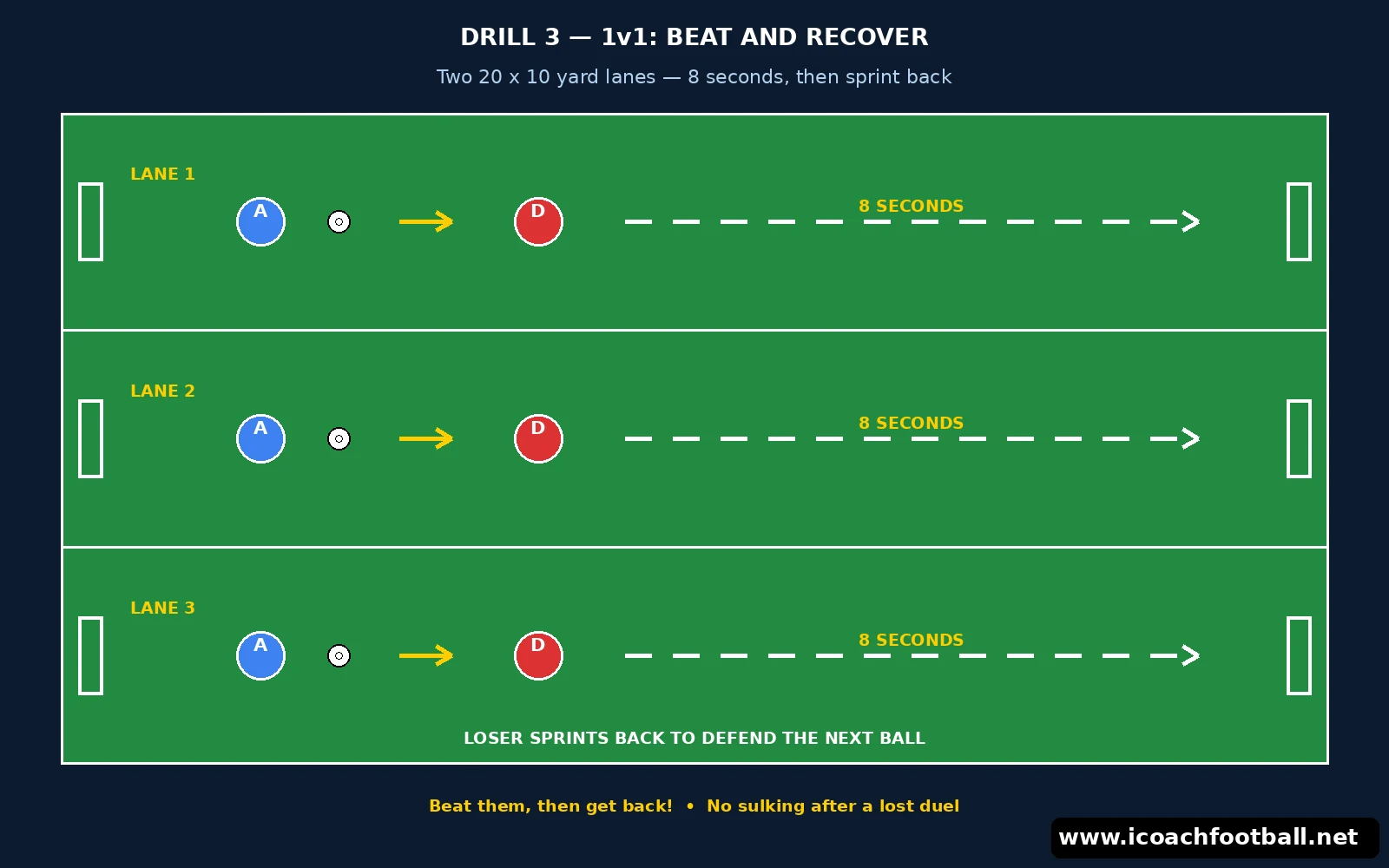
Drill 3 — 1v1: Beat and Recover
Trials are full of duels. Scouts watch both sides of the duel, and what happens after it.
Use these 1v1 finishing drills to rehearse beating a defender and finishing under pressure.
Setup:
- Two lanes, each 20 x 10 yards, with a mini goal at each end.
- One attacker and one defender per lane, the rest waiting at the side in order.
- One ball per lane, spare balls behind each goal.
How to Play:
- The defender passes to the attacker and closes down at once.
- The attacker has 8 seconds to beat the defender and score.
- If the defender wins the ball, they attack the opposite goal.
- Whoever loses the duel sprints back to defend the next ball.
- The next pair enters immediately, so no lane ever waits.
Scouts watch: The attacker’s move at speed, the defender’s patience, and the recovery sprint after being beaten.
Coach’s note: The cue is “Beat them, then get back!” A player who sulks after losing a duel fails the psychological corner.
Progressions: Add a recovering second defender after 4 seconds, or require a weak-foot finish.
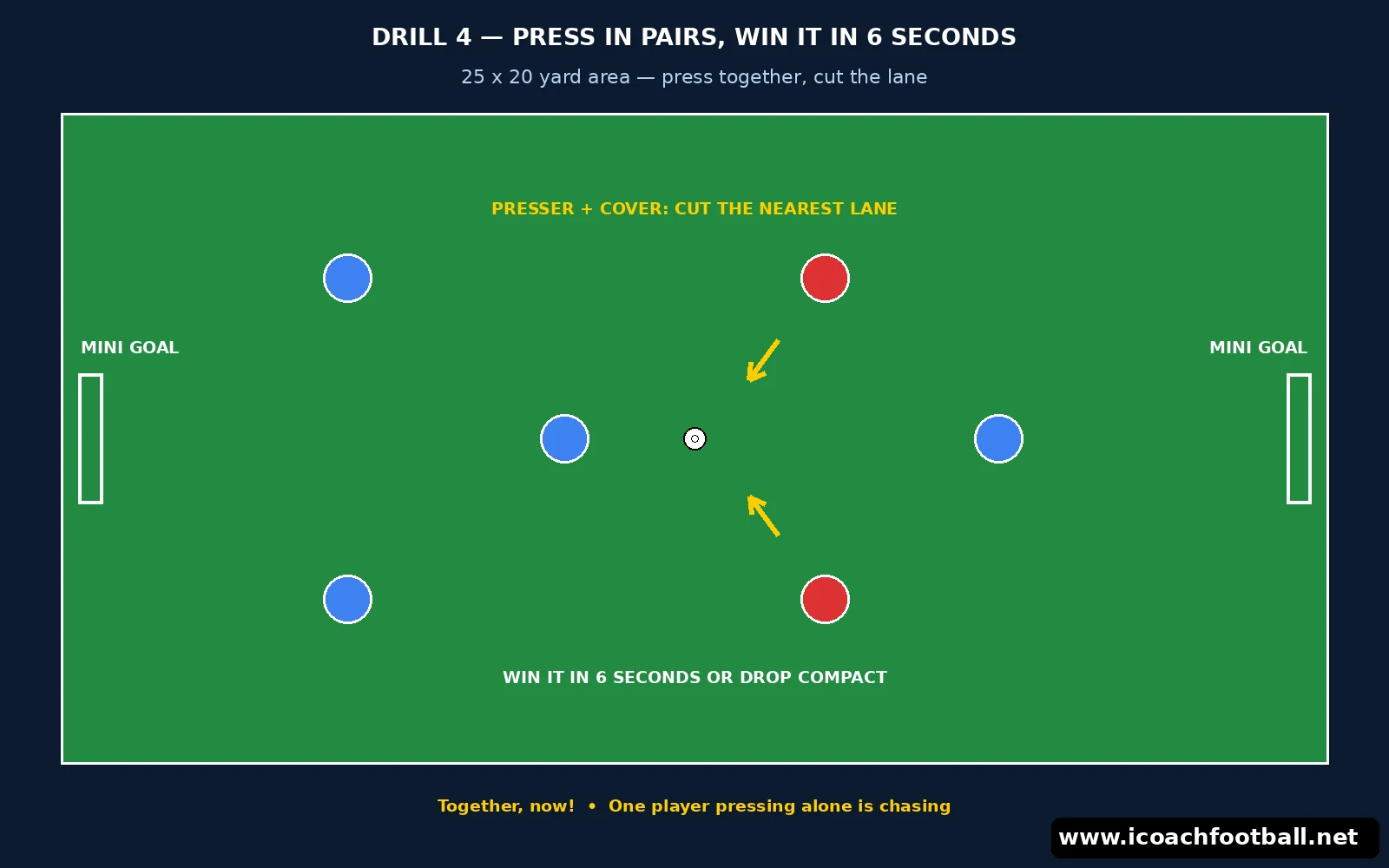
Drill 4 — Press in Pairs, Win It in 6 Seconds
Pressing shows work rate, teamwork and game understanding in one action.
Setup:
- One 25 x 20 yard area, two mini goals, bibs for two teams of four.
- One ball, a coach on the touchline with spare balls for instant restarts.
How to Play:
- One team keeps the ball; the other presses in pairs.
- The nearest player presses the ball, the second cuts the nearest passing lane.
- The pressing team has 6 seconds to win the ball back.
- If they win it, they attack a mini goal at once.
- If they do not win it in 6 seconds, they drop into a compact shape and press again.
Scouts watch: Whether the press is together, and whether the player sprints back when the press is beaten.
Coach’s note: The cue is “Together, now!” One player pressing alone is not pressing. It is chasing.
Progressions: Reduce the win-back target to 4 seconds, or require three passes before the pressing team can score.
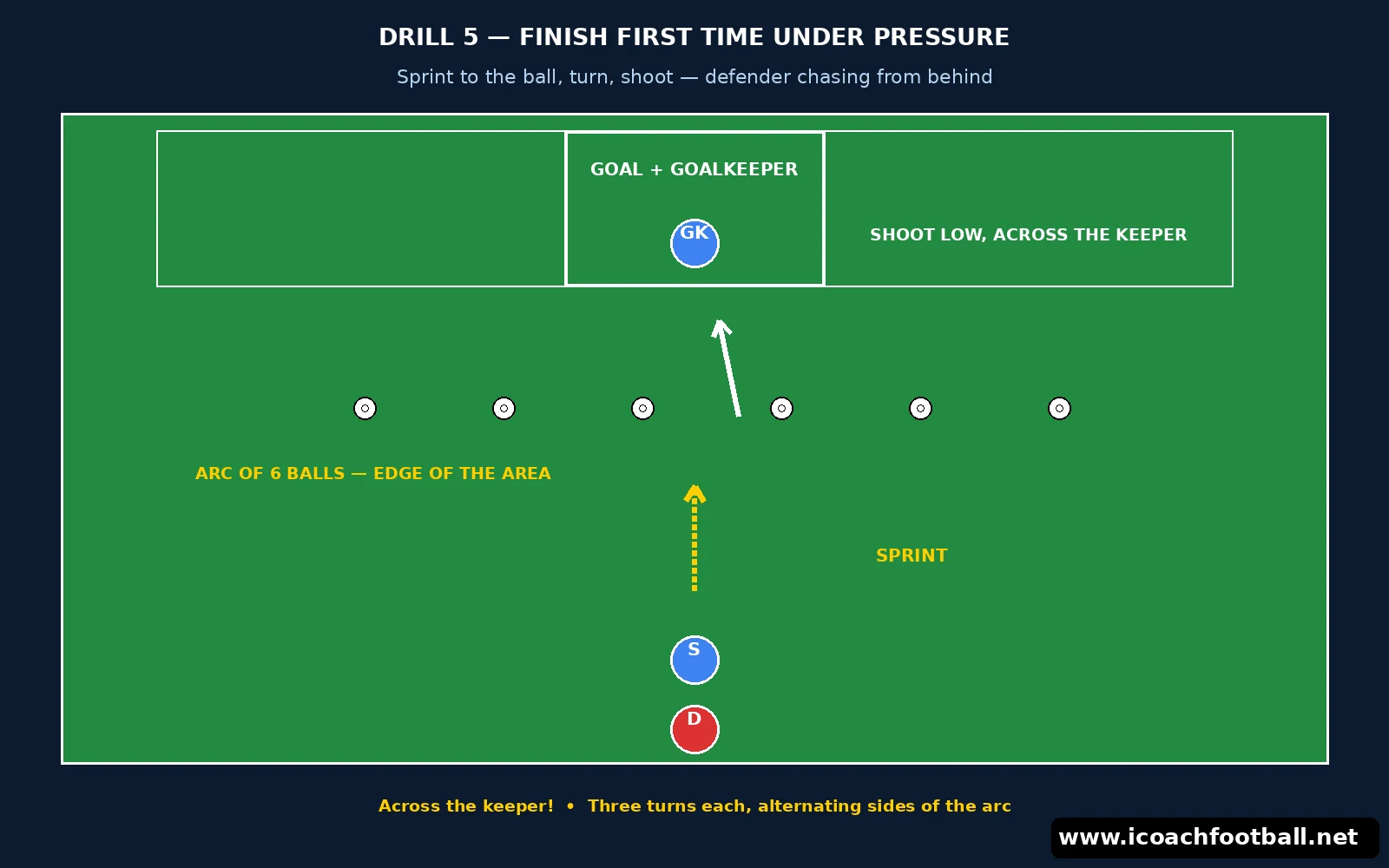
Drill 5 — Finish First Time Under Pressure
Finishing without pressure flatters everyone. Add a sprint and a chasing defender, and composure shows.
Setup:
- One full-size goal with a goalkeeper, an arc of six balls on the edge of the area.
- One shooter at the arc, one defender starting 5 yards behind the shooter.
- A server at each side of the area, feeding the next ball at once.
How to Play:
- The shooter sprints from the halfway line to the nearest ball.
- The shooter turns and shoots first time, or takes one touch and shoots.
- The defender chases from behind and may block, but may not foul.
- After the shot, the shooter collects a ball and joins the serving line.
- Every player takes three turns, alternating sides of the arc.
Scouts watch: Shot placement over power, head up before the shot, and the reaction after a miss.
Coach’s note: The cue is “Across the keeper!” Shots straight at the goalkeeper waste the sprint. Aim low, across the body, into the far corner.
Progressions: Serve the ball bouncing or in the air, or let the defender start level with the shooter.
Drill 6 — Play Out Under Pressure: 4v2 Rondo to Goal
This drill rehearses the exact problem trials create: receive, decide, and play forward with defenders closing in.
The 4v2 to 3v1 pressing rondo is the closest version of this problem in a small-sided game.
Setup:
- One 15 x 12 yard grid, four attackers in blue bibs, two defenders in red.
- A mini goal 10 yards beyond one end of the grid, one ball.
How to Play:
- The four attackers keep the ball with two-touch play.
- After six consecutive passes, they may break out and attack the mini goal.
- If a defender wins the ball, the attacker who lost it swaps in at once.
- The defenders press together and hunt the same passing lane.
- Rotate all six roles every 90 seconds, so everyone attacks and defends.
Scouts watch: Scanning before receiving, first-touch direction, and the decision to break out at the right moment.
Coach’s note: The cue is “Six passes, then go!” Players who break out after two passes have not earned the space. Players who never break out have not seen it.
Progressions: Go to one touch, shrink the grid to 12 x 10 yards, or add a neutral player who always joins the team in possession.

Drill 7 — The Trial Game: 6v6 With Trial Rules
This is the rehearsal that matters most. It is the closest thing to a trial, so run it under trial rules.
Setup:
- One 35 x 25 yard pitch, two full-size goals or four mini goals, goalkeepers if available.
- Two teams of six, bibs, one coach observing only — no touchline coaching.
- Rolling substitutions: a new pair enters every 3 minutes, so every player gets two games.
How to Play:
- Play 6-minute games, with instant restarts from the coach when the ball leaves play.
- No coaching from the touchline during the game; observe only.
- Award a point for a goal, and a point for winning the ball back within 6 seconds.
- After a mistake, the player must sprint back and demand the ball again within 10 seconds.
- Halfway through, the coach gives one instruction to each player; apply it on the very next repetition.
Scouts watch: Movement off the ball, recovery runs, communication, and whether the coach’s instruction appears at once.
Coach’s note: Watch the player without the ball for 10 seconds at a time. The players who keep moving, showing for the ball and covering a teammate, are the ones scouts remember.
Progressions: Play as 7v7 on a 40 x 30 yard pitch, or require three passes before a shot counts.

Trial week and trial day
- Three days before: One 30-minute sharp session only. Drills 1 and 6, short sprints, then stop. Arrive fresh, not tired.
- The day before: No new boots, no new drills, no late night. Pack kit, shin pads, water and a spare pair of boots the night before.
- Arrive early: Arrive 45 minutes early. The warm-up is the first impression. Warm up properly, with the ball, and look engaged from the first minute.
- Say hello and listen: Learn the coaches’ names, listen to the first instruction, and apply it on the next repetition. That single habit signals coachability.
- After a mistake: Sprint back, get into shape, and demand the ball again. Scouts watch the next 10 seconds more closely than the mistake itself.
- Do not hide: Demand the ball, take the 1v1 on, and make the run even when the pass may not come. A quiet trial is an invisible trial.
- After the trial: Thank the coaches, cool down properly, and ask what to work on. Whatever the outcome, one trial never defines a player.
Common mistakes
| Mistake | Fix |
|---|---|
| Cramming new skills in trial week | Rehearse familiar drills so decisions are automatic |
| Training hard the day before | Rest, sleep, and one short sharp session 3 days out |
| Hiding after a mistake | Sprint back, get into shape, demand the ball again |
| Showboating in every duel | Play the simple pass when it is on; beat a player only when the space is there |
| Ignoring the coach’s instruction | Apply it on the very next repetition, then again after that |
| Only sprinting with the ball | Make recovery runs and off-ball runs — scouts watch those too |
Age adaptations
| Age | Change |
|---|---|
| U11–U12 | Shorten Drill 3 lanes to 15 x 8 yards, keep duels to 8 seconds, and grade effort and first touch heaviest in rehearsal |
| U13–U14 | Run the drills as written, with mini goals in Drill 7 if no goalkeepers are available |
| U15–U16 | Add the second defender in Drill 3 and one-touch play in Drill 6 for the final round |
| U17–U18 | Play Drill 7 as 7v7 on a 40 x 30 yard pitch, and rehearse pressing triggers and rest defence explicitly |
Sources
The grading lens in this post is in line with the FIFA Training Centre’s talent identification guidance, which stresses distinguishing a player’s talent and future potential from a single performance, using defined criteria rather than gut feeling, and with The FA’s Four Corner Model, which treats the technical/tactical, physical, psychological and social corners as equally important.
Frequently Asked Questions
How long should football trials preparation take?
Four weeks is enough: three weeks building the habits, one week rehearsing them lightly. Less than two weeks and the habits are not automatic; more than six and the player peaks too early.
What do scouts look for first at football trials?
First touch and decision-making under pressure, then the response to a mistake. Speed and size help, but a player who receives cleanly, scans and picks the right pass keeps the ball for the team.
Should a player practise alone before a trial?
Solo work helps first touch and weak-foot striking, but it cannot rehearse scanning, pressing or decisions. At least two sessions a week should be small-sided games with opponents.
What should a player do the day before a trial?
Rest, sleep well, eat normally, and pack the night before. No new boots, no new drills, and no hard training. Arrive fresh, with familiar kit.
What if a player has a bad trial?
Treat it as one data point. Ask the coaches what to work on, keep training, and take the next trial with the same habits. Scouts judge potential over time, not one session.