U10 Soccer Practice Plan: 8 Drills and a Complete Session
Quick answer: An effective U10 soccer practice should develop receiving on the move, passing combinations, 2v2 and 3v2 decisions, possession and transitions. Use technical repetition briefly, then place the same skills into competitive small-sided games.
U10 players are ready to connect stronger technical habits with clearer game principles. They can begin recognizing support angles, using the third player and reacting more deliberately when possession changes.
This 60-minute session progresses from ball mastery and passing into rondos, overloads, target games and a final 5v5 match.
Keep coaching points focused. One clear theme per activity is more useful than several rules that reduce creativity.
For sessions organized around exact attendance, use our soccer practice plans by number of players. Related age-group sessions include U9 Soccer Practice Plan and U11 Soccer Practice Plan.
Equipment and Setup
PlayersApproximately 10–14 players
Session duration60 minutes
Recommended ageU10
Maximum areaMaximum 38 × 28 yards
Ball sizeSize 3 for U6–U8, size 4 for U9–U14 and size 5 for U15–U16; follow local competition rules
EquipmentSize 4 balls, cones, bibs and four mini goals or cone gates
Complete 60 minutes Session
| Time | Activity | Main objective |
|---|---|---|
| 0–7 minutes | Ball Mastery and Direction Change | Close control, scanning and acceleration |
| 7–14 minutes | Diamond Pass and Follow | Body shape, passing and movement |
| 14–22 minutes | 4v2 Rondo to Escape Gate | Possession and forward recognition |
| 22–29 minutes | 2v2 Plus One Neutral | Support, overloads and transition |
| 29–37 minutes | 3v2 Transition Attack | Attacking overloads and defensive recovery |
| 37–45 minutes | 4v4 Plus Two End Targets | Directional possession and progression |
| 45–53 minutes | 5v5 Four-Goal Game | Width, switching play and transitions |
| 53–60 minutes | 5v5 Match With Build-Up Bonus | Game application and team support |
Age-Appropriate Coaching Priorities
Receive with a purpose: The first touch should prepare a pass, dribble or finish.
Create triangles: Players should support the ball from different angles rather than standing in straight lines.
Use overloads to teach choice: 2v1 and 3v2 games reveal when to combine and when to drive forward.
Coach both transitions: React quickly after winning and losing possession.
Progress one variable at a time: Change space, pressure or touches rather than everything together.
FIFA’s numeric-progression guidance for ages 8–12 uses gradually more complex game situations to develop decision-making, teamwork and tactical understanding. Read FIFA Ages 8–12: Numeric Progression Games.
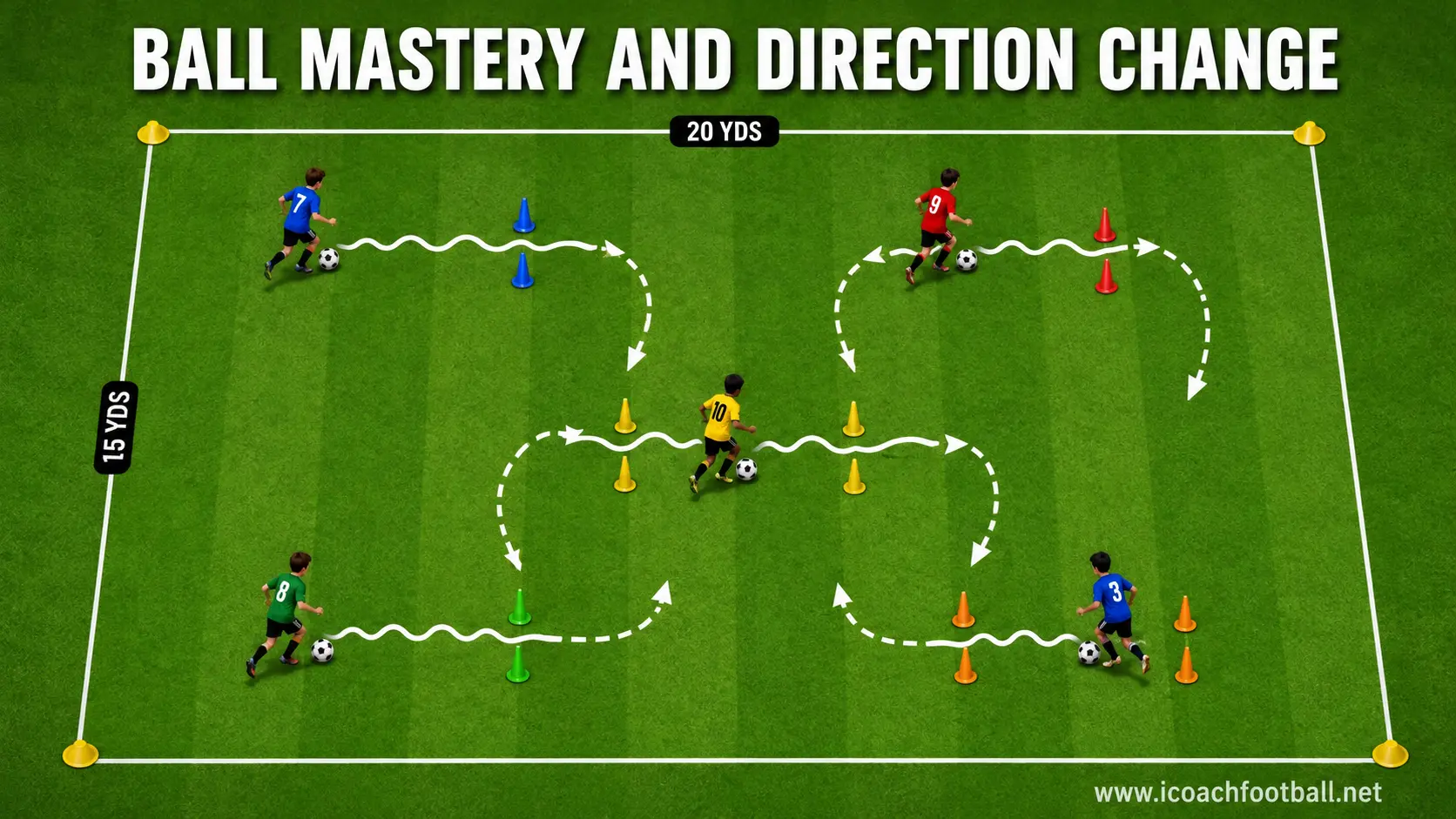
Drill 1: Ball Mastery and Direction Change
Players perform ball-mastery actions before accelerating into a new direction.
Setup
- Create a 20 × 18-yard area.
- Give every player a ball.
- Place four colored gates around the outside.
- Keep the central area open.
How to Play
- Players dribble freely.
- Call a technical action and a gate color.
- Players perform the action, scan and accelerate through that gate.
- Return through a different route.
- Work in 30-second blocks.
Coach’s note: The change of direction should be controlled before the acceleration. Encourage both feet and awareness of traffic.
Progressions: Add a passive defender, require a second move after the gate or use number signals.
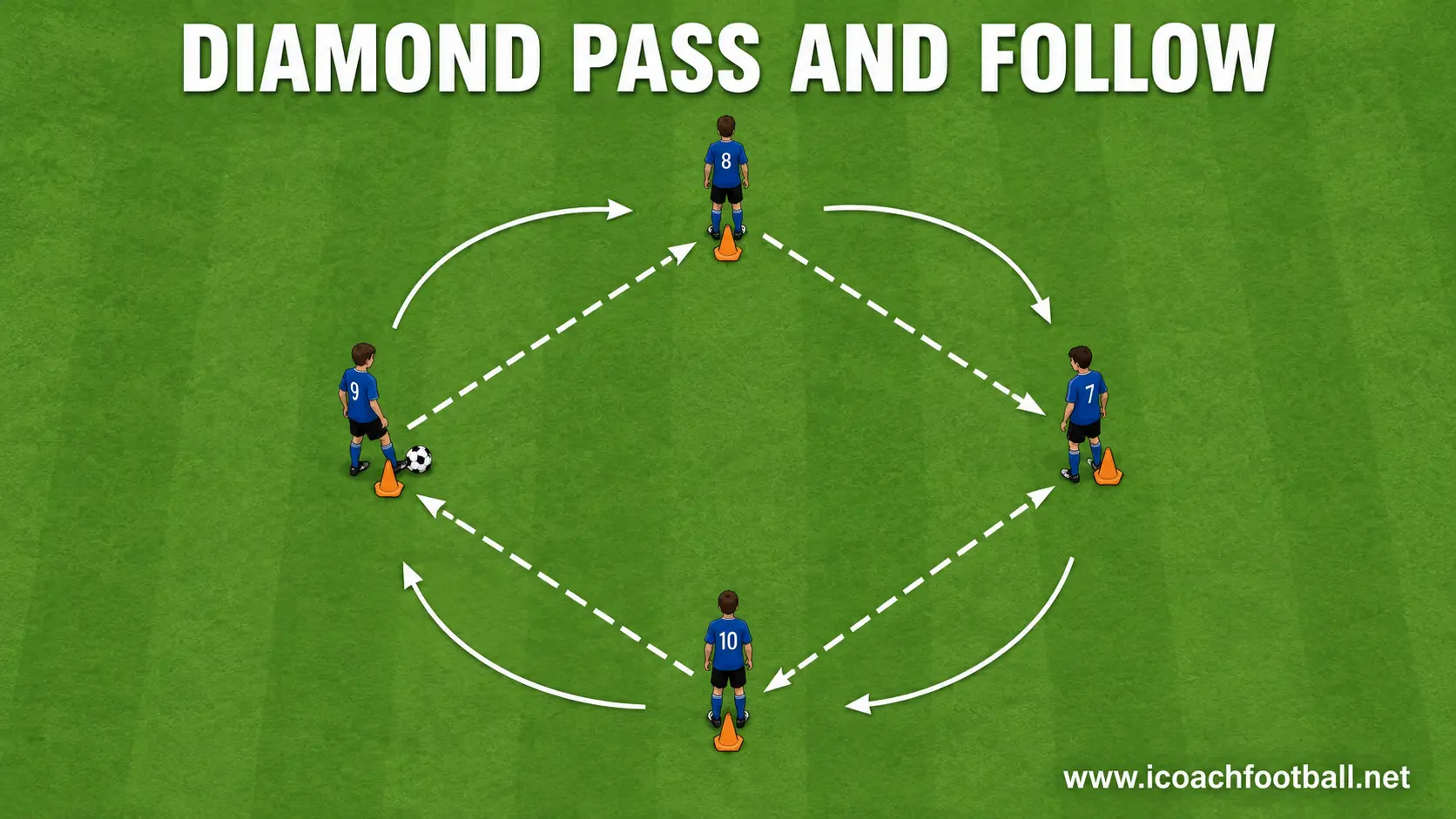
Drill 2: Diamond Pass and Follow
Players pass around a diamond and follow the ball into the next position.
Setup
- Create two diamonds 14–16 yards long.
- Use five to seven players in each.
- Place one player at each point.
- Use one ball per group.
How to Play
- Pass to the next player.
- The receiver opens the body and takes the first touch forward.
- The passer follows the ball.
- Continue around the diamond.
- Change direction after two minutes.
Coach’s note: Players should check away before receiving and use the back foot when appropriate.
Progressions: Add a wall pass, play two-touch or allow a diagonal skip pass.
Drill 3: 4v2 Rondo to Escape Gate
After several passes, attackers can escape through one of two gates.
Setup
- Create a 14 × 14-yard square.
- Use four attackers and two defenders.
- Place two escape gates outside opposite sides.
- Keep spare balls nearby.
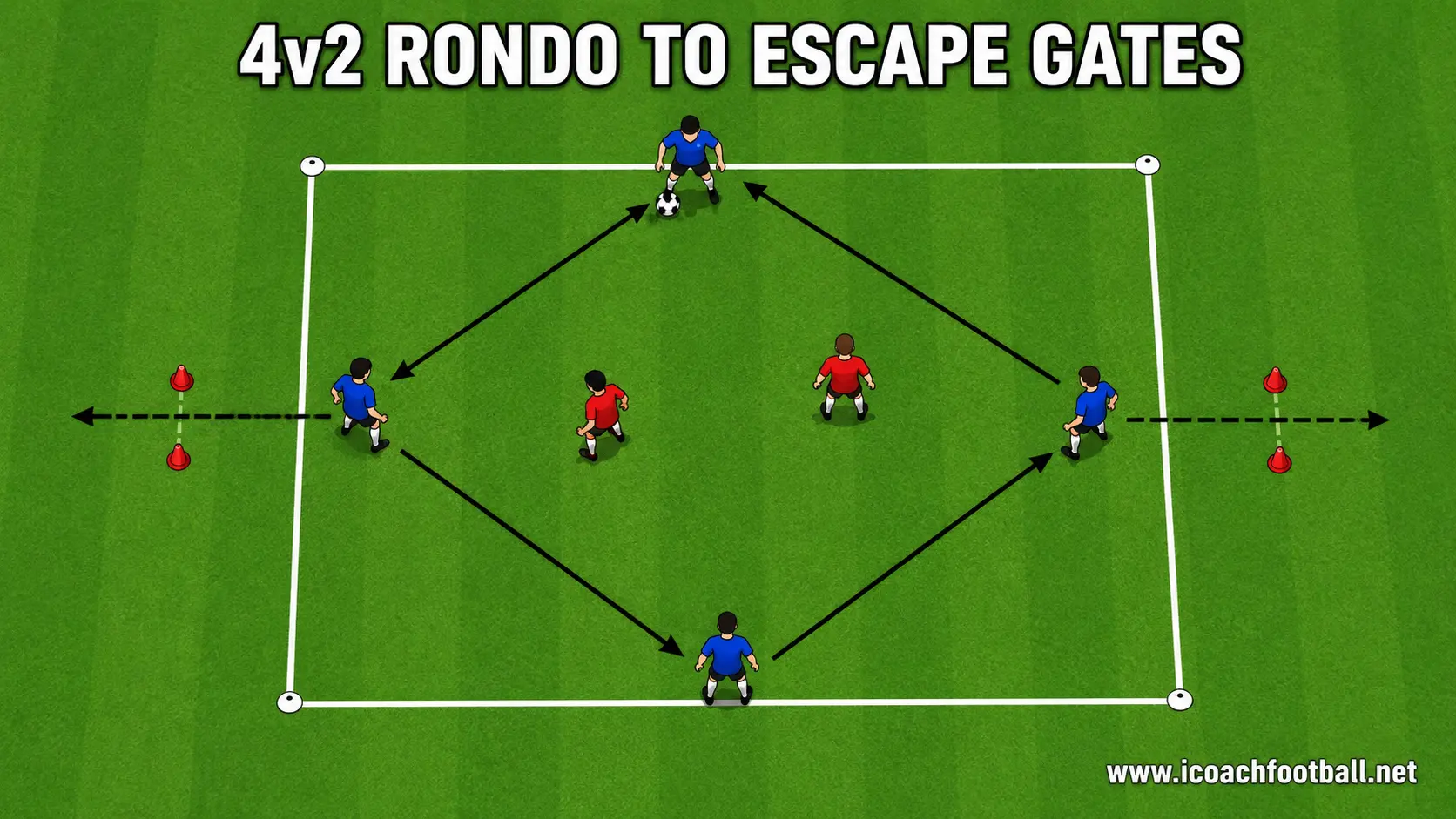
How to Play
- Attackers keep possession.
- Four passes unlock the gates.
- Score by passing to a teammate moving through a gate.
- Defenders score by winning and dribbling through either gate.
- Rotate defenders.
Coach’s note: Move the defenders before attempting the escape pass. The runner should time movement with the passer’s control.
Progressions: Use two touches, narrow the gates or require a one-touch escape pass.
Drill 4: 2v2 Plus One Neutral
A neutral player supports the team in possession to create a 3v2.
Setup
- Create a 16 × 12-yard field.
- Play 2v2 inside.
- Use one neutral player.
- Place a gate at each end.
- Rotate the neutral every two minutes.
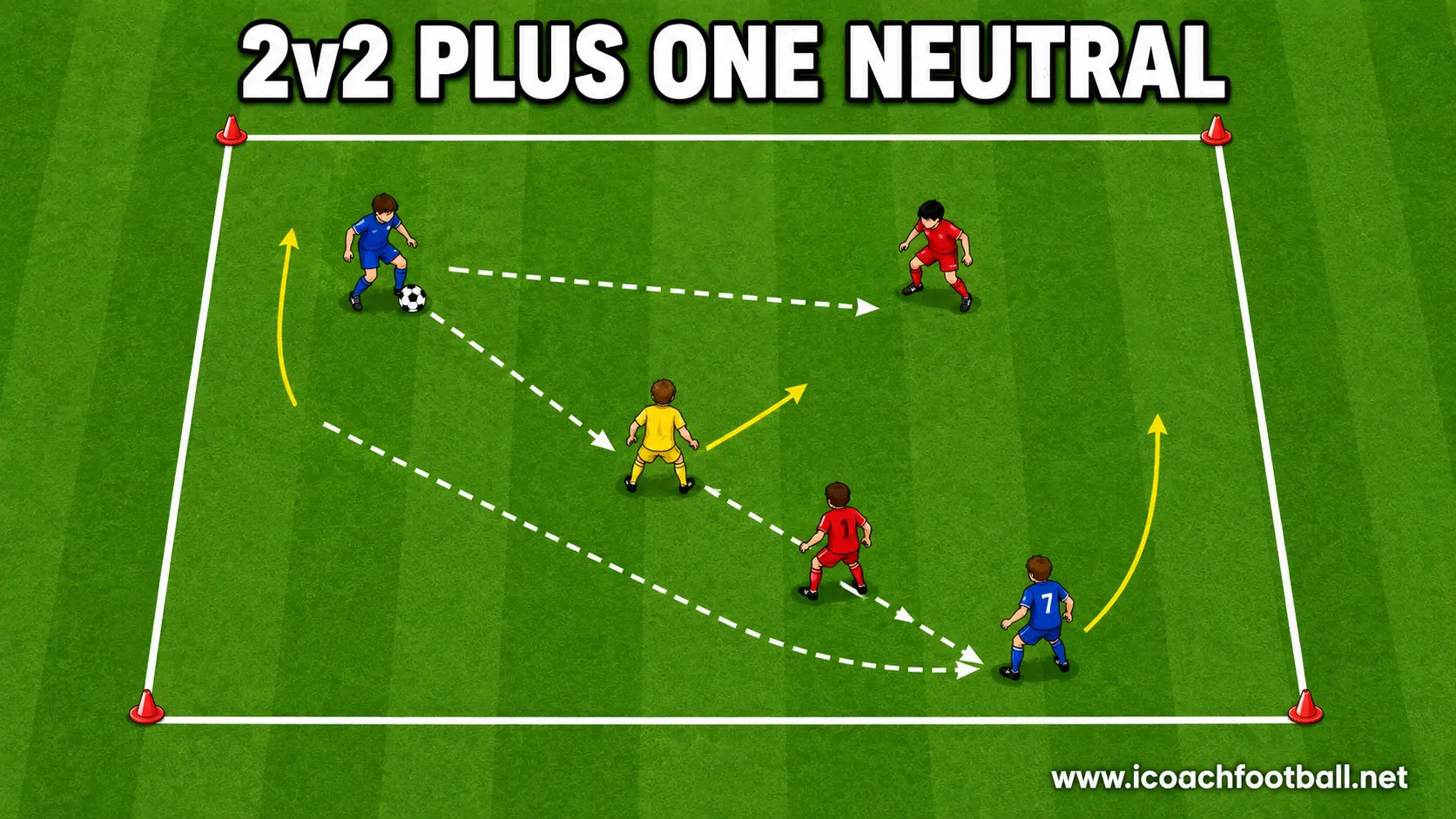
How to Play
- The neutral plays with the team in possession.
- Score by dribbling through the attacking gate.
- When possession changes, the neutral changes teams immediately.
- Use short rounds.
- Restart quickly.
Coach’s note: The neutral should find a new passing line rather than standing beside the ball carrier.
Progressions: Limit the neutral to one touch, add two side neutrals or require a neutral combination before scoring.
Drill 5: 3v2 Transition Attack
Three attackers play against two defenders with immediate counterattacking on a turnover.
Setup
- Create a 26 × 20-yard field.
- Place two mini goals at one end.
- Use three attackers and two defenders.
- Mark a counter line at the opposite end.
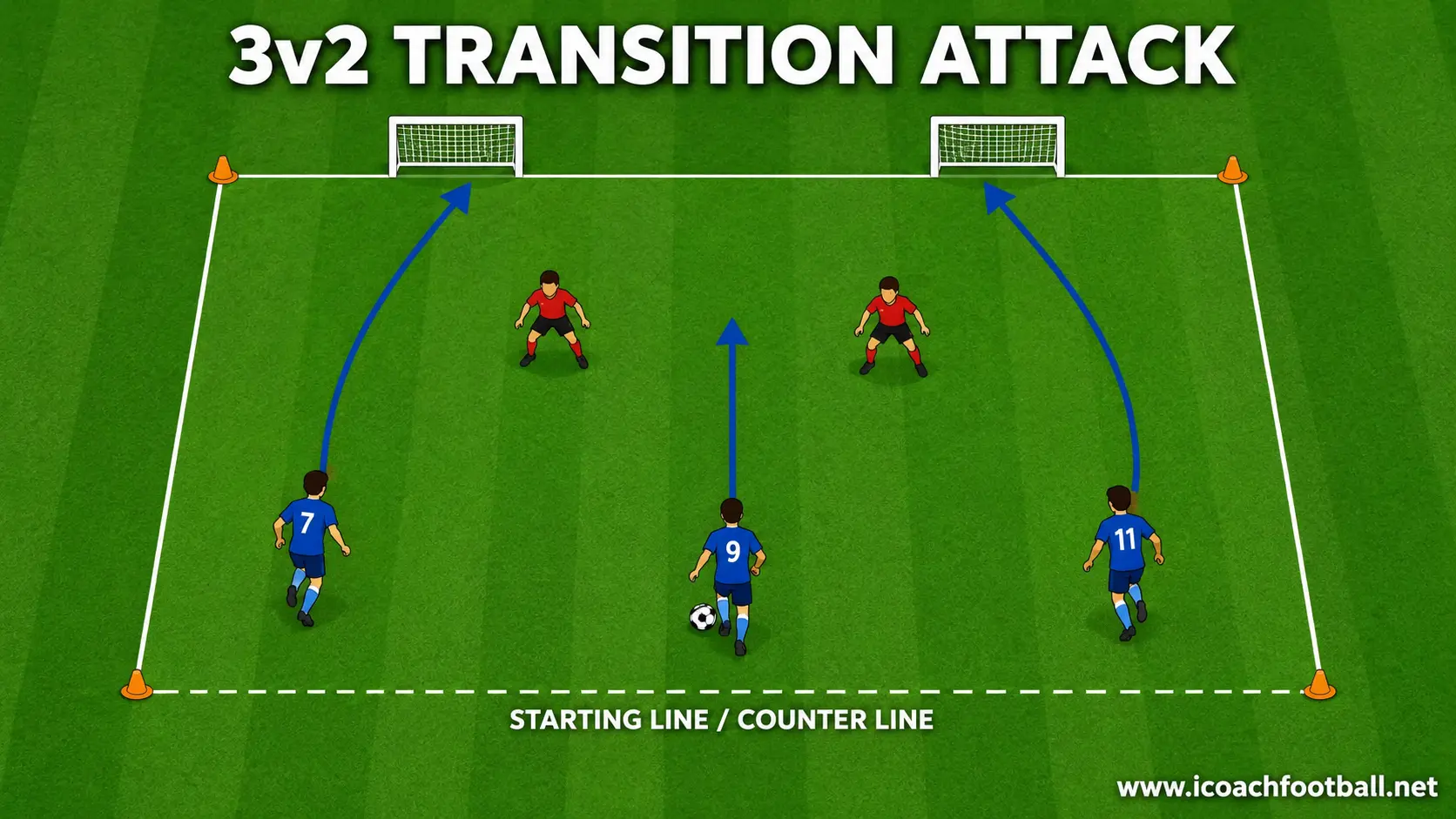
How to Play
- Attackers try to score in either goal.
- Defenders counter across the starting line after winning possession.
- End after a score, counter or ball out.
- Rotate roles.
- Start the next attack quickly.
Coach’s note: Attackers should create width and keep one player behind the ball. Defenders should delay and protect the central route.
Progressions: Add a recovery defender, use a scoring deadline or require a combination before finishing.
Drill 6: 4v4 Plus Two End Targets
Two end targets create direction and a clear progression objective.
Setup
- Create a 28 × 20-yard rectangle.
- Play 4v4 inside.
- Place one target behind each end line.
- Targets support the team in possession.
- Rotate targets regularly.
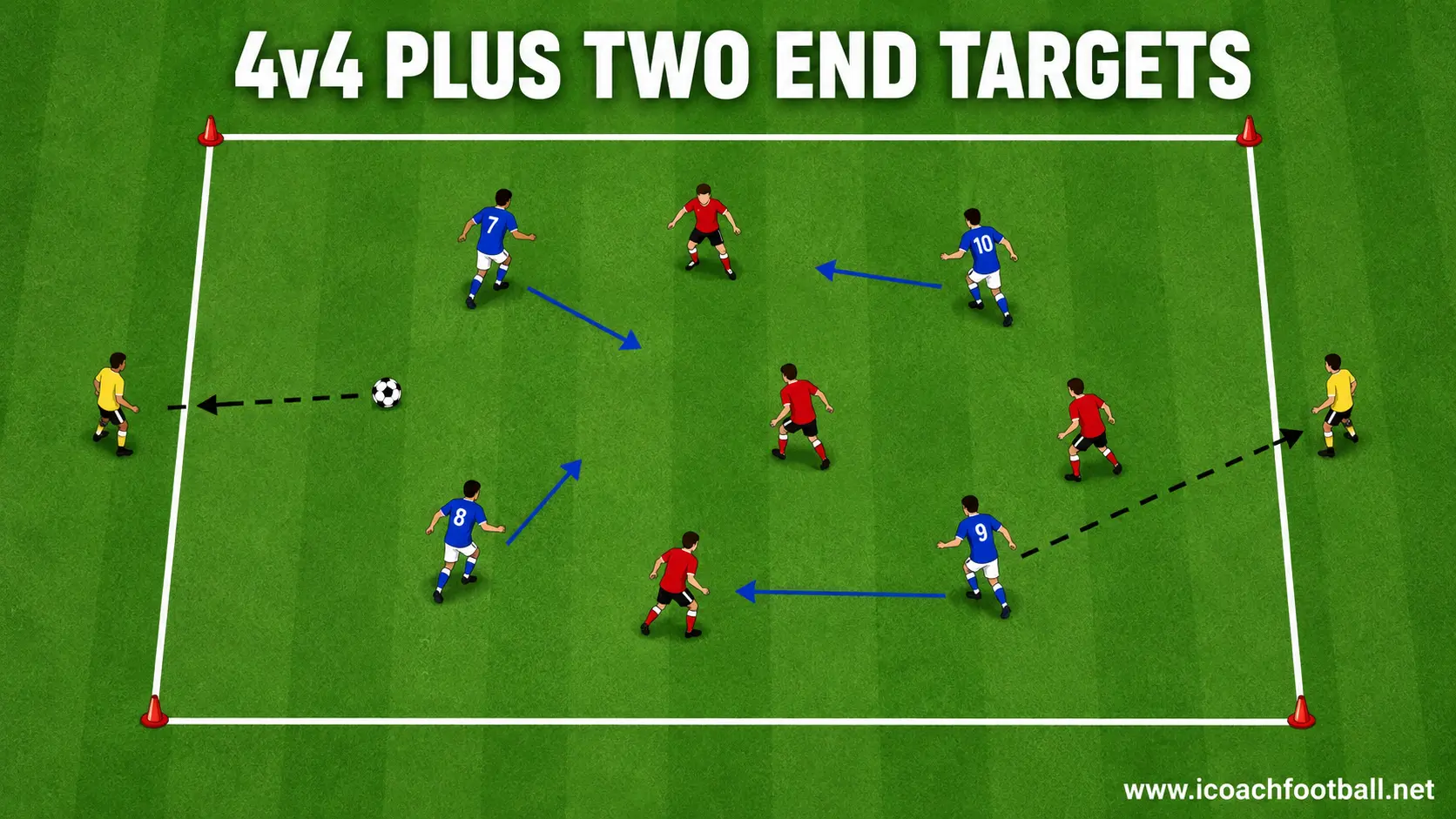
How to Play
- Score by transferring the ball from one target to the other.
- The ball must travel through at least one central player.
- After scoring, attack the opposite direction.
- Targets have two touches.
- Restart quickly.
Coach’s note: Central players should occupy different lines and avoid crowding one target.
Progressions: Make targets one-touch, require a third-player movement or award a bonus for splitting defenders.
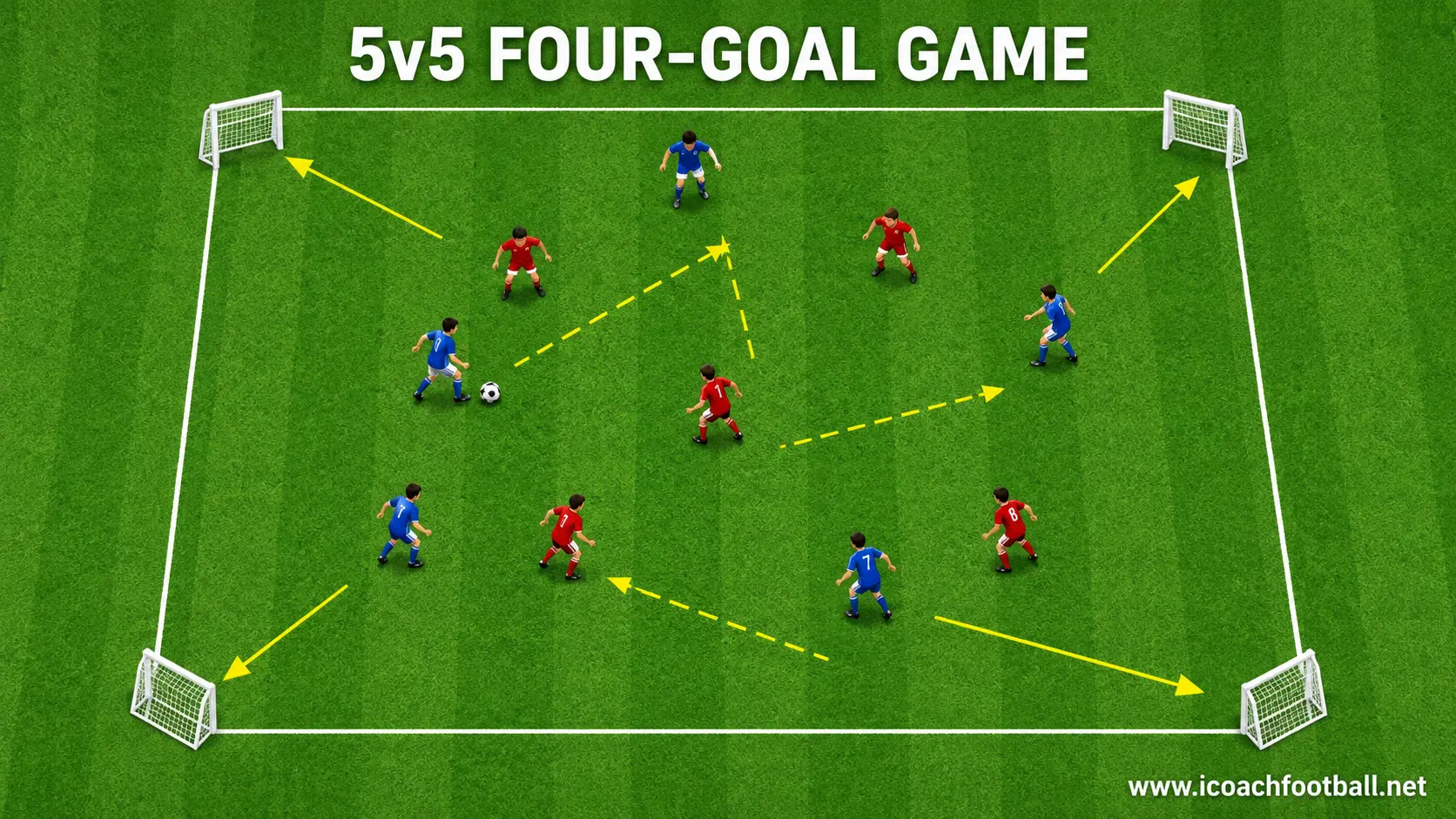
Drill 7: 5v5 Four-Goal Game
Each team attacks two goals and must recognize the less-protected side.
Setup
- Create a 34 × 26-yard field.
- Place one mini goal in each corner.
- Play 5v5.
- Keep spare balls around the outside.
How to Play
- Teams score in either attacking goal.
- Restart immediately after a goal.
- Use kick-ins or dribble-ins.
- Play two short rounds.
- Keep a total score.
Coach’s note: Players away from the ball should move early enough to support a switch.
Progressions: Limit touches, require all teammates to touch the ball or award a bonus for a switch before scoring.
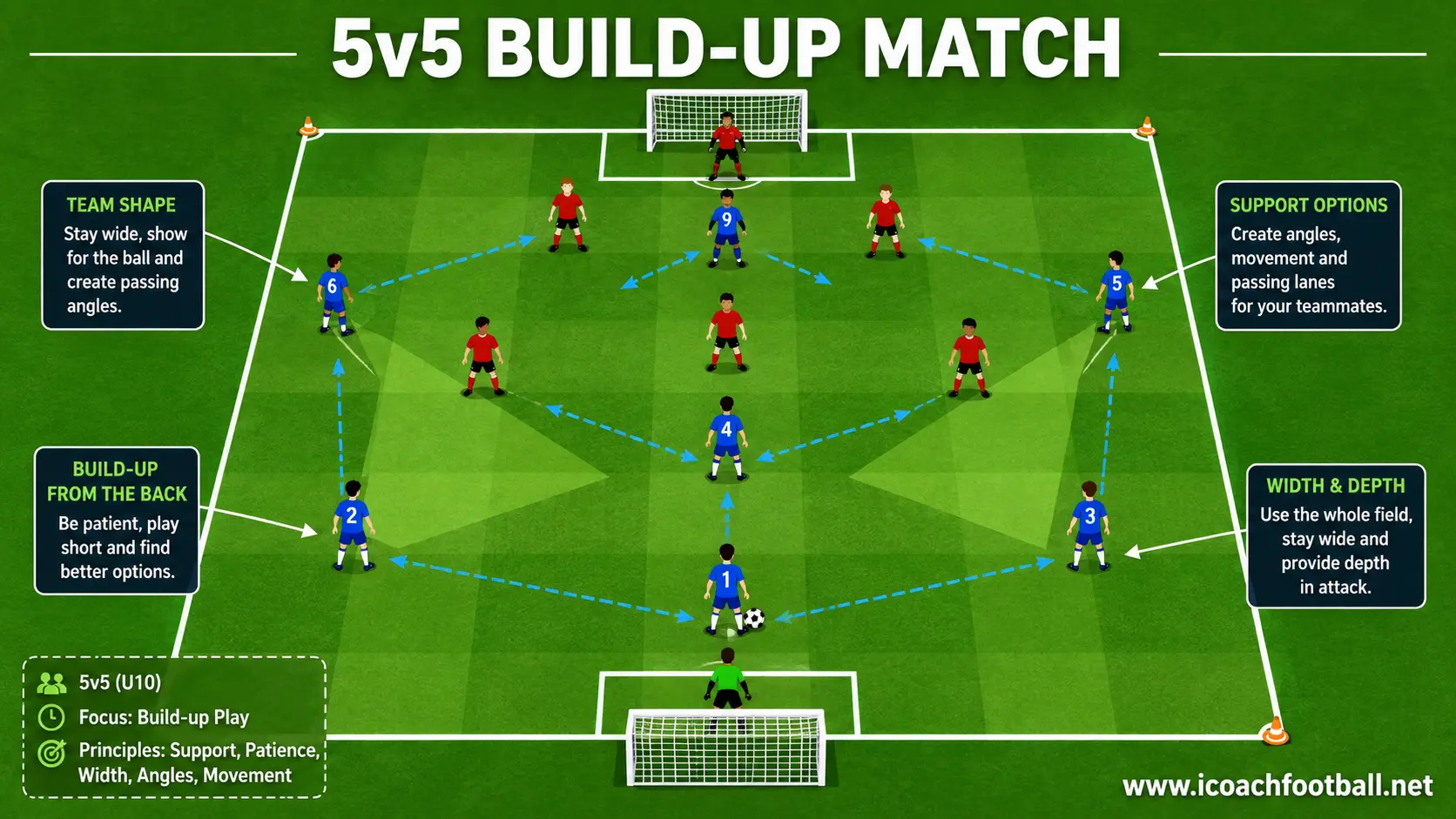
Drill 8: 5v5 Match With Build-Up Bonus
The final match rewards controlled progression from the defending half.
Setup
- Create a 38 × 28-yard field.
- Play 5v5.
- Use two goals or gates.
- Mark a halfway line.
How to Play
- Play normal 5v5.
- A goal counts double when the team connects three passes before crossing halfway.
- Restart quickly.
- Use two rounds.
- Coach between rounds.
Coach’s note: The bonus should encourage support and patience without preventing a direct attack when space is available.
Progressions: Remove the bonus, reward a third-player combination or use four goals.
How to Adapt the Session
For a developing group: Increase space and allow extra touches or a second neutral.
For an advanced group: Reduce space slightly and reward third-player combinations.
For 10 players: Use balanced 5v5 and rotate defenders or targets within drills.
For 14 players: Use two parallel technical groups and rotate teams through short games.
Common Coaching Mistakes
- Turning passing patterns into memorized choreography with no scanning.
- Using touch limits before players understand the objective.
- Rewarding only fast forward play and ignoring safe support.
- Leaving the neutral role unchanged for the whole session.
- Stopping overload games before players experience transitions.
- Using a final game unrelated to the session theme.
Frequently Asked Questions
How long should a U10 soccer practice last?
Around 60 minutes is appropriate for many U10 groups, with short water breaks and active transitions.
What should U10 players work on?
Focus on first touch, passing with both feet, support angles, overload decisions, possession, transitions and small-sided games.
What game format is best for U10?
5v5 and 7v7 are common learning formats, while smaller games such as 3v3 and 4v4 increase individual involvement.
Should U10 players learn build-up play?
Yes, through simple principles such as create width, offer support and recognize when to play forward.
How do I teach third-player movement at U10?
Use simple wall-pass patterns and small games where the player who did not make the first pass becomes the next receiver.
Are rondos useful for U10?
Yes. A 4v2 rondo can develop support, scanning, pressing and forward recognition.
Should U10 players specialize in one position?
Players should still experience multiple roles while gradually learning basic positional responsibilities.
Continue the age-group series: Compare this session with U9 Soccer Practice Plan and U11 Soccer Practice Plan and use the player-number practice-plan hub when attendance changes.