Soccer 5v5 Drills: 6 Games That Turn Five Players Into a Real Team

Quick answer
Five players is the smallest team that still plays like a team. One goalkeeper, two defenders and two attackers is enough for width, depth, combinations and a real press — and small enough that every player touches the ball constantly. These six soccer 5v5 drills teach the shape first, then the combinations, the press, the switch and the finish.
Suitable for: U8–U12
In football — soccer in the US — 5v5 is the first format where shape actually matters. At 3v3 and 4v4 the game is mostly dribbling and chasing; at 5v5 a team that spreads out beats a team that bunches up, every time. The six games below are built on two FIFA Training Centre sessions — the grassroots 5v5 games that teach combination play and quick decisions through target areas and four goals, and the numerical-advantage session that teaches overloads in 1v1, 2v1 and 4v2 mini-matches before finishing with a 5v5 game where a conceded goal costs a player. This post sits between our soccer 4v4 drills and our soccer 6v6 drills in the same six-game structure, and it teaches the shapes in our 5v5 soccer formations guide by playing them, not by lecturing them.
Session snapshot
- Players: 10–14 (two teams of 5, plus subs who rotate in)
- Area: 30 x 20 m for U8–U10; up to 40 x 30 m for U11–U12
- Duration: 60 minutes
- Focus: Shape, combination play, overloads, pressing together, switching play, finishing fast
- Age: U8–U12 (see Age adaptations)
The six 5v5 rules
Every one of these soccer 5v5 drills is built on six rules. Teach them once, then repeat them in every game until the players say them back to you.

| Rule | What it means |
|---|---|
| Spread out | Use the whole pitch — a bunched team is a beaten team |
| Pass and move | Never stand still after you pass |
| Use the overload | A 2v1 beats a 1v1 — find the spare player |
| Press together | Six seconds to win it back, all five of you |
| Switch the play | The far goal is always the open one |
| Finish fast | Shoot when you see it — don’t take a third touch |
Drill 1: Spread Out — The 2-2 Shape Game
The shape lesson. Five players in a 2-2 — goalkeeper, two defenders, two attackers — with a bonus point every time the ball travels goalkeeper to defender to midfielder to striker without going backwards. Based on the FIFA Training Centre session “Technical activation and small-sided games” (#61), in which the 5v5 four-goal game asks players to recognise the best goal to attack and to take up positions that create space — and on our 5v5 soccer formations guide, which picks the 2-2 as the best starting shape for most youth teams.


- Setup: A 30 by 20 metre pitch with a goal at each end and a goalkeeper in each, 5 against 5 in a 2-2 shape, balls with the coach.
How to play:
- Play normal 5v5, but award a bonus point when the ball travels goalkeeper to defender to midfielder to striker without going backwards.
- The two defenders stay wide — one on each side of the pitch, never both in the middle.
- The two attackers split — one high, one dropping short to link play.
- If the ball goes backwards, the chain breaks and the bonus point is lost.
- After a goal, the conceding team restarts from their goalkeeper and builds the chain again.
- Rotate the goalkeeper every four minutes so every player defends the goal.
Coach’s note: Watch the two defenders — if both drift into the middle, the pitch shrinks to a corridor and the 2-2 is just a 4v4 with a goalkeeper; the cue is “spread out,” and our soccer passing drills build the weight and accuracy the chain needs, while our soccer scanning drills train the shoulder check the midfielder needs before receiving.
Progressions: The chain must go goalkeeper to defender to midfielder to striker in four passes or fewer; the midfielder must take a first touch facing forward for the point to count; the defenders may only receive on their back foot.
Drill 2: Three Target Areas — 5v5, 3 Goals
The combination lesson. Three target areas are marked inside the pitch, and a team scores a point by working the ball into one — by passing it or by dribbling it. Based on the FIFA Training Centre session “Technical activation and small-sided games” (#61), in which the skill-development game is exactly this: organise a 5v5, mark three target areas, and let the teams work the ball into one by passing or dribbling — with the coaching question “can you recognise the opportunity to play towards a free target area?”
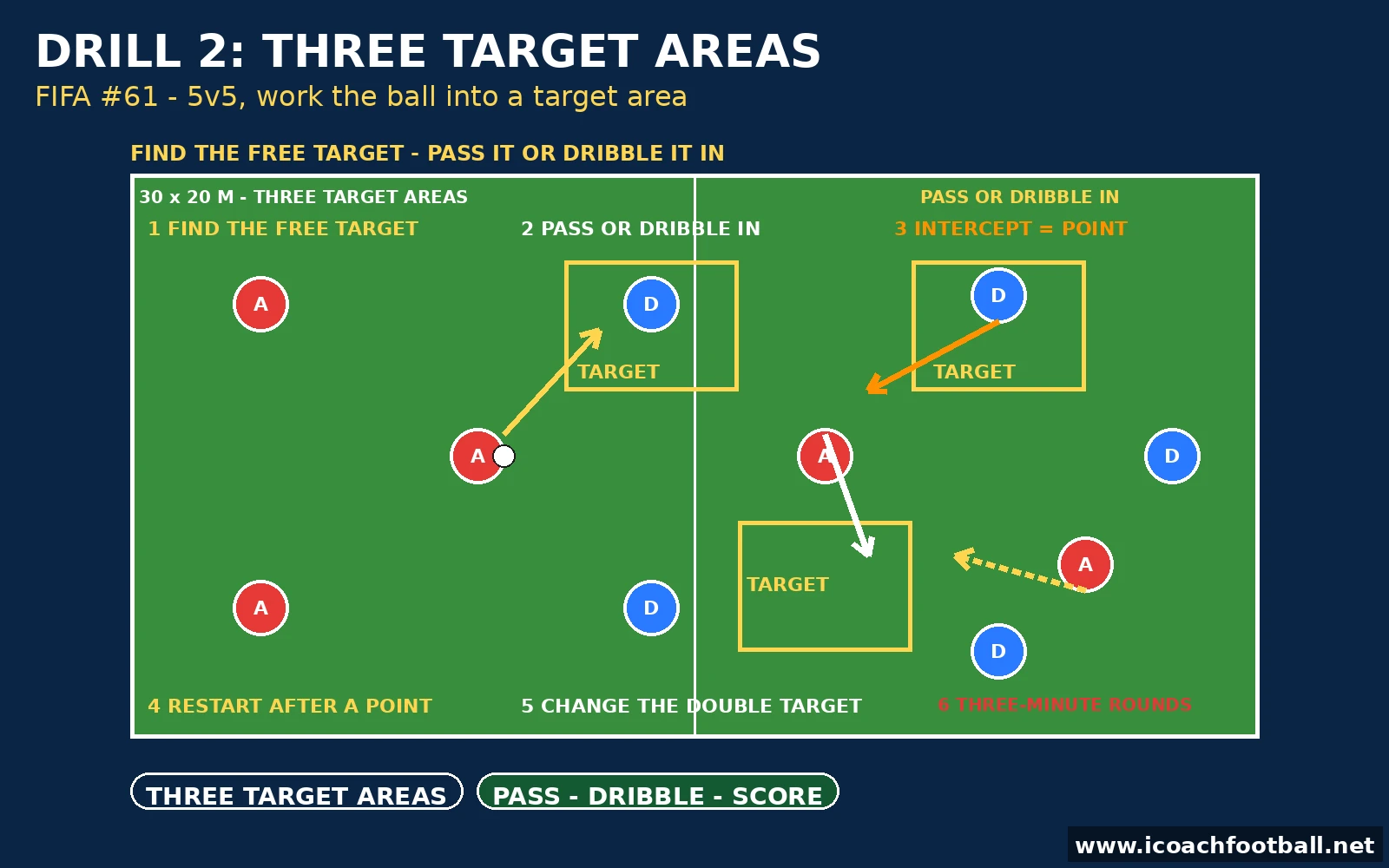
- Setup: A 30 by 20 metre pitch with three target areas marked by cones (one central, one in each half-space), 5 against 5, balls with the coach.
How to play:
- The coach plays the ball in — the team in possession looks for a free target area.
- A point is scored by passing the ball into a target area to a team-mate.
- A point is also scored by dribbling the ball into a target area and stopping it.
- The defending team wins a point by intercepting a pass into a target area.
- After a point, the ball restarts with the team that conceded it.
- Play three-minute rounds, then change which target areas count double.
Coach’s note: Watch the player on the ball — if they dribble into a crowded area when a target area is free on the far side, they are playing the ball, not the game; the cue is “find the free target,” and our soccer dribbling drills train the close control the dribble option needs, while our soccer possession drills train the patience to wait for the free area.
Progressions: Only one target area counts at a time, called by the coach; a point only counts if every player has touched the ball; the target areas shrink, so the pass must be exact.
Drill 3: Use the Overload — 1v1, 2v1 and 4v2 Mini-Matches
The overload lesson. Three small pitches run at once — a 1v1, a 2v1 and a 4v2 — and each attacking team has three minutes to score as many goals as it can before rotating. Based on the FIFA Training Centre session “Use the numerical advantage” (#128), in which the skill-development circuit assigns attackers to three pitches to play 1v1, 2v1 and 4v2, three minutes each, and asks which pitch was hardest and whether it is easier to prevent or score goals.
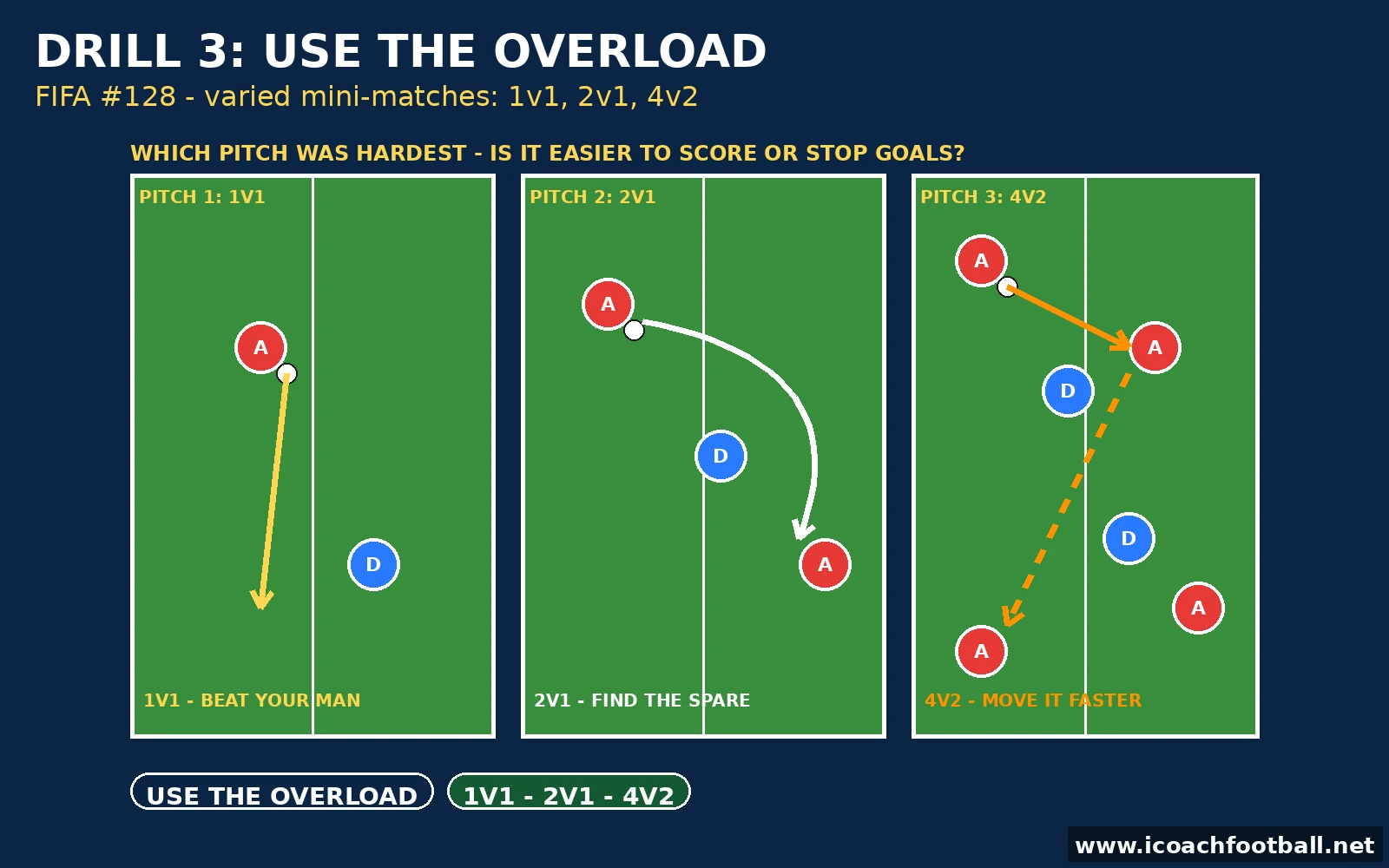
- Setup: Three small pitches side by side (10 x 15 m each) with a mini-goal at each end, two teams split into attackers and defenders, balls with the coach.
How to play:
- Pitch one runs 1v1 — one attacker against one defender, first to the mini-goal.
- Pitch two runs 2v1 — two attackers against one defender, find the spare player.
- Pitch three runs 4v2 — four attackers against two defenders, move the ball faster than they can run.
- Each pitch plays for three minutes — count the goals, then rotate.
- After every rotation, the team that scored most picks which pitch to start on next.
- Finish with a team talk: which pitch was hardest, and was it easier to score or to stop goals?
Coach’s note: Watch the 2v1 pitch — if the two attackers both run at the defender, the overload is wasted; the spare player must stay wide and the ball must go to them early; the cue is “find the spare player,” and our soccer drills for midfielders train the same overload with older players, while our soccer tackling drills train the defender’s job in the 1v1.
Progressions: The 1v1 becomes a 1v1 with a recovering defender; the 2v1 becomes a 2v2 with a late runner; the 4v2 becomes a 4v3, so the overload is smaller and the passes must be faster.
Drill 4: Six-Second Press — 5v5 Press Together
The pressing lesson. The team that loses the ball has six seconds — counted out loud by the coach — to win it back. If they fail, they sprint back into a compact block behind the ball. In line with the FIFA Training Centre session “Technical activation and small-sided games” (#61), which asks players “can you react quickly to defend when the other team gains possession?” — and with the six-second rule in our counter-pressing soccer drills.
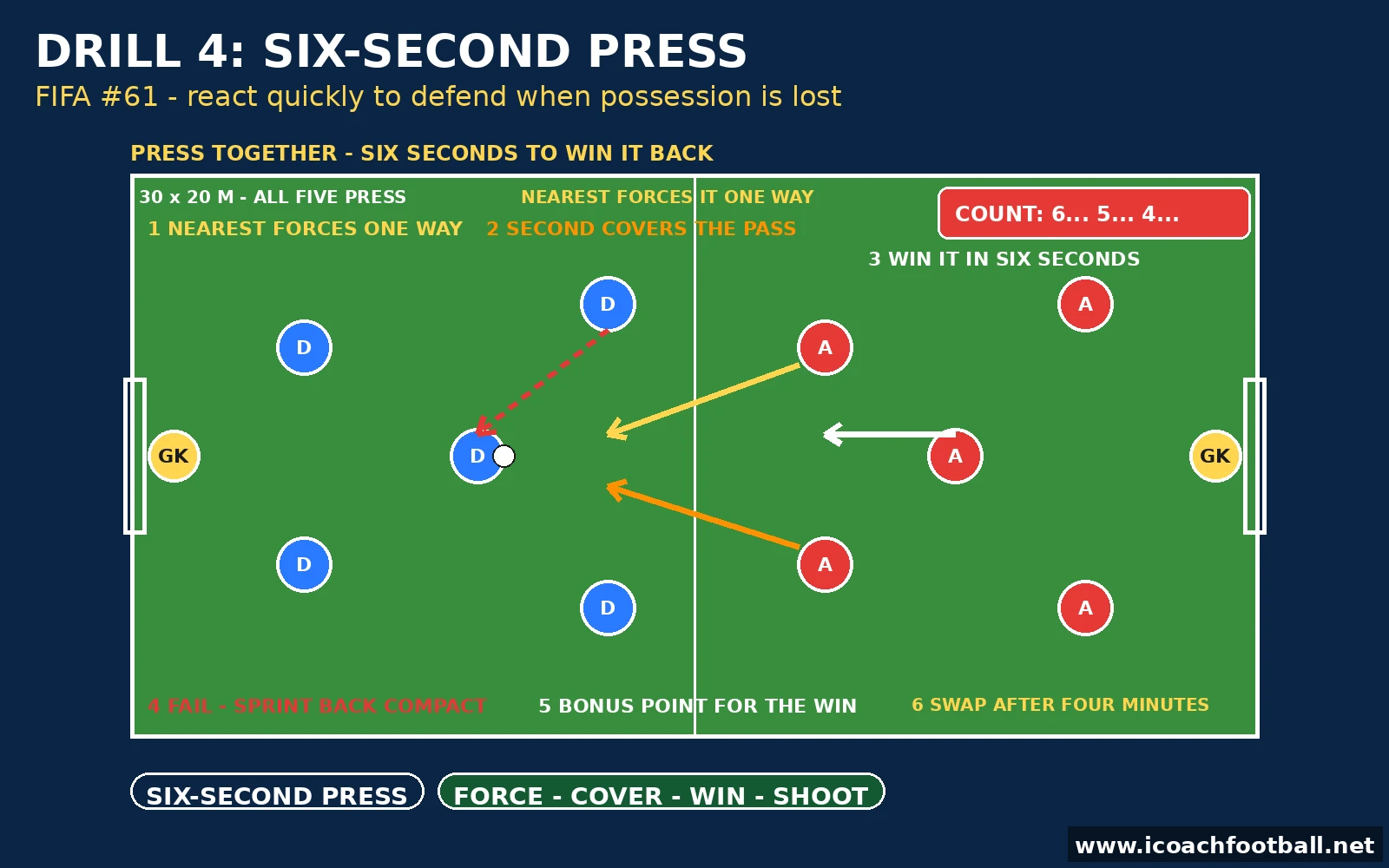
- Setup: A 30 by 20 metre pitch with a goal at each end and a goalkeeper in each, 5 against 5, the coach counts the six seconds out loud, balls with the coach.
How to play:
- Play normal 5v5 — the moment a team loses the ball, the coach starts counting.
- All five players press together — the nearest player forces the ball one way.
- The second player covers the next pass, not the ball — the middle stays shut.
- Win it inside six seconds and the team gets a bonus point on top of the goal.
- Fail to win it and the whole team sprints back into a compact block behind the ball.
- After four minutes, swap which team starts with the ball and run it again.
Coach’s note: Watch the second presser — a press with one player is a chase, and a press with five players who all run to the ball leaves the whole pitch open behind them; the cue is “press together,” and our coaching soccer pressing triggers train the trigger itself, while our soccer drills for 10 players run the same six-second rule with bigger numbers.
Progressions: The count drops to four seconds; the press starts from the goalkeeper’s first touch; the team that wins it must shoot within eight seconds.
Drill 5: Switch and Finish — 5v5 Four-Goal Game
The switching lesson. Four goals sit on the touchlines, two on each side — and a team can score in any of them. Then the game goes directional: each team may only attack two goals, then only the diagonal two. Based on the FIFA Training Centre session “Technical activation and small-sided games” (#61), in which the game application is exactly this 5v5 four-goal game: first any goal counts, then it goes directional, then diagonal — with the coaching question “can you recognise the best goal to attack?”
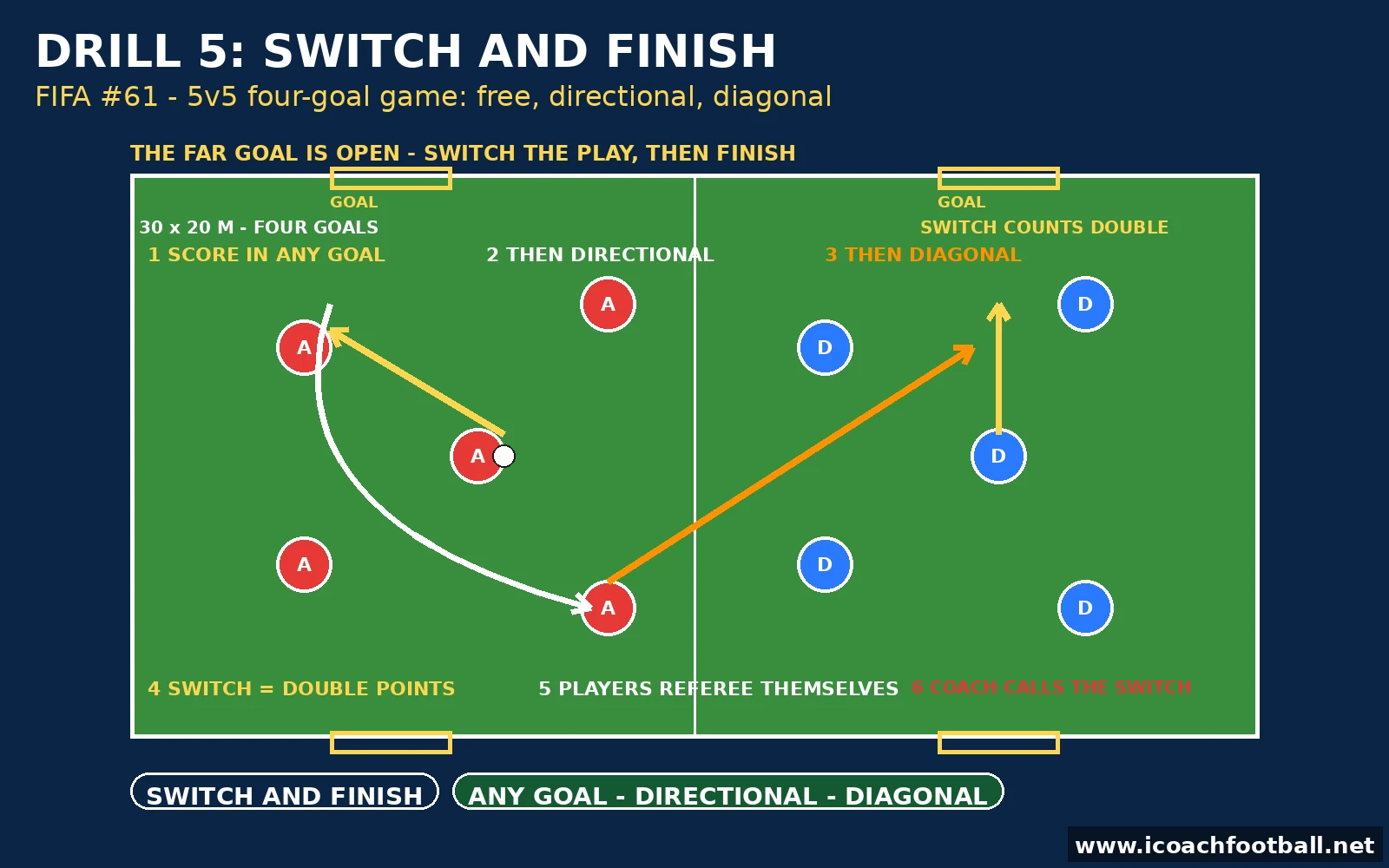
- Setup: A 30 by 20 metre pitch with four mini-goals, two on each touchline, 5 against 5, no goalkeepers, balls with the coach.
How to play:
- Play 5v5 — either team can score in any of the four goals.
- After each goal, the ball restarts with the team that conceded it.
- After four minutes, go directional — each team may only attack its two goals.
- After four more minutes, go diagonal — each team attacks opposite diagonal goals.
- A goal that follows a switch of play across the pitch counts double.
- Let the players referee their own games — the coach only calls the switches.
Coach’s note: Watch the first pass after a goal — a team that plays the same way into the same goal is playing against the game, not with it; the cue is “the far goal is open,” and our switching play drills train the diagonal that opens it, while our soccer drills for strikers train the finish that has to follow the switch.
Progressions: A goal only counts if every player has touched the ball first; one team plays a player down, so the switch must be faster; add goalkeepers and the four goals become two — the switch still decides it.
Drill 6: Last Player Standing — 5v5 Plus Goalkeepers
The match-real finish. Two teams, goalkeepers in each goal, normal rules — except a team that concedes a goal loses a player. The team must choose, fairly and fast, who leaves the pitch, and then find a way to score the next goal a player down. Based on the FIFA Training Centre session “Use the numerical advantage” (#128), in which the game application is a 5v5 plus goalkeepers game with exactly this rule: when a team concedes, they lose a player, the game continues until one team has no players left, and the choice of who leaves must be made fairly — FIFA’s own safety note is to intervene if the same players always end up sitting out.
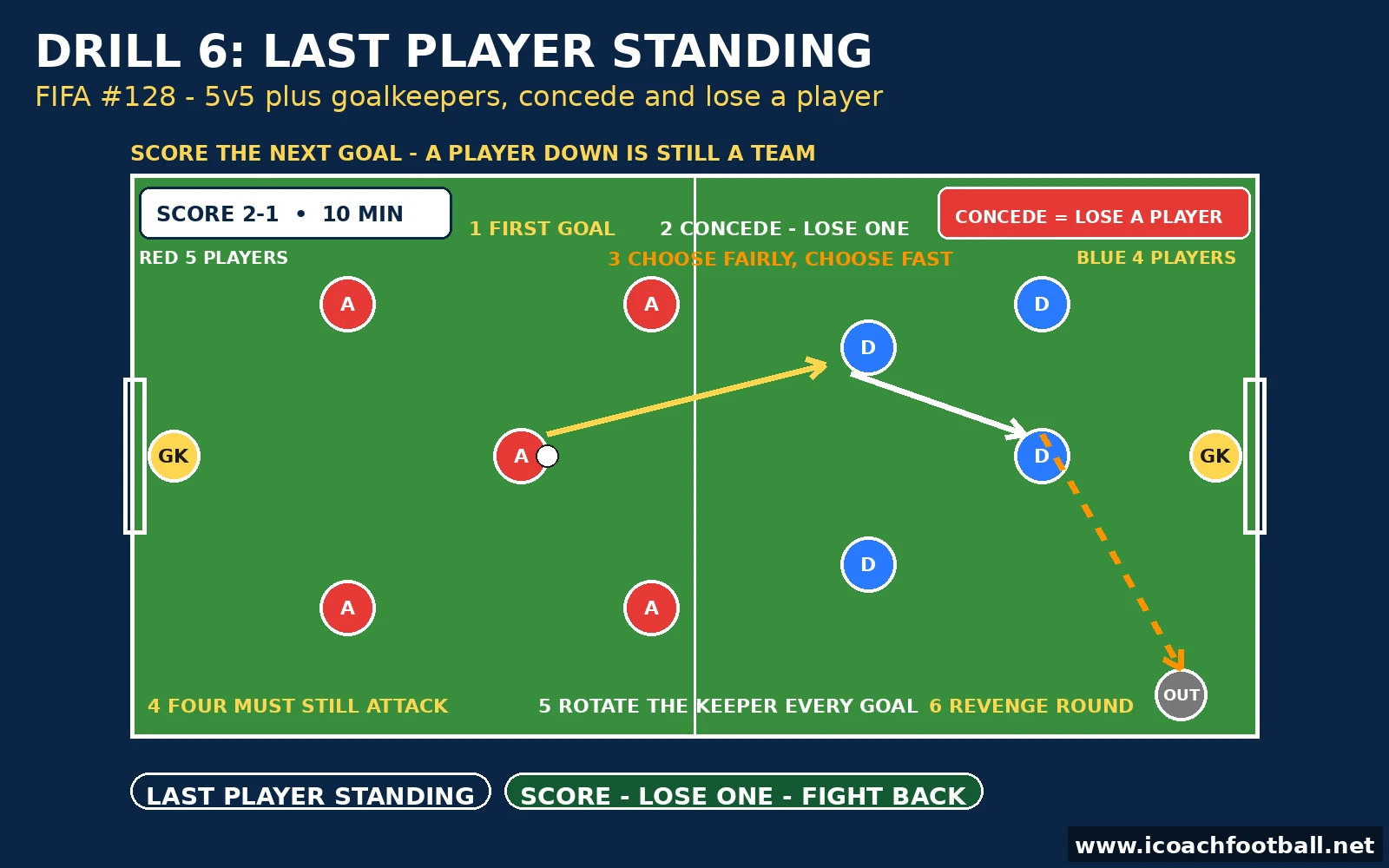
- Setup: A 30 by 20 metre pitch with a full-size goal and a goalkeeper at each end, 5 against 5 plus goalkeepers, a scoreboard the coach updates, balls with the coach.
How to play:
- Play normal 5v5 with goalkeepers — first goal wins the opening point.
- The team that concedes loses a player — they choose who leaves, and they choose fast.
- The team a player down must still attack — defending the lead with four players loses it.
- The game continues until one team has no players left, or the ten minutes run out.
- Rotate the players within the teams and give the same teams a chance at revenge.
- The goalkeeper rotates every goal, so no player is stuck in goal while team-mates sit out.
Coach’s note: Watch who gets chosen to leave — if the same child is always the one who sits out, stop the game and fix it; the rule teaches fairness as much as football; the cue is “score the next goal,” and our soccer goalkeeper communication drills train the keeper’s calls this game depends on, while our 1v1 finishing drills train the finish that keeps a team alive a player down.
Progressions: Start one team a player down, so they must find a way from the first whistle; the team that scores gets a player back; the last two minutes start 1-1, and the team that scores next wins the game.
Coaching points
- Spread out: Use the whole pitch — a bunched team is a beaten team — our 5v5 soccer formations guide picks the 2-2 as the starting shape, and our soccer 4v4 drills teach the same spacing one size down.
- Pass and move: Never stand still after you pass — our soccer passing drills build the weight and accuracy, and our soccer dribbling drills train the drive that follows a good pass.
- Scan before you receive: The first touch decides the next pass — our soccer scanning drills teach the shoulder check, and our soccer drills for midfielders train the No. 6 role in full.
- Use the overload: A 2v1 beats a 1v1 — find the spare player — our soccer 3v3 drills train the same overload with fewer players, and our soccer 6v6 drills train it with more.
- Press together: Six seconds to win it back, all five of you — our counter-pressing soccer drills train the six-second rule, and our coaching soccer pressing triggers train the trigger itself.
- Switch the play: The far goal is always the open one — our switching play drills train the diagonal, and our soccer possession drills train the patience the switch needs.
- Overloads at every size: Our soccer 8v8 drills, our soccer 9v9 drills and our soccer 11v11 drills build the same 5v5 habits with different numbers — and our football 7v7 drills are the team version one size up.
- Finish fast: Shoot when you see it — our soccer drills for strikers train the finish, and our 1v1 finishing drills train the composure in front of goal.
- The goalkeeper is a player: Rotate the keeper every game — our soccer goalkeeper communication drills train the keeper’s calls, and our soccer drills for 10 players run the same 5v5 games with bigger squads.
- Shape in transition: Spread out with the ball, get compact without it — our soccer 4v4 drills and our soccer 6v6 drills are the same lesson at the sizes either side of this one.
Common mistakes
- Bunching around the ball: Five players chasing one ball is not a team — spread out and the ball finds you.
- Standing still after the pass: A player who passes and watches has taken themselves out of the overload — move to create the 2v1, not to admire it.
- Dribbling into the crowd: A dribble into three defenders is a turnover with a counter attached — pass to the free target area instead.
- Pressing as individuals: One player pressing is a chase; five players pressing with the lanes cut is a trap — press the lane, not the man.
- Forgetting the far goal: A team that only attacks the near goal plays half the pitch — switch it and the far goal is open.
- Taking a third touch in front of goal: The third touch is the one the defender wins — shoot on the second, or pass it on.
Age adaptations
| Age | Area | Touches | What changes |
|---|---|---|---|
| U7–U8 | 20 x 15 m, size 3 ball | Unlimited | Drill 1 runs with no bonus-point chain — just the 2-2 shape and the cue “spread out”; Drill 2 uses bigger target areas and the players may throw and catch first, as FIFA suggests; Drill 3 runs 1v1 only, no 4v2; Drill 4 has no count — the coach just shouts “win it back”; Drill 5 scores in any goal all game, no directional phase; Drill 6 drops the lose-a-player rule — play normal 5v5 and rotate the keeper every goal — our U7 soccer practice plan and our U8 soccer practice plan run the same age band in longer session form |
| U9–U10 | 30 x 20 m, size 4 ball | Two touches | Drill 1 runs with the chain as written; Drill 2 uses three target areas and the coach calls which one counts double; Drill 3 runs all three mini-matches; Drill 4 counts to six out loud; Drill 5 goes directional after four minutes; Drill 6 runs the lose-a-player rule for one round only, then resets — our U10 soccer practice plan shows the same age band in a full session |
| U11–U12 | 40 x 30 m, size 4 ball | One–two touches | Drill 1 runs with the four-pass chain limit; Drill 2 shrinks the target areas and a point only counts if every player has touched the ball; Drill 3 adds a recovering defender to the 1v1; Drill 4 drops the count to four seconds; Drill 5 goes diagonal; Drill 6 runs the full last-player-standing game — our U12 soccer practice plan runs the same age band in a full session |
| U13+ (training format) | 40 x 30 m, size 5 ball | One touch | Drill 1 runs with the press starting from the goalkeeper’s first touch; Drill 2 runs with one target area only, called by the coach; Drill 3 runs the 4v2 as a 4v3; Drill 4 runs with the four-second count and the eight-second shot rule; Drill 5 runs with goalkeepers and two goals; Drill 6 runs at full intensity — our soccer drills for midfielders and our soccer drills for strikers run the same habits at full size |
60-minute session plan
These six soccer 5v5 drills fit into the hour like this:
| Block | Minutes | What to run |
|---|---|---|
| Warm-up | 0–10 | Drill 1, spread out, walking pace then half speed |
| Combinations | 10–20 | Drill 2, three target areas |
| Overloads | 20–30 | Drill 3, 1v1, 2v1 and 4v2 mini-matches |
| Pressing | 30–40 | Drill 4, six-second press |
| Switching | 40–50 | Drill 5, switch and finish four-goal game |
| Match-real finish | 50–60 | Drill 6, last player standing 5v5 plus goalkeepers |
For a full guide to building the hour around these blocks, see our 60-minute session plan.
FAQ
What is the best formation for 5v5 soccer?
The 2-2: a goalkeeper, two defenders and two attackers. It gives the team width, depth and a clear job for every player, and it is the shape Drill 1 teaches. Our 5v5 soccer formations guide walks through the 2-2, the 2-1-1 diamond and the 1-2-1, with the training games that teach each one — and Drill 1 here is the playing version of the 2-2.
How big should a 5v5 pitch be?
For U8–U10, 30 by 20 metres with small goals. For U11–U12, up to 40 by 30 metres. For U7, 20 by 15 metres with a size 3 ball. The pitch should be small enough that every player is always involved and big enough that spreading out actually matters — if the whole team can stand in one half, the pitch is too big.
How long should a 5v5 training session be?
Sixty minutes: ten minutes per game in this session. With 90 minutes, run each drill for 15 minutes and give Drill 6 a full 15-minute game at the end. Keep the games short and the rotations fast — at this age, a drill that runs past ten minutes loses them.
What age is 5v5 soccer for?
In the US, 5v5 is principally a U8-and-under format under U.S. Soccer’s small-sided approach — and in England it is the U7 and U8 format. But 5v5 is also the best training format at every age up to senior: the same six games work for U13 and older with a bigger pitch, a size 5 ball and a one-touch limit, as the age adaptations table shows.
How do you teach kids to spread out in 5v5?
Don’t lecture it — score it. Drill 1 awards a bonus point when the ball travels goalkeeper to defender to midfielder to striker without going backwards, which only works if the defenders stay wide and the attackers split. The 5v5 soccer formations guide has the same idea: pick one shape, teach it for four weeks, and only then judge it.
Sources
- FIFA Training Centre — “#61: Technical activation and small-sided games” (grassroots 8–12: the session builds combination play, game understanding and speed of decision-making; skill development is a 5v5 with three target areas — work the ball into a target area by passing or dribbling to score a point; game application is a 5v5 four-goal game on mini-pitches with four goals on the touchlines, first free, then directional, then diagonal; coaching questions include recognising the best goal to attack, taking up positions that create space, and reacting quickly to defend). Drills 1, 2 and 5 in this post are based on and in line with that session.
- FIFA Training Centre — “#128: Use the numerical advantage” (grassroots 12–15: skill development runs varied mini-matches — 1v1, 2v1 and 4v2 — three minutes each, asking which pitch was hardest and whether it is easier to prevent or score goals; game application is a 5v5 plus goalkeepers game with normal rules, except a team that concedes a goal loses a player and must choose fairly who leaves, until one team has no players left). Drills 3 and 6 in this post are based on and in line with that session.