Soccer 3v3 Drills: 6 Games That Teach Combination Play in Tight Spaces
Quick answer
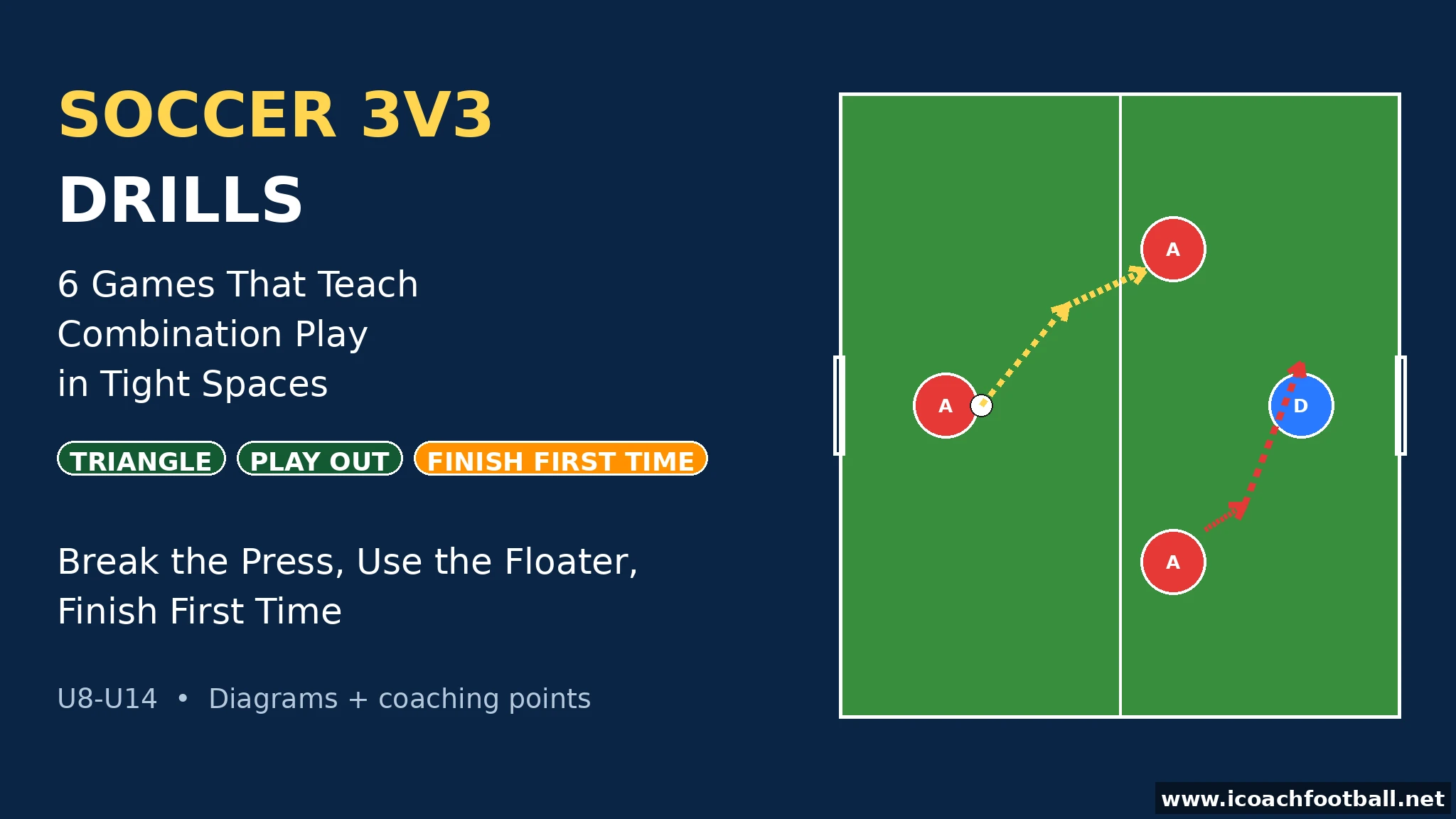
3v3 is the smallest game that still looks like soccer: a triangle that must combine to score, and a defence that must work as a pair to stop it. These six soccer 3v3 drills teach players to break a press, use an extra player, switch the point of attack and finish first time — in spaces so tight that hiding is impossible.
Suitable for: U8–U14
Every coach has watched a 7v7 game where one player never touches the ball. In 3v3 that cannot happen — with only three outfield players per team, every player is involved in almost every phase, which is exactly how the FIFA Training Centre describes its own 3v3 games. In the UK the same games run as football drills, and the format works the same way: small pitch, short rounds, constant decisions.
These six games build in order, from playing out of pressure to finishing under it.
3v3 is where the combination habits start — these soccer 4v4 drills add the fourth player, the width and the shape, so the same combinations now happen at match speed.
Session snapshot
- Players: 12–18, across three 3v3 pitches
- Area: 30 x 25 yards per pitch (FIFA uses 30 x 25 metres for its 3v3 game)
- Duration: 60 minutes
- Focus: Combination play, breaking the press, using the extra player, first-time finishing
- Age: U8–U14 (see Age adaptations)
Why 3v3 works
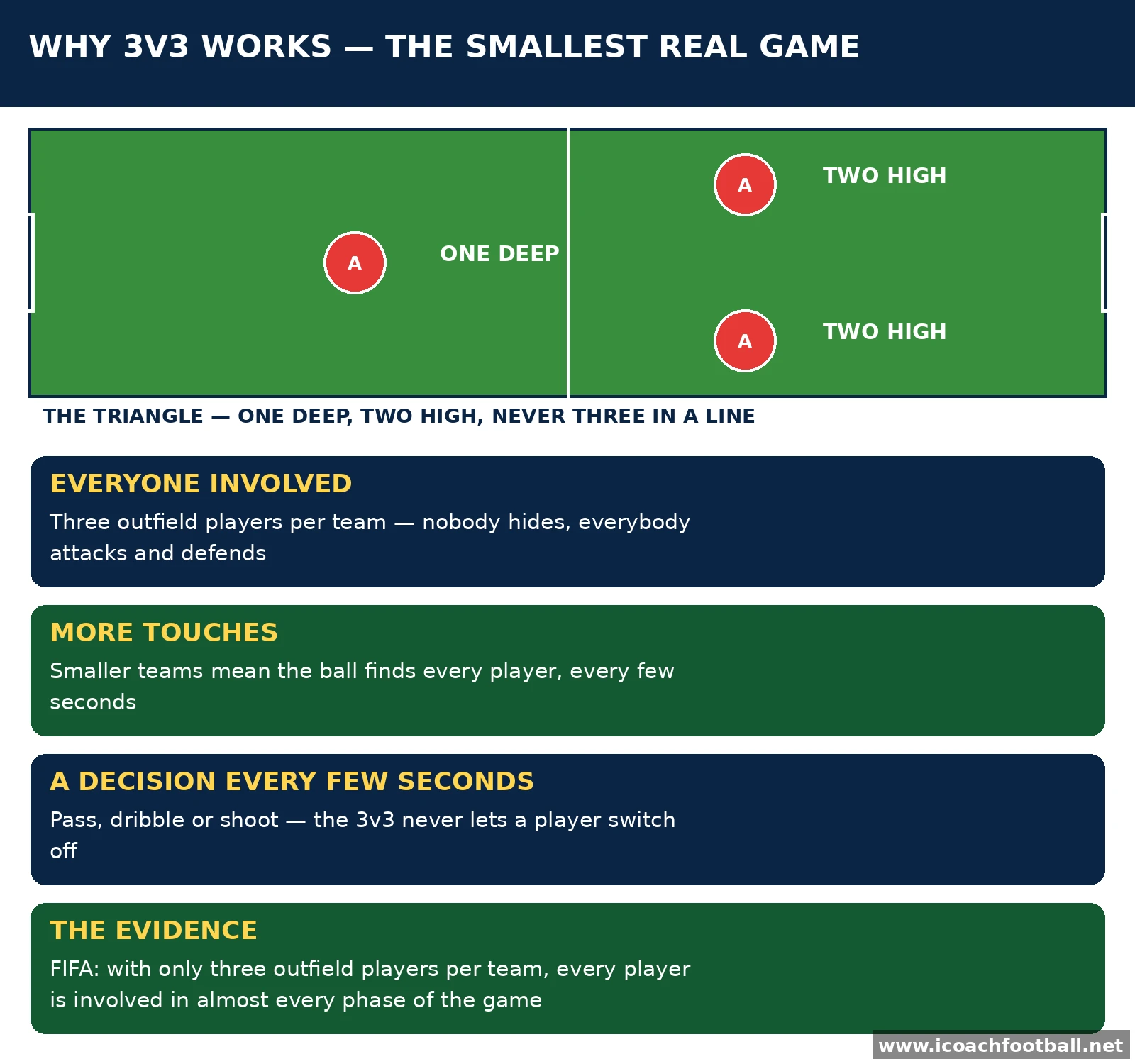
Three players make a triangle, and a triangle is the smallest shape that teaches real combination play. One player has the ball, one supports, one stretches the defence — and the roles swap every few seconds. There is no spare player to hide behind, so every player practices receiving, passing, defending and finishing in every round. The format is in line with the FIFA Training Centre’s grassroots sessions, which build from 2v2 games into 3v3 tournaments across several small pitches.
| Rule | What it means | The call |
|---|---|---|
| TRIANGLE SHAPE | One deep, two high — never three in a line | “TRIANGLE!” |
| PLAY OUT, DON’T CLEAR | Beat the press with a pass, not a punt | “PLAY!” |
| USE THE EXTRA PLAYER | The floater or target is the free man — find them first | “FREE MAN!” |
| FINISH FIRST TIME | In a 3v3 the chance is gone in a second — strike it early | “FIRST TIME!” |
Drill 1: Break the Press, Turn and Finish
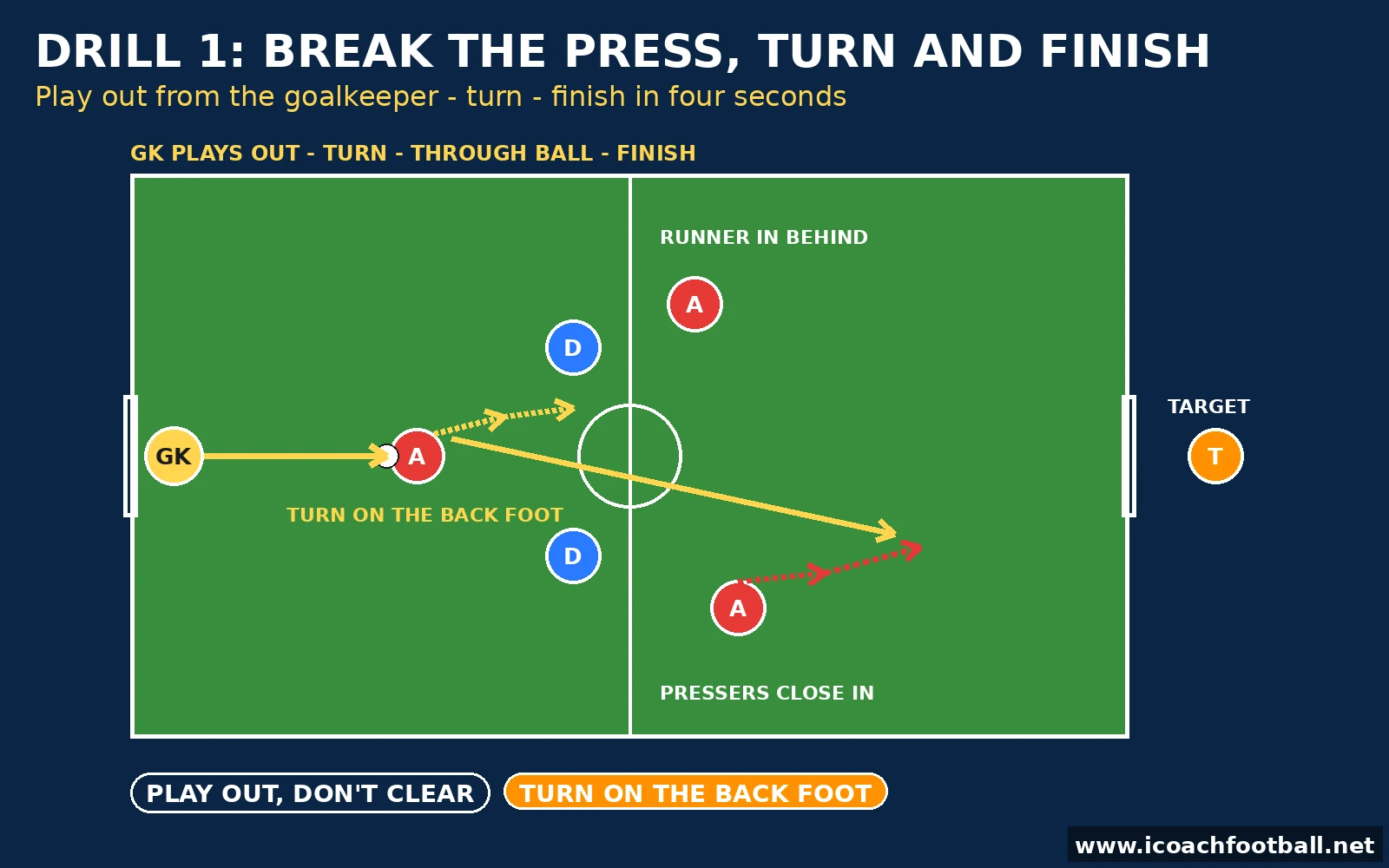
This is the signature game, based on the FIFA Training Centre’s 3v3 game of the same name. The goalkeeper plays out against a press, one player turns, and the attack finishes before the defence recovers. Watch the animation below the diagram: the pass, the turn and the finish happen in four seconds.
Setup
- 30 x 25-yard pitch, one full-size goal with a goalkeeper, one target player behind the opposite end line
- 3v3 plus goalkeeper and target; 1 ball, 12 minutes
How to Play
- The goalkeeper starts with the ball and plays out to the deepest attacker.
- The two pressing defenders close down at once — the ball must be played, not cleared.
- The receiver takes the ball on the half-turn and drives forward into the space behind the press.
- The third attacker makes a run in behind, and the receiver plays them through for the finish.
- If the defence wins the ball, they attack the same goal at once; the team that lost it must recover.
Coach’s note: The turn is the whole drill. A receiver who takes the ball facing their own goal has already lost — the press arrives and the move dies. Teach the trigger: scan before the pass, open the body, take it across the body on the back foot. If players keep receiving square, put a cone behind the receiver and forbid them from turning their back to it. This is the same half-turn receive trained in our 2v2 soccer drills — the difference is the third player, who gives the turn somewhere to go.
Progressions: The target player becomes live and can be used as a wall pass; the pressers start from the halfway line so the build-out has less time; goals only count if the finish is first time.
Drill 2: The End-Zone Game
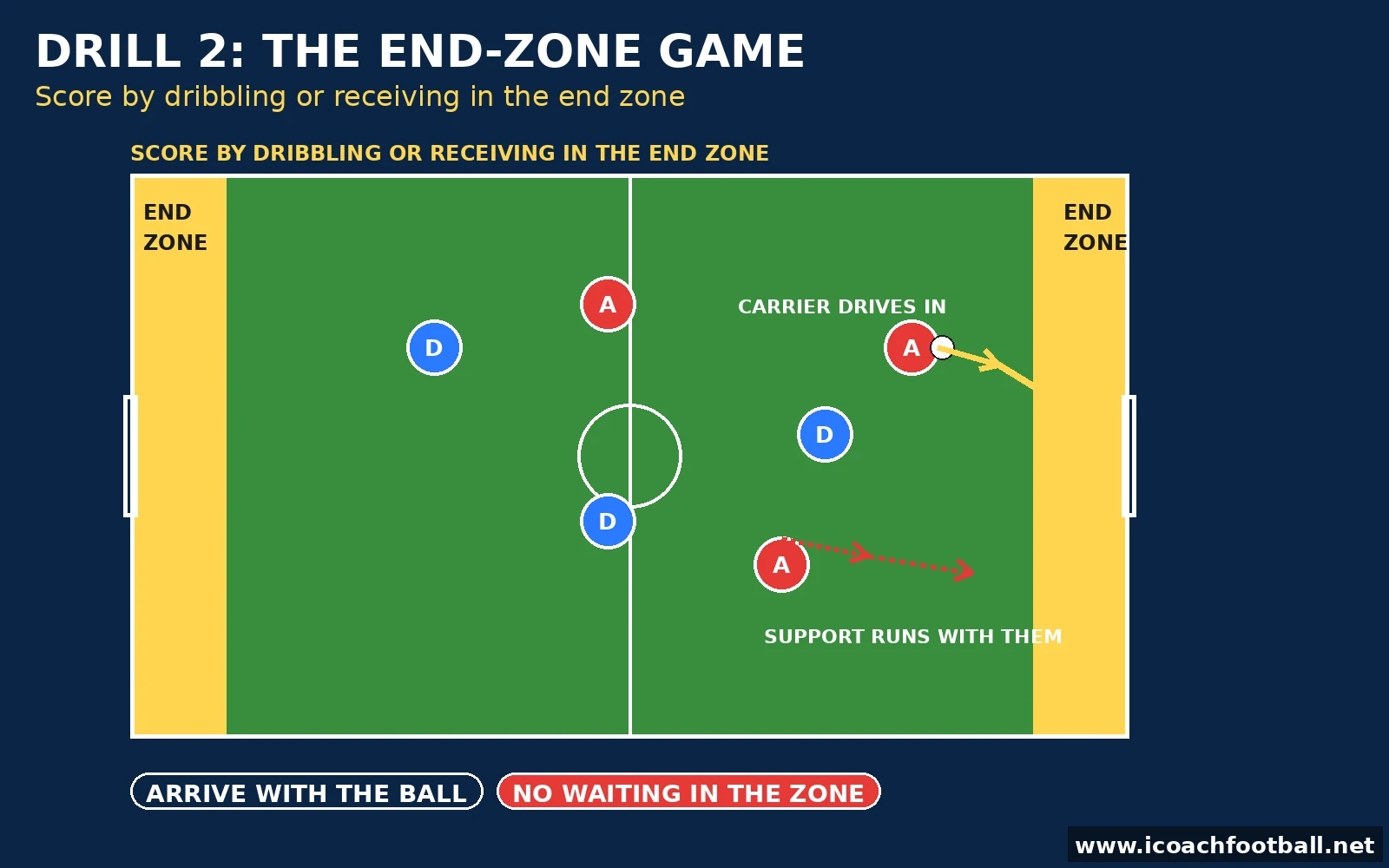
No goals, no goalkeeper — just two end zones. The only way to score is to dribble or receive the ball inside the opponent’s end zone, which forces players to run with the ball and support the carrier.
Setup
- 25 x 20-yard pitch, 5-yard end zones marked with cones at each end, 3v3, no goalkeepers
- 1 ball, 10 minutes
How to Play
- Teams play 3v3 and score by dribbling the ball under control into the opponent’s end zone.
- A player may also receive a pass inside the end zone, but the receiver must be moving when the ball arrives.
- If a team scores, the other team restarts from their own end zone with a dribble-in.
- No player may stand in an end zone waiting — the scorer must arrive there with or after the ball.
- Play 3-minute rounds, then rotate opponents so every group faces a new problem.
Coach’s note: Watch the player without the ball. In a normal game they drift; here they must sprint into the end zone to give the carrier a target. The cue phrase is “run to score, not to watch”. If one player keeps dribbling into trouble, freeze the game and ask the carrier where their two team-mates were — the answer is usually “behind the ball”. The support runs this game teaches are the same ones our 3v2 soccer drills train, with one more defender to beat.
Progressions: A goal only counts after two passes, so the carrier must combine; the end zones get narrower, so the runs must be timed, not just fast.
Drill 3: The Four-Goal Game
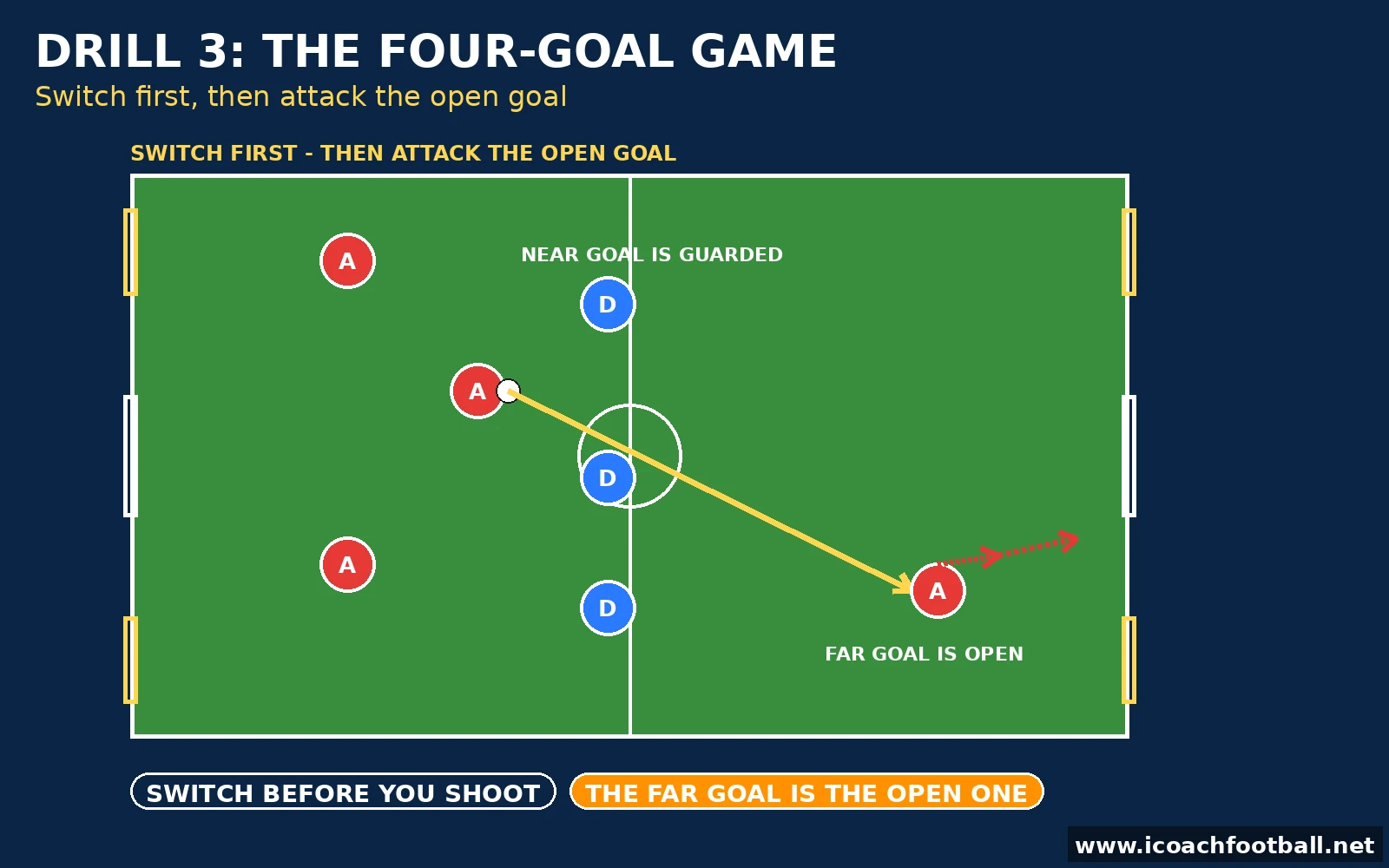
Two goals at each end instead of one. Attackers must scan, because the goal they should attack changes every few seconds — and defenders must guard two targets, which is exactly what makes switching play matter.
Setup
- 30 x 25-yard pitch, four mini-goals — two at each end, placed wide — 3v3 plus goalkeepers optional
- 1 ball, 10 minutes
How to Play
- Teams play 3v3 and may attack either of the two goals at the end they are facing.
- Before shooting, the attacking team must switch the ball from one side of the pitch to the other.
- The switch can be a pass or a dribble, but it must cross the centre line of the pitch.
- If a team scores without switching first, the goal does not count and play restarts from the coach.
- Play 4-minute rounds; the team that concedes restarts with the ball from their own end.
Coach’s note: The first few rounds will be chaos — players will shoot at the nearest goal and forget the switch. That is the lesson: the near goal is guarded, the far goal is open, and the switch is what moves the defence. Shout “SWITCH!” the moment the ball is won, and the habit forms fast. If a team keeps attacking one side, ask the defenders which goal they are protecting — they will point at the one being attacked, which proves the other one is free. This switching habit is the same one trained in our soccer passing drills, compressed into a 3v3.
Progressions: Goals only count from a first-time finish, so the switch must be played to a runner; remove one goal at each end, so the switch has to find the single open target.
Drill 4: 3v3 Plus a Floater
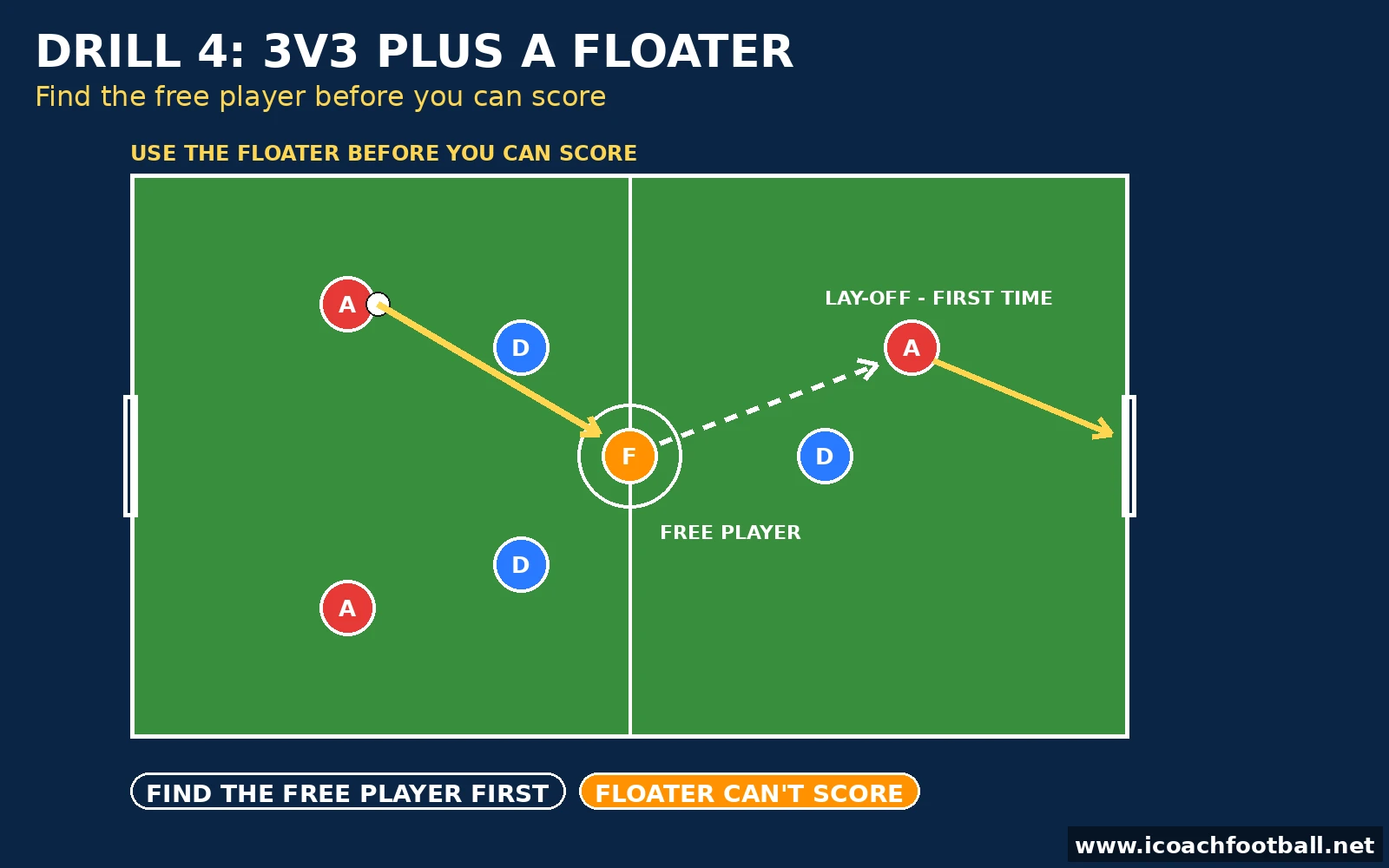
Add one neutral player who always plays for the team with the ball, and 3v3 becomes 4v3 in possession. This is the FIFA grassroots pattern — a 3v3 with floaters — and it teaches the most valuable habit in youth soccer: find the free player first.
Setup
- 30 x 25-yard pitch, two small goals, 3v3 plus one floater who always joins the team in possession
- 1 ball, 12 minutes
How to Play
- The floater wears a different colour and always plays for the team that has the ball.
- A team must use the floater at least once before they are allowed to score.
- The floater may not score and may not be tackled, so the defence must stop the pass into them, not the player.
- When possession changes, the floater switches sides at once — the free player is always on the other team now.
- Rotate the floater every 3 minutes so everyone learns to play as the free man.
Coach’s note: The floater will be ignored for the first five minutes — players will try to beat defenders 1v1 instead of passing to the free player. Stop the game and ask the ball carrier one question: “who is free?” The answer is always the floater. That question, asked often enough, becomes the habit. If the floater is still ignored, make the rule stricter: the team must use the floater twice before scoring. The same free-man idea runs through our 4v4 plus 3 neutrals positional play session, where the extra players create the same overload.
Progressions: The floater is limited to two touches, so the ball must move on; the floater may only play in the attacking half, so the team must earn the right to use them.
Drill 5: Winner Stays On
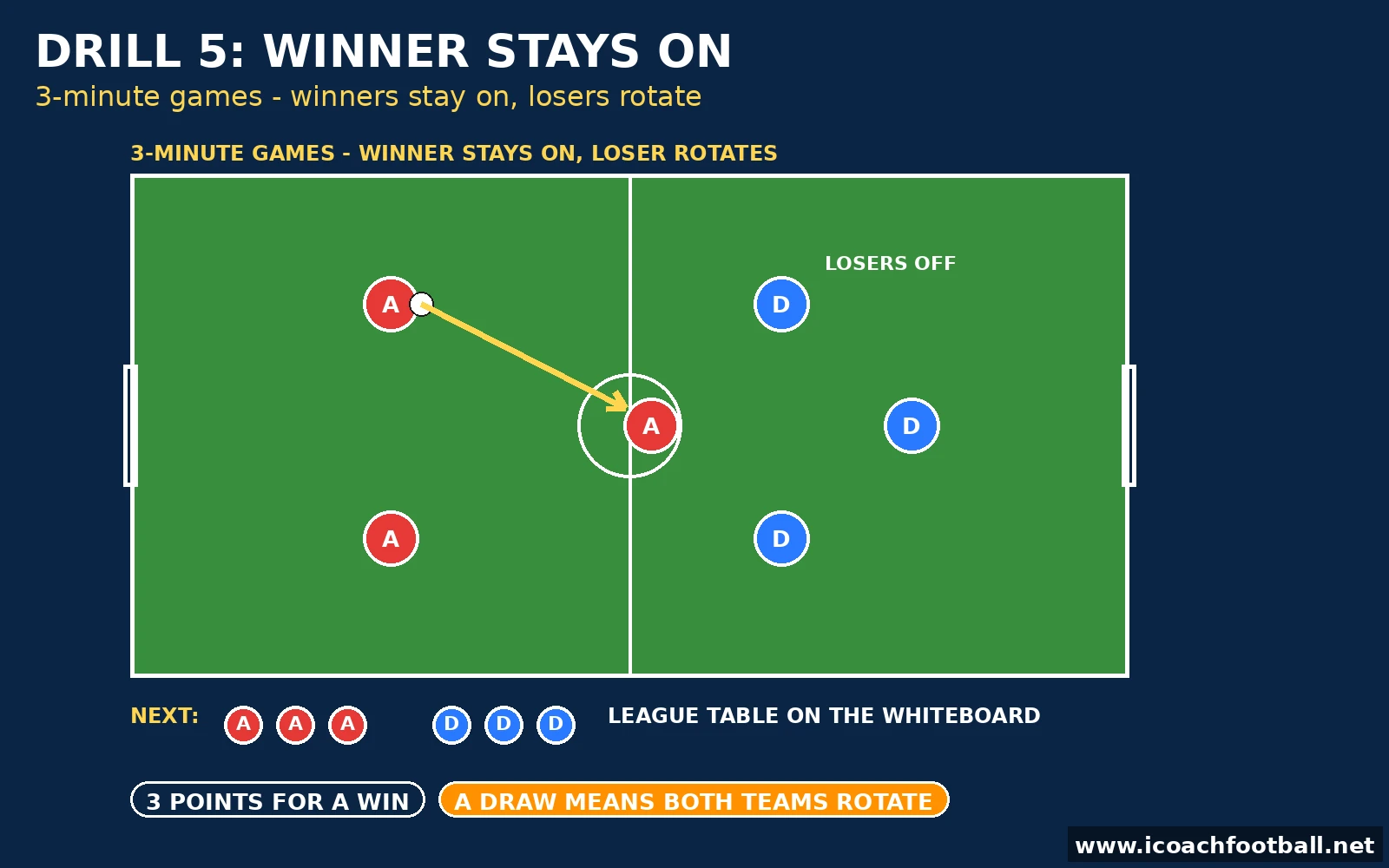
A tournament, not a drill. Three-minute games on two or three pitches, winners stay on, losers rotate off. The format creates pressure, urgency and a crowd — and it solves the numbers problem, because 18 players fit on three pitches with no one standing around.
Setup
- Two or three 25 x 20-yard pitches side by side, mini-goals at each end, 3v3 on each pitch
- 12–18 players in teams of three; 1 ball per pitch, 15 minutes
How to Play
- Teams of three play 3-minute games on each pitch, with the coach calling time.
- The winning team stays on; the losing team rotates off and the next team steps in.
- A draw means both teams rotate off, so every game has a winner.
- Keep a simple league table on a whiteboard — three points for a win, one for a draw.
- After 15 minutes, the top two teams play a 3-minute final on the middle pitch.
Coach’s note: The tournament does the coaching for you. Losing a game and rotating off hurts, so teams start organising themselves — one drops, one presses, one covers — without being told. Your job is to watch the shape, not to shout instructions. If a team keeps losing, give them one adjustment only: “one player always stays behind the ball”. The rotation system is the same one used in the 1v1 to 4v4 transition drill, scaled up to a full session block.
Progressions: The winning team must win by two clear goals to stay on, so dominant teams cannot coast; the final is played with a floater, so the best two teams must find the free player under pressure.
Drill 6: One-Touch Finish
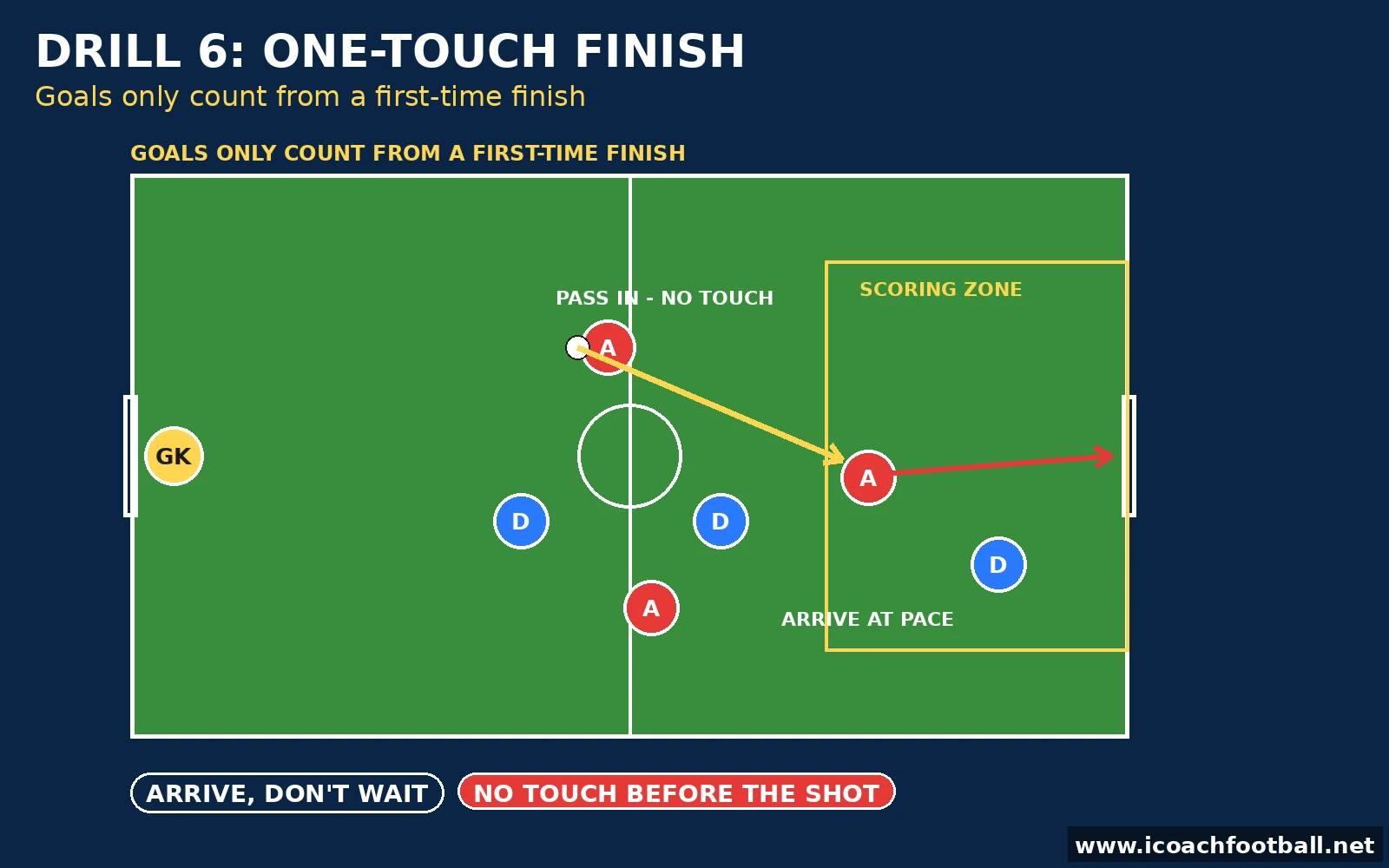
In 3v3 the shooting window is tiny — a defender is always a step away. This game only counts goals scored with a first-time finish, so players learn to arrive at the ball already knowing where the goal is.
Setup
- 25 x 20-yard pitch, one full-size goal with a goalkeeper, 3v3, balls behind the goal for quick restarts
- 1 ball in play, 10 minutes
How to Play
- Teams play 3v3, but a goal only counts if the shot is taken first time — no touch before the strike.
- The shooter must be moving toward the ball when it arrives, not standing still waiting for it.
- If a player takes a touch before shooting, the goal does not count and the other team restarts.
- The team without the ball must defend the goal, not just chase the ball carrier — one defender always stays goal-side.
- Play 3-minute rounds, then swap the goalkeeper so everyone experiences the shooting window from both sides.
Coach’s note: Players will take a touch out of habit and then look at you, knowing the goal will not count. Do not soften the rule — the frustration is the teaching. The fix is in the run, not the strike: the shooter should be arriving at the ball at pace, with their body already open to goal. Teach the cue “arrive, don’t wait” and the one-touch finish follows. The finishing technique itself is the same as in our 1v1 finishing drills — the difference is the 3v3 gives the shooter half the time.
Progressions: The finish must come from a pass played by a team-mate, not from a dribble, so the run and the pass must be timed together; goals from outside a marked scoring zone count double.
Coaching points
- Triangle shape, always. One deep, two high — never three in a line, or the defence can mark all three with two players.
- Play out, don’t clear. Beat the press with a pass, not a punt — the 3v3 gives the receiver time if the first pass is firm.
- Find the free player first. The floater, the target, the spare man — the best pass in 3v3 is usually the obvious one.
- Arrive, don’t wait. The scorer, the switcher and the finisher all move before the ball does.
- Finish first time. In a 3v3 the shooting window closes in a second — strike it early, with the body already open.
- One drops, one presses, one covers. The three-player defence is a unit: the nearest player presses, the second covers, the third stays goal-side.
Common mistakes
- Three in a line. The attackers stand flat across the pitch and the defence marks them all. Fix it with Drill 1 — one player must always be deeper than the other two.
- Clearing under pressure. The goalkeeper or defender punts the ball away instead of playing out. Fix it with Drill 1 — the ball must be played, and the pressers start further back until the build-out is clean.
- Ignoring the free player. The carrier tries to beat a defender 1v1 while the floater stands open. Fix it with Drill 4 — ask “who is free?” after every turnover.
- Standing in the end zone. The scorer waits in the zone for the ball and gets marked. Fix it with Drill 2 — the scorer must arrive with or after the ball, never before it.
- Taking a touch to shoot. The shooter settles the ball and the window closes. Fix it with Drill 6 — the goal does not count unless it is first time.
Age adaptations
| Age group | How the drills change |
|---|---|
| U6–U8 | Use Drills 2 and 5 only, on 20 x 15-yard pitches with no goalkeepers and pop-up goals. 3v3 is the recommended format at this age — keep rounds to 2 minutes and let the game teach. No offside, no floater rule. |
| U9–U10 | Add Drill 3 and Drill 6, on 25 x 20-yard pitches. Introduce the floater in Drill 4 but drop the “must use the floater” rule — just let them discover the free player. |
| U11–U12 | Full areas, introduce Drill 1 with the goalkeeper playing out, and the full floater rule in Drill 4. Add the one-touch finish rule in Drill 6. |
| U13–U14 | Full speed, live pressing in every drill, and the attackers vary the pattern without warning — turn, wall pass, switch or drive. Add a 3-second limit on the ball in Drill 4 so the free player must be found fast. |
60-minute session plan
| Block | Time | What to run |
|---|---|---|
| Warm-up | 0–8 min | 3v3 keep-ball on three pitches: two touches maximum, no goals |
| Drill 1 | 8–18 min | Break the Press, Turn and Finish — play out, turn, finish |
| Drill 2 | 18–26 min | The End-Zone Game — run to score, support the carrier |
| Drill 3 | 26–34 min | The Four-Goal Game — scan, switch, attack the open goal |
| Drill 4 | 34–44 min | 3v3 Plus a Floater — find the free player first |
| Drill 5 | 44–54 min | Winner Stays On — tournament, 3-minute games |
| Game | 54–60 min | One-Touch Finish — goals only count first time (extend to 10 minutes if time allows) |
Sources
- FIFA Training Centre — “3v3 Break the Press, Turn and Finish”: played on a 30×25-metre pitch, 3v3 plus a goalkeeper and a target player; with only three outfield players per team, every player is involved in almost every phase of the game; the game exaggerates playing out from the back against a high press and creating chances in the final third. https://www.fifatrainingcentre.com/en/practice/training-perspectives/designing-games-for-development/3v3-break-the-press-turn-and-finish.php
- FIFA Training Centre — “#8 Small-sided games” (grassroots): 2v2 games with changing partners, then a 3v3 tournament played across three fields. https://www.fifatrainingcentre.com/en/practice/grassroots/4-to-8/small-sided-games.php
FAQ
What size pitch should I use for 3v3 soccer drills?
Use 30 x 25 yards for U11–U14, and 20 x 15 yards for U8 and under. The FIFA Training Centre’s 3v3 game uses a 30 x 25-metre pitch. The test is simple: if players keep kicking the ball far away, the pitch is too big; if they cannot find a passing lane, it is too small.
How long should a 3v3 game last?
Three to five minutes per round, then rotate. Short rounds keep the intensity high and give every team a fresh problem. A full 60-minute session runs six games of about 10 minutes each, or a winner-stays-on tournament with 3-minute games.
Should 3v3 have goalkeepers?
Not at U8 and under — use end zones or pop-up goals instead, and let every player attack and defend. From U10, add a goalkeeper and a target player, as in the FIFA 3v3 game, so players learn to play out from the back and finish against a keeper.
What is the best 3v3 formation?
The triangle: one player deep and two high, or two deep and one high — never three in a line. The deep player builds out, the two high players stretch the defence wide, and the shape rotates as the ball moves. Teach the shape, not positions: in 3v3 every player attacks and defends.
How do I run 3v3 drills with 18 players?
Set up three pitches side by side and run a winner-stays-on tournament (Drill 5). Six teams of three, 3-minute games, winners stay on and losers rotate off. No one stands around, every team plays every few minutes, and the league table gives the session an edge.