Soccer Drills for Wing Backs: 6 Games That Teach the Flank Player to Overlap, Cross and Recover
Quick answer
The wing back is the player who owns the whole flank. These six soccer drills for wing backs teach the wide player in a back three or five to stay wide and stretch the pitch, overlap on the winger’s signal, cross on the move, defend 1v1 in the channel and sprint back the full length of the flank — in one 60-minute session.
Suitable for: U12–U18
In football — soccer in the US — the wing back is the most demanding wide role on the pitch and the one most coaches train the least. Teams drill the winger’s 1v1 and the full-back’s duel, then hand the wing back the entire touchline and hope the running takes care of itself. It does not. The six games below train the job as FIFA teaches wing play: the FIFA Training Centre session “Wing play” builds the movement patterns that get the wide player in behind — the wide midfielder drops in to drag the defender, the full-back roams into the space and crosses — and “Attacking in wide areas” builds the overload and the overlap that finishes it. This post is the specialist companion to our soccer drills for fullbacks — that post trains the back-four full-back, this one trains only the wing back, the player who has no winger in front of them and must do both jobs on the flank.
Session snapshot
- Players: 12–20 (pairs and small groups for the patterns, 9v9 for the finish)
- Area: A 50-by-40-metre octagon for the possession work; two thirds of a full pitch for the patterns
- Duration: 60 minutes
- Focus: Staying wide, overlapping on the signal, crossing on the move, defending 1v1, sprinting back
- Age: U12–U18 (see Age adaptations)
The six wing-back rules
Every one of these soccer drills for wing backs is built on six rules. Teach them once, then repeat them in every game until the players say them back to you.

| Rule | What it means |
|---|---|
| Stay wide, stay in tune | Hug the touchline to stretch the pitch — but never wider than the centre-back can find you |
| First touch forward, open body | Side-on, far foot, first touch up the line — never back to your own goal |
| Overlap on the signal, not before | The run starts when the winger comes inside — early and the lane is closed, late and the cross is gone |
| Cross early or cut back — never cross blind | Know which delivery before you reach the byline — early, driven or cut-back, with a runner at every post |
| Defend 1v1: show outside, delay, recover | The winger goes down the line, never inside — and the first sprint back starts the moment the ball is lost |
| Sprint back first | The flank is yours to defend — the cross you just delivered does not excuse the run you did not make back |
Drill 1: Up, Back and Through — The FIFA Pattern
The pattern lesson. Two thirds of a full pitch with four mannequins in a square on each side: the wide midfielder drops in to drag the defender, the ball goes inside, and the wing back runs in behind to cross. Based on the FIFA Training Centre session “Wing play”, in which the “up, back and through” pattern plays the ball into the wide midfielder, who drops into the space between the mannequins to receive, passes inside to the centre-midfielder, and — as the pass is being played — the full-back runs into the space in behind the defence to latch onto the return ball and cross into the waiting attackers.


Setup: Two thirds of a full pitch, a full-size goal and keeper at one end, four mannequins in a square on each side just inside the opposition half, two centre-backs, two centre-midfielders, two wide midfielders, two wing backs and a striker, balls with the coach, 10 minutes.
How to play:
- The coach plays the ball into the centre-back, who carries it forward.
- As the centre-back nears the mannequins, the wide midfielder drops into the space between them to receive.
- The centre-back plays into the wide midfielder, who passes inside to the centre-midfielder.
- As the pass is played, the wing back runs in behind the defence down the flank.
- The centre-midfielder plays the ball into the space for the wing back to latch onto.
- The wing back crosses first time into the waiting attackers, who try to score.
Coach’s note: Watch the wing back who runs before the wide midfielder drops in — a run made too early lets the defender step across and close the lane before the pass is played, and the pattern dies on the touchline; the cue is “run on the pass, not before it,” and our soccer scanning drills teach the shoulder check that times the run, while our soccer passing drills build the firm driven ball the pattern needs.
Progressions: Run the pattern from the opposite side on every second repetition; add a defender who presses the centre-back, so the timing must hold under pressure; the wing back must cross with the weaker foot on the second block.
Drill 2: The Overlap Circuit — Winger In, Wing Back Out
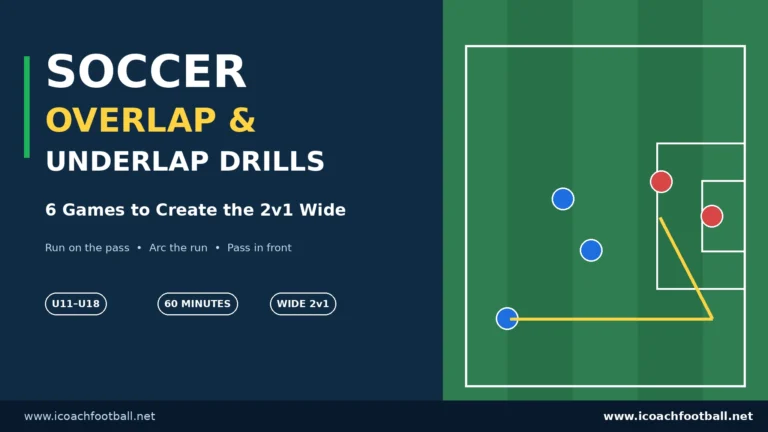
The overlap lesson. Half a pitch against ten mannequins in a 4-4-2 shape: the winger comes inside and calls for the ball, the wing back overlaps, and the cross comes from the byline. Based on the FIFA Training Centre session “Attacking in wide areas”, in which the 10v1 set-up asks the winger to come inside and turn with the ball, and on that signal the full-back overlaps, runs into an attacking position down the wing, receives the winger’s pass and delivers the ball into the box.

Setup: The opposition half only, ten mannequins in a 4-4-2 shape and one keeper, ten attackers in their positions, a winger and a wing back on each flank, balls with the coach, 10 minutes.
How to play:
- The attackers circulate the ball around their positions, maximum two touches.
- On the coach’s signal, a centre-midfielder plays the ball into the space ahead of the winger.
- The winger comes inside, turns with the ball and calls for the overlap.
- On that signal, the wing back overlaps down the outside and runs into the attacking position.
- The winger plays the ball to the wing back, who delivers it into the box.
- The striker attacks the near post, the opposite winger attacks the far post, and the late midfielder attacks the edge.
Coach’s note: Watch the wing back who overlaps on the coach’s signal instead of the winger’s — the overlap is a two-player move, and a run made before the winger turns lets the defender stay set and step across; the cue is “wait for the call,” and our soccer drills for wingers train the inside turn that triggers it, while our soccer drills for midfielders train the centre-midfielder who must play the ball into the space at the right weight.
Progressions: The winger may cut inside and finish instead of passing, so the wing back must read the shot and follow it in; the centre-midfielder may play the ball out wide to the wing back directly, so the overlap is not the only route; a live defender replaces a mannequin on the flank, so the overlap must beat a real opponent.
Drill 3: Cross on the Move — Early, Driven or Cut-Back
The delivery lesson. A 3v2 in the final third: the wing back receives wide, drives to the byline and must choose the right cross — early, driven low or cut back to the edge — with a runner at every post. In line with the FIFA Training Centre session “Attacking in wide areas”, in which the key coaching points ask players to understand passing and crossing options, including cut-backs, to recognise open space, and to have every area of the box attacked — near post, far post, central area and the edge.

Setup: The final third of the pitch with one full-size goal and a keeper, a wing back and a winger against two defenders, a striker and a late midfielder as runners, balls with the coach, 10 minutes.
How to play:
- The coach plays the ball wide to the wing back at the edge of the final third.
- The wing back drives at the defender and beats them on the outside.
- The striker attacks the near post and the late midfielder attacks the edge of the box.
- The wing back chooses the delivery: an early cross before the defender recovers, a driven low cross to the near post, or a cut-back to the edge.
- The runners finish first time — a goal from a cut-back counts double.
- After every two crosses, rotate the wing back so every player delivers from both flanks.
Coach’s note: Watch the wing back who crosses to an empty box — a delivery played before the runners arrive is a clearance, not a cross, and the ball rolls through to nobody; the cue is “head up before the byline,” and our soccer attacking third drills train the cut-back this finish depends on, while our soccer drills for strikers train the near-post run the cross is aimed at.
Progressions: The defender may show the wing back inside, so the cross must come from the half-space; the wing back must deliver with the weaker foot; the runners must score first time, so the delivery must arrive at the right pace.
Drill 4: The Channel Duel — Show Outside, Delay, Recover
The defending lesson. A 1v1 in a wide channel from the halfway line to goal: the wing back defends the winger, shows them outside, delays the attack and recovers the moment the ball is lost. In line with the FIFA Training Centre’s zonal defending work and our football defending wide areas drills, in which the closest defender presses and forces play outside while the second defender covers inside.
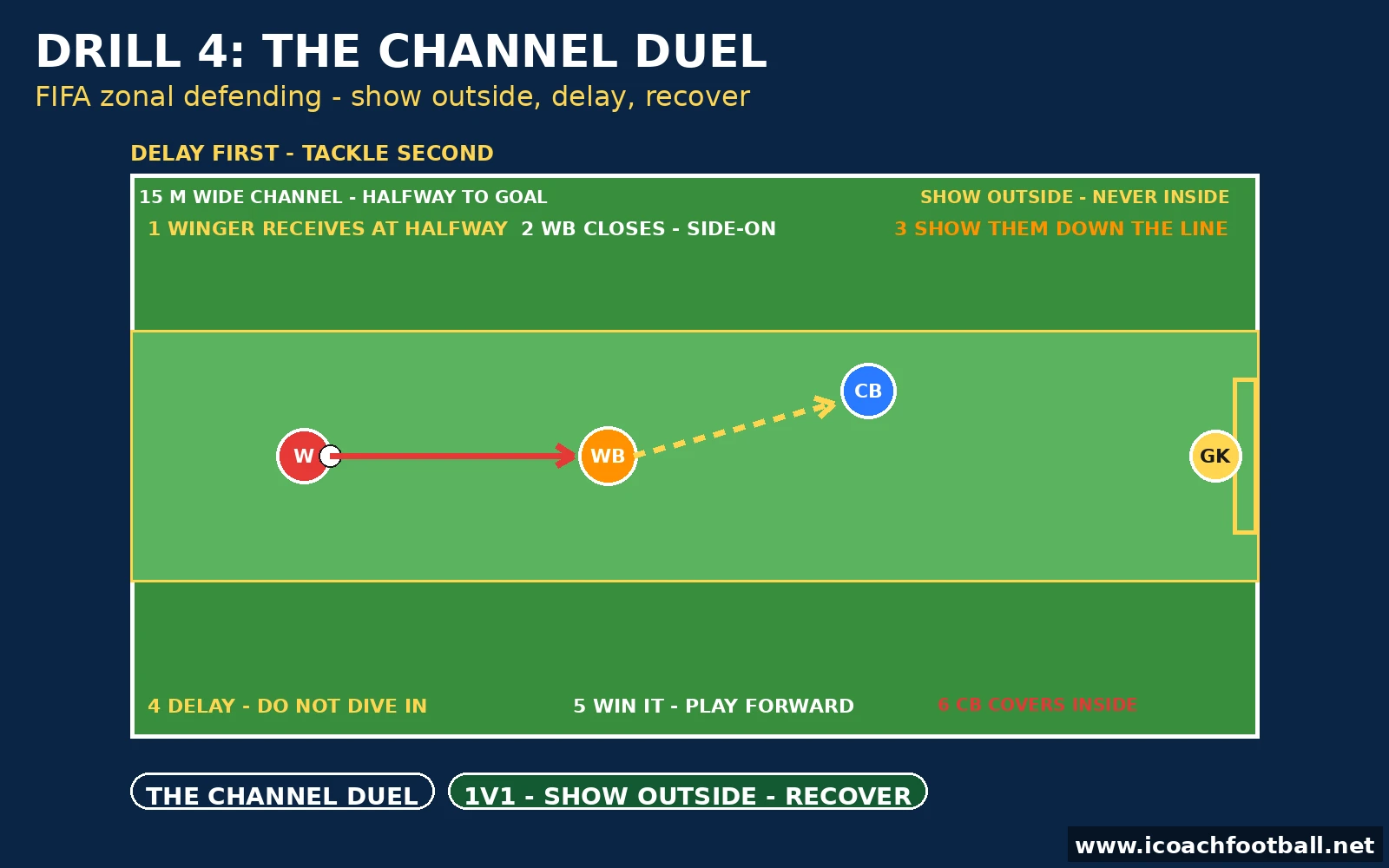
Setup: A 15-metre-wide channel running from the halfway line to the goal, one full-size goal and a keeper, one winger against one wing back, a centre-back as cover, balls with the coach, 10 minutes.
How to play:
- The coach plays the ball to the winger at the halfway line, facing the wing back.
- The wing back closes the distance immediately, side-on, on the balls of their feet.
- The wing back shows the winger down the line — never inside towards goal.
- If the winger beats them, the wing back sprints to recover and the centre-back covers inside.
- If the wing back wins it, they drive forward and play into the mini-goal at halfway.
- After every two duels, swap the wing back so every player defends the channel.
Coach’s note: Watch the wing back who dives in on the first touch — a defender who commits too early is beaten with one feint, and the channel is open to the byline; the cue is “delay first, tackle second,” and our football defending wide areas drills train the press-and-cover pair this duel sits inside, while our soccer dribbling drills train the feint the wing back must not bite on.
Progressions: A second attacker joins as an overlapping runner, so the wing back must choose between the ball carrier and the runner; the winger starts with a two-metre head start, so the recovery sprint is real; the wing back must win it and play forward within three seconds.
Drill 5: Switch and Sprint — The Far Flank Opens Up
The switching lesson. A full-width game in which the ball is switched to the far wing back, who must drive forward into the space and cross before the defence recovers. Based on the FIFA Training Centre session “Wing play”, in which the switch-of-play variation plays the ball to the centre-midfielder, who switches play with a diagonal pass into the space for the wide player on the opposite side to latch onto, while the wide midfielder on the far side makes a run into space up the flank.

Setup: Two thirds of a full pitch, full width, a full-size goal and keeper at each end, two wing backs, two centre-backs, two centre-midfielders and two wingers per side, balls with the coach, 10 minutes.
How to play:
- Play starts with the goalkeeper, and the team builds on one flank.
- The centre-midfielder receives and switches play with a diagonal pass to the far wing back.
- The far wing back receives on the half-turn and drives forward into the space up the flank.
- The near-side winger attacks the far post and the striker attacks the near post.
- The wing back crosses before the defence can shift across — a cross delivered within five seconds of the switch counts double.
- If the defence wins it, they switch play themselves, and the wing back must sprint back.
Coach’s note: Watch the far wing back who stands still while the ball is switched — a wing back who does not move early is still on the halfway line when the pass arrives, and the five-second window is gone before the run starts; the cue is “move on the switch, not on the pass,” and our soccer possession drills build the patience to keep the ball until the far side is open, while our soccer drills for center backs train the diagonal ball the switch depends on.
Progressions: The switch must be played first time, so the decision is made before the ball arrives; the far wing back must beat a defender 1v1 before crossing; the cross must be a cut-back, so the runners must attack the edge.
Drill 6: The Wing-Back Game — 9v9, Wide Goals Count Double
The match-real finish. A 9v9 game in a 50-by-40-metre octagon in which a goal involving the wide areas counts double — the wing back is the player the game is built around. Based on the FIFA Training Centre session “Attacking in wide areas”, in which the 9v9 in the octagon combines all the earlier exercises, the attacking team may use the cut-off corners and the area outside the pitch to attack and cross, and a goal involving the wide areas counts as two points while all other goals count as one.

Setup: A 50-by-40-metre octagon with the corners cut off, full-size goals with keepers, 9v9 in a 3-5-2 shape against a 3-5-2, both wing backs marked, balls with the coach, 12 minutes.
How to play:
- Play a normal game, but a goal involving the wide areas counts double.
- The wing backs may use the cut-off corners and the area outside the octagon to attack and cross.
- Every attack must go through a wing back at least once — a goal scored without one does not count.
- After the cross, the opposite wing back must be at the far post or the edge — never still on the halfway line.
- If the wing back loses the ball high up the pitch, they must sprint back before the next pass is played.
- Play two six-minute halves, then swap which team carries the wing-back role.
Coach’s note: Watch the wing back who stops running after the cross — a wing back who delivers and walks has done half the job, and the game is won by the player who sprints back the moment the ball is lost; the cue is “cross, then recover,” and our soccer counter attack drills train the same three-second transition this game demands, while our soccer 6v6 drills train the same movement in a smaller game.
Progressions: The defending team may now enter the outside areas, so the wing back must cross under real pressure; the wing backs are limited to two touches, so the combination must be first time; only goals created through a wing back count at all.
Coaching points
- Stay wide, stay in tune: Hug the touchline to stretch the pitch — our soccer drills for fullbacks train the same width in a back four, and our soccer drills for U15 train it one age up.
- First touch forward, open body: A closed body can only play backwards — our soccer scanning drills teach the shoulder check that finds the lane, and our soccer passing drills build the firm first-time ball.
- Overlap on the signal: The run starts when the winger comes inside — our soccer drills for wingers train the inside turn that triggers it, and our soccer drills for midfielders train the whole midfield job this role sits inside.
- Cross early or cut back: Know the delivery before the byline — our soccer attacking third drills train the cut-back it finishes, and our soccer drills for strikers train the near-post run it is aimed at.
- Defend 1v1: show outside, delay, recover: The winger goes down the line, never inside — our football defending wide areas drills train the press-and-cover pair, and our soccer drills for center backs train the cover behind the duel.
- Sprint back first: The flank is yours to defend — our soccer drills for U16 run the same recovery at full speed, and our soccer drills for U17 train it against senior defenders.
- Move on the switch, not on the pass: The far wing back is early or the window is gone — our soccer possession drills train the patience, and our soccer 5v5 drills train it in a bigger game.
- Attack every area of the box: Near post, far post, central area and edge — our football late runs into the box drills train the same timed arrival, and our soccer drills for U18 run it at senior pace.
- The cross is a pass, not a hope: A delivery to an empty box is a clearance — our soccer drills for U19 run the same finish at adult intensity, and our college soccer drills run it at the next level.
- The wing back is a defender too: The modern wing back is the first defender after the ball is lost — our soccer 4v4 drills train the same transition in a smaller game, and our soccer drills for U15 run it one age down.
Common mistakes
- Running before the wide midfielder drops in: A run made too early lets the defender step across — run on the pass, not before it.
- Overlapping on the coach’s signal, not the winger’s: A run made before the winger turns lets the defender stay set — wait for the call.
- Crossing to an empty box: A delivery played before the runners arrive is a clearance — head up before the byline.
- Diving in on the first touch: A defender who commits too early is beaten with one feint — delay first, tackle second.
- Standing still while the ball is switched: A wing back who does not move early is still on the halfway line when the pass arrives — move on the switch, not on the pass.
- Stopping after the cross: A wing back who delivers and walks has done half the job — cross, then recover.
Age adaptations
| Age | Area | Touches | What changes |
|---|---|---|---|
| U12–U13 | Two thirds of a pitch, 50-by-40-metre octagon | Three touches | Drill 1 runs with a passive pressing line at first, so the wing back learns the pattern before a defender arrives; Drill 2 runs with mannequins only, so the overlap is learned without a live opponent; Drill 3 runs with the cross from one side only; Drill 4 runs 1v0, so the wing back learns the show-outside shape before a winger is added; Drill 5 runs with the switch played to feet, not into space; Drill 6 runs 7v7 with no wide-goal rule — our U13 soccer practice plan shows the same age band in a full session |
| U14–U15 | Two thirds of a pitch, 50-by-40-metre octagon | Two touches | Drill 1 runs as written, with the defender added in the second block; Drill 2 runs with a live defender replacing a mannequin on the flank; Drill 3 runs with the cross from either side; Drill 4 runs 1v1 as written; Drill 5 runs with the five-second cross rule; Drill 6 runs with the wide-goal rule — our soccer drills for U15 train the same habits in a full session |
| U16–U17 | Half a pitch, reduced pitch | One–two touches | Drill 1 runs with the wing back crossing with the weaker foot; Drill 2 runs with the winger cutting inside to finish instead of passing; Drill 3 runs with the defender showing the wing back inside; Drill 4 runs with a second attacker joining as an overlapping runner; Drill 5 runs with the switch played first time; Drill 6 runs with the defending team allowed into the outside areas — our soccer drills for U16 and our soccer drills for U17 run the same age band in full sessions |
| U18 (and adult) | Half a pitch, reduced pitch | One touch | Drill 1 runs at full speed with the defender forcing the timing choice; Drill 2 runs with the wing back finishing with the weaker foot; Drill 3 runs with the runners scoring first time; Drill 4 runs with the winger starting with a two-metre head start; Drill 5 runs with the cross as a cut-back only; Drill 6 runs with only goals created through a wing back counting — our soccer drills for U18 and our soccer drills for U19 run the same habits at full size |
60-minute session plan
These six soccer drills for wing backs fit into the hour like this:
| Block | Minutes | What to run |
|---|---|---|
| Warm-up | 0–10 | Drill 1, up, back and through, walking pace then half speed |
| Overlap | 10–20 | Drill 2, the overlap circuit |
| Delivery | 20–30 | Drill 3, cross on the move |
| Defending | 30–40 | Drill 4, the channel duel |
| Switching | 40–50 | Drill 5, switch and sprint |
| Match-real finish | 50–60 | Drill 6, the wing-back game 9v9 |
For a full guide to building the hour around these blocks, see our 60-minute session plan.
FAQ
What is a wing back?
A wing back is the wide player in a team that plays with three centre-backs — usually a 3-5-2 or 5-3-2 — who owns the whole flank. Unlike a full-back in a back four, who has a winger in front of them, the wing back is both the wide defender and the wide attacker: they defend 1v1 in their own half, overlap to cross in the opposition half, and sprint back the full length of the touchline on every transition. In football — soccer in the US — it is the most physically demanding wide role, which is why this post trains it as a complete job rather than a single skill.
What is the difference between a wing back and a full-back?
The full-back plays in a back four with a winger ahead of them and defends a smaller area; the wing back plays in a back three or five with no winger ahead and owns the entire flank. The full-back overlaps occasionally; the wing back overlaps on every attack, crosses on the move and is the team’s width. The two jobs meet on the touchline — which is why our soccer drills for fullbacks train the back-four role this post plays alongside.
What is the difference between a wing back and a winger?
The winger is an attacker who starts high, stays narrow or wide to receive, and rarely tracks back to their own box; the wing back starts deep, defends their own box, and arrives in the opposition box late. The winger beats the defender and shoots; the wing back overlaps the winger, crosses for the striker and sprints back when the ball is lost. Our soccer drills for wingers train the winger’s half of that partnership.
What age should a player start training as a wing back?
From U12. Before that, every player should rotate through every position, including the wing back, so they learn the running and the crossing without being fixed in it. From U12 the role becomes a real job: the player who stays wide, overlaps on the signal and sprints back. Drill 1 in this post is the first drill to teach it — a pattern that works from U12 up, with the defender and the one-touch rules added as the players get older.
How do you train a wing back’s fitness without running laps?
You train it inside the drills, not beside them. Every drill in this post makes the wing back run the full length of the flank — the recovery in Drill 6, the overlap in Drill 2, the switch sprint in Drill 5 — so the fitness comes from repeated high-intensity runs with the ball, which is how the role actually works in a match. Add one rule and the conditioning takes care of itself: every attack must go through a wing back, and the cross-then-recover rule in Drill 6 keeps the intensity honest.
Sources
- FIFA Training Centre — “Wing play” (Aidy Boothroyd, former England U-21 head coach: the wide midfielder drops into the space in front of the defensive line to drag the defender in, creating space in the wide areas for the full-back to roam into and deliver a cross; the “up, back and through” pattern, the switch-of-play variations, the feeder run, and the 10v10 opposed movement patterns on a 70-by-45-metre pitch; key points — full-backs stay wide to stretch the field, time runs so they are synchronised, positive first touch). Drills 1, 5 and 6 in this post are based on and in line with that session.
- FIFA Training Centre — “Attacking in wide areas” (Daniel Gygax, former Swiss international and FC Zurich youth coach: a hexagon passing circuit, an 8v8 possession game in a 50-by-40-metre octagon, a 10v1 tactical set-up in which the winger comes inside and the full-back overlaps to deliver into the box, and a 9v9 in the octagon where a goal involving the wide areas counts double; key points — create overloads on the wings, break the defensive line, understand crossing options including cut-backs, attack the near post, far post, central area and edge of the box). Drills 2, 3 and 6 in this post are based on and in line with that session.