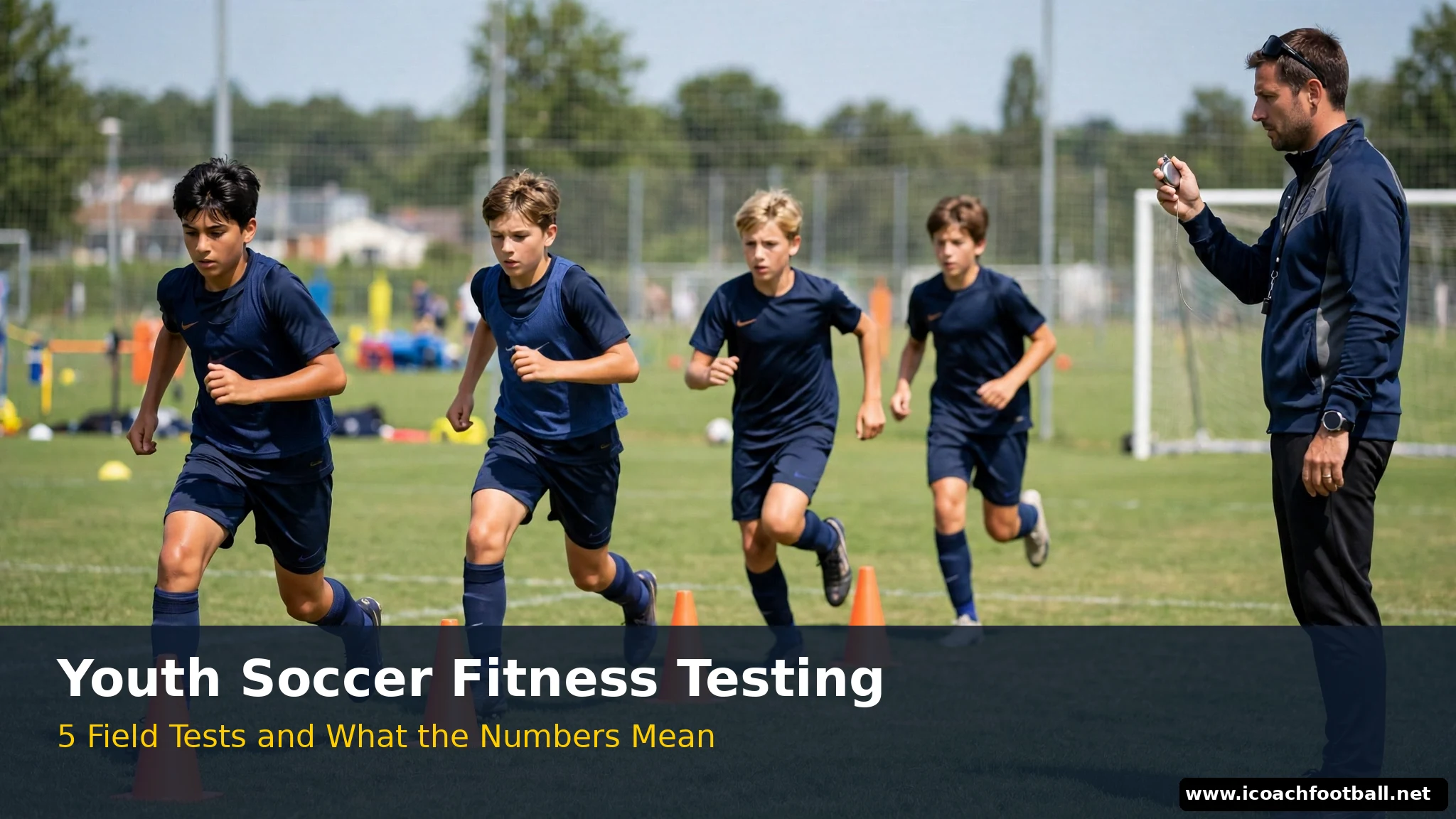
Youth Soccer Fitness Testing: 5 Field Tests and What the Numbers Mean
Quick answer: Test five qualities, in this order, with cones and a phone: standing long jump, 30-metre sprint, 5-0-5 agility, repeated sprints, then the Yo-Yo Intermittent Recovery Test Level 1 on a separate day. Record each player’s best score, compare each player only with their own last test, and never use maximal tests to select players at U12 and under.
Most fitness testing fails before a single sprint is timed. Coaches test too much, in the wrong order, on a tired group, then file numbers nobody uses.
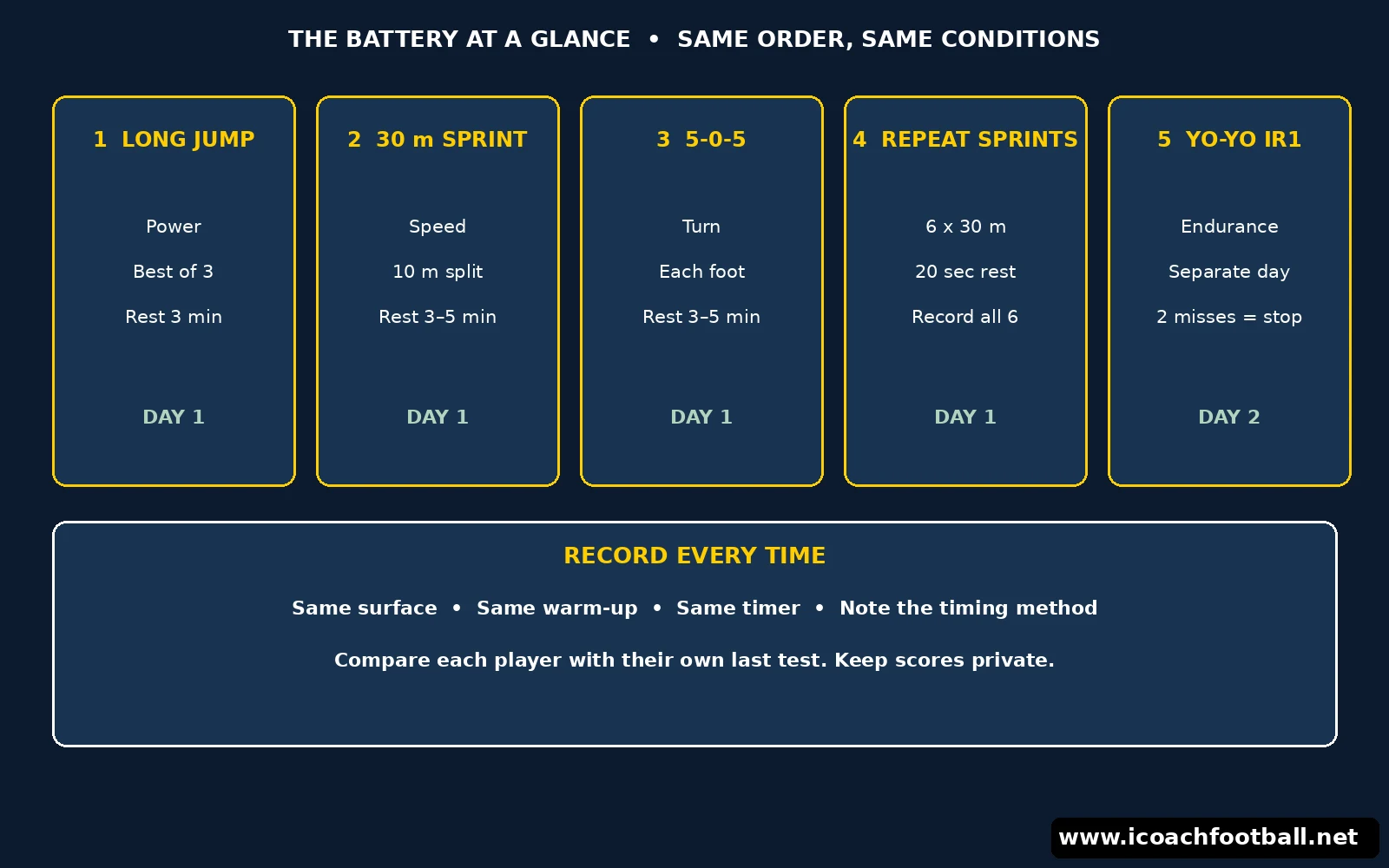
This battery fixes that. Five field tests cover power, speed, change of direction, repeat-sprint ability and intermittent endurance. Every test runs with cones, a tape measure and a phone stopwatch. In the UK the same battery is usually called football fitness testing, and the setups, distances and recording rules below work exactly the same way.
Session snapshot
- Players: Whole squad, tested in small waves (4–6 at a time, rest rotate)
- Area: Flat grass or turf, 40 metres of straight, clear runway plus a 25-metre Yo-Yo lane
- Duration: Day 1: 45 minutes (Tests 1–4). Day 2: 25 minutes (Test 5)
- Focus: Power, speed, change of direction, repeat-sprint ability, intermittent endurance
- Equipment: Cones, 30-metre tape, stopwatch or phone timer, Yo-Yo IR1 audio, recording sheet, water
- Age: U13–U19 full battery (see age adaptations; U12 and under use submaximal versions only)
Testing order
| Order | Test | What it measures | Rest before next test |
|---|---|---|---|
| 1 | Standing long jump | Lower-body power | 3 minutes |
| 2 | 30-metre sprint (10 m split) | Acceleration and speed | 3–5 minutes |
| 3 | 5-0-5 agility | Change of direction | 3–5 minutes |
| 4 | 6 x 30-metre repeated sprints | Repeat-sprint ability | Separate day if possible |
| 5 | Yo-Yo Intermittent Recovery Test Level 1 | Intermittent endurance | Last, on its own day |
Why this order matters
- Fresh first: Jumps and sprints need fresh legs. A tired jump tells you about fatigue, not power.
- Hardest last: The Yo-Yo test runs to exhaustion. Nothing useful can be tested after it.
- Same conditions, every time: Same surface, same warm-up, same time of day, same tester. A faster time on turf after a rest day is not improvement.
- Research backing: Field-test batteries used with youth players combine jumps, sprints, a 5-0-5 change-of-direction test and the Yo-Yo Intermittent Recovery Test Level 1. That combination is in line with the battery in the peer-reviewed study linked in Sources.
- Cue: “Best effort, full recovery.” Shout it before every rep. Rushed reps with short rests produce junk numbers.
Test 1 — Standing Long Jump
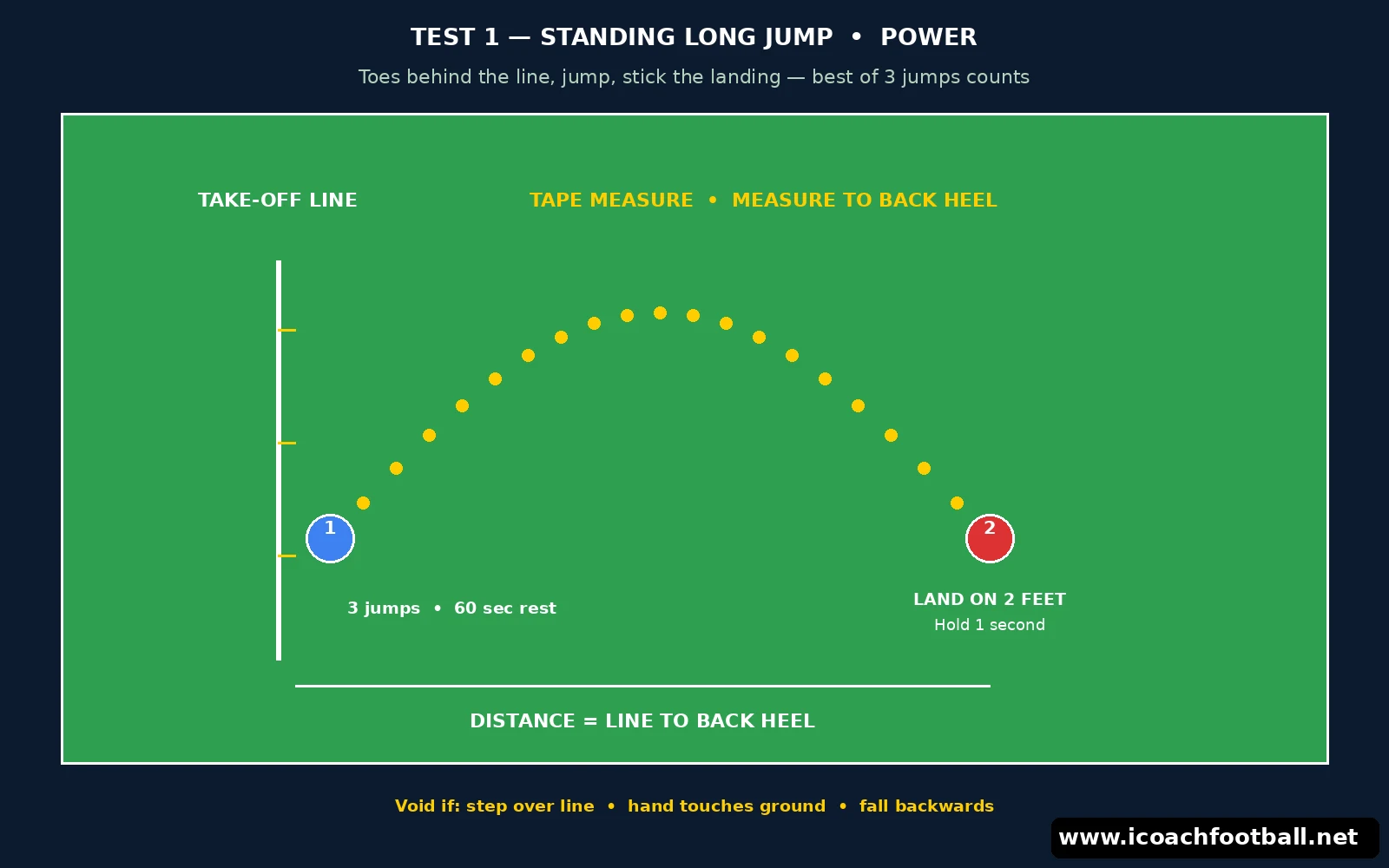
A no-kit power test. Every player can do it, and it needs no timing gates.
Setup:
- One take-off line marked with tape or a flat cone line.
- A tape measure laid straight out from the line, to at least 3 metres.
- One recorder with the sheet, standing to the side, not in the landing zone.
- Players wait 3 metres behind the line, so nobody stands in the way.
- Flat, dry surface. Never test on wet grass or a slope.
How to Play:
- The player stands with toes just behind the take-off line, feet hip-width apart.
- The player swings the arms back, bends the knees, and jumps forward as far as possible.
- The player lands on two feet and holds the landing for one second.
- The recorder measures from the take-off line to the back heel at landing.
- The player takes 3 jumps, with 60 seconds of rest between jumps, and the best jump counts.
Coach’s note: A step over the line, a hand touching the ground, or a fall backwards voids the jump. The cue is “Stick the landing!” A jump that ends in a stumble is not a score.
Progressions: If scores are flat across the squad, add landing and jumping work to warm-ups. If one leg lands well ahead of the other, note it and retest after four weeks of single-leg landing practice.
Test 2 — 30-Metre Sprint (10 m Split)
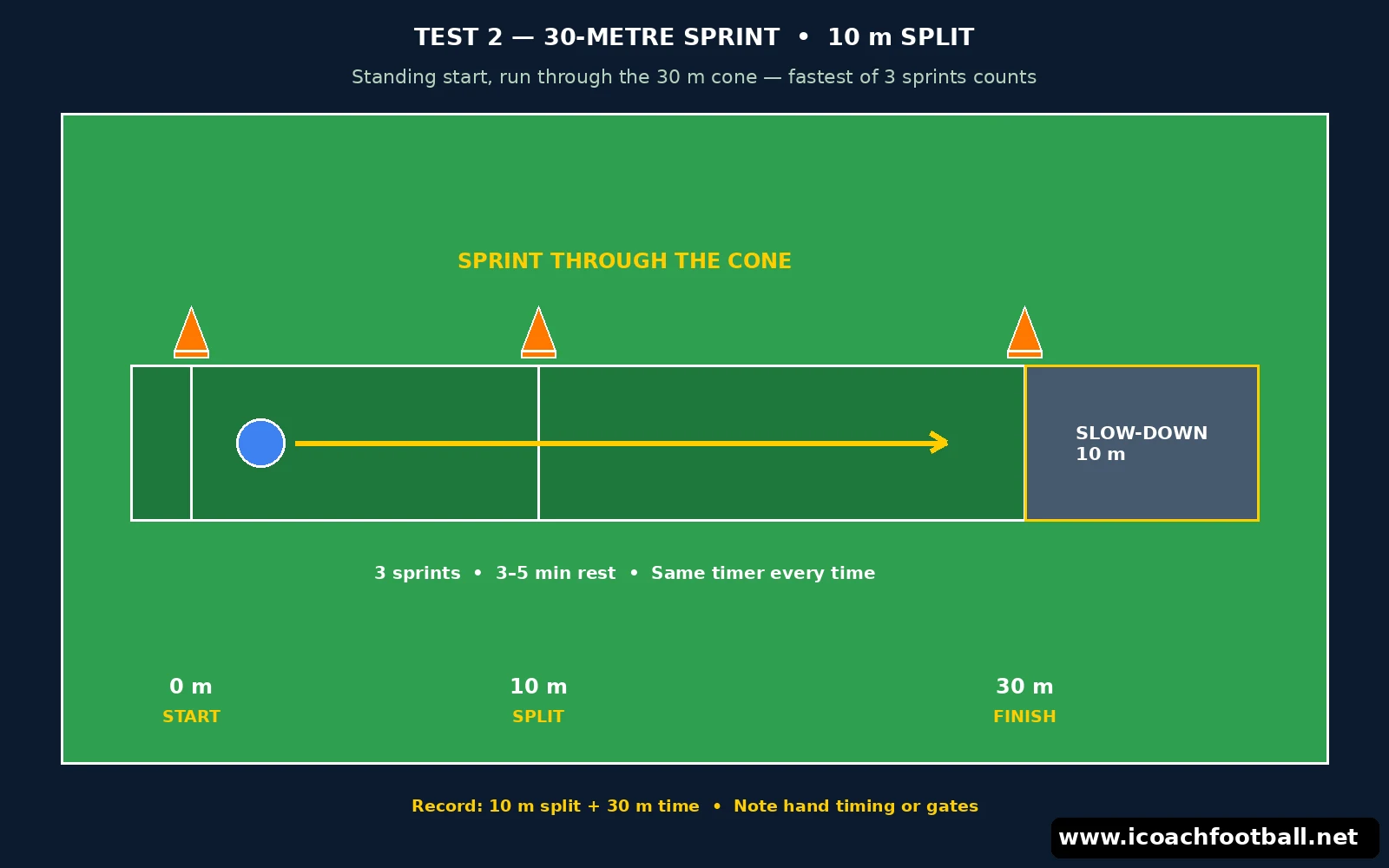
One sprint gives two scores: acceleration over 10 metres, and top speed over 30 metres.
Setup:
- A straight 40-metre runway, with cones at 0 m, 10 m and 30 m, plus 10 metres to slow down.
- A standing start, with the front foot just behind the 0-metre line.
- One timer at the 10-metre cone and one at the 30-metre cone, or one timer using a phone app with splits.
- Players start only on “Ready, go!” No rolling starts, no countdown sprints.
- Same starter and same timer for every player, every test day.
How to Play:
- The player stands still behind the 0-metre line, facing the runway.
- On “Ready, go!” the player sprints as fast as possible through the 30-metre cone.
- The timer records the 10-metre split and the 30-metre time.
- The player walks back slowly, taking at least 3 minutes before the next sprint.
- The player runs 3 sprints, and the fastest 30-metre time counts, with its 10-metre split.
Coach’s note: Hand timing runs faster than timing gates, so never compare a hand-timed score with a gate-timed score. The cue is “Run through the cone, not to it!” Players who slow down at 28 metres lose a tenth for nothing.
Progressions: If the 10-metre split is slow but the 30-metre time is strong, work on first-step acceleration. If the split is fast but the finish fades, work on sprint mechanics and relaxed top speed.
Test 3 — 5-0-5 Agility Test
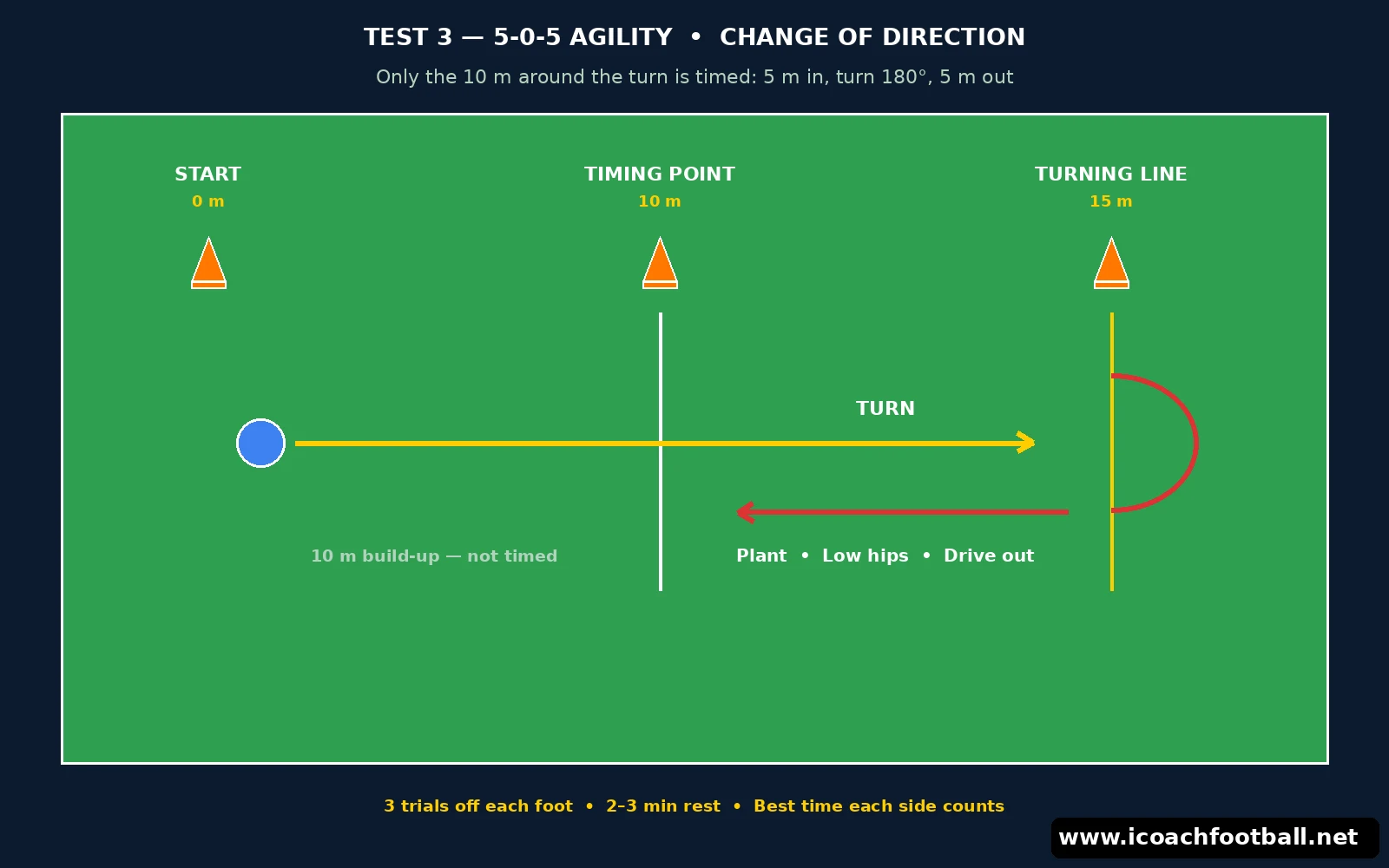
One 180-degree turn, timed. It separates turning ability from straight-line speed.
Setup:
- Three cones in a straight line: start at 0 m, timing point at 10 m, turning line at 15 m.
- The player starts at the 0-metre cone and builds speed for 10 metres.
- Timing runs only over the 10 metres around the turn: 5 metres in, 5 metres out.
- A phone stopwatch at the 10-metre cone, or timing gates if available.
- Players turn off the left foot and the right foot, in separate trials.
How to Play:
- The player sprints from the start cone, through the 10-metre point, to the 15-metre turning line.
- The player plants one foot on or behind the turning line and turns 180 degrees.
- The player sprints back through the 10-metre point as fast as possible.
- The timer records the 10-metre time around the turn, to two decimal places.
- The player takes 3 trials turning off each foot, with 2–3 minutes of rest, and the best time each side counts.
Coach’s note: The turn is the test. A player who rounds the turn in a wide arc has not turned. The cue is “Plant, low hips, drive out!” A left-right gap over 0.15 seconds is worth noting, not punishing.
Progressions: Subtract the 10-metre sprint time from the 5-0-5 time to get the change-of-direction deficit. A large deficit means turning work, not more straight sprinting. Small-sided games with tight turns build it.
Test 4 — 6 x 30-Metre Repeated Sprints
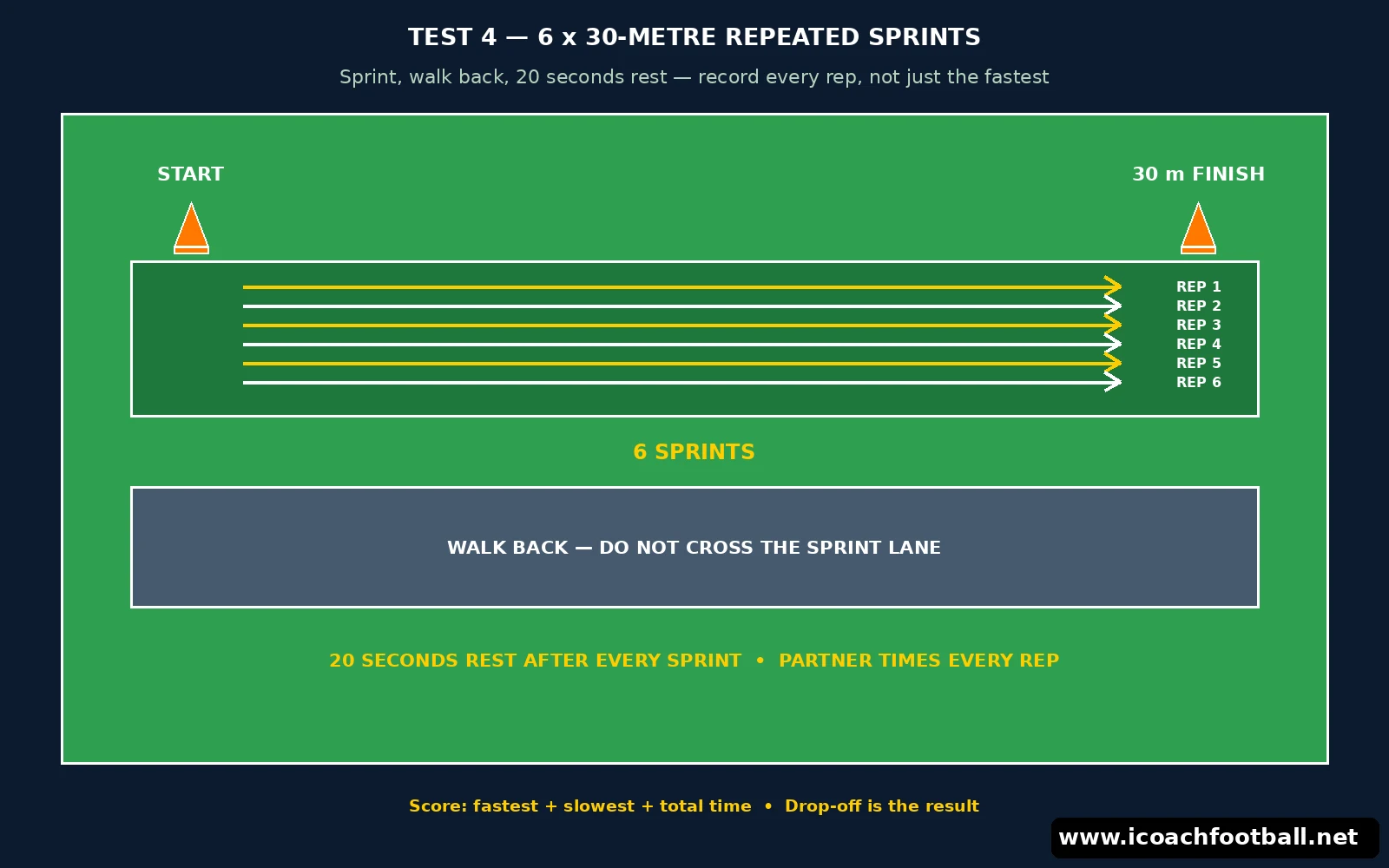
Soccer is sprint, recover, sprint again. This test measures how well speed holds up.
Setup:
- One 30-metre straight, with a start cone and a finish cone.
- A timer with a 20-second countdown, called aloud for every rep.
- Players work in pairs: one sprints, one times, then they swap roles.
- A walk-back recovery lane beside the sprint lane, so nobody crosses a sprinter.
- Water at the start line. No player starts a rep while still breathing hard from a warm-up sprint.
How to Play:
- The player sprints 30 metres as fast as possible, then walks back to the start.
- The player rests for 20 seconds from the end of the sprint, timed by the partner.
- The player sprints again, on the partner’s call, and repeats for 6 sprints in total.
- The partner records every sprint time, not just the fastest one.
- The coach records the fastest sprint, the slowest sprint, and the total time of all 6 sprints.
Coach’s note: The drop-off is the score. A player whose sixth sprint is far slower than the first needs repeat-sprint conditioning, not one more maximal sprint. The cue is “Every rep counts, same start!”
Progressions: If the drop-off is large, use short small-sided games with 20-second recoveries in training. If times stay level, lengthen the sprint to 40 metres or shorten recovery to 15 seconds, for older players only.
Test 5 — Yo-Yo Intermittent Recovery Test Level 1
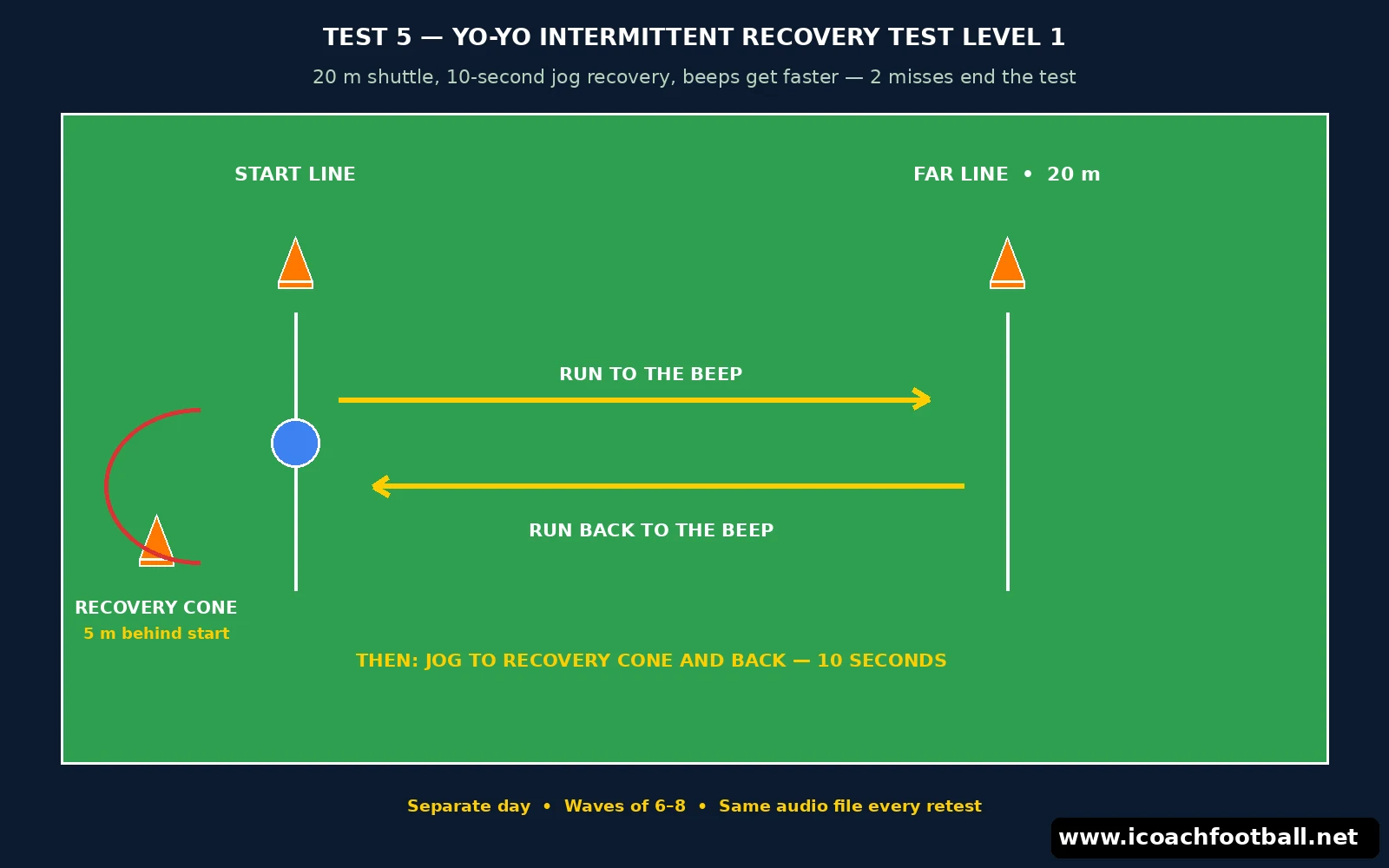
The soccer endurance test. Repeated 20-metre shuttles, faster and faster, with a 10-second jog recovery.
Setup:
- Two lines 20 metres apart, marked with cones, plus a recovery cone 5 metres behind the start line.
- The Yo-Yo IR1 audio file, played from a speaker every player can hear.
- One recorder per 4 players, marking each completed shuttle on the sheet.
- Players start together, in waves of 6–8, so the recorder can watch every runner.
- Test on a separate day from Tests 1–4, after a full warm-up and a practice shuttle.
How to Play:
- On the audio signal, the player runs 20 metres to the far line, reaching it before the beep.
- The player turns and runs 20 metres back to the start line, before the next beep.
- The player jogs to the recovery cone, 5 metres behind the start, and back, in 10 seconds.
- The beeps get faster after every shuttle, so the running speed keeps rising.
- The player stops after missing the beep twice in a row, and the recorder notes the total distance covered.
Coach’s note: Two misses end the test, not one. A player who misses once, then catches the next beep, keeps going. The cue is “Reach the line, jog back, breathe!” Never let a player run on after two misses to chase a team-mate’s score.
Progressions: Use the distance to set interval training: players with shorter distances need more aerobic base work in small-sided games, while players with long distances can handle higher-speed intervals. Retest after 8–10 weeks, with the same audio file.
What the numbers mean
- Compare with self, not with team-mates. Growth changes everything at youth level. A taller, earlier-maturing player will usually jump further and sprint faster. That is development, not talent.
- Same test, same conditions. A score only means something against the same test, on the same surface, with the same timing method. Note the surface and timer on every sheet.
- Small changes count. In sprint and agility tests, a change of 0.05–0.10 seconds between tests is real progress when conditions match. In the Yo-Yo test, an extra 100–200 metres after 8–10 weeks is a clear gain.
- One weak test is a training clue, not a verdict. A slow 5-0-5 with a fast 30-metre sprint points to turning work. A strong jump with a weak Yo-Yo score points to aerobic work. Use the pattern, not one number.
- Never rank, select or cut on fitness scores alone. Technique, decisions, attitude and growth all matter more, and fitness scores move fast as players grow. Keep scores private to the player and the coaching staff.
Coaching points that make testing work
- Warm up fully, every time. Ten minutes of jogging, dynamic movement and two practice reps at 70% effort, then two at 90% effort. Cold players test slowly and pull muscles.
- Test fresh, not after a hard session. Schedule testing at the start of a light week, after a rest day, with water and shade available.
- One tester, one sheet. The same coach times, the same coach records, and every score goes on the sheet before the next player starts. Memory is not a recording method.
- Tell players why. “We test so training fits you” beats “We test to see who is fit.” Players who understand the purpose give full effort and accept the numbers.
- Act on the numbers within a week. Share each player’s scores privately, name one training focus per player, and show it in the next two weeks of sessions. Numbers that change nothing should not have been collected.
Common mistakes — and the fix
- Testing to exhaustion at U12 and under. Fix: use submaximal versions only (see age adaptations). Maximal Yo-Yo and repeated-sprint tests to failure do not belong in children’s sessions.
- Testing everything on one day. Fix: split the battery across two days. Tired sprints and jumps after a Yo-Yo test measure fatigue, not fitness.
- Changing the setup between tests. Fix: mark the lines, photograph the setup, and use the same cones, tape and timer next time. A moved turning line ruins the comparison.
- Comparing hand timing with timing gates. Fix: record the timing method on the sheet, and only compare like with like. Hand times usually read faster than gate times.
- Publishing a ranking. Fix: keep scores private, talk about personal progress, and praise effort and improvement, not the top score.
Age adaptations
- U9–U12: No maximal testing. Use standing long jump for fun and technique, 10-metre and 20-metre sprints at submaximal effort, and short games to observe endurance. No Yo-Yo test to exhaustion, no repeated sprints to failure. Keep it short, positive and game-based.
- U13–U14: Full battery, with care. Run the Yo-Yo test only when players understand the beeps and the two-miss rule, and stop any player who looks distressed. Expect wide score ranges: growth spurts move jump and sprint scores quickly, in both directions.
- U15–U17: Full battery, plus a countermovement jump if a jump mat or phone app is available. Scores start to stabilise, so 8–10 week retests show training effects more clearly. Link results to position demands: wide players and forwards usually need the fastest repeat-sprint scores.
- U19 and adults: Full battery, with stricter timing. Use timing gates where possible, and add a 30-15 intermittent fitness test for players who need individual interval speeds. Our soccer endurance training guide shows how to build those intervals into the week.
FAQ
How often should youth soccer players do fitness testing?
Test twice a year, at the start of preseason and midseason, with the same battery and conditions. More testing wastes training time. Retest after 8–10 weeks only if a training block targeted one quality.
What is a good Yo-Yo test score for a youth soccer player?
There is no single good score, because distance rises with age, growth and level. Track each player’s own distance, on the same audio file, and look for 100–200 metres of improvement after 8–10 weeks of training.
Should U12 players do the beep test or Yo-Yo test to exhaustion?
No. At U12 and under, use submaximal, game-based observation instead of maximal tests to failure. The full battery in this post is for U13 and older, following the progressive approach in the FIFA Training Centre guidance for ages 12–15.
What equipment do I need for youth soccer fitness testing?
Cones, a 30-metre tape, a phone stopwatch and the Yo-Yo IR1 audio file. Timing gates and a jump mat help, but they are not required. The same timer and surface matter more than expensive kit.
How do I use fitness test results in training?
Match the weakest quality to the training focus: turning work for a weak 5-0-5, acceleration work for a slow 10-metre split, and small-sided games for a short Yo-Yo distance. Share scores privately, set one focus per player, and retest under the same conditions.
Sources and further reading
- Peer-reviewed field-test battery in youth players, using squat jump, countermovement jump, 5-0-5 change-of-direction timing, speed over 5, 10, 15 and 20 metres, the Yo-Yo Intermittent Recovery Test Level 1 and a running-based anaerobic sprint test: peer-reviewed study — The test selection and order in this post are in line with that battery; no approval or affiliation is claimed.
- FIFA Training Centre, Ages 12–15: Introduction to the progressive methodology, on moving young players from simple activities to more complex, game-like situations in a clear progression: FIFA Training Centre guidance for ages 12–15 — The age guidance here is in line with that progressive approach; no approval or affiliation is claimed. The Yo-Yo test itself was developed by Jens Bangsbo, and is described in Bangsbo, Iaia and Krustrup (2008), The Yo-Yo Intermittent Recovery Test, Sports Medicine.
- For speed and agility work between tests, see our SAQ speed, agility and quickness manual, and for building endurance into the week, see our soccer endurance training guide, linked above. Our hamstring injury prevention drills cover the warm-up strength work that keeps testing safe.