Soccer Defending 2v1 Drills: 6 Games to Delay, Deny and Survive the Overload
Quick answer
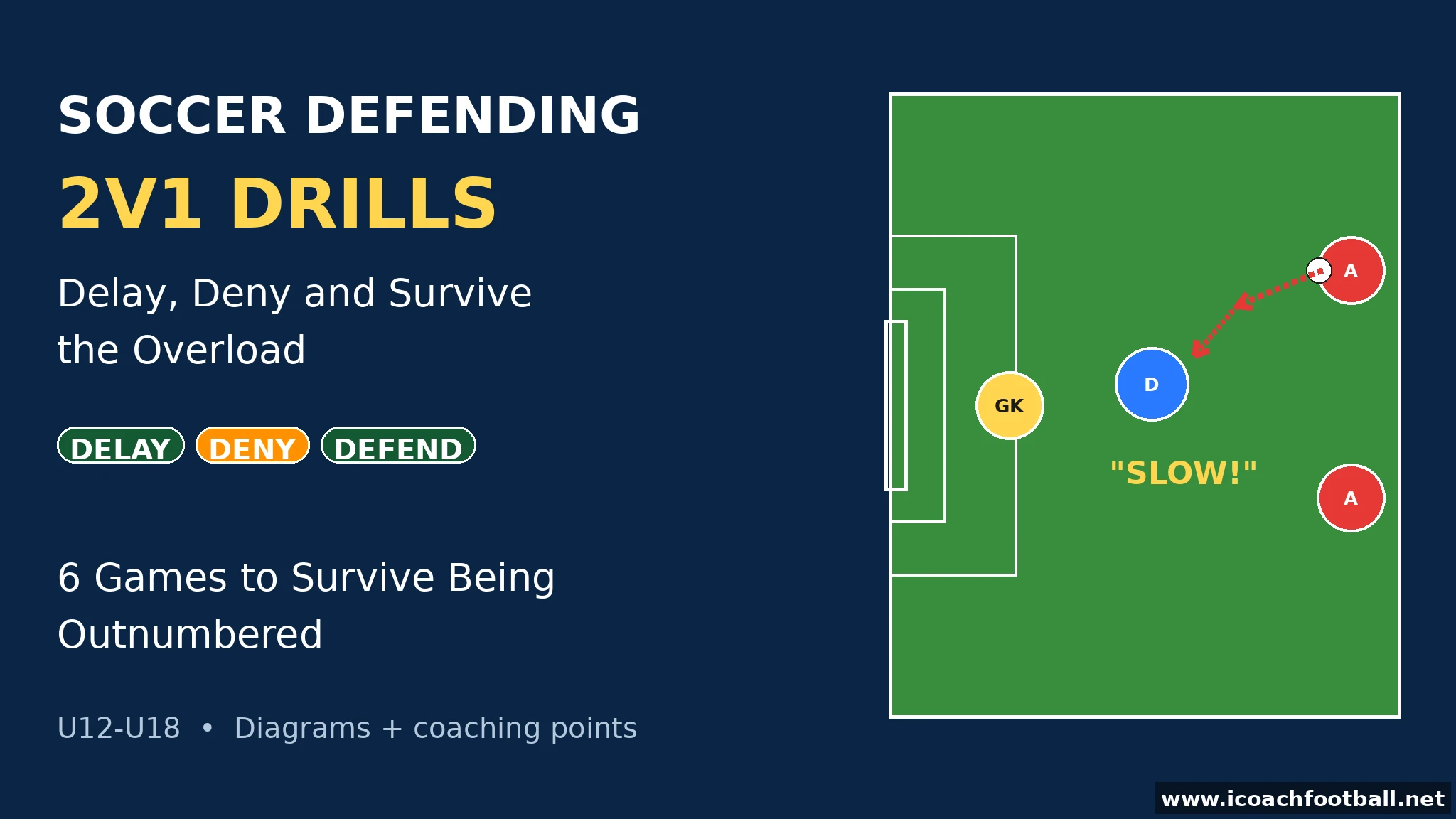
Being outnumbered is the most common defensive problem in youth soccer. These six soccer defending 2v1 drills teach one defender to delay the ball carrier, deny the pass and survive until help arrives — without diving in and getting beaten.
Suitable for: U12–U18
Every coach has watched it: two attackers against one defender, and the defender charges in, gets beaten, and the goal is gone in three seconds. The fix is not bravery — it is patience. A defender who delays buys the five seconds their team-mates need to get back, and five seconds turns a 2v1 into a 2v2. The same idea applies in football at any level: win the duel by refusing to lose it. These six games build that habit, one overload at a time.
Session snapshot
- Players: 10–14, plus goalkeepers
- Area: Half a pitch, one goal
- Duration: 60 minutes
- Focus: Delaying the carrier, denying the pass, surviving until the recovery arrives
- Age: U12–U18 (see Age adaptations)
Delay, deny, defend — the three jobs
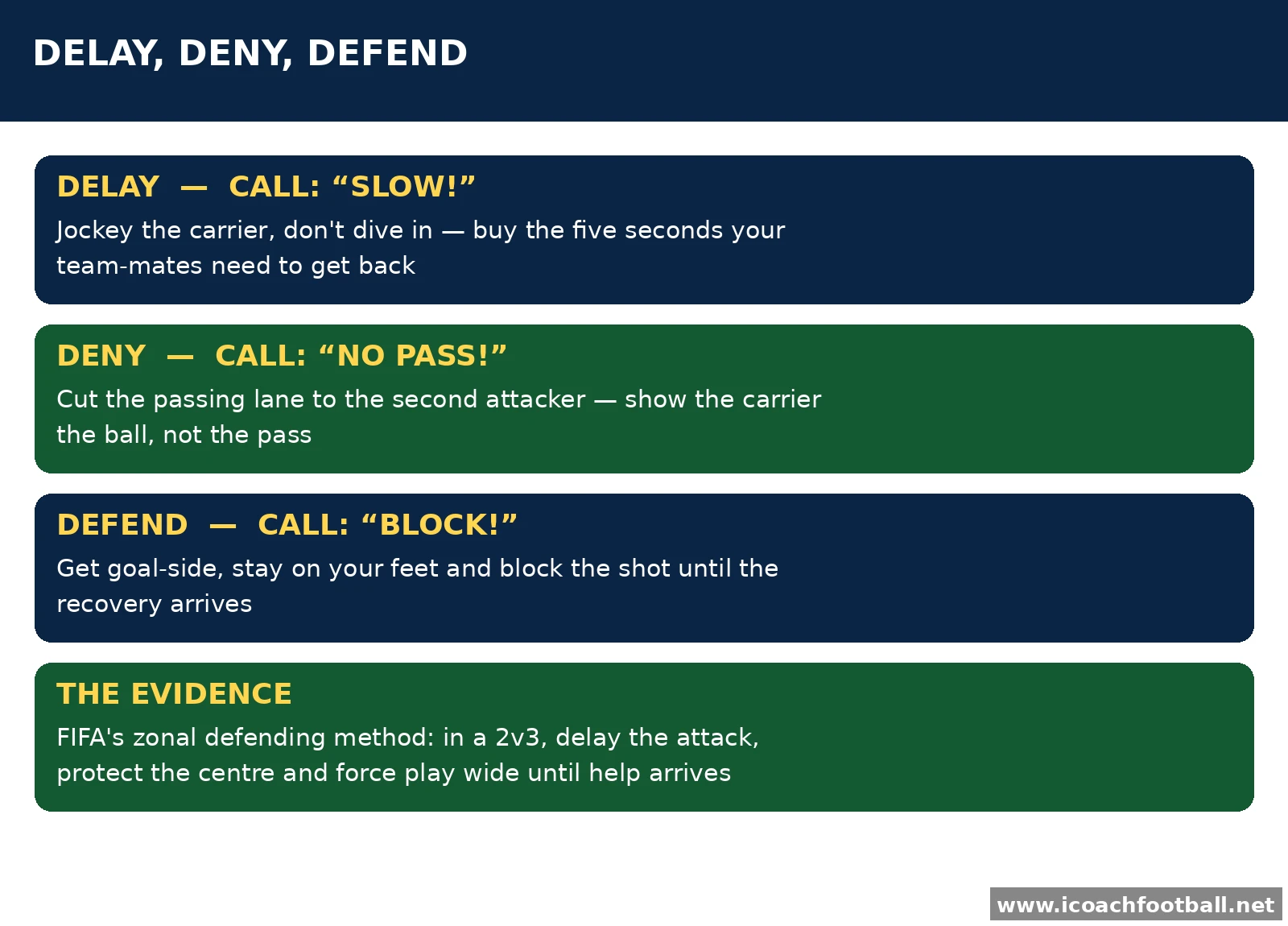
One defender against two attackers has three jobs, in this order. Get them in the wrong order and the overload wins: dive in first and there is no second defender to cover. This framework is in line with the FIFA Training Centre’s zonal defending methodology: in a 2v3 the defender’s job is to delay the attack, protect the central spaces and force play away from dangerous areas until support arrives.
| Job | What it means | The call |
|---|---|---|
| DELAY | Slow the ball carrier down — jockey, don’t dive in, make every second count | “SLOW!” |
| DENY | Cut the passing lane to the second attacker — show the carrier the ball, not the pass | “NO PASS!” |
| DEFEND | Protect the goal — get goal-side, block the shot, and stay alive until the recovery arrives | “BLOCK!” |
Drill 1: Delay the Carrier
Before any defender can survive a 2v1, they must learn to wait. This drill teaches the hardest part of defending outnumbered: doing nothing until the moment is right.
Setup
- 25 x 20-yard grid, one mini-goal at each end, 2 attackers, 1 defender
- The defender starts 5 yards from the ball carrier; the second attacker starts wide
- 6 repetitions per defender, then rotate; 10 minutes
How to Play
- The ball carrier dribbles toward the defender while the second attacker moves to support.
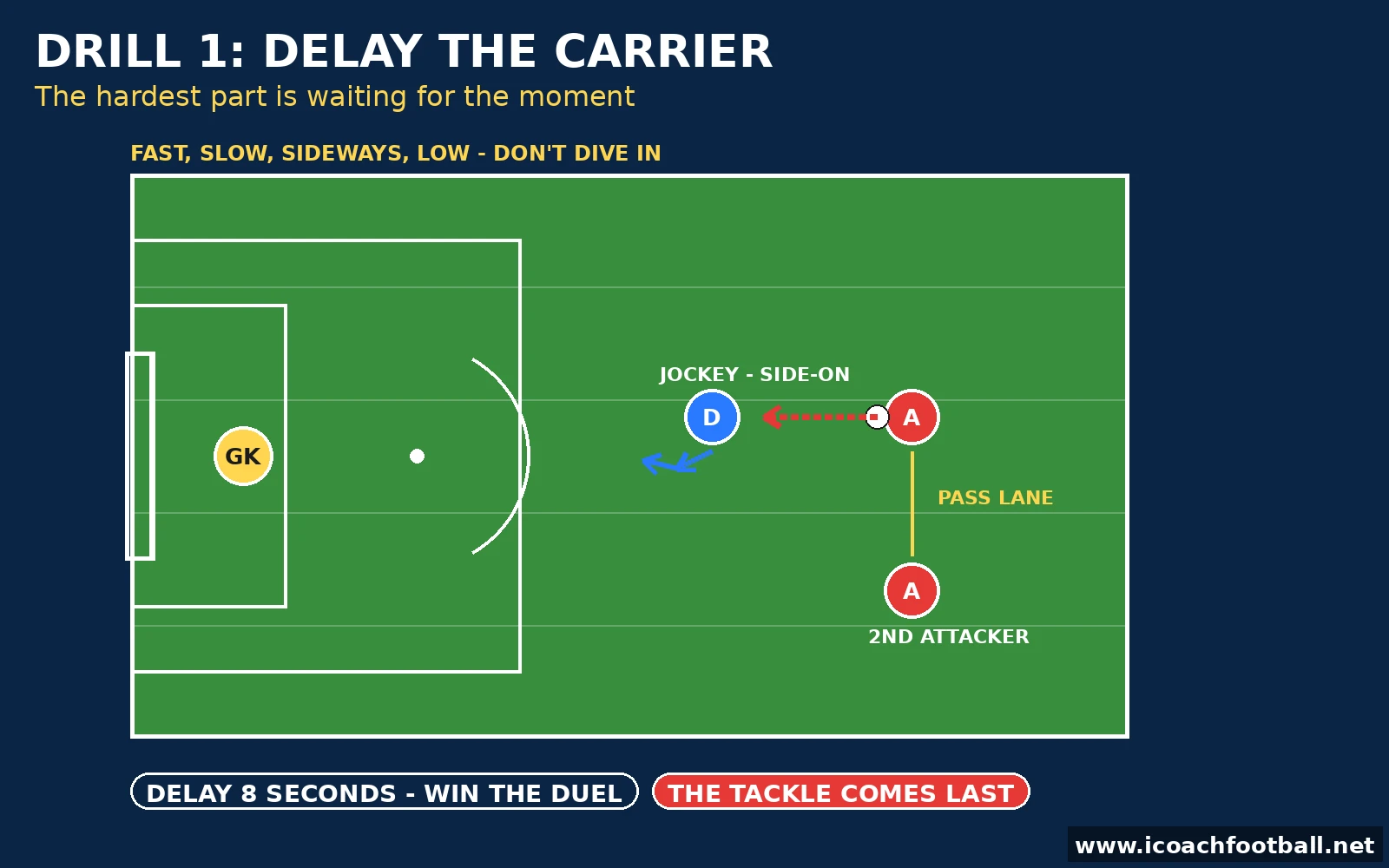
- The defender closes down fast, then slows — “fast, slow, sideways, low” — and jockeys.
- The defender stays goal-side and forces the carrier toward the sideline, never diving in.
- If the carrier passes, the defender sprints across to delay the receiver, not the ball.
- The defender wins by delaying the attack for 8 seconds or forcing the ball out of the grid.
Coach’s note: Watch the defender’s feet. The moment they plant both feet and lunge, they are beaten — keep them bouncing on their toes, side-on, one foot forward. Shout “SLOW!” every time a defender charges in, and praise the one who waits longest. The eight-second rule is the whole lesson: eight seconds is enough for a team-mate to recover, and this is the same delay-and-recover habit trained in our football defensive transition drills.
Progressions: The attackers must score within 10 seconds, so the delay has a real deadline; the second attacker may overlap, so the defender must read the run and not just the ball.
Drill 2: Force It Wide
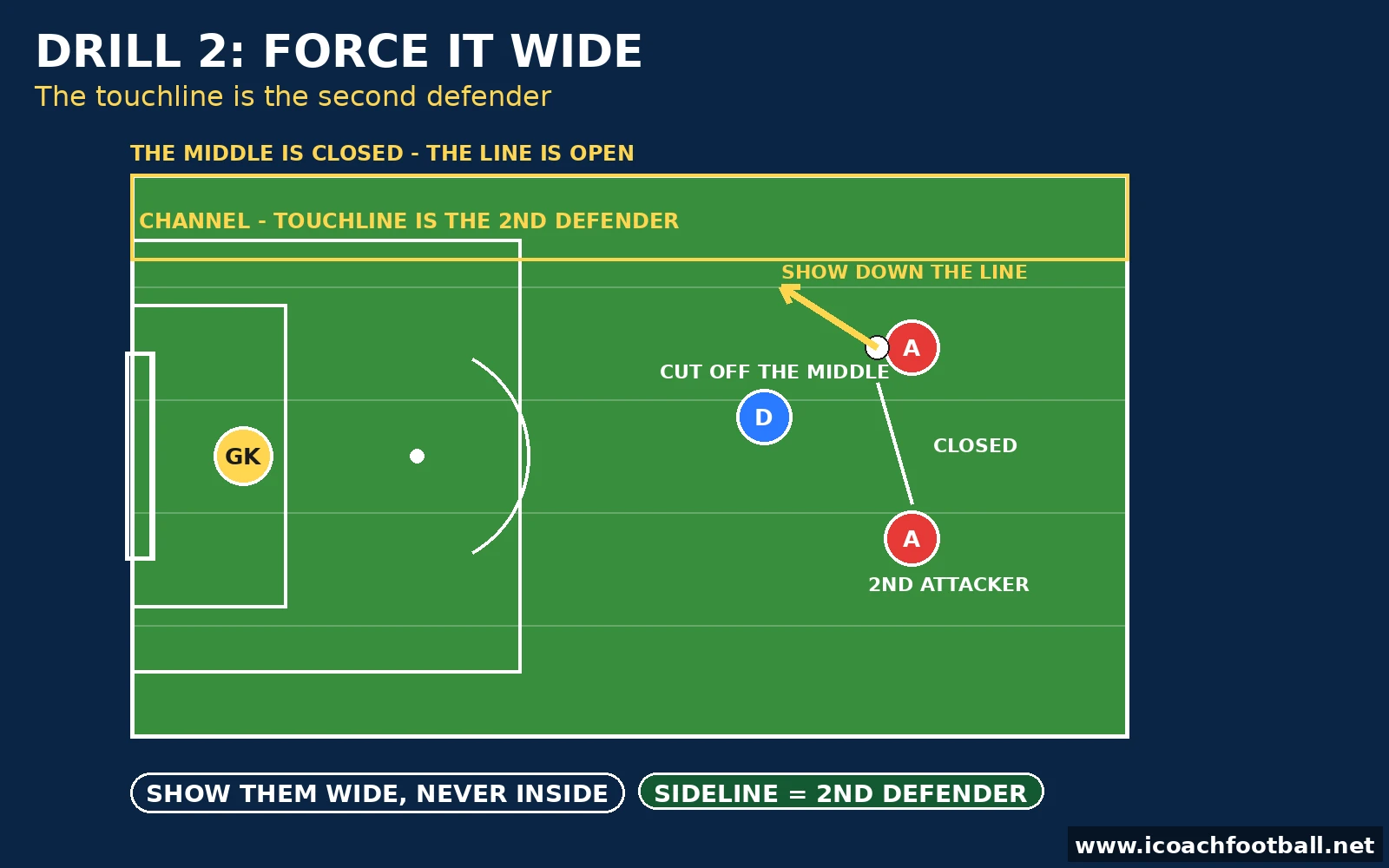
The sideline is the defender’s best team-mate. This drill teaches the defender to use it — show the attackers outside, where the angle is bad and the help is near.
Setup
- A 30-yard channel along the touchline, one goal, 2 attackers, 1 defender, 1 goalkeeper
- Cones mark the channel; the far sideline is the defender’s “second defender”
- 6 repetitions per defender, then rotate; 10 minutes
How to Play
- The two attackers start in the channel with the ball, 30 yards from goal.
- The defender approaches from the inside, cutting off the pass into the middle.
- The defender shows the carrier down the line, toward the touchline, and stays goal-side.
- If the carrier tries to cut inside, the defender blocks the lane and forces the ball back outside.
- The attackers score only by beating the defender down the line and crossing or shooting.
Coach’s note: The common mistake is the defender who stands square and lets the carrier choose a direction. Freeze the drill and ask the defender which way they are showing the ball — if they cannot answer, they are not defending, they are watching. The rule is simple: the middle is closed, the line is open. This is the same wide-area principle from our football defending wide areas drills, shrunk to a 2v1.
Progressions: The second attacker may underlap inside, so the defender must communicate and hand over; the channel narrows to 20 yards, so the sideline does even more of the work.
Drill 3: The Recovering Defender
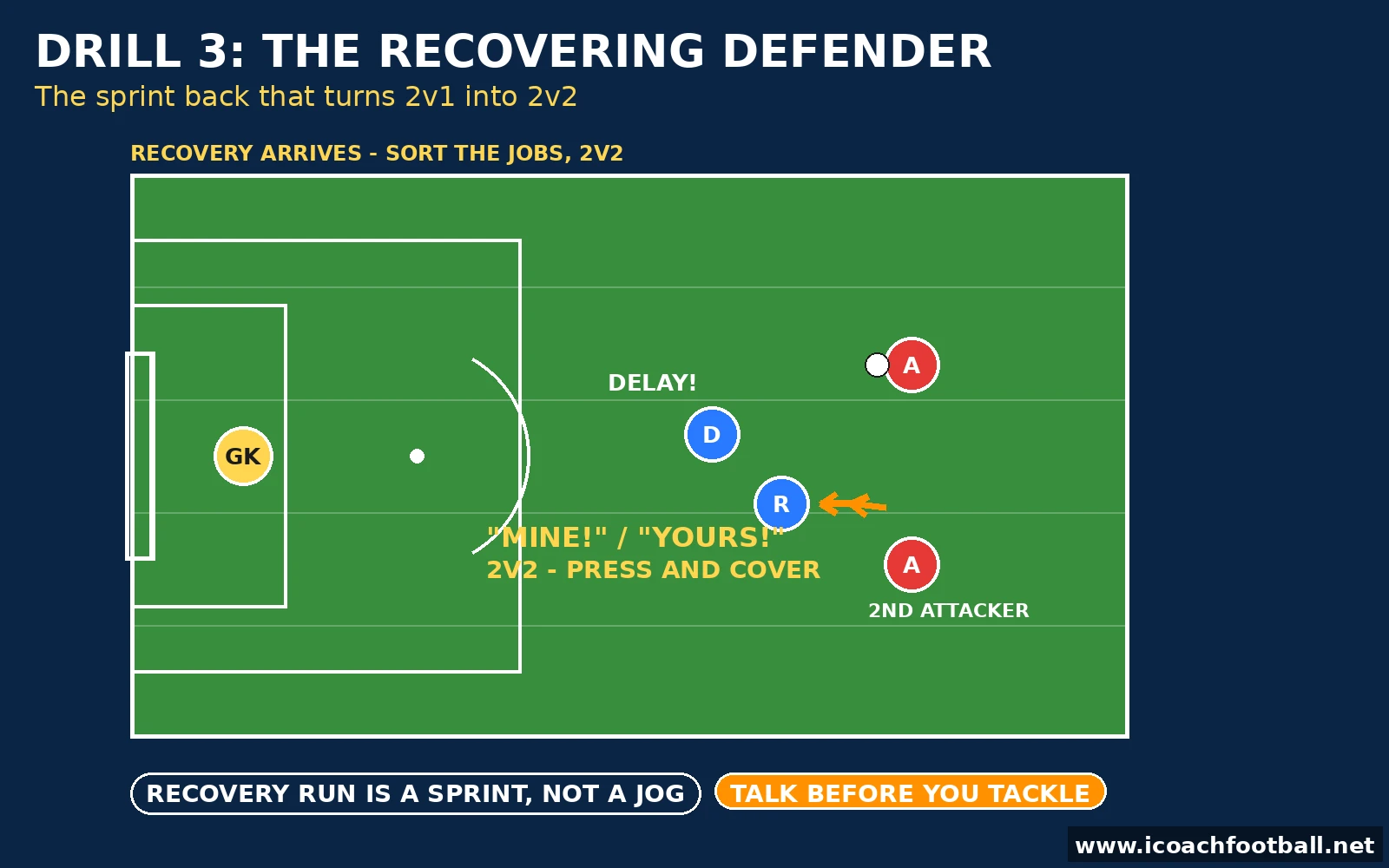
A 2v1 is only a 2v1 until someone gets back. This drill trains the moment that changes everything: the second defender’s recovery run. Watch the animation below the diagram: the recovery sprint, the handover and the new 2v2 happen in that order.
Setup
- Half a pitch, one goal, 1 goalkeeper, 2 attackers, 1 defender, 1 recovering defender
- The recovering defender starts 20 yards behind play, at a cone on the halfway line
- 6 repetitions per pair, then rotate; 12 minutes
How to Play
- The two attackers start 2v1 against the first defender, 30 yards from goal.
- The first defender delays — jockeys, denies the pass, forces the ball wide.
- On the coach’s whistle, the recovering defender sprints back from the halfway line.
- The first defender shouts “MINE!” or “YOURS!” and the two defenders sort the jobs between them.
- Once the recovery arrives, the pair defend 2v2 and try to win the ball or force it out.
Coach’s note: The recovery run must be a sprint, not a jog — a recovering defender who arrives at walking pace is a spectator. But the first defender’s job matters just as much: if they dive in before help arrives, there is nothing to recover to. Teach the handover call before you add the sprint — “MINE!” means I press, you cover; “YOURS!” means you press, I cover. If neither player speaks, both press and the pass splits them.
Progressions: The recovering defender starts further back, so the first defender must delay longer; the attackers may switch the ball, so the recovering defender must read the switch and cover the far side.
Drill 4: Split the Pass
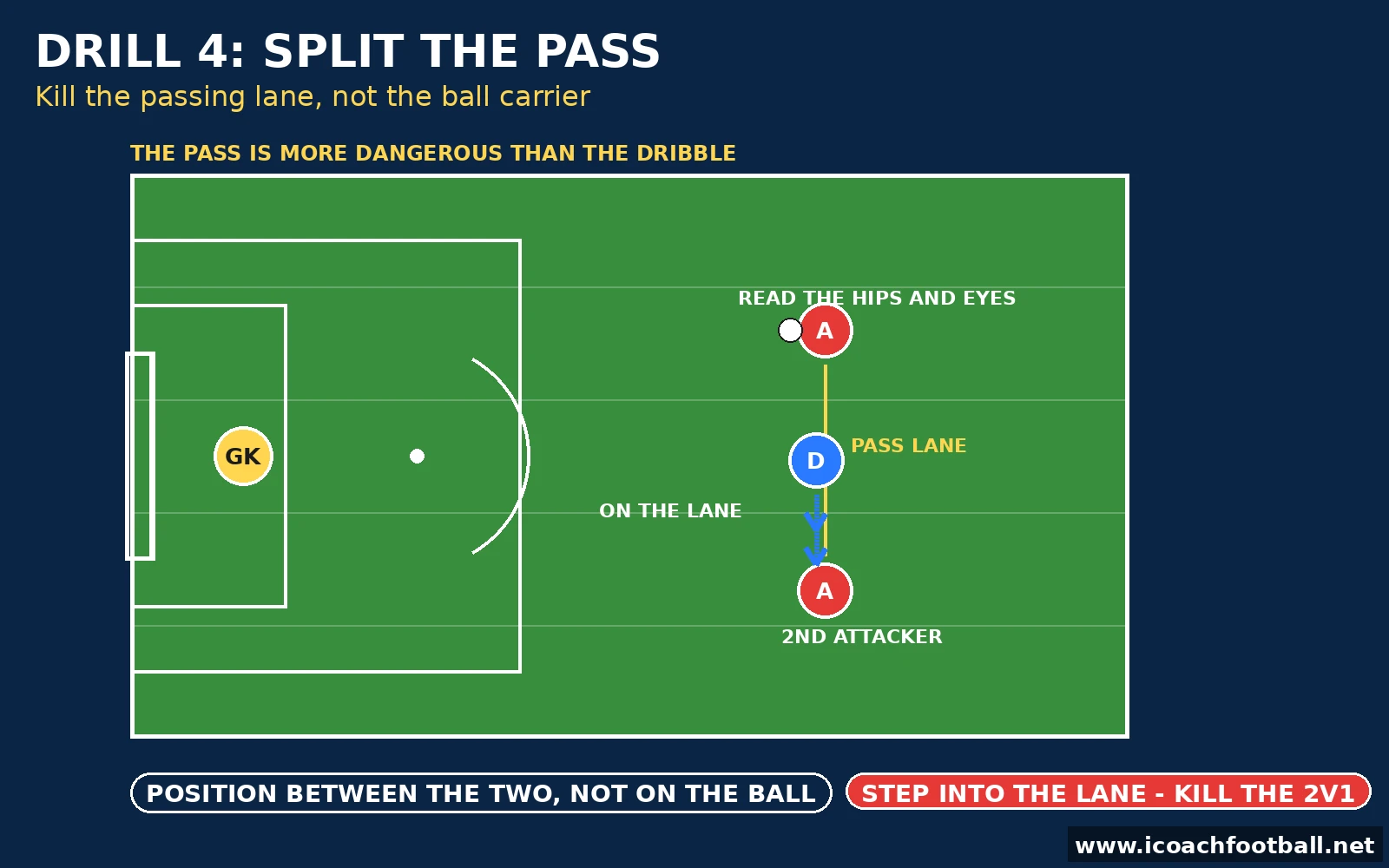
The most dangerous thing in a 2v1 is not the dribble — it is the pass. This drill teaches the defender to kill the passing lane so the two attackers cannot combine.
Setup
- 20 x 20-yard grid, 2 mini-goals, 2 attackers, 1 defender
- The attackers start 15 yards apart; the defender starts between them, 5 yards off the ball
- 6 repetitions per defender, then rotate; 10 minutes
How to Play
- The ball carrier passes to the second attacker, who returns it — the pair must combine to score.
- The defender positions themselves on the line between the two attackers, not on the ball.
- The defender shuffles with the ball, always half a step closer to the passing lane than to the carrier.
- If the carrier dribbles, the defender engages; if the carrier looks to pass, the defender is already in the lane.
- The defender wins by intercepting a pass, forcing a backwards pass, or delaying for 8 seconds.
Coach’s note: Teach the defender to watch the carrier’s hips and eyes, not the ball. The pass is telegraphed a full second before it is played — the head goes down, the body opens up. A defender who reads that cue steps into the lane and the 2v1 dies. The mistake is the defender who charges the ball carrier and leaves the lane wide open; that is exactly what the attackers want. This lane discipline is the same press-and-cover relationship FIFA’s McLaren teaches in his 2v2 and 2v3 small-group defending work.
Progressions: The attackers may use a one-two, so the defender must track the runner after the pass; the grid shrinks to 15 x 15, so the lane is tighter and the interceptions come faster.
Drill 5: The Last Line
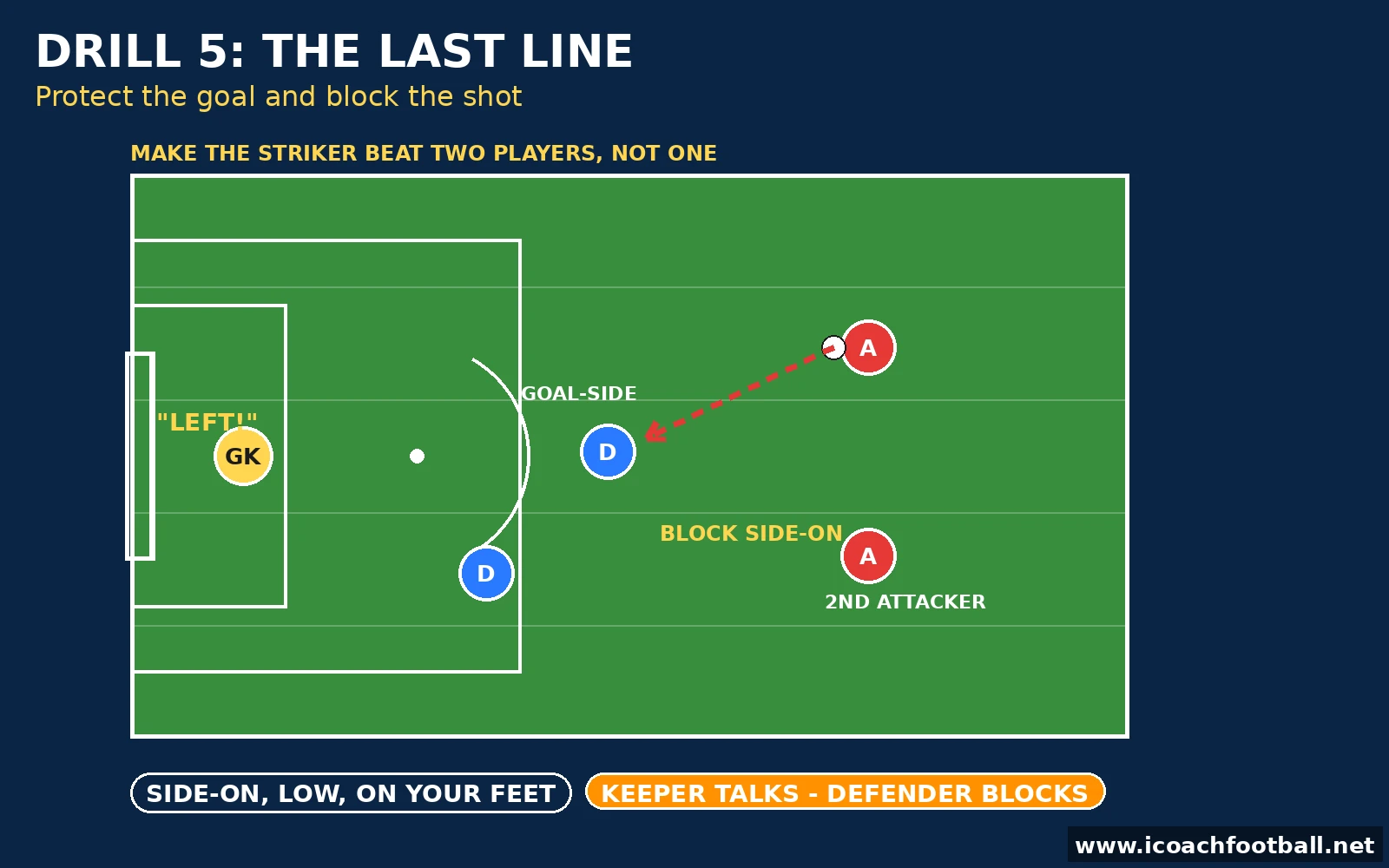
Sometimes the delay fails and the shot is coming. This drill trains the final job: protect the goal, block the shot and make the striker beat two players, not one.
Setup
- Final third, one full-size goal, 1 goalkeeper, 2 attackers, 1 defender
- The attackers start 25 yards from goal; the defender starts on the edge of the box
- 6 repetitions per defender, then rotate; 10 minutes
How to Play
- The two attackers combine toward goal while the defender drops goal-side, between the ball and the goal.
- The defender stays on their feet and shows the shooter to the goalkeeper’s strong side.
- The goalkeeper calls “LEFT!” or “RIGHT!” so the defender knows which side to leave open.
- If the shot comes, the defender blocks it side-on, with their body behind the ball.
- If the pass comes, the defender sprints across to block the second attacker — never both at once.
Coach’s note: The defender’s body shape is everything here. Side-on, low, weight on the front foot, arms in — a defender who stands square is a traffic cone. And the goalkeeper is part of this drill: the keeper must talk, because the defender cannot see the goal and the shooter at the same time. If the keeper is silent, the drill is silent, and the shot goes in. This is the same keeper-defender communication trained in our 1v1 defending drills, applied to the overload.
Progressions: The attackers get one touch only, so the shot comes faster and the block must be instant; the defender starts further up the pitch, so the drop-back and the block happen at full speed.
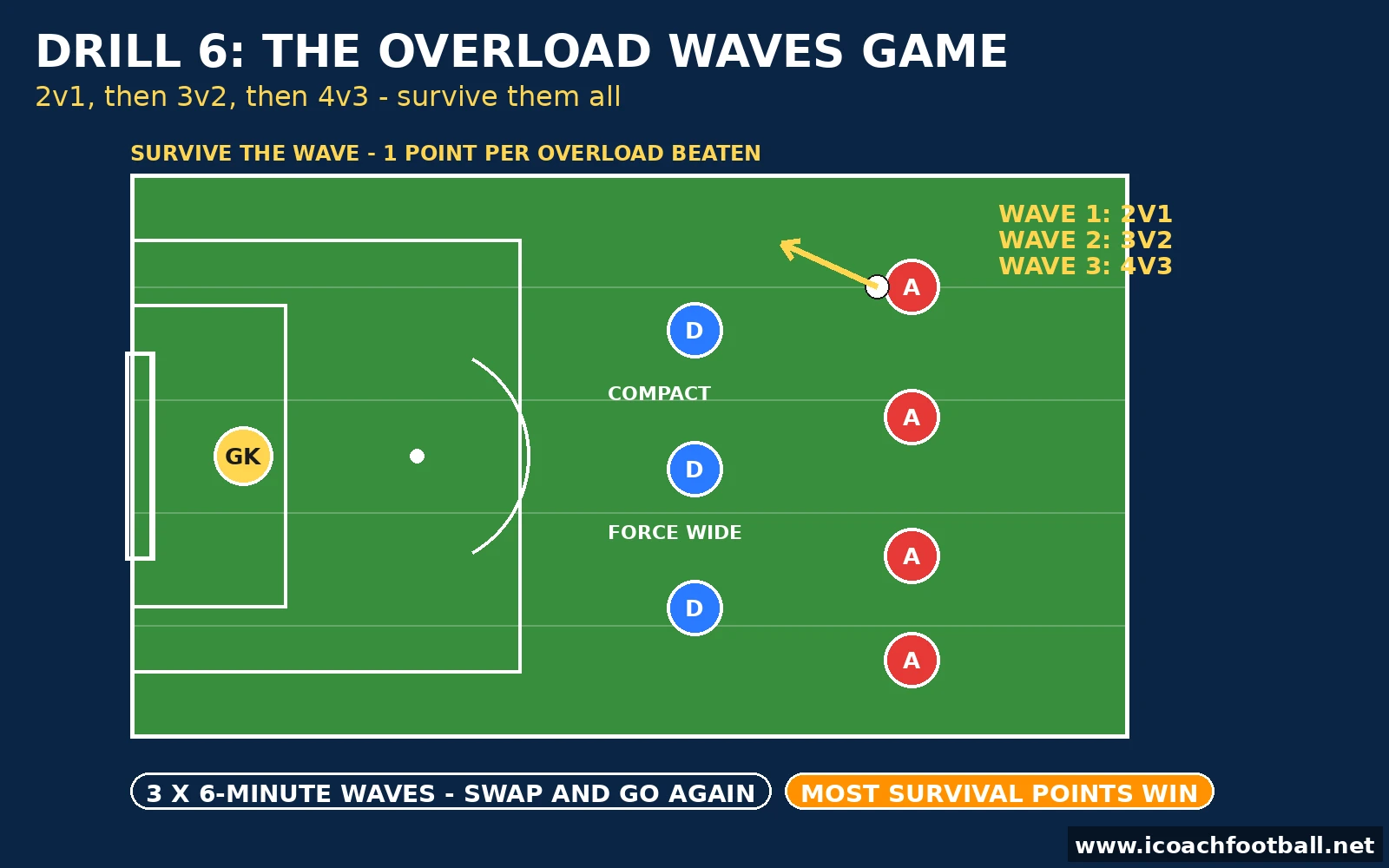
Drill 6: The Overload Waves Game
Now put it all together. This game throws overload after overload at the defenders — 2v1, then 3v2, then 4v3 — and rewards the team that survives them.
Setup
- Half a pitch, one goal, 2 teams of 6 plus goalkeepers, cones marking three waves
- Defenders score 1 point for every overload they survive; attackers score 1 point per goal
- 3 x 6-minute waves; 18 minutes
How to Play
- Wave 1: two attackers against one defender, 30 yards from goal — survive 8 seconds to score a point.
- Wave 2: three attackers against two defenders — the pair must delay, deny and hand over.
- Wave 3: four attackers against three defenders — the back three stay compact and force play wide.
- After each wave the teams swap, so everyone defends the overload and attacks it.
- The team with the most survival points wins; the coach shouts the score after every wave.
Coach’s note: Watch for the team that stops communicating once they are winning — that is when the overloads start scoring. Keep the survival points loud: shout the score after every wave so the whole pitch hears it. If a team concedes three goals and none of them came from a delay, stop the game and ask the defenders what their first job was. The answer is usually “delay” — and that is the whole lesson. This is the defending mirror of our 2v1 soccer drills for the attack: the same moment, the other side of it.
Progressions: The attackers get a time limit of 12 seconds per wave, so the delay has a real deadline; add a second goal and play both ways, so defenders must recover and delay again on the next attack.
Coaching points
- Delay first, tackle last. A defender who dives in loses the duel and the goal; a defender who delays wins five seconds and the recovery.
- Show them wide, never inside. The middle is closed; the touchline is open. The sideline is the second defender.
- Kill the passing lane. In a 2v1 the pass is more dangerous than the dribble — position yourself between the two attackers, not on the ball.
- Talk before you tackle. “MINE!” and “YOURS!” sort the jobs before the ball moves; silence splits the pair.
- Stay goal-side and on your feet. A defender on the ground is a defender beaten — block side-on, low, and alive for the next ball.
- The recovery run is a sprint. A team-mate who jogs back is a spectator; a team-mate who sprints back turns a 2v1 into a 2v2.
Common mistakes
- Diving in. The defender charges the carrier, gets beaten, and the goal is gone. Fix it with Drill 1 — reward the defender who waits longest.
- Standing square. A square defender lets the carrier choose a direction. Fix it with Drill 2 — freeze and check which way the ball is being shown.
- Chasing the ball, not the lane. The defender presses the carrier and leaves the pass open. Fix it with Drill 4 — position between the attackers, not on the ball.
- Going to ground. A sliding tackle in a 2v1 is a coin flip the defender usually loses. Fix it in every drill — stay on your feet until the recovery arrives.
- Silent defending. Two defenders who don’t talk both press the same player. Fix it with Drill 3 — no handover call, no drill.
Age adaptations
| Age group | How the drills change |
|---|---|
| U12–U13 | Smaller areas (20 x 20 grids), no heading, slower attackers, and the 8-second delay rule becomes 6 seconds — the timing matters more than the pressure. Keep the recovery runs short and the calls loud. |
| U14–U15 | Full-size areas, introduce the recovery defender (Drill 3) and the passing-lane work (Drill 4), and let attackers use one-twos. Add the survival-points scoring in the game. |
| U16–U18 | Full speed, full-size pitch, mannequins as extra attackers, and the attackers vary the overload without warning. Defenders must read the game, not the coach’s call. |
| Adults | Add the offside line to Drill 5 and Drill 6, and let the attackers choose between the dribble, the pass and the switch — defenders must read all three. |
60-minute session plan
| Block | Time | What to run |
|---|---|---|
| Warm-up | 0–8 min | Rondo with a defender rule: the defender who delays longest wins the round |
| Drill 1 | 8–18 min | Delay the Carrier — the jockey and the wait |
| Drill 2 | 18–28 min | Force It Wide — the sideline as a second defender |
| Drill 3 | 28–40 min | The Recovering Defender — the sprint back and the handover |
| Drill 4 | 40–48 min | Split the Pass — kill the passing lane |
| Drill 5 | 48–56 min | The Last Line — protect the goal and block the shot |
| Game | 56–60 min | The Overload Waves Game — survive 2v1, 3v2 and 4v3 (extend to 18 minutes if time allows) |
Sources
- FIFA Training Centre — “Developing defensive coordination in small groups” (Stuart McLaren): through 2v2, 2v3 and 3v3 scenarios, players develop their ability to defend spaces in small groups while learning when, why and how to press and cover for one another; Exercise 2 is “Defending 3v2 into 1v1”. https://www.fifatrainingcentre.com/en/practice/talent-coach-programme/zonal-defending/developing-defensive-coordination-in-small-groups.php
- FIFA Training Centre — “Zonal defending: From principles to practice using a progressive methodology”: defending in 2v3 situations develops players’ ability to manage numerical disadvantages — delay the attack, protect central spaces and force play away from dangerous areas until support arrives. https://www.fifatrainingcentre.com/en/practice/talent-coach-programme/zonal-defending/from-principles-to-practice-using-a-progressive-methodology.php
FAQ
How do you defend a 2v1 in soccer?
Delay first. The defender jockeys the ball carrier, stays goal-side, cuts the passing lane to the second attacker and forces play wide — buying the five to eight seconds a team-mate needs to recover. The tackle comes last, not first. Drill 1 trains the delay; Drill 3 trains the recovery that makes it a 2v2.
Should the defender dive in or delay in a 2v1?
Delay, every time. A defender who dives in and misses leaves the goalkeeper alone against two attackers. The only time to engage is when the carrier’s touch is heavy or the ball is played into the defender’s path. Until then, jockey — fast, slow, sideways, low — and make the attackers beat you with a pass, not a dribble.
What age can you start coaching defending overloads?
From U12, in small grids with clear rules. U12–U13 players learn the delay and the “show them wide” rule in 2v1 grids; U14–U15 add the recovering defender and the passing-lane work; U16–U18 run the full waves game at speed. Keep the areas small and the calls loud at the younger ages.
How do you stop a 2v1 on the wing?
Use the touchline as a second defender. Show the ball carrier down the line, cut off the pass inside, and stay goal-side so the cross or shot comes from a bad angle. Drill 2 trains exactly this — the channel, the show-outside shape and the block when the carrier tries to cut in.
What do you do when the second defender arrives?
Talk, then sort the jobs. The first defender calls “MINE!” or “YOURS!” — one presses the ball, the other covers the pass and the space behind. The handover is the moment most 2v1s are won or lost: two defenders who both press get split by one pass, while a pair that talks turns the overload into an even duel.