College Soccer Drills: 6 Games That Prepare a Team for the NCAA Season
Quick answer
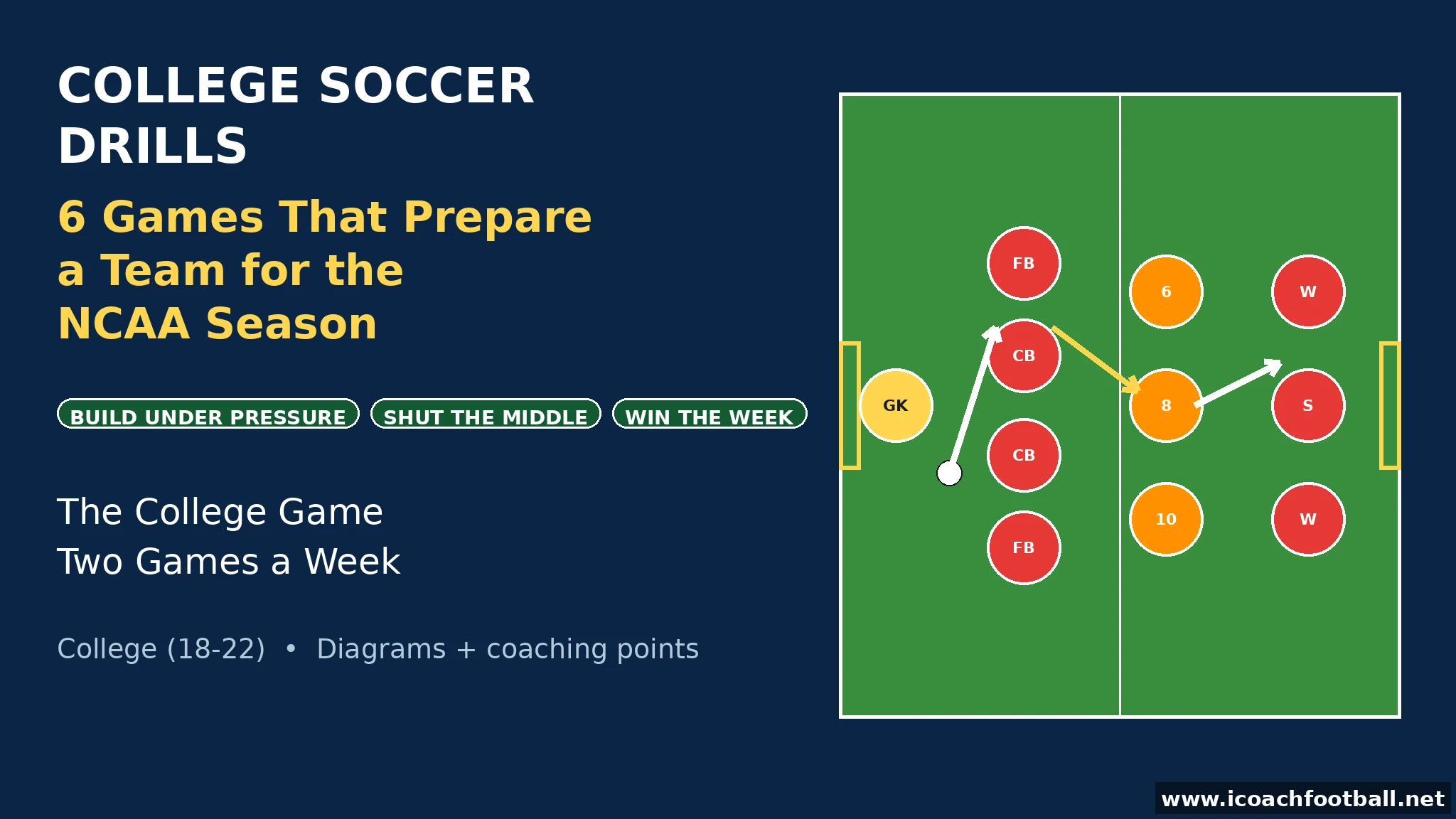
College soccer is a different game from youth soccer: two games a week, a 90-minute clock that counts down, substitution rules that punish a wasted change, and no overtime in the regular season — a draw is a result. These six college soccer drills prepare an 18- to 22-year-old team for exactly that: build under pressure, break through centrally, shut the middle, win the transition, own set pieces — and manage the week.
Suitable for: College (18–22) and adult players
In soccer — football in the UK and most of the world — college is the first level where the schedule, not the coach, sets the training load. Most college teams play twice a week across a compressed fall season, so the second game is won on the training ground: on fresh legs, on rehearsed restarts and on a bench that is planned, not improvised. The six games below are built on two FIFA Training Centre sessions — the central-midfielder game situations that teach a No. 6 to build under pressure, and the coordinated press that shuts the middle — plus the set-piece and game-management work the college game itself demands. This is the next step after our soccer drills for U19, which bridge youth football and the senior game, and it sits above our soccer drills for U18 and our soccer drills for U17 in the same six-game structure.
Session snapshot
- Players: 18–28 (a college roster; 22 for the 11v11 game plus subs)
- Area: A full pitch for the game; grids 25 x 15 m to 60 x 50 m for the drills
- Duration: 60 minutes
- Focus: Building under pressure, breaking through centrally, shutting the middle, winning transitions, set pieces, and managing the Friday–Sunday week
- Age: College (18–22) / Adult (see Age adaptations)
The six college rules
Every one of these college soccer drills is built on six rules. Teach them once, then repeat them in every game until the players say them back to you.

| Rule | What it means |
|---|---|
| Build through the middle | The No. 6 is always an option — create the lane before you need it |
| Scan before you receive | The first touch decides the next pass |
| Shut the middle | Force them wide, never through you |
| Win it and go | Six seconds to shoot after the win |
| Set pieces win tight games | Rehearse them at both ends, every week |
| Manage the week | Subs, clock and the draw are all results |
Drill 1: Build Under Pressure — The Central Rondo
The build-up lesson. Two defenders press at once in a tight central area, so the attackers must create a clear passing lane to the pivot, scan before receiving, and drive at the defender to isolate them and make a 2v1. Based on the FIFA Training Centre session “Game-situations: Developing central midfielders” (Ruttensteiner), in which Part 1 builds under pressure in central areas: two attackers combine to play through to the opposite end zone using the neutral player in a 4 m central zone, defenders are restricted to their zones, and if the attackers lose the ball they press immediately to regain it.


Setup: A 25 by 15 metre area with a 4 m central zone and a mini-goal at each end, 6 attackers against 4 defenders plus 2 neutral players, balls with the coach.
How to play:
- The coach passes to one of the two attackers in the starting zone.
- The attackers combine to play through the pivot in the central zone.
- The pivot scans before receiving, then turns and drives at the defender.
- On entry into the end zone, the attackers finish in either mini-goal.
- Defenders stay in their assigned zones — if they win it, they counter to the opposite mini-goals.
- If the attackers lose it, they press immediately to win it back.
Coach’s note: Watch the pivot’s scan — a midfielder who receives without scanning plays the first pass they see, and at college tempo that pass is a turnover; the cue is “scan before you receive,” and our soccer scanning drills train the shoulder check this game depends on, while our soccer drills for midfielders train the No. 6 role in full.
Progressions: Two touches maximum, then one touch for the pivot; 90-second blocks at full tempo, so the press never drops; the neutrals may only play forward.
Drill 2: Build and Break Through Centrally — 4+2v2
The progression lesson. The build-up starts 4+2v2, the ball goes through the two neutrals in the middle, and the attack finishes with another 4+2v2 — the same picture twice, once to build and once to score. Based on the FIFA Training Centre session “Game-situations: Developing central midfielders” (Ruttensteiner), in which Part 2 builds and breaks through centrally: play starts with a 4+2v2 scenario and advances into an attack where there should also be a 4+2v2 scenario, the midfielders create passing lanes so they can link or turn and drive with the ball, and the three most common build-up solutions are the vertical pass into midfield, the midfielder drifting wide, and the diagonal split pass.

Setup: A 40 by 22 metre pitch with a full-size goal and a keeper at each end and an 18 m central zone across the middle, 4 attackers and 2 neutrals against 4 defenders, balls with the keeper.
How to play:
- Play starts with the goalkeeper, who builds a 4+2v2 in the first half.
- The midfielders create passing angles behind the two pressing players.
- The ball goes through the two neutrals to progress into attack.
- In the final phase, the attack creates another 4+2v2 and finishes with a shot.
- Defenders stay 2 and 2, each pair restricted to its own half at all times.
- If the defending team wins it, they counter to score in the opposite goal.
Coach’s note: Watch the first pass out of the back — a pass played to a midfielder standing still is a press trigger, and a pass played behind the runner kills the move; the cue is “create the lane before you need it,” and our soccer passing drills build the weight and accuracy the vertical pass needs, while our soccer drills for U19 train the same 4+2v2 one age down.
Progressions: The neutrals must turn and drive, not just link; the finish must come within eight seconds of entering the final third; the defenders press higher, so the build-up starts from the keeper under pressure.
Drill 3: Shut the Middle — Prevent Progression 4v4
The pressing lesson. The opposition wants to play through the middle, so the press shuts it: pressers approach side-on, arch their runs to cut the inside lane, and force the ball wide — where the touchline becomes an extra defender. Based on the FIFA Training Centre session “Preventing progression through central areas” (García/Arana), in which the 4v4 small-sided game is played in three channels with a striker behind the defensive line: the out-of-possession team must coordinate their press to win the ball, cover for each other, stay compact in relation to the ball carrier, and switch mindset from attack to defence the instant possession is lost.

Setup: A 25 by 25 metre area with a halfway line, three channels and a mini-goal at each end, 4 attackers against 4 defenders in a 3-1 shape, a striker behind the defensive line, balls with the coach.
How to play:
- The coach plays the ball in — the in-possession team circulates and looks for the striker.
- The nearest presser goes side-on and arches the run to shut the inside lane.
- The second presser covers the next pass, not the ball — the middle stays shut.
- Force the ball wide, then close it down on one side and force the turnover.
- If the press is beaten, the team drops into a compact mid-block and protects the middle.
- Win it and the teams swap roles at once — the mindset switch is the drill.
Coach’s note: Watch the second presser — a press with one player is a chase, and a press with two players who both go to the ball leaves the middle open; the cue is “shut the middle,” and our coaching soccer pressing triggers train the trigger itself, while our counter-pressing soccer drills train the six-second win-back this game demands.
Progressions: The press starts higher, so the first pass must be played under real pressure; the striker may drop into the middle, so the pressers must track and hand over; the channels narrow, so the wide trap closes faster.
Drill 4: Transition Repeats — Win It and Go 7v7+3
The transition lesson. College games are decided in the seconds after a turnover, when one team is stretched and the other is not. Win it in the middle third, and the team has six seconds to shoot — with three neutrals making the overload. Based on the FIFA Training Centre session “Preventing progression through central areas” (García/Arana), in which the final 7v7+3 team game is played on a reduced pitch with the neutrals always in central areas: the in-possession team can use them to create a 10v7, the out-of-possession team must stay compact, press central areas and force the opposition wide, and when the ball is lost the players must regain their shape immediately and stay compact.
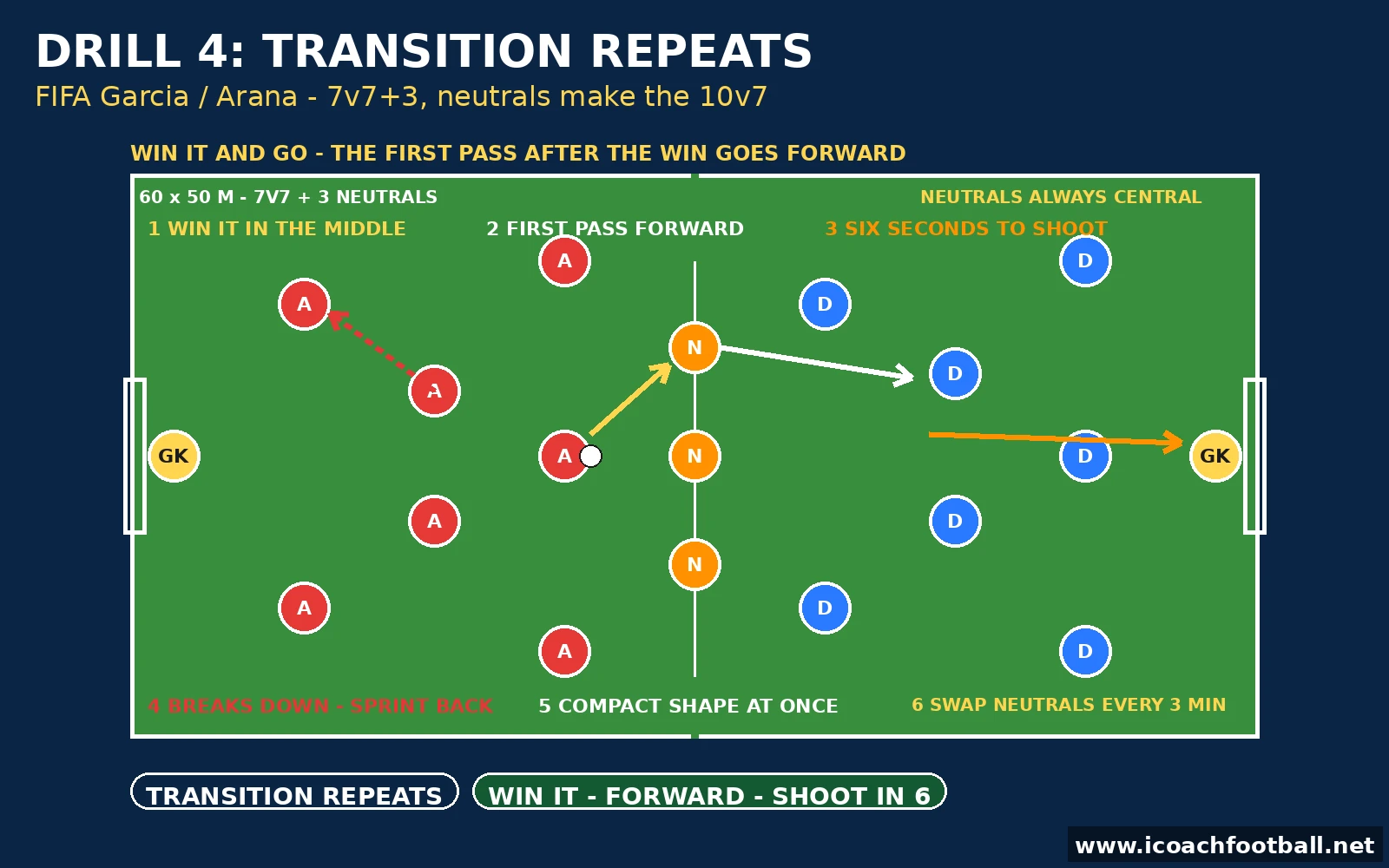
Setup: A 60 by 50 metre area with a full-size goal and a keeper at each end, 7 against 7 plus 3 neutrals who always play for the team in possession, balls with the coach.
How to play:
- The coach plays the ball in — the team in possession uses the neutrals to make a 10v7.
- The neutrals stay central at all times, so the overload is always in the middle.
- Win the ball in the middle third and the team has six seconds to shoot.
- The first pass after the win goes forward — never square, never back.
- If the attack breaks down, the team sprints back into a compact shape at once.
- Swap the neutrals every three minutes so every player practices both jobs.
Coach’s note: Watch the first pass after the win — a square pass after a turnover gives the opposition the seconds they need to reset, and a forward pass into the striker keeps the transition alive; the cue is “win it and go,” and our soccer counter attack drills train the first pass after the win, while our soccer tackling drills train the duel that starts it.
Progressions: The six-second clock drops to four; the neutrals are limited to one touch; the team that wins it must finish with a first-time shot.
Drill 5: Set Pieces Win College Games — Corners and Second Balls
The restart lesson. College games are tight — most are decided by one goal, and the cheapest goal in the game is a rehearsed corner. This drill runs the full routine: the delivery, the runners, the marking, and the second ball that decides it. It builds on our soccer corner kick plays, which carry the full routine book, and our football defending set pieces drills, which train the marking side.

Setup: A full penalty area with a goal and a keeper, 8 attackers against 7 defenders plus a keeper, balls with the taker, cones marking the near-post, far-post and second-ball zones.
How to play:
- The taker calls the routine — near post, far post or short — before the kick.
- The near-post runner attacks the ball; the far-post runner attacks the space behind.
- The second-ball players hold the edge of the area and attack the clearance.
- Defenders mark man-to-man inside the box and zonal at the edge — no free runners.
- The keeper calls the marking before every kick and claims anything in the six-yard box.
- Run each routine five times from each side, then swap attack and defence.
Coach’s note: Watch the second ball — a team that wins the first contact and loses the second ball has done the hard work for nothing, and a team that attacks the landing spot scores the goal the routine was built for; the cue is “attack the landing spot,” and our soccer drills for strikers train the finish that has to follow it, while our soccer goalkeeper communication drills train the keeper’s calls this routine depends on.
Progressions: The taker varies the delivery without telling the runners, so they must read the run; the defending team gets a counter to mini-goals if they clear it; the routine runs against a full 11v11 shape in Drill 6.
Drill 6: The Friday–Sunday Game — 11v11 Managing the Week
The match-real finish. Two games in three days, a 90-minute clock that counts down, and substitution rules that punish a wasted change — this is the college week, played out in one game. Under the NCAA’s 2026 and 2027 rules, a field player taken off in the first half cannot re-enter until the second half, and then only once — and in Division I men’s soccer each team gets six substitution moments a game and no re-entry in the same period — so the bench is planned in waves, not used on impulse. Regular-season games have no overtime since 2022: tied after 90 minutes, the game ends as a draw.

Setup: A full pitch with two full-size goals and a keeper in each, 11v11 in a 4-3-3 shape, a scoreboard and a countdown clock the coach updates, size 5 ball.
How to play:
- Play the second game of the week — Friday’s game is already in the legs.
- The score starts 1-0 to one side, with 15 minutes on the clock.
- The team ahead protects the lead: compact shape, no risks in their own third.
- The team behind chases it: full-backs push on, the No. 6 steps higher, crosses come early.
- Subs come in planned waves — a first-half change cannot come back until the second half.
- Reset the score after every goal and play all three scenarios: protect, chase, and hold a draw on the road.
Coach’s note: Watch the shape when the ball is lost — if the team is still stretched, the counter runs straight through tired legs; the cue is “manage the week,” and our soccer goalkeeper 1v1 drills train the keeper’s decisions when the game opens up, while our soccer 11v11 drills build the same habits at the next size up.
Progressions: Start 1-0 down with ten minutes left, so the team must chase it; the team ahead plays with ten men; the last five minutes start 1-1, and a draw is a result worth protecting.
Coaching points
- Build through the middle: The No. 6 is always an option — create the lane before you need it — our soccer drills for midfielders train the role in full, and our soccer drills for U19 train the same build-up one age down.
- Scan before you receive: The first touch decides the next pass — our soccer scanning drills teach the shoulder check, and our soccer dribbling drills train the drive that follows a good scan.
- Shut the middle: Force them wide, never through you — our coaching soccer pressing triggers train the trigger, our counter-pressing soccer drills train the six-second rule, and our football rest defence drills train the shape behind the ball.
- Win it and go: Six seconds to shoot after the win — our soccer counter attack drills train the first pass, and our soccer tackling drills train the duel that starts it.
- Switch the play: A switch buys the seconds a press cannot give back — our switching play drills train the diagonal, and our soccer passing drills build the weight and accuracy the switch needs.
- Overloads at every size: Our soccer 8v8 drills, our soccer 9v9 drills and our soccer 11v11 drills build the same 4v3 habits with different numbers — and our soccer 6v6 drills and our football 7v7 drills are the team versions one size down.
- Set pieces win tight games: A corner is the cheapest chance in the game — our soccer corner kick plays build the full routine book, and our football defending set pieces drills train the marking side.
- Finish the transition: A team that wins the second ball and shoots before the shape resets scores the goals college football is built on — our soccer drills for strikers train the finish, our soccer drills for wingers train the wide delivery, and our soccer drills for fullbacks train the overlap that makes the same 2v1 from behind.
- Two games a week is a fitness problem: The second game is won on Tuesday — our soccer endurance drills build the aerobic base the second game needs, and our youth soccer fitness testing gives you the field tests to track who is fresh and who is not.
- Manage the game: The last fifteen minutes are a different game — our soccer goalkeeper communication drills train the keeper’s calls, and our soccer drills for center backs train the partnership that has to win the first contact.
- The 4-3-3 is the shape: Keeper, back four, midfield three, front three — and our 11v11 formations and our 9v9 soccer formations pick up the same shape one size down; our 5v5 soccer formations build the same habits on a smaller pitch, and our soccer possession drills train the patience the build-up needs.
Common mistakes
- Playing the square ball into the press: A square pass against a pressing pair is a turnover with a counter attached — play through the middle or around them, never into them.
- Standing still after the pass: A player who passes and watches has taken themselves out of the overload — move to create the 2v1, not to admire it.
- Pressing as individuals: One player pressing is a chase; three players pressing with the lanes cut is a trap — press the lane, not the man.
- Forgetting the counter-press: A team that loses the ball and walks back gives away the transition it just trained to win — counter-press for six seconds, then drop into shape.
- Running a corner with no second-ball plan: A corner with no runner on the clearance is a goal conceded in reverse — attack the landing spot, not just the first ball.
- Burning the subs: A first-half change cannot come back until the second half, and a second-half change gets one re-entry — plan the waves before kick-off, not during it.
Age adaptations
| Age | Area | Touches | What changes |
|---|---|---|---|
| U17–U18 (pre-college) | Grids 25 x 15 m | Two touches | Drill 1 builds with the press passive for the first five minutes; the 2v1 in Drill 2 is timed to a coach’s call, not the pass; the press in Drill 3 starts in a mid-block, not high; the six-second clock in Drill 4 runs to ten seconds; set pieces in Drill 5 are walked through before they are run live — our U14–U18 soccer training sessions show the same age band in a longer format, and our soccer drills for U17 and our soccer drills for U18 run the same six-game structure just below this level; players aiming at college should also read our soccer tryout drills, which run the same evaluation lens college coaches use |
| College (18–22) | As written | One–two touches | Full live pressing in Drill 1, the 2v1 in Drill 2 is timed to the pass, the press in Drill 3 starts high, the six-second clock in Drill 4, the full set-piece routines in Drill 5, and the full Friday–Sunday game in Drill 6 with the NCAA substitution waves planned in advance |
| Adult / senior | Full pitch | One touch | Drill 1 runs with the press starting from the keeper’s first touch; Drill 2 adds a second wave of defenders, so the 2v1 must be finished in one touch; Drill 3 runs with defenders pressing inside the channels; Drill 4 runs with the clock at four seconds; Drill 5 runs against a full 11v11 shape; Drill 6 runs at full intensity — most adult leagues allow freer re-entry than the NCAA, so check your league’s rules before you plan the waves — our how to get better at soccer masterclass runs the same drills for solo work, and our soccer drills for U15 and our soccer drills for U16 run the same six-game structure two and three ages down |
60-minute session plan
These six college soccer drills fit into the hour like this:
| Block | Minutes | What to run |
|---|---|---|
| Warm-up | 0–10 | Drill 1, build under pressure, walking pace then half speed |
| Build-up | 10–20 | Drill 2, build and break through centrally 4+2v2 |
| Pressing | 20–30 | Drill 3, shut the middle 4v4 |
| Transitions | 30–40 | Drill 4, transition repeats 7v7+3 |
| Set pieces | 40–50 | Drill 5, corners and second balls |
| Match-real finish | 50–60 | Drill 6, the Friday–Sunday game 11v11 |
For a full guide to building the hour around these blocks, see our 60-minute session plan.
FAQ
How long should a college soccer practice be?
College sessions typically run 90 to 120 minutes. This session is 60 minutes — ten minutes per block — which is the core: add a 15-minute dynamic warm-up at the start and 15 minutes of set-piece work at the end to reach 90. With 120 minutes, run each drill for 20 minutes and give Drill 6 a full 30-minute game at the end. Keep one session a week light: two games a week means the load is real, and fatigue shows first in decision-making, not in running.
How do NCAA substitution rules work?
Under the NCAA’s 2026 and 2027 Soccer Rules (Rule 3.5.1), there is no cap on the total number of substitutions — up to 11 players at a time — but a field player taken off in the first half cannot re-enter in the first half, and gets one re-entry in the second half, with no re-entry in either overtime period. Goalkeepers get one re-entry per period. Division I men are tighter: six substitution moments per game (Rule 3.4.3), usable at any stoppage, and no re-entry in the same period. The clock stops for substitutions by the leading team, or when the score is tied, in the last 15 minutes of the second half and in overtime. Plan the waves before kick-off — Drill 6 is built around exactly that.
Is there overtime in college soccer?
Not in the regular season. Since the NCAA Playing Rules Oversight Panel’s 2022 change, a regular-season game tied after 90 minutes ends as a draw — there is no overtime. In the postseason (conference and NCAA tournament), tied games go to two full 10-minute overtime periods with no golden goal, and then to penalties if still level. That is why Drill 6 treats a draw as a result worth protecting on the road and chasing at home.
How many games a week do college teams play?
Usually two — often Friday and Sunday — across a compressed fall season of about ten weeks. That rhythm is the whole point of this session: Drill 4 trains the transitions that decide tired games, Drill 5 rehearses the set pieces that decide tight ones, and Drill 6 plans the substitution waves and the clock so the second game of the week is not lost on the bench. Our soccer endurance drills build the aerobic base the second game needs, and our youth soccer fitness testing tracks who is fresh.
What formation should a college team play?
The 4-3-3: a keeper, a back four, a midfield three and a front three. It teaches the lines players will use as adults, gives the wingers width and the No. 6 a clear job, and it is the shape Drill 6 uses. Our 11v11 formations guide walks through the 4-3-3 and the 4-2-3-1 for this age — and our soccer drills for U13 and our soccer drills for U14 build the same shape four and five ages down.
Sources
- FIFA Training Centre — “Game-situations: Developing central midfielders” (Willi Ruttensteiner, Technical Lead for FIFA Talent Coach and Academies Programme: the No. 6 must support the build-up, connect play to progression and launch attacks through smart positioning, clear passing lines, space-creating movement and decisive ball-carrying; Part 1 builds under pressure in a 25 x 15 m area with a 4 m central zone, 6 attackers against 4 defenders plus 2 neutrals and mini-goals; Part 2 builds and breaks through centrally in a 40 x 22 m pitch with a 4+2v2 in the build-up and another 4+2v2 in the final phase). Drills 1 and 2 in this post are based on and in line with that session.
- FIFA Training Centre — “Preventing progression through central areas” (FIFA Talent Coach Claudio García and Costa Rican FA Talent Coach Lina Arana: block and prevent the opposition from playing through central areas with a highly efficient, coordinated press; pressers approach side-on and arch their runs to shut off passing lanes, force ball carriers wide, cover team-mates’ passing options, and switch mindset from attack to defence the instant possession is lost; the session runs a passing circuit, a 4v2 possession game, a 4v4 small-sided game in three channels, a 4+1v2 zone game and a 7v7+3 team game). Drills 3 and 4 in this post are based on and in line with that session.