5v5 Soccer Formations: The Complete Youth Guide
Intro
Most youth coaches pick a 5v5 soccer formation the way they pick a lineup: they copy what looks tidy on a whiteboard, then watch it fall apart in the first three minutes. In 5v5, shape is not a picture. It is a set of habits — who stays, who goes, and what happens the second possession changes hands.
This guide gives you three shapes that actually work with young players, the exact job of every player in each one, and the training games that teach shape without a single lecture. Pick one shape, teach it for four weeks, and only then judge it.
One notation note before we start, because this is where most articles confuse coaches: in this guide, formation numbers count outfield players only. The goalkeeper is extra. So 2-2 means two defenders and two attackers, plus a goalkeeper — five players in total. Every diagram in this post follows that rule.
Session snapshot
- Players: 5 per team (goalkeeper + 4 outfield players); train with squads of 10–14 and rotate
- Area: 30 x 20 yards for U8–U10 games; up to 40 x 30 yards for U11–U12
- Duration: teach one shape in 15 minutes of a 60–90 minute session, then play 4 x 6-minute games
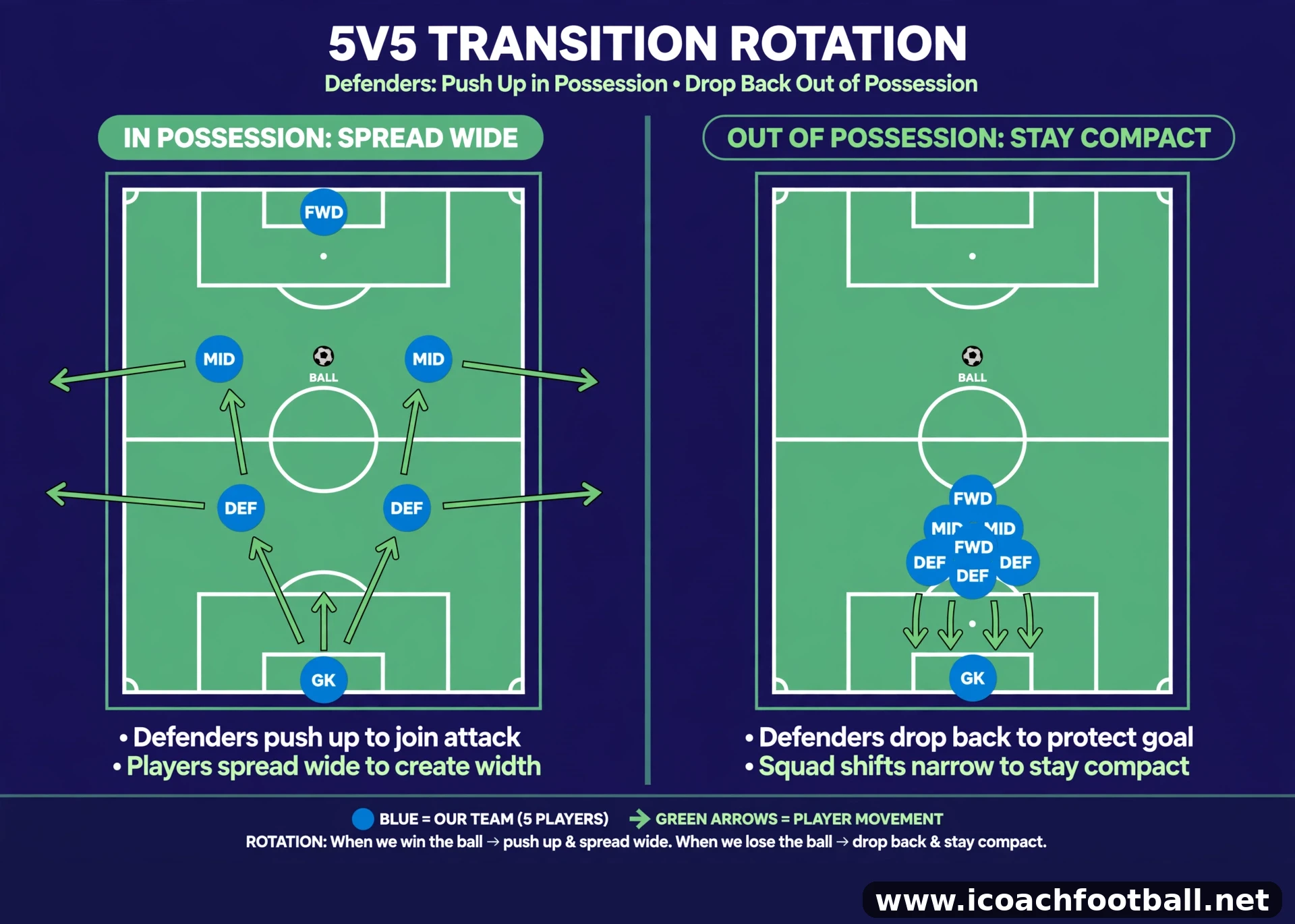
- Focus: shape in transition — spread out with the ball, get compact without it
- Best for: U8–U12 coaches, plus any coach using 5v5 as a training format at older ages
Why 5v5 shape is different
In 11v11, a player out of position can hide. In 5v5, there is nowhere to hide, and that is the point. Every player touches the ball constantly, every mistake becomes a chance, and every recovery run matters. That is why small-sided games are the backbone of youth development: U.S. Soccer’s age-group guidance builds its youngest formats around small-sided play, and the FIFA Training Centre’s grassroots sessions use the same logic — small games, lots of decisions, skills learned inside the game rather than in lines.
The coaching mistake is teaching 5v5 shape as positions to stand in. Teach it as distances instead. In possession, your team should be as wide as the pitch and as long as it needs to be. Out of possession, it should be narrow enough that a pass through the middle is a risk, not a gift. If your players learn those two pictures, the formation number almost takes care of itself.
The three 5v5 soccer formations
1. The 2-2 — the best starting shape for most youth teams
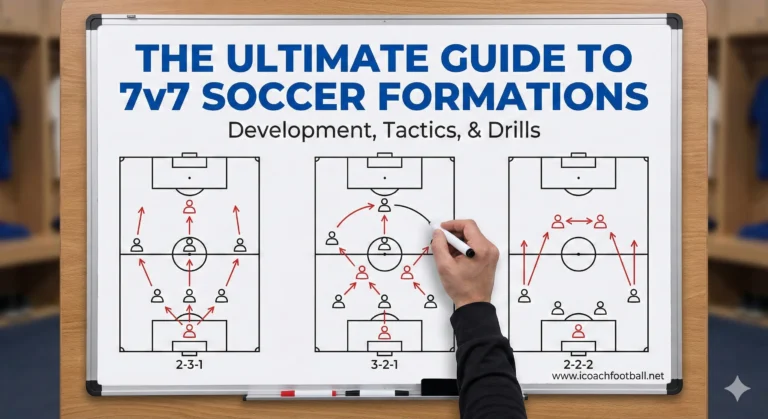
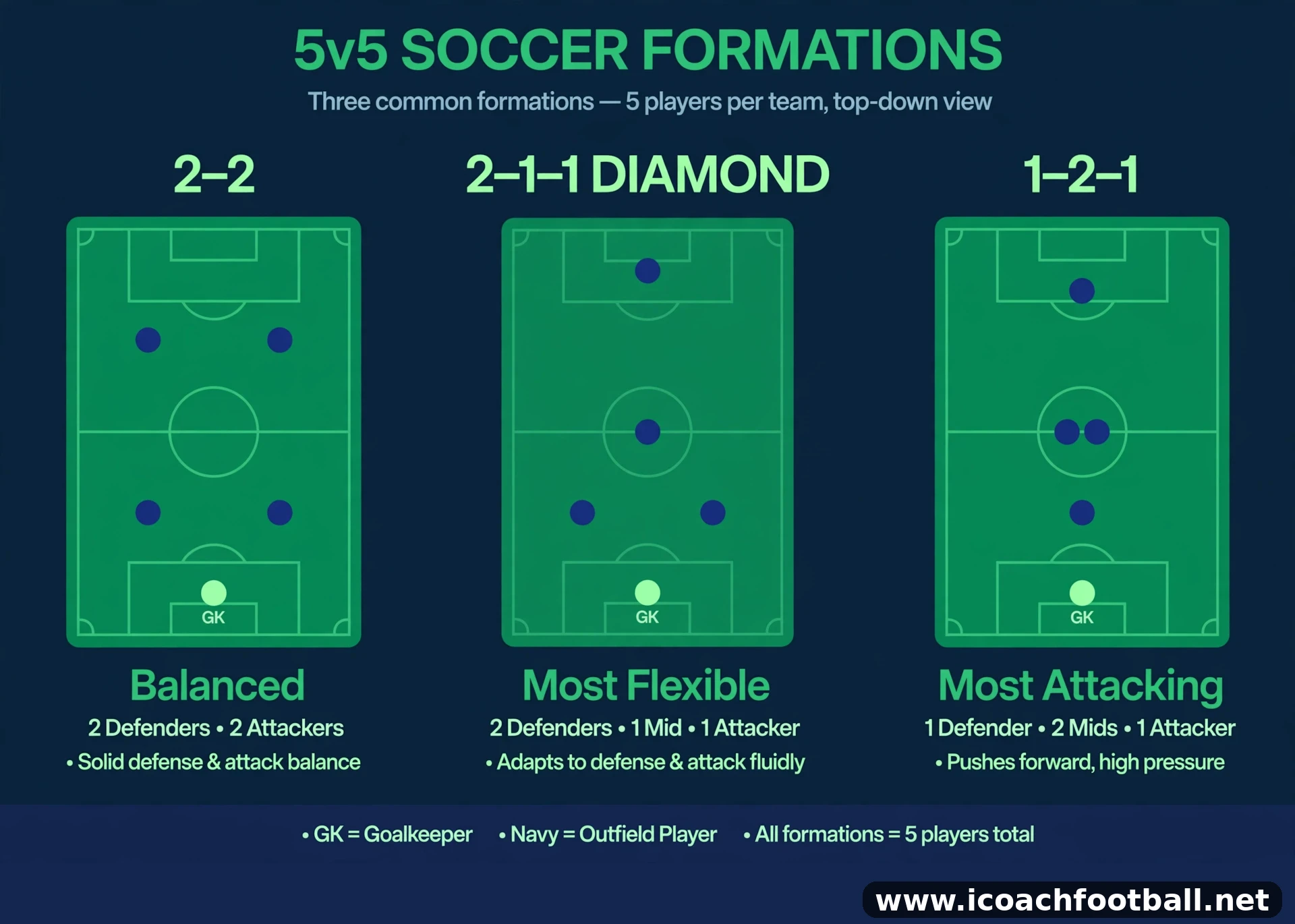
Two defenders, two attackers, goalkeeper behind them. Draw a box, not a line: the two defenders stay connected to each other, the two attackers stay connected to each other, and the gap between the pairs is the space your team plays in.
Use it when: you are coaching U8–U10, your team is new, or you concede goals from straight through the middle. The two defenders give young goalkeepers protection, and the two attackers always have a partner to combine with.
Player jobs:
- Goalkeeper: starts attacks, not just stops shots. Cue: “Keeper, can you be our first passer?”
- Defenders: stay side by side, never both step to the same attacker. One presses, one covers.
- Attackers: one drops to receive, one stretches the defence. If both chase the ball, the shape is gone.
Coaching cue that works: “Two at the back, two up top — stay in your pair.” Say it once, then let them play. The moment to correct is when both defenders are caught on the same side of the pitch.
Weakness: the middle can go empty. If the other team plays a midfielder who drops between your pairs, your defenders have to decide: step out and leave a gap, or hold and let them turn. That decision is exactly what the next shape trains.
2. The 2-1-1 diamond — the most flexible shape
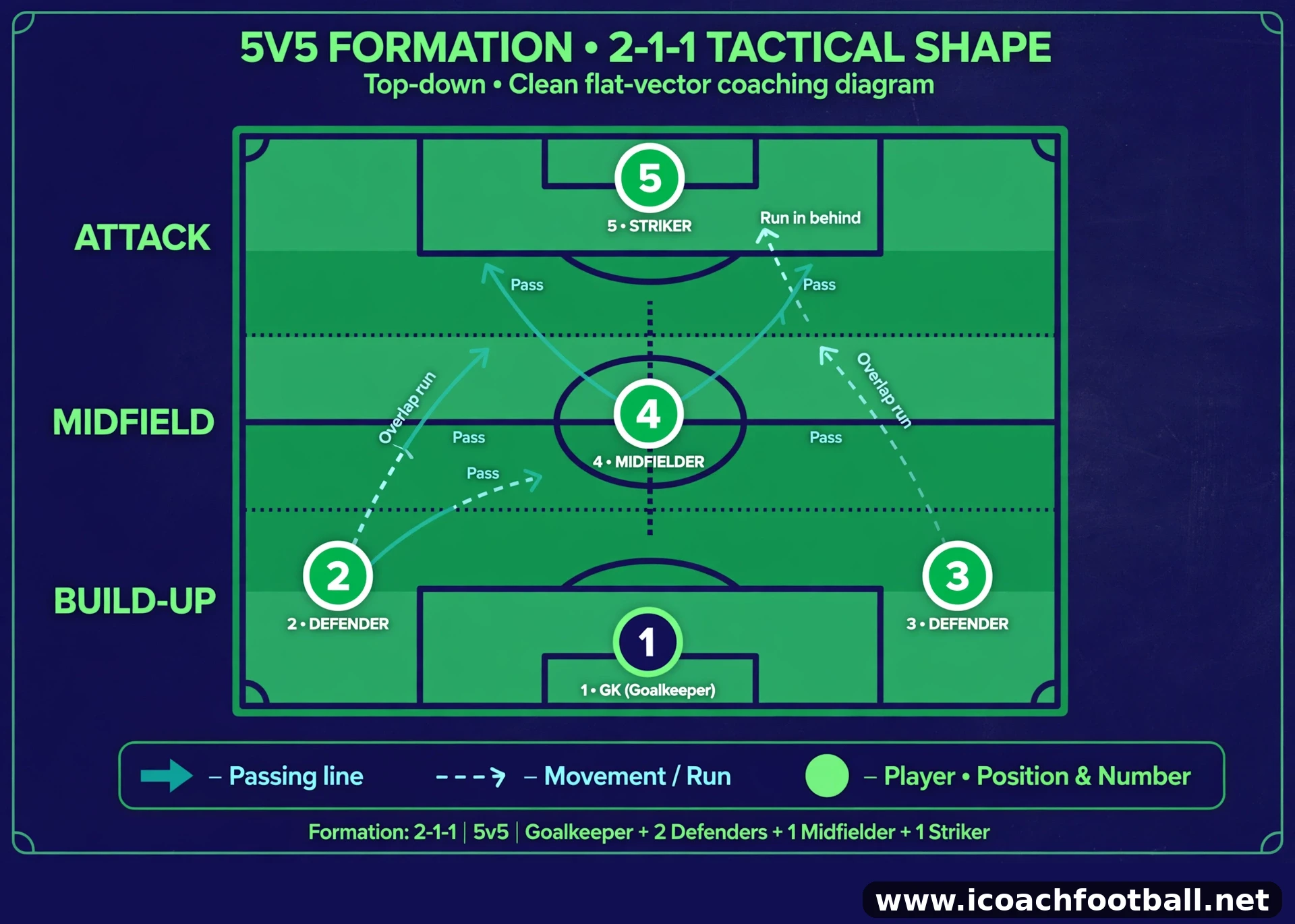
Two defenders, one midfielder, one striker, plus the goalkeeper. This is the shape in the main diagram below, and it is the best all-round 5v5 formation for teams that can already pass and move.
The midfielder is the hinge. In possession, they drop between the defenders to make a 3v2 build-up, or push up to support the striker. Out of possession, they screen the middle and force play wide. That one player decides whether your team looks organized or stretched.
Use it when: your players can receive on the half-turn, your goalkeeper is comfortable with the ball at their feet, and you want to teach rotations rather than fixed positions.
Player jobs:
- Goalkeeper: splits wide on goal kicks so the defenders can split too. Cue: “Wide, keeper, make the pitch big.”
- Defenders: one steps into midfield when the ball is on their side; the other tucks in to cover.
- Midfielder: scans before receiving — the phrase to drill is “check your shoulder.” If they receive facing their own goal under pressure, the diamond collapses.
- Striker: holds the line high enough to stretch the defence, then checks back for the ball. Never both striker and midfielder in the same square metre.
Train it with the diamond rotation game below. The most common mistake is the midfielder becoming a second striker. If your midfielder is standing next to the striker for more than a few seconds, freeze the game and ask: “Who is our link player right now?” Let the players fix it.
3. The 1-2-1 — the attacking shape, used with care
One defender, two midfielders, one striker, plus the goalkeeper. This is the pressing shape: it puts three players high, wins the ball early, and creates overloads around the opposition goal.
Use it when: you are chasing a game, the opposition struggles to play out, or your team is older and fitter. Do not start a U8 season here. With one defender, a single beaten press is a breakaway, and young players will learn the wrong lesson — that shape does not matter, only effort does.
Player jobs:
- The lone defender: stays, delays, and funnels play to one side. They must not dive in. Cue: “Slow them down, don’t win it.”
- Midfielders: press in a pair, like a gate. If one presses and the other watches, the gate is open.
- Striker: angles the first press to force the ball toward the side your midfielders are waiting on.
- Goalkeeper: plays high, almost as a sweeper, and must be ready for long balls over the top.
The rule for this shape: if you lose the ball and cannot win it back in six seconds, drop into a compact block immediately. That six-second rule is your safety net. Without it, 1-2-1 is just chaos with good intentions.
Comparison
- 2-2: Balanced. Best for beginners and for protecting a lead. Risk: empty midfield.
- 2-1-1 diamond: Most flexible. Best for developing teams. Risk: depends on one midfielder.
- 1-2-1: Most attacking. Best for pressing and chasing games. Risk: exposed at the back.
How shape changes by age group
- U8–U9: Start with 2-2 and keep it simple. Do not name positions beyond “two back, two front.” Rotate every player through every role across the season. At this age, shape is a starting picture, not a job description — players will follow the ball, and that is normal.
- U10–U11: Introduce the 2-1-1 diamond once players can pass to a moving target. Teach the midfielder’s scanning habit first, before any rotation pattern. A diamond without scanning is just a 2-2 with a confused player in the middle.
- U12 and older: Use all three shapes situationally. A U12 team should be able to start 2-1-1, switch to 1-2-1 when pressing high, and drop to 2-2 to see a game out. That is the bridge to 7v7: the same ideas — width in possession, compactness out of it, one player linking the lines — carry straight into the 7v7 soccer formations guide linked below.
You can sketch these switches before training with the site’s Formation Maker.
Three training games that teach 5v5 formations
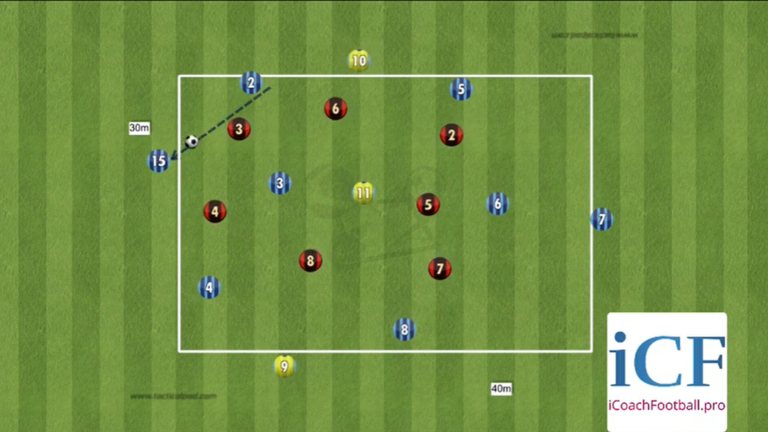
- The Diamond Rotation Game (15 minutes, 5v5, 30 x 20 yards). Play normal 5v5, but award a bonus point every time the ball travels goalkeeper to defender to midfielder to striker without going backwards. Players learn the diamond’s passing lanes by chasing points, not by listening to instructions. Progression: the midfielder must take a first touch facing forward to count the point.
- The Six-Second Press (4 x 4 minutes, 5v5). In the 1-2-1 shape, the team that loses the ball has six seconds — counted out loud by the coach — to win it back. If they fail, they must sprint back into a compact block behind the ball. This single game teaches both halves of the attacking shape: press together, or drop together.
- Wide Goals, Narrow Goals (20 minutes). Play 5v5 with wide goals in one game and narrow goals in the next. Wide goals reward the 2-2’s width; narrow goals reward the diamond’s central combinations. After both games, ask the players which shape suited which goal — they will tell you the answer you were about to lecture them on.
Common mistakes coaches make with 5v5 formations
- Changing shape every week. A shape needs four weeks of games before you can judge it. Changing it after one bad result teaches players that shape is the coach’s problem, not theirs.
- Freezing play to lecture. In 5v5, stoppages kill the very thing you are training: decision speed. Use one cue phrase, then restart. Save the explanation for a water break.
- Naming positions too early. “Left back” means nothing to an eight-year-old. “Two back, two front, stay with your partner” means everything.
- Ignoring the goalkeeper. In 5v5, the goalkeeper touches the ball more than anyone. If your keeper only practices shot-stopping, your build-up will always break down at the first pass.
- Copying 11v11 shapes down. A 4-3-3 does not shrink into 5v5. The numbers, the distances and the rotations are different. Teach 5v5 on its own terms, then let it feed 7v7 and 9v9.
Which 5v5 formation should you pick?
If you coach one team and want one answer: start with the 2-2 if your players are under 10, and the 2-1-1 diamond if they are 10 or older and can already pass and move. Keep the 1-2-1 in your pocket for pressing moments and for games you need to chase. Review after a month: are your players wider with the ball and narrower without it? If yes, the shape is working, whatever the scoreline says.
Related guides on iCoachFootball
Frequently asked questions
What is the best 5v5 soccer formation for youth teams?
For most youth teams, the 2-2 is the best starting shape because it is simple and protects the goal. Once players can pass and scan, the 2-1-1 diamond is the best all-round shape. The 1-2-1 is best used as a pressing shape, not a default.
How many players are in a 5v5 soccer formation?
Five per team: a goalkeeper plus four outfield players. Formation numbers in this guide count outfield players only, so 2-2 means two defenders and two attackers, plus the goalkeeper.
What age group plays 5v5 soccer?
In the United States, 5v5 is principally a U8-and-under format under U.S. Soccer’s small-sided approach, though many leagues and training programmes use 5v5 at older ages too. Always check your local league’s format, because it varies by association.
How do you teach 5v5 formations to young players?
Teach distances, not positions: wide with the ball, compact without it. Use small games with points for the patterns you want, one cue phrase at a time, and give one shape four weeks before judging it.
When should a team switch formations during a 5v5 game?
Switch to 1-2-1 to press when chasing a game, and drop to 2-2 to protect a lead. Only switch if your players already know both shapes from training; a shape introduced mid-game is a guess, not a plan.