Football Rest Defence Drills: 6 Games to Stay Safe While You Attack
Quick answer
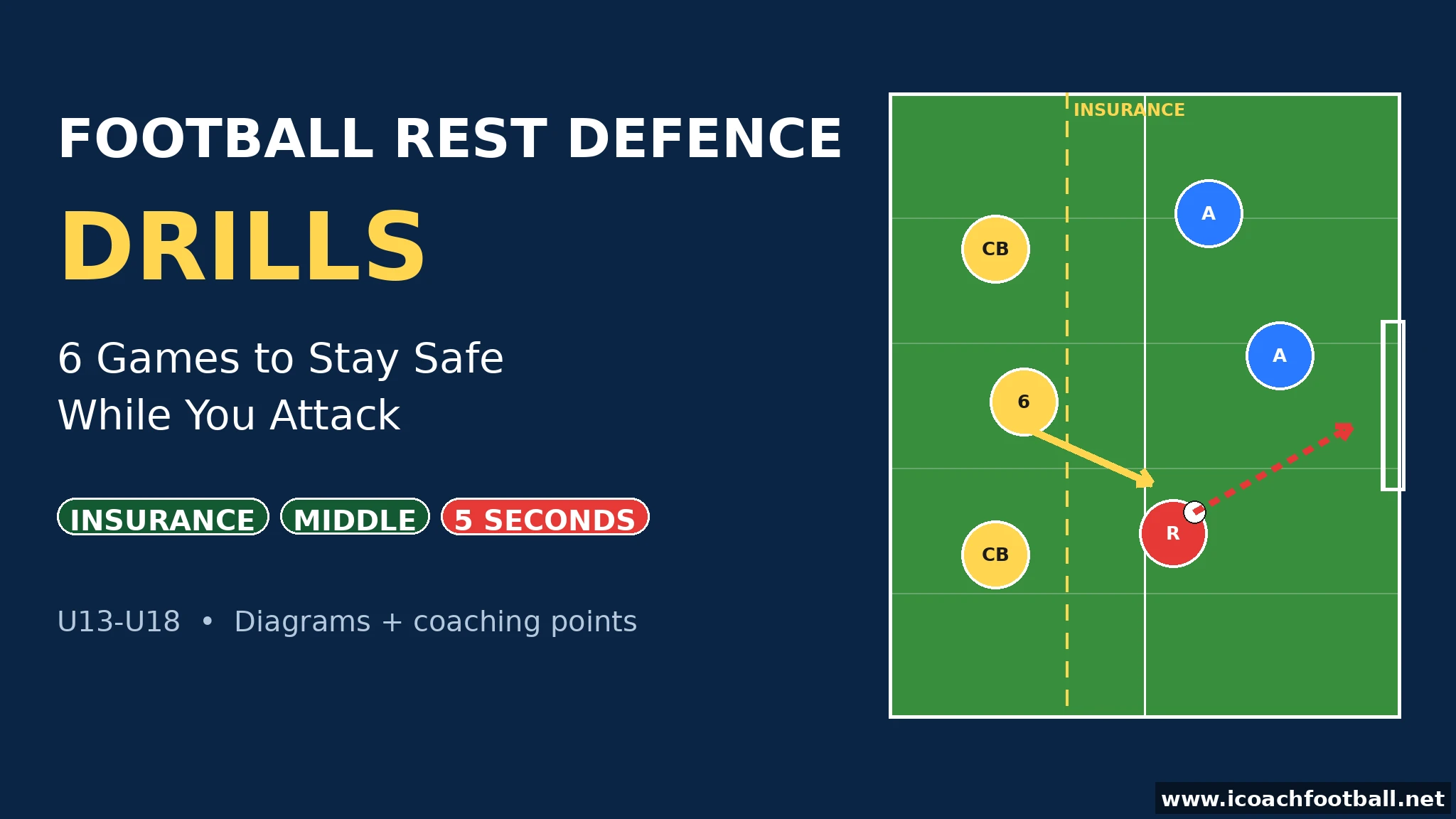
Rest defence is the shape your team holds while you attack — the two or three players left behind the ball on purpose, so the moment you lose it the counter dies instead of becoming a footrace to your goal. The job has one question at its heart: who is our insurance?
Suitable for: U13–U18
Most youth teams attack with everyone and defend with no one. Six players pile into the box, the ball is lost, and suddenly two defenders are sprinting back against three attackers with the whole pitch open. These six football rest defence drills fix that — they teach your players to hold a balanced shape while attacking, protect the middle first, and kill the counter within five seconds of the turnover. (In American soccer coaching the same idea is usually called rest defense — the job is identical.)
Session snapshot
- Players: 8 or more (attackers, rest defenders, goalkeeper)
- Area: Half pitch up to two-thirds, depending on the drill
- Duration: 60 minutes
- Focus: Insurance shape, middle protection, five-second kill
- Age: U13–U18 (see Age adaptations)
Rest-defence shapes by formation
The shape below is in line with the FIFA Training Centre’s zonal defending methodology: positioning guided by the ball, your team-mates and the spaces you must protect — not by chasing opponents. Pick the shape that fits your formation and name it before every session, so every player knows whether they are part of the attack or part of the insurance. It is the other half of the defensive transition — the shape that makes the six-second win-back possible.
| Formation | Rest-defence shape | Who is the insurance |
|---|---|---|
| 4-3-3 | 2-3 | Two centre-backs, holding midfielder, both full-backs tucked in |
| 4-2-3-1 | 3-2 | Two centre-backs plus one full-back, two holding midfielders |
| 3-5-2 | 3-2 | Three centre-backs, two holding midfielders |
| 9v9 (3-2-3) | 2-1 | Two defenders, one holding midfielder |
| 7v7 (2-3-1) | 1-1 | One defender, nearest midfielder |
Drill 1: Name the Insurance
Before any player can hold a shape, they have to know the job exists. This walk-through names the insurance players out loud — no running, no ball pressure, just the picture.
Setup
- Full team in your attacking shape on a half pitch, balls with the attackers
- No opposition at first; coach stands on the halfway line with a whistle
- 10 minutes, then repeat inside Drill 6 as a freeze
How to Play
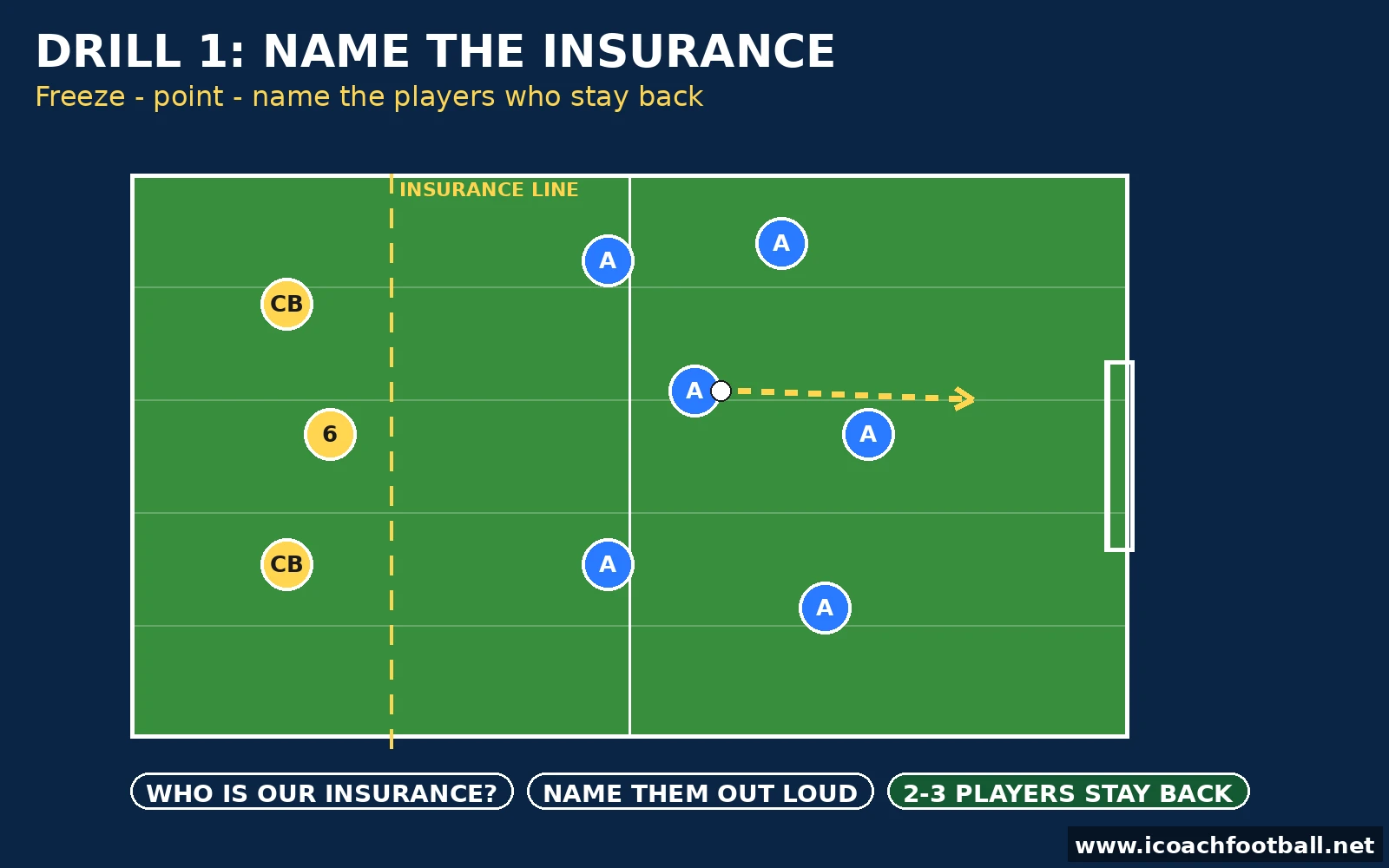
- The attackers pass the ball around the top third while the insurance players hold their shape.
- The coach blows the whistle and shouts “FREEZE!” — everyone stops dead.
- Every player points at the insurance players and says their names out loud.
- The coach asks one question: “If we lose it now, who stops the counter?”
- Play restarts; freeze again after 30 seconds, from a different part of the pitch.
Coach’s note: The first freeze always exposes it — four players pointing at different team-mates, or nobody pointing at all. That confusion is the lesson. Keep freezing until the whole team names the same two or three players in under two seconds.
Progressions: Add two passive defenders who walk toward the ball on the freeze; let the insurance players call the shape themselves with no coach prompt.
Drill 2: The Five-Second Kill
The turnover moment, trained in volume. Your attack tries to score; the instant the ball is lost, the rest defence has five seconds to kill the counter — or it counts against them.
Setup
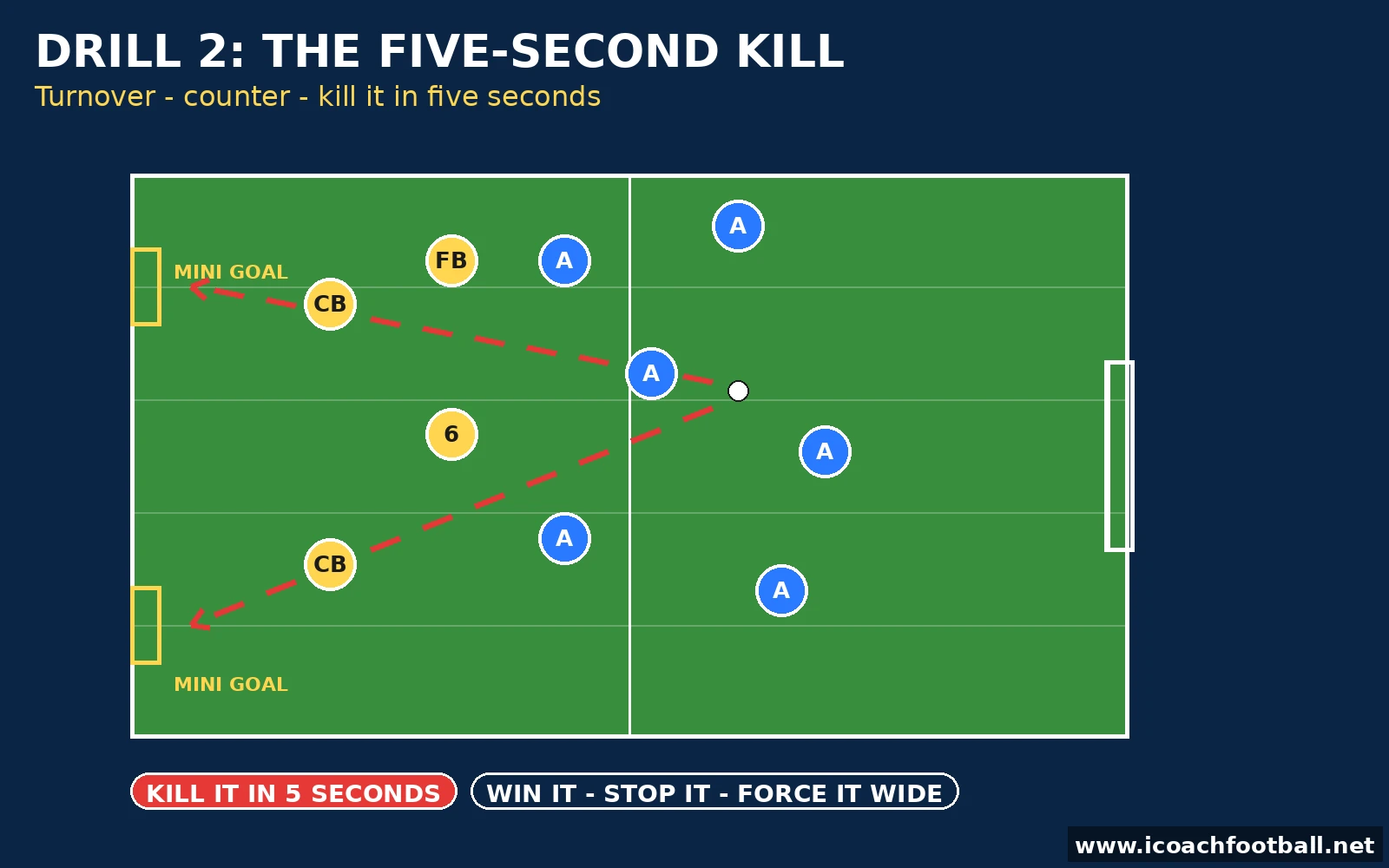
- 6 attackers vs 4 rest defenders plus goalkeeper, two-thirds of a pitch
- Two mini goals on the halfway line for the counter-attackers
- Attackers start with the ball 30 yards from goal; 4 x 3-minute games
How to Play
- The attackers try to score in the big goal; the rest defence holds its 2-3 shape behind the ball.
- The moment the ball is lost — tackle, interception or bad pass — the defenders counter at full speed toward the mini goals.
- The rest defence must kill the counter within five seconds: win it, foul it (in training, just stop it) or force it wide.
- A killed counter scores the rest defence 1 point; a mini-goal scores the counter team 2 points.
- Rotate the rest-defence group every game so every player feels the job.
Coach’s note: Count out loud — “one, two, three, four, FIVE” — so players feel the window. Most youth counters are killed or conceded inside five seconds; if your rest defence is still jogging at three, the goal is already coming.
Progressions: Give the counter team a third runner arriving late; require the kill to be a clean interception or tackle, not just a foul or a punt.
Drill 3: The Sliding Box
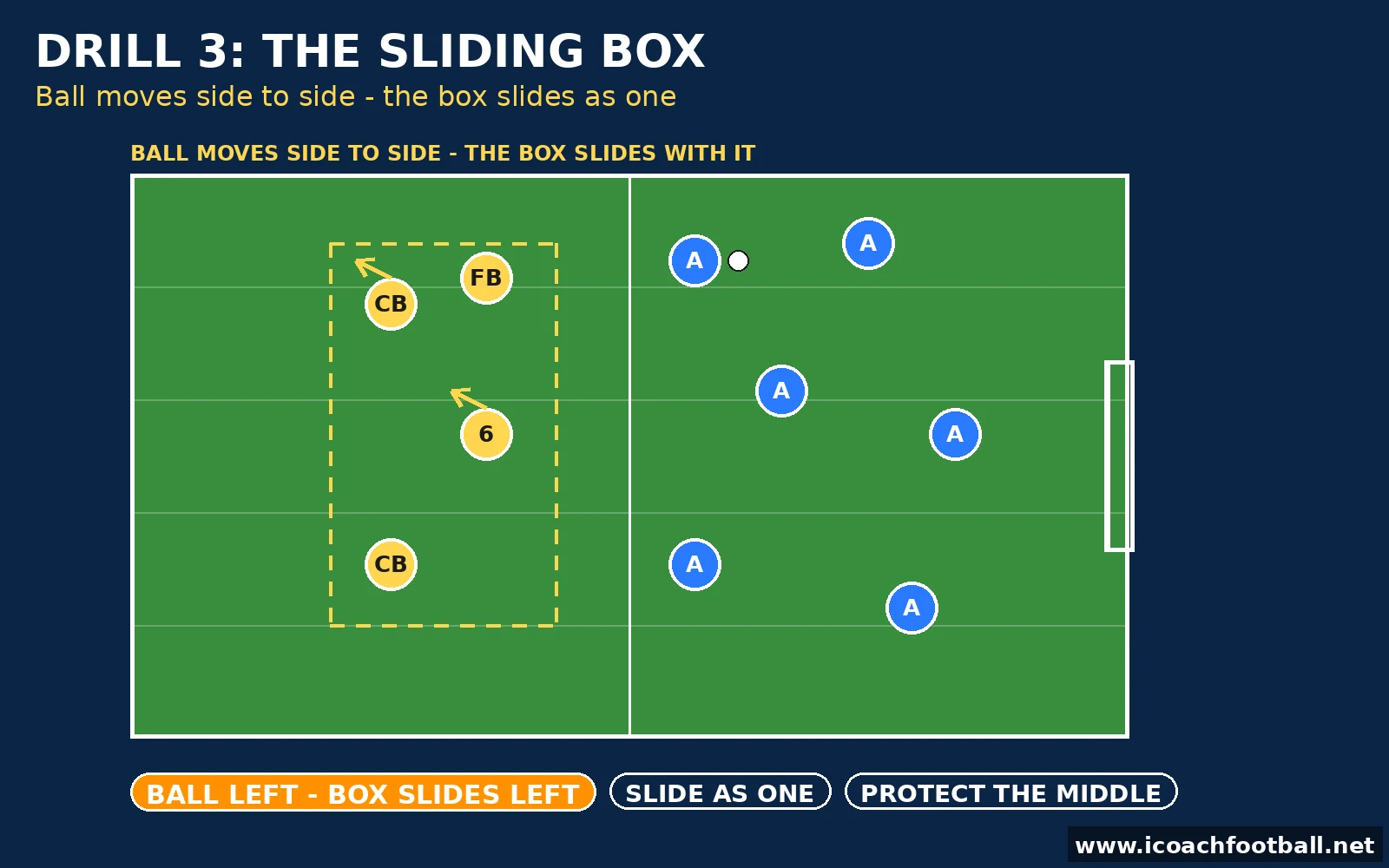
A rest defence that stands still is a rest defence that gets played around. This drill teaches the box — two centre-backs, holding midfielder and tucked-in full-back — to slide as one as the ball moves. Watch the animation below the diagram: the slide is the skill.
Setup
- 8 attackers vs 4 rest defenders plus goalkeeper, half pitch
- Rest defence set as a 2-3 box: two centre-backs, one holder, one full-back tucked in
- Coach serves balls from the halfway line; 4 x 4-minute blocks
How to Play
- The attackers keep the ball and move it from side to side, hunting a gap.
- The rest-defence box slides with the ball — ball-side full-back steps up, far-side full-back tucks in, holder screens the middle.
- The coach calls “TURNOVER!” and plays a long ball to a counter runner on the far side.
- The box must collapse on the ball side, protect the middle first and show the counter wide.
- If the counter is killed, the box resets and the attackers start again.
Coach’s note: The mistake to watch is the far-side full-back ball-watching. When the ball is on the left, the right full-back must still be tucked in and goal-side — the counter always comes back through the middle, never down the touchline they are staring at.
Progressions: Let the attackers score in the big goal if the box is beaten; add a second counter runner so the box must choose which side to collapse on.
Drill 4: Show Them Wide
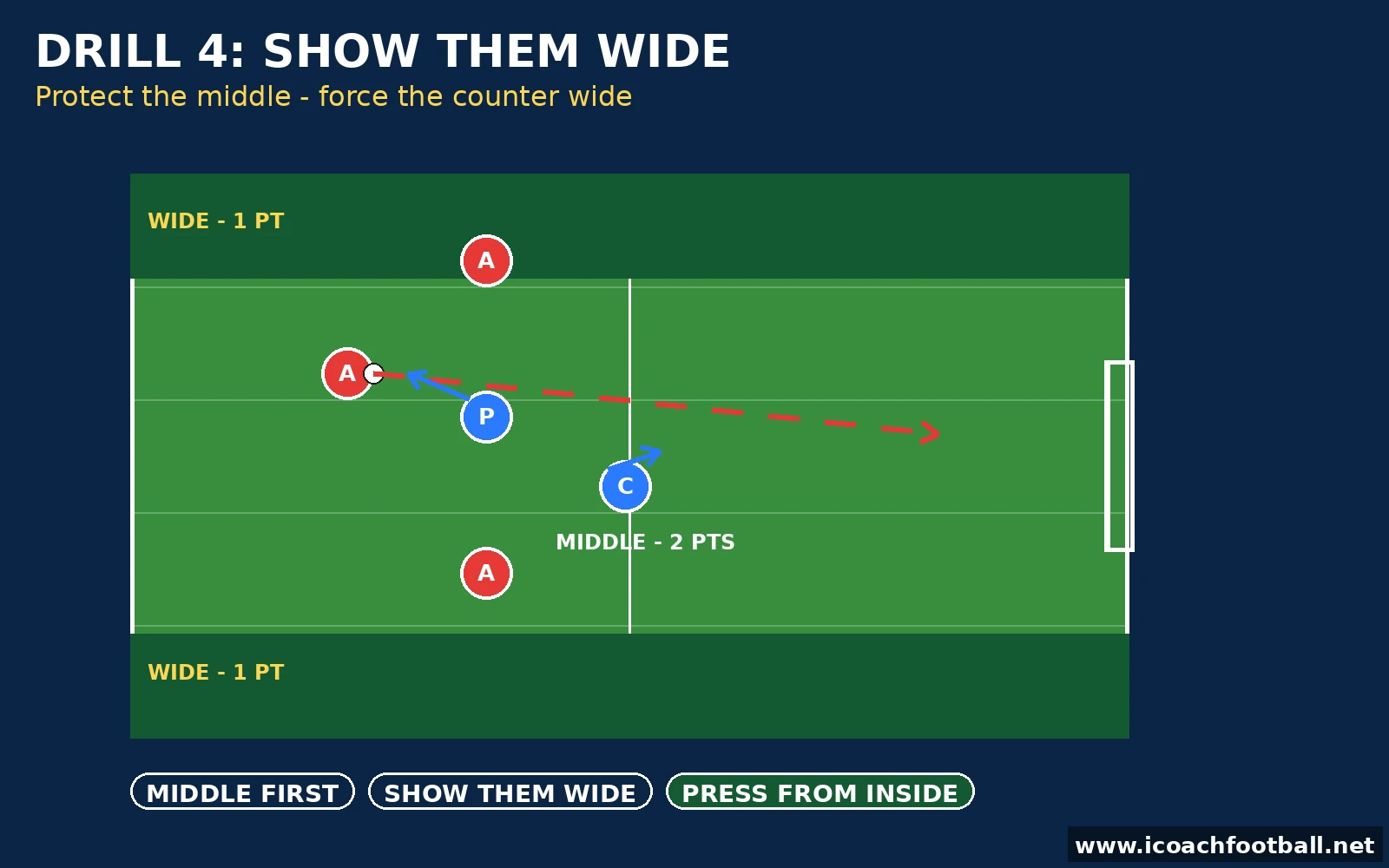
A counter down the middle is a goal. A counter down the touchline buys your whole team four seconds to recover. This wave game teaches the rest defence to protect the middle first and force everything wide.
Setup
- 3 attackers vs 2 rest defenders plus goalkeeper, 30 x 25-yard area
- One big goal, two wide channels marked with cones, balls with the coach
- Waves of 3 attackers; defenders stay on for 3 waves, then rotate
How to Play
- The coach plays the ball to the attackers, who counter at full speed.
- The nearest rest defender presses the ball and angles their run to show the attacker wide.
- The second defender drops goal-side, protects the middle and cuts the pass inside.
- A goal scored through the middle counts 2 points; a goal from a wide cross counts 1.
- If the defenders win it, they score by passing to the coach in under three seconds.
Coach’s note: The cue is “middle first, then wide.” A defender who chases the ball carrier and leaves the middle open has done the counter’s job for them. The press must always come from the inside shoulder, never square on.
Progressions: Add a third attacker arriving late through the middle; let the second defender step in and win it if the ball carrier takes a heavy touch.
Drill 5: The Recovery Sprint
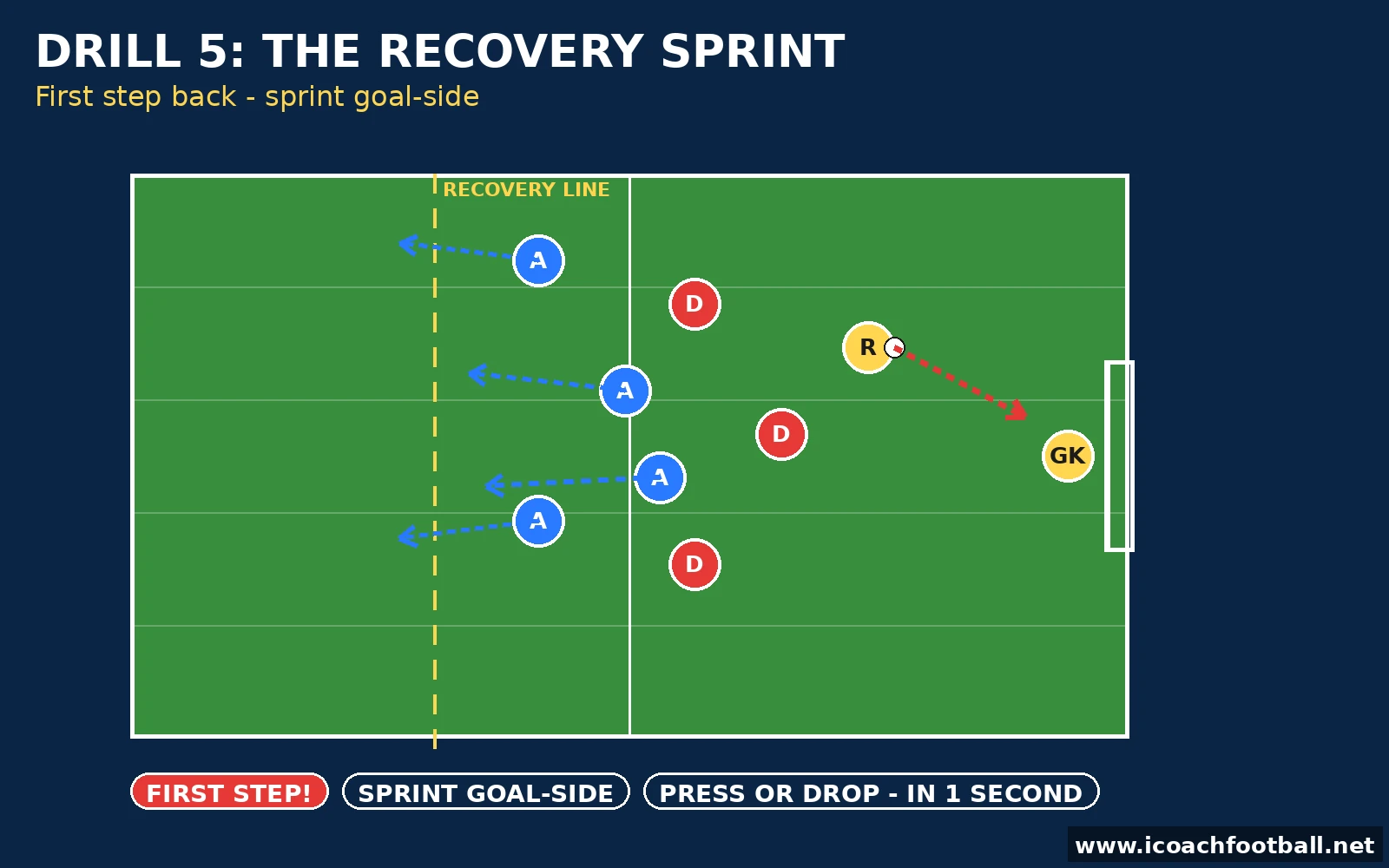
Rest defence is not just the players who stayed back — it is also the nearest attackers sprinting goal-side the instant the ball is lost. This drill trains the first three seconds after the turnover.
Setup
- 4 attackers vs 3 defenders plus goalkeeper, half pitch
- Coach on the touchline with a supply of balls; 6 waves per group
- A cone line 20 yards from goal marks the recovery line
How to Play
- The attackers build up and shoot or lose the ball — either way, the coach immediately plays a new ball to a counter runner.
- The nearest attacker becomes the first defender and presses the ball at full sprint.
- The other attackers sprint back goal-side of the ball, inside the recovery line.
- The three defenders hold their shape, delay the counter and wait for the runners.
- The counter is over when the ball is won, goes out, or crosses the recovery line with the shape set.
Coach’s note: Watch the first step, not the sprint. A player who turns and jogs has already lost the race; a player whose first step is a sprint toward their own goal changes the whole picture. Shout “FIRST STEP!” until the habit is automatic.
Progressions: Start the counter with a long ball over the top, so the recovery is a real chase; score the counter team double if they score before the recovery line is set.
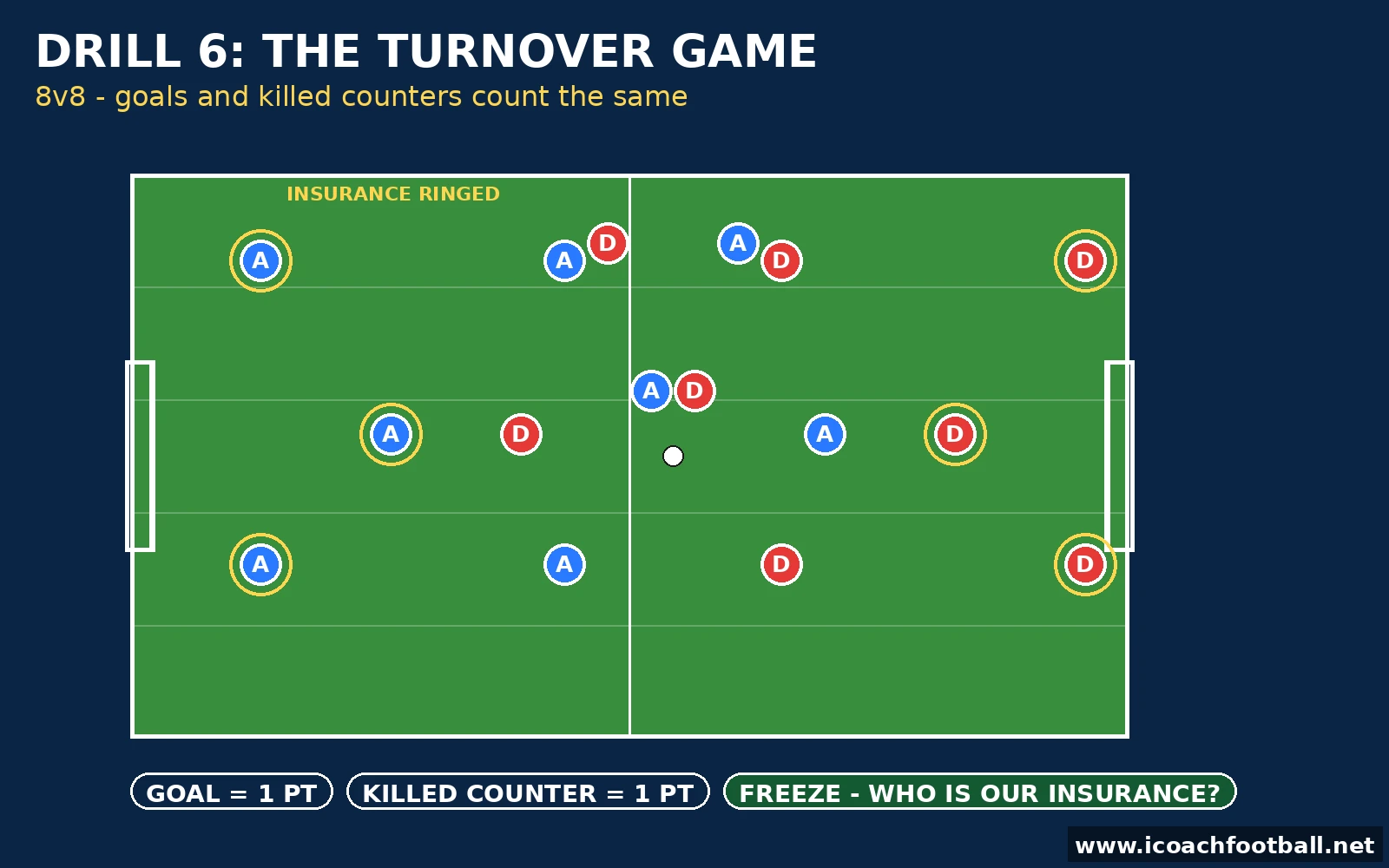
Drill 6: The Turnover Game
Put the whole idea inside a real game — and score the rest defence, not just the goals.
Setup
- 8v8 plus goalkeepers on a half pitch with full-size goals
- Normal small-sided rules, plus the scoring rule below
- 4 x 4-minute games, 1-minute rests
How to Play
- Teams play 8v8 as normal, each in its own rest-defence shape.
- A goal is worth 1 point — and so is killing a counter within five seconds of losing the ball.
- The team that loses the ball must show its insurance shape before it can win the point; a scramble does not count.
- The coach freezes play twice per game and asks: “Who is our insurance right now?”
- The team with the most points at the end wins — goals and killed counters count the same.
Coach’s note: Counting killed counters changes behaviour overnight. Teams that used to send everyone forward suddenly leave their insurance in place — because the insurance is now worth as much as a goal. That is the whole point of the session.
Progressions: Only goals scored after a killed counter count double; play 11v11 in your real formation with your real rest-defence shape.
Coaching points
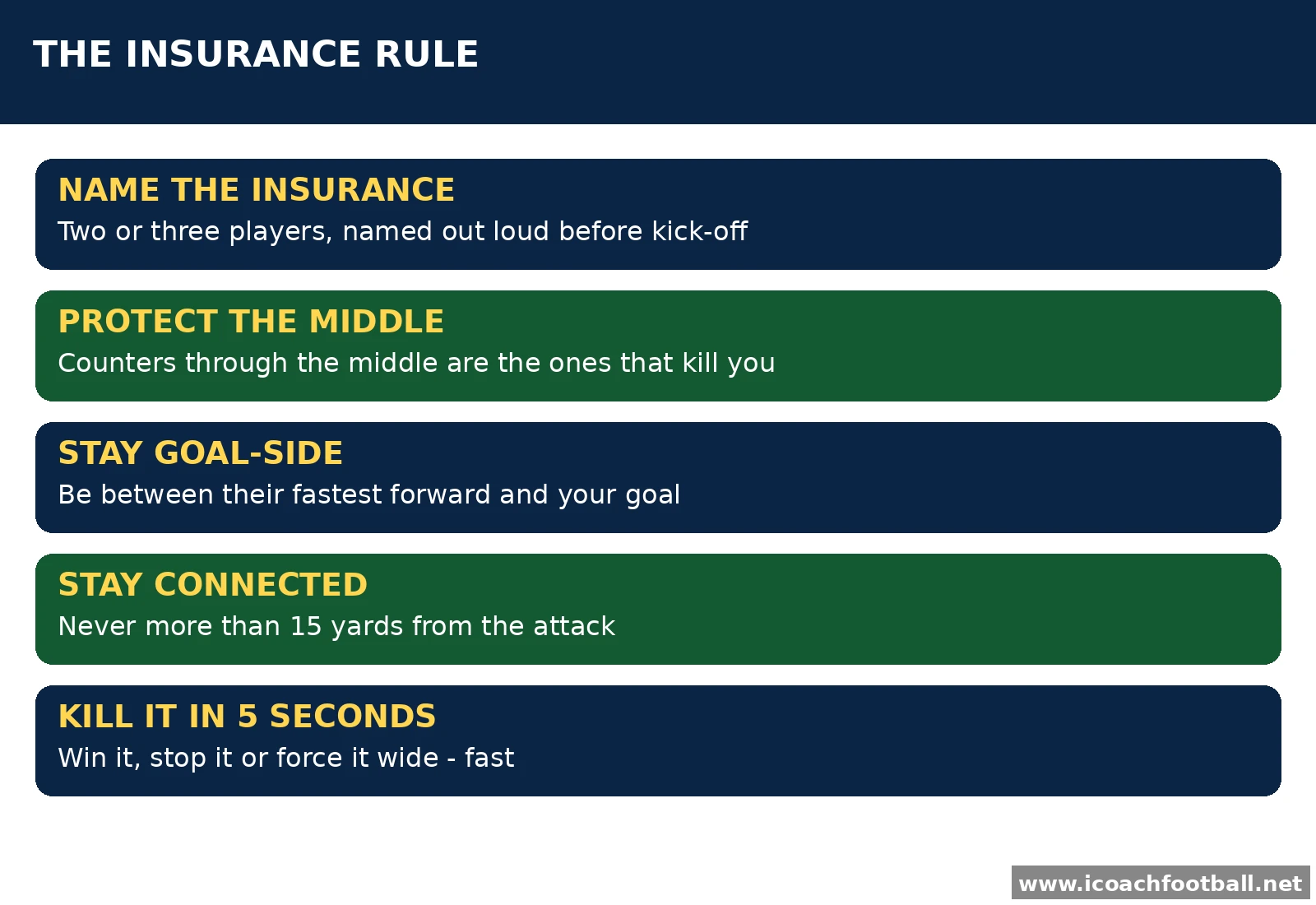
- Name the insurance before kick-off. Every player should be able to say who stays back and who goes. If the team cannot name them, there is no rest defence — there is just hope.
- Protect the middle first. Counters scored through the middle are the ones that kill you. Force play wide and the touchline becomes an extra defender.
- Stay goal-side of their fastest forward. The rest defence’s first job is not to win the ball — it is to be between the fastest opponent and your goal when the ball turns over.
- Stay connected. The gap between the rest defence and the attack should never grow so large that the space between them becomes the opposition’s playground. Fifteen yards is the limit.
- Decide in one second: press or drop. The nearest player presses if they can win it; everyone else drops into shape. Hesitation between the two is what concedes the goal. The trigger that starts the press — a bad touch, a square pass — is the same one our pressing triggers guide teaches you to spot.
- Win the second ball, then organise. If the counter starts with a long ball, the first duel is the drop — our second ball drills train that moment, and the rest defence must be set behind it.
- A killed counter is an attack. Win it and go forward at once — the counter attack the other way starts from the same shape.
- Compactness is the whole job. A rest defence spread across the pitch is no rest defence at all — the connected, compact shape our defensive block work builds is what makes the box hold.
Common mistakes
- Everyone bombs forward. Six players in the box looks brave until the ball is lost. Hold the insurance — the attack does not need eight players to score.
- Rest defenders ball-watching. The far-side defender staring at the ball is the one the counter runs behind. Scan, check your shoulder, stay goal-side.
- Stepping out of the line. One rest defender chasing a lost cause opens the gate for the through ball. Hold the line; let the press come from the front.
- Dropping too deep. A rest defence camped on its own box invites pressure and gives the counter a free run at the line. Hold your position — level with the ball, not behind it.
- No communication. The insurance players must talk constantly: “I’ve got middle,” “you press,” “drop.” Silence is how two players press the same man and leave the middle empty.
- Treating it as a defenders-only job. Rest defence is a team shape. Midfielders and wingers are part of the insurance too — the nearest player to the ball has a job the instant it is lost.
Age adaptations
| Age group | How the session changes |
|---|---|
| U11–U12 | Drills 1 and 2 only, with one cue: “Who is our safety?” No shapes by formation, no five-second counting — just the habit of leaving two players back |
| U13–U15 | Full Drills 1–4; introduce the 2-3 and 3-2 shapes by formation; use the five-second count as a challenge, not a punishment |
| U16–U18 | Full speed throughout; formation-specific shapes, players name and organise the insurance themselves with no coach prompts; add the second-runner progressions |
60-minute session plan
This is the full session, built on our 60-minute plan structure — warm-up, two drill blocks, game, cool-down.
| Block | Time | Content |
|---|---|---|
| Warm-up | 0–10 min | Passing in threes with a “freeze” call — on the call, two players drop into rest-defence positions |
| Drill 1 + 2 | 10–25 min | Name the Insurance, then The Five-Second Kill |
| Drill 3 + 4 | 25–40 min | The Sliding Box (with animation), then Show Them Wide |
| Drill 5 + 6 | 40–55 min | The Recovery Sprint, then The Turnover Game |
| Cool-down | 55–60 min | Light jog, stretch, one-line review: “Who was our insurance today — and did they hold?” |
Sources
- FIFA Training Centre — Zonal defending: From principles to practice using a progressive methodology (https://www.fifatrainingcentre.com/en/practice/talent-coach-programme/zonal-defending/from-principles-to-practice-using-a-progressive-methodology.php). The drills above are based on and in line with its coaching of positioning guided by the ball, team-mates and the spaces to protect; pressure, cover and balance; compact distances within and between lines; and the transition decision to press immediately or recover into a compact shape — they are not FIFA-approved sessions.
- FIFA Training Centre — Developing defensive coordination in small groups (FIFA Talent Coach Stuart McLaren) (https://www.fifatrainingcentre.com/en/practice/talent-coach-programme/zonal-defending/developing-defensive-coordination-in-small-groups.php). Used in line with its 2v2 pressure-and-cover and 3v3 defensive-triangle practices: the closest defender presses and shows the attacker outside, the second defender supports behind and inside, and the furthest defender provides balance on the weak side.
FAQ
What is rest defence in football?
Rest defence is the shape your team holds while you attack — the players deliberately left behind the ball so a turnover becomes a tackle instead of a footrace to your goal. In a 4-3-3 it is usually a 2-3 shape: two centre-backs, a holding midfielder and tucked-in full-backs. In American soccer it is usually called rest defense.
How many players should stay back in rest defence?
Two or three, depending on your formation — two centre-backs plus a holder in most youth shapes. The rule is simple: always have one more player behind the ball than the opposition has forwards waiting for the counter.
What age should you teach rest defence?
From U13 upward, when players can hold a team shape. At U11–U12 keep it to one cue — “who is our safety?” — and two players staying back. Younger players should never be nailed to the halfway line as permanent insurance; rotate the job so everyone learns it.
What is the difference between rest defence and counter-pressing?
Rest defence is the shape you hold before the ball is lost; counter-pressing is what you do in the five seconds after it is lost. They work together: good rest defence makes counter-pressing safe, because if the press fails there is still a shape behind it. Train the shape first, then the press.
How do you stop your team conceding on the counter every game?
Name the insurance before kick-off, protect the middle first, and score the rest defence in training — a killed counter worth a point, as in Drill 6. Teams concede on the counter because nobody was given the job; give it a name, give it points, and the shape appears.