Soccer Goalkeeper 1v1 Drills: 6 Games to Read, Close and Win the Duel
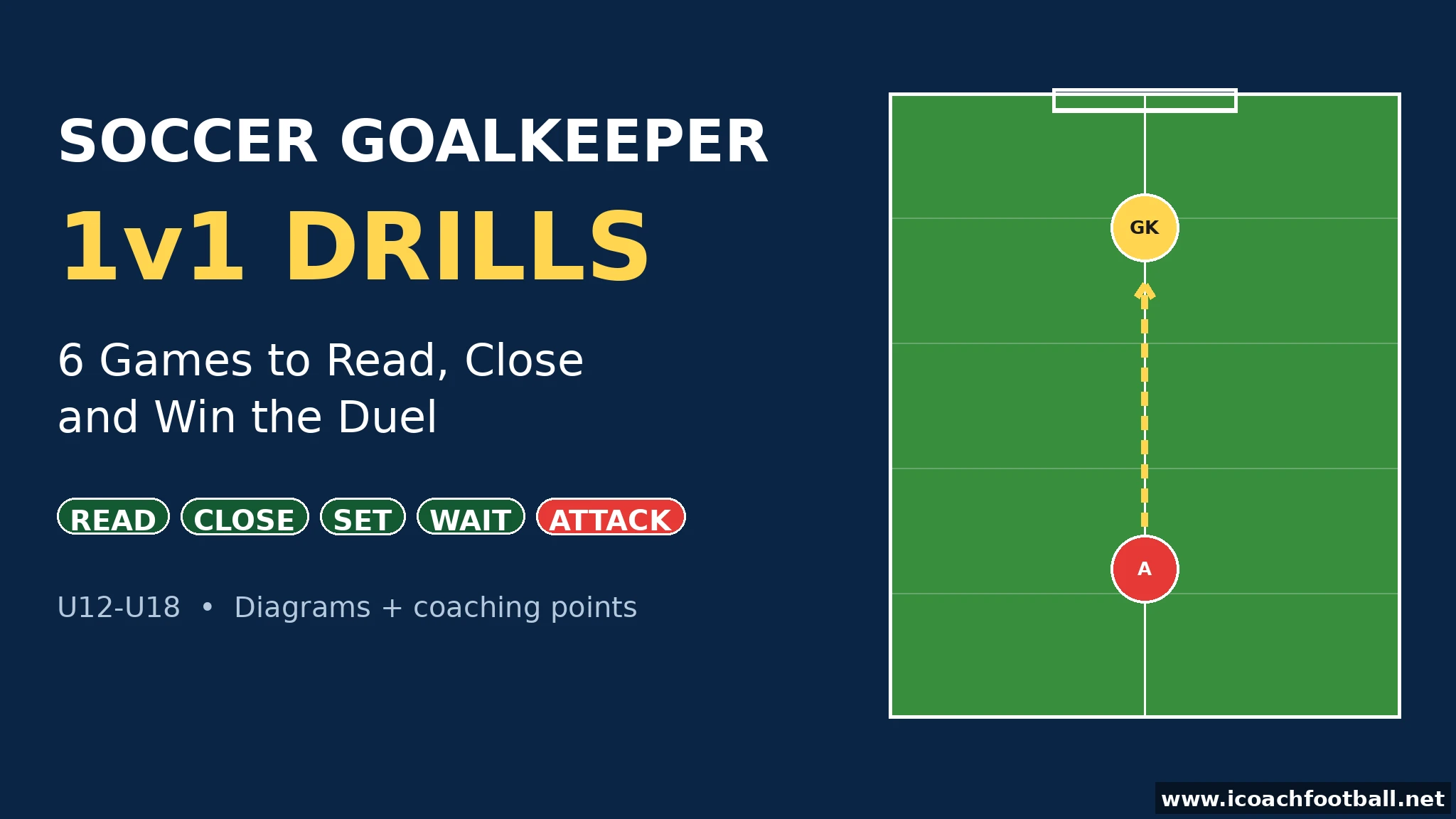
Quick answer: A goalkeeper wins a 1v1 by reading the attacker’s first touch, closing the angle fast, setting early, waiting for the trigger — then attacking the ball.
Suitable for: U12–U18
Most keepers lose 1v1s before the shot. They stay on their line too long, charge too early, or dive at feet they can never reach. These six soccer goalkeeper 1v1 drills fix that decision first and the save second. (In the UK the same session is usually called football goalkeeper 1v1 drills — the duel is identical.)
Session snapshot
Players: 3 or more (1 goalkeeper, attackers, servers).
Area: Penalty box to half pitch, depending on the drill.
Duration: 60 minutes.
Focus: Read, close, set, wait, attack.
Age: U12–U18 (see Age adaptations).
Build the save first: these youth goalkeeper shot stopping drills cover handling and diving technique, these youth goalie drills suit younger keepers, and this goalkeeper distribution guide covers what the keeper does after the duel — while these soccer second ball drills train the next moment when the ball drops loose. For the full session structure, use the 60-minute plan.
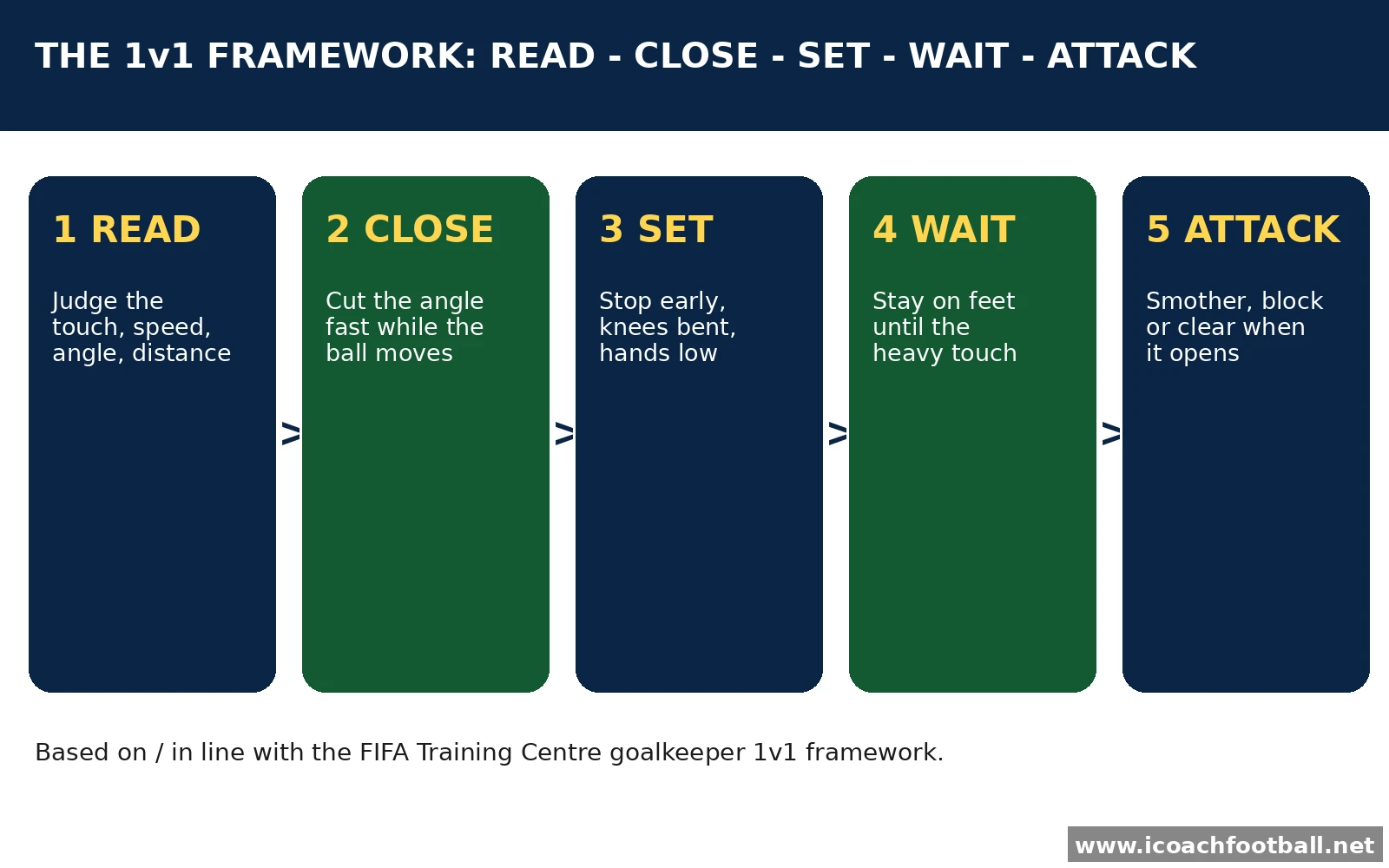
The one rule: read, close, set, wait, attack
The framework below is in line with the FIFA Training Centre’s 1v1 framework for goalkeepers: read the touch, close the angle, set before the shot, wait for the trigger, then attack the ball.
| Situation | What to do |
|---|---|
| Heavy touch, ball runs free | Attack the ball — smother or clear first time. |
| Tight control, attacker at speed | Close fast, set early, force one more touch. |
| Attacker slows to pick a finish | Wait — stay big, stay on feet, do not dive early. |
| Attacker shapes to shoot | Set, spread, react to the ball — not the feint. |
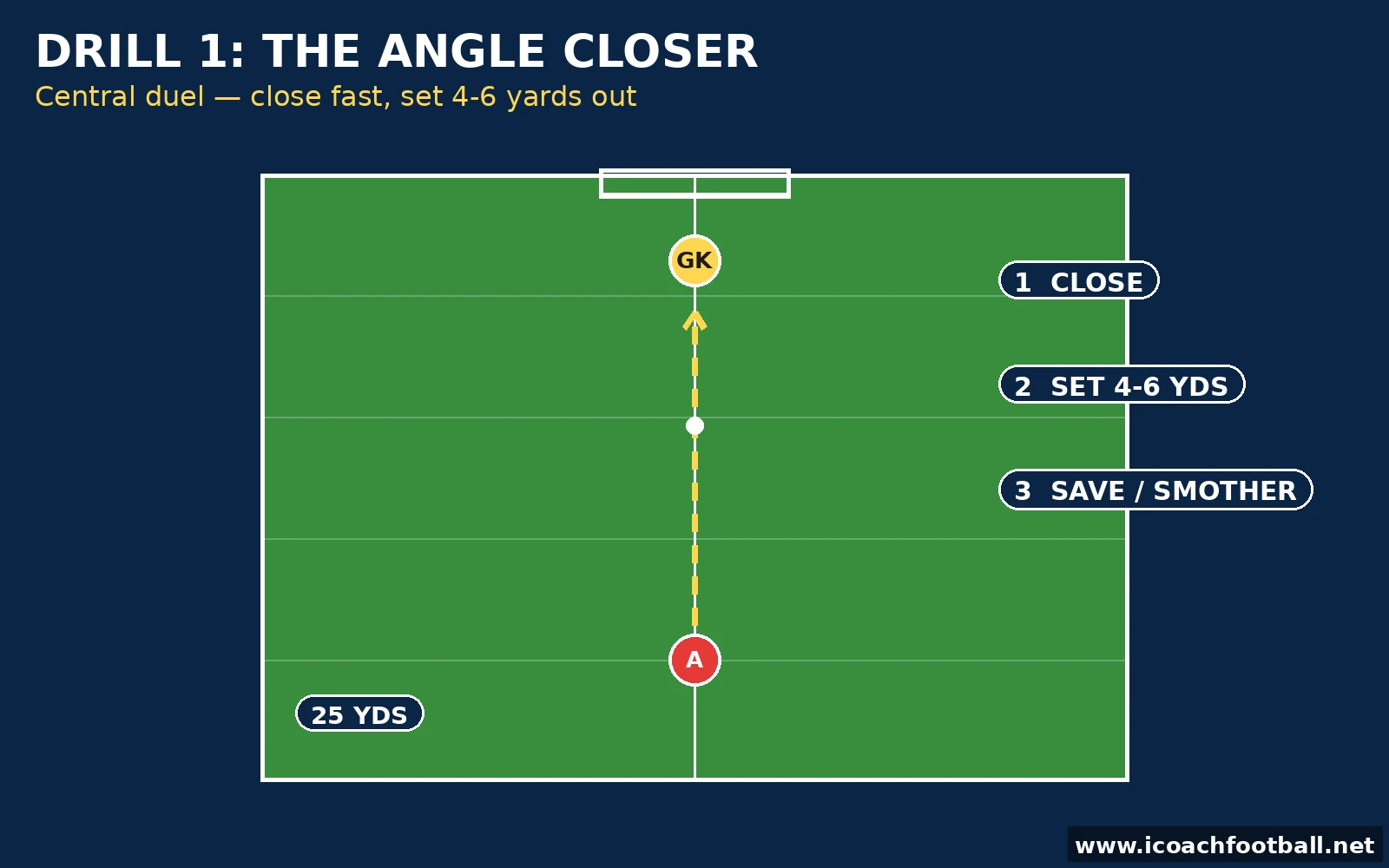
Drill 1: The Angle Closer
Teach the keeper to cut the goal down before the striker can pick a corner.
Setup
- 1 goalkeeper, 1 attacker, 1 server with balls
- Attacker starts 25 yards out, central, facing goal
- Keeper starts on the goal line
- 8 balls, 2-minute blocks, then swap roles
How to Play
- The server plays into the attacker, who dribbles straight at goal.
- The keeper advances quickly while the ball is moving, not after it stops.
- The keeper sets 4–6 yards out, knees bent, hands low and ready.
- The attacker must finish — no pass, no lay-off.
- The keeper saves, smothers or concedes, then resets to the line.
Coach’s note: Shout “Close! Set!” — the two words are the whole drill at first.
Progressions: Start the attacker wider each round; allow one feint before the finish.
Drill 2: The Wide-Angle Duel
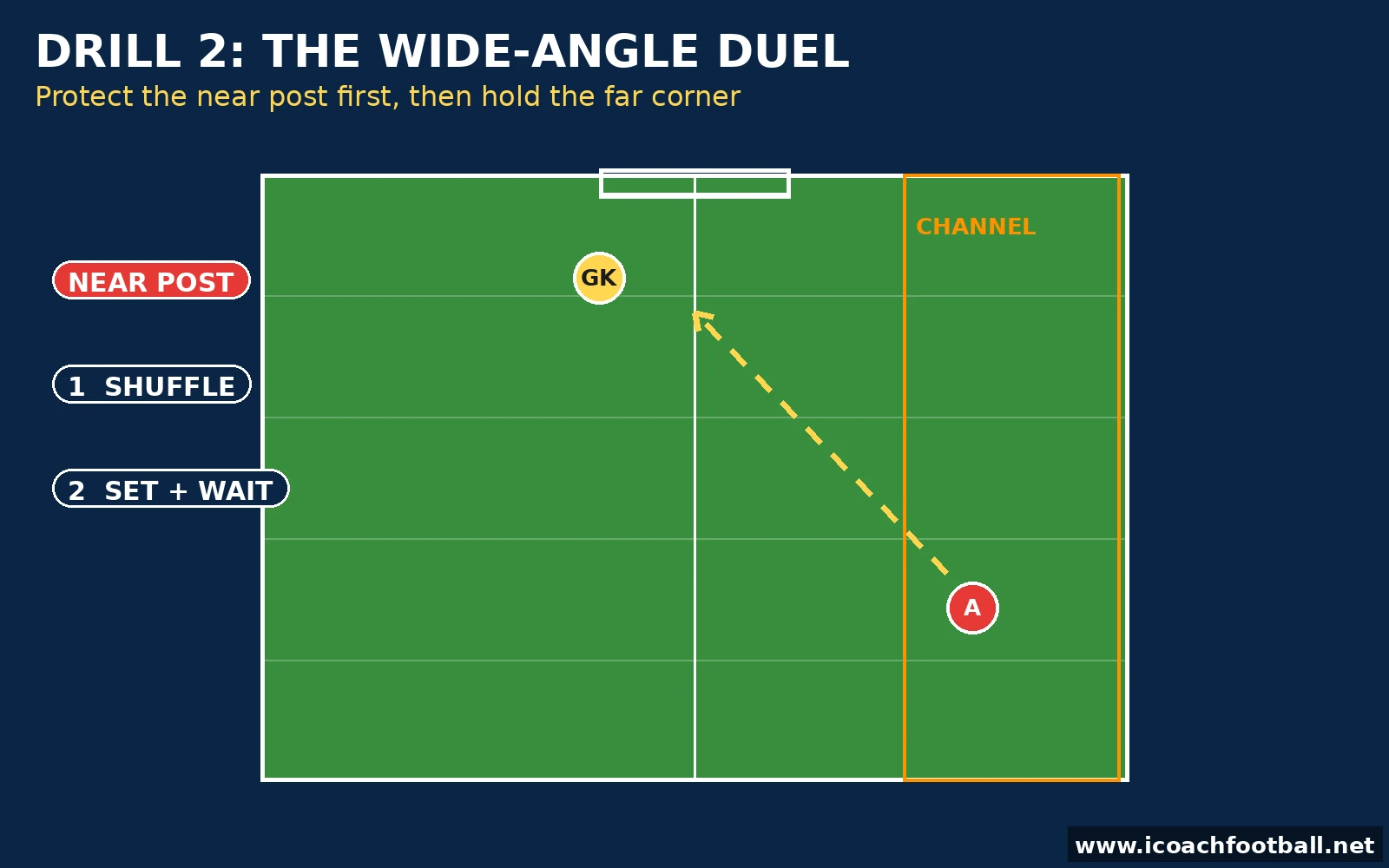
Wide 1v1s are lost at the near post. This drill teaches the keeper to protect it without giving away the far corner.
Setup
- 1 goalkeeper, 1 attacker, 1 server
- Attacker starts in the wide channel, level with the penalty-box corner
- Keeper starts on the goal line, slightly toward the near post
- Cones mark a 20-yard channel into the box
How to Play
- The server plays the attacker into the channel.
- The keeper shuffles across, staying on the ball line to the near post.
- The keeper closes until the near-post gap is one body-width wide.
- The keeper sets and waits — no early dive across goal.
- The attacker finishes first time or after one touch.
Coach’s note: If the keeper is beaten at the near post, they closed too slowly; if beaten far post, they over-committed to the near side.
Progressions: Let the attacker cut inside onto the stronger foot; add a second attacker arriving late at the far post (keeper must still win the first duel).
Drill 3: The Through-Ball Race
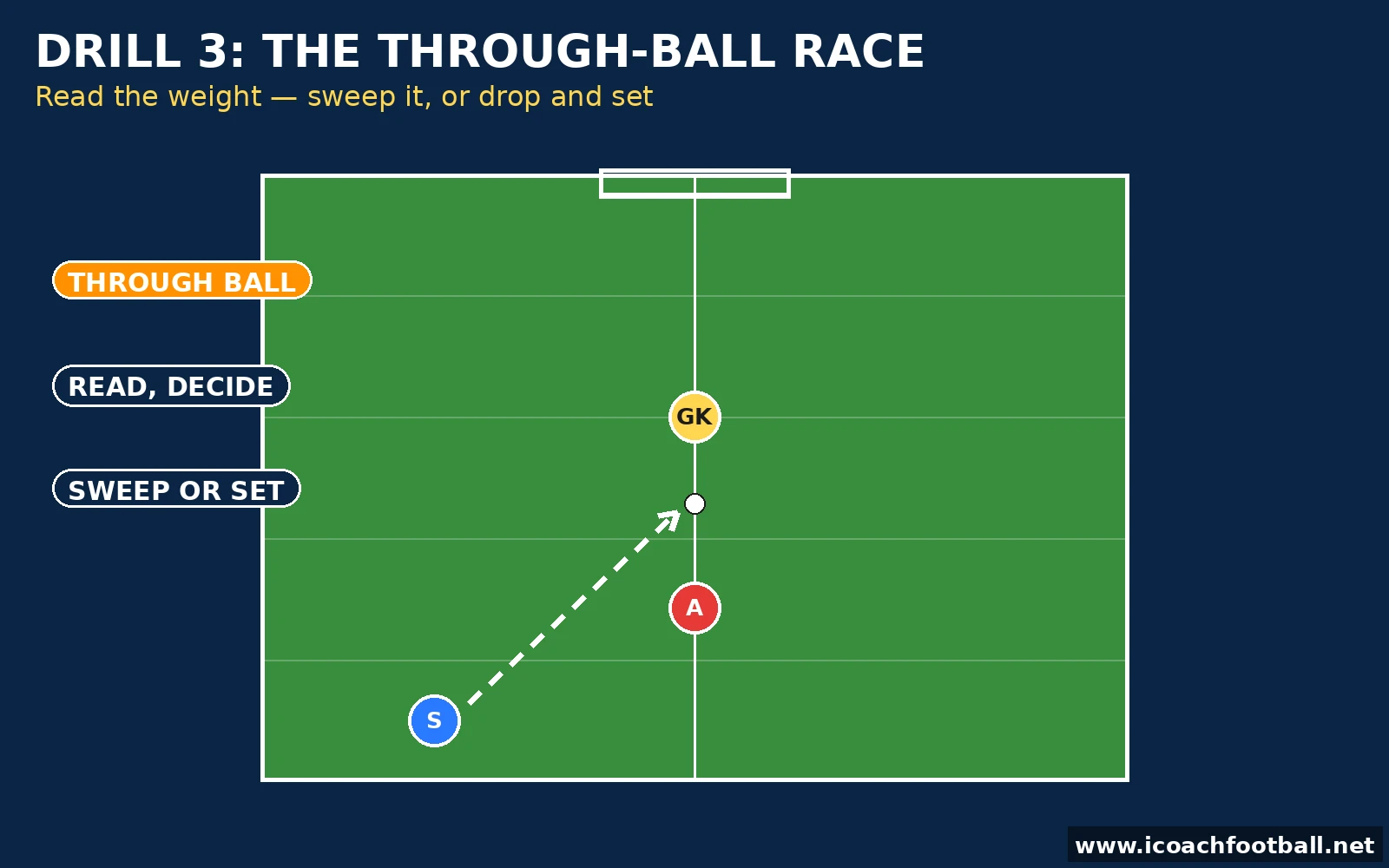
The classic breakaway: a ball slid behind the line, keeper against striker in a footrace with a decision at the end.
Setup
- 1 goalkeeper, 1 attacker, 1 server 30 yards out
- Full-size goal, penalty box marked
- Keeper starts on the six-yard line; attacker starts on the halfway side of the server
- 10 balls with the server
How to Play
- The server slides a through ball behind the defensive line.
- The keeper reads the weight instantly: can I get there first?
- If yes, the keeper sprints and smothers or clears first time.
- If no, the keeper drops fast, closes the angle and sets before the shot.
- The attacker has three touches maximum to finish.
Coach’s note: The decision is the drill. Praise a correct drop-and-set as loudly as a smother — keepers who always charge learn nothing.
Progressions: Vary the weight and angle of the through ball; start the attacker level with the keeper.
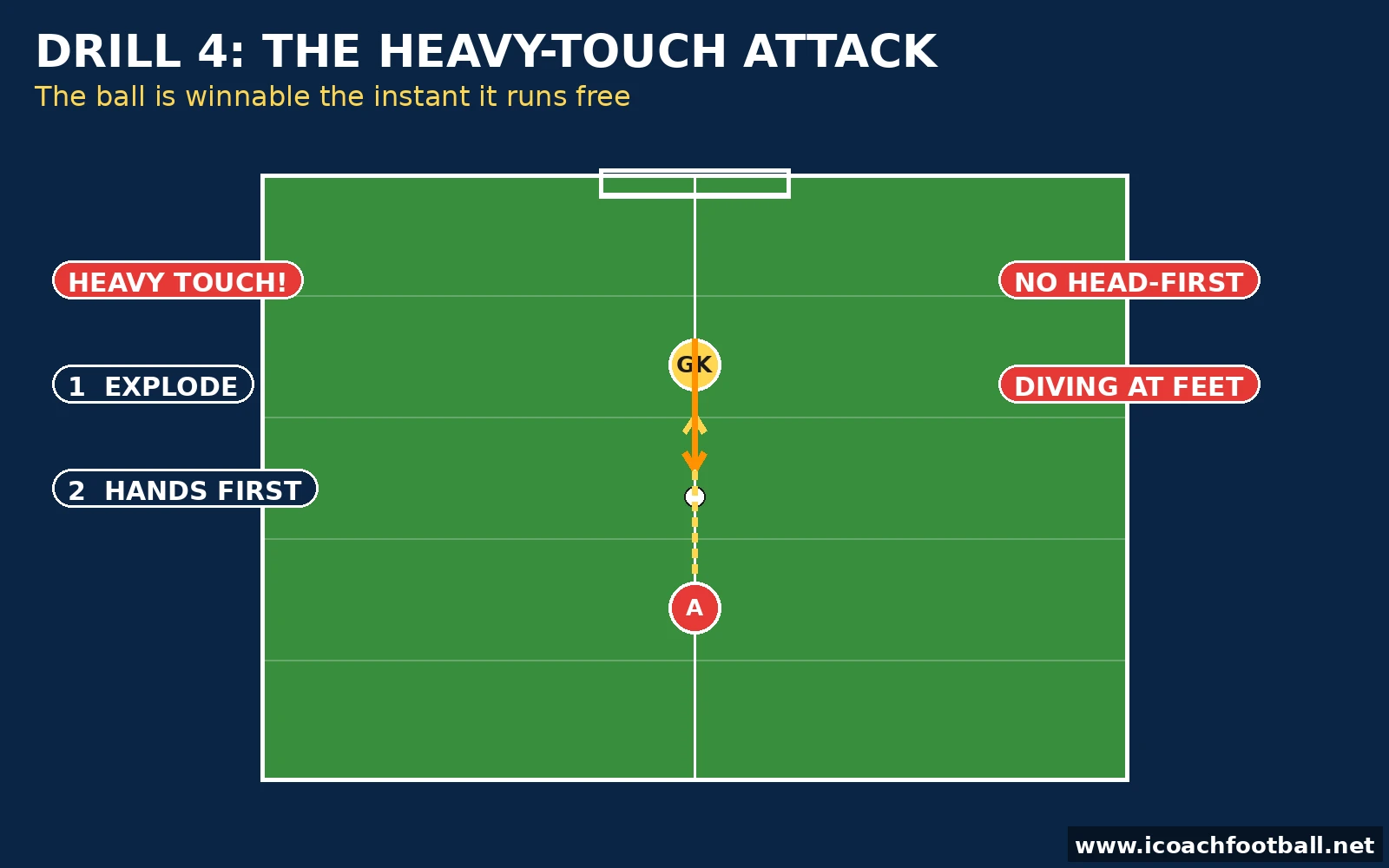
Drill 4: The Heavy-Touch Attack
Keepers must recognise the one moment the ball is truly winnable: the heavy touch.
Setup
- 1 goalkeeper, 1 attacker, 1 coach-server
- Attacker dribbles from 30 yards out toward goal
- Keeper starts on the goal line
- Coach calls “touch!” at random moments — the attacker must then take a deliberately heavy touch
How to Play
- The attacker dribbles at the keeper at match speed.
- On the coach’s call, the attacker pushes the ball 3–4 yards ahead.
- The keeper explodes forward the instant the ball leaves the foot.
- The keeper smothers with hands first, body low and behind the ball.
- If the keeper is late, they must stop, set and block instead of diving in.
Coach’s note: Never dive head-first at the attacker’s feet. Hands lead, body follows, head stays protected — and on hard ground, use the block stance instead of a ground smother.
Progressions: Remove the coach’s call so the keeper reads real heavy touches; let the attacker disguise the heavy touch as a shot fake.
Drill 5: The Recovering-Defender Duel
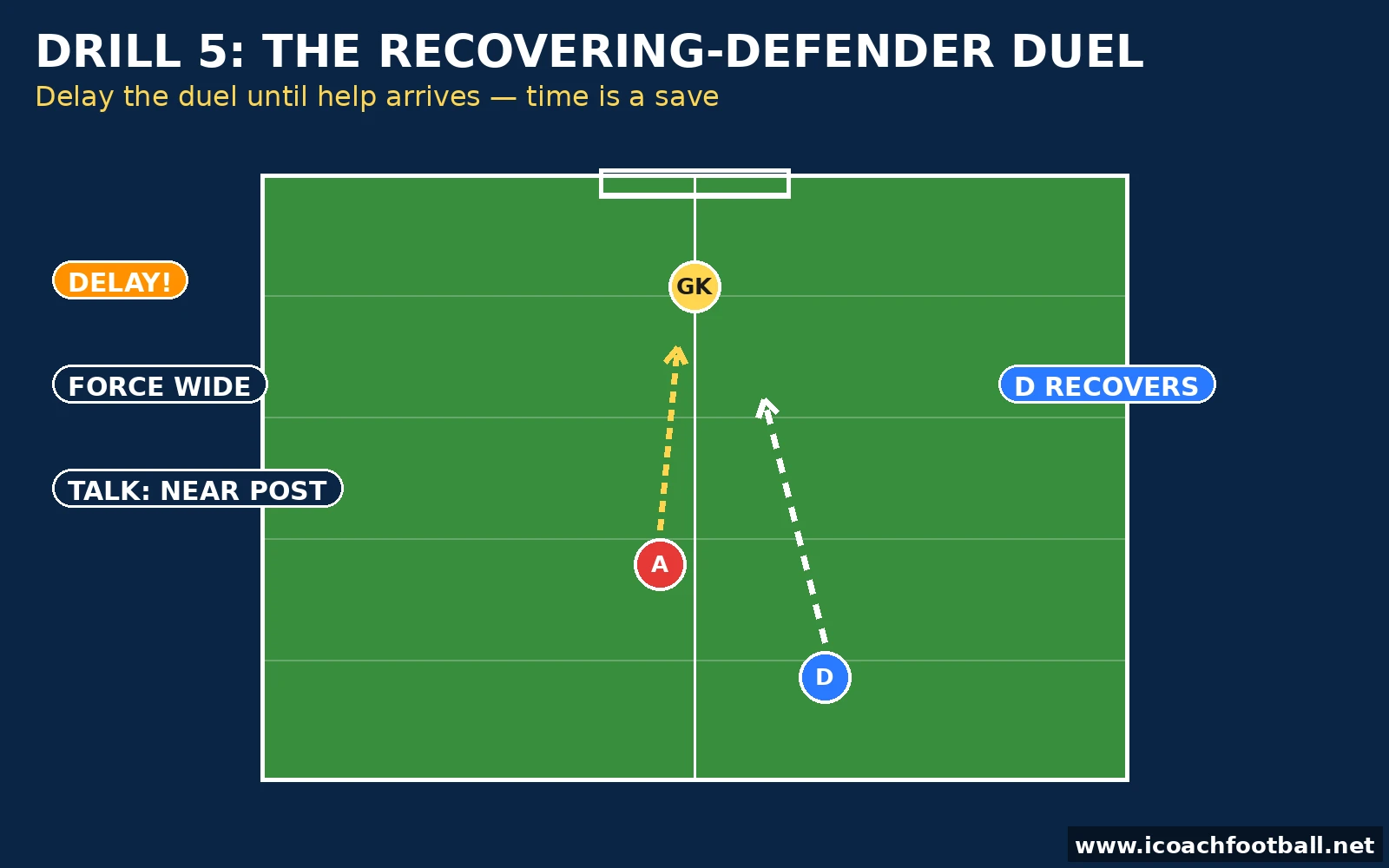
Real 1v1s rarely stay 1v1. This drill teaches the keeper to delay until help arrives.
Setup
- 1 goalkeeper, 1 attacker, 1 recovering defender, 1 server
- Attacker starts 30 yards out with the ball; defender starts 10 yards behind the attacker
- Keeper starts on the goal line
- Play to a finish, a save, or the defender’s tackle
How to Play
- The server plays the attacker through on goal.
- The keeper closes and sets, showing the attacker away from goal — not into the middle.
- The keeper talks constantly: “Delay! I’ve got near post! Force wide!”
- The defender recovers and presses from behind while the keeper holds the duel.
- The duel ends on a shot, a save, a tackle or a smother.
Coach’s note: The keeper’s job here is time, not heroics. A delayed duel the defender wins counts as a keeper win.
Progressions: Start the defender further back; allow the attacker to square to a late runner if the keeper over-commits.
Drill 6: The Breakaway Game
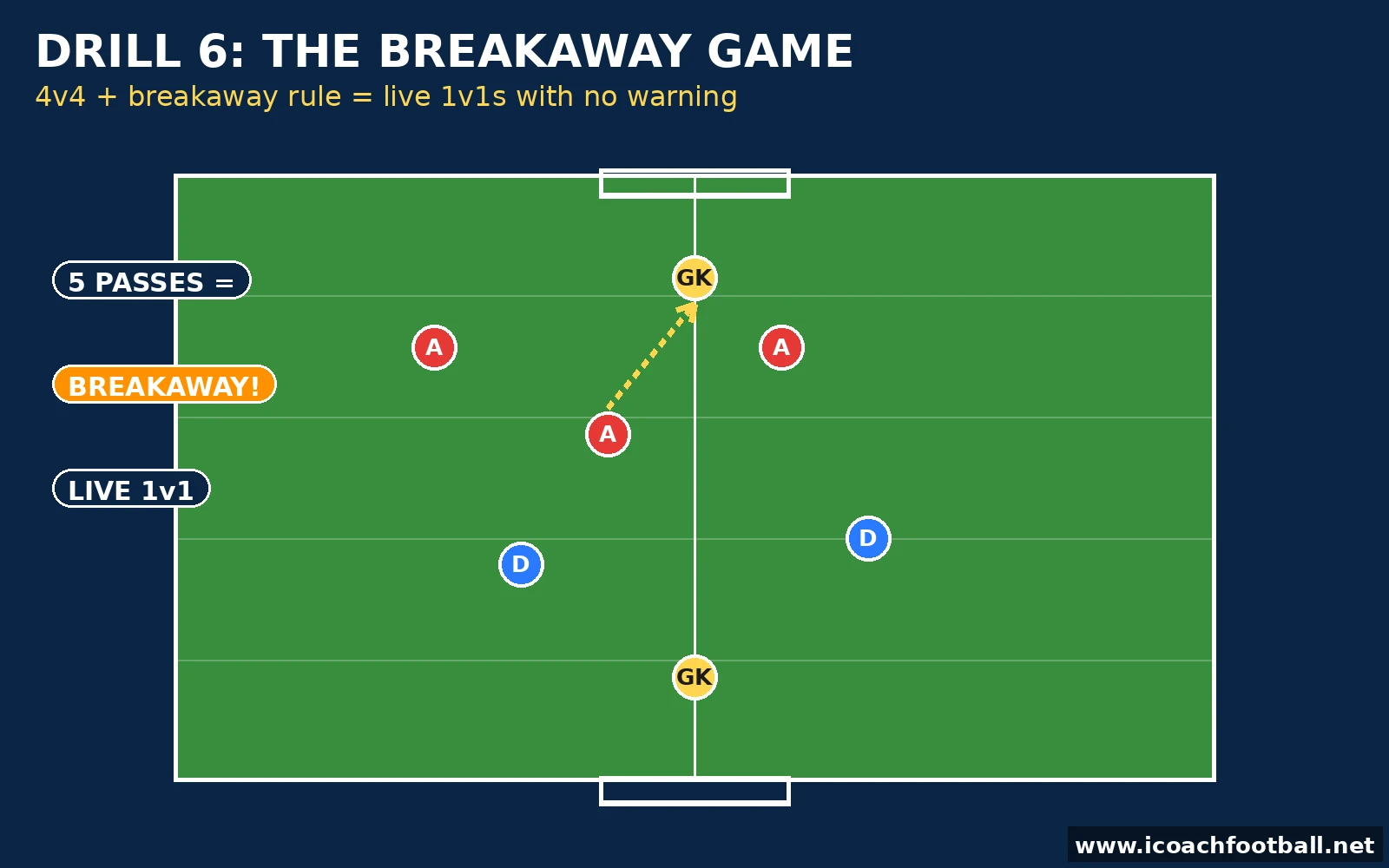
Put the duel inside a real game so keepers must read it without a coach’s warning.
Setup
- 4v4 plus 2 goalkeepers on a 40 x 30-yard pitch with full-size goals
- Normal small-sided rules, plus one breakaway rule (below)
- 4 x 4-minute games, 1-minute rests
How to Play
- Teams play 4v4 as normal.
- When a team completes 5 passes, one attacker may break free toward goal.
- The defending keeper faces a live 1v1 — no whistle, no setup.
- After the duel, play restarts with the keeper’s distribution.
- Rotate keepers every game so both face at least 8 duels.
Coach’s note: Count keeper decisions, not just saves. A good drop-and-set that forces a rushed finish beats a lucky sprawl.
Progressions: Lower the pass count to 3 for more duels; require the breakaway attacker to finish within 5 seconds.
Coaching points
- Set before the shot, every time. A keeper still moving when the ball is struck cannot react.
- Stay on feet until the trigger. A heavy touch, a loose touch or a shooting shape is the trigger — not the crowd’s gasp.
- Make yourself big, then small at the right moment. Tall and wide on the close; low and spread on the block.
- Talk the duel. “Near post!”, “Force wide!”, “Delay!” — silence helps only the striker.
Common mistakes
- Charging and stopping halfway. Half-closed is the worst place: too far to smother, too close to react. Commit to close or to set — never drift between them.
- Diving at the first feint. Feints are designed to put keepers on the floor. Stay up until the ball actually moves toward goal.
- Guarding the far post and conceding the near one. The near post is the striker’s easiest finish. Protect it first.
- Going quiet. A silent keeper gives the attacker all the time in the world. The voice is part of the save.
Age adaptations
| Age | Adaptation |
|---|---|
| U12–U13 | Shorter distances (20 yards max), block saves only — no ground smothers on hard ground, attacker finishes with placement, not power. |
| U14–U15 | Full Drill 3 and 4; introduce the recovering-defender duel; attackers may use one feint. |
| U16–U18 | Full speed, full Breakaway Game; keepers call the duel themselves with no coach prompts; add second-phase finishes. |
60-minute session plan
| Time | Block |
|---|---|
| Warm-up 0–10 min | Keeper handling circuit + short sprints to set position. |
| Drill 1 + 2, 10–25 min | Angle Closer, then Wide-Angle Duel. |
| Drill 3 + 4, 25–40 min | Through-Ball Race (with animation), then Heavy-Touch Attack. |
| Drill 5 + 6, 40–55 min | Recovering-Defender Duel, then Breakaway Game. |
| Cool-down 55–60 min | Light handling, stretch, one-line review: “What was your trigger today?” |
Sources
- FIFA Training Centre — Goalkeeper 1v1s: The “read, close, set, wait, attack” framework — FIFA Training Centre
- FIFA Training Centre — session plan including slid play into 1v1 situations for goalkeepers and attackers — FIFA session plan (PDF)
The drills above are based on and in line with this framework; they are not FIFA-approved sessions.
FAQ
When should a goalkeeper come out, and when should they stay?
Come out when you can clearly win the ball first — a heavy touch or a slow through ball. Stay and set when the attacker has tight control and you cannot reach the ball before the shot. The wrong choice in either direction concedes; the right choice is decided by the first touch, not by bravery.
What is the correct set position for a 1v1?
Feet shoulder-width apart, knees bent, weight forward on the balls of the feet, hands low and in front of the body. Set early, 4–6 yards out for a central duel, and stay still from the moment the attacker shapes to shoot.
How do you teach 1v1s safely to youth goalkeepers?
Start with block saves from set position, keep distances short, and ban head-first dives at feet. Teach the smother only on grass, with hands leading and the body low behind the ball — and use the block stance on hard ground.
What should a goalkeeper do if the attacker is faster?
Do not race a faster attacker to a ball you will lose. Drop early, close the angle instead, and force the attacker wide or into one more touch. Speed wins footraces; angles win duels.
How often should goalkeepers train 1v1 situations?
Once a week inside a normal session is enough — two 10-minute blocks, one technical (Drills 1–4) and one live (Drills 5–6). Daily 1v1s at full speed exhaust young keepers and teach reckless charging instead of decisions.