Football Defending Set Pieces Drills: 6 Games to Stop Corners and Free Kicks
Quick answer: Defend every set piece with a named system, a named job for every player, and a plan for the second ball. Pick zonal, man-to-man or hybrid before the kick, put your best headers in the front and central zones, set the wall from the goalkeeper’s call, and leave one player on the edge of the box for the clearance.
Suitable for: U11–U16
Most youth goals from set pieces are not beaten by brilliance. A runner arrives unmarked, a wall jumps apart, or a clearance drops to an attacker with nobody on the edge of the box.
The fix is organisation, practised at match speed. Nobody should be deciding their job while the taker is running up. The same defending works in soccer anywhere, because the box, the wall distance and the flight of the ball do not change.
These six football defending set pieces drills build the whole job: first contact, marking, the short corner, the wall, the second ball, and a live game that tests them all together. Each drill can be run from the diagram and steps alone.
Session snapshot
- Players: 14–18 (8–10 defenders plus a goalkeeper, 4–6 attackers, 1–2 servers)
- Area: One penalty area and the corner arc; Drill 4 works 18–25 yards from goal; Drill 6 uses one half
- Duration: 60 minutes (45-minute version: Drills 1, 4 and 6 only)
- Focus: First contact, marking systems, short-corner press, wall and goalkeeper organisation, second balls, counter-attack outlets
- Equipment: 10–12 balls, 16 cones, bibs, mannequins or cones for the wall, 1 full-size or age-appropriate goal, 2 mini-goals for Drill 6
- Age: U11–U16 (heading only from U12, limited — see age adaptations)
Choose your marking system first
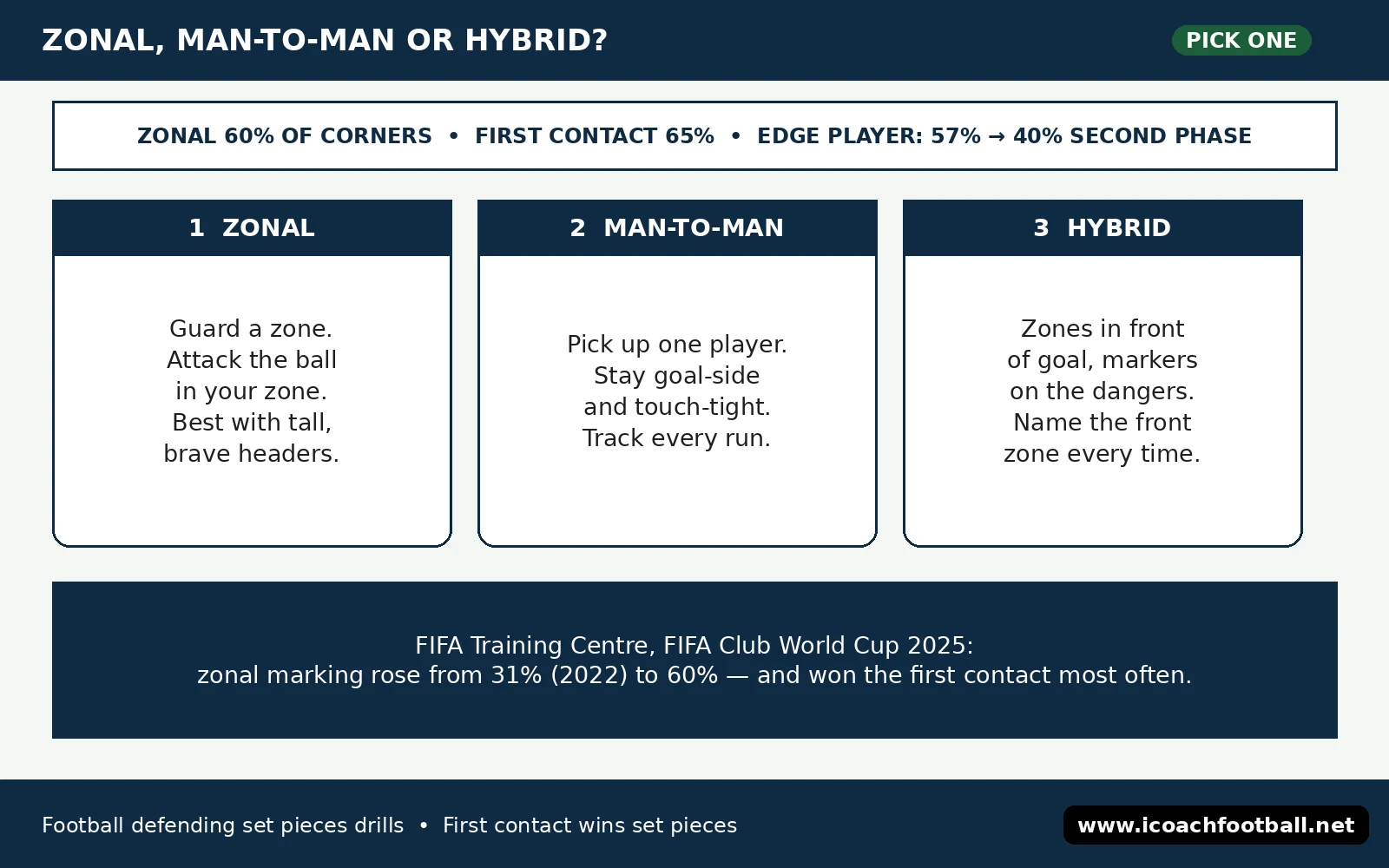
Do not change systems corner by corner. Pick one, train it, and let every player learn the same zones and calls.
- Zonal: Defenders guard zones, not players. They attack the ball in their zone and split their focus between the delivery and the runners.
- Man-to-man: Each defender picks up one attacker, stays goal-side and touch-tight, and tracks the run.
- Hybrid: Some players guard zones in front of goal, the rest mark the most dangerous attackers. This is the most common youth compromise.
The FIFA Training Centre analysis of the FIFA Club World Cup 2025 found zonal marking was used in 60% of defensive corners, up from 31% at the FIFA World Cup Qatar 2022. Zonal marking also had the best first-contact success, at 65%. Teams most often used five or six zonal players, with the front and central zones loaded first.
One more finding decides Drill 5. When no player protected the edge of the penalty area, 57% of corners entered a second phase. With one edge player, that fell to 40%. The edge player is not a spare player. The edge player is the second-ball plan.
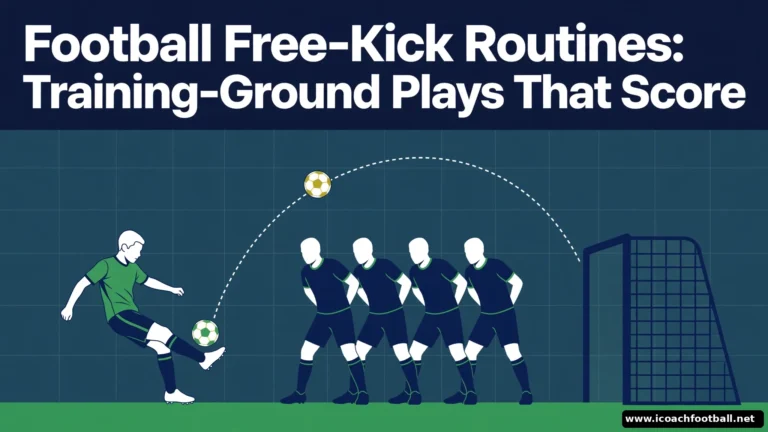
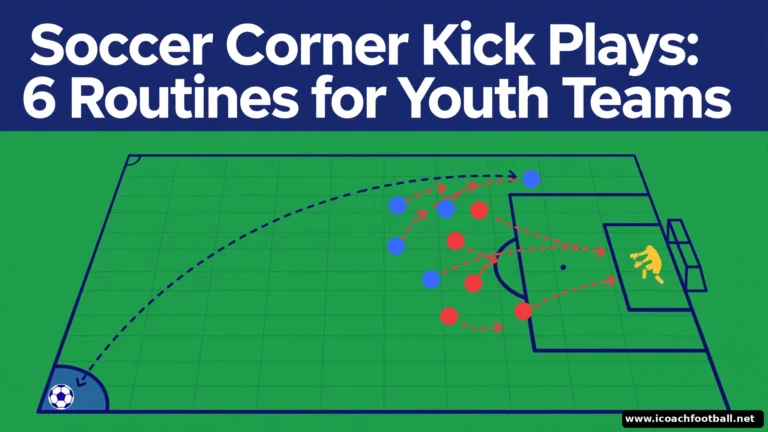
For the attacking side of the same restarts, see these soccer corner kick plays and these football free-kick routines — knowing the routines attackers rehearse is what tells defenders which runs to expect.
| System | Best when | Watch out for |
|---|---|---|
| Zonal | Tall, brave headers; a settled back line | Runners arriving late into a zone nobody attacks |
| Man-to-man | Attackers with one dominant header; a small box | Blocks and screens dragging markers away from goal |
| Hybrid | Mixed heights; two or three dangerous attackers | Confusion over who owns the front zone — name it every time |
Drill 1 — First-Contact Zones
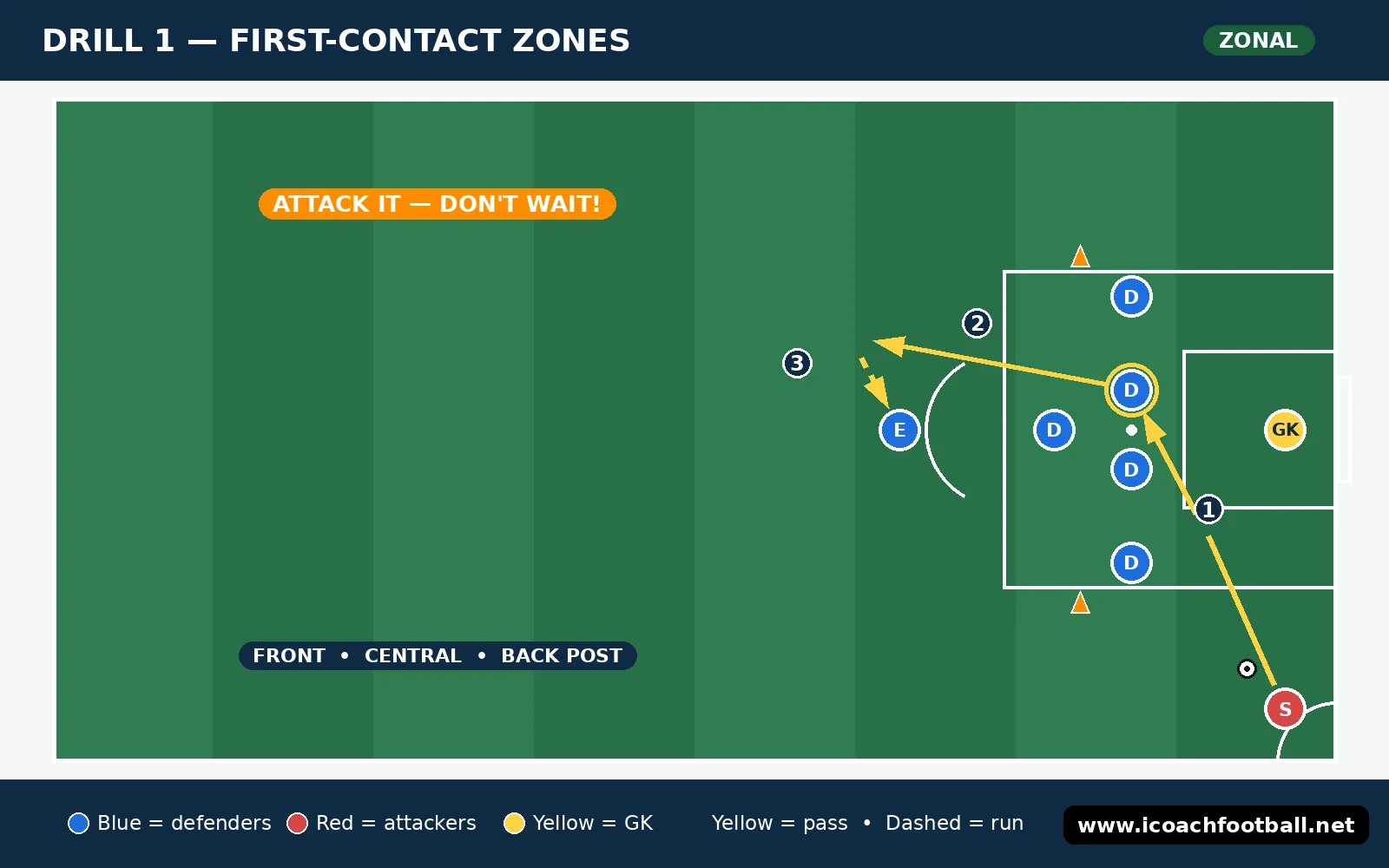
The zonal walkthrough. No attackers first, so defenders learn the zones, the starting spots and the attack-the-ball movement before anyone runs at them.
Setup:
- Five zonal defenders across the 6-yard box: two front, two central, one back-post.
- Goalkeeper on the line, one edge player on the D, and a server at the corner.
- Balls with the server, and cones marking the front, central and back-post zones.
How to Play:
- The goalkeeper calls “Zones set!” and each zonal defender touches their zone cone.
- The server delivers to the front zone, and the front defender attacks the ball at its highest point.
- The defender heads or clears the ball high, wide and far, away from the middle.
- The server delivers to the central zone next, then to the back post, in turn.
- The edge player collects every clearance that drops short and plays it safe to the server.
Coach’s note: The cue is “Attack it, don’t wait for it!” A zonal defender who waits in the zone lets the attacker win the first contact. Step to the ball on its flight.
Progressions: Add two attackers who may only run into one named zone, then let the server choose the zone without calling it.
Drill 2 — Man-to-Man Mark-Up
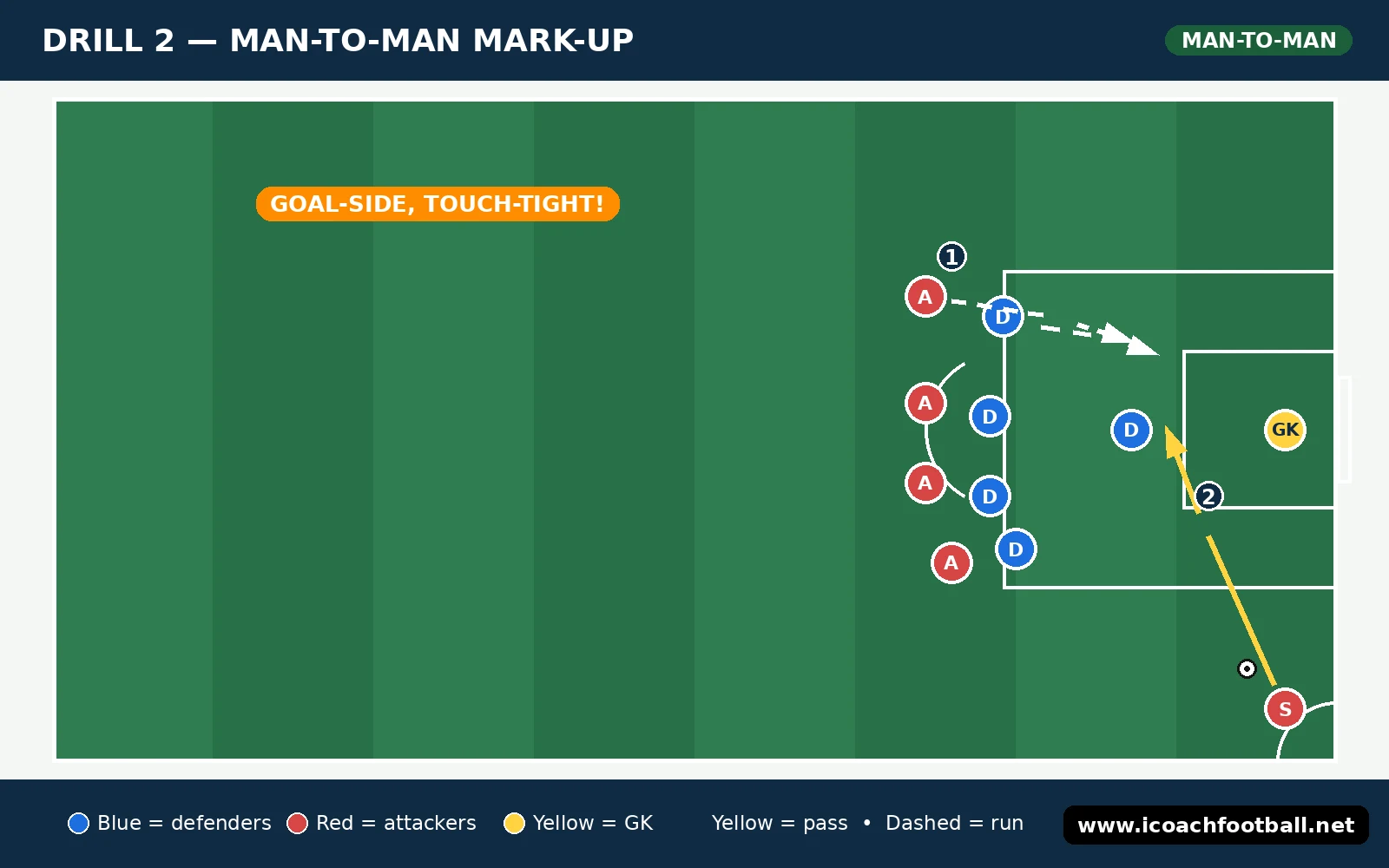
The marking drill. Every defender picks up one attacker before the kick, stays goal-side, and tracks the run without holding or blocking.
Setup:
- Four attackers start on the edge of the box, four defenders pick them up touch-tight and goal-side.
- Goalkeeper in goal, one zonal defender on the front zone, and a server at the corner.
- Balls with the server, and a cone on the penalty spot marking the runners’ start line.
How to Play:
- Defenders pick up their player as the server walks to the corner, not after the kick.
- The goalkeeper calls each pairing by shirt or name, so no attacker is left free.
- The server delivers, and each defender tracks their runner, staying goal-side throughout.
- The defender attacks the ball if it comes to their player, and clears it high, wide and far.
- After the clearance, the whole line steps out together, to leave attackers offside at the next restart.
Coach’s note: The cue is “Goal-side, touch-tight, eyes on the ball!” A marker who watches only the player loses the flight. A marker who watches only the ball loses the runner. Both, at once.
Progressions: Attackers may block and screen, then the server may deliver short, so defenders must hold their pairing until the ball moves. The jockeying and body shape here build on our 1v1 defending drills.
Drill 3 — Short-Corner Press
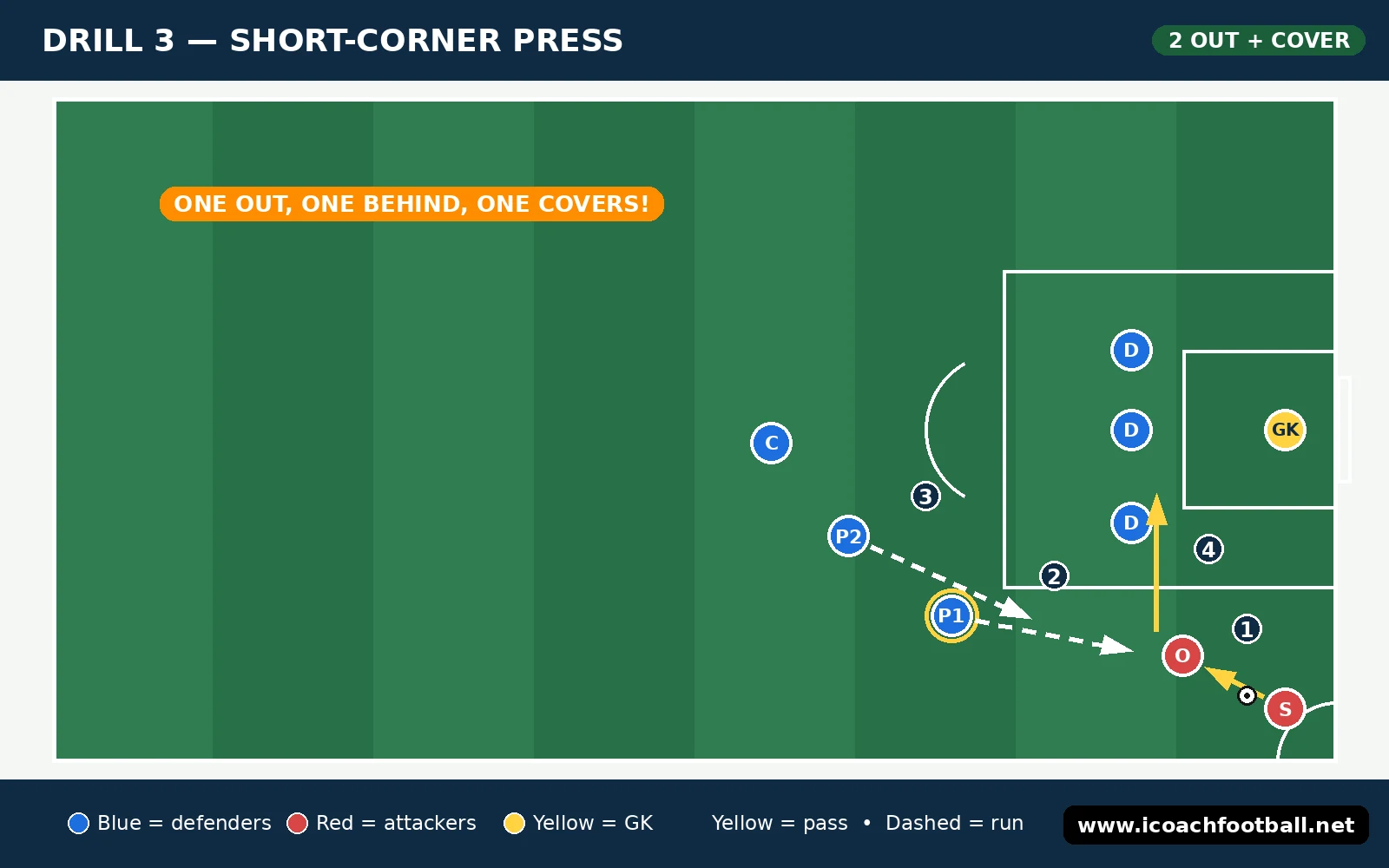
The two-out press. Two defenders sprint to the short corner, one covers behind them, and the rest hold the box — nobody is dragged out twice.
Setup:
- Two pressers start on the edge of the box, one cover player 5 yards behind them.
- Remaining defenders hold the box in a hybrid setup, with the goalkeeper calling the shape.
- Server and short option at the corner, 8 yards apart, with balls at the corner arc.
How to Play:
- The server plays short, and the first presser sprints out at once to close the ball down.
- The second presser follows 3 yards behind, cutting off the pass back inside.
- The cover player holds the space the pressers have left, facing play, ready for the cutback.
- If the ball is crossed, both pressers sprint back goal-side and pick up the nearest attacker.
- If the ball is played back out, the press holds until the cross comes, and the box defenders never leave their zones.
Coach’s note: The cue is “One out, one behind, one covers!” A single presser is beaten by one pass. Two pressers with cover behind them force the ball back out or into a hurried cross.
Progressions: The short option may dribble inside instead of crossing, then the pressers must hand over to the cover player and recover to the box.
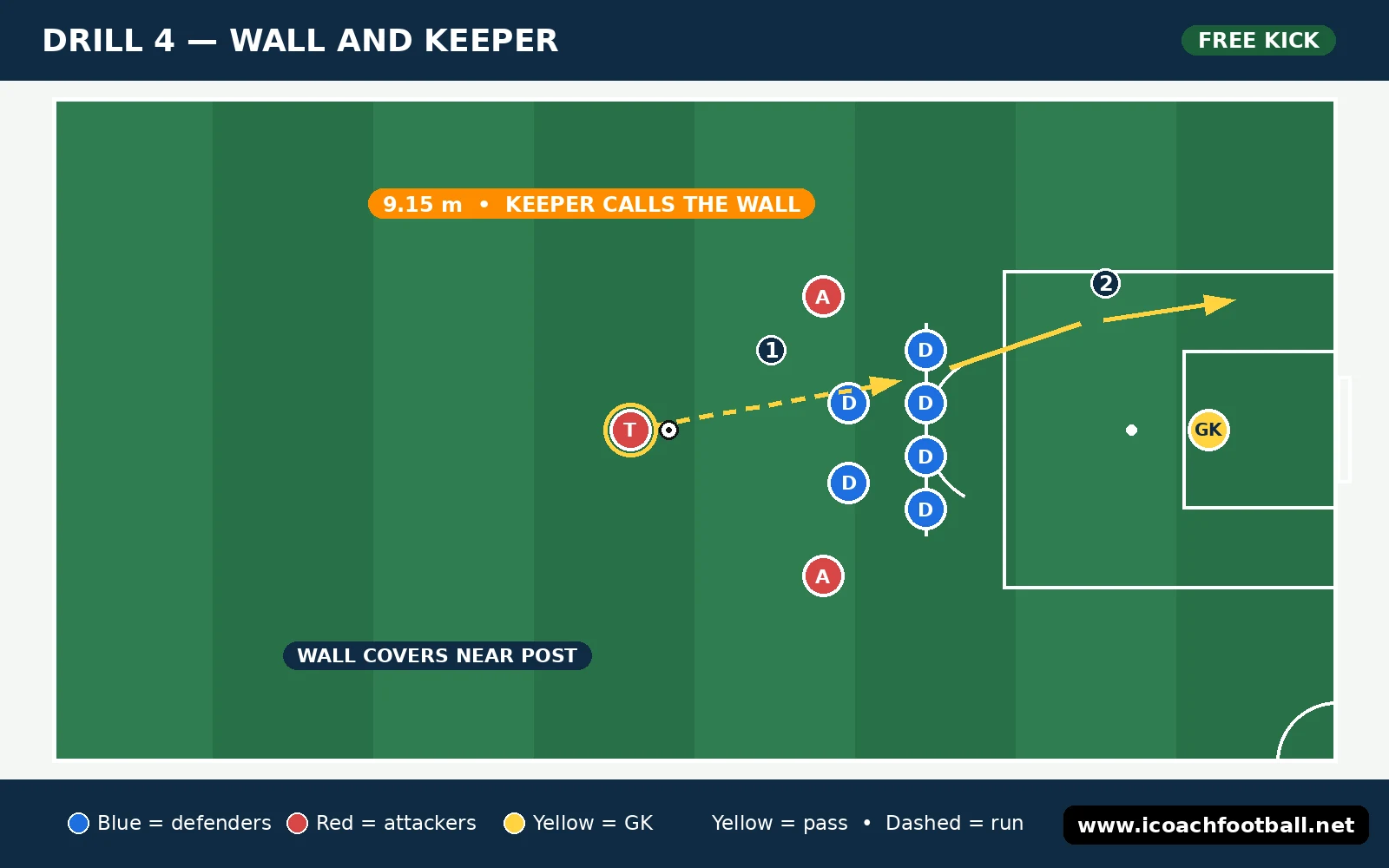
Drill 4 — Wall and Keeper
The wall race. The goalkeeper sets the wall in seconds, from the right spot, and the wall holds its shape while the keeper covers the open side.
Setup:
- Ball central, 20–25 yards from goal, with a taker and two runners on the edge of the box.
- Four defenders form the wall, 9.15 metres (10 yards) from the ball, with cones marking the distance.
- Goalkeeper in goal, with a second goalkeeper or coach behind the goal watching the wall’s line.
How to Play:
- The goalkeeper calls the number in the wall and points to the end player who sets its line.
- The wall lines up so its inside end covers the near post, and the goalkeeper steps to the open side.
- The nearest player steps to the ball at once, to stop a quick free kick before the wall is set.
- The taker strikes, the wall stays tight and jumps together, and the goalkeeper deals with the open side.
- The markers on the edge pick up the runners, and the wall players sprint back to defend any rebound.
Coach’s note: The cue is “Keeper calls, wall holds!” If the wall sets itself, it sets up wrong. The goalkeeper owns the wall, and nobody moves until the kick is taken.
Progressions: Move the ball wider so the wall must cover a different angle, then let the taker play a layoff, so the wall must hold for a second strike.
Drill 5 — Second-Ball Hunt
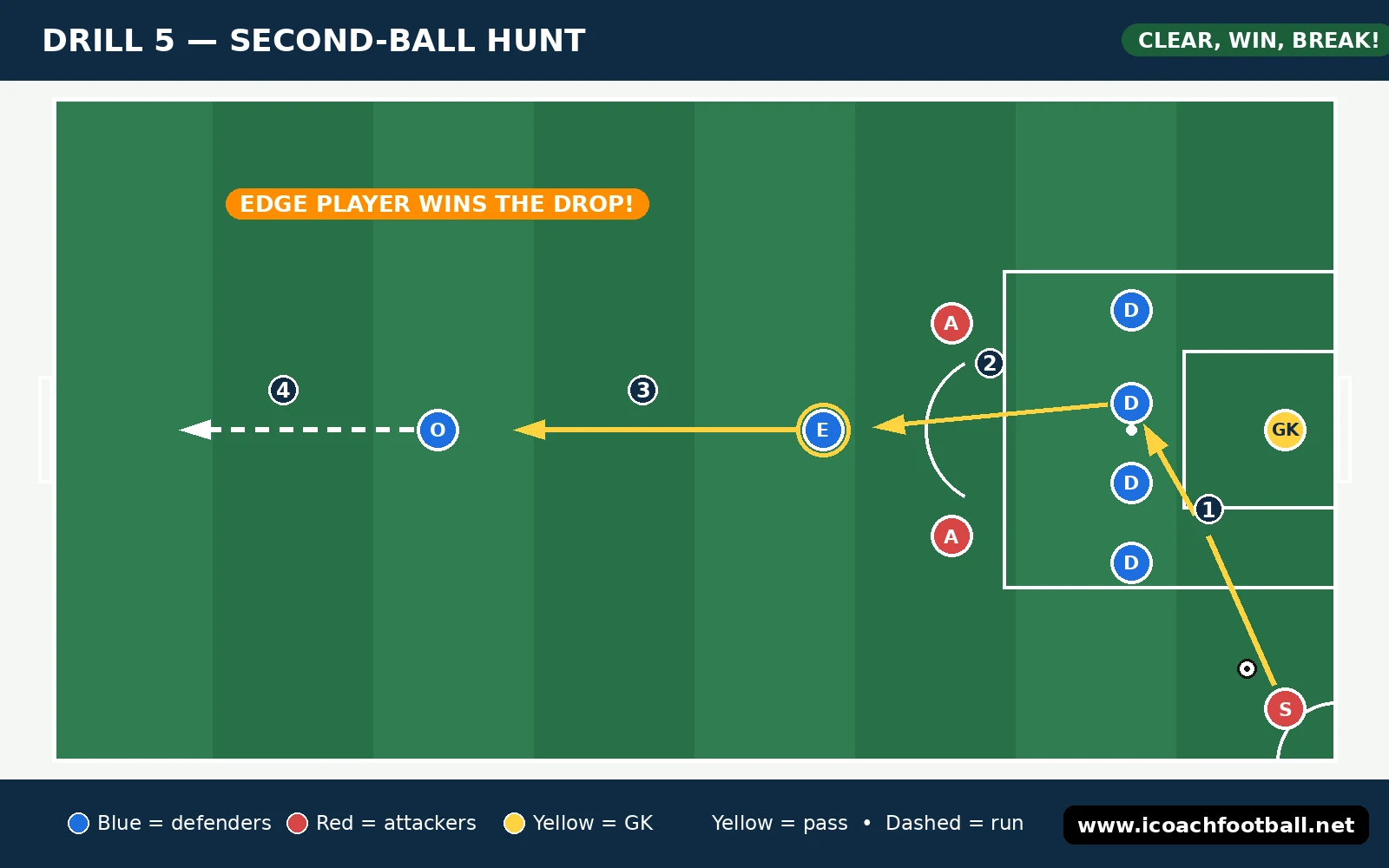
The clearance is only half the job. The edge player wins the drop, the outlet is ready, and the clearance becomes the first pass of a counter-attack.
Setup:
- Eight defenders plus a goalkeeper against six attackers, in and around one penalty area.
- One edge player on the D, facing play, and one outlet player high, level with the halfway line.
- Server at the corner with balls, and two mini-goals on the halfway line for the counter-attack.
How to Play:
- The server delivers a corner, and the box defenders win the first contact and clear high and wide.
- The edge player attacks the clearance first time, before it bounces twice in the box.
- The edge player controls or heads the ball to the outlet player, never back into the box.
- The outlet player drives forward at once, with two supporting runners flooding forward beside them.
- The counter-attack finishes in a mini-goal within 8 seconds, or the rep restarts with a new corner.
Coach’s note: The cue is “Clear, win, break!” A clearance that drops to an attacker is a second chance for the attack. The edge player must arrive before the ball does, and the outlet must already be moving.
Progressions: The outlet starts deeper and must receive facing forward, then the attackers keep one player high, so the counter-attack must beat a recovering defender. This outlet role is in line with the FIFA Training Centre analysis of defensive corners as counter-attack springboards, where a zonal outlet on the edge of the box is left free to break forward.
Drill 6 — The Set-Piece Game
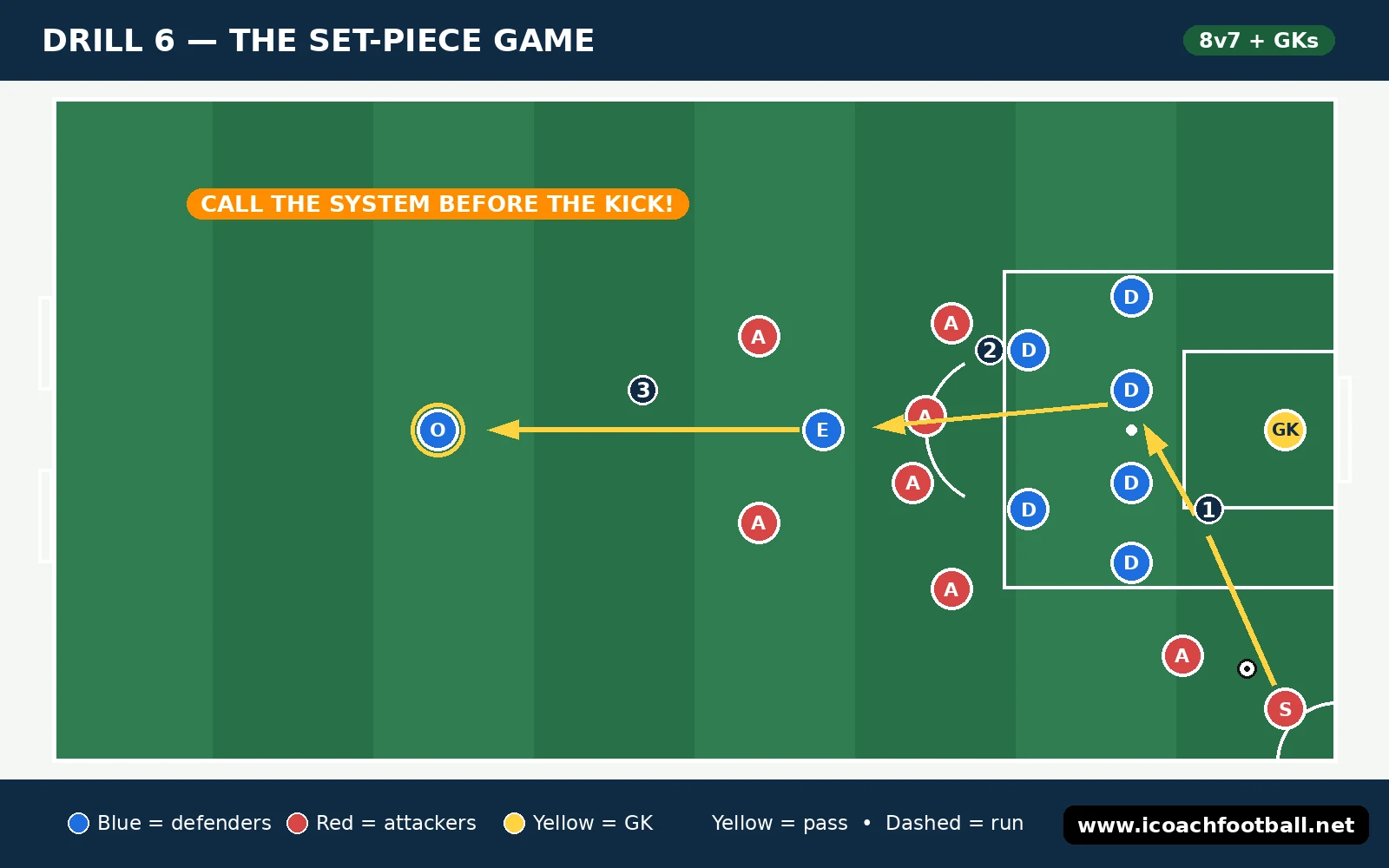
Live corners and free kicks, both sides, with points for first contacts, clean clearances and counter-attacks. This is where the first five drills are tested together.
Setup:
- Eight defenders plus a goalkeeper against seven attackers, in one half, with balls at both corners.
- Three free-kick spots marked: central, wide left and wide right, 20–28 yards from goal.
- Two mini-goals on the halfway line for defender counter-attacks after a clearance.
How to Play:
- Corners and free kicks alternate sides, and the defending team calls its system before each restart.
- The goalkeeper sets the shape, calls every pairing, and the team holds it until the ball is in play.
- If the ball is cleared, play stays live until a goal, a second clearance or the ball leaves play.
- A clean first-contact clearance scores 1 point for the defence, a second-ball win scores 2, and a counter-attack goal scores 3.
- After 6 restarts, swap the teams and repeat from the other side, with the other system.
Coach’s note: Stop after three restarts and reset the organisation. Most set-piece goals come from players forgetting the system, not from the delivery. The reset is the coaching.
Progressions: The attacking team may take a quick free kick with no wall set, so the defence must organise in seconds, then the outlet player must stay high for every restart.
Coaching points
- “Zones set, names called!” No restart is taken until every pairing and every zone is named. Silence before a corner is a goal waiting to happen.
- “Attack it, don’t wait for it!” First contact wins set pieces. The defender who moves to the ball beats the attacker who waits for it.
- “Keeper calls, wall holds!” The goalkeeper sets the wall, covers the open side, and calls the clearance. The wall never sets itself.
- “Clear, win, break!” A clearance is the first pass of the counter-attack only if the edge player and the outlet are already in place.
- “Step out together!” After a clearance, the whole line steps up as one. A line that steps out in ones and twos plays attackers onside.
- “One out, one behind, one covers!” The short-corner press is three players, not one. A lone presser is beaten by the first pass.
Common mistakes
| Mistake | Fix |
|---|---|
| No system called before the kick | Drill 6 rule: no restart until the system and every pairing are called |
| Zonal defenders waiting in their zone | Drill 1 cue “Attack it!”; freeze any defender who lets the ball drop |
| Markers ball-watching and losing runners | Drill 2: goal-side, touch-tight, eyes on ball and player at once |
| One presser out at a short corner | Drill 3: one out, one behind, one covers — never a lone presser |
| Wall set by the wall, keeper unsighted | Drill 4: keeper calls the number and the line; wall holds until the kick |
| Nobody on the edge for the second ball | Drill 5: edge player starts on the D and faces play on every restart |
| Everyone in the box, no outlet | Drill 6: outlet stays high on every restart; counter-attack goals score 3 |
Age adaptations
| Age | Change |
|---|---|
| U11–U12 | Drills 1, 3 and 4 only, with servers and mannequins instead of live attackers; heading limited, lightweight ball, few repetitions |
| U13–U14 | Full six-drill menu with live attackers, hybrid marking, and the short-corner press at full pace |
| U15–U16 | Live wall that jumps in Drill 4, quick free kicks in Drill 6, and the outlet must stay high for every restart |
45-minute session plan
Run the six games as one session with this 60-minute plan, or take any two games for a 20-minute block.
| Block | Time | Drill |
|---|---|---|
| 1 | 10 minutes | Drill 1 — First-Contact Zones |
| 2 | 10 minutes | Drill 2 — Man-to-Man Mark-Up |
| 3 | 10 minutes | Drill 3 — Short-Corner Press |
| 4 | 10 minutes | Drill 4 — Wall and Keeper |
| 5 | 10 minutes | Drill 5 — Second-Ball Hunt |
| 6 | 10 minutes | Drill 6 — The Set-Piece Game |
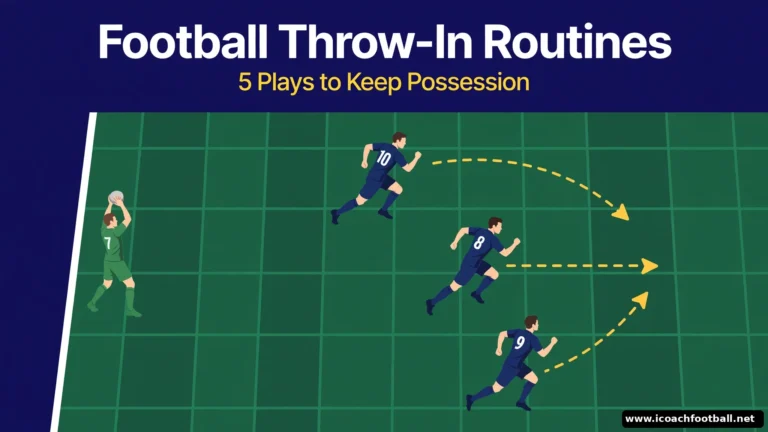
Defending throw-ins needs the same zone-first thinking as the corner drills above — see football throw-in routines.
Sources
These football defending set pieces drills are based on, and in line with, the FIFA Training Centre analysis of defending corner strategies at the FIFA Club World Cup 2025, which reports the rise of zonal marking, the 65% first-contact success for zonal systems, and the value of an edge player for second balls, and the FIFA Training Centre analysis of defensive corners as counter-attack springboards, which shows how a zonal outlet on the edge of the box turns a clearance into a direct counter-attack. No drill here is claimed as approved by or affiliated with FIFA, UEFA or The FA.
The Law facts in this post follow the Laws of the Game: opponents must stay at least 9.15 metres from the ball at a free kick and at least 9.15 metres from the corner arc at a corner, and a player cannot be offside directly from a corner kick.
FAQ
Should youth teams defend corners zonally or man-to-man?
Start with hybrid: zonal players guard the front and central zones, and markers pick up the two or three most dangerous attackers. Name the front-zone owner every time. Move to full zonal only when the team attacks first contact reliably, as in Drill 1.
How many players should be in the wall at a free kick?
It depends on the angle and distance, and the goalkeeper decides. Three or four is normal from 20–25 yards central. The wall covers the near post, the goalkeeper covers the open side, and the nearest player steps to the ball to stop a quick free kick.
Can a player be offside from a corner kick?
No. A player who receives the ball directly from a corner kick cannot be offside. Once another player has touched the ball, normal offside rules apply again, which is why the line steps out together after a clearance.
How do you defend a short corner?
Send two players out and keep one covering behind them, as in Drill 3. The first presser closes the ball, the second cuts off the pass inside, and the cover player holds the cutback space. The box defenders stay in their zones and never follow the press out twice.
What is the most common mistake when defending set pieces?
Having no plan for the second ball. Teams clear the first delivery and then stand still, so the clearance drops to an attacker. Leave one player on the edge of the box, facing play, on every restart, and give them an outlet to play to, as in Drill 5.