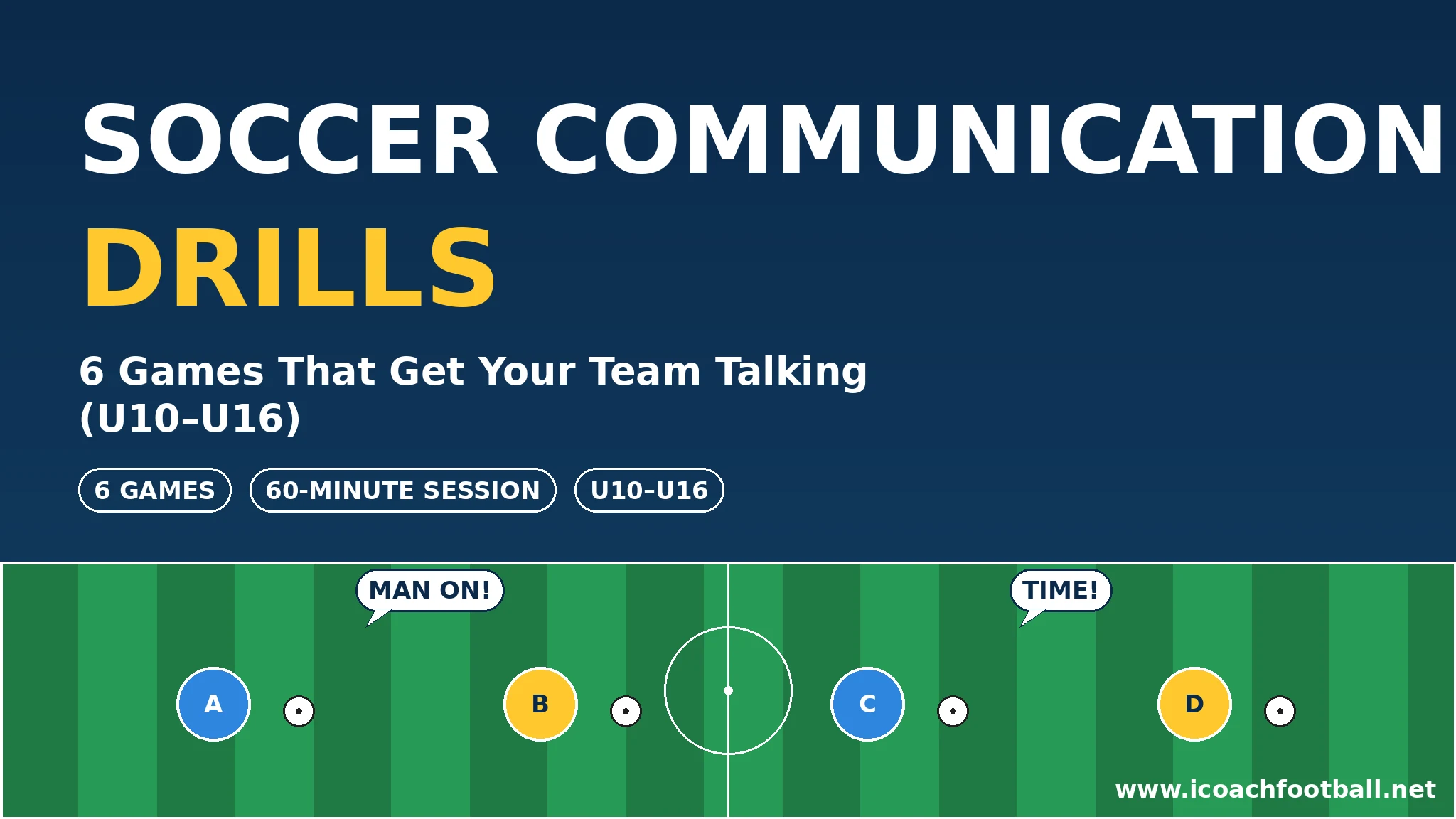
Soccer Communication Drills: 6 Games That Get Your Team Talking (U10–U16)
Quick answer
The loudest team on the pitch usually wins the second ball, holds its shape and concedes fewer goals — and talking is a skill you can train like passing. These six games teach players to call the right word, early and loud, and to listen and act on it — in one 60-minute session.
Suitable for: U10–U16 (ages 9–16)
Session snapshot
- Players: 10–14 (U10–U16, two teams plus a caller)
- Area: 30 x 25 yards (grids from 15 x 15 to 30 x 25)
- Duration: 60 minutes
- Focus: Calling early, listening, organising each other
- Equipment: 8–10 balls, 20 cones, 6 mini goals, bibs, 2 blindfolds
Why these six games work
A quiet team is not a polite team — it is a team playing blind. The player on the ball can only see what is in front of them; the teammates around them can see the pressure, the space and the runner. Talking closes that gap, but only if the call is short, early and true. FIFA’s Training Centre session “#84: Communication is key” is built on exactly this: it starts with a blindfold exercise where one player must guide a partner by voice alone, because good communication is what builds trust between players — and it ends with a 5v5 game where the players appoint their own captain and organise themselves. Drill 3 below is based on that blindfold warm-up, in line with the FIFA session. FIFA’s “#52: Take responsibility” session makes the same point from the other side: its keep-ball rondo warm-up tells the coach to “encourage verbal communication among the players on the outside and between the two defenders”. Drill 1 below is built on that rondo model, in line with that FIFA session. In the UK the same session runs as football communication drills — the calls and the games are identical.
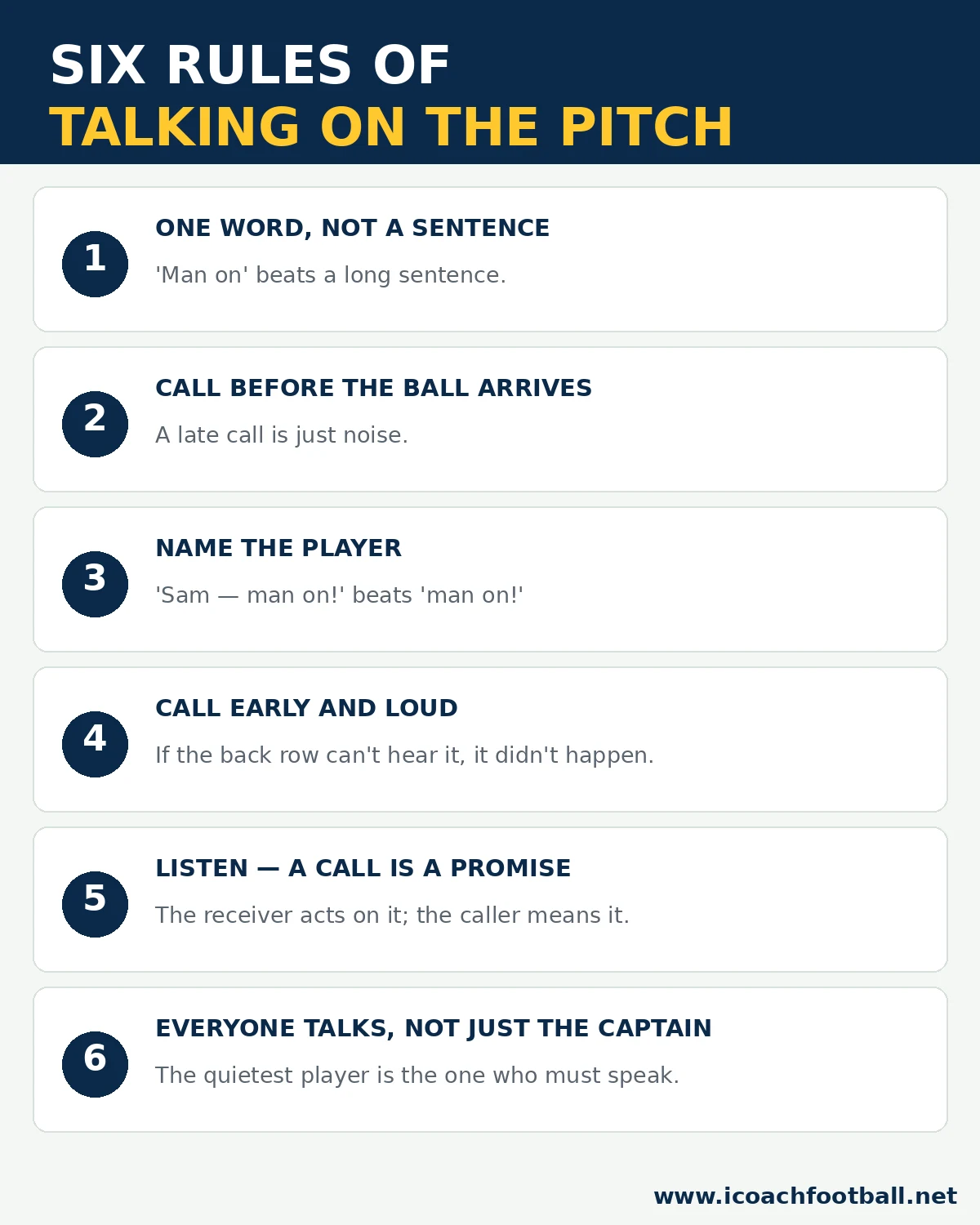
Six rules of talking on the pitch
- One word, not a sentence. “Man on” beats “there’s a player coming behind you.”
- Call before the ball arrives. A late call is just noise.
- Name the player. “Sam — man on!” beats “man on!”
- Call early and loud. If the back row can’t hear it, it didn’t happen.
- Listen — a call is a promise. The receiver acts on it; the caller means it.
- Everyone talks, not just the captain. The quietest player is the one who must speak.
Drill 1 — Three Calls Rondo
Three attackers in a triangle, one defender inside — and every pass gets a call. A teammate who can see the receiver shouts “MAN ON”, “TIME” or “TURN” before the ball arrives, and the receiver must act on the call. The simplest talking drill there is, and the one to start with.
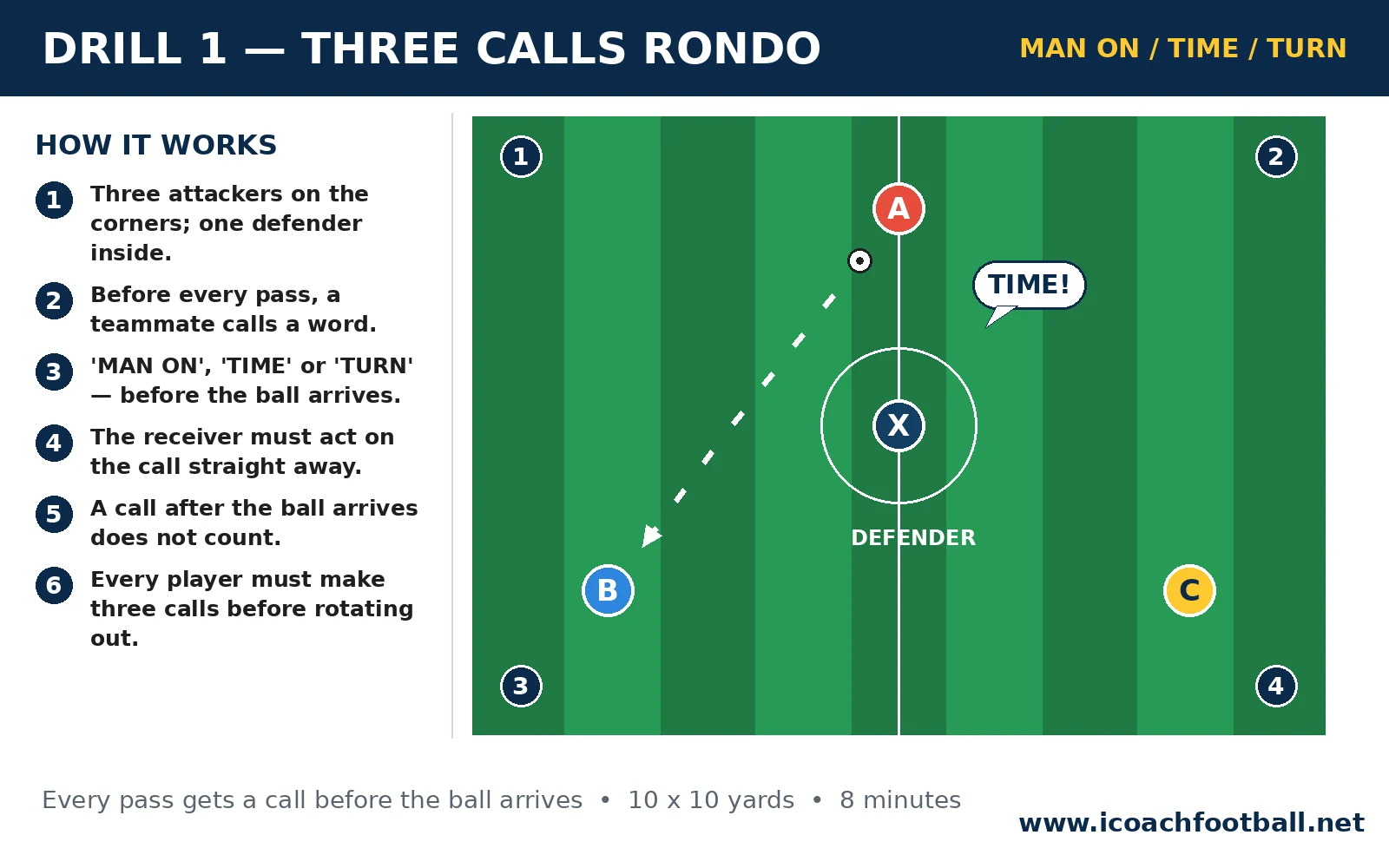
- Setup: 10 x 10 yard triangle. Three attackers on the corners, one defender inside. 8 minutes.
How to play:
- Three attackers stand on the corners; one defender works inside.
- Before every pass, a teammate calls “MAN ON”, “TIME” or “TURN”.
- The receiver must act on the call — first time, turn, or take a touch.
- A call after the ball arrives does not count. The pass is replayed.
- The defender scores by intercepting; rotate the defender every 90 seconds.
- Every player must make at least three calls before they rotate out.
Coach’s note: “The call is the pass — if nobody speaks, the ball doesn’t move.”
Progressions: The caller must name the receiver too (“Sam — time!”); two-touch limit; the defender presses the receiver as well as the passer.
Drill 2 — The Silent Game
A 4v4 played twice: three minutes in total silence, then three minutes where talking is compulsory. The players feel the difference in their own legs — and they never forget it. The game that proves talking works, without a single lecture.
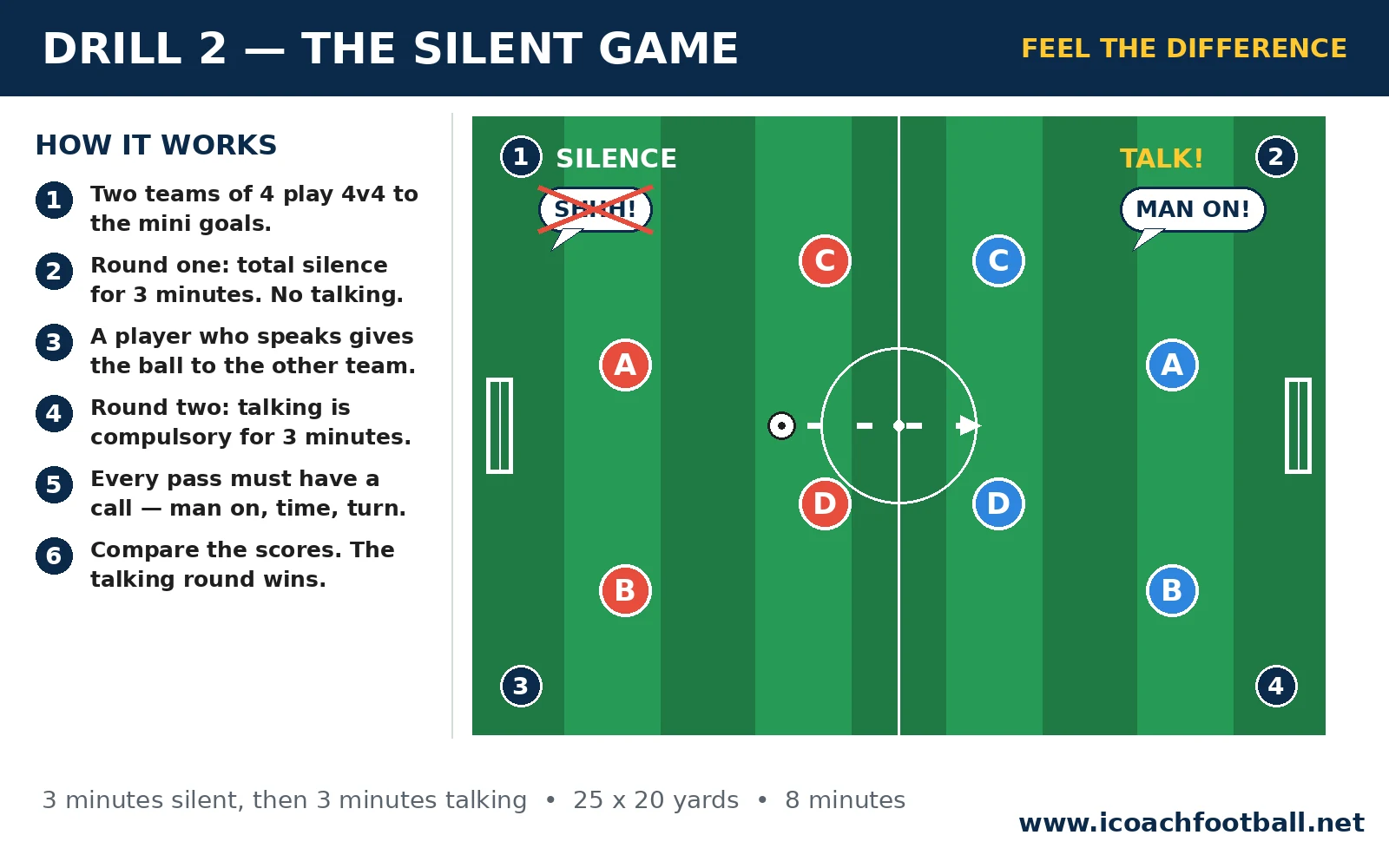
- Setup: 25 x 20 yard pitch. Two teams of 4, mini goals at each end. 8 minutes.
How to play:
- Two teams of 4 play 4v4 to the mini goals.
- Round one: total silence for 3 minutes. No talking at all.
- A player who speaks gives the ball to the other team.
- Round two: talking is compulsory for 3 minutes. Silence loses the ball.
- Every pass must have a call — “man on”, “time”, “turn” or a name.
- Compare the scores. The talking round almost always wins.
Coach’s note: “Silence is the lesson — three quiet minutes teach more than ten minutes of me talking.”
Progressions: Round three: only the two quietest players may call; the loudest players must listen; play the second round with a one-touch rule.
Drill 3 — Blindfold Guide
One player is blindfolded and dribbles by voice alone. Their partner is their eyes: “straight on… left… slow — cone!” The guide learns to give short, true calls, and the dribbler learns to trust them. The drill FIFA uses to build trust — and the one players remember longest.
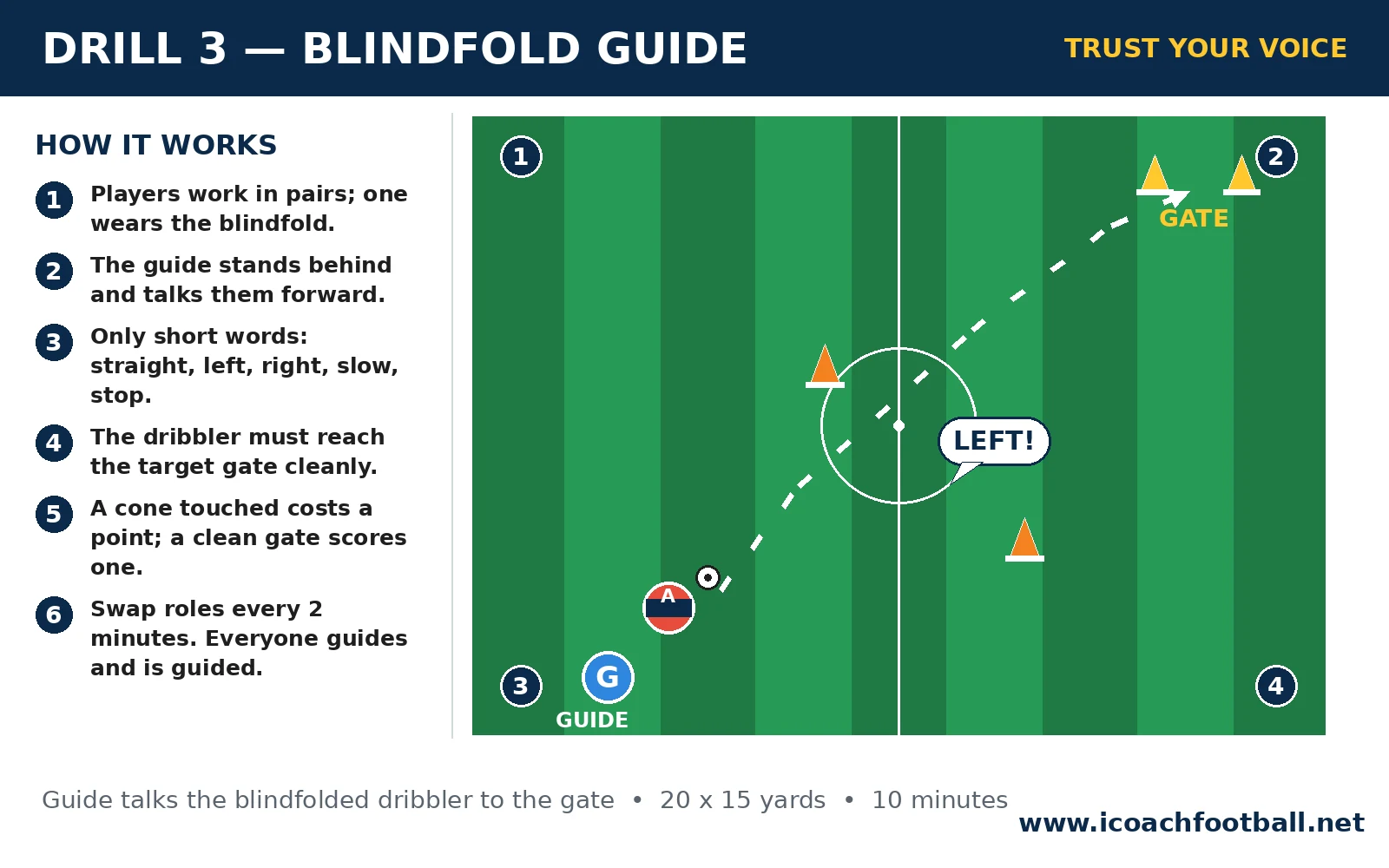
- Setup: 20 x 15 yard area. Pairs, one ball per pair, cones as obstacles, one target gate. 10 minutes.
How to play:
- Players work in pairs; one wears the blindfold, one is the guide.
- The guide stands behind the blindfolded dribbler and talks them forward.
- The guide calls only short words: “straight”, “left”, “right”, “slow”, “stop”.
- The dribbler must reach the target gate without touching a cone.
- A cone touched costs a point; reaching the gate clean scores one.
- Swap roles every 2 minutes so every player guides and is guided.
Coach’s note: “Short and true — if the call is late or wrong, your partner walks into a cone.”
Progressions: The guide may only use one-word calls; the guide walks on the far side so the voice comes from further away; add a second pair crossing the same area.
Drill 4 — Call the Press
A 5v5 where nobody presses until one player shouts “GO!” — and then everyone presses together. The trigger-caller learns to read the moment, and the team learns that a press is one decision made by eleven voices, not eleven decisions made alone.
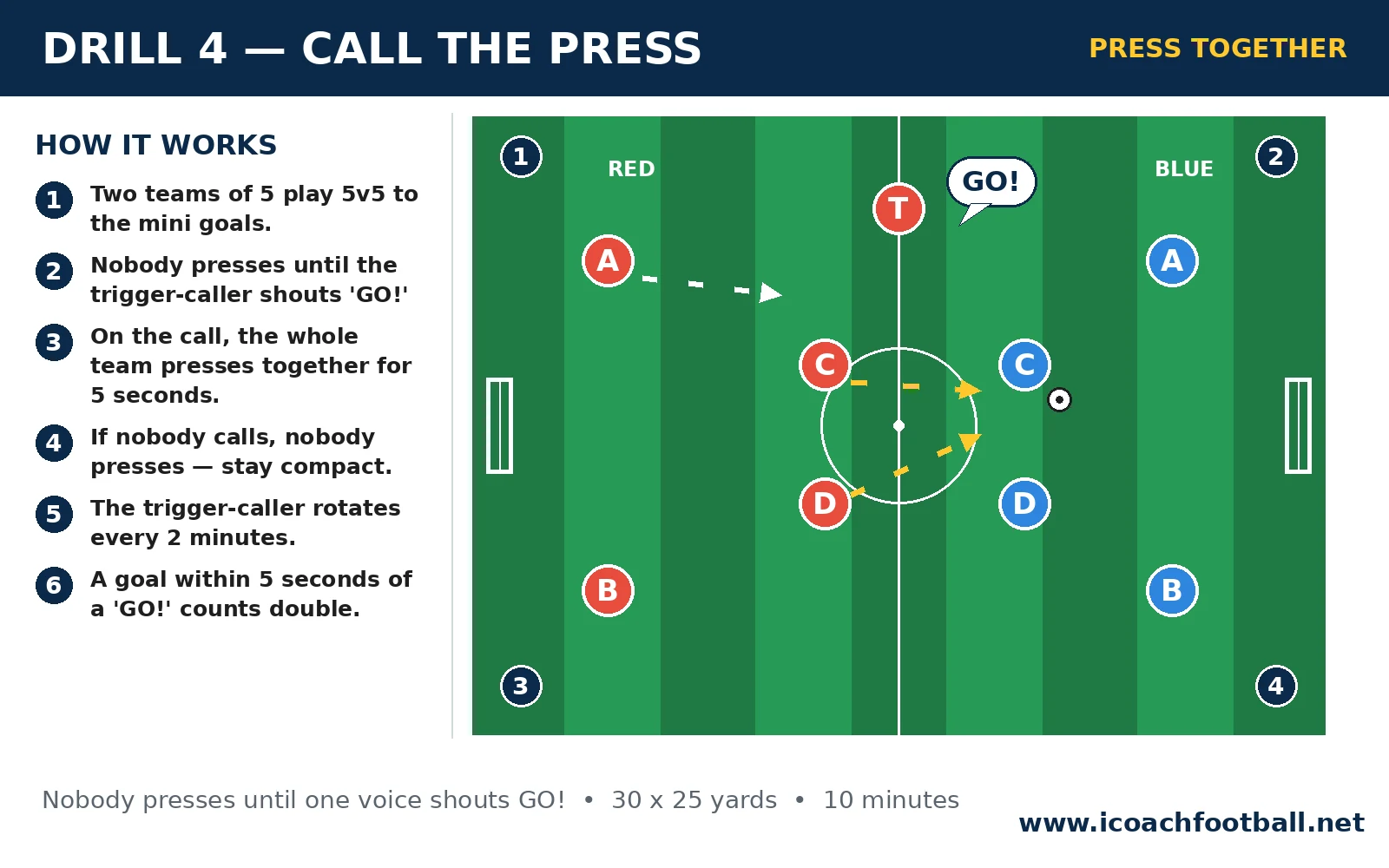
- Setup: 30 x 25 yard pitch. Two teams of 5, mini goals at each end. 10 minutes.
How to play:
- Two teams of 5 play 5v5 to the mini goals.
- Nobody presses until the trigger-caller shouts “GO!”
- On the call, the whole team presses the ball together for 5 seconds.
- If nobody calls, nobody presses — the defending team must stay compact.
- The trigger-caller rotates every 2 minutes so everyone reads the moment.
- A goal scored within 5 seconds of a “GO!” counts double.
Coach’s note: “One voice starts the press — eleven voices finish it.”
Progressions: The caller must name the trigger (“GO — left foot!”); the press lasts 8 seconds; the opposition may call a fake “GO!” once per game.
Drill 5 — Organise the Line
Four defenders, one line, one voice. The back four must call “STEP!”, “DROP!” and “SQUEEZE!” to move as one — and if the line breaks, the attack scores double. The defending drill that teaches the whole team to talk at once.
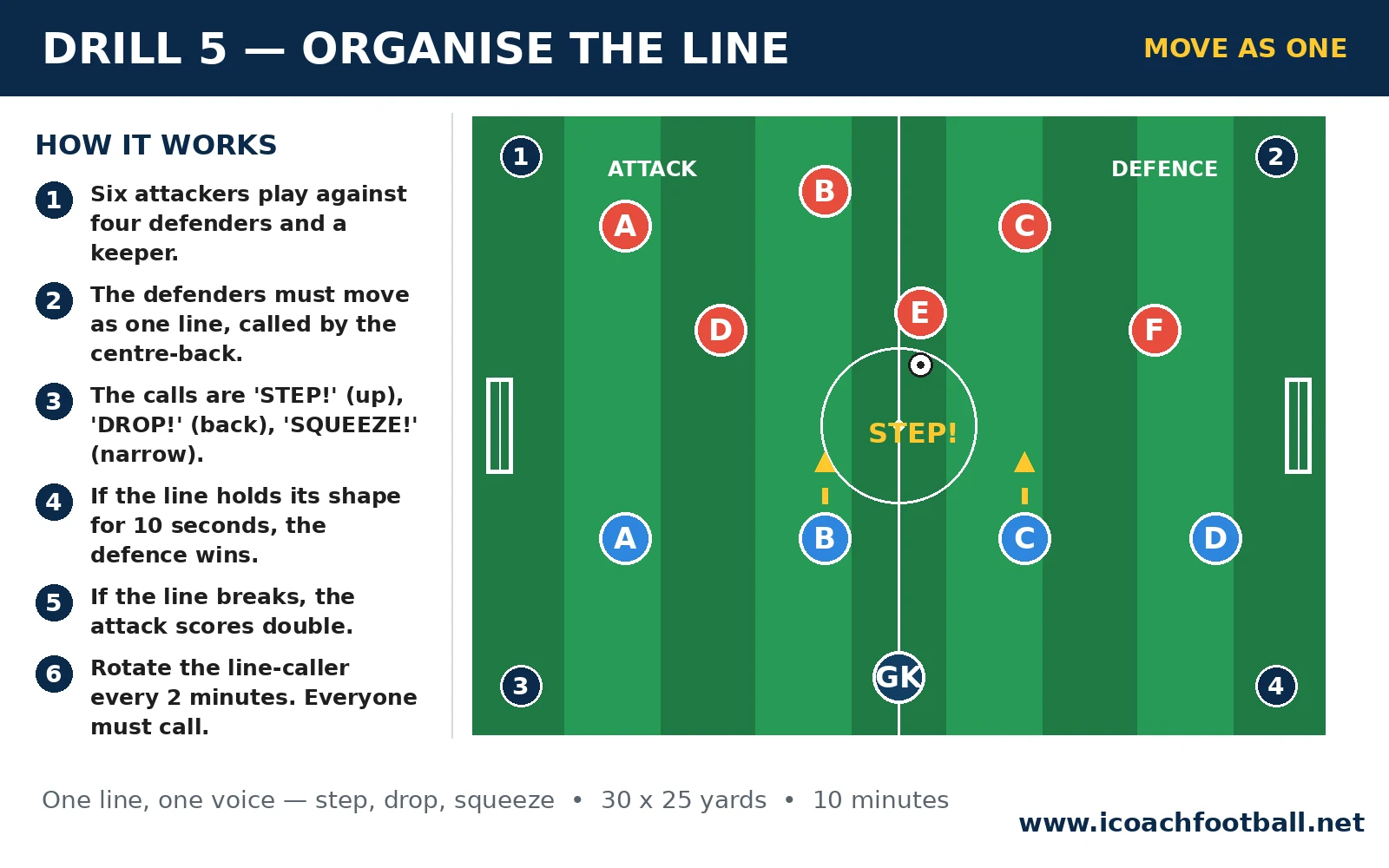
- Setup: 30 x 25 yard pitch. Six attackers against four defenders plus a goalkeeper. 10 minutes.
How to play:
- Six attackers play against four defenders and a goalkeeper.
- The defenders must move as one line, called by the centre-back.
- The calls are “STEP!” (push up), “DROP!” (fall back) and “SQUEEZE!” (narrow).
- If the line holds its shape for 10 seconds, the defence wins the point.
- If the line breaks — one defender steps while the rest drop — the attack scores double.
- Rotate the line-caller every 2 minutes; every defender must call at least once.
Coach’s note: “Four players, one line — if one steps and the rest drop, the gap is the goal.”
Progressions: The goalkeeper calls the line instead of the centre-back; the attackers must call their own runs too (“overlap!” / “in behind!”); play with an offside line.
Drill 6 — Talk-to-Win 6v6
The final game, and the only rule that matters: a goal only counts if the scorer was called for the ball before the pass. “MINE!”, “SAM — THROUGH!”, “TURN!” — every goal needs a call, so every player talks or their team doesn’t score.
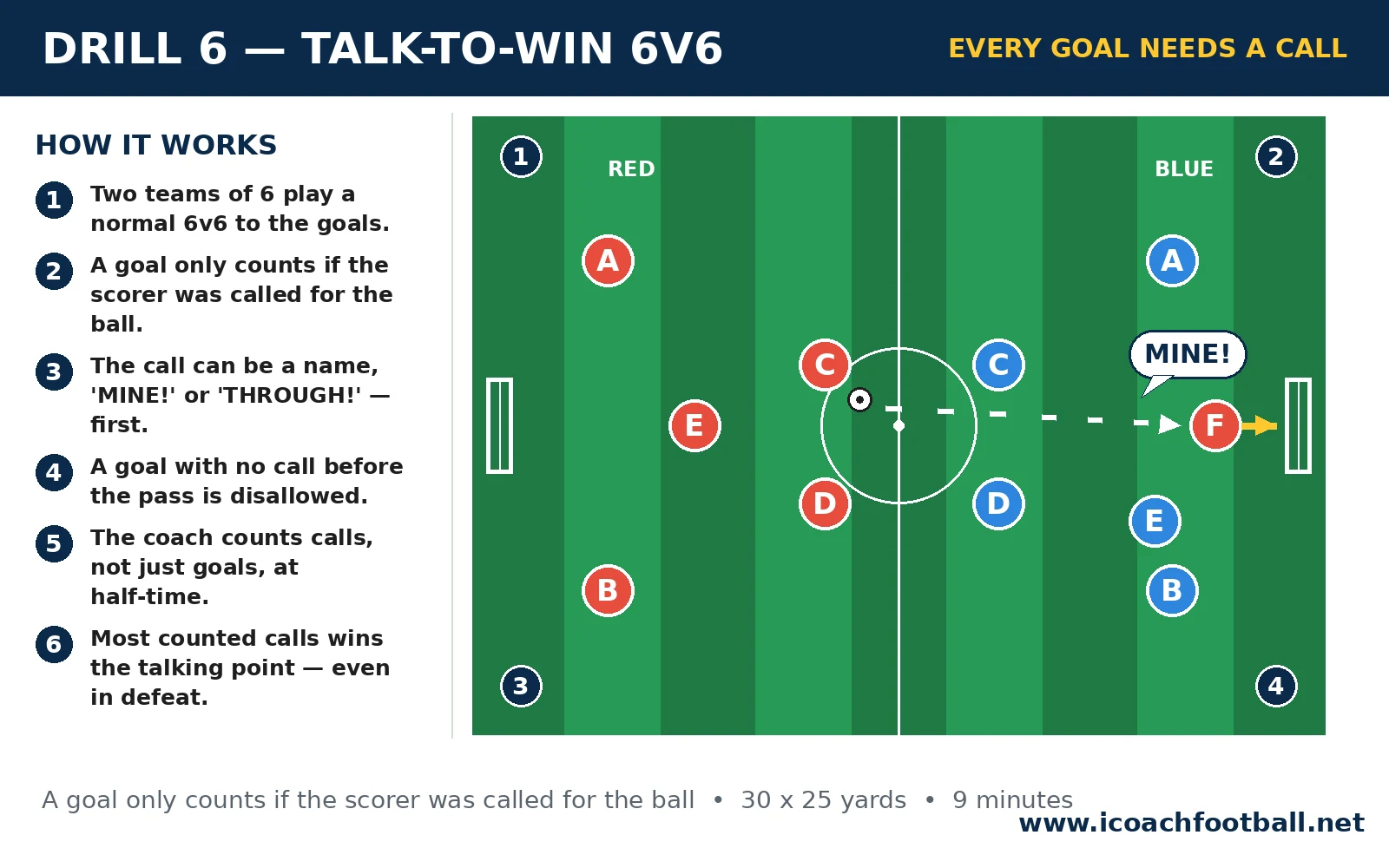
- Setup: 30 x 25 yard pitch. Two teams of 6, goals at each end. 9 minutes.
How to play:
- Two teams of 6 play a normal 6v6 to the goals.
- A goal only counts if the scorer was called for the ball before the pass.
- The call can be a name, “MINE!” or “THROUGH!” — but it must come first.
- A goal with no call before the pass is disallowed, however well it is finished.
- The coach counts calls, not just goals, and reports both at half-time.
- The team with the most counted calls wins the talking point — even if it loses the game.
Coach’s note: “No call, no goal — talk your way to the scoreboard.”
Progressions: The call must name the scorer (“Sam — through!”); the goal only counts if two different players called in the same attack; play the last 3 minutes in silence and watch the goals disappear.
Coaching points: the five mistakes that keep teams quiet
| Mistake | What you see | Fix |
|---|---|---|
| Shouting without information | “Go go go!” — noise, not a call | Call what you see: man on, time, turn, or a name |
| Talking only on the ball | The player with the ball talks; the ten who can see stay silent | The player off the ball is the one who sees — they must call |
| Late calls | The call arrives after the touch — the receiver already decided | Drill 1 rule: a call after the ball arrives does not count |
| One voice only | The captain talks; ten players are silent | Rotate the caller every 2 minutes — everyone must call |
| Punishing a wrong call | Players stop talking rather than risk being wrong | Praise the call, coach the content — a loud wrong call beats silence |
Age adaptations
| Age | Area | What changes |
|---|---|---|
| U10–U11 (ages 9–11) | 15 x 15-yard grids | Three calls only — man on, time, turn; the coach calls first and the players copy; Drill 3 runs with the guide holding hands and the blindfold optional — see the U10 soccer practice plan and the U11 soccer practice plan for the next step |
| U12–U13 (ages 11–13) | 20 x 15-yard grids | The caller must name the receiver too; the defender presses the receiver as well as the passer; Drill 5 adds the “squeeze” call — see soccer drills for U13 and the U12 soccer practice plan |
| U14–U16 (ages 13–16) | 30 x 25-yard grids | All six games as written; a second defender joins Drill 1; Drill 6 goals need a name call; the captain rotates every 5 minutes — see soccer drills for U14, soccer drills for U15 and soccer drills for U16 |
60-minute session plan
| Time | Block | Drill |
|---|---|---|
| 0:00–0:05 | Arrival game | Free 3v3 — talk from the first touch |
| 0:05–0:13 | Three calls | Drill 1 — Three Calls Rondo |
| 0:13–0:21 | Feeling the difference | Drill 2 — The Silent Game |
| 0:21–0:31 | Trust by voice | Drill 3 — Blindfold Guide |
| 0:31–0:41 | Pressing together | Drill 4 — Call the Press |
| 0:41–0:51 | Moving as one line | Drill 5 — Organise the Line |
| 0:51–0:60 | The talking game | Drill 6 — Talk-to-Win 6v6 |
New to coaching this age? Stretch the arrival game to 8 minutes and cut Drill 3 to 7 minutes and you have the same session with more settling-in time — see our 60-minute plan for the structure (the same shape, shortened where you need it).
Keep building from here
Talking sits on top of scanning, so start there if your players never look up: our soccer scanning drills teach the check-shoulder habit, and the moving monkeys rondo turns it into a game. The choice that follows the call is the decision itself: our soccer decision making drills train what to do with the information the call gives you. Build the passing base next: soccer passing drills for the weight and accuracy Drills 1–3 need, and weak foot soccer drills so both feet can play the called pass. The formats in this session have their own deep dives: soccer 3v3 drills for the combination play behind Drill 2, soccer 4v4 drills for the shape behind Drills 2 and 6, soccer 5v5 drills for the numbers behind Drill 4, and the rondo blueprint for the possession angles behind Drill 1. The press in Drill 4 is the same skill as our coaching soccer pressing triggers and counter-pressing, and the flip from attack to defence is our football defensive transition drills — while the line in Drill 5 is the same problem as our the defensive block, and the move from 1v1 to the full game is our 1v1 to 4v4 transition drill. The overload in Drill 4 is the same problem as our 2v1 soccer drills, and switching play is the four-goal game that rewards a team that talks across the pitch. Pairs work is the step before these games: soccer drills for two players run the same calls in pairs, and soccer drills for 6 players run them with a full small group — and when numbers change on the night, our soccer practice plans by number of players pick the session that fits. New to coaching? Start with soccer drills for beginners, and if you coach a school team, our soccer drills for middle school players run the same calls in a school context. Quiet players need confidence most of all: our soccer drills for girls show how to build it in a team that has never talked. Protect the players as they grow: our soccer injury prevention guide shows how to build the warm-up into every session, and our 10 soccer warm-up drills give you the full warm-up library. When they are older, the road runs through our soccer drills for U13, soccer drills for U14, soccer drills for U15 and soccer drills for U16 — and if you run selections one day, our soccer tryout drills show how to grade a group fairly. Goalkeepers talk too, from the back: our soccer goalkeeper communication drills train the same calls from the goal line.
FAQ
At what age should players start communication drills?
At U10 — once they can control and pass the ball reliably. Before that, the call is too big: a U8 player who is still fighting the ball cannot also read the picture and shout. Younger players need scanning games first, like our soccer scanning drills, and the full calling games in this session land best from age 9 or 10. In the UK the same session is football communication drills, and the age is the same.
What exactly should players shout on the pitch?
Three words cover most of the game: “man on” (pressure is coming), “time” (you have space) and “turn” (you can turn). Add a name before the word — “Sam — man on!” — and add direction when it matters: “left!”, “drop!”, “step!”. One word, early and loud. Long sentences are noise; the receiver has already decided by the time a sentence ends.
How do you get quiet players to talk?
Give them a job, not a lecture. Rotate the caller every 2 minutes so every player must call — Drill 1 makes three calls the price of staying in the game. Praise the call, not the outcome: a loud wrong call beats silence, and a player who is punished for a wrong call will never call again. Small-sided games help most, because in a 3v3 there is nowhere to hide — and our soccer drills for girls show how to build confidence in a team that has never talked.
Should the coach stop the game to correct a bad call?
No — ask instead. Stop at a natural break, ask “what did you see?”, and let the player find the answer. The FIFA Training Centre sessions this post is built on do the same: they ask the players how it feels to rely on a partner and what kind of help they want, rather than telling them. A call is a promise between players — the coach’s job is to make the promise worth keeping.
Do goalkeepers need separate communication training?
Yes — and they need it most, because the keeper sees the whole pitch and organises the line in front of them. Our soccer goalkeeper communication drills train the keeper’s calls — “keeper’s!”, “away!”, “step up!” — from the goal line, and Drill 5 in this session is the outfield version of the same job: the line moves when one voice moves it.
Sources
- FIFA Training Centre, “#84: Communication is key” (8-to-12) — a session that begins with a blindfold exercise where one player guides a partner by voice alone, because good communication builds trust between players, then moves to a small-sided game of three pairs plus goalkeeper and ends with a 5v5 game where players appoint their own captain and organise themselves. The blindfold guide in Drill 3 and the captain rotation in Drill 6 are based on / in line with that session. https://www.fifatrainingcentre.com/en/practice/grassroots/8-to-12/communication-is-key.php
- FIFA Training Centre, “#52: Take responsibility” (8-to-12) — a session whose keep-ball rondo warm-up tells the coach to “encourage verbal communication among the players on the outside and between the two defenders”, followed by 3v1-to-3v3 end-to-end waves and a 6v6 game where every player is responsible for a direct opponent. The three-calls rondo in Drill 1 is based on / in line with that session. https://www.fifatrainingcentre.com/en/practice/grassroots/8-to-12/take-responsibility.php