U9 Soccer Practice Plan: 8 Age-Appropriate Drills
A strong U9 practice should connect technical repetition with game decisions. Use ball mastery, receiving, a 4v2 rondo, 1v1 transitions, 2v1 overloads and small-sided games that require players to scan, support and react when possession changes.
U9 players can begin performing technical actions with greater speed and purpose. They are also ready to solve simple game problems such as when to dribble, when to pass and how to support the player in possession.
This complete 60-minute session moves from individual scanning and receiving into opposed games, overloads and a competitive final match.
The activities remain flexible. Increase the area for a developing group or reduce it slightly when players need more pressure.
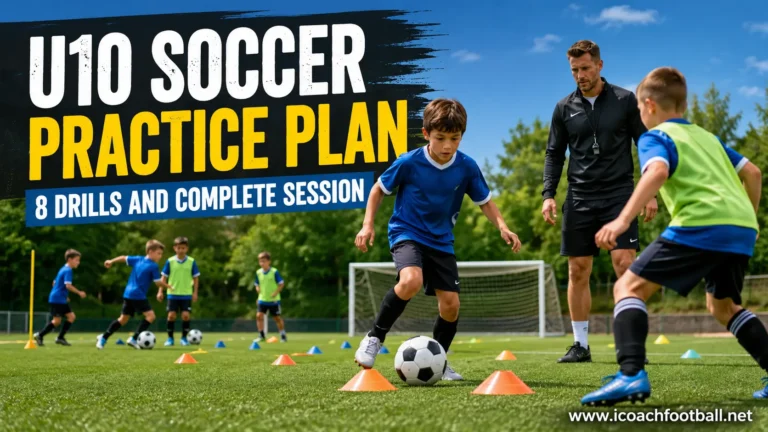
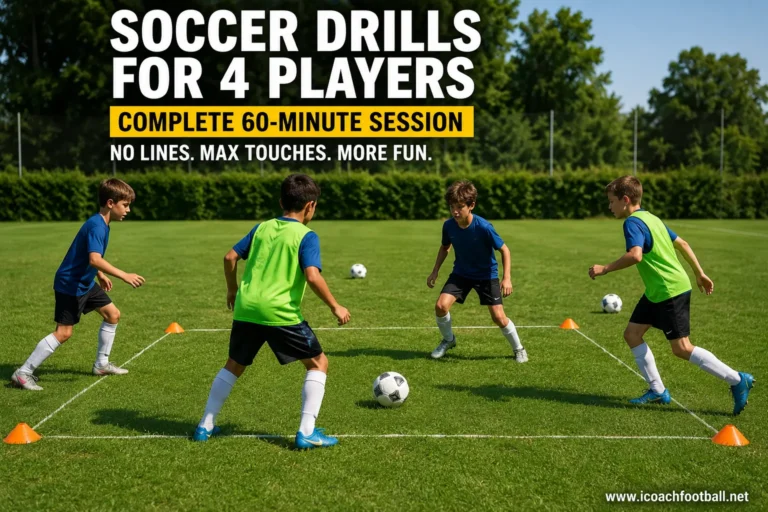
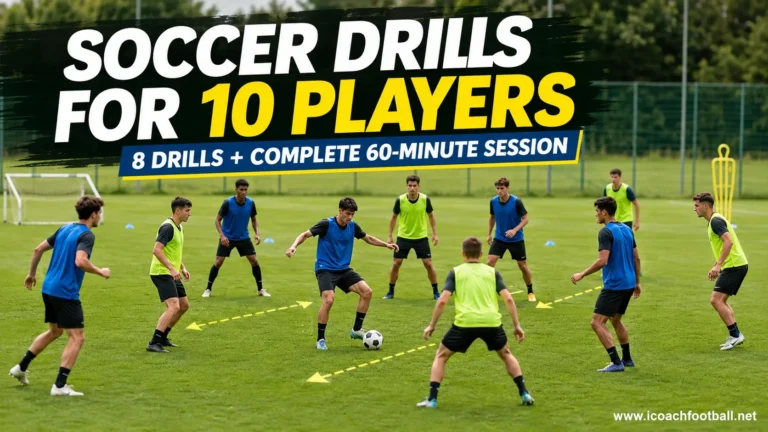
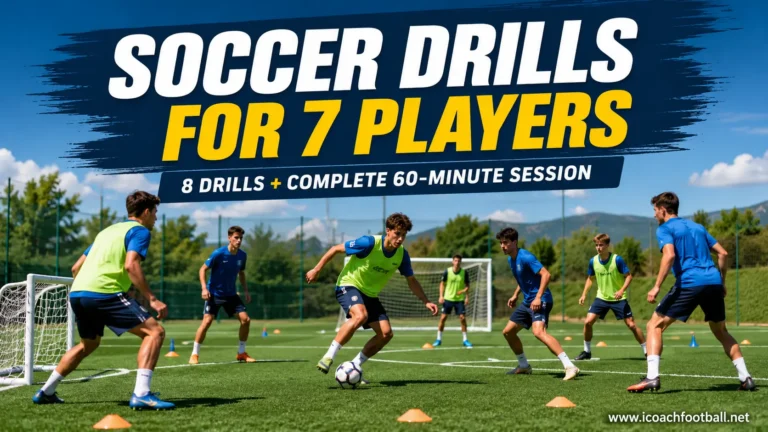
For sessions organized around exact attendance, use our soccer practice plans by number of players. Related age-group sessions include U8 Soccer Practice Plan and U10 Soccer Practice Plan.
Equipment and Setup
PlayersApproximately 10–14 players
Session duration60 minutes
Recommended ageU9
Maximum areaMaximum 34 × 26 yards
Ball sizeSize 3 for U6–U8, size 4 for U9–U14 and size 5 for U15–U16; follow local competition rules
EquipmentSize 4 balls, cones, bibs and four mini goals or cone gates
Complete 60 minutes Session
| Time | Activity | Main objective |
|---|---|---|
| 0–7 minutes | Scanning Ball-Mastery Grid | Ball control, scanning and direction changes |
| 7–14 minutes | Receive Across the Body | First touch, body shape and passing |
| 14–22 minutes | 4v2 Rondo | Possession, support angles and pressing |
| 22–29 minutes | 1v1 Transition Duel | Attacking, defending and transition reactions |
| 29–37 minutes | Continuous 2v1 Wave Attack | Overload decisions and finishing |
| 37–45 minutes | 3v3 Plus Two End Targets | Directional possession and support |
| 45–53 minutes | 4v4 Four-Goal Game | Scanning, width and switching play |
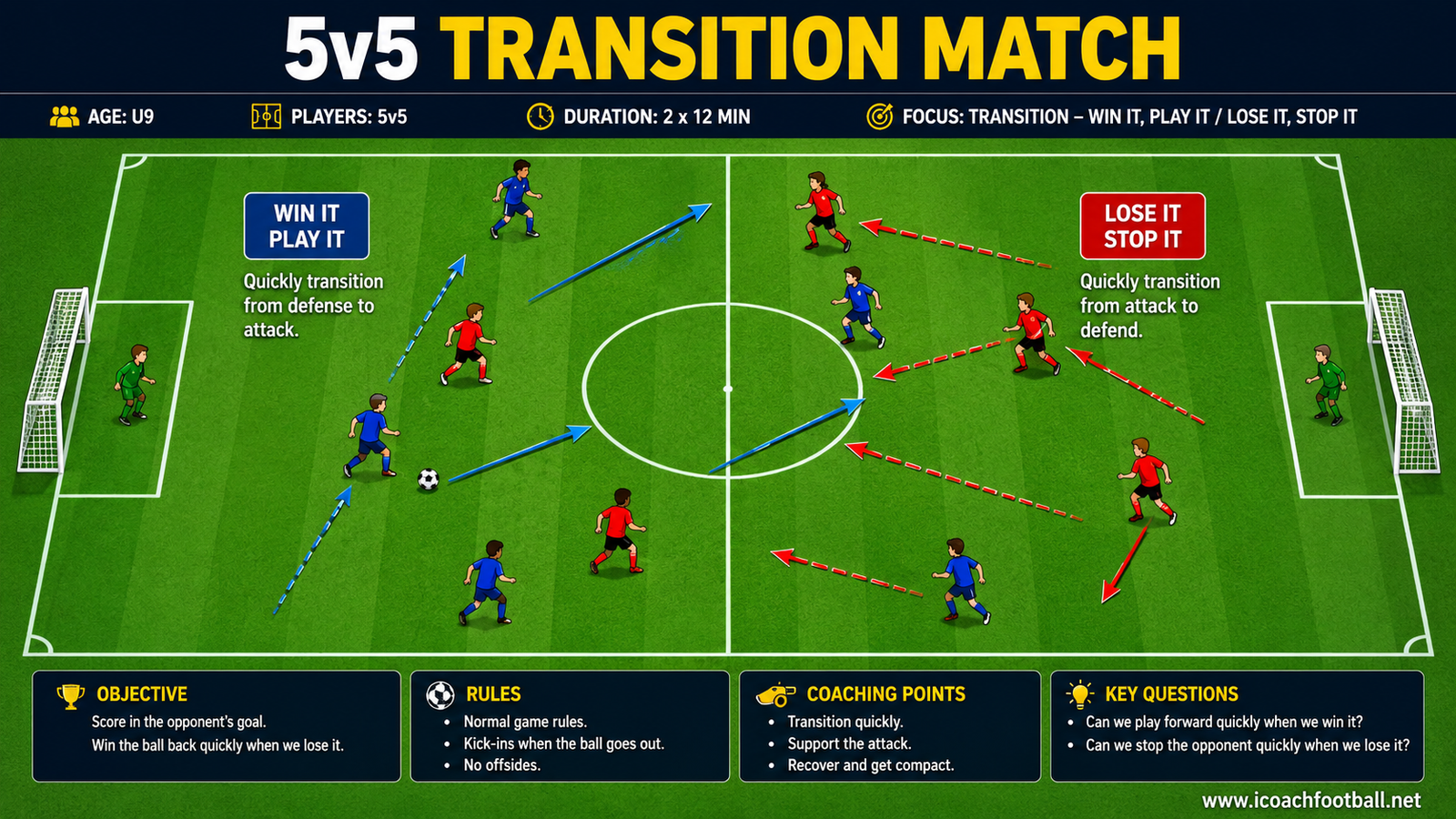
| 53–60 minutes | 5v5 Match With Transition Bonus | Game application and reactions |
Age-Appropriate Coaching Priorities
Scan before receiving: Introduce shoulder checks and awareness without stopping the activity constantly.
Connect technique to decisions: Passing and receiving work should quickly progress into opposition.
Use realistic transitions: Players should react immediately after winning or losing the ball.
Encourage both feet: Technical repetitions should include receiving and passing in both directions.
Ask guided questions: Help players recognize options rather than giving every answer.
FIFA’s guidance for ages 8–12 recommends competitive warm-ups, possession games and street-football elements to keep training purposeful and enjoyable. Read FIFA Ages 8–12: Fun and Impactful Warm-Ups.
Drill 1: Scanning Ball-Mastery Grid
Players perform individual touches while checking visual signals around the area.
Setup
- Create an 18 × 18-yard grid.
- Give every player one ball.
- Place four colored markers around the outside.
- The coach holds up or calls colors.
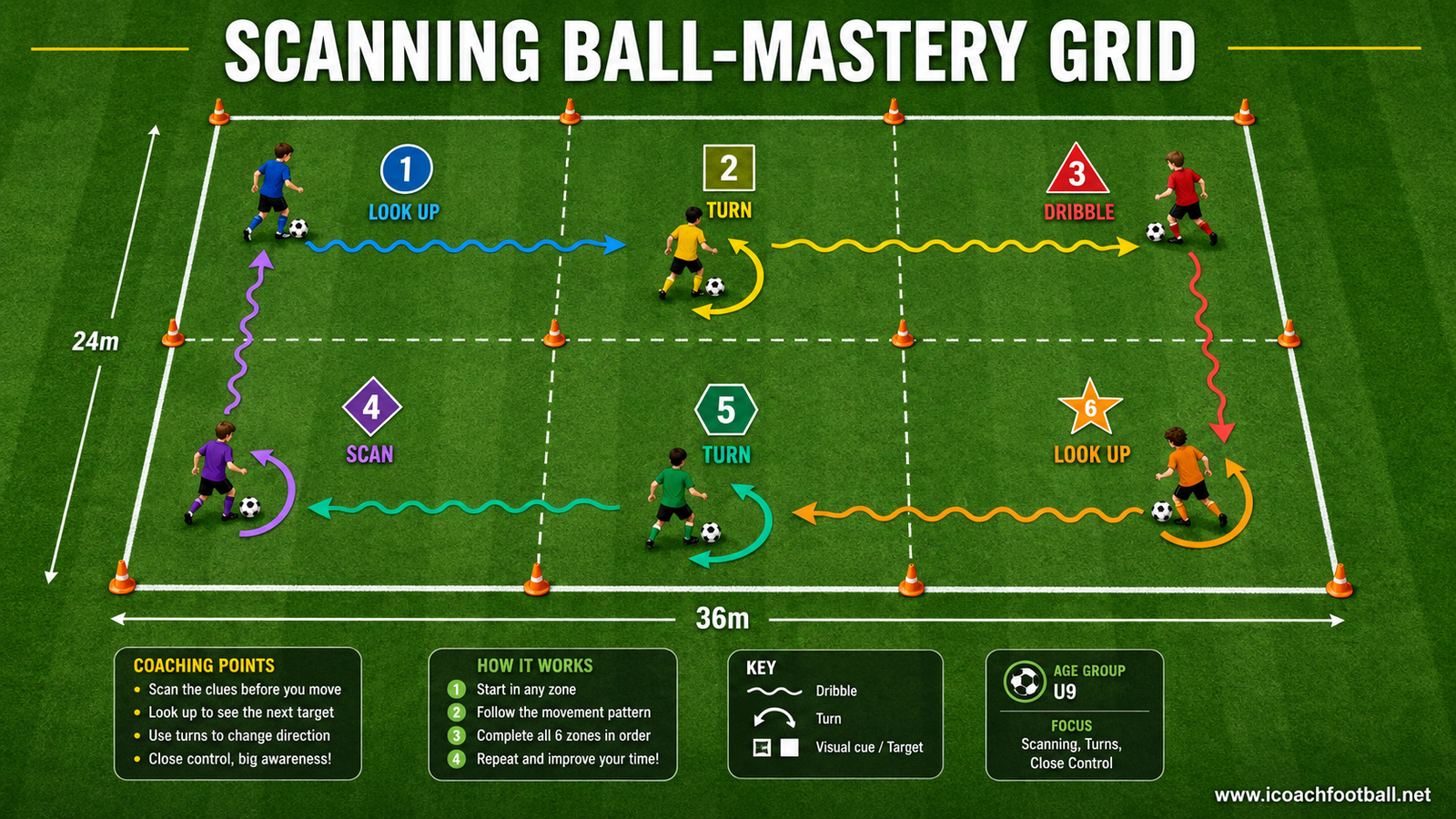
How to Play
- Players dribble freely.
- Before each turn, players scan for the called color.
- Use inside cuts, outside cuts, drag-backs and sole rolls.
- After the turn, accelerate into open space.
- Change the action every 30 seconds.
Coach’s note: The scan should happen before the turn rather than after it. Keep the tempo controlled enough for players to lift their head.
Progressions: Add number signals, use the weaker foot or pair players so one gives the visual cue.
Drill 2: Receive Across the Body
Players receive from one side and move the ball across their body toward the next pass.
Setup
- Create several triangles 10–12 yards across.
- Use three or four players per triangle.
- Place one player at each point.
- Use one ball per group.
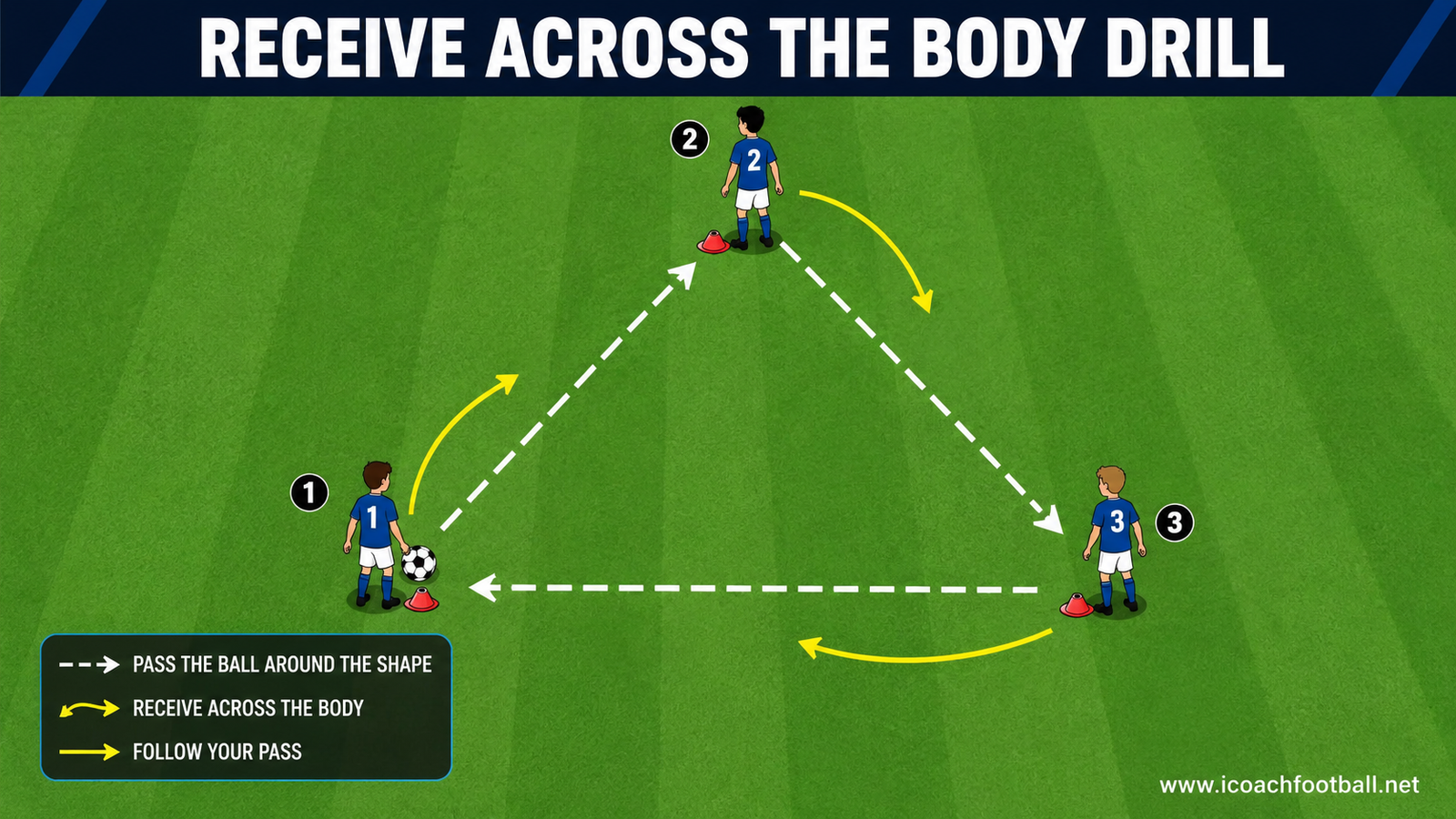
How to Play
- Player A passes to player B.
- Player B checks a shoulder and receives across the body.
- Player B passes to player C and follows the ball.
- Continue around the triangle.
- Change direction after two minutes.
Coach’s note: The receiving player should open the hips before the ball arrives and use the first touch to prepare the next action.
Progressions: Play two-touch, add a passive defender or require a wall pass before the long pass.
Drill 3: 4v2 Rondo
Four players keep possession against two defenders in a compact square.
Setup
- Create a 12 × 12-yard square.
- Use four attackers and two defenders.
- Allow attackers to move along the edges.
- Keep spare balls close.
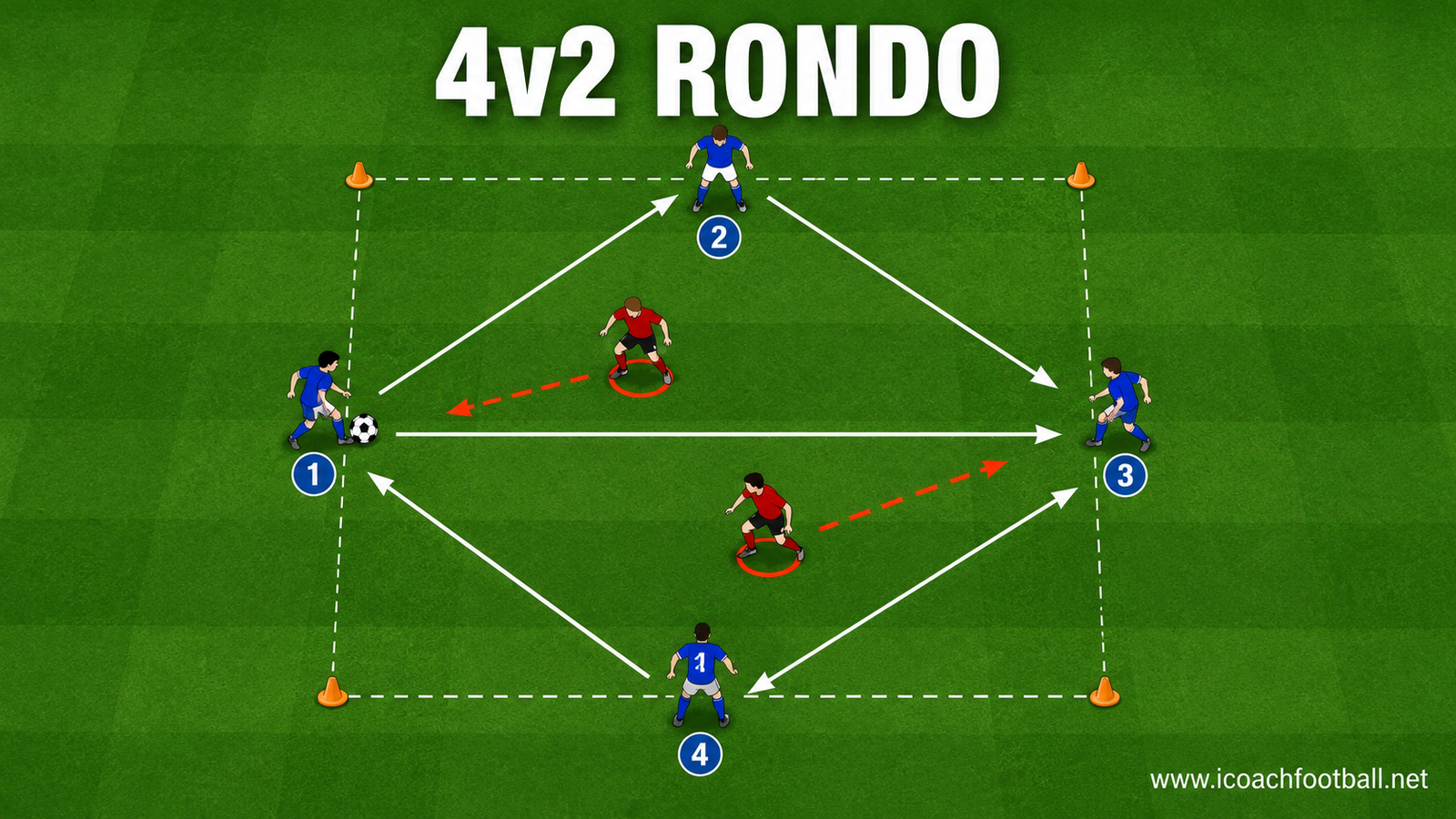
How to Play
- Attackers keep possession.
- Five passes earn one point.
- A split pass earns a bonus.
- When a defender wins it, the player responsible enters the middle.
- Rotate the second defender regularly.
Coach’s note: Attackers should create diagonal passing lines and move after the ball travels. Defenders should press together.
Progressions: Use two touches, reduce the area or allow one attacker to play inside.
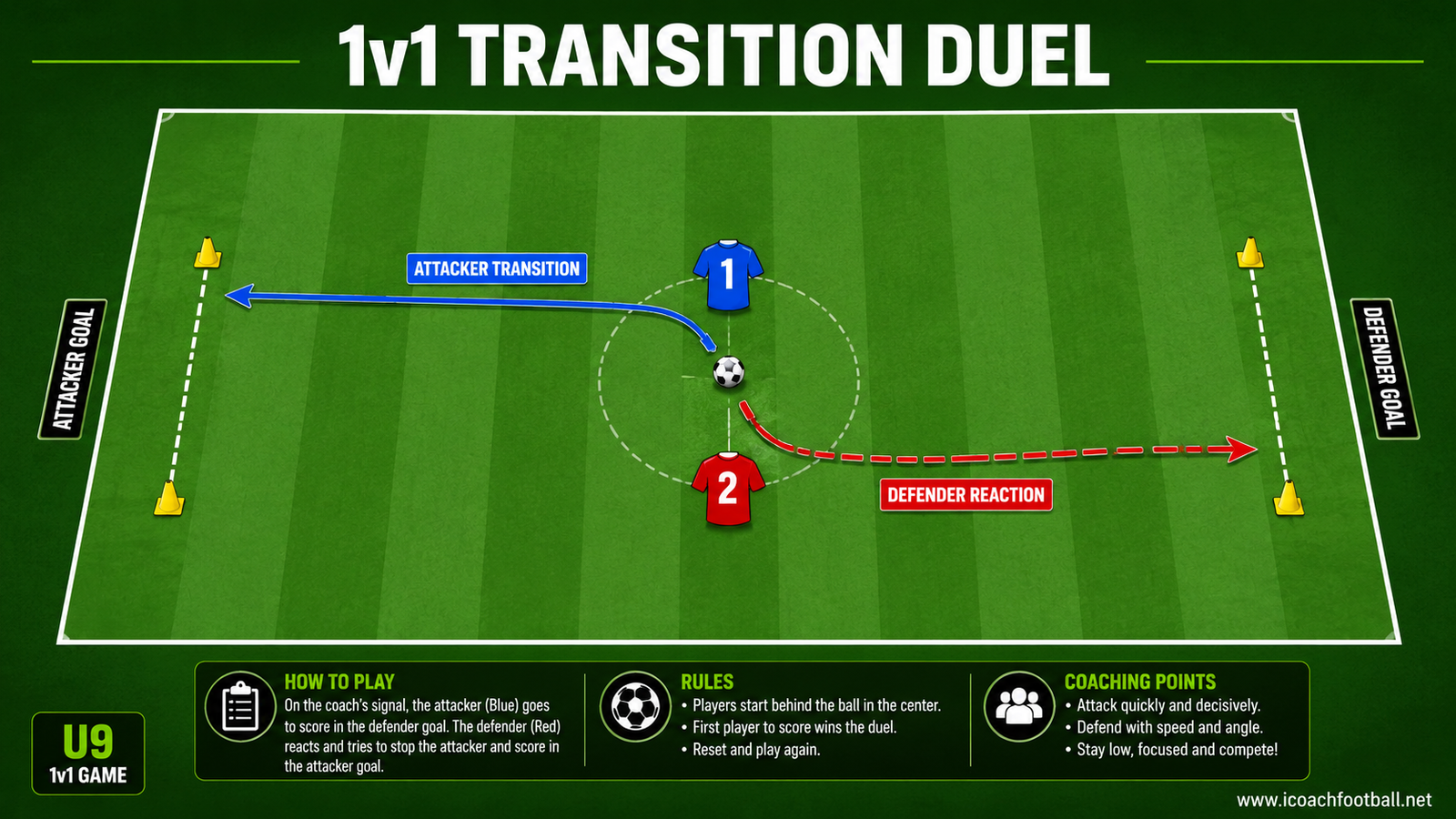
Drill 4: 1v1 Transition Duel
The winner of one duel immediately becomes the attacker in the next direction.
Setup
- Create a 14 × 10-yard field.
- Place one gate at each end.
- Organize players in two lines at opposite ends.
- Use one ball.
How to Play
- Player A attacks player B’s gate.
- If B wins possession, B immediately attacks the opposite gate.
- After the turn ends, the next defender enters with a new ball.
- Rotate continuously.
- Keep repetitions short.
Coach’s note: The defender should stay balanced and show the attacker away from the most direct route. The attacker should change speed after a move.
Progressions: Use two gates at each end, start with a pass or add a five-second scoring target.
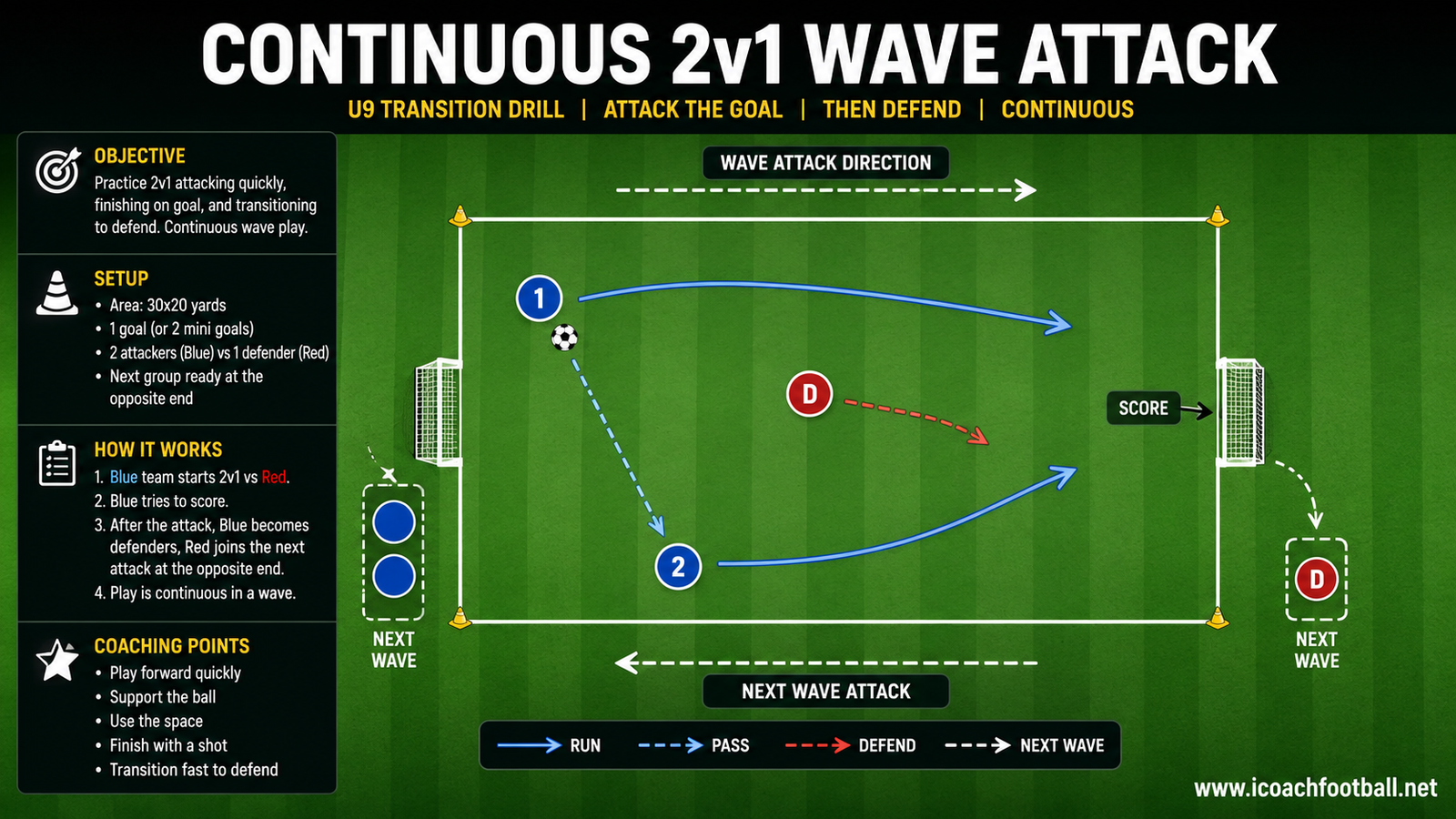
Drill 5: Continuous 2v1 Wave Attack
Two attackers play against one defender before the next wave travels in the opposite direction.
Setup
- Create a 24 × 18-yard field.
- Place one mini goal or two gates at each end.
- Organize players at both ends.
- Start with two attackers and one defender.
How to Play
- The attackers try to score.
- When the attack ends, the last attacker becomes the next defender.
- Two players from the opposite end begin immediately.
- Continue end to end.
- Rotate starting roles.
Coach’s note: The player without the ball should provide width and arrive at a useful angle rather than running alongside the ball carrier.
Progressions: Add a scoring deadline, require a wall pass or introduce a recovery defender.
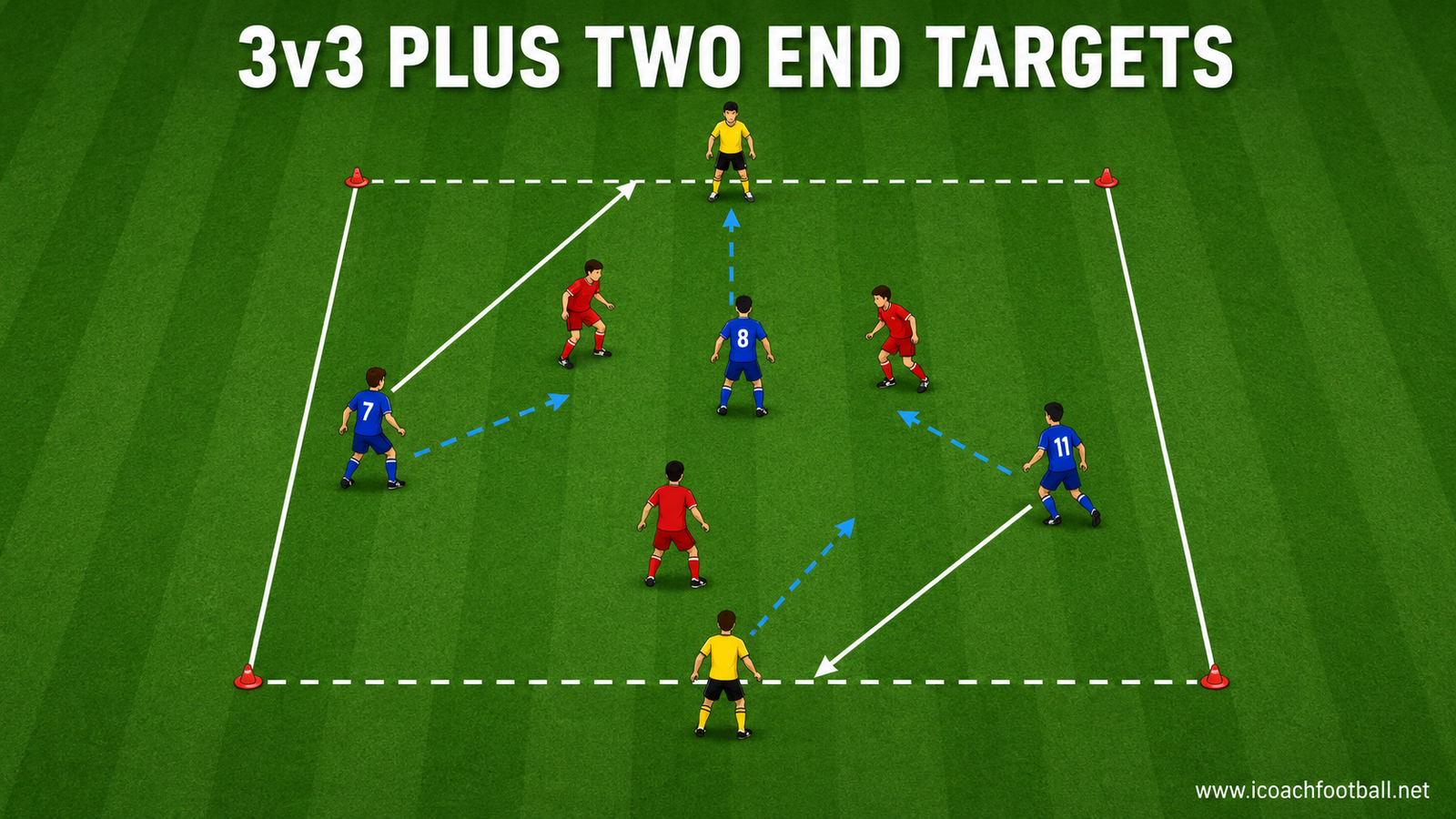
Drill 6: 3v3 Plus Two End Targets
Three-versus-three players connect with end targets to score.
Setup
- Create a 24 × 18-yard rectangle.
- Play 3v3 inside.
- Place one target behind each end line.
- Rotate targets every two minutes.
How to Play
- Each team attacks one target.
- Score by passing to the target and receiving the return pass.
- Targets have two touches.
- After scoring, attack the opposite direction.
- Restart quickly.
Coach’s note: Central players should create width, depth and one supporting option behind the ball.
Progressions: Make targets one-touch, require a third-player run or add one neutral inside.
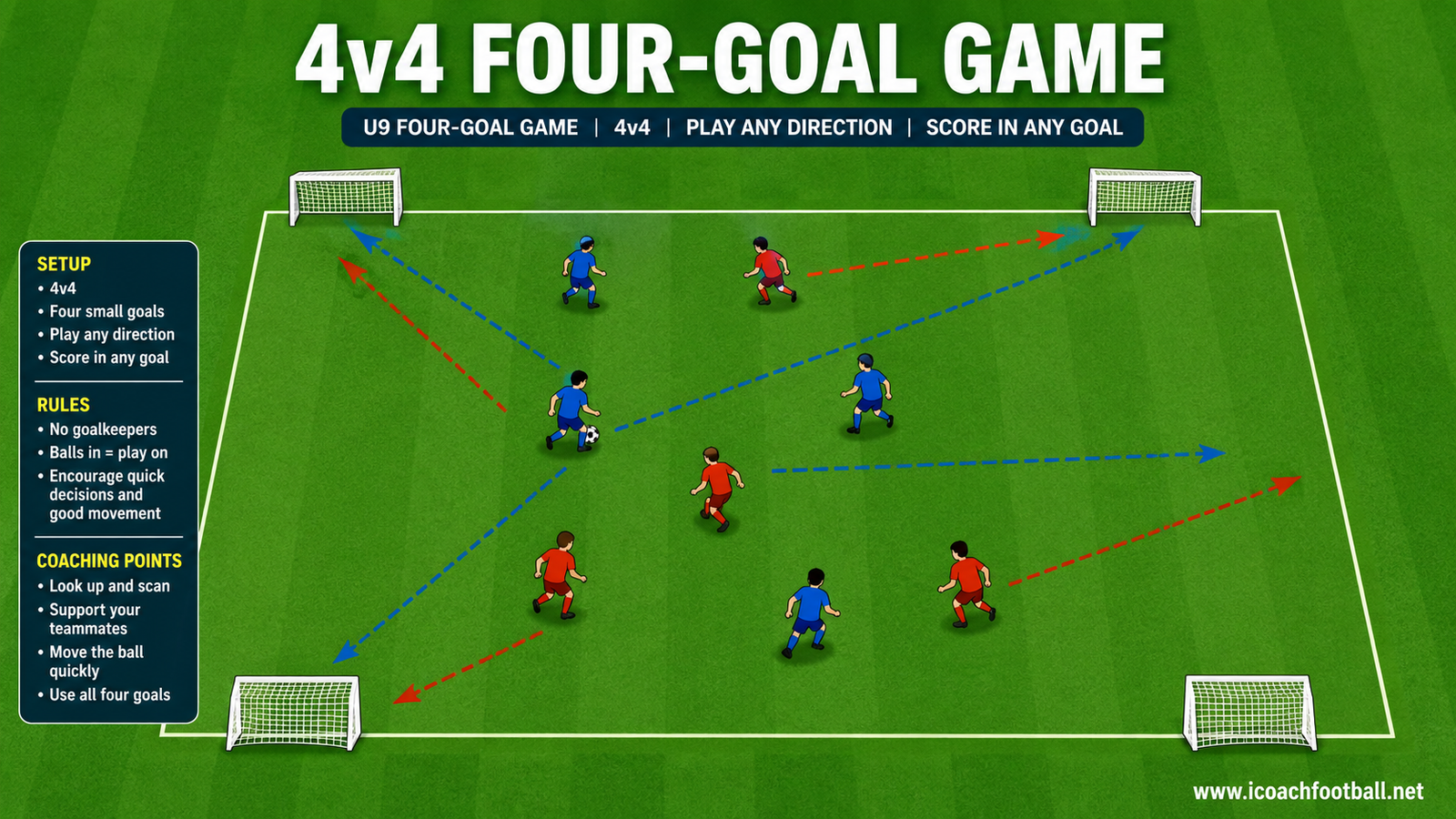
Drill 7: 4v4 Four-Goal Game
Each team attacks two corner goals.
Setup
- Create a 28 × 22-yard field.
- Place one mini goal in each corner.
- Play 4v4.
- Use rolling substitutes.
How to Play
- Teams score in either attacking goal.
- Restart immediately after goals.
- Use kick-ins or dribble-ins.
- Play short rounds.
- Keep a total score.
Coach’s note: Encourage players to receive in a position that lets them see both attacking targets.
Progressions: Require all teammates to touch the ball, award a bonus for switching play or use three touches.
Drill 8: 5v5 Match With Transition Bonus
The final match rewards quick, controlled play after regaining possession.
Setup
- Create a 34 × 26-yard field.
- Play 5v5.
- Use two goals or gates.
- Keep spare balls around the field.
How to Play
- Play normal 5v5.
- A goal within six seconds of regaining possession counts double.
- Restart quickly.
- Use two short rounds.
- Coach between rounds.
Coach’s note: The bonus should encourage awareness, not rushed play. Players may keep possession when the forward option is not safe.
Progressions: Remove the bonus, use four goals or award a point for five consecutive passes.
How to Adapt the Session
For a developing group: Increase the field, allow extra touches and use neutral players.
For an advanced group: Reduce space slightly and add one clear challenge linked to the theme.
For 10 players: Use 5v5 in the final game and rotate targets during earlier activities.
For 14 players: Create parallel rondos or use two teams playing while one short team rests and observes.
Common Coaching Mistakes
- Teaching scanning as a verbal command without a visual reason to scan.
- Using technical patterns for too long before adding opposition.
- Forcing one-touch play when players cannot control the ball consistently.
- Allowing defenders to dive in rather than stay balanced.
- Making transition rules so strict that players rush every action.
- Assigning permanent positions at a young age.
Frequently Asked Questions
How long should a U9 soccer practice last?
A complete U9 session can last around 60 minutes with short activities and quick transitions.
What should U9 players learn?
U9 players should develop scanning, first touch, passing with both feet, 1v1 ability, support angles, overload decisions and transition reactions.
What game format is best for U9?
4v4 and 5v5 are useful, while 3v3 can provide even more involvement for smaller groups.
Should U9 players use rondos?
Yes. A 4v2 rondo is a simple way to develop support, passing and coordinated pressing.
How tactical should U9 training be?
Use simple principles such as create width, support the ball and react after possession changes.
How can I improve U9 first touch?
Use receiving exercises with a clear next action, then apply the skill under pressure in small games.
Should U9 players specialize in positions?
Players should experience several roles and continue building broad technical and game understanding.
Continue the age-group series: Compare this session with U8 Soccer Practice Plan and U10 Soccer Practice Plan and use the player-number practice-plan hub when attendance changes.