Soccer Drills for 4 Players: A Complete 60-Minute Session
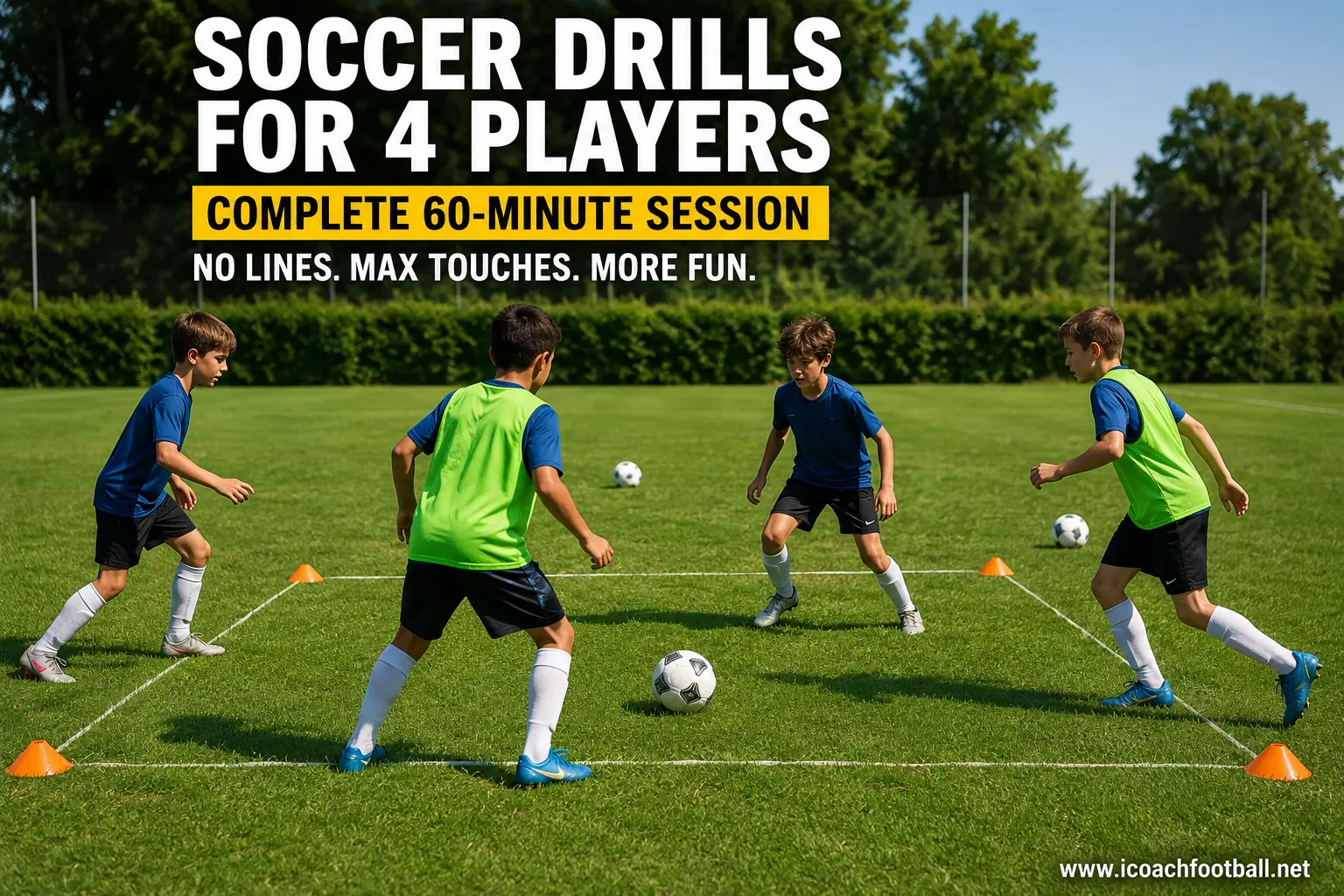
Only four players have arrived, the goalkeeper is unavailable, and the session you planned no longer works.
That does not mean training has to be cancelled—or reduced to an hour of passing between cones.
A group of four is small enough to give every player constant involvement but large enough to train many of the actions that decide real matches: receiving, supporting, dribbling, defending, reacting to turnovers and competing under pressure.
This complete 60-minute session contains five soccer drills for 4 players. There are no long lines, no goalkeeper is required, and every activity can be adjusted for youth, academy or adult players.
Quick answer: The best four-player soccer session combines ball mastery, passing and awareness, a 3v1 rondo, opposed 1v1 work and a competitive 2v2 game.
You need four balls, 8–12 cones, four bibs and four mini-goals or cone gates.
Soccer Drills for 4 Players: Session Overview
The session moves from individual ball contact into passing, possession, direct opposition and a final small-sided game. Each activity prepares the players for the next part of the session.
| Time | Activity | Main focus | Intensity |
|---|---|---|---|
| 0–8 minutes | Four-Corner Ball Mastery | Touches, scanning and reactions | Moderate |
| 8–18 minutes | Two-Ball Passing Square | Passing, receiving and awareness | Moderate |
| 18–30 minutes | 3v1 Escape Rondo | Support angles and pressing | High |
| 30–42 minutes | 1v1 Transition Gates | Dribbling, defending and recovery | High |
| 42–57 minutes | 2v2 Four-Goal Game | Width, decisions and transitions | Very high |
| 57–60 minutes | Recovery and Review | Cooldown and reflection | Low |
Why Training With Only Four Players Can Be Effective
The obvious limitation of a four-player session is that you cannot reproduce an entire 11v11 tactical picture. The advantage is that nobody can disappear.
Every player is constantly involved. They are either on the ball, supporting the ball, defending, transitioning or preparing for the next action. Poor first touches are exposed immediately, support angles matter, and every turnover creates a new problem to solve.
A four-player session is particularly useful for:
- low-attendance training nights;
- private and small-group coaching;
- additional technical work before team training;
- players returning gradually to full practice;
- indoor or limited-space sessions;
- players who need more touches and individual feedback.
Small-sided environments increase player involvement because there are fewer players sharing the same ball and space. Coaches can also adjust the pitch size, scoring rules and time limits to change the technical, tactical and physical demands.
For more information about game-based coaching, read the official U.S. Soccer Play-Practice-Play guidance.
Equipment and Setup
PlayersFour outfield players
DurationApproximately 60 minutes
Recommended agesU9 to adult
GoalkeeperNot required
Maximum areaApproximately 25 × 20 yards
EquipmentFour balls, cones, bibs and mini-goals
Set up the main training area before the players begin. A four-player practice should flow quickly. If the coach spends several minutes rebuilding the field between exercises, one of the biggest advantages of small-group training is lost.
Drill 1: Four-Corner Ball Mastery and Scanning
This is not intended to be a slow cone warm-up. The objective is to prepare the players technically while immediately asking them to scan and react to the movement of the other three players.
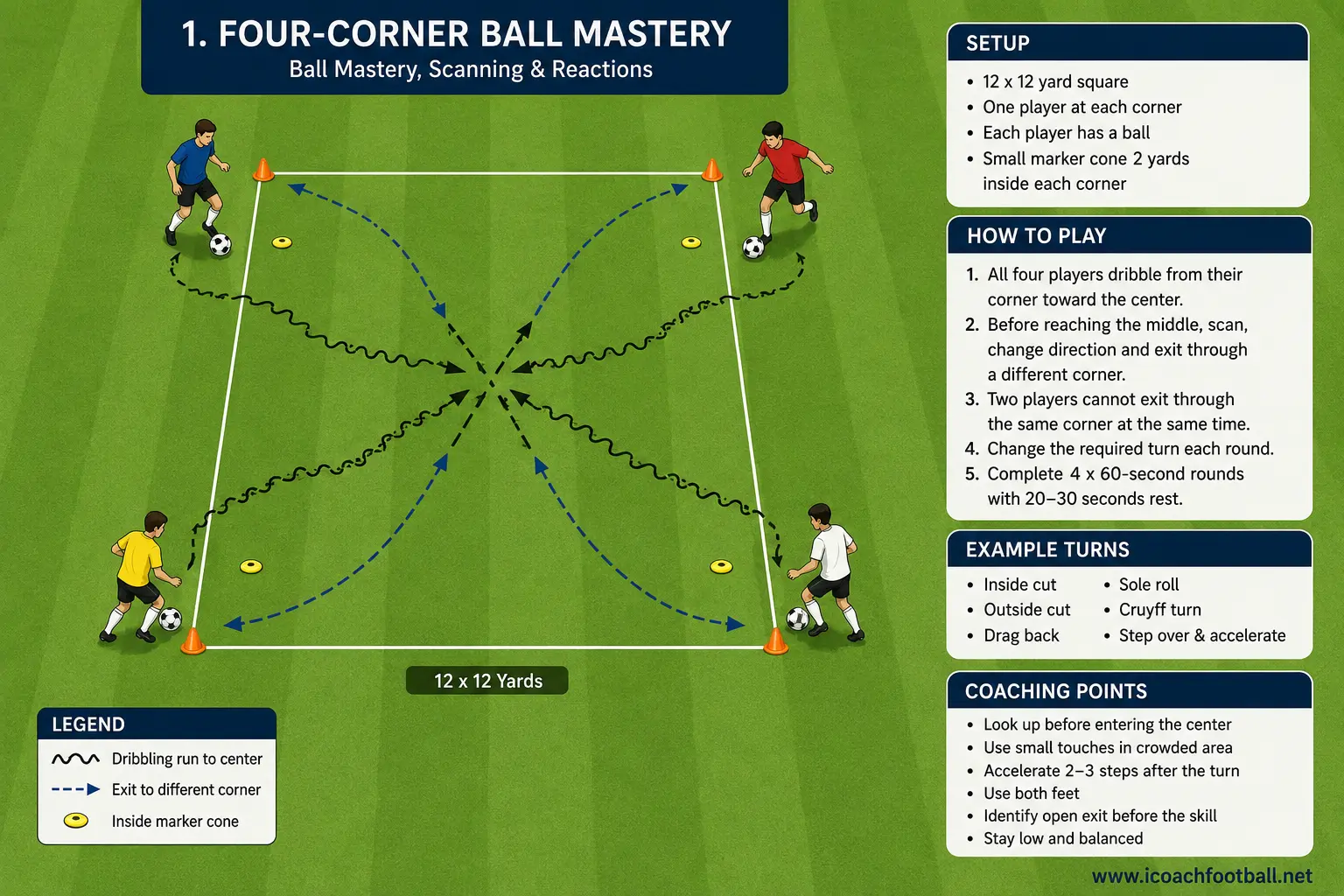
Setup
- Create a 12 × 12-yard square.
- Place one player at each corner.
- Give every player a ball.
- Place a small marker approximately two yards inside each corner.
How to Run the Drill
- All four players dribble from their corner toward the central area.
- Before reaching the middle, each player scans, changes direction and exits through a different corner.
- Two players cannot leave through the same corner at the same time.
- Change the required turn after each round.
- Complete four 60-second rounds with 20–30 seconds of recovery.
Suggested Turns
- inside cut;
- outside cut;
- sole roll;
- drag-back;
- Cruyff turn;
- step-over and acceleration.
Coaching Points
- Look up before entering the central area.
- Use smaller touches when the space becomes crowded.
- Accelerate for two or three steps after changing direction.
- Use both feet rather than repeating the strongest-side turn.
- Identify the open exit before performing the skill.
- Keep the knees slightly bent and the body balanced.
Coach’s note: Watch the players’ eyes as closely as their feet. A player who performs a perfect turn while staring continuously at the ball has completed only half the task.
Progressions:
- Assign a color or number to each exit and call the target late.
- Ask players to exchange balls with a teammate in the middle.
- Allow one player to work without a ball and apply passive pressure.
- Award one point for every clean exit without a collision.
Drill 2: Two-Ball Passing Square
With two balls moving at the same time, players cannot switch off after making a pass. They must receive with an open body shape, check the position of the second ball and communicate early.
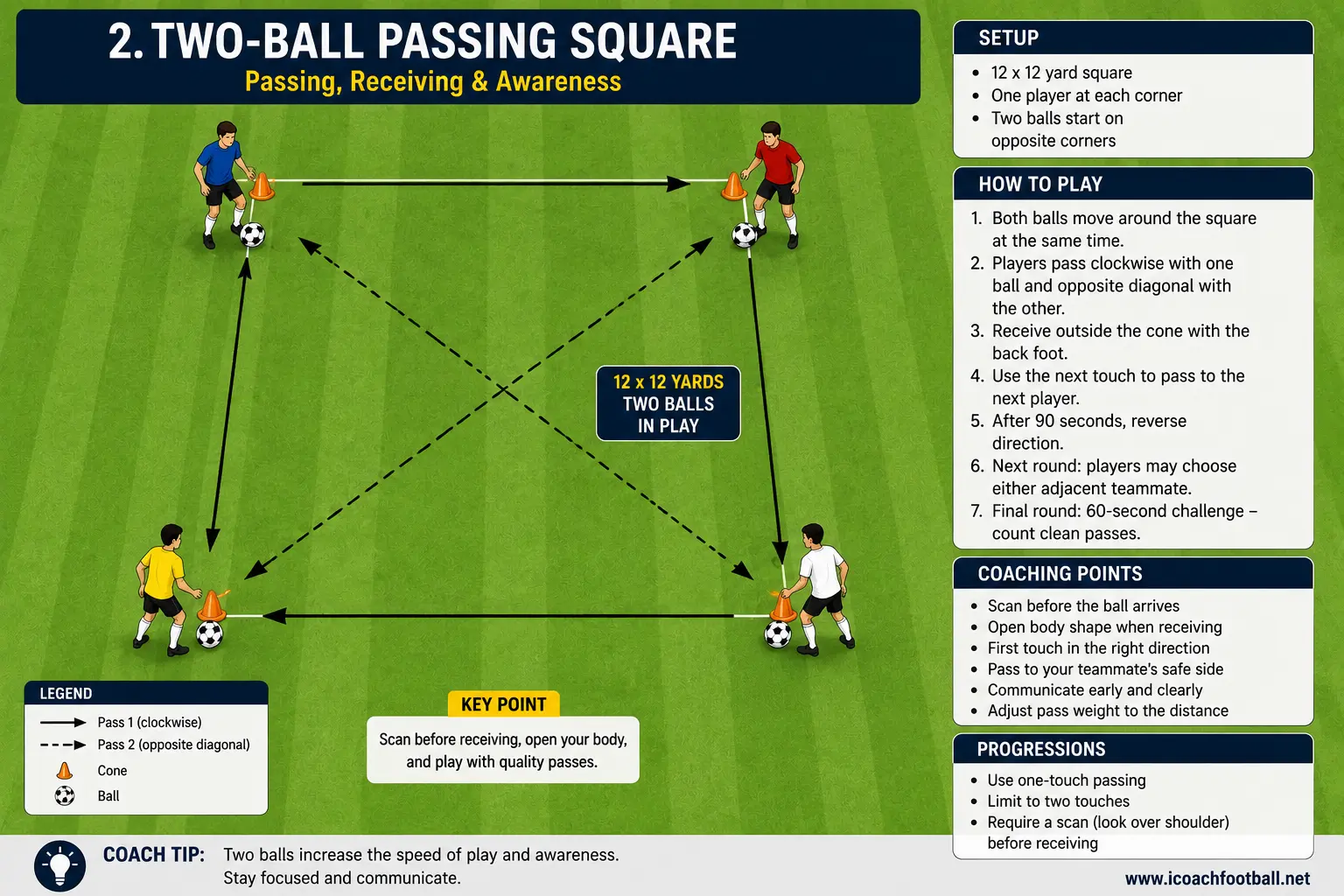
Setup
- Keep the same 12 × 12-yard square.
- Place one player at each corner.
- Start with two balls on opposite corners.
How to Run the Drill
- Both balls travel clockwise around the square.
- Players receive outside the cone with the back foot.
- The next touch is used to pass toward the next player.
- After 90 seconds, reverse the direction.
- In the next round, each player may choose either adjacent teammate.
- Finish with a 60-second team challenge and count the clean passes.
Coaching Points
- Scan before the ball arrives.
- Receive side-on rather than facing the passer squarely.
- Move the first touch toward the next passing line.
- Pass toward the teammate’s safe side.
- Adjust the weight of the pass to the distance.
- Communicate using names and useful information.
If the second ball creates confusion, do not remove it immediately. Slow the tempo and demand earlier scanning. The second ball is what changes a basic passing square into an awareness exercise.
Make it easier: Start with one ball and introduce the second ball when the players understand the movement.
Make it harder: Use two-touch passing, one-touch passing or require every player to check their shoulder before receiving.
For more passing exercises, use the ideas in 27 Soccer Passing Drills Every Coach Needs.
Drill 3: The 3v1 Escape Rondo
A standard 3v1 rondo can become repetitive if the outside players simply keep possession without trying to progress. The escape rule gives possession a clear purpose: attract the defender, recognize the free space and attack an open gate.
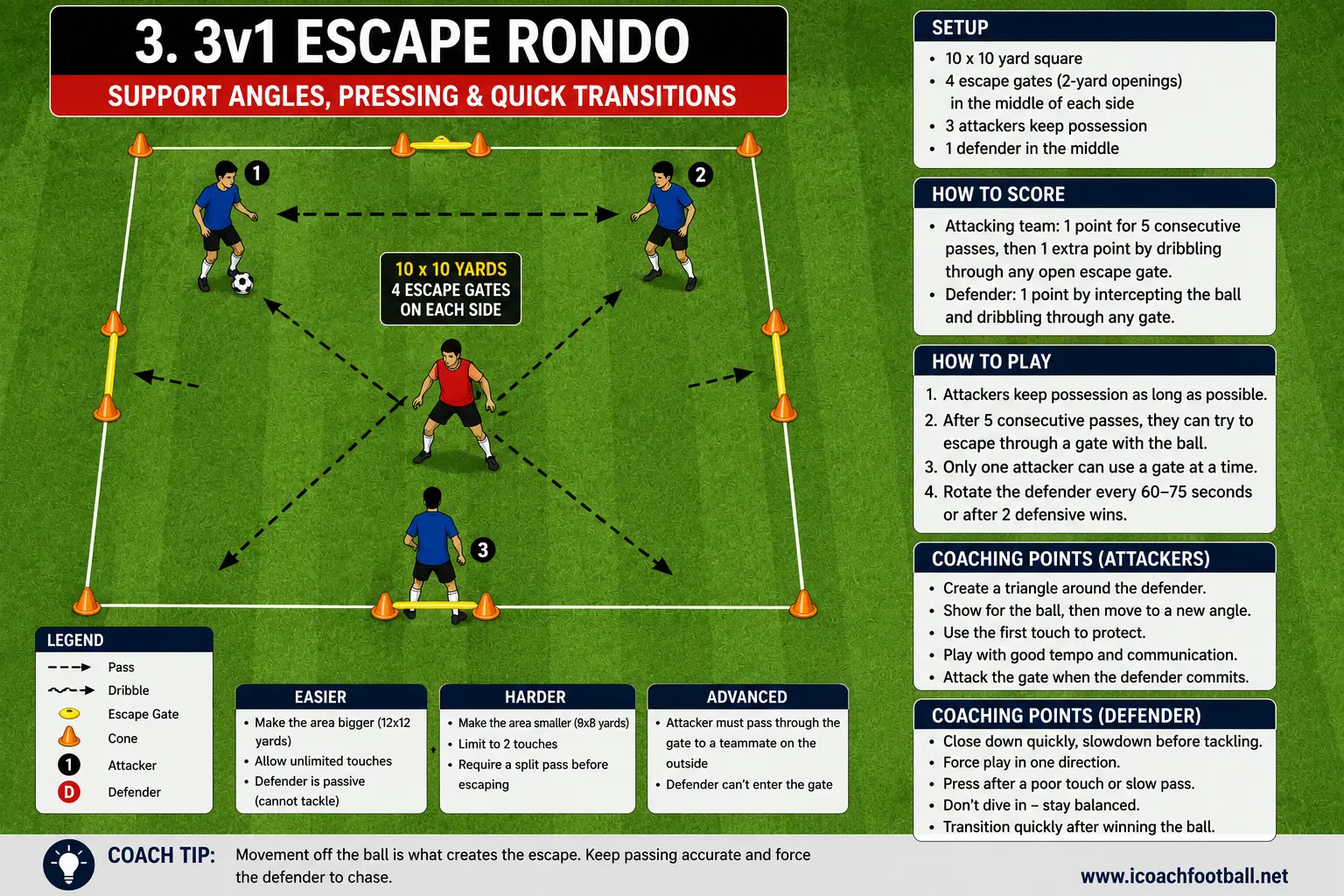
Setup
- Create a 10 × 10-yard square.
- Place a two-yard escape gate on each side.
- Three players keep possession against one defender.
- The three attackers may move freely inside the area.
How to Score
- The attackers earn one point after completing five consecutive passes.
- After the fifth pass, an attacker can earn a second point by dribbling through an open escape gate.
- The defender scores by winning the ball and dribbling through any gate.
- Change the defender after 60–75 seconds or after two defensive wins.
Attacking Coaching Points
- Create a triangle around the defender.
- Avoid standing in a straight line.
- Move while the pass is travelling.
- Receive with the furthest foot where possible.
- Use the first touch to protect the ball.
- Attack the gate when the defender overcommits.
Defending Coaching Points
- Approach quickly but arrive under control.
- Use the body angle to remove one passing option.
- Press aggressively after a poor touch or slow pass.
- Avoid chasing the ball without a clear purpose.
- Transition immediately after regaining possession.
Easier version: Increase the area to 12 × 12 yards and allow unlimited touches.
Harder version: Reduce the area, introduce a two-touch limit or require a split pass before the escape.
Advanced version: The attackers must pass through the gate to a teammate instead of dribbling through it.
For additional rondo progressions, see The Rondo Blueprint: 5 Advanced Soccer Rondos.
Drill 4: 1v1 Transition Gates
The first three activities favor possession. This practice introduces direct opposition and forces an immediate change of mentality when the ball is won or lost.
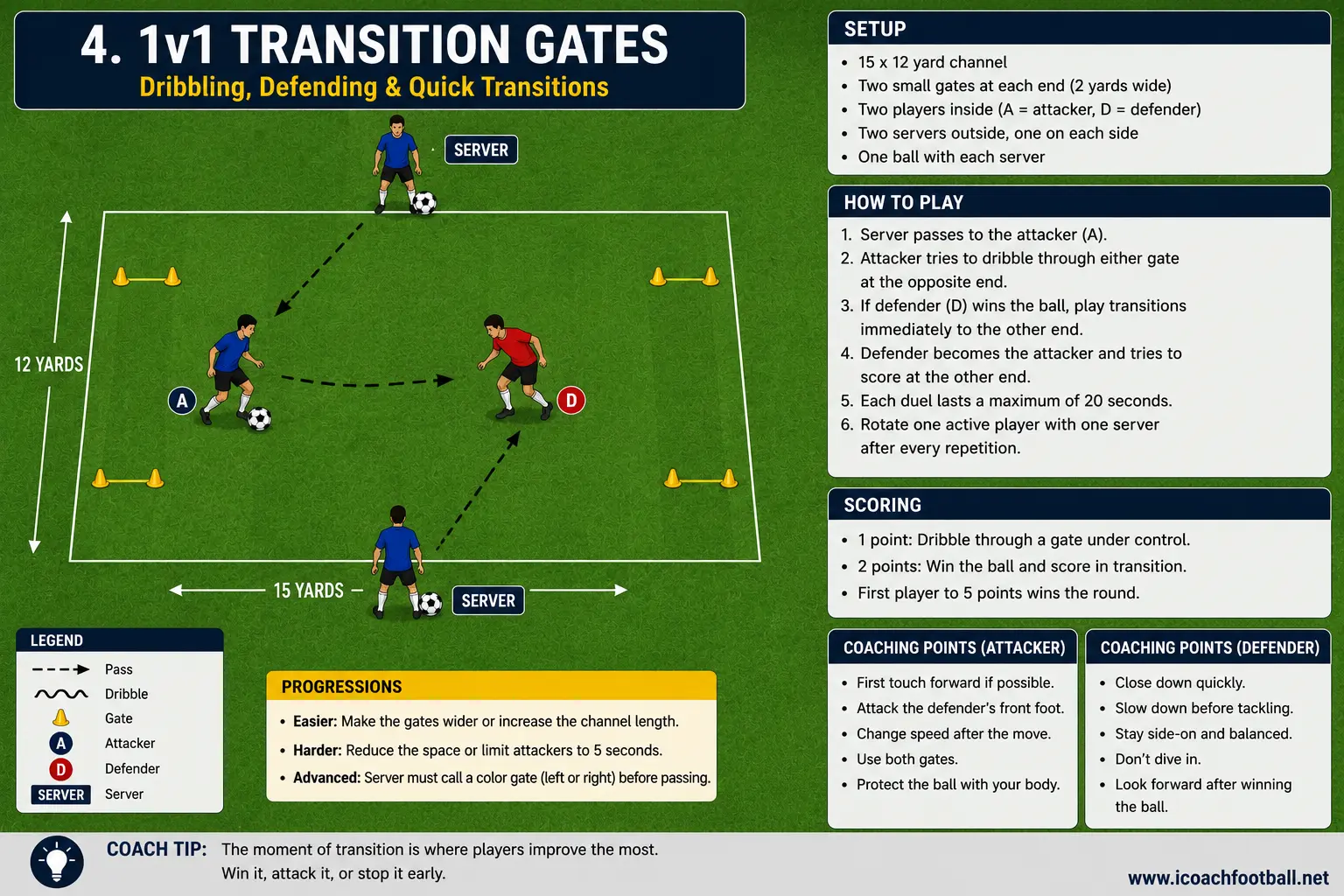
Setup
- Create a 15 × 12-yard channel.
- Place two small scoring gates at each end.
- Two players begin inside the channel.
- The other two act as servers, one on each touchline.
- Keep one ball with each server.
How to Run the Drill
- One server passes to the attacker inside the channel.
- The attacker attempts to dribble through either gate at the opposite end.
- If the defender wins possession, the direction changes immediately.
- The defender becomes the attacker and tries to score at the other end.
- Each duel lasts for a maximum of 20 seconds.
- Rotate one active player with one server after every repetition.
Scoring
- One point for dribbling through a gate under control.
- Two points for regaining the ball and scoring during the transition.
- The first player to five points wins the round.
Attacking Coaching Points
- Take the first touch forward when space is available.
- Attack the defender’s front foot.
- Change speed after the feint.
- Use the second gate when the nearest route closes.
- Protect the ball with the body when necessary.
Defending Coaching Points
- Close the space quickly.
- Slow down before reaching tackling distance.
- Remain side-on and balanced.
- Avoid diving into the tackle.
- Look forward immediately after winning possession.
Coach’s note: Do not praise only successful dribbles. Also recognize defenders who delay the attacker, recover after being beaten or transition forward immediately after regaining possession.
For a longer competitive 1v1 format, use The 1v1 King of the Hill Tournament.
Drill 5: 2v2 Four-Goal Transition Game
The final activity brings the entire session together. Players must pass, support, dribble, defend space and react when possession changes.
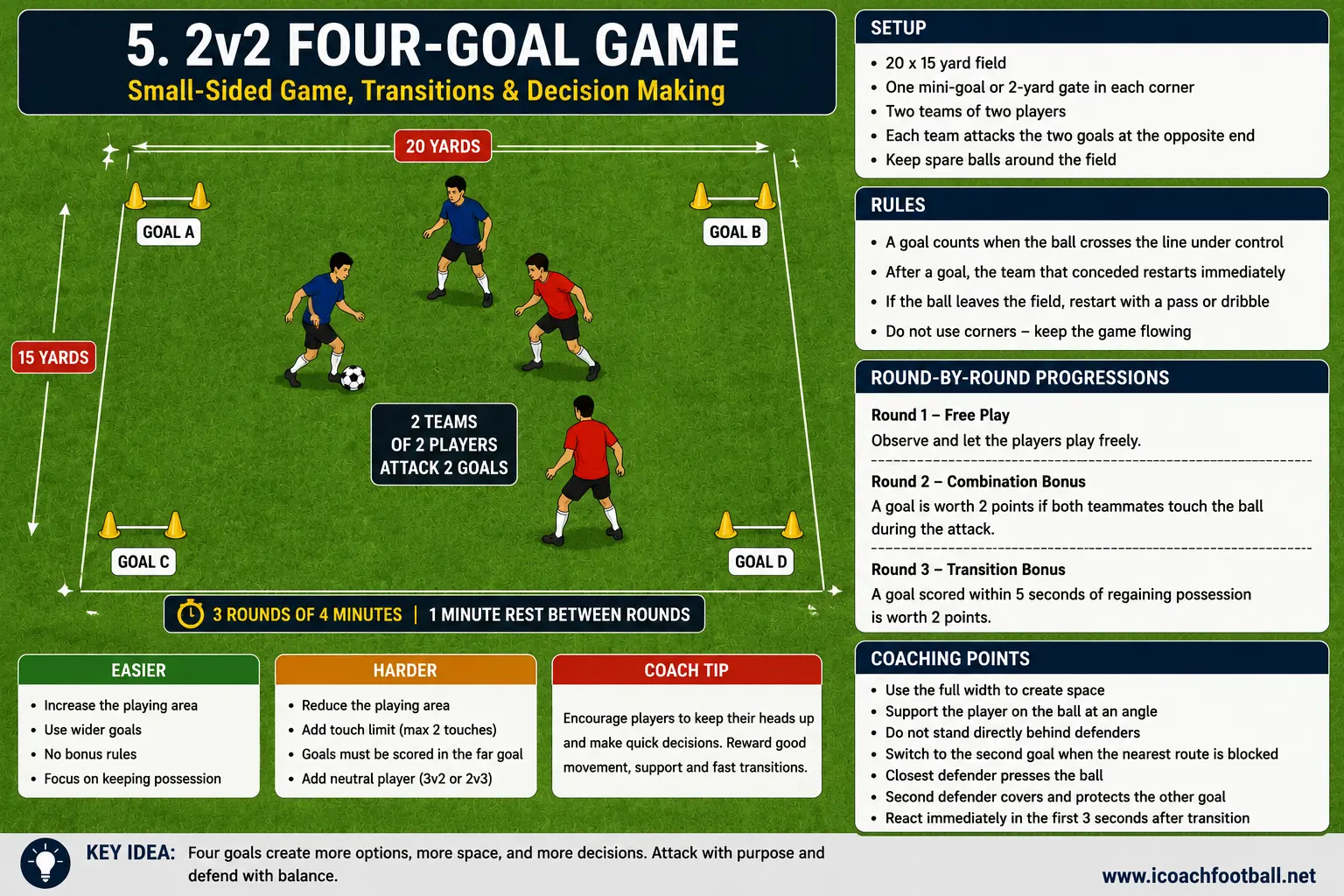
Four goals create constant decisions because the attacking team always has more than one route to score.
Setup
- Create a 20 × 15-yard field.
- Place one mini-goal or two-yard cone gate near each corner.
- Divide the players into two teams of two.
- Each team attacks the two goals at the opposite end.
- Keep spare balls around the field for fast restarts.
Rules
- Play three rounds of four minutes.
- Allow one minute of recovery and coaching between rounds.
- A goal counts only when the ball crosses the line under control.
- After a goal, the team that conceded restarts immediately.
- If the ball leaves the field, restart with a pass or dribble.
- Do not use corners; keep the game flowing.
Round-by-Round Progressions
Round 1: Free play
Observe the players before giving detailed instructions. Look at their natural spacing, support and reaction after losing possession.
Round 2: Combination bonus
A goal is worth two points if both teammates touch the ball during the attack.
Round 3: Transition bonus
A goal scored within five seconds of regaining possession is worth two points.
What to Coach
- Use the full width to separate the defenders.
- Support the player on the ball at a different angle.
- Avoid standing directly behind a defender.
- Switch toward the second goal when the nearest route is blocked.
- The closest defender pressures the ball.
- The second defender provides cover and protects the other goal.
- React immediately during the first three seconds after possession changes.
Do not overcoach the final game: Let the players experience the consequences of their decisions. Make one clear correction between rounds rather than stopping every attack.
More game-based practices are available in the Small-Sided Soccer Games library.
Complete 60-Minute Practice Plan
| Activity | Duration | Work format | Coaching priority |
|---|---|---|---|
| Four-Corner Ball Mastery | 8 minutes | Four 60-second rounds | Scan before turning |
| Two-Ball Passing Square | 10 minutes | Three progressive rounds | First touch and awareness |
| 3v1 Escape Rondo | 12 minutes | 60–75-second rotations | Support angles and pressing triggers |
| 1v1 Transition Gates | 12 minutes | Short 20-second duels | Change of speed and transition |
| 2v2 Four-Goal Game | 15 minutes | Three four-minute rounds | Width, support and reactions |
| Recovery and Review | 3 minutes | Light movement and questions | Player reflection |
How to Adapt the Session for Different Ages
U7–U9 Players
- Increase the size of the areas.
- Use wider scoring gates.
- Avoid strict touch restrictions.
- Demonstrate rather than giving long explanations.
- Keep defending periods to 30–45 seconds.
- Use simple language such as “find space” and “help your teammate.”
U10–U13 Players
The session can be used largely as written.
Ask the players to scan before receiving and introduce simple tactical language such as width, support, pressure, cover and transition.
U14 to Adult Players
- Reduce the playing areas.
- Increase the speed of restarts.
- Add weaker-foot conditions.
- Use touch limits during selected rounds.
- Reward goals scored quickly after regaining possession.
- Track individual and team scores.
Common Mistakes When Coaching Only Four Players
Turning the Whole Session Into Cone Passing
Technical repetition is valuable, but four players provide ideal numbers for 3v1, 1v1 and 2v2 exercises. Use opposition so the players must read teammates, defenders and space.
Talking for Too Long
When the coach speaks, all four players stop. A two-minute explanation removes eight combined minutes of player activity.
Demonstrate quickly, begin the exercise and make one correction at a time.
Making Every Exercise Physically Exhausting
Small numbers naturally create high involvement. Alternate demanding opposed work with controlled technical practice. Quality falls when every activity becomes a fitness punishment.
Using an Area That Is Too Small
A tight area can improve speed of play, but it can also create random collisions and constant turnovers. Begin slightly larger and reduce the dimensions only when the players can maintain control.
Removing Competition
Small-group sessions become flat when every activity is cooperative. Use points, timed challenges and short rounds to increase concentration naturally.
What If a Fifth Player Arrives?
You do not need to abandon the session.
Use the fifth player as:
- a rotating neutral player in the 2v2 game;
- a second defender in a 3v2 rondo;
- a target player behind the scoring gates;
- a server who rotates after each repetition;
- a recovery player during the highest-intensity rounds.
If attendance falls to three, use 3 High-Intensity Soccer Drills for 3 Players.
Soccer Drills for 4 Players: Frequently Asked Questions
Can four players have a proper soccer practice?
Yes. Four players are enough for ball mastery, passing, a 3v1 rondo, 1v1 duels and a competitive 2v2 game. The group cannot reproduce full-team tactics, but it can complete a highly active technical and physical session.
What are the best soccer drills for four players?
The strongest combination is a two-ball passing square, a 3v1 rondo, an opposed 1v1 exercise and a 2v2 small-sided game. Together, these activities train technique, awareness, attacking, defending and transitions.
Can these drills be completed without a goalkeeper?
Yes. Every exercise in this session uses mini-goals, cone gates or open space. A goalkeeper is not required.
How much space is needed?
The largest activity uses an area of approximately 20 × 15 yards. Younger players may benefit from slightly more room, while advanced players can work in a smaller space.
How long should a small-group soccer session last?
For most youth players, 45–60 minutes is sufficient when involvement is constant. Older and more advanced players can train longer, but the quality of the actions should determine the duration.
Are four-player drills useful for adult players?
Yes. Reduce the space, increase the speed of the restarts and use more demanding scoring conditions. The same 3v1, 1v1 and 2v2 formats can provide high-quality training for adults.
Can this session be used indoors?
Yes. Replace mini-goals with cone gates, use an appropriate indoor or futsal ball and reduce the size of the 1v1 and 2v2 areas to suit the available space.
Final Coaching Note
A low-attendance training night does not have to become a wasted night.
Four players are enough to create hundreds of purposeful touches, repeated duels and constant decisions. The key is the flow of the session: begin with the ball, add awareness, introduce opposition and finish with a competitive game.
Keep the explanations short. Keep the ball moving. Let the players solve problems.
That is how a group of four leaves the field feeling as though it trained properly—not as though it merely filled an hour.
Continue the small-group series:
Start with Soccer Drills for 3 Players, then use this four-player session before progressing to five-, six-, eight- and ten-player practice plans.