Soccer Drills for Preschoolers: 6 Games for a Mixed-Age Class (Ages 3–5)
Quick answer
Preschool soccer is never one age. A real preschool class mixes 3-, 4- and 5-year-olds in one group — and a session written for one age fails the other two. These six games are built for that mixed-age class: one ball per child, every 3-year-old paired with a 5-year-old big buddy, and a 3-year-old job and a 5-year-old job inside every game, in one 30-minute class.
Suitable for: ages 3–5 (preschool, pre-U6)
Session snapshot
- Players: 8–12 preschoolers (ages 3–5 mixed, plus one adult per group of 4)
- Area: 20 x 15 yards (a garden, hall or small pitch)
- Duration: 30 minutes
- Focus: Dribbling, stopping the ball, first passing, colours, fun
- Equipment: 1 ball per child (size 2), 20 cones in 4 colours, 4 mini goals, bibs, music on a phone
Why these six games work
In the UK the same class is football drills for preschoolers, and the problem is the same on both sides of the Atlantic: almost everything written for young players is written for one age, and a preschool coach runs a mixed class. The games below follow the Play-Practice-Play model FIFA’s Grassroots Coaching Essentials sets out for ages 4–8: start with play, practise the skill in the middle, and finish with play again — so the children never sit through a lecture, and the game itself does the teaching. FIFA’s guidance starts at 4, and this class takes the same principles one step younger, with a big buddy beside every 3-year-old. The World Health Organization’s guidance for children under 5 says children aged 1–2 and 3–4 need at least 180 minutes of physical activity a day, spread through the day — a 30-minute ball class like this one is a joyful slice of that total, not a training block. So every game here gives each child their own ball, lasts four or five minutes, and has a story — puppies, Simon Says, gardens, colours, music, a World Cup — because a preschooler remembers a story long after they forget an instruction.
Six rules of coaching preschoolers
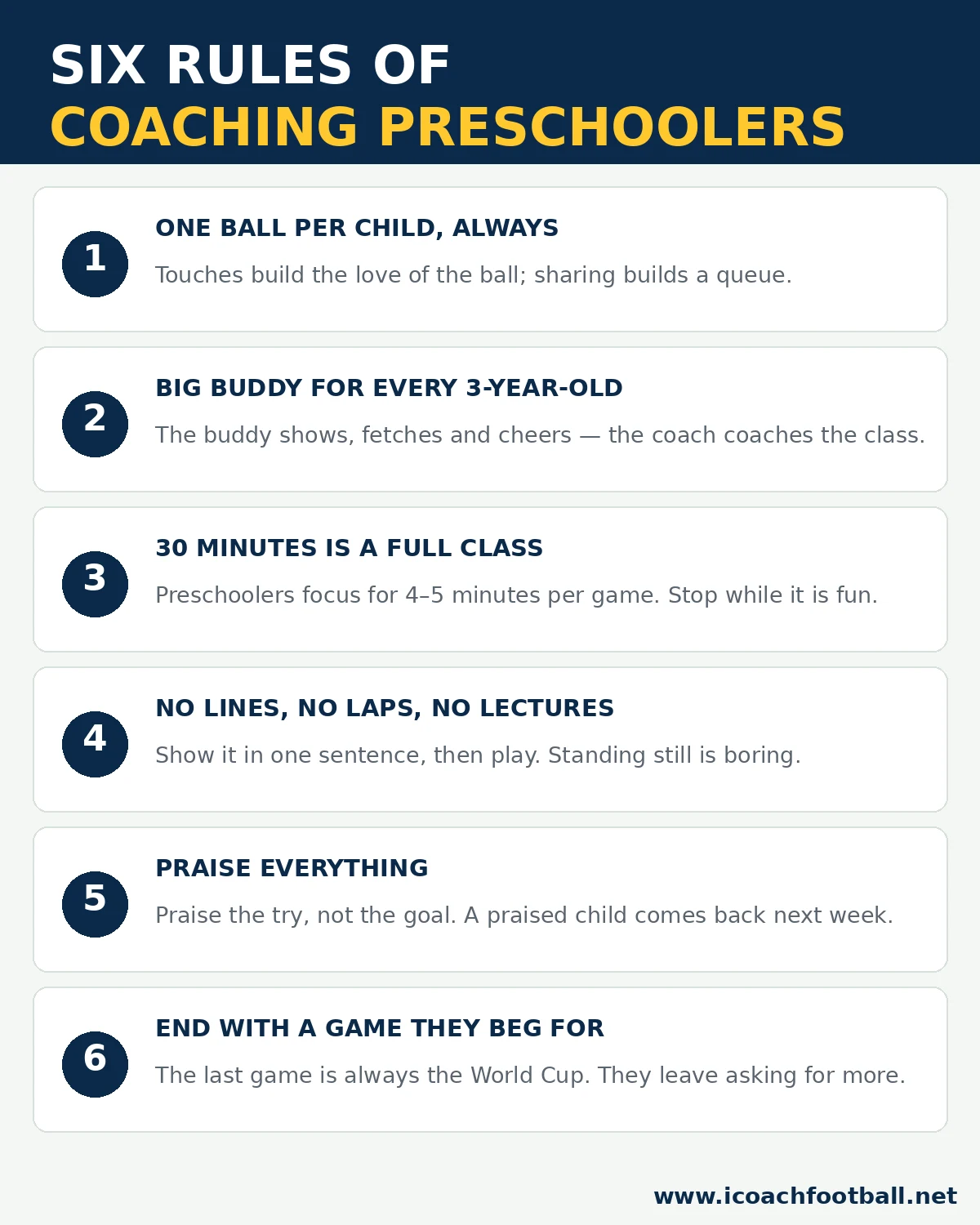
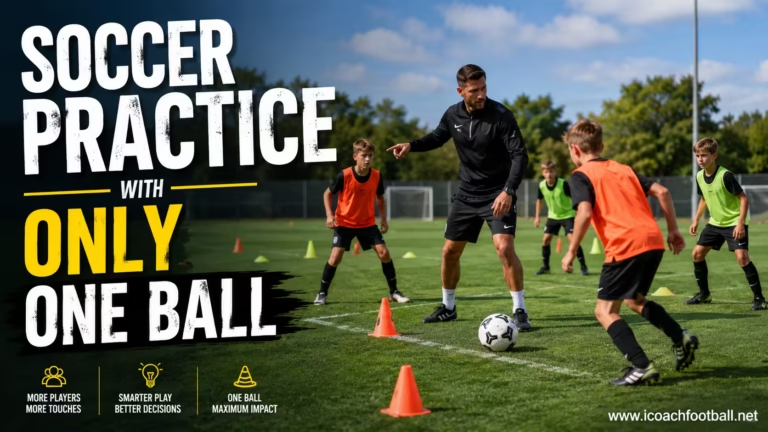
- One ball per child, always. Touches build the love of the ball; sharing one ball builds a queue.
- Pair every 3-year-old with a 5-year-old big buddy. The buddy shows, fetches and cheers — the coach coaches the whole class.
- 30 minutes is a full class. Preschoolers focus for 4–5 minutes per game. Stop while it is still fun.
- No lines, no laps, no lectures. Show it in one sentence, then play. If they are standing, they are bored.
- Praise everything. Praise the try, not the goal. A child who is praised comes back next week.
- End with a game they beg to play again. The last game is always the World Cup. They leave asking for more.
Drill 1 — Walk the Puppy
Every child dribbles their ball around the garden like a puppy on a lead — the ball stays close, or the puppy runs away. The first game of the class, and the one that teaches the only skill that matters at 3: keeping the ball close while moving.
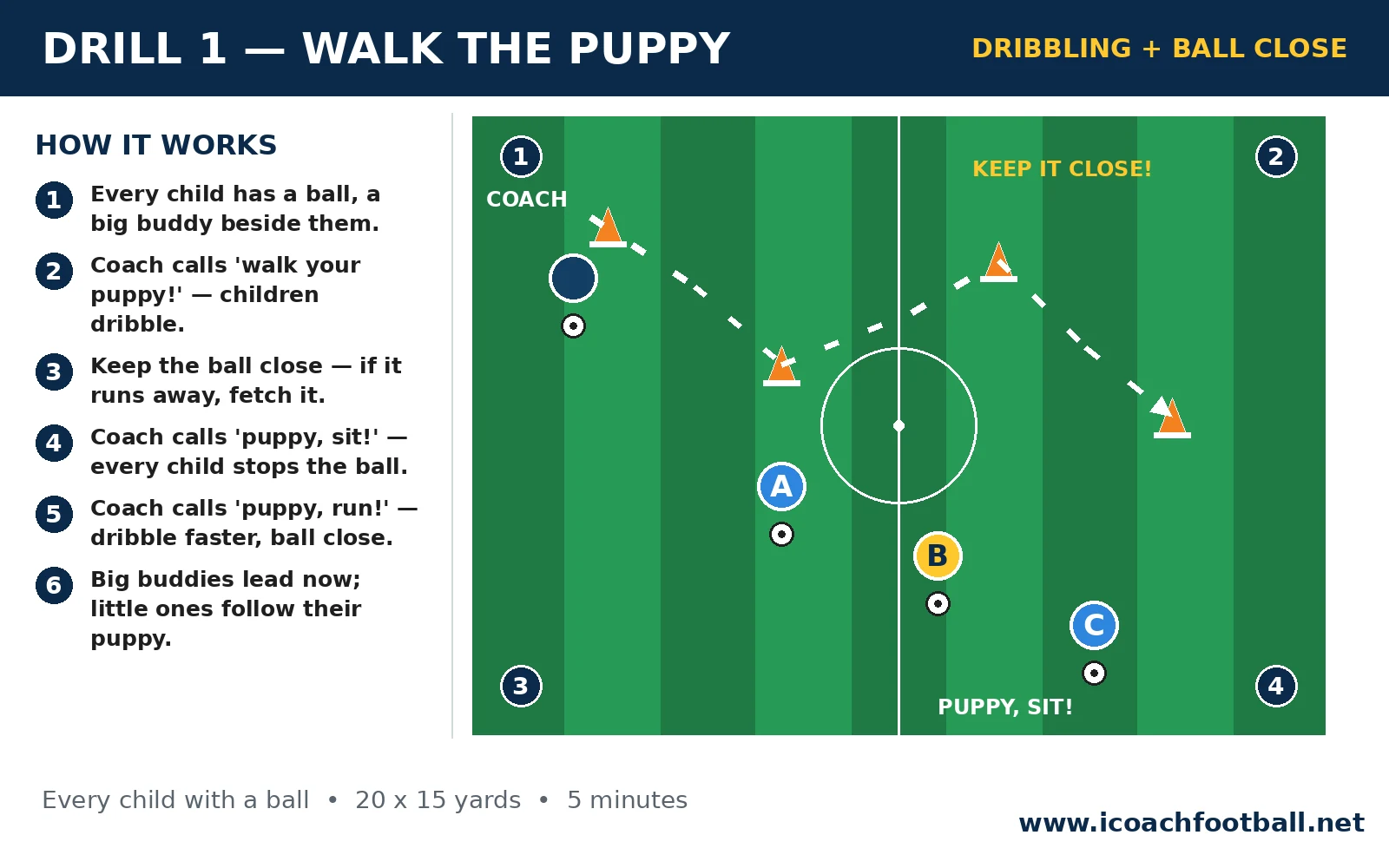
- Setup: 20 x 15 yard area (“the garden”). Every child with a size 2 ball. 5 minutes.
How to play:
- Every child stands with a ball, a big buddy beside the 3-year-olds.
- The coach says “walk your puppy!” and the children dribble slowly around the garden.
- The ball must stay close — if it runs away, the puppy is lost and the child fetches it.
- The coach calls “puppy, sit!” and every child stops the ball dead with the sole of their foot.
- The coach calls “puppy, run!” and the children dribble faster, still keeping the ball close.
- After two minutes the big buddies lead, and the little ones follow their buddy’s puppy.
- Coach’s note: “Little kicks, little steps — the puppy never runs away from you.”
- Progressions: The puppy must stay inside the garden (boundaries); dribble with the weak foot only; the puppy weaves around the cones.
Drill 2 — Simon Says Soccer
Simon says dribble, Simon says stop, Simon says turn — and if Simon does not say it, the ball stays still. The listening game that teaches stopping and turning without a single technical word.
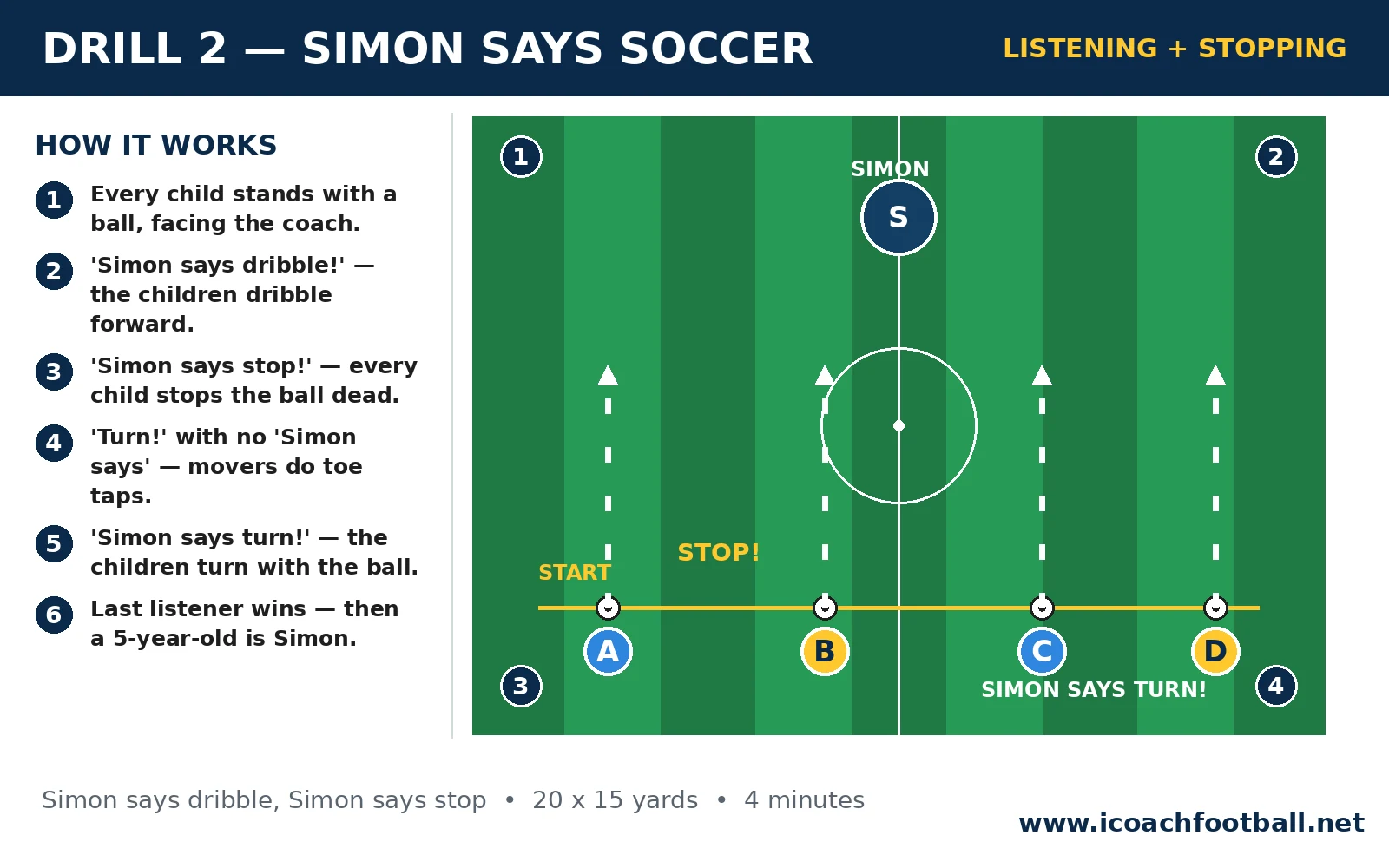
- Setup: 20 x 15 yard area. Every child with a size 2 ball. Coach at one end. 4 minutes.
How to play:
- Every child stands with a ball, facing the coach.
- The coach says “Simon says dribble!” and the children dribble forward.
- The coach says “Simon says stop!” and every child stops the ball dead.
- The coach says “turn!” without “Simon says” — anyone who turns does five toe taps.
- The coach says “Simon says turn!” and the children turn with the ball.
- The last child still listening wins — then a 5-year-old gets to be Simon.
- Coach’s note: “Ears open, ball close — listen first, move second.”
- Progressions: Add “Simon says hop over the ball”; the commands come faster; a 5-year-old calls the commands while the coach watches.
Drill 3 — Clean Your Garden
Two gardens, one messy with balls — kick every ball out of your garden into the other team’s garden. The passing game that works at 3 because the target is a whole half of the pitch, and every kick feels like winning.
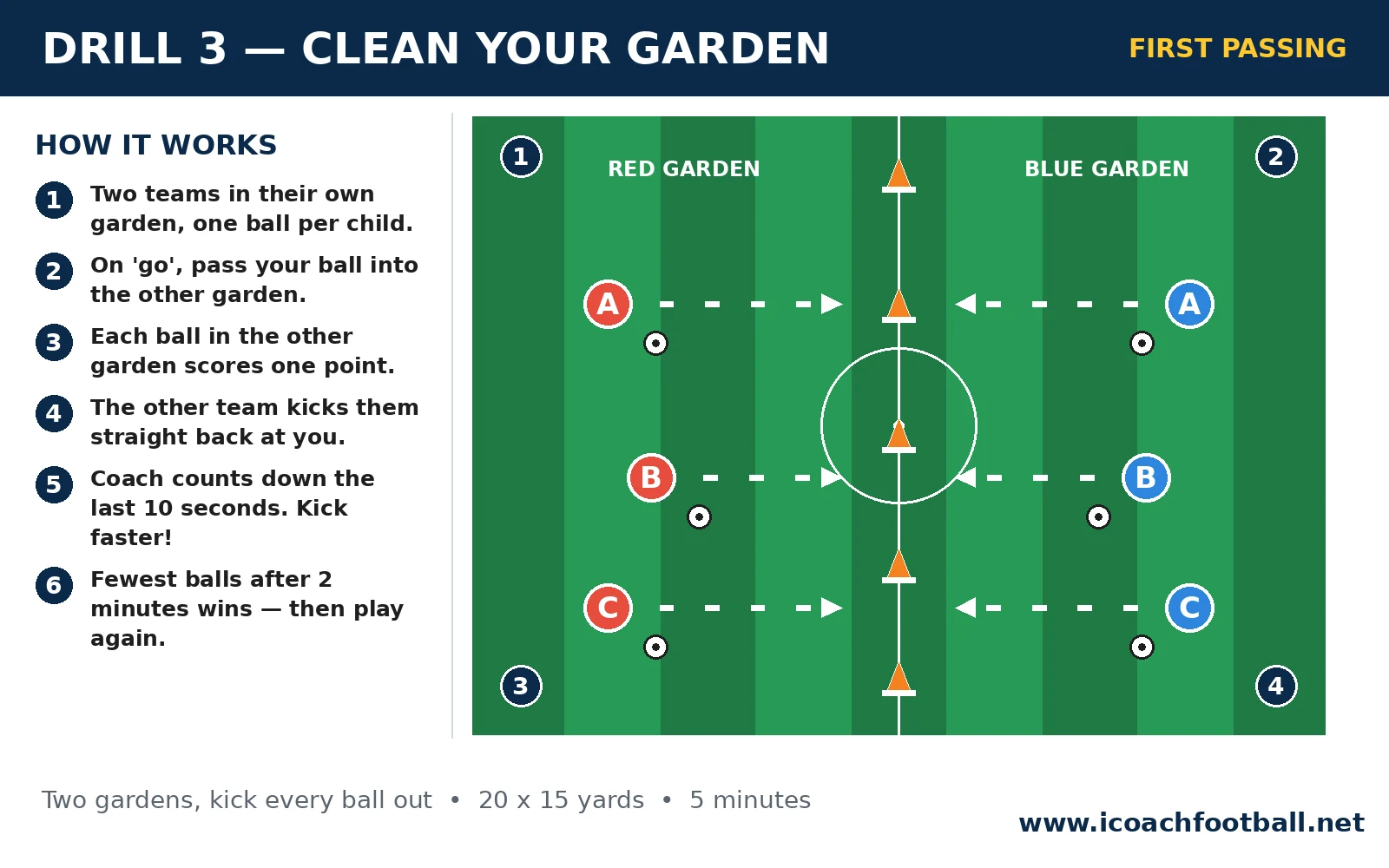
- Setup: 20 x 15 yard area split into two gardens by a line of cones. 2 teams of 4–6, one ball per child, balls scattered in both gardens. 5 minutes.
How to play:
- Two teams stand in their own garden, each child with a ball.
- On “go”, the children pass their ball into the other team’s garden.
- Every ball that lands in the other garden scores one point for your team.
- Balls keep coming back — the other team kicks them straight back at you.
- The coach counts down the last 10 seconds and the children kick faster.
- After 2 minutes the garden with the fewest balls wins — then play again.
- Coach’s note: “Pass with the inside of your foot — the flat part — and the ball goes where you look.”
- Progressions: Only the 5-year-olds may kick with their weak foot; balls must stay on the ground; the gardens get narrower.
Drill 4 — Colour Match
The coach calls a colour, and every child passes their ball to the cone of that colour. The passing game that teaches accuracy and colours at the same time — because the target is a colour, not a teammate.
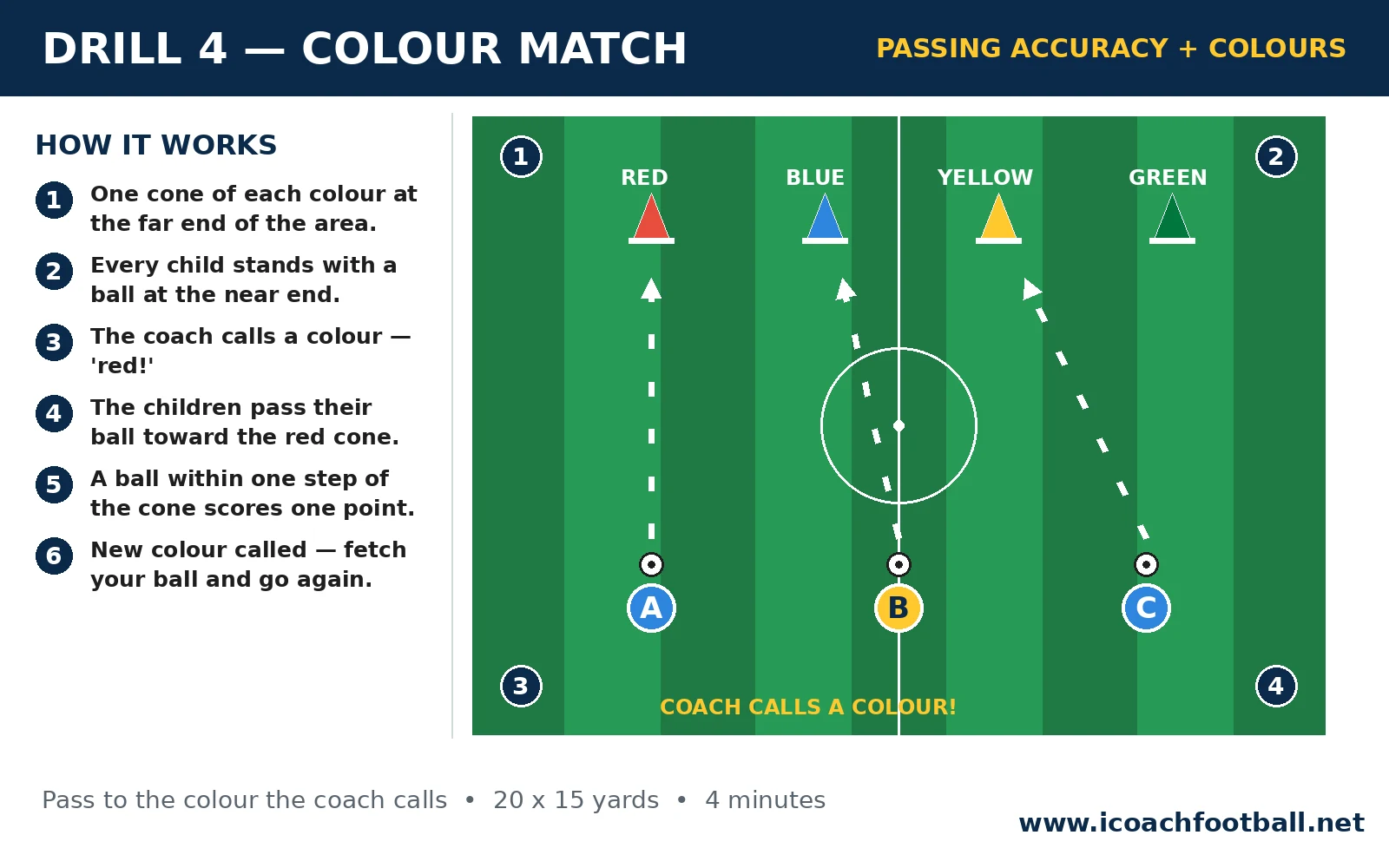
- Setup: 20 x 15 yard area. 4 coloured cones (red, blue, yellow, green) at the far end. 1 ball per child. 4 minutes.
How to play:
- Put one cone of each colour at the far end of the area.
- Every child stands with a ball at the near end.
- The coach calls a colour — “red!”
- The children pass their ball toward the red cone.
- A ball that stops within one step of the cone scores one point.
- The coach calls a new colour and the children fetch their ball and go again.
- Coach’s note: “Point your standing foot at the colour — the ball follows your foot.”
- Progressions: The coach calls two colours in a row; the 5-year-olds pass with their weak foot; the cones move further away.
Drill 5 — Musical Balls
Dribble while the music plays, and when the music stops, stop the ball and sit on it. The game that teaches stopping the ball and listening at the same time — and the one the children ask for by name.
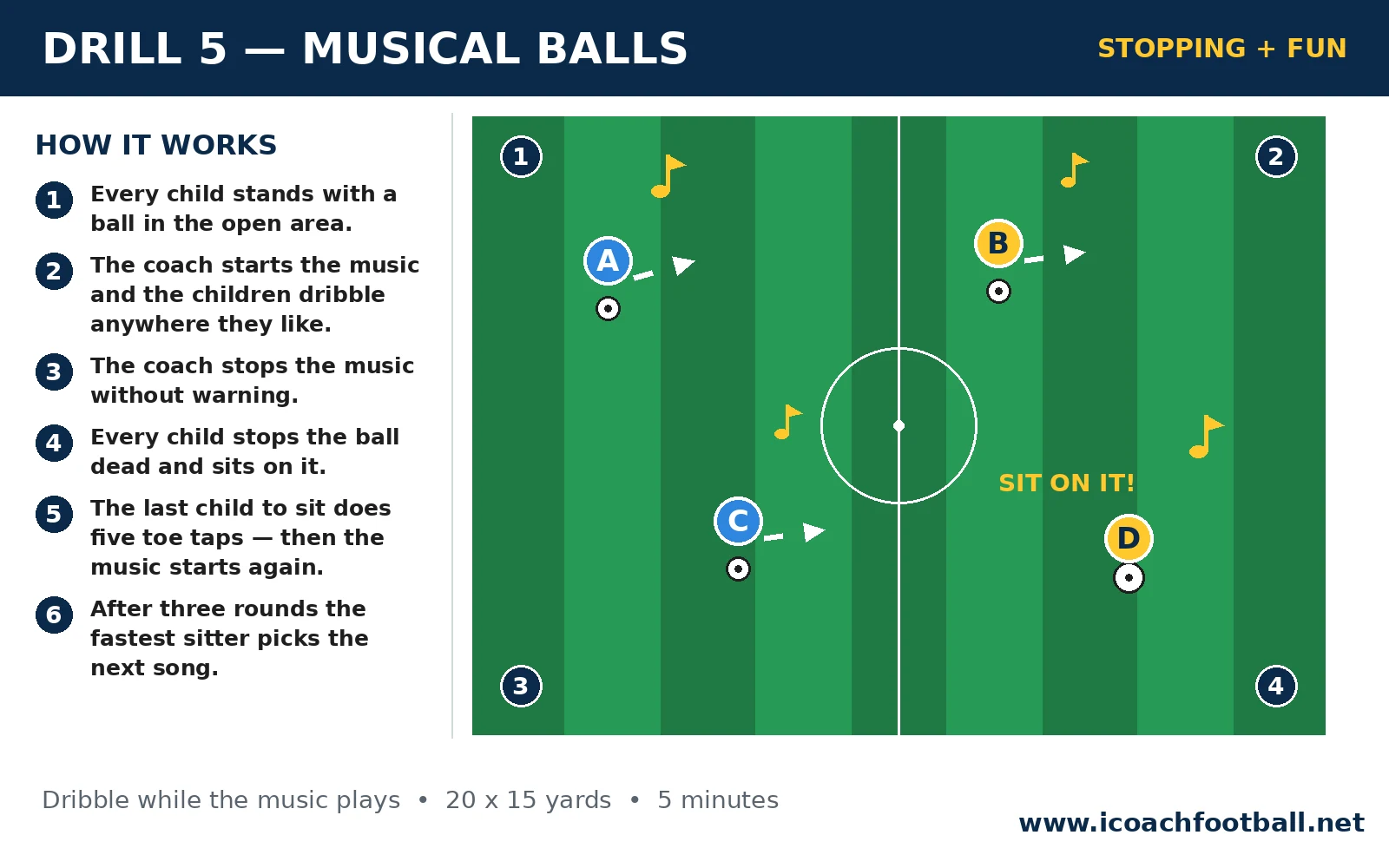
- Setup: 20 x 15 yard area. Every child with a size 2 ball. Music on a phone. 5 minutes.
How to play:
- Every child stands with a ball in the open area.
- The coach starts the music and the children dribble anywhere they like.
- The coach stops the music without warning.
- Every child stops the ball dead and sits on it.
- The last child to sit does five toe taps — then the music starts again.
- After three rounds the fastest sitter picks the next song.
- Coach’s note: “When the music stops, the ball stops — sit on it like a chair.”
- Progressions: Stop the ball with the weak foot only; sit on the ball without using hands; the music stops mid-dribble, so children must stop from full speed.
Drill 6 — Preschool World Cup 4v4
Two mixed-age teams — every team has 3-, 4- and 5-year-olds — play 4v4 to the mini goals, and the coach rolls a new ball in every time one goes out. The match-real finish: the first real game most of these children have ever played together, and the reason they ask to come back.
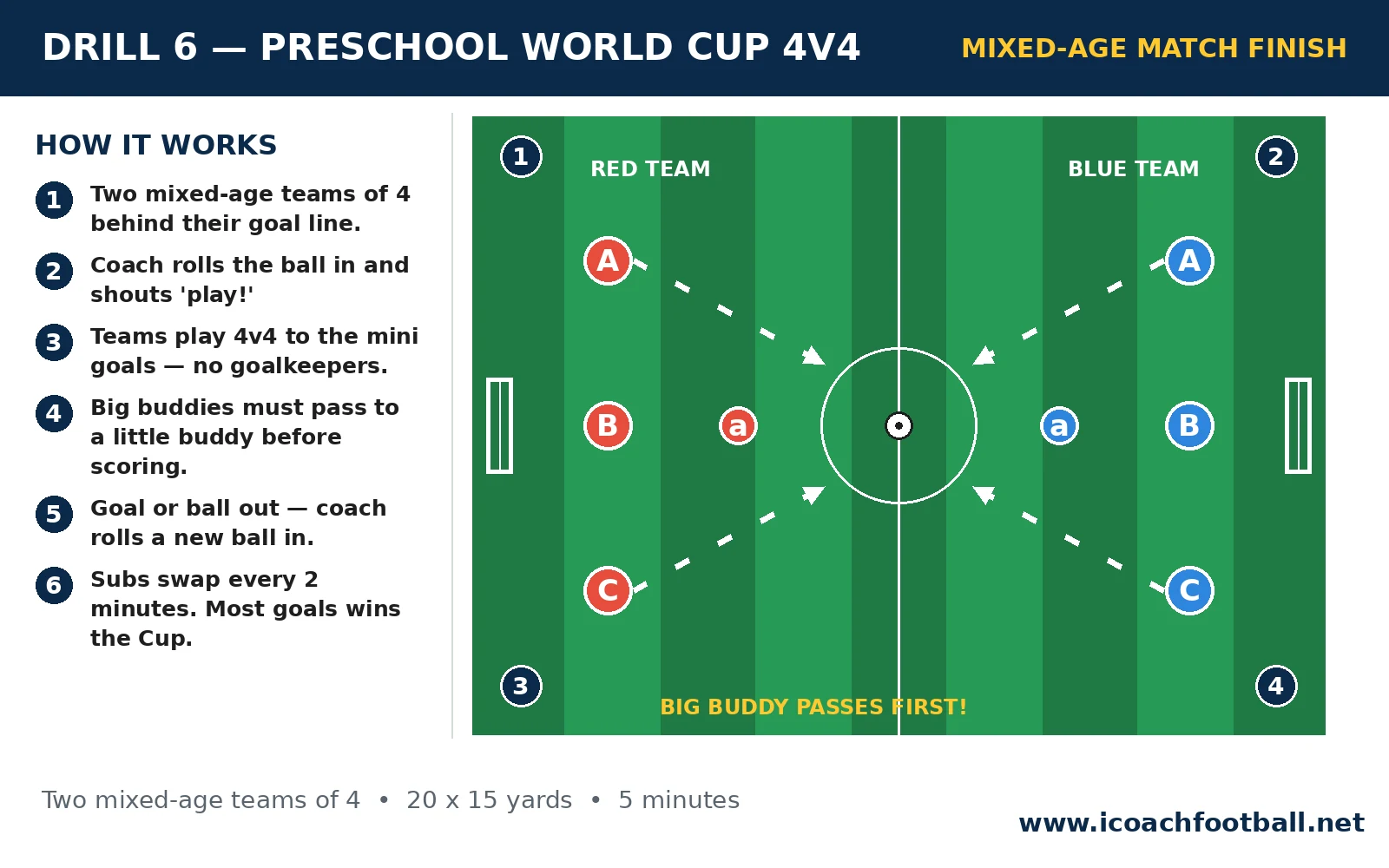
- Setup: 20 x 15 yard pitch, mini goal at each end. Two mixed-age teams of 4 (each team has at least one 3-year-old and one 5-year-old). Coach with the balls. 5 minutes.
How to play:
- Two mixed-age teams of 4 stand behind their own goal line.
- The coach rolls the ball into the middle and shouts “play!”
- The teams play 4v4 to the mini goals — no goalkeepers.
- The big buddies must pass to a little buddy before their team can score.
- When a goal is scored or the ball goes out, the coach rolls a new ball in.
- Subs swap in every 2 minutes so everyone plays — the team with the most goals wins the World Cup.
- Coach’s note: “Pass to your little buddy first — a goal after a pass to a 3-year-old counts double.”
- Progressions: Goals only count after a pass; the 5-year-olds defend only; the coach joins as a player.
Coaching points: the five mistakes that lose preschoolers
| Mistake | What you see | Fix |
|---|---|---|
| Coaching a mixed-age class like one age | The 3-year-olds are lost, the 5-year-olds are bored | Every game has a 3-year-old job and a 5-year-old job — the buddy system does the rest |
| One ball for the whole group | Children queue and watch | One ball per child — the ball is the lesson |
| A ball that is too big | Children trip over a size 3 or 5 | Size 2 for ages 3–5 (size 1 for just-turned-3s) — light, soft, and theirs to control |
| Long explanations | Eyes glaze over in 10 seconds | One sentence, one demo, then play |
| Letting the 5-year-olds dominate the game | The little ones never touch the ball | Mixed teams, and a goal only counts after a pass to a little buddy |
Age adaptations
| Age | Ball | Area | What changes |
|---|---|---|---|
| Age 3 (just turned 3) | Size 1 or 2 | 15 x 10-yard grids | A big buddy stays beside them in every game; games last 3–4 minutes; Drill 3 runs with fewer balls; Drill 6 runs 2v2 with no score kept — see our soccer drills for 3 year olds for the next step |
| Age 4 | Size 2 | 20 x 15-yard grids | All six games as written; Drill 2 runs with slower commands; Drill 5 runs with the coach stopping the music — see our soccer drills for 4 year olds for the same age on its own |
| Age 5 (turning 5) | Size 2 (size 3 when they join organised U6 play) | 20 x 15-yard grids | All six games as written; Drill 3 and Drill 4 run from further back; Drill 6 runs 4v4 with goals counted — see our soccer drills for 5 year olds and the U6 soccer practice plan for the next step |
30-minute session plan
| Time | Block | Drill |
|---|---|---|
| 0:00–0:03 | Arrival game | Free dribble — every child with a ball, explore the garden |
| 0:03–0:08 | Dribbling + following | Drill 1 — Walk the Puppy |
| 0:08–0:12 | Listening + stopping | Drill 2 — Simon Says Soccer |
| 0:12–0:17 | First passing | Drill 3 — Clean Your Garden |
| 0:17–0:21 | Passing accuracy | Drill 4 — Colour Match |
| 0:21–0:26 | Stopping + fun | Drill 5 — Musical Balls |
| 0:26–0:30 | Match-real finish | Drill 6 — Preschool World Cup 4v4 |
New to coaching this age? Stretch the arrival game to 5 minutes and cut Drill 3 to 3 minutes and you have the same class with more settling-in time — see our 60-minute plan for the structure (the same shape, shortened for preschoolers).
Keep building from here
These six games are the start, not the whole curriculum. When the class splits by age, move to our soccer drills for 3 year olds, then soccer drills for 4 year olds and soccer drills for 5 year olds, and the U6 soccer practice plan. The school version of this class is our soccer drills for elementary school, and girls who start at 3 grow into our soccer drills for girls — boys into our soccer drills for boys. Build the individual skills next: soccer dribbling drills for the close control Drills 1, 2 and 5 need, soccer passing drills for the gentle weight Drills 3 and 4 need, and weak foot soccer drills so both feet can play the games. Pairs work is the next step up from one ball per child: soccer drills for two players run the same skills in pairs, soccer drills for 3 players no goalie adds a third runner, and soccer 3v3 drills run the same combinations in bigger games — and when they are old enough to take penalties, our soccer penalty kick drills teach the full routine. New to coaching? Start with soccer drills for beginners, and if you coach indoors in winter, our indoor soccer drills for kids and soccer drills for small spaces run the same six games in a hall. For more ideas at this age, our 7 best soccer drills for kids and fun soccer games for kids both work for preschoolers with a big buddy beside them. Protect the players as they grow: our soccer injury prevention guide and our hamstring injury prevention drills show how to build the warm-up into every session, our 10 soccer warm-up drills give you the full warm-up library, and our youth soccer fitness testing shows how to measure progress without maximal testing at U12 and under. When they are older, the road runs through our soccer drills for middle school players — and if you run selections one day, our soccer tryout drills show how to grade a group fairly.
FAQ
What age can preschoolers start soccer?
Three years old — with games, not drills. FIFA’s grassroots guidance covers ages 4–8, and this class takes the same principles one step younger: one ball per child, 30 minutes, and a 5-year-old big buddy beside every 3-year-old. In the UK the same class is football drills for preschoolers — the age and the games are identical.
What size soccer ball does a preschooler need?
A size 2 ball for ages 3–5 — it is light enough for small feet to control and soft enough that a mistimed kick does not hurt. A just-turned-3-year-old can start on a size 1, and a 5-year-old moves up to a size 3 when they join organised U6 play. A size 3 is too big and too heavy at 3 or 4; move up only when they turn 5 and join a league that uses it.
How long should a preschool soccer class be?
Thirty minutes, with each game lasting 4–5 minutes. A preschooler’s attention span is about one game long, so change the game before they get bored — and stop the class while it is still fun, not when they are tired and crying. The World Health Organization says children aged 1–2 and 3–4 need at least 180 minutes of physical activity a day, spread through the day — this 30-minute class is one joyful slice of that total.
Do preschoolers need shin guards or cleats?
No. Trainers are fine on grass at this age, and most preschool programmes do not require shin guards — check your league’s rules, and buy shin guards only if they ask for them. No special boots, no expensive kit: a ball and a smile are the equipment.
Can I run a mixed-age preschool class with 3-, 4- and 5-year-olds together?
Yes — that is how most preschool soccer actually runs, and it is what this session is built for. Pair every 3-year-old with a 5-year-old big buddy, give every game a 3-year-old job and a 5-year-old job, and keep the teams mixed in the final game. The older children learn by teaching, the younger ones learn by copying, and nobody waits in a line.
Sources
- FIFA Training Centre, Dr Jené Baclawski, “Ages 4-8: An introduction to Play-Practice-Play”, Grassroots Coaching Essentials — a child-centred model that places playing the game at the core of every session: begin with small-sided play, move into core skill practice with plenty of repetition, and finish with open play where players apply what they learned. This class follows that shape: free play first, the six games in the middle, and the World Cup game to finish. https://www.fifatrainingcentre.com/en/practice/grassroots/grassroots-and-youth-football-essentials/grassroots-coaching-essentials/an-introduction-to-play-practice-play.php
- World Health Organization, “Guidelines on physical activity, sedentary behaviour and sleep for children under 5 years of age” (2019) — children aged 1–2 and 3–4 should spend at least 180 minutes a day in a variety of physical activities, spread throughout the day; for 3–4-year-olds at least 60 of those minutes should be moderate-to-vigorous intensity. https://apps.who.int/iris/handle/10665/311664