Football Defending Wide Areas Drills: 6 Games to Stop Wingers, Block Crosses and Protect the Box
Quick answer
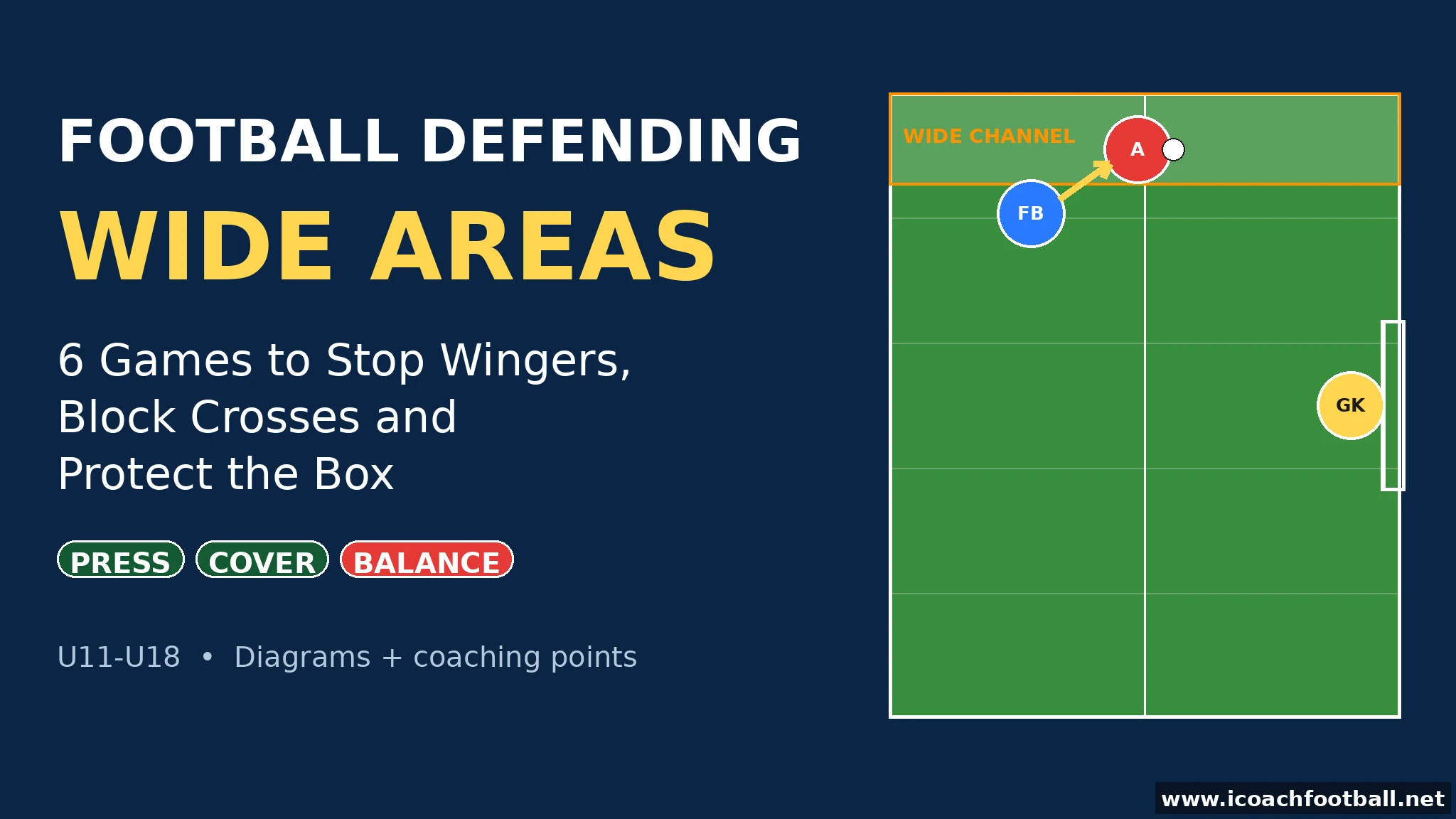
Wide areas are defended by a pair, not a player: one defender presses the winger and shows them outside, the second covers inside, and the far side stays balanced.
Suitable for: U11–U18
Most goals from wide areas start with the same mistake. A full-back dives in, or a winger fails to track back, and suddenly the cross arrives with nobody goal-side. These six football defending wide areas drills train the pair — full-back and winger together — to stop the winger, block the cross and protect the box. (In the US the same session is usually called soccer defending wide areas drills — the defending is identical.)
Session snapshot
- Players: 8 or more (pairs of defenders, attackers, servers)
- Area: Wide channel to half pitch, depending on the drill
- Duration: 60 minutes
- Focus: Press, cover, balance
- Age: U11–U18 (see Age adaptations)
The three rules: press, cover, balance
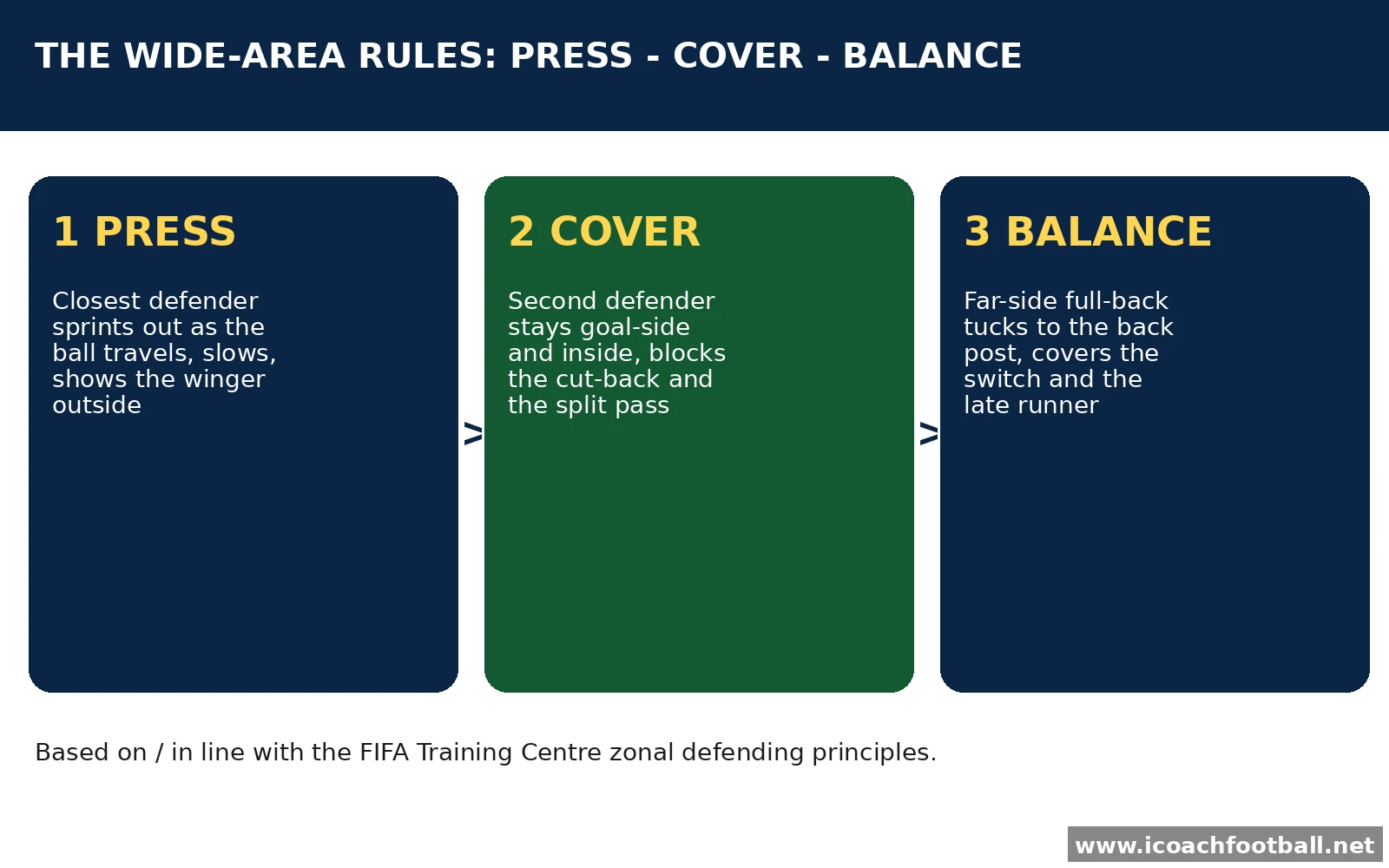
The framework below is in line with the FIFA Training Centre’s zonal defending work: the closest defender presses and forces play outside, the second defender covers inside, and the far side provides balance.
| What the winger does | The defenders’ answer |
|---|---|
| Drives down the outside | Presser shows them to the touchline and blocks the cross |
| Cuts inside onto the stronger foot | Cover defender steps across; presser recovers goal-side |
| Overlaps with a team-mate | Winger tracks the runner; full-back holds the duel |
| Switches play to the far side | Far-side full-back tucks in to the back post |
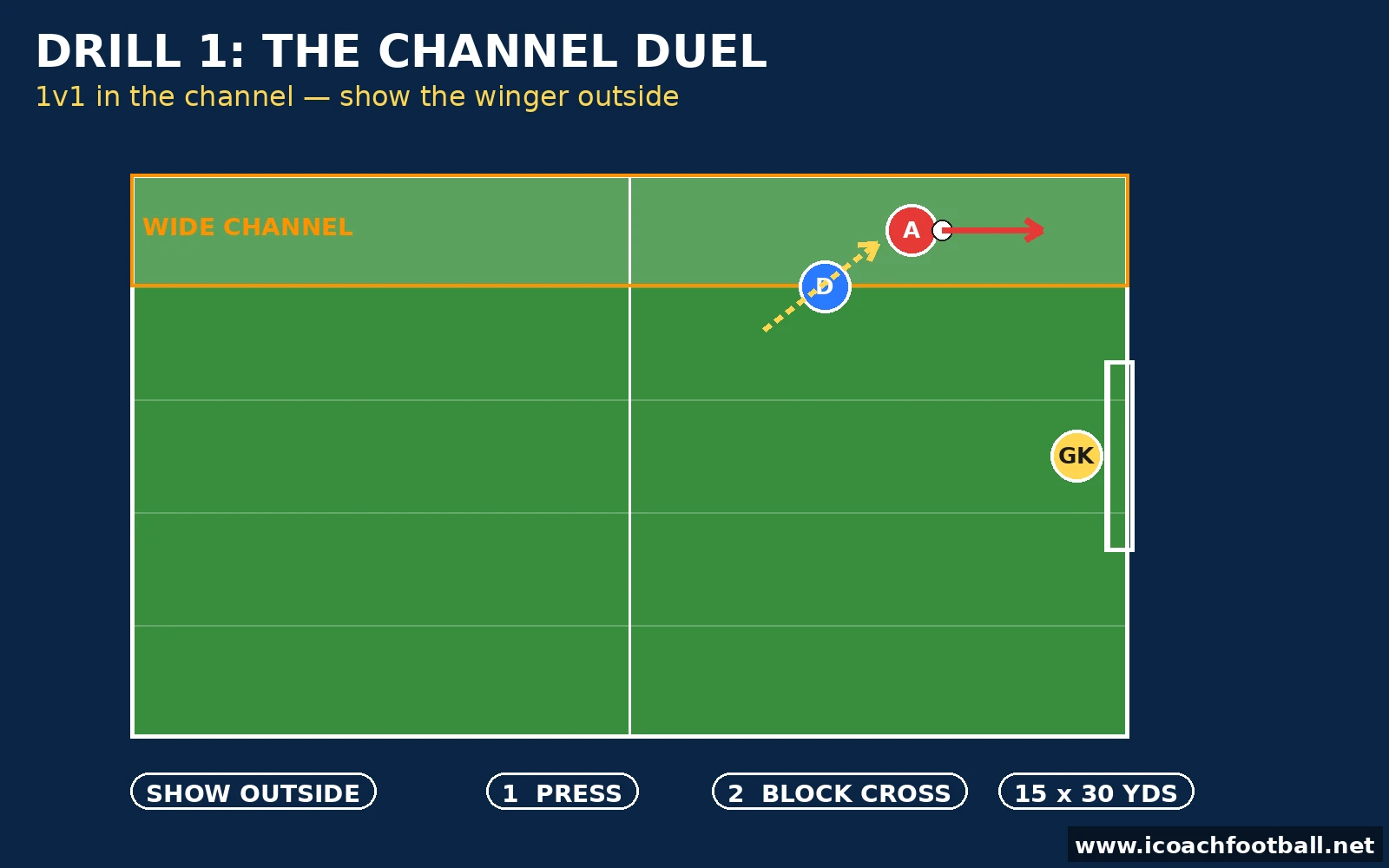
Drill 1: The Channel Duel
The foundation of wide defending: a 1v1 in the channel where the defender’s only job is to keep the winger away from the box.
Setup
- 1 defender, 1 winger, 1 server with balls
- Channel 15 yards wide, 30 yards long, along the touchline
- Mini-goal at the byline end, representing the six-yard box
- Defender starts goal-side, 5 yards inside the channel
How to Play
- The server plays the winger into the channel.
- The defender sprints out as the ball travels, then slows on arrival.
- The defender gets side-on, low, and shows the winger down the line.
- The winger tries to beat the defender and score in the mini-goal.
- If the defender wins it, they play out to the server for a point.
Coach’s note: Shout “Show outside!” — the first thing a young full-back must learn is that the touchline is an extra defender.
Progressions: Let the winger cut inside for a shot at a second mini-goal; shrink the channel to 10 yards wide.
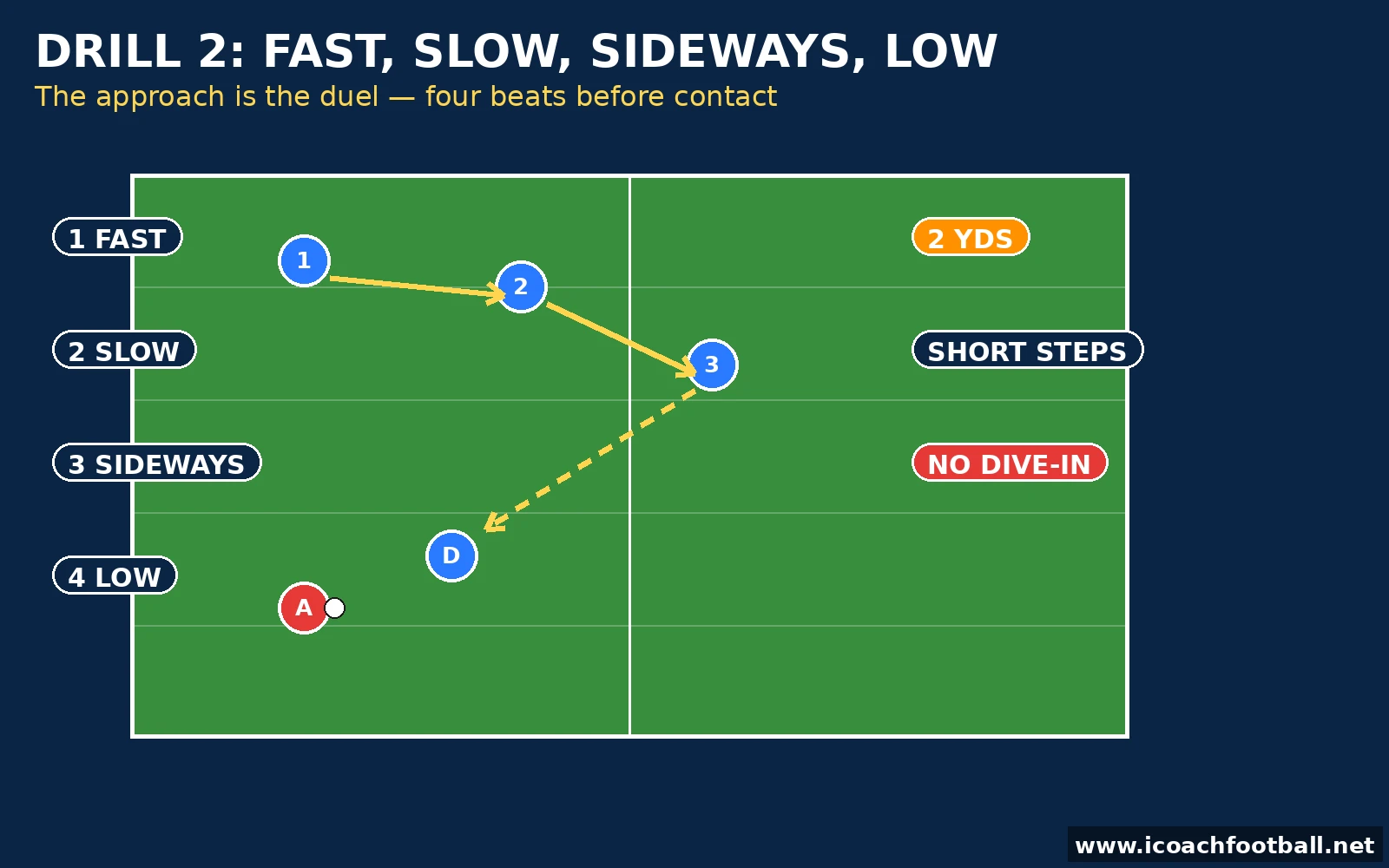
Drill 2: Fast, Slow, Sideways, Low
The approach is the duel. This drill isolates the four beats every wide defender needs before contact.
Setup
- Pairs: 1 defender, 1 winger, 1 ball per pair
- Cones mark a 20-yard run-up for the defender
- Winger starts with the ball on the touchline, 25 yards from goal
- 4 x 2-minute blocks, then swap roles
How to Play
- The winger takes a touch forward to start the duel.
- The defender sprints the first 15 yards — fast, while the ball is moving.
- The defender slows to short steps 2 yards from the winger.
- The defender turns sideways and low, knees bent, front foot pointing outside.
- The defender jockeys for 5 seconds without diving in, then the rep ends.
Coach’s note: Watch the feet, not the ball. A defender who arrives at full speed cannot change direction — the slow-down is the skill.
Progressions: The winger may attack after 3 seconds; add a second defender who must arrive as cover before the tackle.
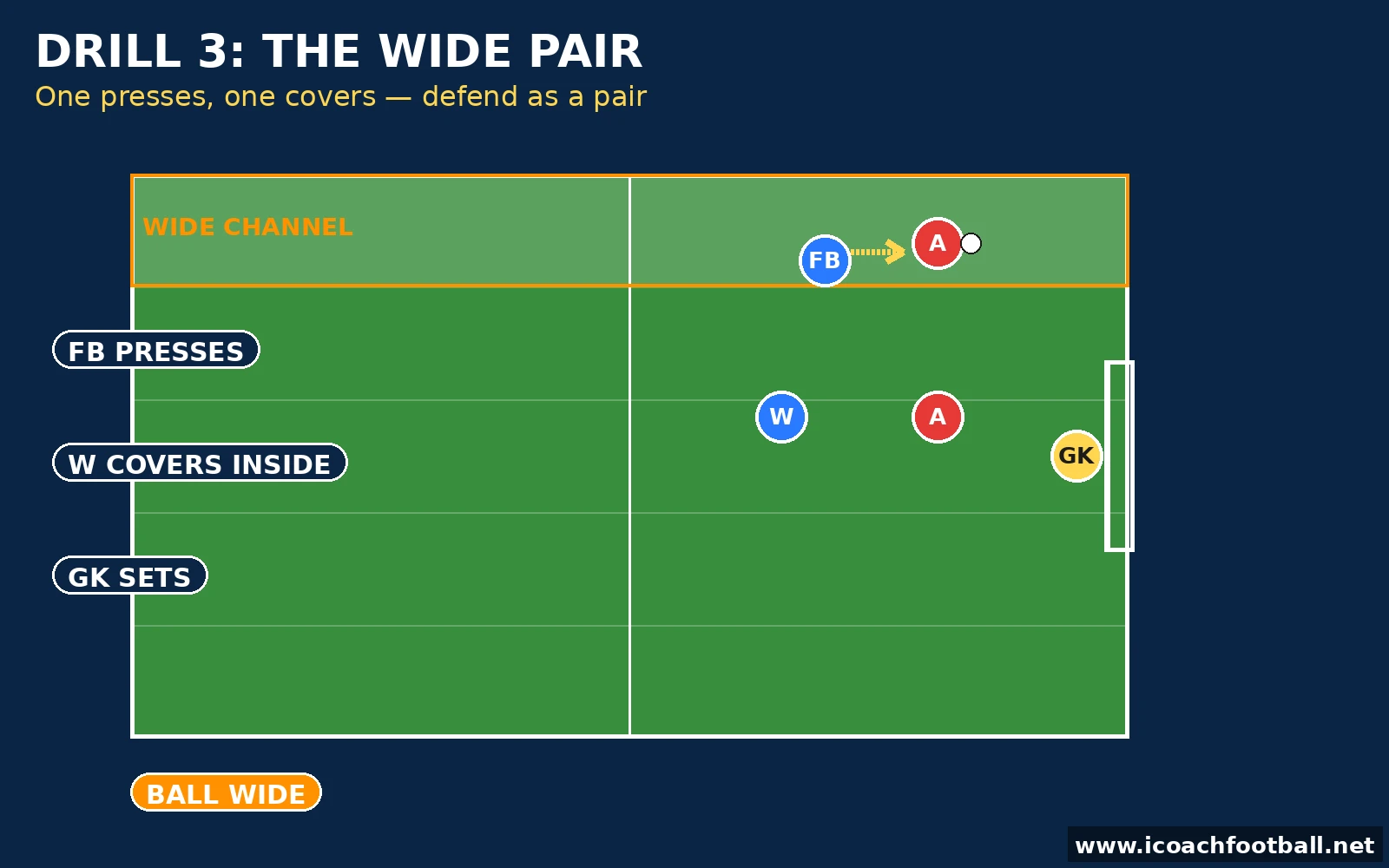
Drill 3: The Wide Pair
One defender presses, one covers. This is the drill that turns two 1v1s into a partnership.
Setup
- 2 defenders (full-back + winger), 2 attackers, 1 server
- Channel 20 yards wide, 35 yards long, with a full-size goal at the end
- Attackers start wide; defenders start narrow and compact, goal-side
- 6 balls with the server, 3-minute blocks
How to Play
- The server plays wide to the first attacker.
- The nearest defender presses: fast out, slow on arrival, show outside.
- The second defender slides goal-side and inside, blocking the cut-back and the through ball.
- The attackers try to combine past the pair and finish.
- If the defenders win it, they must play out through the server within 3 seconds.
Coach’s note: The covering defender’s distance is the whole drill — close enough to help if the presser is beaten, far enough inside to cut the split pass.
Progressions: Add an overlapping runner so the covering defender must choose between the cut-back and the runner; let the attackers switch sides.
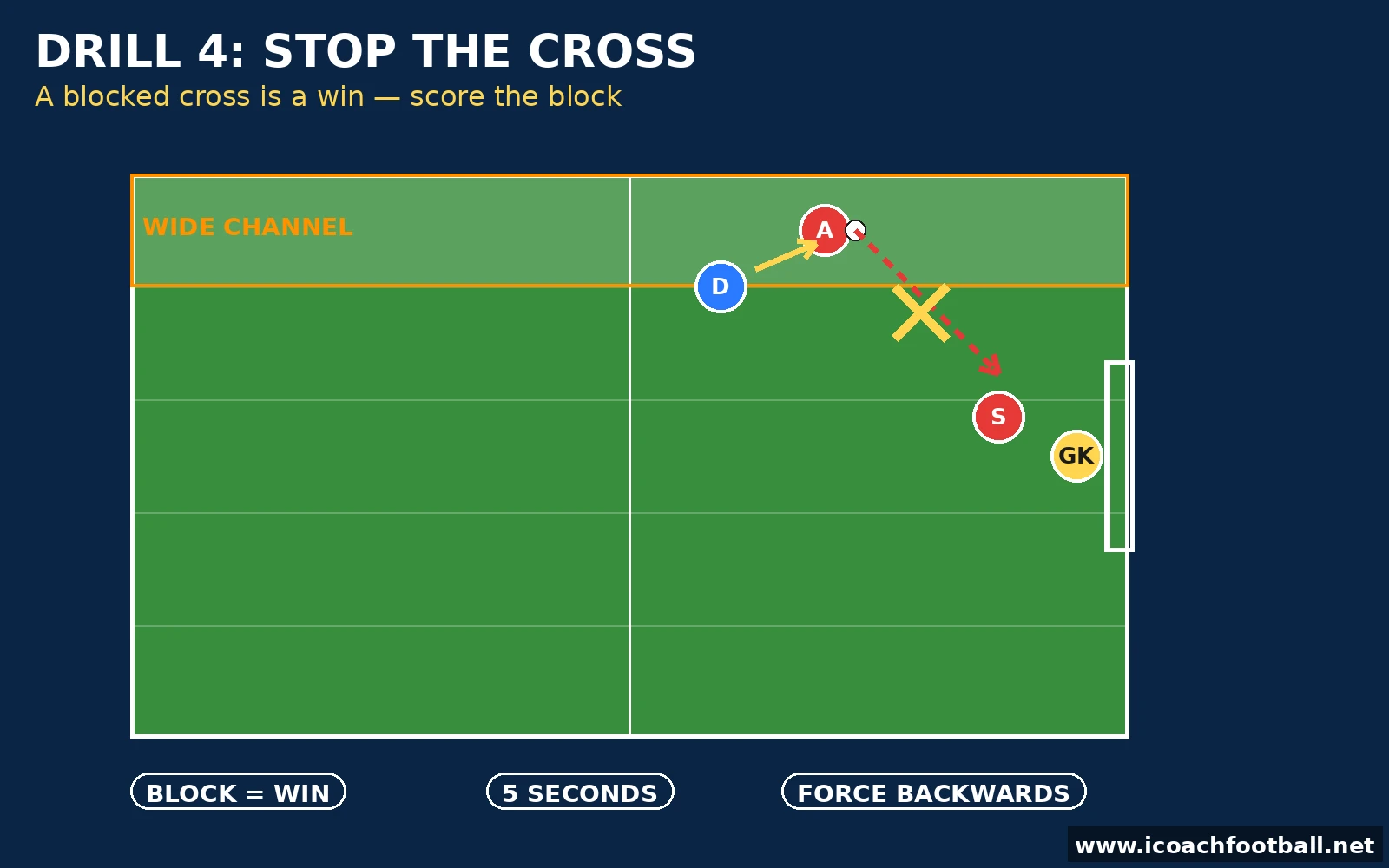
Drill 4: Stop the Cross
A cross is only dangerous if it arrives. This drill scores the block, not the tackle.
Setup
- 1 defender, 1 winger, 1 striker, 1 server
- Wide channel into the box, full-size goal with a goalkeeper
- Striker waits at the penalty spot; winger starts on the touchline
- Defender starts 10 yards goal-side of the winger
How to Play
- The server plays the winger wide.
- The defender closes fast and forces the winger toward the byline.
- The winger must cross within 5 seconds of receiving.
- The defender blocks the cross, or forces it backwards, to score.
- If the cross reaches the striker, the attackers score double.
Coach’s note: A blocked cross is a win — celebrate it like a tackle. Defenders who chase the ball instead of the cross end up watching the header.
Progressions: Add a second striker at the back post; let the winger fake the cross and cut inside.
Drill 5: The Overlap Trap
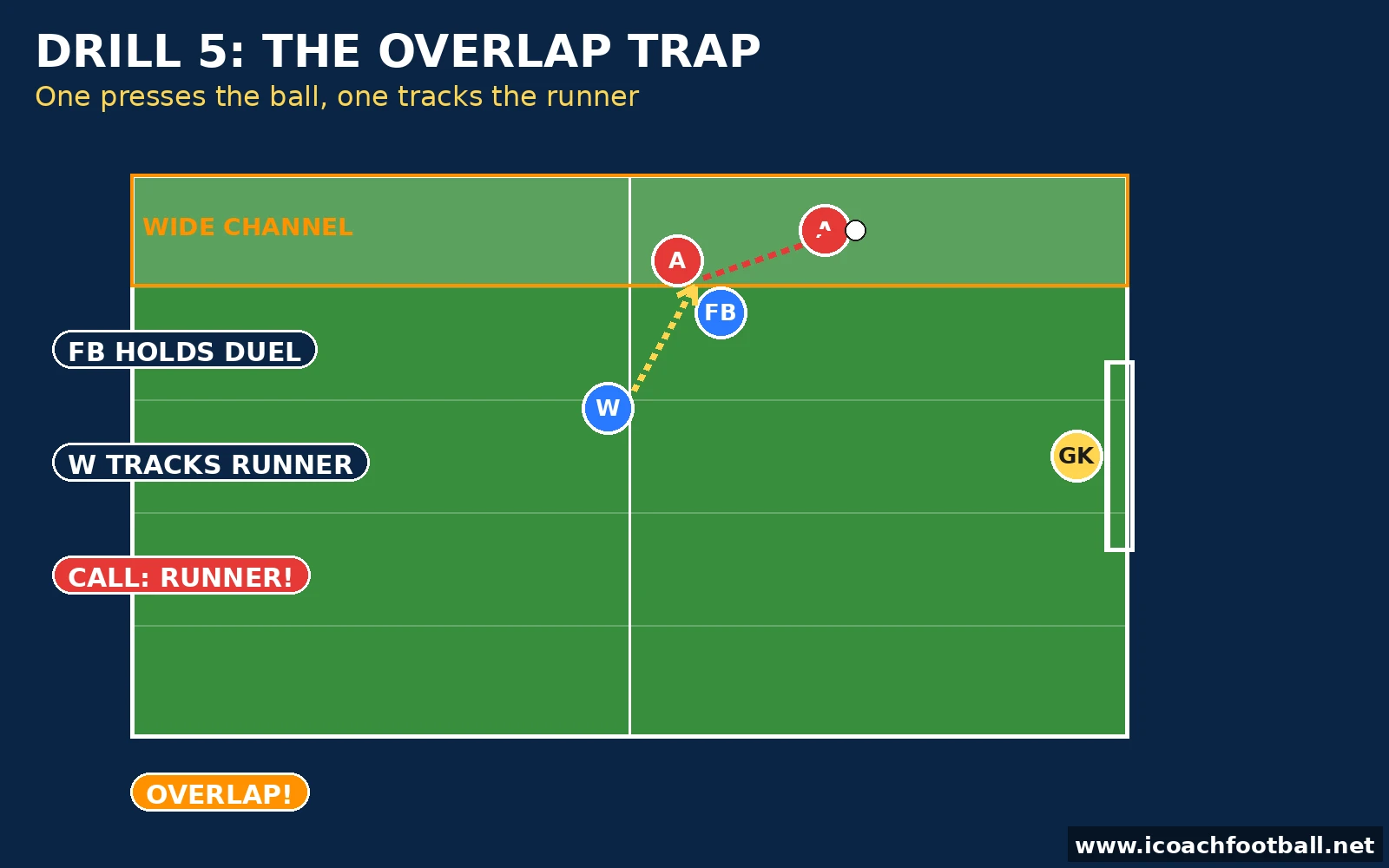
Overlaps break wide defences because both defenders chase the ball. This drill teaches the pair to split the two threats.
Setup
- 2 defenders, 2 attackers, 1 server, 1 goalkeeper
- Half a pitch wide, from halfway to the byline, full-size goal
- Attackers start in the channel; defenders start narrow, goal-side
- 4-minute blocks, then swap sides
How to Play
- The server plays into the winger in the channel.
- The full-back presses the ball carrier and shows them outside.
- The overlapping runner sprints past on the outside — the winger tracks them, not the ball.
- The full-back must not get drawn to the runner; the duel stays theirs.
- Play ends on a cross, a shot, a tackle or the ball going out.
Coach’s note: The loudest mistake in wide defending is silence. The covering player must call “Runner!” before the overlap starts, not after it.
Progressions: Let the runner underlap inside instead; add a third attacker arriving late at the edge of the box.
Drill 6: The Wide-Area Game
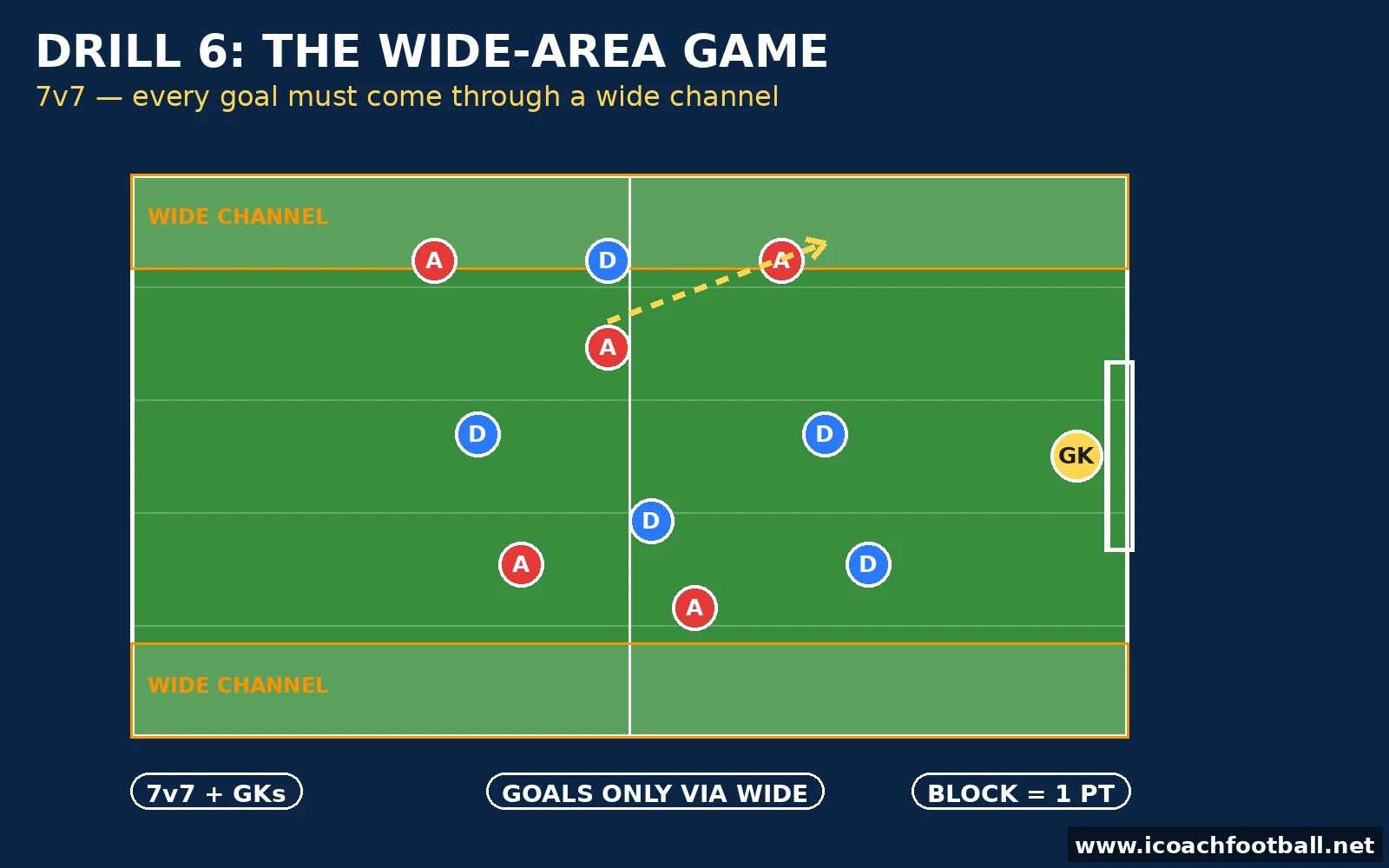
Put the pair inside a real game where every attack comes down the wings.
Setup
- 7v7 plus 2 goalkeepers on a 50 x 35-yard pitch with full-size goals
- Two 8-yard wide channels marked on each side of the pitch
- Normal small-sided rules, plus the wide-area rule below
- 4 x 4-minute games, 1-minute rests
How to Play
- Teams play 7v7 as normal.
- Goals only count if the attack enters the final third through a wide channel.
- The defending pair must press, cover and balance on every wide entry.
- A blocked cross or a forced backwards pass earns the defending team a point.
- Rotate the wide pair every game so every defender faces the channel.
Coach’s note: Count blocked crosses on the whiteboard, not just goals. What you count is what they practise.
Progressions: Goals from the central channel count double for the attackers; require the defending team to win the ball and play out through a wide channel.
Coaching points
- Use the touchline. The line is a defender: show the winger outside and the pitch itself cuts off half their options.
- Presser and coverer are one job. The first defender cannot press with confidence unless the second is goal-side and inside.
- Delay beats the dive. A winger who is still dribbling after 5 seconds has run out of ideas; a defender on the floor has run out of options.
- Talk before the run. “Runner!”, “Show outside!”, “I’ve got cover!” — the call must arrive before the overlap, not after it.
Common mistakes
- Both defenders chasing the ball. The overlap exists to punish this. One presses, one covers — never two on the ball carrier.
- Showing the winger inside. The inside route leads to the penalty spot. Force play outside, even if it feels like giving ground.
- Arriving at full speed and diving in. The sprint is for closing distance; the duel starts when the feet stop. Slow down, get side-on, stay patient.
- The far side switching off. When the ball is wide, the far-side full-back must tuck to the back post. A switch of play finds them asleep otherwise.
Age adaptations
| Age group | How the session changes |
|---|---|
| U11–U12 | Channels 10 yards wide, no goalkeeper in Drills 1–3, winger must cross within 8 seconds, celebrate every blocked cross |
| U13–U14 | Full Drills 1–4; introduce the overlap in Drill 5 at walking pace first; keep the wide-area rule in Drill 6 simple (goals only from wide entries) |
| U15–U18 | Full speed throughout; add the underlap and late-runner progressions; defenders call the press and cover themselves with no coach prompts |
60-minute session plan
| Block | Time | Content |
|---|---|---|
| Warm-up | 0–10 min | Sideways shuffles, short sprints to set position, 1v1 jockeying in pairs |
| Drill 1 + 2 | 10–25 min | Channel Duel, then Fast, Slow, Sideways, Low |
| Drill 3 + 4 | 25–40 min | Wide Pair (with animation), then Stop the Cross |
| Drill 5 + 6 | 40–55 min | Overlap Trap, then Wide-Area Game |
| Cool-down | 55–60 min | Light jog, stretch, one-line review: “Who pressed, and who covered?” |
Sources
- FIFA Training Centre — Developing defensive coordination in small groups. The drills above are based on and in line with its pressure-and-cover principles for defending in pairs and small groups; they are not FIFA-approved sessions.
- FIFA Training Centre — Building the foundations of collective defending. Used in line with its direct, delay and deny principles for 1v1 defending and forcing attackers away from central areas.
FAQ
What is the first thing a full-back should do when the ball goes wide?
Sprint out while the ball is travelling, then slow down 2 yards from the winger, get side-on and low, and show them down the line. The sprint closes the space; the slow-down wins the duel.
How do two defenders defend a winger and an overlapping full-back?
One presses the ball carrier, the other tracks the runner. The winger tracks the overlap and the full-back holds the duel — if both defenders chase the ball, the overlap is free.
Should a defender show a winger inside or outside?
Outside, almost always. The touchline is an extra defender, and the inside route leads to the penalty spot. Show inside only to a winger’s weaker foot when cover is already set behind you.
How do you stop crosses without diving in?
Close the space early, stay goal-side, and step across the winger’s crossing lane as they shape to cross. A blocked cross counts as a win — the defender who blocks it has done the job, even without a tackle.
What age should players start learning to defend wide areas?
The channel duel works from U11, with narrower channels and no goalkeeper at first. The pair work — pressing and covering together — lands best from U13, once players can hold a shape while the ball moves.