Football Late Runs Into the Box Drills: 6 Games to Time the Arrival and Finish First Time
Quick answer
The late run is the goal your team scores when nobody is marking anyone. These six football late runs into the box drills teach midfielders to hold their run, burst at the right moment and arrive as the ball is delivered — unmarked, on the move, first time.
Suitable for: U12–U18
Every coach has watched it happen against their team: the cross comes in, the strikers are marked, and then a midfielder ghosts in from nowhere and scores. Nobody tracked them because nobody thought they were a threat — until they were. That is the late run, and it is trainable. The same idea works in soccer and football alike: delay the movement, read the crosser, and arrive on the ball instead of waiting for it. These six games build that habit, one timing rule at a time.
Session snapshot
- Players: 8 midfielders and attackers, plus wide players, defenders and a goalkeeper as needed
- Area: Final third, one goal
- Duration: 60 minutes
- Focus: Holding the run, reading the delivery, arriving on the ball first time
- Age: U12–U18 (see Age adaptations)
Hold, burst, arrive — the timing
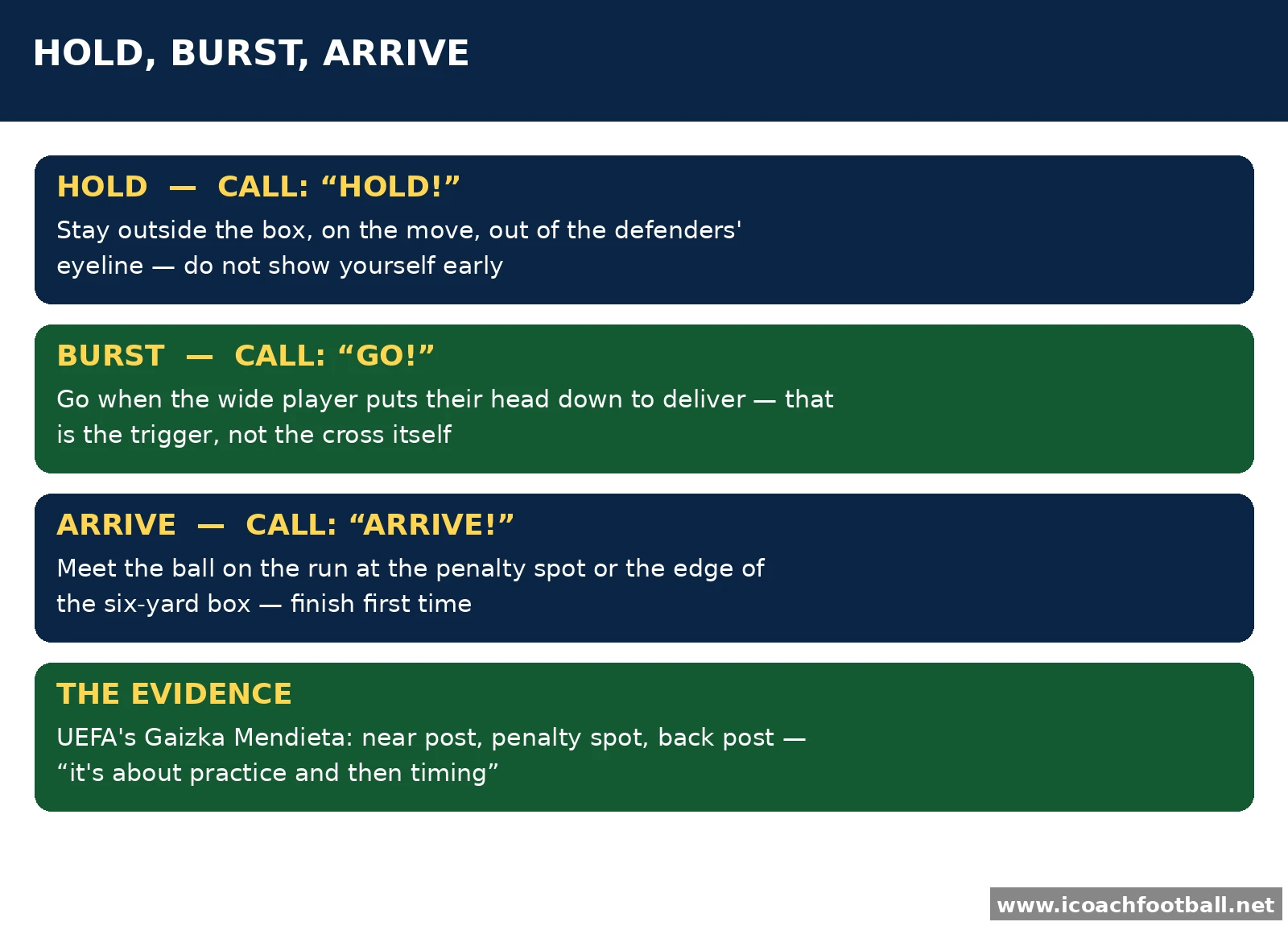
Every late run follows the same three beats. Get them in the wrong order and the run is useless: go too early and you are marked; go too late and the ball is gone. This framework is in line with the FIFA Training Centre’s final-third combination work: players should time and coordinate their runs off the ball, using clever runs such as cross runs and rotations to lose their markers and be free to attack the goal.
| Beat | What it means | The call |
|---|---|---|
| HOLD | Stay outside the box, on the move, out of the defenders’ eyeline — do not show yourself early | “HOLD!” |
| BURST | Go when the wide player puts their head down to deliver — that is the trigger, not the cross itself | “GO!” |
| ARRIVE | Meet the ball on the run at the penalty spot or the edge of the six-yard box — finish first time | “ARRIVE!” |
Drill 1: Hold and Burst
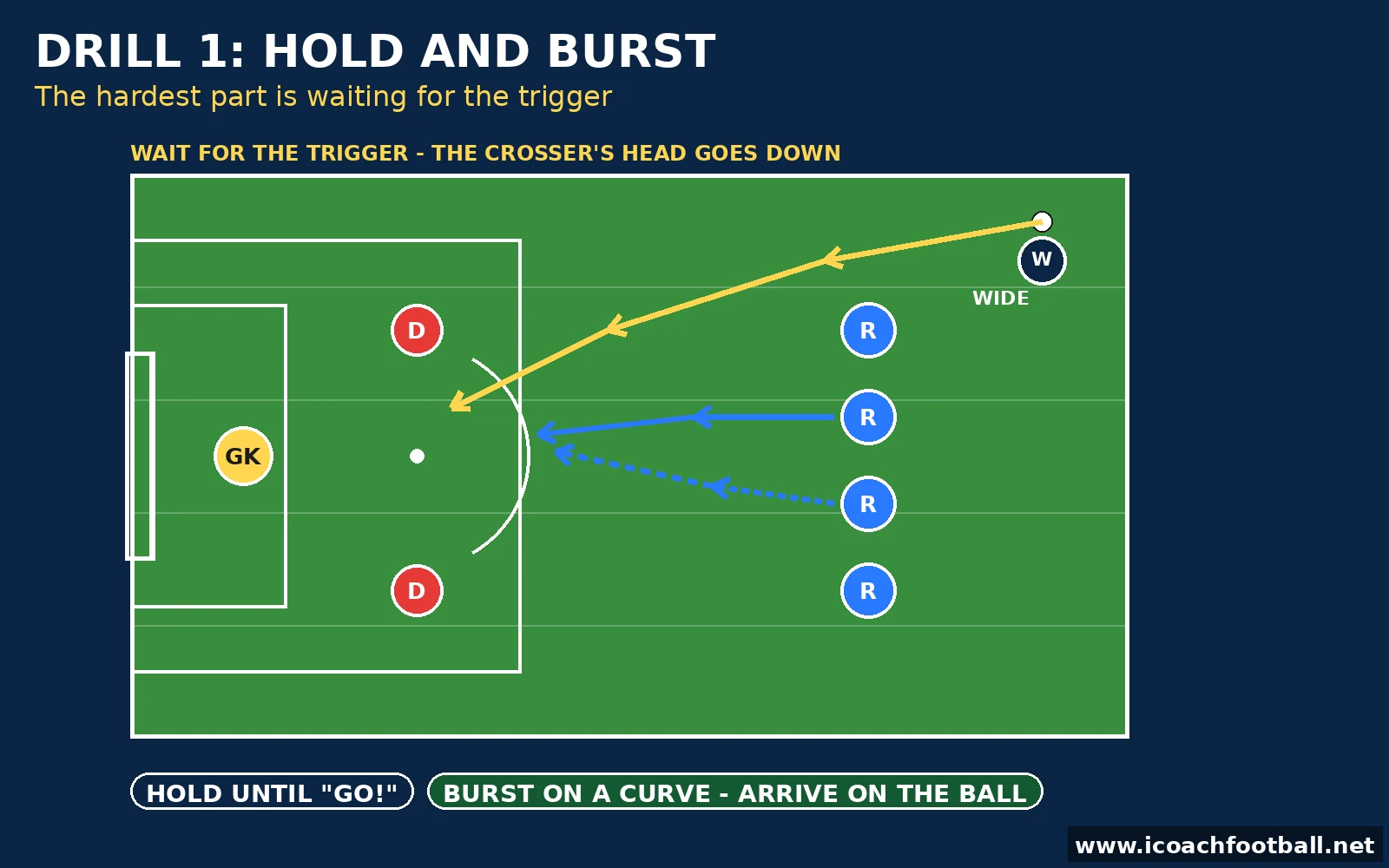
Before any runner arrives, they must learn to wait. This drill teaches the hardest part of the late run: doing nothing until the trigger appears.
Setup
- Final third, one goal, 1 goalkeeper, 2 wide servers, 4 runners, 2 defenders
- Runners start 25 yards from goal, outside the box, each with a cone marker
- 8 repetitions per runner, then rotate; 10 minutes
How to Play
- The runners start outside the box, jogging on the spot, eyes on the wide server.
- The server dribbles wide and the runners must stay put — no early movement.
- The moment the server puts their head down to cross, the coach shouts “GO!”.
- Each runner bursts on a curved run toward the penalty spot, arriving as the ball comes in.
- The first runner to meet the ball finishes first time; the others take the rebound.
Coach’s note: Watch the runners’ feet. The moment they go flat-footed they have stopped reading the game — keep them bouncing on their toes. The trigger is the crosser’s head going down, not the ball being struck; if they wait for the cross itself, they are already a yard late. Shout “HOLD!” every time a runner cheats early, and praise the one who waits longest.
Progressions: Add a defender who tracks the first runner to move, so early runners get punished; the server varies the delivery — early cross, cutback, or low ball across — so runners must read and react, not guess.
Drill 2: Three Lanes, One Finish
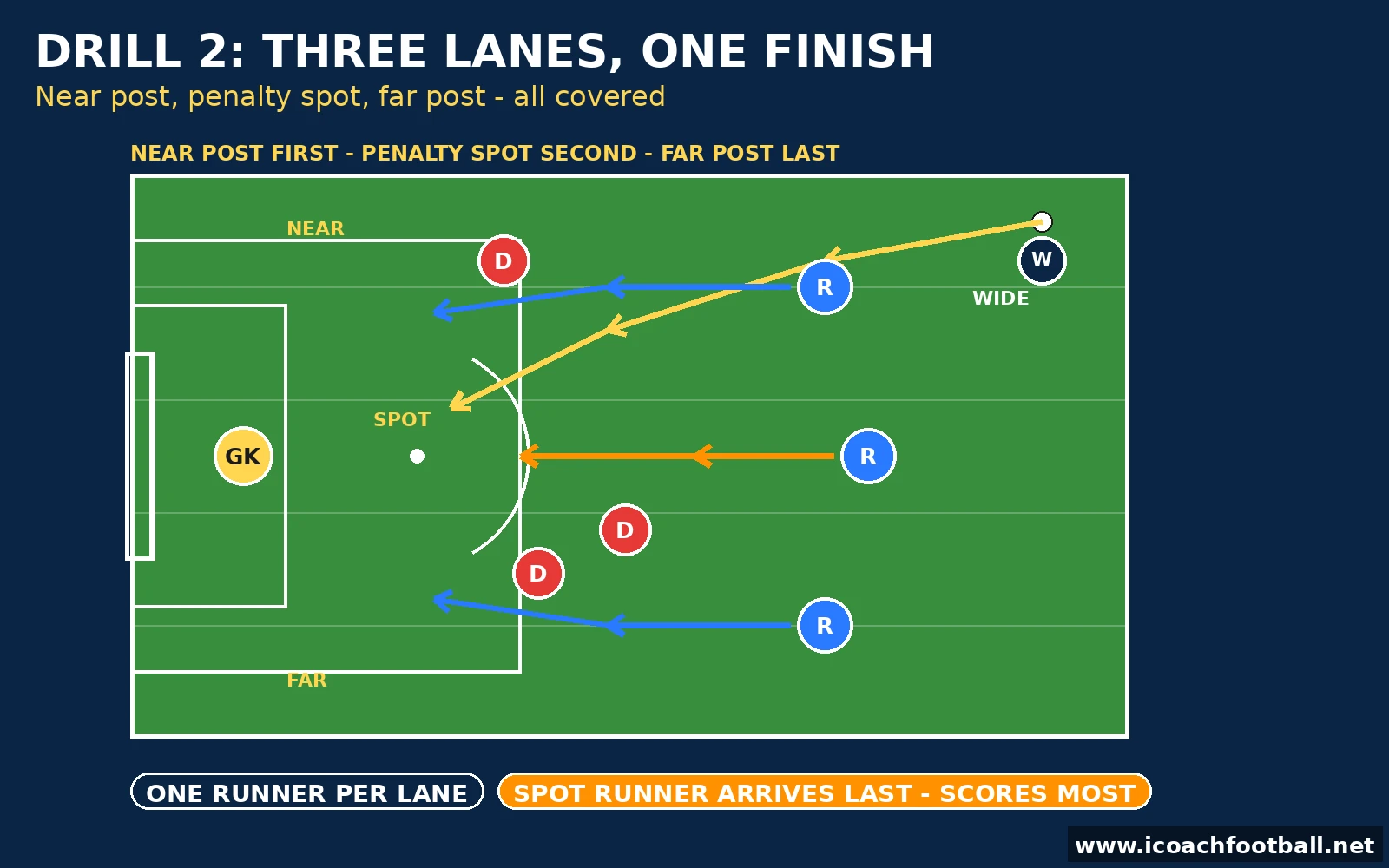
A cross needs three runners, not one. This drill teaches the team to cover the whole box — near post, penalty spot and far post — so every delivery finds someone.
Setup
- Final third, one goal, 1 goalkeeper, 2 wide servers, 3 runners, 3 defenders
- Cones mark three lanes: near post, penalty spot, far post
- 8 crosses per side, then rotate; 10 minutes
How to Play
- The three runners start outside the box, one assigned to each lane.
- The wide player receives and drives toward the byline while the runners hold.
- On the delivery trigger, all three burst at once — near-post runner first, penalty-spot runner second, far-post runner last.
- Each runner attacks only their own lane and finishes first time if the ball reaches them.
- Defenders mark man-to-man; the runners must lose them with a change of pace or direction.
Coach’s note: The common mistake is all three runners chasing the same ball. Freeze the drill and ask each runner where their lane is before you restart — if they cannot point to it, they cannot attack it. This is the UEFA point in practice: as Gaizka Mendieta puts it, one goes near post, one to the penalty spot, one to the back post — “it’s about practice and then timing.” The penalty-spot runner is the late one; they arrive last and score most.
Progressions: The runners swap lanes on the coach’s call mid-attack; the wide player may cut inside and shoot instead of crossing, so runners must hold for the shot and take the rebound.
Drill 3: The Cutback Arrival
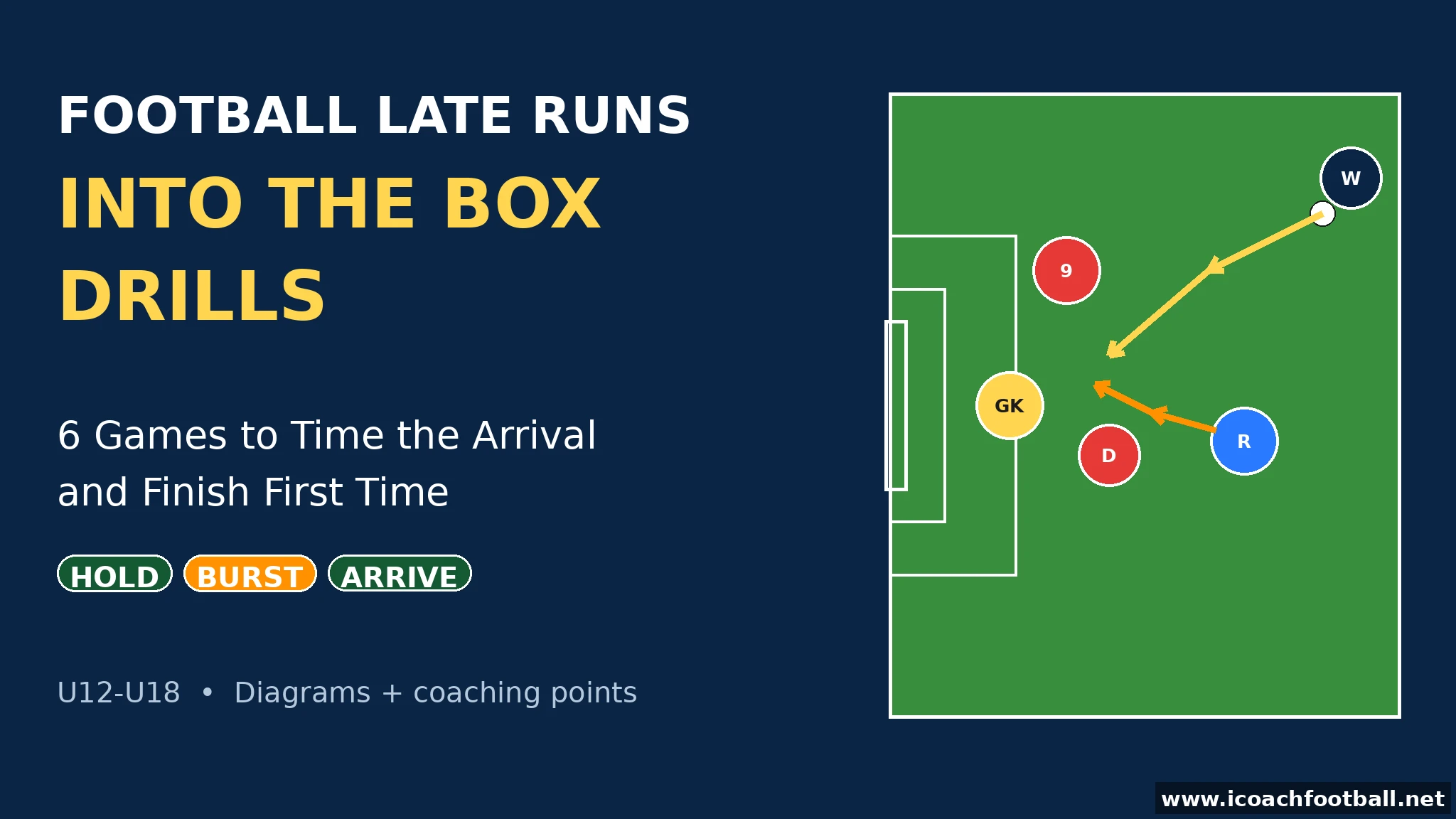
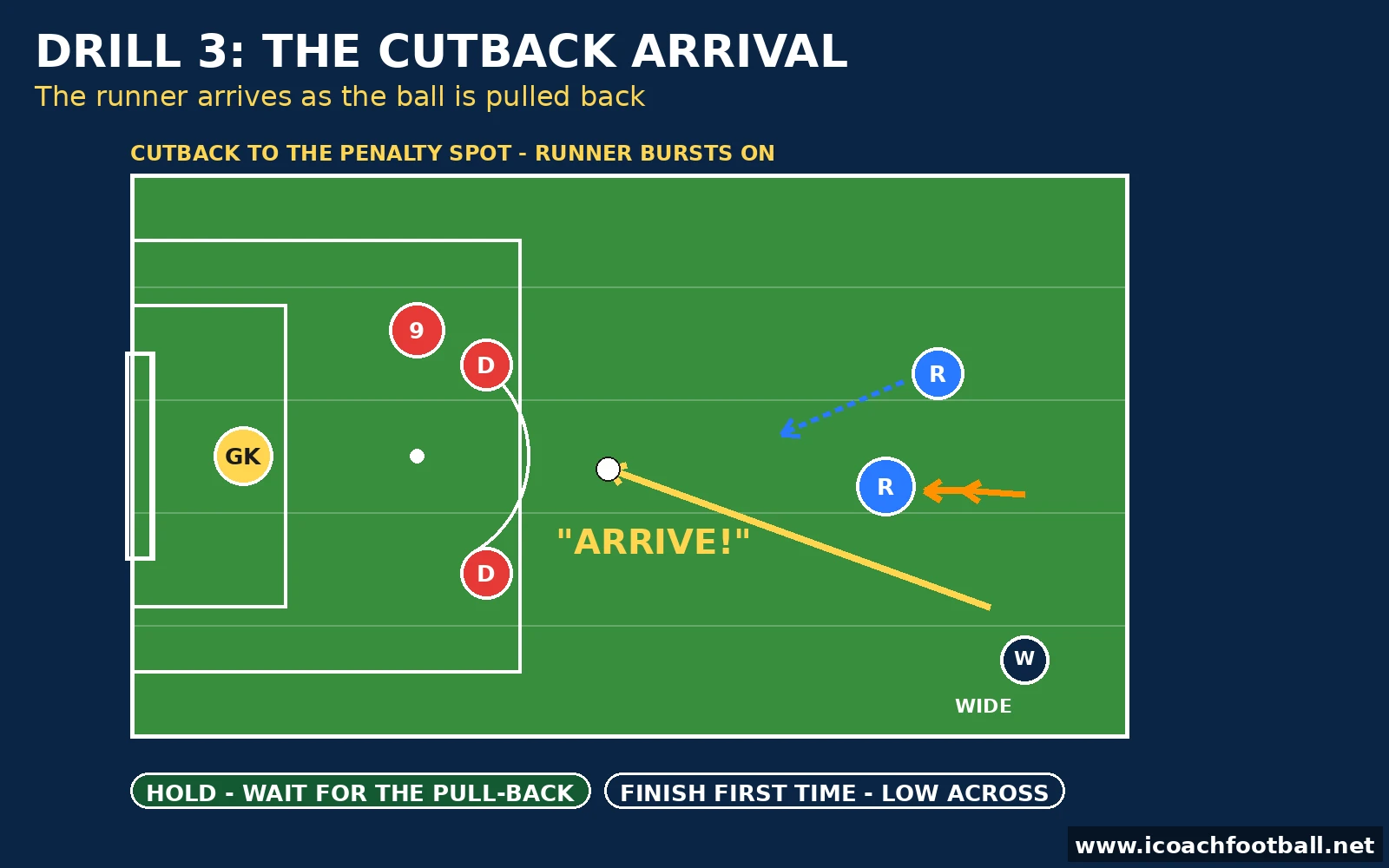
The cutback is the late runner’s best friend. The ball comes back against the defenders’ momentum, and the runner arriving from deep is the only one facing the right way. Watch the animation below the diagram: the hold, the burst and the finish happen in that order.
Setup
- Final third, one goal, 1 goalkeeper, 1 wide player, 1 striker, 2 runners, 2 defenders
- The wide player starts on the touchline 30 yards from goal; the striker pins the near post
- 8 repetitions per runner, then rotate; 12 minutes
How to Play
- The wide player receives and drives to the byline while the striker makes the near-post run.
- The two runners hold outside the box, out of the defenders’ eyeline.
- The wide player pulls the ball back across the penalty spot — the cutback.
- The first runner bursts onto it and finishes first time, low and across the goalkeeper.
- The second runner follows in for the rebound and the striker stays near post for the flick.
Coach’s note: The finish matters as much as the run. A runner arriving at full speed must not try to smash it — side-foot it low across the keeper, first time. If the runner takes a touch, the moment is gone and the defenders recover. The wide player’s pull-back should be firm and along the ground, at the penalty spot — that is the zone the runner is aiming for, and it is the same zone our soccer cutback drills train the delivery into.
Progressions: A defender is released to track the first runner, so the burst must lose them with a curved run; the wide player may cross high to the far post instead, so the runners must read the delivery type before they go.
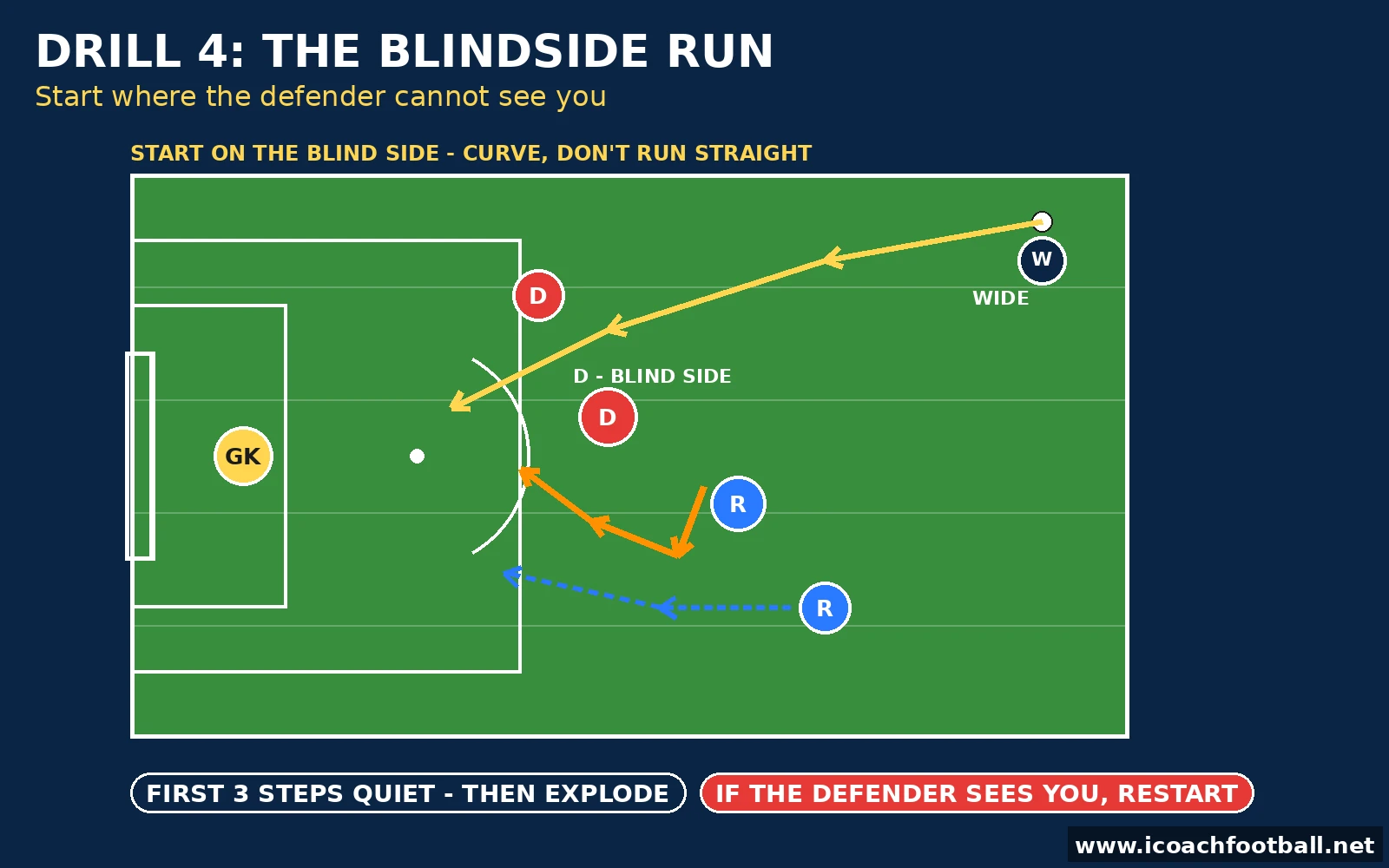
Drill 4: The Blindside Run
The best late runs are the ones nobody sees. This drill teaches runners to start on a defender’s blind side and attack the space behind them.
Setup
- Final third, one goal, 1 goalkeeper, 2 wide servers, 2 runners, 2 defenders
- A mannequin or cone marks the defender’s blind-side shoulder
- 8 repetitions per runner, then rotate; 10 minutes
How to Play
- Each runner starts 5 yards behind their defender, on the defender’s blind side.
- The wide player receives and the runners stay hidden — no movement the defender can see.
- On the delivery trigger, the runner curves around the defender’s blind shoulder.
- The runner attacks the penalty spot at full speed and finishes first time.
- The defender must turn and react; if they see the run early, the runner restarts.
Coach’s note: Teach the curved run, not the straight one. A straight run is easy to track; a curved run takes the runner out of the defender’s eyeline and into the space behind them. The runner’s first three steps should be quiet and short — the explosion comes last. If the defender turns their head and sees the runner before the trigger, the runner has shown themselves too early.
Progressions: The defender is allowed to drop off and track the runner, so the runner must use a decoy — a step one way, then the burst the other; the wide player varies the delivery height, so runners must adjust their finish.
Drill 5: Second Ball at the Edge
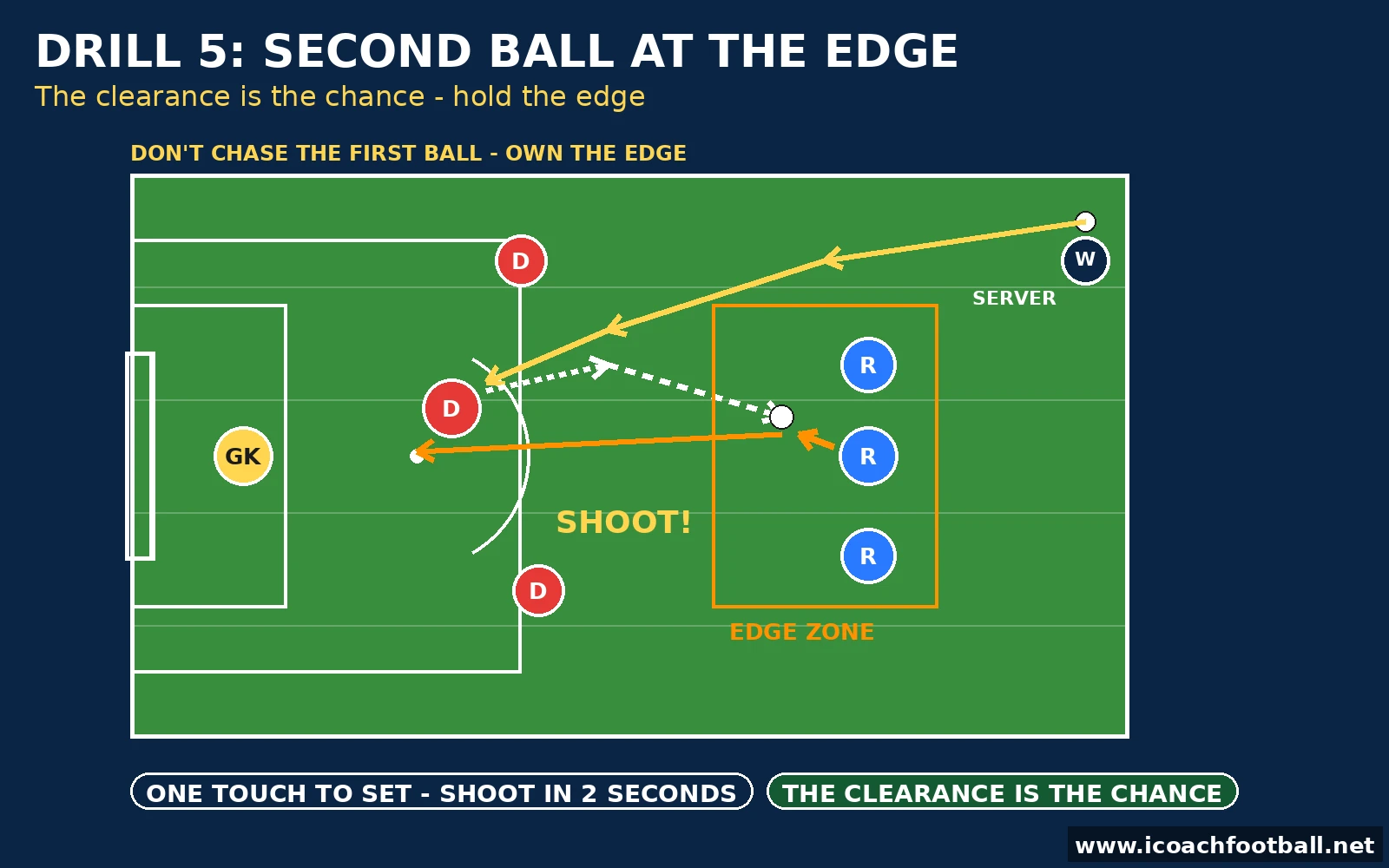
Not every late run ends with a cross. When the ball is cleared to the edge of the box, the midfielder who held their position is the one who scores. This drill trains the edge-of-the-box arrival.
Setup
- Edge of the penalty area, one goal, 1 goalkeeper, 1 server, 3 runners, 3 defenders
- Runners start 25 yards from goal, spread across the width of the box
- 8 clearances per round, then rotate; 10 minutes
How to Play
- The server plays a high ball into the box and the defenders head it clear.
- The three runners hold their positions on the edge — they do not chase the first ball.
- The moment the clearance leaves the box, the nearest runner bursts onto it.
- That runner takes one touch to set and shoots first time, low and hard.
- The other two runners follow in for the rebound and the defenders must recover.
Coach’s note: The mistake is the runner who charges into the box for the first ball and leaves the edge empty. Freeze the drill after a clearance and ask who is on the edge — if nobody is there, the second ball is the opposition’s. This is the same second-ball habit trained in our soccer second ball drills, applied to the final third: win the drop, then shoot. One touch to set, then shoot — two touches lets the defence reset.
Progressions: The server varies the clearance — high and looping, or low and driven — so runners must read the flight; a defender is released to close the shooter down, so the shot must come within two seconds of the clearance.
Drill 6: The Late Run Game
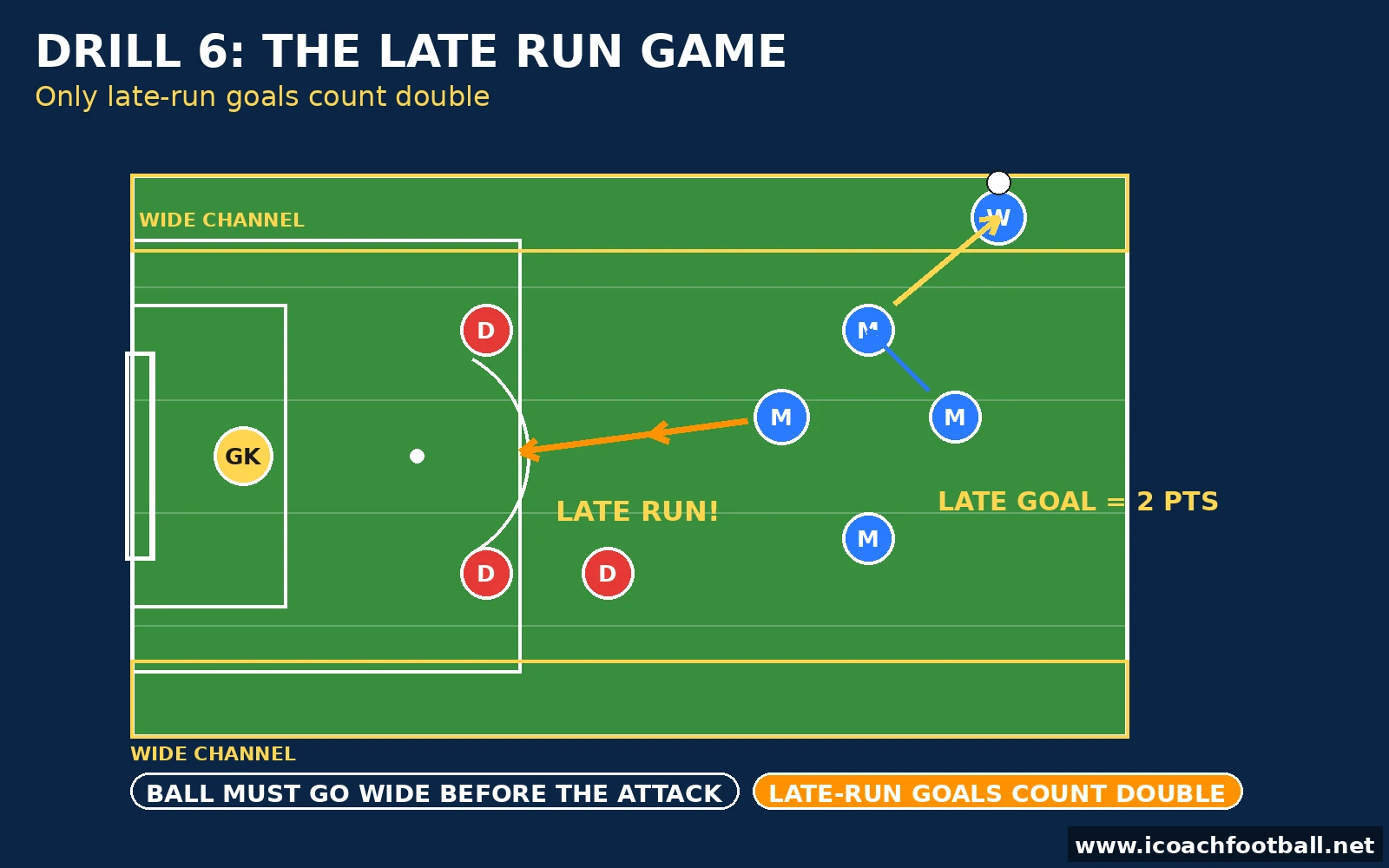
Now put it all together. This game rewards only one thing: goals scored by a player arriving late from outside the box.
Setup
- Half a pitch, one goal, 2 teams of 6 plus goalkeepers, 2 wide channels marked with cones
- Goals scored by a late runner count double; goals from inside the box count single
- 2 x 8-minute games; 16 minutes
How to Play
- Play starts from the goalkeeper and teams build through the middle third.
- A team may only attack the goal after the ball has gone wide into a channel.
- When the ball goes wide, the midfielders must hold their runs until the delivery trigger.
- Goals scored by a runner arriving from outside the box count double.
- The team that scores the most late-run goals wins; rotate the wide players each game.
Coach’s note: Watch for the team that stops running late once they are winning — that is when the habit dies. Keep the double-goal rule loud: shout the score after every late-run goal so the whole pitch hears it. If a team scores three goals and none are late runs, stop the game and ask them where their midfielders were. The answer is usually “in the box too early” — and that is the whole lesson.
Progressions: Remove the wide-channel rule so teams must create the wide ball themselves; add a second goal and play both ways, so runners must sprint back and hold again on the next attack.
Coaching points
- The trigger is the crosser’s head going down. Runners who wait for the cross are a yard late; runners who go before the trigger are marked.
- Arrive on the move, never standing still. A stationary runner is easy to mark; a runner arriving at speed is almost impossible to track.
- Curve the run. A curved run takes the runner out of the defender’s eyeline; a straight run walks them into it.
- Finish first time. A late run creates a split second of space — a touch kills it. Side-foot low across the goalkeeper.
- One runner per lane. Near post, penalty spot, far post — if two runners chase the same ball, the third lane is empty.
- Hold the edge. When the ball is cleared, the runner on the edge of the box is the most dangerous player on the pitch.
Common mistakes
- Going too early. The runner arrives before the ball and stands in the box, marked. Fix it with Drill 1 — reward the runner who waits longest.
- Running in a straight line. Straight runs are easy to track. Fix it with Drill 4 — teach the curved run around the blind shoulder.
- Chasing the first ball. Midfielders who charge into the box for the cross leave the edge empty. Fix it with Drill 5 — the second ball is the goal.
- Taking a touch to finish. One touch lets the defence recover. Fix it in every drill — first-time finishes only, low and across the keeper.
- All runners in one lane. Three runners attacking the near post leaves the penalty spot and far post empty. Fix it with Drill 2 — freeze and check the lanes.
Age adaptations
| Age group | How the drills change |
|---|---|
| U12–U13 | Smaller area (final third only), no heading, slower servers, and finish with the inside of the foot — the timing matters more than the power. Keep the runs short and the triggers loud. |
| U14–U15 | Full-size final third, introduce the blindside run (Drill 4) and the second-ball edge (Drill 5), and let defenders track runners. Add the double-goal rule in the game. |
| U16–U18 | Full speed, full-size pitch, mannequins as defenders, and the wide player varies the delivery without warning. Runners must read the game, not the coach’s call. |
| Adults | Add the offside line to Drill 2 and Drill 6, and let the wide player choose between cross, cutback and shot — runners must read all three. |
60-minute session plan
| Block | Time | What to run |
|---|---|---|
| Warm-up | 0–8 min | Rondo with a late-runner rule: the player who passes wide must make a run into the box |
| Drill 1 | 8–18 min | Hold and Burst — the trigger and the wait |
| Drill 2 | 18–28 min | Three Lanes, One Finish — cover the whole box |
| Drill 3 | 28–40 min | The Cutback Arrival — the late runner’s best friend |
| Drill 4 | 40–48 min | The Blindside Run — lose the marker |
| Drill 5 | 48–56 min | Second Ball at the Edge — the clearance is the chance |
| Game | 56–60 min | The Late Run Game — double goals for late arrivals (extend to 16 minutes if time allows) |
Sources
- FIFA Training Centre — “Combination play in the final third (Zamrat)”: players should time and coordinate their runs off the ball, using clever runs such as cross runs and rotations to lose their markers and be free to attack the goal. https://www.fifatrainingcentre.com/en/practice/elite-sessions/in-possession/combination-play-in-the-final-third.php
- UEFA — “Champions League Performance Insights: How teams create goals from out wide”: UEFA Technical Observer Gaizka Mendieta on timing runs for a cross — one player near post, one at the penalty spot, one at the back post, “it’s about practice and then timing”, and “you wait as an attacking player for the right moment when the wide player puts their head down to send the ball in”. https://www.uefa.com/uefachampionsleague/news/02ab-21f9e5b6d197-815594963832-1000–champions-league-performance-insights-how-teams-create-goal/
FAQ
When should a midfielder start their late run into the box?
When the wide player puts their head down to deliver. That is the trigger — not the cross itself, and not the moment the ball goes wide. A runner who waits for the cross is a yard late; a runner who goes before the trigger is marked. Train it with Drill 1, where the coach shouts the trigger until the timing becomes a habit.
Which part of the box should a late runner attack?
The penalty spot, most often. The near post and far post are covered by the strikers and wide players; the late runner’s space is the penalty spot and the edge of the six-yard box, where the ball drops after the first challenge. Drill 2 trains all three lanes so every delivery finds a runner.
How do you coach late runs to U12 players?
Keep it simple: smaller area, slower servers, and one rule — do not move until the crosser’s head goes down. Finish with the inside of the foot and celebrate the wait, not just the goal. At U12 the timing matters more than the power, and the runs should stay short.
What is the difference between a late run and a third-man run?
A third-man run is a combination that breaks a line in midfield — the runner receives the ball and plays on. A late run is a finishing run: the runner arrives in the box as the ball is delivered and finishes first time. Both use timing, but the late run ends with a shot. Our soccer third man runs drills cover the combination; this post covers the finish.
How many players should arrive late into the box?
Two or three, in different lanes. One runner is easy to track; three runners in three lanes — near post, penalty spot, far post — force the defence to choose. The extra runner on the edge of the box covers the clearance, so a second ball becomes a shot instead of a clearance.