Soccer Drills for Box-to-Box Midfielders: 6 Games That Teach the No. 8 to Win It, Drive It and Arrive Late
Quick answer
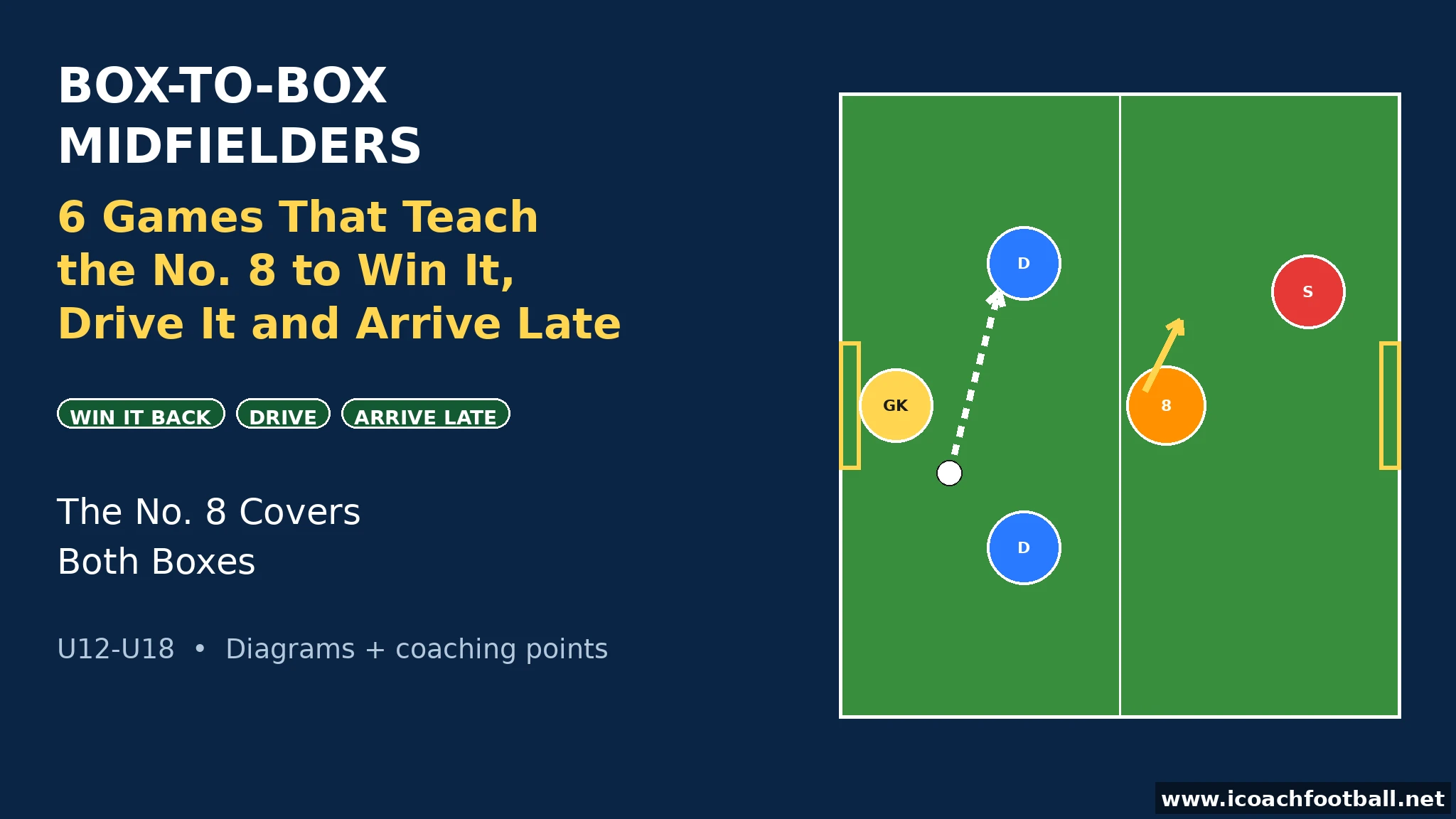
The box-to-box midfielder is the player who covers both penalty boxes. These six soccer drills for box-to-box midfielders teach the No. 8 to win the ball back in their own half, receive between the lines on the half-turn, drive at a defender to create a 2v1, break through centrally in a 4-plus-2 game, and arrive late in the opposition box — in one 60-minute session.
Suitable for: U12–U18
In football — soccer in the US — the box-to-box midfielder is the hardest job on the pitch and the one most coaches train the least. Teams drill the No. 6’s screen and the No. 10’s pocket, then hand the No. 8 the whole middle of the pitch and hope the running takes care of itself. It does not. The six games below train the job as FIFA teaches central midfielders: the FIFA Training Centre session “Individual actions: Developing central midfielders” builds the receive-and-turn from a mannequin circuit, and “Game-situations: Developing central midfielders” builds the break-through from a 4-plus-2 game — both by Willi Ruttensteiner, FIFA’s Technical Lead for Talent Coach and Academies. This post is the specialist companion to our soccer drills for midfielders — that post trains the whole midfield job, this one trains only the No. 8, and it completes the set with our soccer drills for defensive midfielders (the No. 6) and our soccer drills for attacking midfielders (the No. 10).
Session snapshot
- Players: 12–20 (pairs and small groups for the circuits, 8v8 for the finish)
- Area: A 20-by-30-metre circuit for the receiving work; a 40-by-22-metre pitch for the break-through game
- Duration: 60 minutes
- Focus: Winning it back, receiving on the half-turn, driving at defenders, breaking through centrally, arriving late
- Age: U12–U18 (see Age adaptations)
The six No. 8 rules
Every one of these soccer drills for box-to-box midfielders is built on six rules. Teach them once, then repeat them in every game until the players say them back to you.
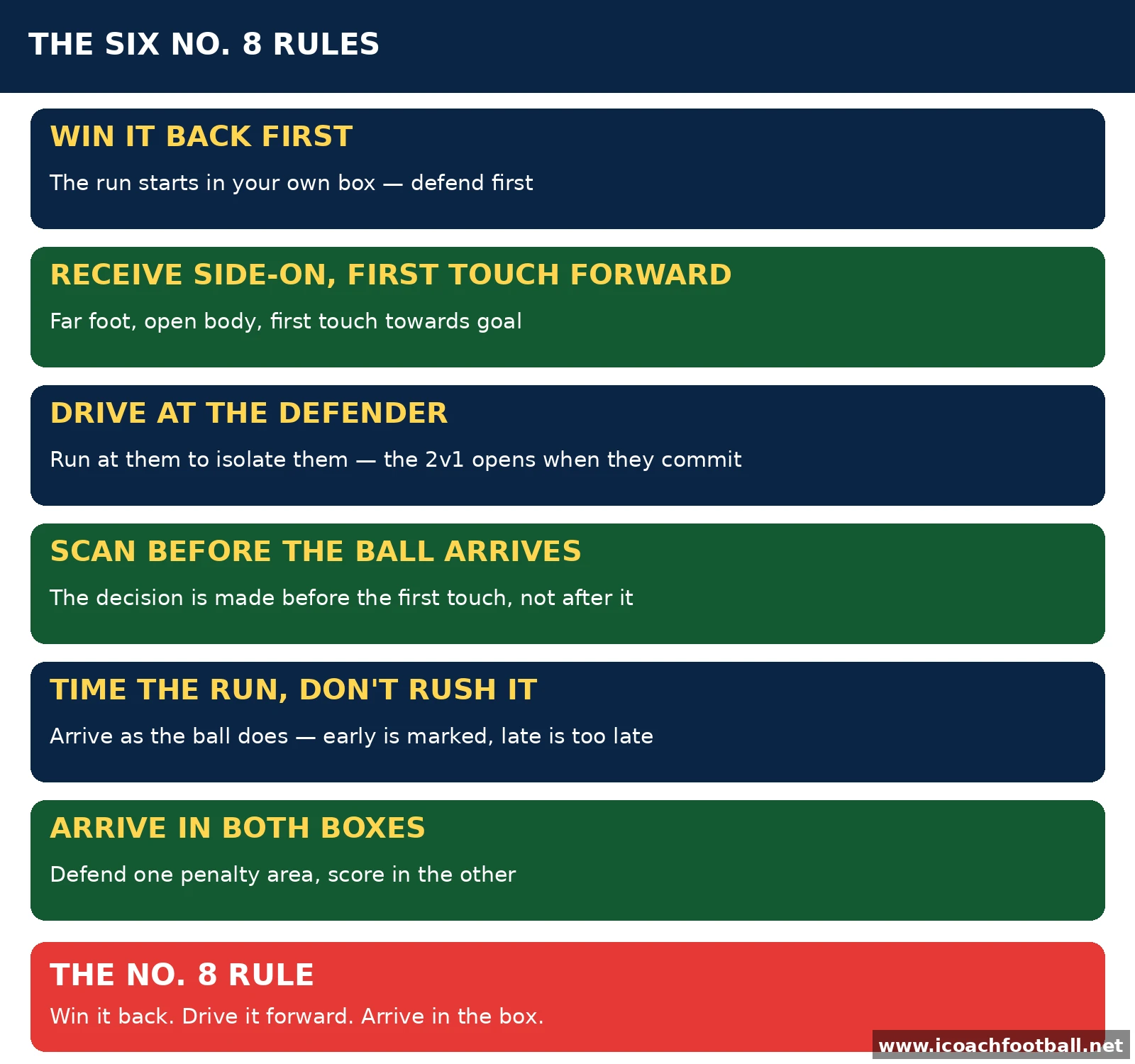
| Rule | What it means |
|---|---|
| Win it back first | The run starts in your own box — a No. 8 who does not defend is a No. 10 with a longer run |
| Receive side-on, first touch forward | Side-on body, far foot, first touch towards the opposition goal — never back to your own |
| Drive at the defender | Run at them to isolate them — the 2v1 only opens when the defender has to commit |
| Scan before the ball arrives | The decision is made before the first touch, not after it |
| Time the run, don’t rush it | Arrive as the ball does — early and you are offside or marked, late and the chance is gone |
| Arrive in both boxes | Defend one penalty area, score in the other — the No. 8’s game is measured at both ends |
Drill 1: Receive, Turn, Drive — The FIFA Circuit
The receiving lesson. A 20-by-30-metre circuit with three lines of mannequins: the No. 8 makes a diagonal offer between the lines, receives, turns and plays into a mini-goal. Based on the FIFA Training Centre session “Individual actions: Developing central midfielders”, in which the individual-action circuit asks the midfielder to recognise the moment, make a diagonal offer between the midfield and defensive mannequins, receive, turn, and finish by playing into a mini-goal — and to keep circulating until the next diagonal offer appears.
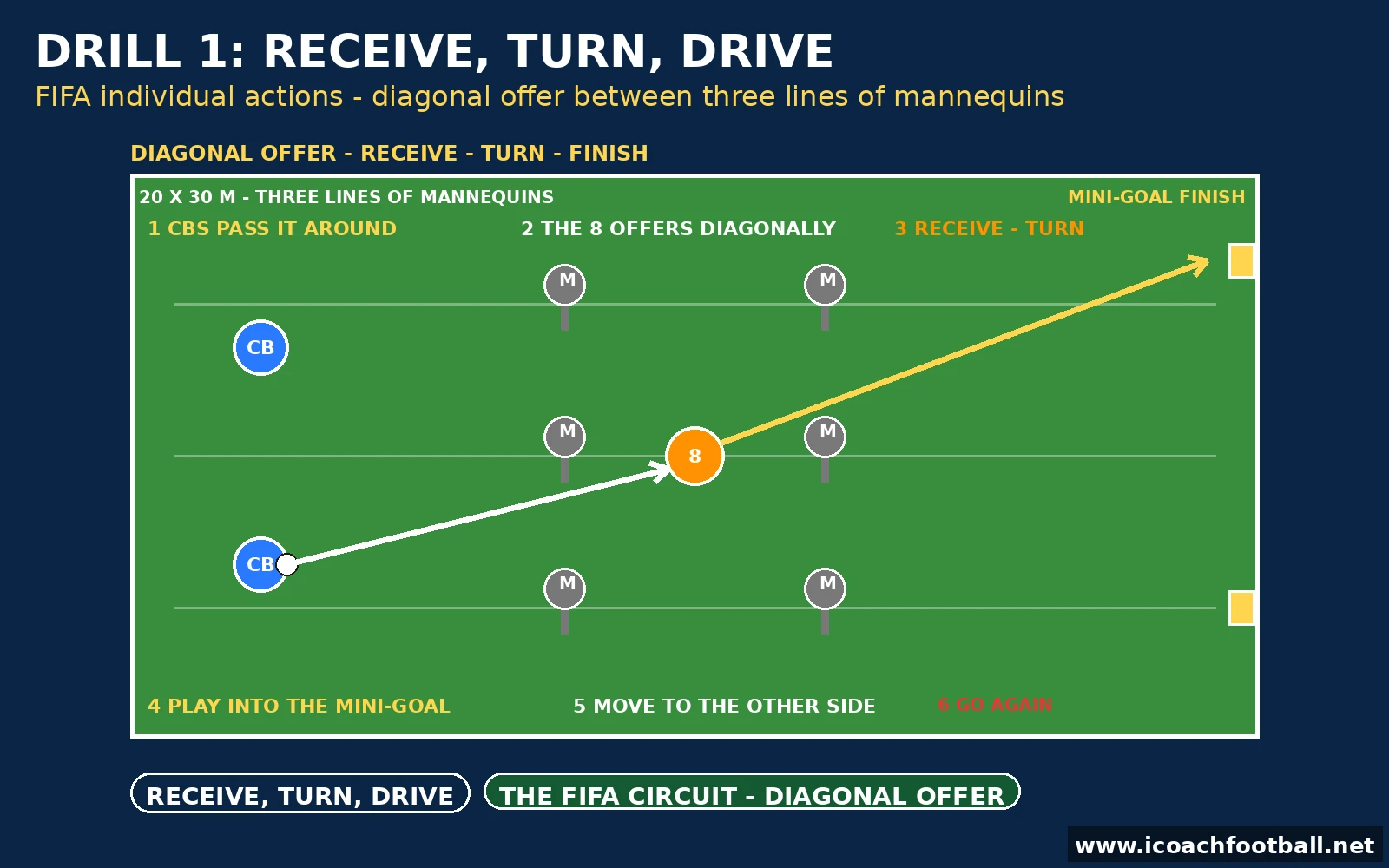
- Setup: A 20-by-30-metre area, two mannequins 10 metres apart on three lines (defensive, midfield, attacking) with 10 metres between lines, a mini-goal in each corner at one end and two mini-goals diagonally at the other, two centre-backs, one No. 8, balls with the coaches, 10 minutes.
- How to play:
- The two centre-backs pass the ball between themselves at the back of the area.
- The No. 8 watches for the moment and makes a diagonal offer between the midfield and defensive mannequins.
- The centre-back plays a diagonal pass between the mannequins into the 8’s path.
- The 8 receives side-on with the far foot and turns out of the space between the mannequins.
- The 8 plays first time into the mini-goal on the same side.
- The 8 moves to the opposite side and the sequence repeats — receive, turn, finish.
- Coach’s note: Watch the 8 who offers too early and stands still between the mannequins — a static offer is marked before the pass is played, and the diagonal lane never opens; the cue is “offer at the right moment,” and our soccer scanning drills teach the shoulder check that times the offer, while our soccer passing drills build the diagonal ball the circuit needs.
- Progressions: A defender applies light pressure on the 8, so the turn must beat a real opponent; the 8 must finish with the weaker foot; the 8 must receive, turn and play into the far mini-goal instead of the near one.
Drill 2: The Pivot Game — Building Under Pressure
The build-up lesson. A 25-by-15-metre area with a 4-metre central zone: six attackers and two neutral pivots build against four defenders, and the No. 8 is the player who connects the zones. Based on the FIFA Training Centre session “Game-situations: Developing central midfielders”, in which the build-under-pressure exercise marks a 25-by-15-metre area with a 4-metre central zone, places the neutral pivot inside it, and asks the attackers to connect with the pivot to play from defence into attack — with the midfielder always thinking ahead to provide a clear passing lane.
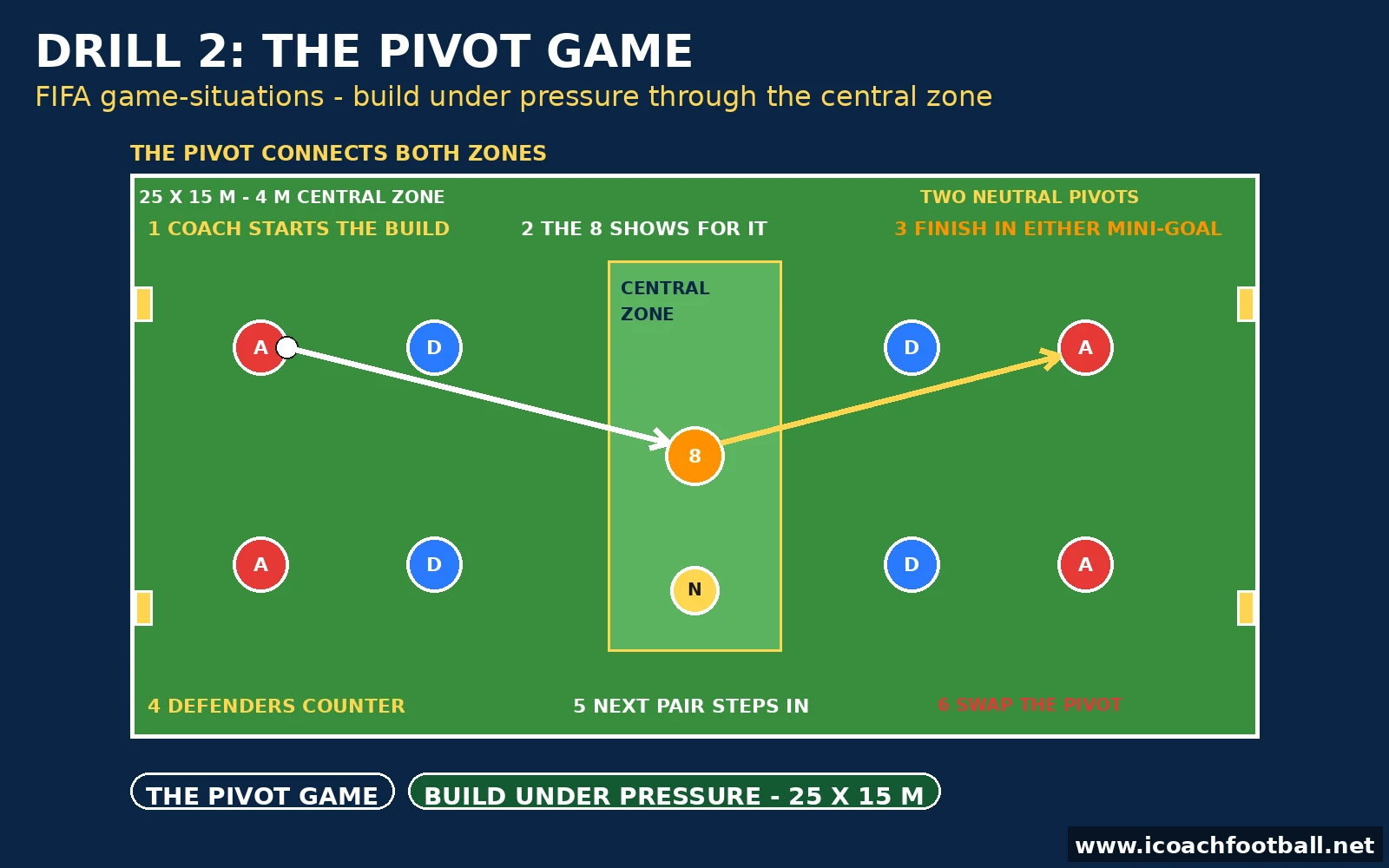
- Setup: A 25-by-15-metre area with a 4-metre central zone marked across the middle, two mini-goals at each end, six attackers, four defenders, two neutral pivots who always play with the team in possession, balls with the coach, 10 minutes.
- How to play:
- The coach plays the ball to the two attackers in the starting zone.
- The attackers combine to play through to the opposite end zone, using the pivot in the central zone.
- The No. 8 is the pivot — they must always offer a clear passing lane to the build-up player.
- On entry into the end zone, the attackers finish by scoring in either mini-goal.
- If the defenders win the ball, they counter and score in the opposite mini-goals.
- After each goal, the next pair of attackers steps in and the No. 8 swaps with a team-mate.
- Coach’s note: Watch the 8 who hides behind a defender in the central zone — a pivot who cannot be found is not a pivot, and the build-up dies in the starting zone; the cue is “show for it on the half-turn,” and our soccer possession drills build the patience to keep the ball until the lane opens, while our soccer drills for defensive midfielders train the No. 6 who must cover behind the pivot when the ball is lost.
- Progressions: The defenders may enter the central zone, so the pivot must receive under pressure; the pivot is limited to two touches, so the scan must happen before the ball arrives; the attackers must score within three passes of the first ball into the pivot.
Drill 3: Drive at the Defender — Isolate and Create the 2v1
The carrying lesson. A 2v1 in a 20-by-20-metre channel: the No. 8 receives, drives straight at the defender to isolate them, and creates the 2v1 for the runner. Based on the FIFA Training Centre session “Game-situations: Developing central midfielders”, in which the coaching points ask the midfielder to drive at the defender to isolate them and create a 2v1 — and to turn into the free space they have identified to find a finishing opportunity.
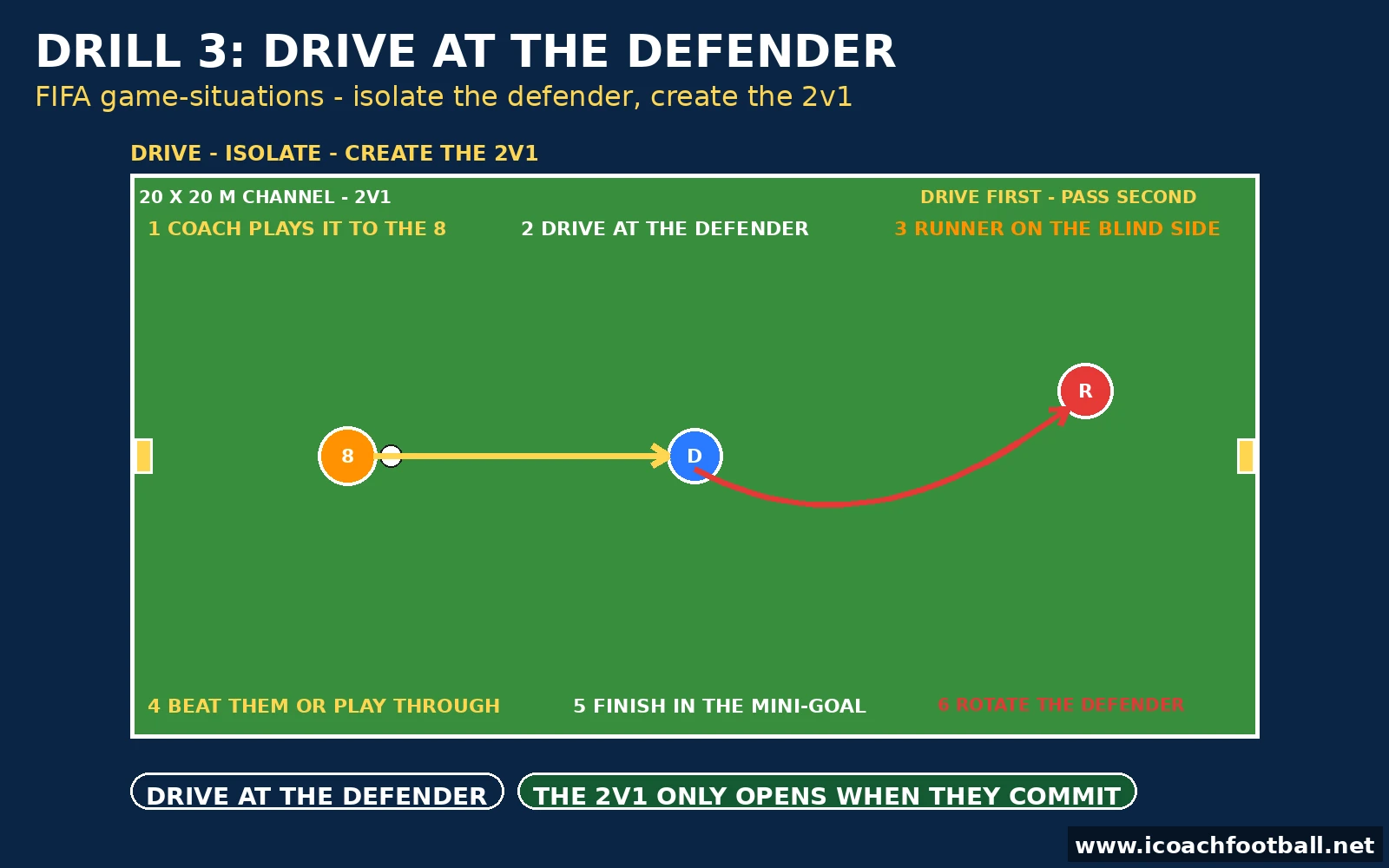
- Setup: A 20-by-20-metre channel with a mini-goal at each end, one No. 8 and one runner against one defender, balls with the coach, 10 minutes.
- How to play:
- The coach plays the ball into the No. 8 at the edge of the channel.
- The 8 receives on the half-turn and drives straight at the defender.
- The runner times a supporting run on the 8’s blind side — not too early, or the defender reads it.
- The 8 either beats the defender 1v1 or plays the runner through into the mini-goal.
- If the defender wins it, they counter to the opposite mini-goal and the 8 must win it back.
- After every two sequences, rotate the defender so every player defends the 2v1.
- Coach’s note: Watch the 8 who passes sideways before driving — a pass played before the defender commits lets the defender stay set, and the 2v1 never opens; the cue is “drive at them first,” and our soccer dribbling drills train the feint that unbalances the defender, while our soccer drills for wingers train the same isolation from the wide areas.
- Progressions: A second defender joins as cover, so the 8 must play the runner before the cover arrives; the runner must make a decoy run across the defender first; the 8 must finish with the weaker foot after beating the defender.
Drill 4: The Break-Through Game — 4 Plus 2 Against 2
The progression lesson. A 40-by-22-metre pitch with an 18-metre central zone: four attackers and two neutral midfielders build a 4-plus-2 against two defenders, then break through centrally and finish. Based on the FIFA Training Centre session “Game-situations: Developing central midfielders”, in which the second exercise starts as a 4-plus-2 against 2, advances into an attack that is also a 4-plus-2, and asks the neutral midfielders to create passing angles behind the two pressing players so they can link, turn and drive into attack.
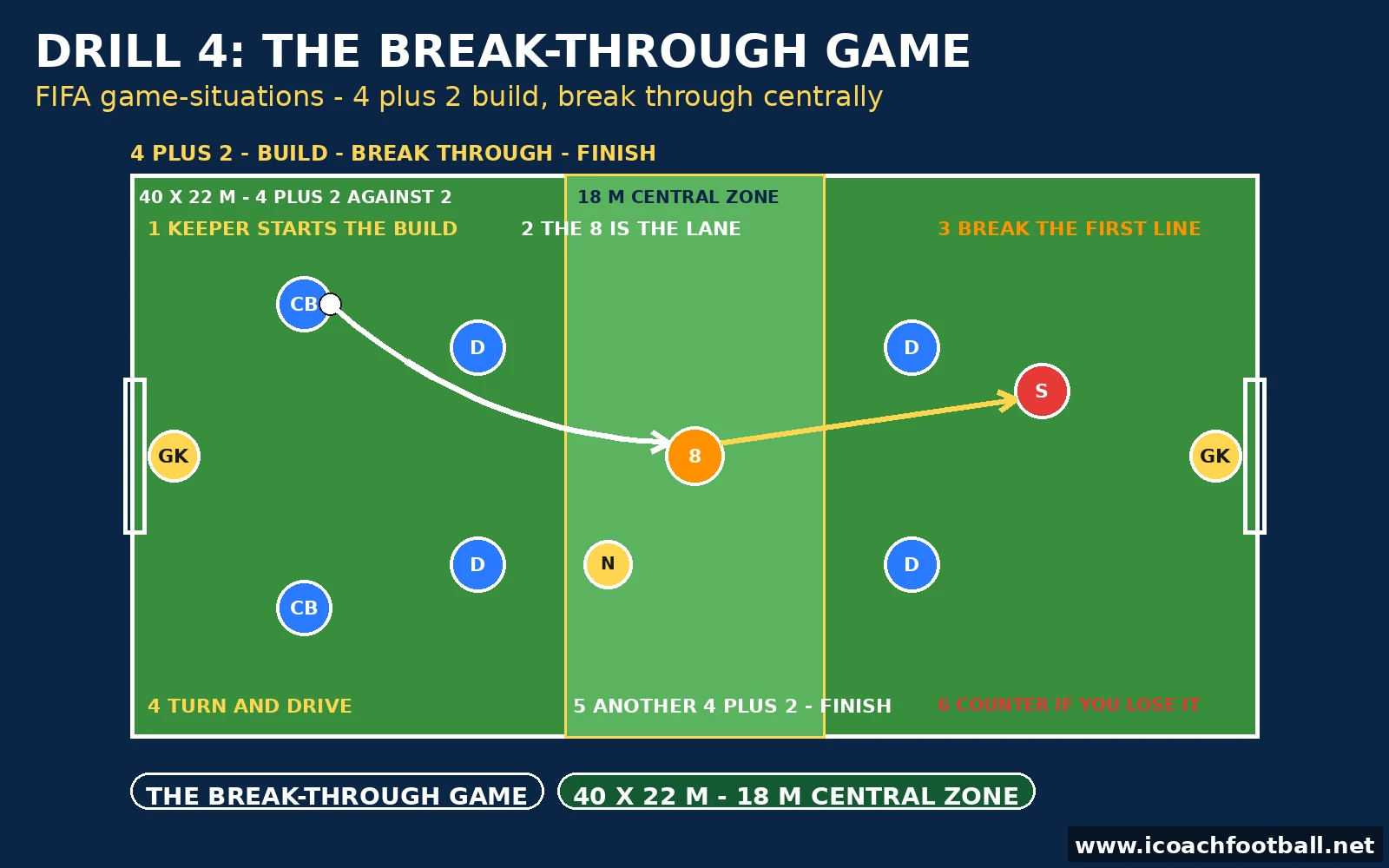
- Setup: A 40-by-22-metre pitch with a full-size goal and a keeper at each end, an 18-metre central zone marked across the middle, four attackers, four defenders split two and two in their own halves, two neutral midfielders who always play with the team in possession, balls with the coach, 10 minutes.
- How to play:
- Play starts with the goalkeeper, and the attackers build a 4-plus-2 against the two pressing defenders.
- The No. 8 positions behind the two pressing players, on a diagonal passing lane.
- The centre-backs find the 8 with a vertical or diagonal pass that breaks the first line.
- The 8 receives on the half-turn and links, turns or drives into the central zone.
- In the final phase, the attackers create another 4-plus-2 and finish with a shot on goal.
- If the defenders win the ball, they counter to the opposite goal and the 8 must recover.
- Coach’s note: Watch the 8 who receives facing their own goal — a closed body can only play back, and the break-through dies before it starts; the cue is “turn into the free space,” and our soccer drills for attacking midfielders train the same half-turn one line higher, while our soccer 4v4 drills train the same small-sided shape without the zone.
- Progressions: The defenders may cross into the other half, so the 8 must find space under real pressure; the neutrals are limited to one touch, so the combination must be instant; the attack must finish within three passes of the first ball into the 8.
Drill 5: Arrive Late — The Run From Deep
The finishing lesson. The No. 8 starts 30 metres from goal and times the run to arrive at the penalty arc as the cross comes in — the goal that comes from being in the right place a second after everyone else has run past it. In line with the FIFA Training Centre session “Game-situations: Developing central midfielders”, in which the midfielder must turn into the free space they have identified and create a 2v1 to find a finishing opportunity — the late arrival is the No. 8’s version of that finish.
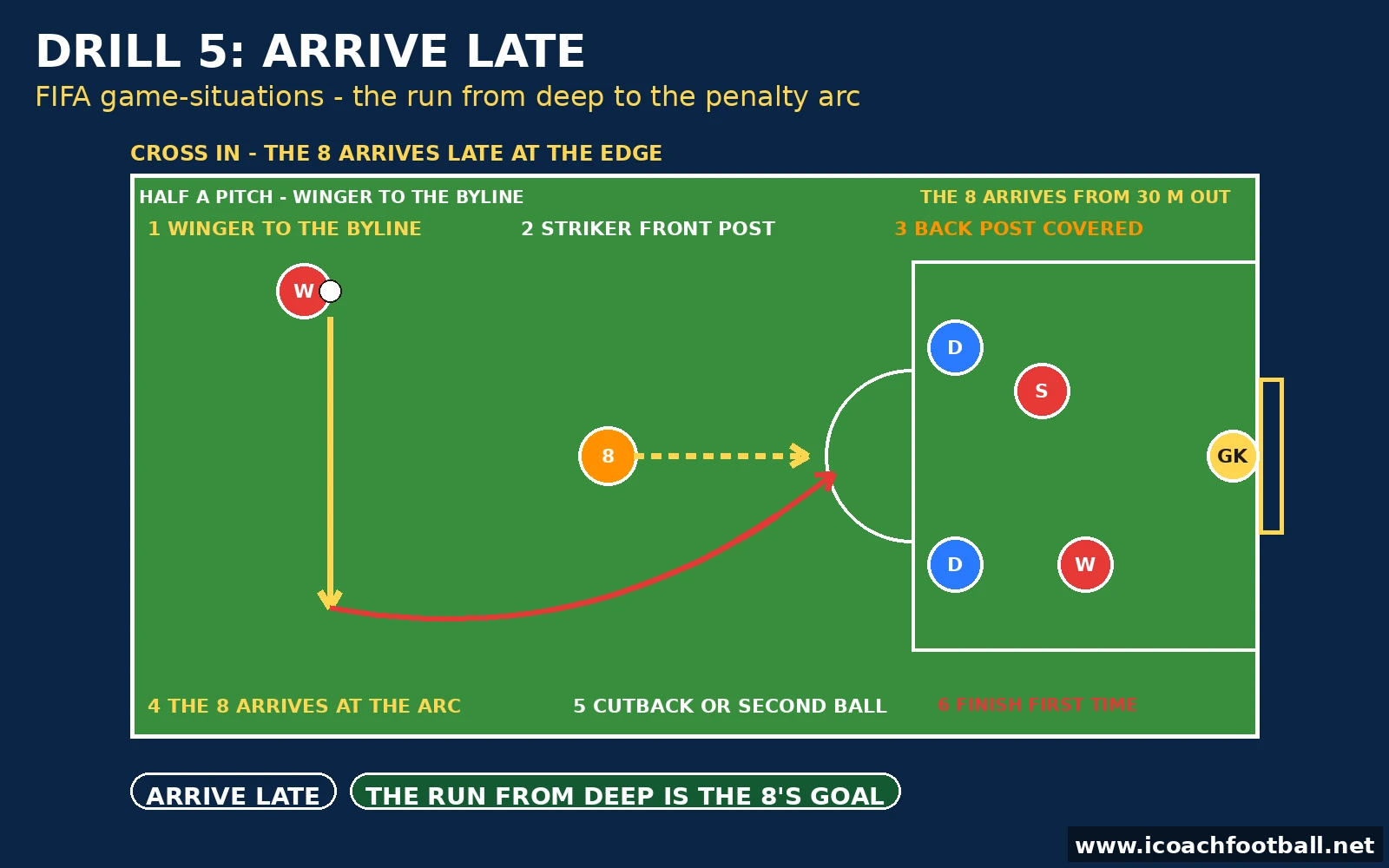
- Setup: Half a pitch with one full-size goal and a keeper, a winger and a striker against two defenders, the No. 8 starting 30 metres from goal, balls with the coach, 10 minutes.
- How to play:
- The coach plays the ball wide to the winger, who drives to the byline.
- The striker attacks the front post and the opposite winger attacks the back post.
- The No. 8 times the run from deep to arrive at the penalty arc as the cross comes in.
- If the cross is cut back, the 8 finishes first time from the edge.
- If the cross is cleared, the 8 takes the second ball and shoots or plays it wide again.
- After five minutes, the defenders may step out to close the 8, so the arrival must be disguised.
- Coach’s note: Watch the 8 who sprints into the box with the striker — two players at the same post leave the edge empty, and the cutback rolls through to nobody; the cue is “arrive late, arrive at the edge,” and our football late runs into the box drills train the same timed arrival from deeper, while our soccer attacking third drills train the cutback this finish depends on.
- Progressions: The 8 must finish first time with the weaker foot; the winger may cut inside and shoot, so the 8 must read the shot and follow it in; the second ball must be finished within two seconds of the clearance.
Drill 6: The Box-to-Box Game — 8v8, Both Boxes Count
The match-real finish. An 8v8 game on a reduced pitch in which the No. 8 must touch both penalty boxes on every attack: win it back in your own half, drive it forward, and arrive in the other box. In line with the FIFA Training Centre central-midfielder sessions, in which the midfielder must contribute in all phases — build-up, progression and transition — and the game-phases method exposes the player to the full complexity of a real match.
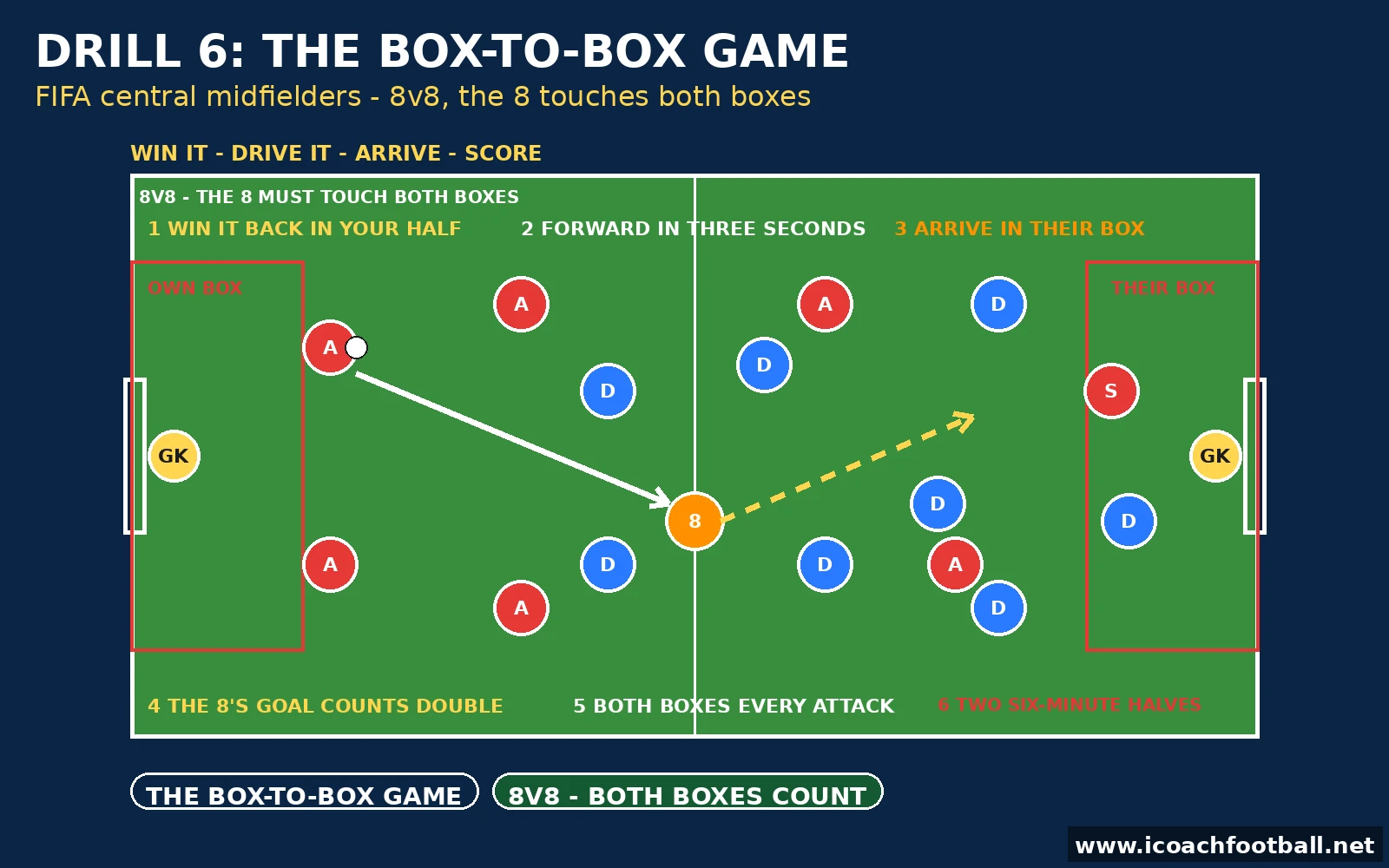
- Setup: A reduced pitch, full width, two full-size goals with keepers, 8v8 in a 3-3-2 shape against a 3-3-2, both penalty boxes marked, balls with the coach, 12 minutes.
- How to play:
- Play a normal game, but the No. 8 must win the ball back in their own half at least once per attack.
- After the regain, the 8 drives forward or plays the first forward pass within three seconds.
- The 8 then sprints to arrive in the opposition box for the finish — late, at the edge.
- A goal scored or assisted by the 8 after a recovery in their own half counts double.
- If the 8 does not touch both boxes in an attack, the attack does not count towards the score.
- Play two six-minute halves, then swap which team carries the No. 8 role.
- Coach’s note: Watch the 8 who stops running after the pass — a No. 8 who plays the ball and walks has done half the job, and the box-to-box game is won by the player who keeps going; the cue is “run through the pass,” and our soccer counter attack drills train the same three-second transition this game demands, while our soccer 6v6 drills train the same movement in a smaller game.
- Progressions: The three-second rule becomes two seconds, so the transition must be instant; the 8 is limited to two touches, so the combination must be first time; only goals created through the 8 count at all.
Coaching points
- Win it back first: The run starts in your own box — our soccer drills for defensive midfielders train the No. 6 who covers behind the 8, and our soccer drills for U15 train the same recovery run one age up.
- Receive side-on, first touch forward: A closed body can only play backwards — our soccer scanning drills teach the shoulder check that finds the lane, and our soccer passing drills build the firm first-time ball.
- Drive at the defender: The 2v1 only opens when the defender commits — our soccer dribbling drills train the feint, and our soccer drills for wingers train the same isolation wide.
- Scan before the ball arrives: The decision is made before the first touch — our soccer drills for midfielders train the whole midfield job this role sits inside, and our soccer drills for U16 run the same scan at full speed.
- Time the run, don’t rush it: Early is offside or marked, late is too late — our football late runs into the box drills train the same timed arrival, and our soccer drills for U17 train it against senior defenders.
- Arrive in both boxes: The No. 8’s game is measured at both ends — our soccer drills for strikers train the finish the 8 arrives for, and our soccer drills for U18 run it at senior pace.
- Play forward first: The first look is through the lines — our soccer possession drills train the patience, and our soccer 3v3 drills train the same forward pass in a smaller game.
- Turn into the free space: The space you scanned for is the space you drive into — our soccer drills for attacking midfielders train the same half-turn one line higher, and our soccer 5v5 drills train it in a bigger game.
- The 8 defends too: The modern No. 8 is the second defender after the ball is lost — our soccer drills for U19 run the same press at adult intensity, and our college soccer drills run it at the next level.
- The finish is the job: A No. 8 who creates but never scores is half a player — our soccer attacking third drills train the cutback it finishes, and our soccer drills for U15 run the same arrival one age down.
Common mistakes
- Offering too early and standing still: A static offer is marked before the pass is played — offer at the right moment.
- Hiding behind a defender in the central zone: A pivot who cannot be found is not a pivot — show for it on the half-turn.
- Passing sideways before driving: A pass played before the defender commits lets them stay set — drive at them first.
- Receiving facing your own goal: A closed body can only play back — turn into the free space.
- Sprinting into the box with the striker: Two players at the same post leave the edge empty — arrive late, at the arc.
- Stopping after the pass: A No. 8 who plays the ball and walks has done half the job — run through the pass.
Age adaptations
| Age | Area | Touches | What changes |
|---|---|---|---|
| U12–U13 | 20-by-30-metre circuit, 25-by-15-metre area | Three touches | Drill 1 runs with a passive pressing line at first, so the 8 learns the diagonal offer before a defender arrives; Drill 2 runs with the pivot free in the central zone; Drill 3 runs 2v0, so the 8 learns the drive before a defender is added; Drill 4 runs with the defenders staying in their own halves; Drill 5 runs with the cross from one side only; Drill 6 runs 6v6 with no box-touch rule — our U13 soccer practice plan shows the same age band in a full session |
| U14–U15 | 20-by-30-metre circuit, 40-by-22-metre pitch | Two touches | Drill 1 runs as written, with the defender added in the second block; Drill 2 runs with the defenders entering the central zone; Drill 3 runs 2v1 as written; Drill 4 runs with the neutrals on two touches; Drill 5 runs with the cross from either side; Drill 6 runs with the box-touch rule — our soccer drills for U15 train the same habits in a full session |
| U16–U17 | Half a pitch, reduced pitch | One–two touches | Drill 1 runs with the 8 finishing with the weaker foot; Drill 2 runs with the pivot on two touches; Drill 3 runs with a second defender joining as cover; Drill 4 runs with the defenders free to cross halves; Drill 5 runs with the 8 finishing first time with the weaker foot; Drill 6 runs with the three-second rule — our soccer drills for U16 and our soccer drills for U17 run the same age band in full sessions |
| U18 (and adult) | Half a pitch, reduced pitch | One touch | Drill 1 runs at full speed with the defender forcing the turn-or-play-back choice; Drill 2 runs with the attack scoring within three passes of the first ball into the pivot; Drill 3 runs with the 8 finishing with the weaker foot; Drill 4 runs with the attack finishing within three passes of the first ball into the 8; Drill 5 runs with the second ball finished within two seconds; Drill 6 runs with the two-second rule and only goals created through the 8 counting — our soccer drills for U18 and our soccer drills for U19 run the same habits at full size |
60-minute session plan
These six soccer drills for box-to-box midfielders fit into the hour like this:
| Block | Minutes | What to run |
|---|---|---|
| Warm-up | 0–10 | Drill 1, receive, turn, drive, walking pace then half speed |
| Build-up | 10–20 | Drill 2, the pivot game |
| Carrying | 20–30 | Drill 3, drive at the defender |
| Progression | 30–40 | Drill 4, the break-through game |
| Finishing | 40–50 | Drill 5, arrive late |
| Match-real finish | 50–60 | Drill 6, the box-to-box game 8v8 |
For a full guide to building the hour around these blocks, see our 60-minute session plan.
FAQ
What is a box-to-box midfielder?
A box-to-box midfielder — usually the No. 8 — is the central midfielder who contributes in both penalty boxes: they win the ball back in their own half, carry or pass it forward through midfield, and arrive late in the opposition box to score or assist. The two boxes are the penalty areas at either end of the pitch, and the No. 8 connects them by running between them on every attack. In football — soccer in the US — it is the most physically demanding outfield role, which is why this post trains it as a complete job rather than a single skill.
What is the difference between a box-to-box midfielder and a defensive midfielder?
The defensive midfielder — the No. 6 — protects the space in front of the back four and rarely leaves it; the box-to-box midfielder — the No. 8 — starts in the same central area but runs the full length of the pitch. The No. 6 screens a lane and wins the ball; the No. 8 wins the ball and then drives it forward and arrives in the box. The two jobs meet in the middle of the pitch — which is why our soccer drills for defensive midfielders train the holding role this post plays alongside.
What is the difference between a box-to-box midfielder and an attacking midfielder?
The attacking midfielder — the No. 10 — lives between the opposition’s midfield and defence and rarely tracks back to their own box; the box-to-box midfielder — the No. 8 — starts deeper, defends their own box, and arrives in the opposition box late. The No. 10 finds the pocket and plays the through ball; the No. 8 wins it, drives it, and is the player arriving at the edge when the No. 10’s pass comes in. Our soccer drills for attacking midfielders train the No. 10’s half of that partnership.
What age should a player start training as a box-to-box midfielder?
From U12. Before that, every player should rotate through every position, including the No. 8, so they learn the running and the receiving without being fixed in it. From U12 the role becomes a real job: the player who wins it back, drives at defenders and arrives late. Drill 1 in this post is the first drill to teach it — a circuit that works from U12 up, with the defender and the one-touch rules added as the players get older.
How do you train a box-to-box midfielder’s fitness without running laps?
You train it inside the drills, not beside them. Every drill in this post makes the No. 8 run the full length of the job — the recovery in Drill 6, the drive in Drill 3, the late arrival in Drill 5 — so the fitness comes from repeated high-intensity runs with the ball, which is how the role actually works in a match. Add one rule and the conditioning takes care of itself: the No. 8 must touch both boxes on every attack, and the three-second transition rule in Drill 6 keeps the intensity honest.
Sources
- FIFA Training Centre — “Individual actions: Developing central midfielders” (Willi Ruttensteiner, Technical Lead for FIFA Talent Coach and Academies Programme: a ball-mastery exercise receiving between two lines of mannequins, a receiving-behind-pressure exercise in a 10-by-10-metre mannequin area with mini-goals 20 metres away, and an individual-action circuit in a 20-by-30-metre area with three lines of mannequins in which the midfielder makes a diagonal offer, receives, turns and plays into a mini-goal; the PMDS model — Position, Moment, Direction, Speed — as the assessment frame; scan before receiving, receive side-on, first touch forward). Drills 1 and 3 in this post are based on and in line with that session.
- FIFA Training Centre — “Game-situations: Developing central midfielders” (Willi Ruttensteiner: building under pressure in a 25-by-15-metre area with a 4-metre central zone and a pivot player, and a 4+2v2 build-and-break-through game on a 40-by-22-metre pitch with an 18-metre central zone; key points — create clear passing lanes, find and hold the right spaces to receive between or beyond lines, scan early and often, drive at defenders to isolate them and create a 2v1, turn into the free space). Drills 2, 4, 5 and 6 in this post are based on and in line with that session.