Soccer Drills for Improving Defending Against the Switch of Play: 6 Games That Lock One Side, Shift as a Unit and Kill the Diagonal (U11–U17)
Quick answer
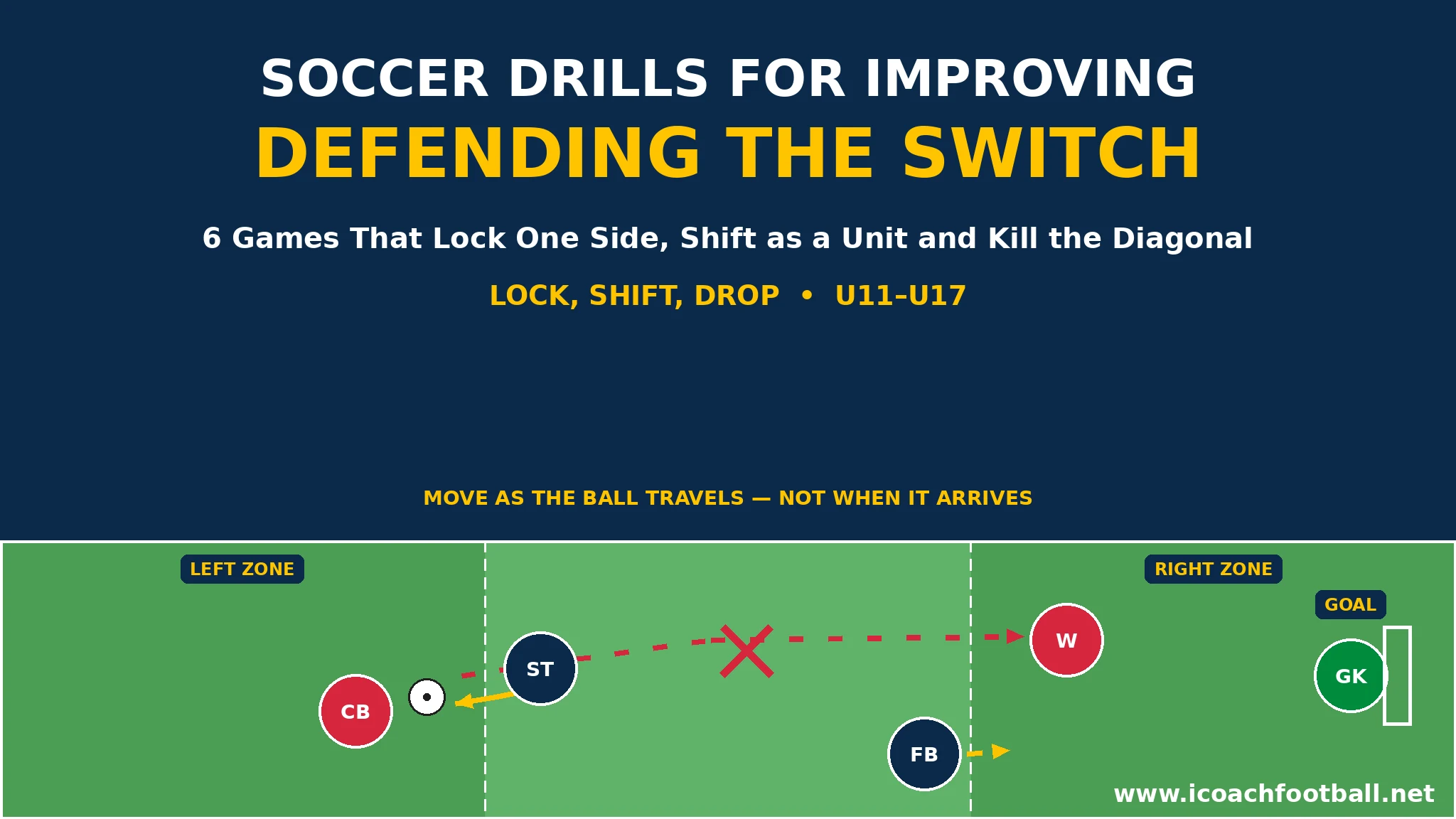
A switch of play is the long diagonal ball that moves the attack from one side of the pitch to the other — usually from a centre-back or midfielder out to the far-side winger, where your defence is thinnest. Most goals conceded from a switch are not conceded because the far-side defender was too slow. They are conceded because the defence shifted after the ball arrived instead of while it travelled, or because the far-side full-back stayed wide and left the space in behind open, or because nobody locked the ball carrier to one side and the switch was played for free. A good defence stops the switch with three habits: lock the ball carrier to one side so the switch is hard to play, move as a unit while the ball travels, and drop on the far side to protect the space in behind. These six soccer drills for improving defending against the switch of play train the skill step by step: a lock-one-side pressing drill, a shifting-as-a-unit drill, a far-side drop drill, a 3-zone switch game, a recovery-and-delay drill, and a full game where a goal after a switch scores three and a stopped switch scores two.
Suitable for: U11–U17 (ages 10–17)
Session snapshot
- Players: 14–18
- Age: U11–U17 (ages 10–17)
- Area: Half a pitch, with 2 full goals
- Duration: 60 minutes
- Focus: Defending against the switch of play — lock one side, shift as a unit, drop on the far side, the 3-zone switch game, recover and delay, and the switch game
- Equipment: 14 balls, 30 cones, bibs, 2 full goals
Why these six games work
A team that cannot defend the switch of play cannot defend the width of the pitch at all. The ball goes to one side, your whole team slides across to deal with it — and then comes the beat the whole session is built on. The diagonal ball goes to the far side, where your full-back is either too wide, too high, or still running. Chase the switch late and the winger receives it with time to cross. Stay narrow and the winger has the whole flank to himself. The right answer is boring, and it is a matter of order, not speed: lock the ball carrier to one side so the switch is hard to play in the first place, shift while the ball is travelling so the unit arrives together, and drop on the far side so the space in behind is protected before the ball lands.
The first drill fixes the switch at its source: a striker angles his press so the centre-back can only play one way, taking the switch away before it is even an option. The second drill fixes the shift: the back line slides together as the ball moves side to side, so no gap opens between the lines. The third drill fixes the far side: the far-side full-back drops off to protect the space in behind as the switch travels. The fourth drill fixes the decision under pressure: a 3-zone game in which the attack must switch before they can score, and the defence must defend two zones and leave the far man free. The fifth drill fixes the recovery: the wide midfielder sprints back the moment the switch is played and delays the receiver out wide. The last drill puts it into a game where a goal after a switch scores three and a stopped switch scores two, so both sides fight for the diagonal.
The drills are grounded in the FIFA/UEFA coaching community. Drills 1, 2 and 6 are based on / in line with the FIFA Training Centre session “NEC Nijmegen U-15s: Foundations for defensive compactness and pressing”, in which U-15 head coach Niels Voet trains his team to turn a compact defensive shape into an attacking weapon: stay compact, shift across together and keep the back line connected, protect the centre by closing central passing lanes, force the opponent wide or backwards, and — the detail this session is built on — the number 9 forces the centre-back to one side, taking away the option to switch play and creating a better pressing situation for team-mates. Drills 3, 4 and 5 are based on / in line with the England Football Learning article “How to defend like England: space in wide areas”, which sets out how the national teams deal with the switch of play: counter-press to force the opposition to one side, stay compact in the centre, assess who will press the ball, who will deny the space in behind and who is responsible for covering the areas away from the ball, and as the ball goes out wide, the full-back drops off to protect the space in behind while a recovering wide player tracks back to apply pressure out wide. In the UK the same session is football drills for improving defending against the switch of play — the lock, the shift and the drop are identical.
This is the defensive side of the switching play our posts already teach. Our switching play soccer drills 4 goal game trains the attack — how to switch play and score in any of the four goals — and our football defending wide areas drills trains stopping wingers and blocking crosses — this session trains the specific moment between the two: the diagonal ball itself, and the shift that stops it.
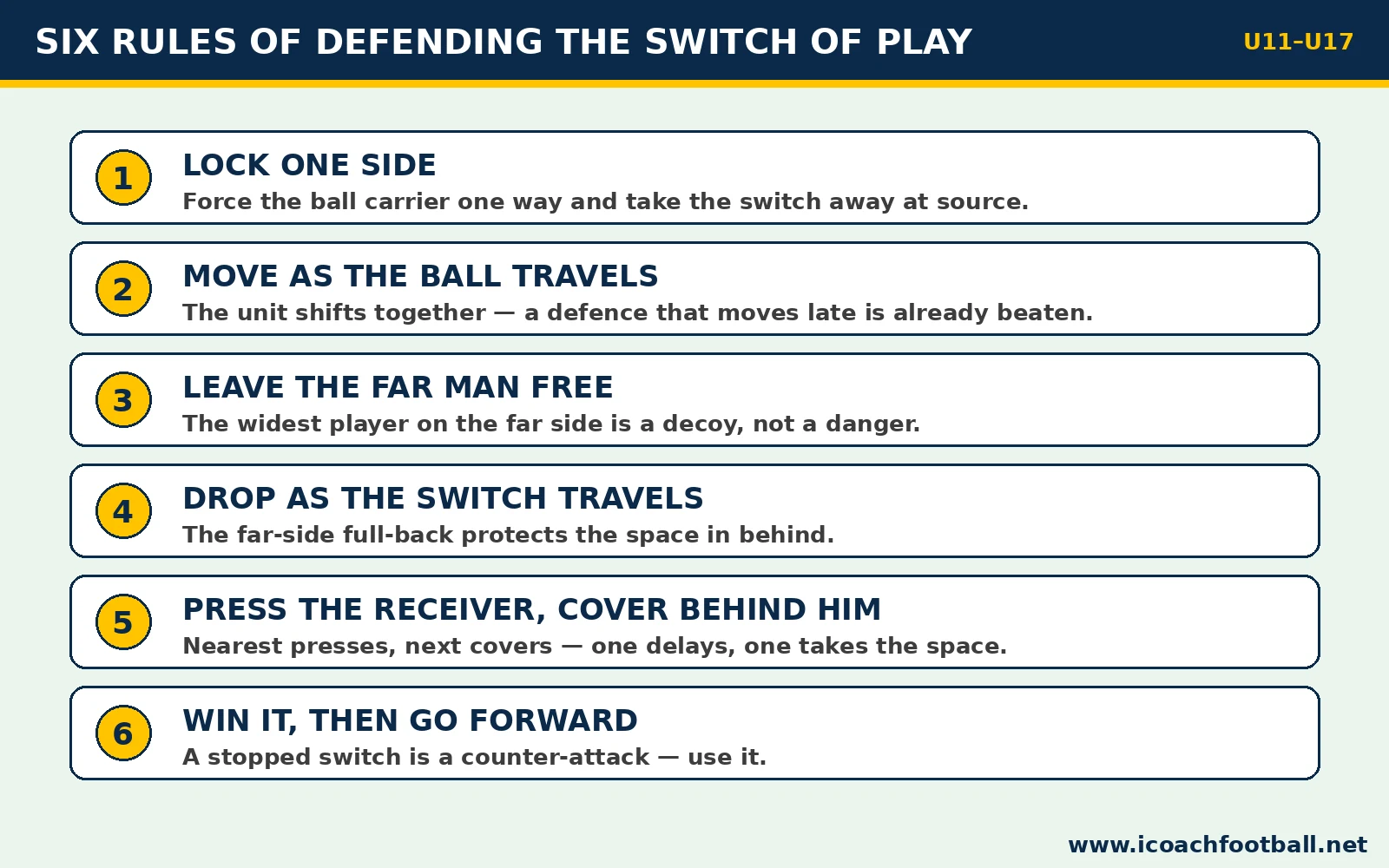
Six rules of defending against the switch of play
- Lock one side — force the ball carrier one way and take the switch away at source. A switch that is never played needs no defending.
- Move as the ball travels, not when it arrives — the unit shifts together. A defence that moves after the ball lands is already beaten.
- Leave the far man free — the widest player on the far side is a decoy, not a danger. Defend two zones out of three and let the far man wait.
- Drop as the switch travels — the far-side full-back protects the space in behind. A full-back who stays high while the ball is in the air is a goal waiting to happen.
- Press the receiver, cover behind him — nearest presses, next covers. One player delays the winger; the next one takes the space behind him.
- Win it, then go forward — a stopped switch is a counter-attack. Compact defending wins the ball in a dangerous area, so use it.
Drill 1 — Lock One Side
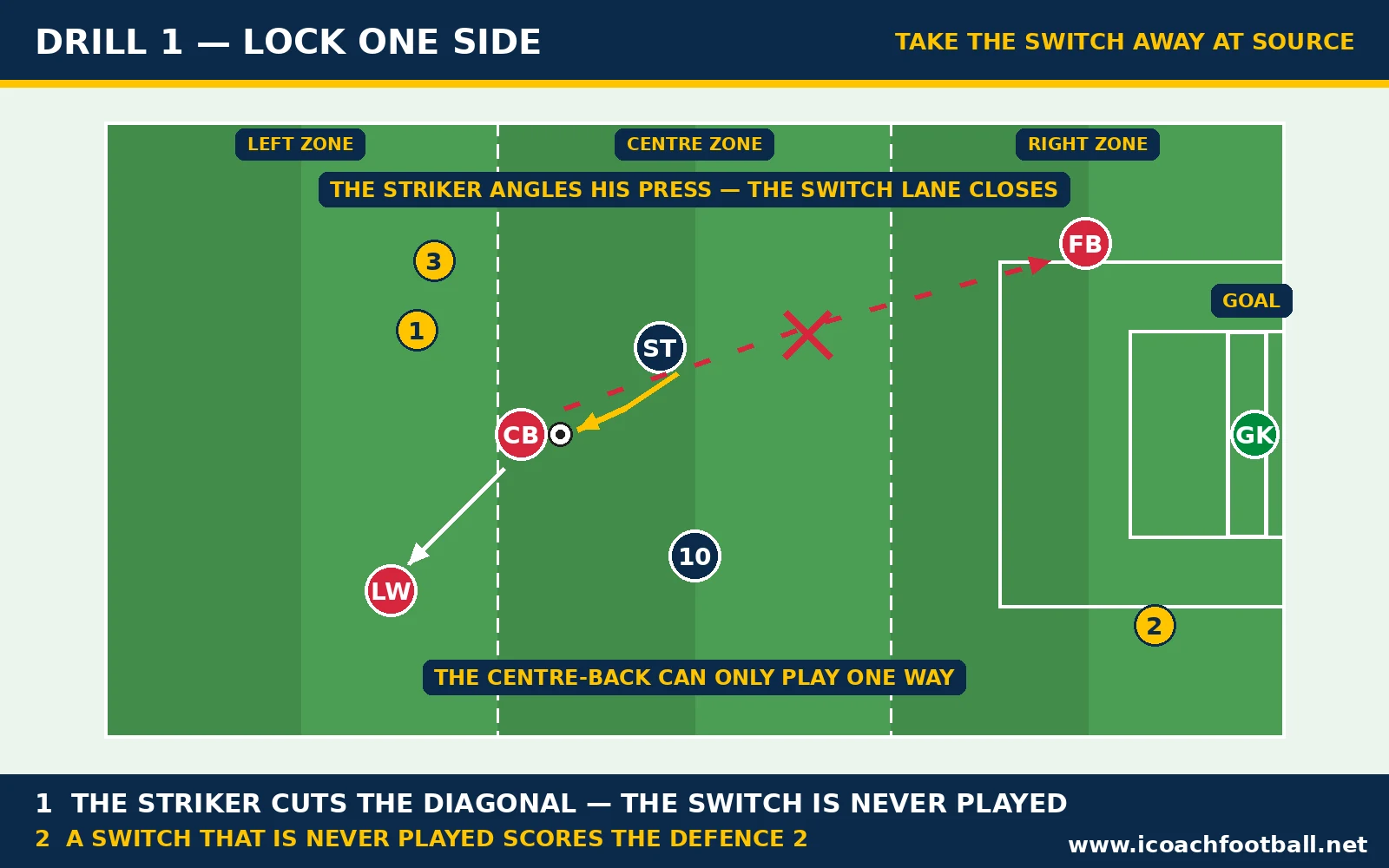
The pressing drill — a striker angles his run so the centre-back can only play one way, taking the switch away at source before it is even an option, in line with FIFA’s “NEC Nijmegen U-15s: Foundations for defensive compactness and pressing” session: the number 9 forces the centre-back to one side, taking away the option to switch play and creating a better pressing situation for team-mates.
Setup
- Area a 40 x 30-yard zone across the full width of the pitch with 1 full goal and a goalkeeper, plus 4 mini-goals.
- 8 minutes, then swap the pressing striker.
How to Play
- The centre-back receives the ball from the goalkeeper, 30 yards from goal, with the striker set ten yards in front of him.
- The striker sprints at the centre-back on a curved run, closing the passing lane to the far side.
- The centre-back can only play to the near side, where the wide midfielder is waiting to press.
- The striker’s team-mate, the number 10, drops two yards to cover the space behind the press.
- The defence stays compact and shifts across with the ball, closing the central passing lanes.
- A switch that is never played scores the defence 2; a switch that is played and reaches the far side scores the attack 2.
Coach’s note: “Take the switch away — the number 9 forces the centre-back one way, and the switch dies before it is played.”
Progressions: The centre-back is allowed to dribble out instead of passing, so the striker must read the touch; the far-side full-back starts ten yards higher, so the press must be faster; the striker presses without a call, on eye contact only.
Drill 2 — Move as the Ball Travels
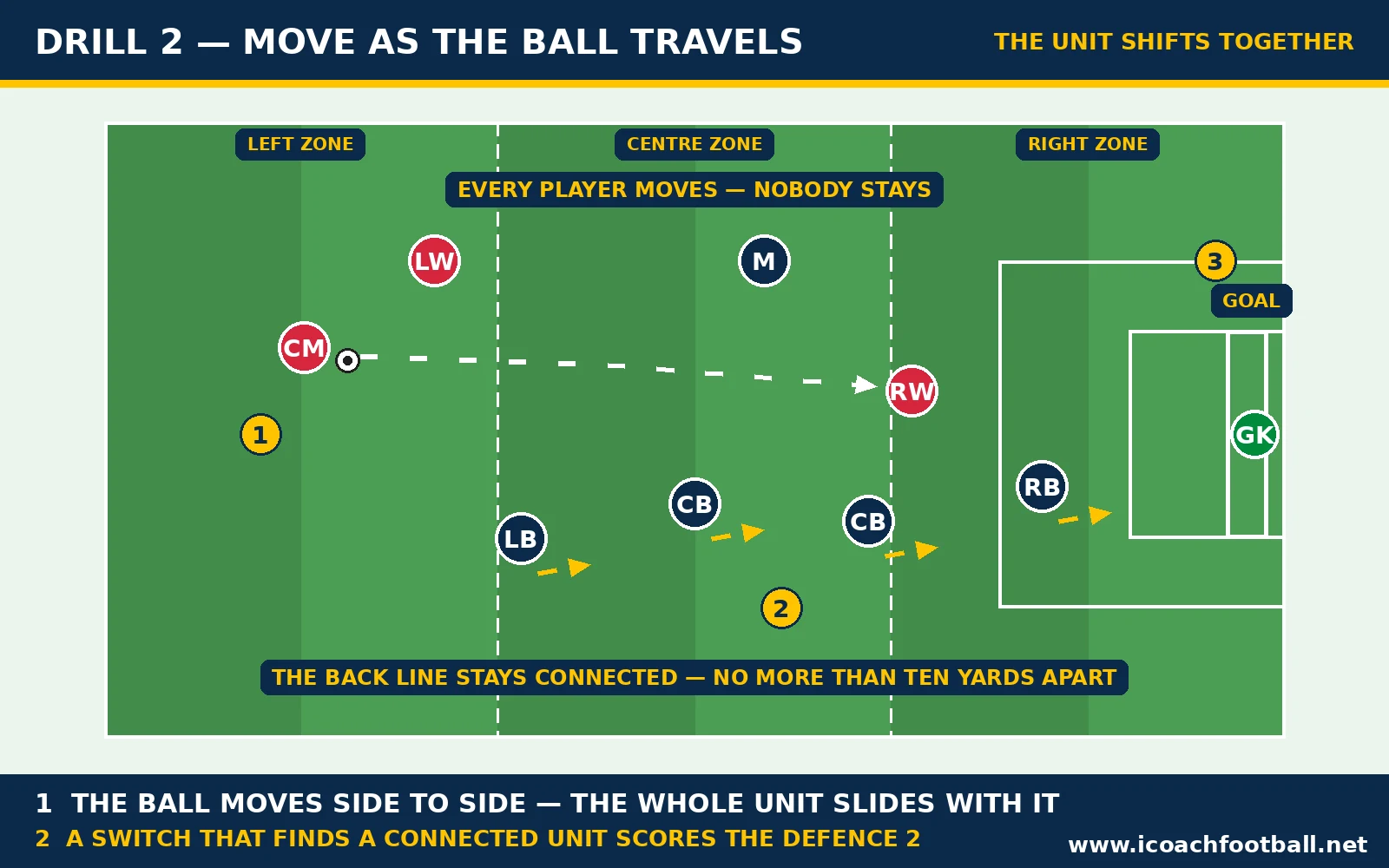
The shifting drill — the back line slides together as the ball moves from side to side, so no gap opens between the lines and the unit arrives together, in line with FIFA’s “NEC Nijmegen U-15s: Foundations for defensive compactness and pressing” session: stay compact, shift across together and keep the back line connected, and the defenders close central passing lanes and force play wide.
Setup
- Area half a pitch, 2 full goals with goalkeepers, 8v8, the pitch split into three vertical zones.
- 9 minutes, then swap the teams.
How to Play
- The attack keeps the ball on the left, with the defending back four tucked across to that side.
- The attack moves the ball to the centre, and the whole defence slides across with it.
- The attack moves the ball to the right, and the defence slides again — every player moves, nobody stays.
- The back line stays connected, with no more than ten yards between any two defenders.
- The midfield stays tight in front of the defence, screening the central passing lanes.
- A switch that finds a gap between the lines scores the attack 2; a switch that finds a connected unit scores the defence 2.
Coach’s note: “Move as the ball travels — a defence that moves after the ball lands is already beaten.”
Progressions: The attack moves the ball faster, with one-touch passing; the zones narrow by five yards, so the shift must be tighter; the defence must win the ball and score in a mini goal within ten seconds.
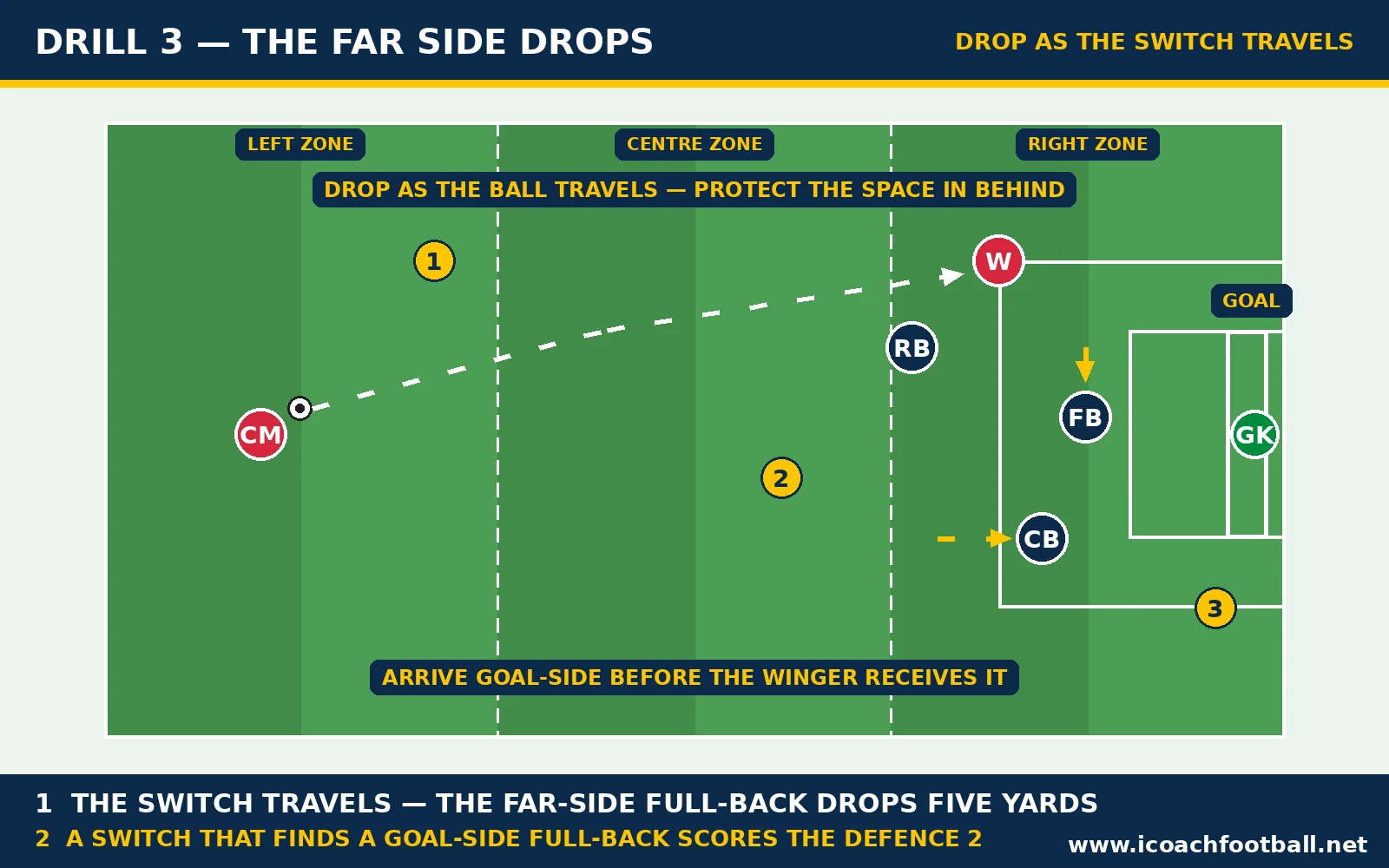
Drill 3 — The Far Side Drops
The dropping drill — the far-side full-back drops off to protect the space in behind as the switch travels, arriving goal-side before the winger receives it, in line with England Football Learning’s “How to defend like England: space in wide areas”: as the ball goes out wide, the full-back drops off to protect the space in behind the defensive line, which forces the attack to carry the ball down the wing rather than threading it through the defence.
Setup
- Area half a pitch, 1 full goal with a goalkeeper, winger plus far-side full-back against a switcher and a receiver.
- 9 minutes, then swap the dropping full-back.
How to Play
- The attack builds on the left, with the far-side full-back tucked in narrow and ten yards goal-side of the winger.
- The switcher plays the diagonal ball to the right winger, who receives it wide.
- The far-side full-back drops five yards the moment the ball is played, protecting the space in behind.
- The near-side full-back presses the receiver, showing him down the line and not inside.
- The centre-back shuffles across to cover the space the full-back has left.
- A switch that finds the winger in behind scores the attack 2; a switch that finds a goal-side full-back scores the defence 2.
Coach’s note: “Drop as the ball travels — a full-back who stays high while the ball is in the air is a goal waiting to happen.”
Progressions: The switch comes from a driven pass with less warning; the full-back starts ten yards higher, so the drop must be faster; the winger is allowed to cut inside if the full-back arrives late.
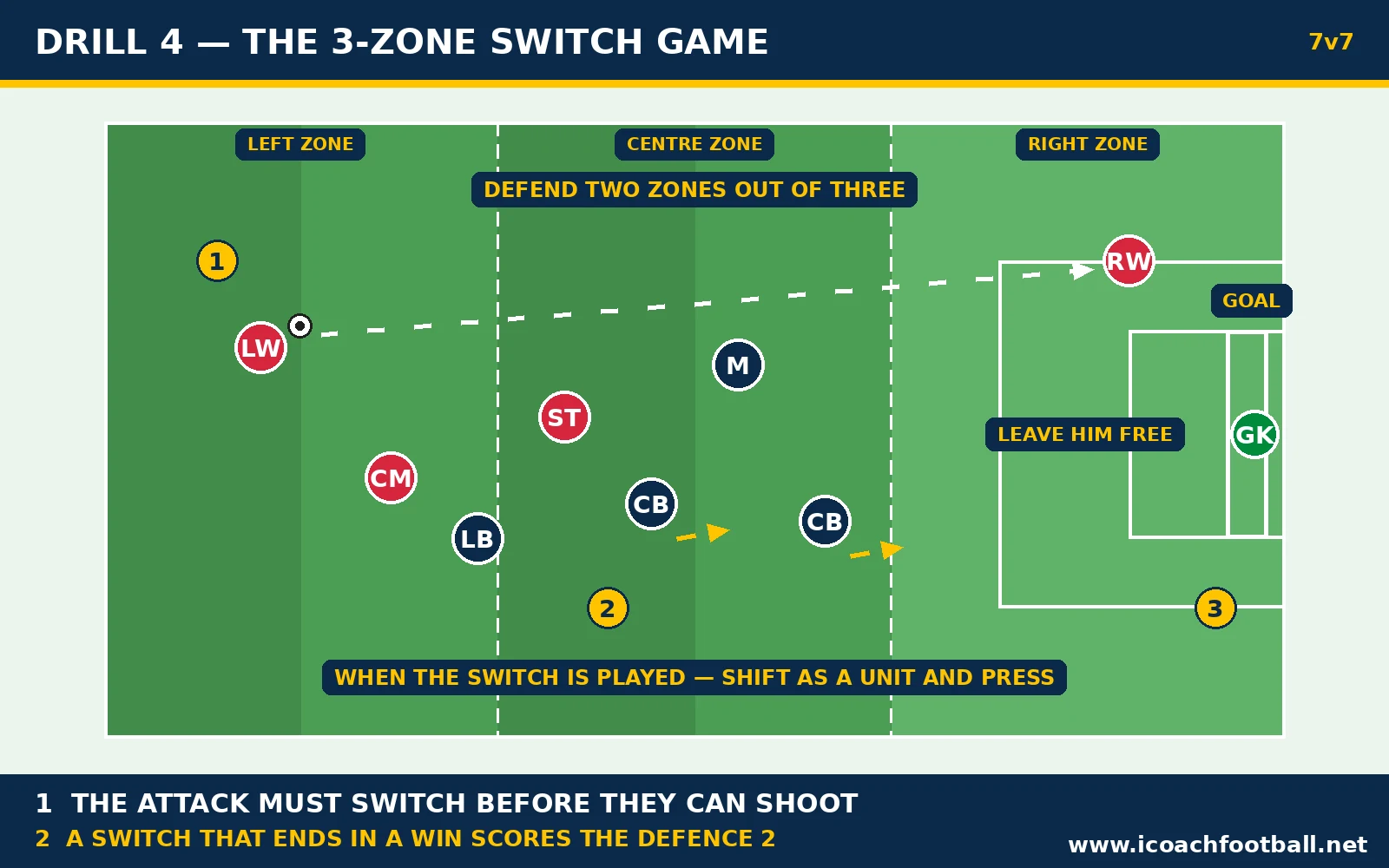
Drill 4 — The 3-Zone Switch Game
The decision game — the attack must switch the ball before they can score, and the defence must defend two zones out of three and leave the far man free, in line with England Football Learning’s “How to defend like England: space in wide areas”: when the opposition switch play, the team must assess who will press the ball, who will deny the space in behind, and who is responsible for covering the areas away from the ball.
Setup
- Area half a pitch split into three vertical zones, 2 full goals with goalkeepers, 7v7.
- 9 minutes, then swap the teams.
How to Play
- Two teams play 7v7 on half a pitch, with the pitch split into left, centre and right zones.
- The attack must complete a switch of play — the ball must travel from one wide zone to the other — before they can shoot.
- The defence stays compact in two zones out of three, leaving the far-side winger free.
- When the switch is played, the defence shifts as a unit and the nearest player presses the receiver.
- A goal after a switch scores the attack 2; a switch that ends in a win or a blocked cross scores the defence 2.
- After each rep the teams swap roles, and the zones switch sides every three minutes.
Coach’s note: “Defend two zones, leave the far man — the widest player on the far side is a decoy, not a danger.”
Progressions: The attack must switch twice before they can shoot; the zones narrow by five yards; the defence must win the ball back within eight seconds of the switch.
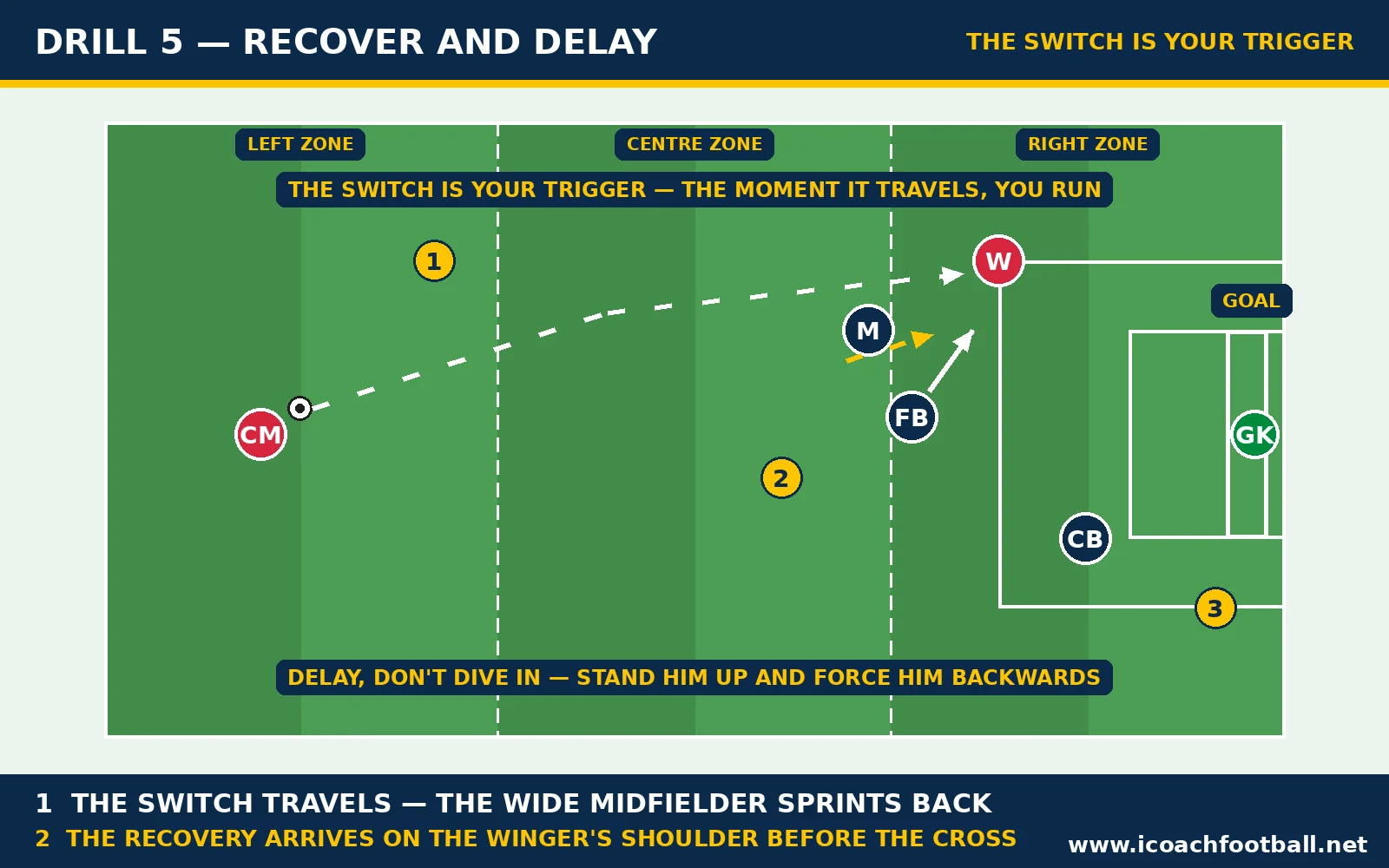
Drill 5 — Recover and Delay
The recovery drill — the wide midfielder sprints back the moment the switch is played and delays the receiver out wide, buying the unit time to arrive, in line with England Football Learning’s “How to defend like England: space in wide areas”: a recovering wide player tracks back to apply pressure out wide, which forces the attack to carry the ball down the wing rather than threading it through the defence.
Setup
- Area half a pitch, 1 full goal with a goalkeeper, winger plus switcher attacking, wide midfielder recovering from the far side.
- 10 minutes, then swap the recovering midfielder.
How to Play
- The attack switches play from the left to the right winger, who receives the ball wide.
- The wide midfielder, who was ten yards upfield, sprints back the moment the switch is played.
- The defending full-back stays on the winger and shows him down the line, not inside.
- The recovering midfielder arrives on the winger’s shoulder as the pass is played wide.
- The midfielder delays the winger — he does not dive in, he stands him up and forces him backwards.
- A recovery that stops the cross scores the defence 2; a cross that reaches the box scores the attack 2.
Coach’s note: “The switch is your trigger — the moment the ball travels, you run, and you delay, you don’t dive in.”
Progressions: The switch comes from a long diagonal ball with less warning; the recovery starts from the centre circle, ten yards further away; the winger is allowed to cut inside if the recovery arrives late.
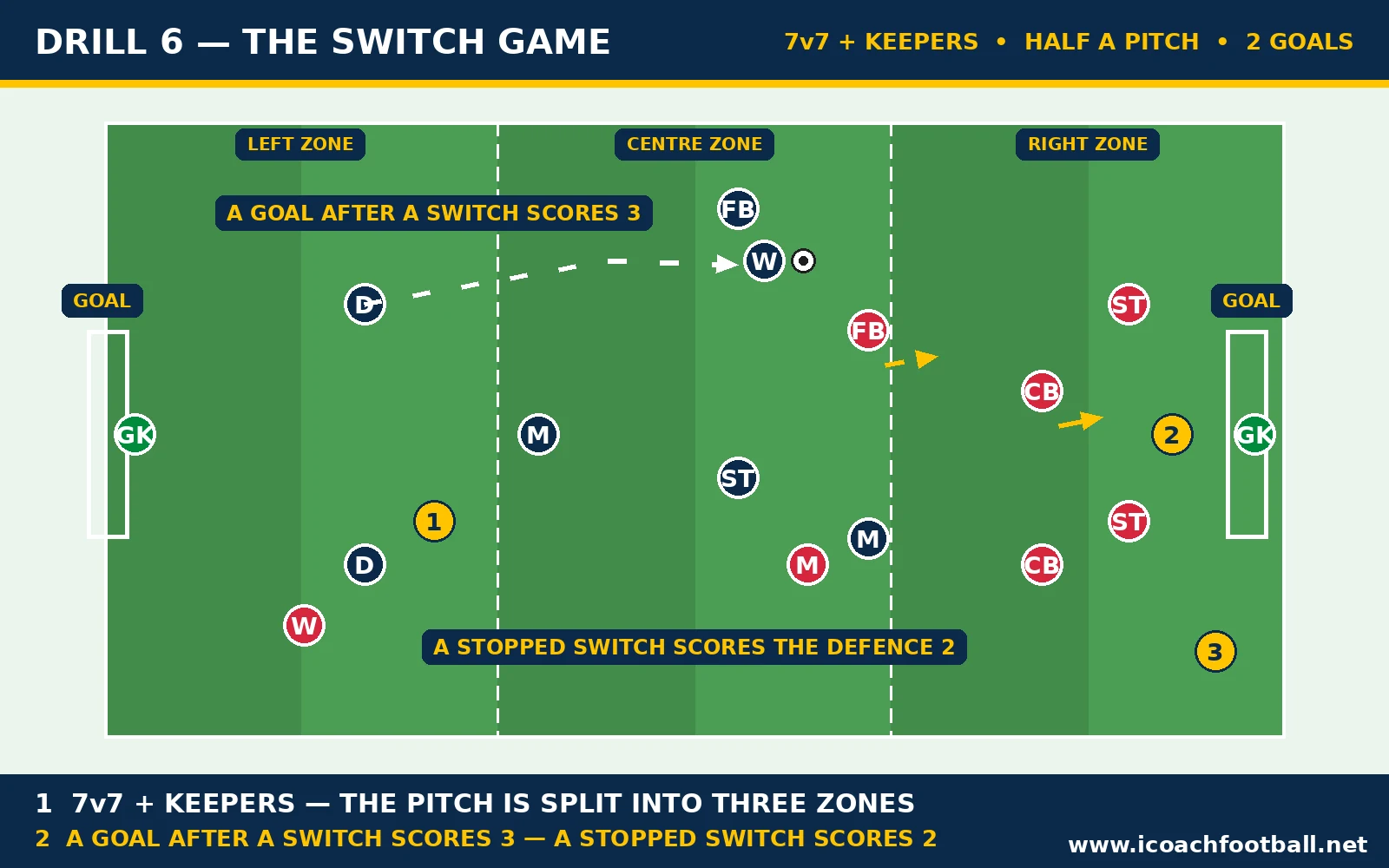
Drill 6 — The Switch Game
The full game. A 7v7 on half a pitch where a goal after a switch scores 3 and a stopped switch scores the defence 2, so both sides fight for the diagonal, in line with FIFA’s “NEC Nijmegen U-15s: Foundations for defensive compactness and pressing” session: the final 11v11 game brings all of the principles together — protect the centre, force the opponent to play backwards, and apply coordinated pressure to create a decision-making dilemma, turning defensive compactness into a tool for winning the ball and launching quick counter-attacks.
Setup
- Half a pitch, 2 full goals with goalkeepers, 7v7, the pitch split into three vertical zones.
- 10 minutes, teams swap ends at five minutes.
How to Play
- Two teams play 7v7 on half a pitch with a goalkeeper in each goal.
- A goal scored after a switch of play — the ball travelling from one wide zone to the other — scores the attack 3.
- A switch that the defence stops — by locking one side, shifting as a unit or dropping on the far side — scores the defence 2.
- A goal scored without a switch scores 1, so the attack keeps trying to switch.
- After a stopped switch, the defending team keeps the ball and attacks the far goal.
- The game runs for ten minutes; the team with the most points wins, and the teams swap ends at five minutes.
Coach’s note: “Three points for a goal after a switch — that is the game telling the attack what to do, and two points for a stopped switch telling the defence.”
Progressions: Only goals after a switch count in the final three minutes; the switch must come from a centre-back, not a midfielder; the goalkeepers must start the next attack with a throw to a centre-back, so every attack can switch.
Coaching points
- Lock one side — force the ball carrier one way and take the switch away at source. A switch that is never played needs no defending.
- Move as the ball travels, not when it arrives — the unit shifts together. A defence that moves after the ball lands is already beaten.
- Leave the far man free — the widest player on the far side is a decoy, not a danger. Defend two zones out of three and let the far man wait.
- Drop as the switch travels — the far-side full-back protects the space in behind. A full-back who stays high while the ball is in the air is a goal waiting to happen.
- Press the receiver, cover behind him — nearest presses, next covers. One player delays the winger; the next one takes the space behind him.
- Win it, then go forward — a stopped switch is a counter-attack. Compact defending wins the ball in a dangerous area, so use it.
Common mistakes
| Mistake | Fix |
|---|---|
| The striker pressing straight on, so the centre-back can switch either way | Angle the press — Drill 1 scores 0 if the centre-back can still play the diagonal |
| The back line shifting after the ball arrives, so a gap opens between the lines | Move as the ball travels — Drill 2 scores 0 if any defender is still moving when the ball lands |
| The far-side full-back staying wide and high as the switch travels, so the winger is in behind | Drop as the ball travels — Drill 3 scores the attack 2 if the switch finds the winger in behind |
| The defence chasing the far man and stretching across the whole pitch | Defend two zones — Drill 4 scores the defence 0 if a defender is in the far zone before the switch |
| The recovering midfielder jogging back after the switch, so the winger crosses unopposed | Run on the switch — Drill 5 scores 2 only if the recovery arrives before the cross |
| Diving in at the receiver and getting beaten, so the cross comes in anyway | Delay, don’t dive in — Drill 6 scores the defence 2 for a stopped switch, and 0 for a dive-in that gets beaten |
Age adaptations
| Age | Format | What changes |
|---|---|---|
| U11–U12 (ages 10–12) | Small zones (20 x 15 yards per zone), size 4 ball, the switcher starts from a standing start with the ball at his feet | Keep it to one decision at a time. Drill 1 runs with the centre-back walking the ball out, so the striker can practise the curved press slowly. Drill 4 runs with the call made loud — “Switch!” — before every rep, and the coach freezes the drill if nobody calls. Drill 6 counts every stopped switch, even a lucky one, so the players learn to celebrate stopping it |
| U13–U14 (ages 12–14) | Full zones, size 4 ball, the switch comes from a driven pass, the press starts from a jog | The shift becomes the session’s main skill. Drill 2 adds one-touch passing, so the shift must be faster. Drill 3 adds the driven switch with less warning, and Drill 4 adds the eight-second win-it-back rule. Players are asked to name the decision before each rep — “Lock” or “Shift” — so the timing becomes a conscious skill, not a lucky guess |
| U15–U17 (ages 14–17) | Full areas, size 5 ball, full pressure from the first rep, zones marked at 15 yards wide | Full pressure from the start. Drill 1 runs with the centre-back allowed to dribble out as a variation, Drill 4 narrows the zones by five yards, and Drill 6 plays with only switch goals counting in the final three minutes. Players are asked to run the shift without a call — eye contact only — so the communication becomes a habit, not a shout |
60-minute session plan
| Block | Time | Content |
|---|---|---|
| Arrival game | 0:00–0:05 | Switch warm-up — pairs, one switcher, one striker, the striker practises angling his press as the centre-back passes side to side |
| Lock one side | 0:05–0:13 | Drill 1 — Lock One Side |
| Move as the ball travels | 0:13–0:22 | Drill 2 — Move as the Ball Travels |
| The far side drops | 0:22–0:31 | Drill 3 — The Far Side Drops |
| The 3-zone switch game | 0:31–0:40 | Drill 4 — The 3-Zone Switch Game |
| Recover and delay | 0:40–0:50 | Drill 5 — Recover and Delay |
| The switch game | 0:50–1:00 | Drill 6 — The Switch Game |
Keep building from here
The switch this session stops is our switching play soccer drills 4 goal game, and the four progressive ways to coach it are our 4 progressive drills to coach switching the play. The overlap the switch sets up is our soccer drills for improving defending the overlap, and the wide areas where the switch lands are our football defending wide areas drills. The cross the switch produces is our soccer drills for improving defending crosses, and the half space the switch can open up is our soccer drills for improving defending the half space. The starting position that puts the far-side full-back goal-side early is our soccer drills for improving defensive positioning, and the zone habits that put a defender in the right place to take the receiver are our soccer drills for zonal marking. The long ball that switches the play is our soccer defending long balls drills, and the transition that follows every stopped switch is our football defensive transition drills. The high line the switch can catch out is our soccer drills for improving defending a high defensive line, and the recovery run that gets a player back after the switch is our soccer drills for improving recovery runs. The pace that makes the far-side winger dangerous is our soccer drills for improving defending against pace. Defending the switch is high-repetition, high-intensity work — plan the week’s load with our training load calculator.
What is a switch of play in soccer?
A switch of play is a long diagonal pass that moves the ball from one side of the pitch to the other — usually from a centre-back or midfielder out to the far-side winger. It works because it moves the ball faster than any player can run, so the defence has to shift across the whole pitch while the ball is in the air. A good switch finds the far-side winger in space, with time to cross or cut inside.
How do you stop a team switching play?
Lock the ball carrier to one side before the switch is played. The nearest striker angles his press so the centre-back can only play one way, which takes the switch away at source — Drill 1 trains exactly this. If the switch is still played, shift as a unit while the ball travels and drop the far-side full-back to protect the space in behind, so the winger receives it with a goal-side defender in front of him and no space to run into.
Should the far-side full-back tuck in or stay wide when the ball is on the other side?
Tuck in and drop off. When the ball is on the far side, the full-back’s job is to protect the space in behind and stay connected to the centre-back — not to mark a winger who does not have the ball. Drill 3 trains this: the full-back drops five yards the moment the switch is played, arriving goal-side before the winger receives it. He only goes wide again once the ball has actually arrived on his side.
When should the defence shift — as the ball travels or when it arrives?
As the ball travels. The whole unit — back line, midfield and forwards — slides together while the ball is moving, so the defence arrives at the same time as the ball. A defence that waits until the ball arrives is already beaten, because the winger receives it with time to cross. Drill 2 trains this: the back line slides with every pass, and the defence scores 0 if any defender is still moving when the ball lands.
How do you coach defending the switch of play to U11s?
Keep it to one decision at a time. Start Drill 1 with the centre-back walking the ball out, so the striker can practise the curved press slowly, and make the call loud — “Switch!” — before every rep in Drill 4, freezing the drill if nobody calls. Use small zones (20 x 15 yards) and count every stopped switch, even a lucky one, so the players learn to celebrate stopping it. The shift matters more than the technique at this age.
Sources
- FIFA Training Centre. “NEC Nijmegen U-15s: Foundations for defensive compactness and pressing” — U-15 head coach Niels Voet trains his team to turn a compact defensive shape into an attacking weapon: stay compact, shift across together and keep the back line connected, protect the centre by closing central passing lanes, force the opponent wide or backwards, and the number 9 forces the centre-back to one side, taking away the option to switch play. Verified live 2026-11-23 (HTTP 200, full text read). Drills 1, 2 and 6 are based on / in line with this session.
- England Football Learning / The FA Boot Room. “How to defend like England: space in wide areas” — The FA’s article on how the national teams deal with the switch of play: counter-press to force the opposition to one side, stay compact in the centre, assess who will press the ball, who will deny the space in behind and who is responsible for covering the areas away from the ball, and as the ball goes out wide, the full-back drops off to protect the space in behind while a recovering wide player tracks back to apply pressure out wide. Verified live 2026-11-23 (HTTP 200, full text read). Drills 3, 4 and 5 are based on / in line with this article.