Soccer Drills for Improving Defending a High Defensive Line: 6 Games That Hold the Line and Catch Runners Offside (U11–U17)
Quick answer
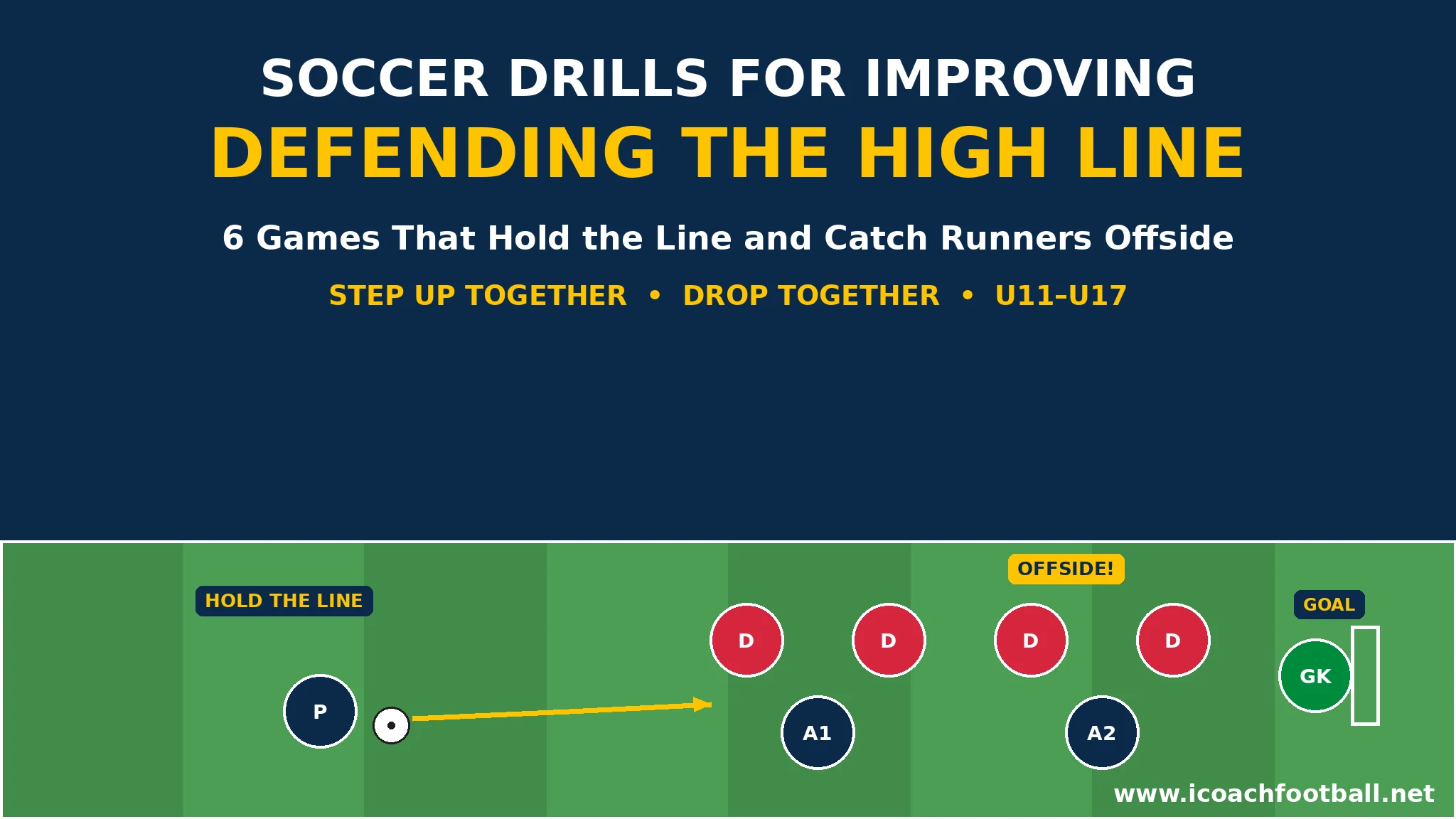
A high defensive line wins games and loses them in the same moment. The win is the space it takes away: the opposition have thirty yards less pitch to play in, their midfield is squeezed, and every pass forward has to be perfect. The loss is the space it leaves behind: one through ball over the top and a fast striker is in on goal. Defending a high line is therefore a team skill, not a back-four skill: the line must move as one unit, step up on clear triggers, drop the instant the passer has time and space, and trust a goalkeeper who plays high and talks constantly. These six soccer drills for improving defending a high defensive line train exactly that: a shuffle drill that grooves the line moving as one, a triggers game that teaches when to step up, an offside-trap race that makes the trap visible, a drop-or-hold decision game, a sweeper-keeper drill for the space behind, and a conditioned game where clean offsides score points.
Suitable for: U11–U17 (ages 10–17)
Session snapshot
- Players: 14–18
- Age: U11–U17 (ages 10–17)
- Area: Half a pitch, with 1 full goal and 2 mini goals
- Duration: 60 minutes
- Focus: Defending a high defensive line — line discipline, step-up triggers, the offside trap, drop-or-hold decisions and sweeper-keeper work
- Equipment: 14 balls, 24 cones, bibs, 1 full goal, 2 mini goals
Why these six games work
Most teams defending a high line make one of two mistakes. They either drop deeper every time the ball comes near them, which hands the opposition the whole middle of the pitch and makes the high line pointless, or they hold the line no matter what, which leaves a fast striker one pass away from a clean run at goal. Both mistakes come from the same gap: nobody has taught the line when to step and when to drop — and who decides.
The first two drills teach the two habits a high line runs on: a shuffle drill where the back four moves as a single unit, six to eight metres apart, and a triggers game where the line steps up the moment the ball goes backwards or the passer drops their head. The next two drills train the decisions themselves: an offside-trap race that scores only clean offsides, and a drop-or-hold game where the line reads the passer and chooses in a split second. The last two drills finish the job: a sweeper-keeper drill for the balls that do get in behind, and a conditioned game where the whole team defends with a high line and clean offsides score points.
The drills are grounded in the FIFA/UEFA coaching community. Drills 1, 3 and 5 are based on / in line with the FIFA Training Centre session “16) Defending with a back four (Lehmann)”, in which former Arsenal goalkeeper and assistant coach Jens Lehmann trains a back four to move as a unit, stay six to eight metres apart, shuffle quickly across the pitch, push the line up and squeeze the space whenever the opposition play backward passes, keep a high line and force the opposition back, and communicate constantly with the goalkeeper — its first exercise is a 6v5 on a 25-by-50-metre pitch defending two goals, its second is a 6v4 on half a pitch with a full goal, and its third is a 7v6 in which the defending team adopt a 4-2 formation against a 5-2 attack. Drills 2, 4 and 6 are based on / in line with The FA’s Boot Room article “How to defend like England: roles and responsibilities”, which breaks defending into press, cover and balance — the closest player presses the ball, three supporting players provide cover, and three players away from the ball provide balance — and teaches players to recognise triggers, communicate who presses and who covers, and ask themselves when roles change as the ball moves. In the UK the same session is football drills for defending a high defensive line — the line, the triggers and the trap are identical.
This post is the defending mirror of our attacking work. The other side of the high line — how to time the run and finish in the space behind it — is our soccer drills for improving attacking against a high defensive line, and the through ball the line has to stop is our soccer through ball drills.
Six rules of defending a high line
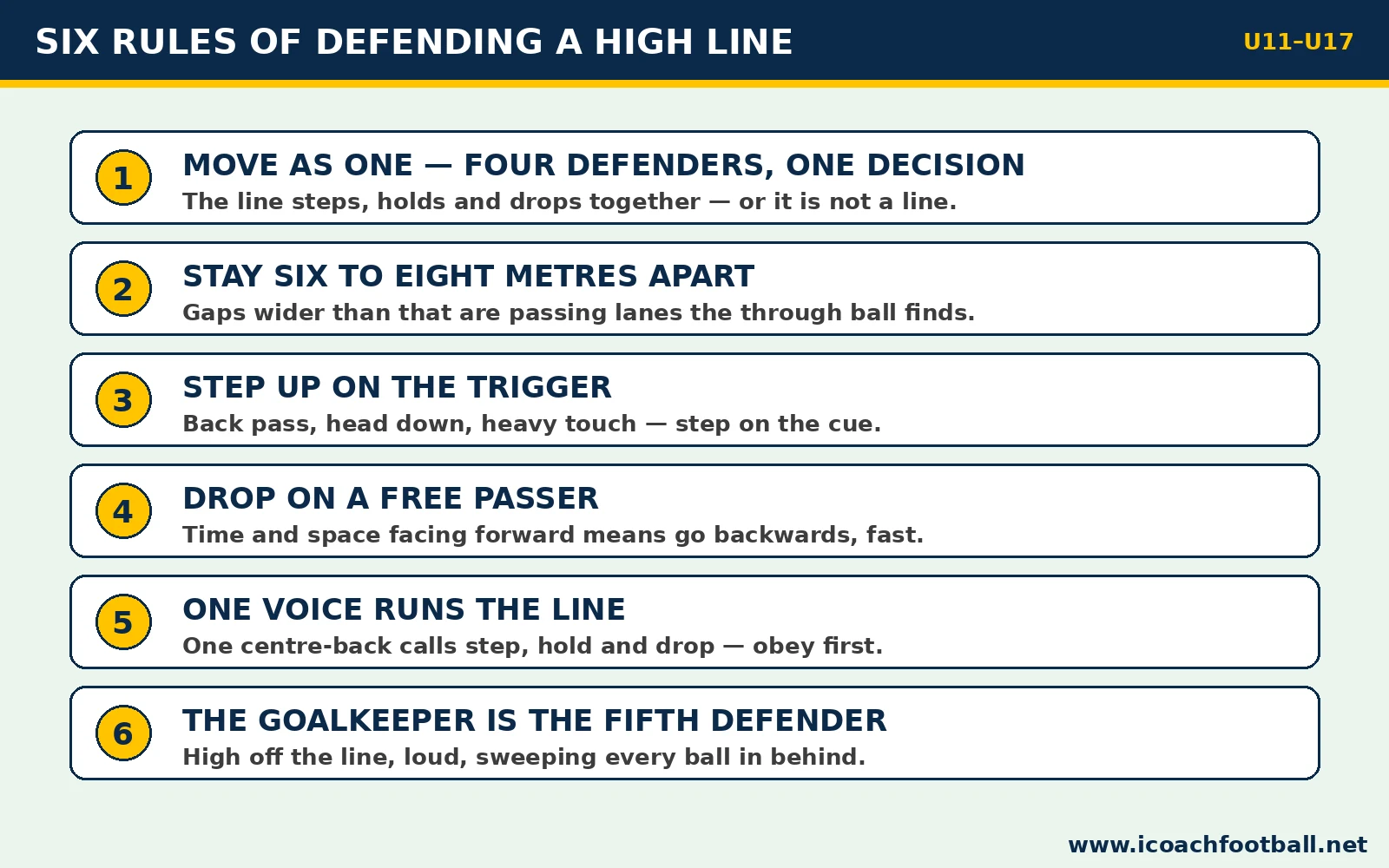
- Move as one — four defenders, one decision. The line steps, holds and drops together, or it is not a line at all.
- Stay six to eight metres apart. Gaps wider than that are passing lanes; gaps tighter than that are an invitation to play around you.
- Step up on the trigger — back pass, head down, heavy touch. The line moves forward the moment the ball goes backwards or the passer loses their picture.
- Drop the instant the passer has time and space facing forward. A free passer with their head up is the one moment the line must go backwards, fast.
- One voice runs the line. One centre-back calls step, hold and drop — the other three obey first and discuss later.
- The goalkeeper is the fifth defender. High off the line, loud, and sweeping every ball that gets in behind.
Drill 1 — The Line Shuffle
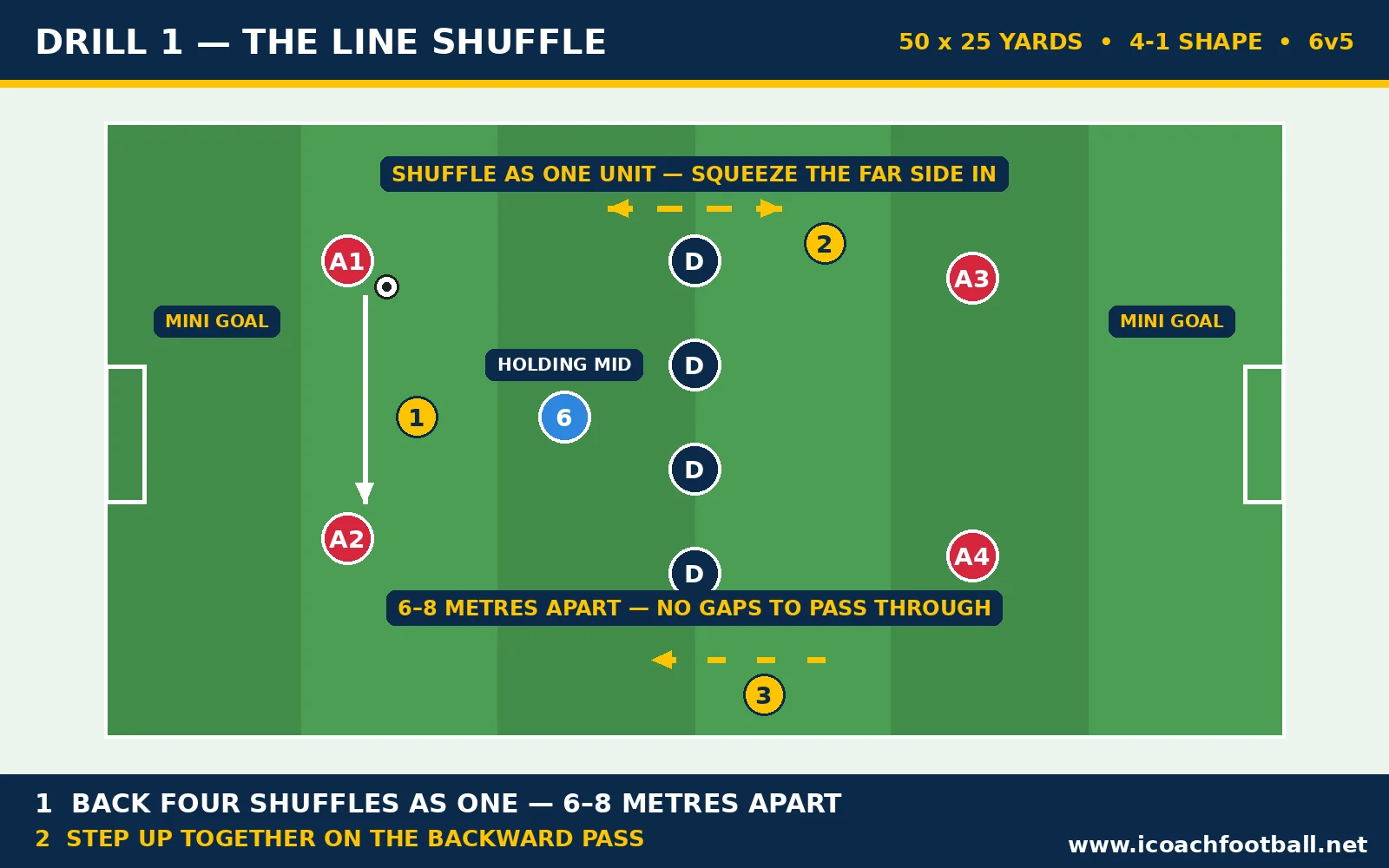
The discipline drill — the back four walks, then jogs, then sprints across the pitch as one unit, six to eight metres apart, exactly as the FIFA Training Centre’s Lehmann session opens its back-four work.
Setup
- Area 50 yards by 25 yards, 2 mini goals at each end, groups of 5 defenders.
- 8 minutes, then swap the defending unit.
How to Play
- A back four plus a holding midfielder set up in a 4-1 shape across a 50-by-25-yard area, with a mini goal at each end.
- Six attackers spread across the area with one ball, passing it slowly from side to side.
- The back four shuffle across as a unit, following the ball, keeping six to eight metres between each defender.
- The far-side defender squeezes in every time the ball moves away — nobody stays wide and flat.
- When the attackers play a backward pass, the whole line steps up together and squeezes the space.
- If the line breaks — one defender a yard ahead or behind — the coach stops play and the unit resets to the line.
Coach’s note: “Watch the far-side defender. If they stay wide when the ball is on the other side, the shape is already broken — squeeze is the call.”
Progressions: The attackers may switch play quickly, so the shuffle has to be fast; the holding midfielder drops out, so the back four defend alone; the attackers are allowed three touches only, so the ball moves faster and the line must react sooner.
Drill 2 — Step Up on the Back Pass
The triggers drill — the line steps up every time the ball goes backwards or the passer drops their head, in line with The FA’s press-cover-balance roles: one presses, three cover, three balance.
Setup
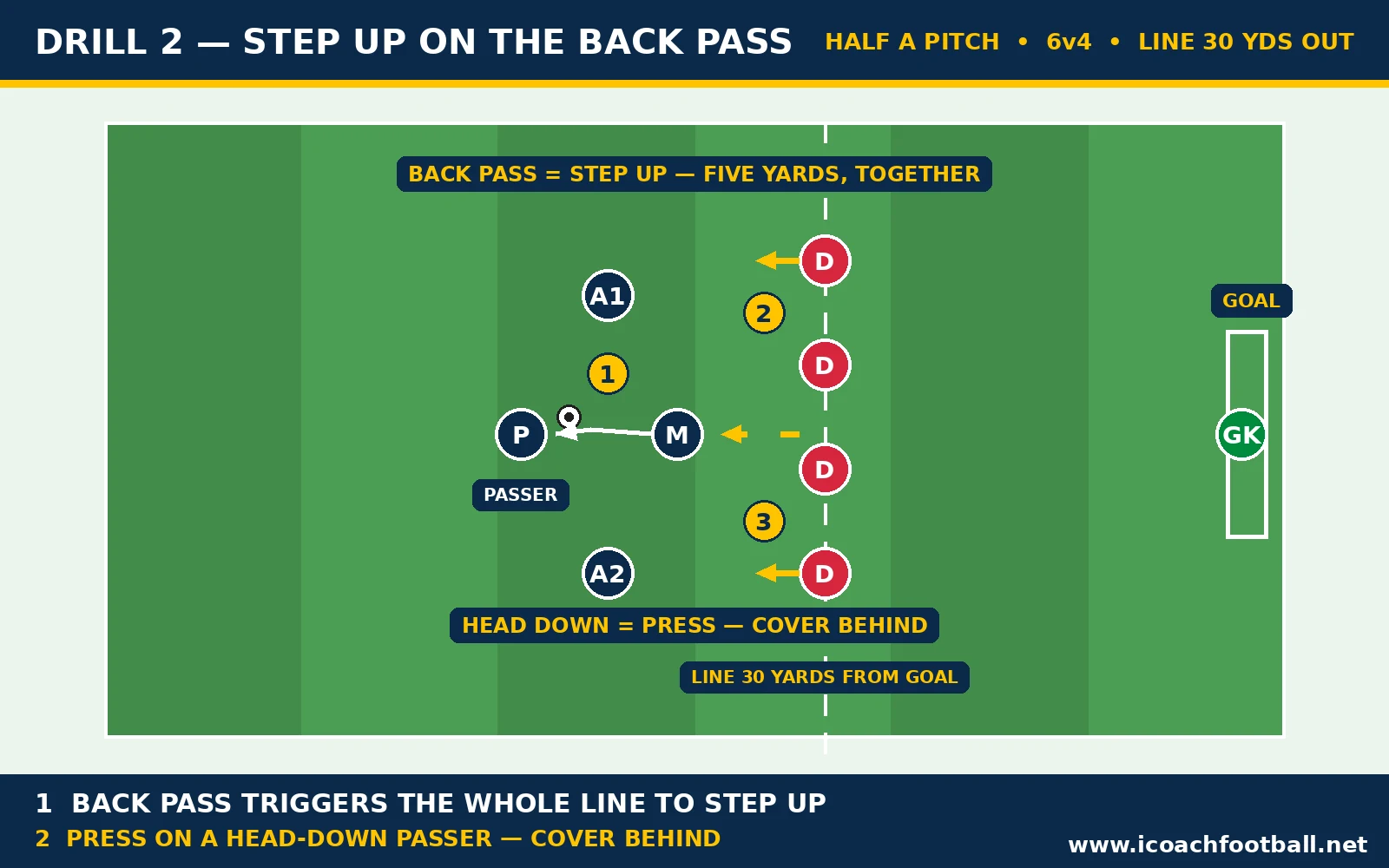
- Half a pitch, 1 full goal with a goalkeeper, a marked line 30 yards from goal, 6v4.
- 10 minutes, then swap the defending unit.
How to Play
- Four defenders and a goalkeeper hold a high line 30 yards from goal against six attackers in a 3-3 shape.
- The attackers pass the ball across the front of the line, looking for a gap to play through.
- The moment an attacker plays a backward pass, the whole line steps up five yards together — the centre-back calls “STEP!”
- When the passer drops their head to play forward, the nearest defender presses and the other three drop half a yard to cover.
- If the line steps up together and the attackers are caught offside, the defending team scores a point.
- Rotate the defending unit after every round, so every player calls the step at least once.
Coach’s note: “The trigger is the ball going backwards — not the shout, not the feeling. Step on the pass, not on the hope.”
Progressions: The attackers may play a heavy touch on purpose, so the line must step on that trigger too; the centre-back may only call the step once per attack, so the timing has to be right; the attackers add a runner in behind, so the step has to catch them offside or the line must drop.
Drill 3 — The Offside Trap Race
The timing drill — the back four steps up on the passer’s cue and the trap either works or it does not, so the timing of the line is trained, not just talked about.
Setup
- Half a pitch, 1 full goal with a goalkeeper, a marked offside line, groups of 4 defenders and 3 attackers.
- 10 minutes, rotating roles after every round.
How to Play
- A back line of four defenders holds a high line across the halfway line, with a goalkeeper behind them.
- Three attackers wait on the shoulder of the last defender, level with the offside line, and one passer waits with the ball.
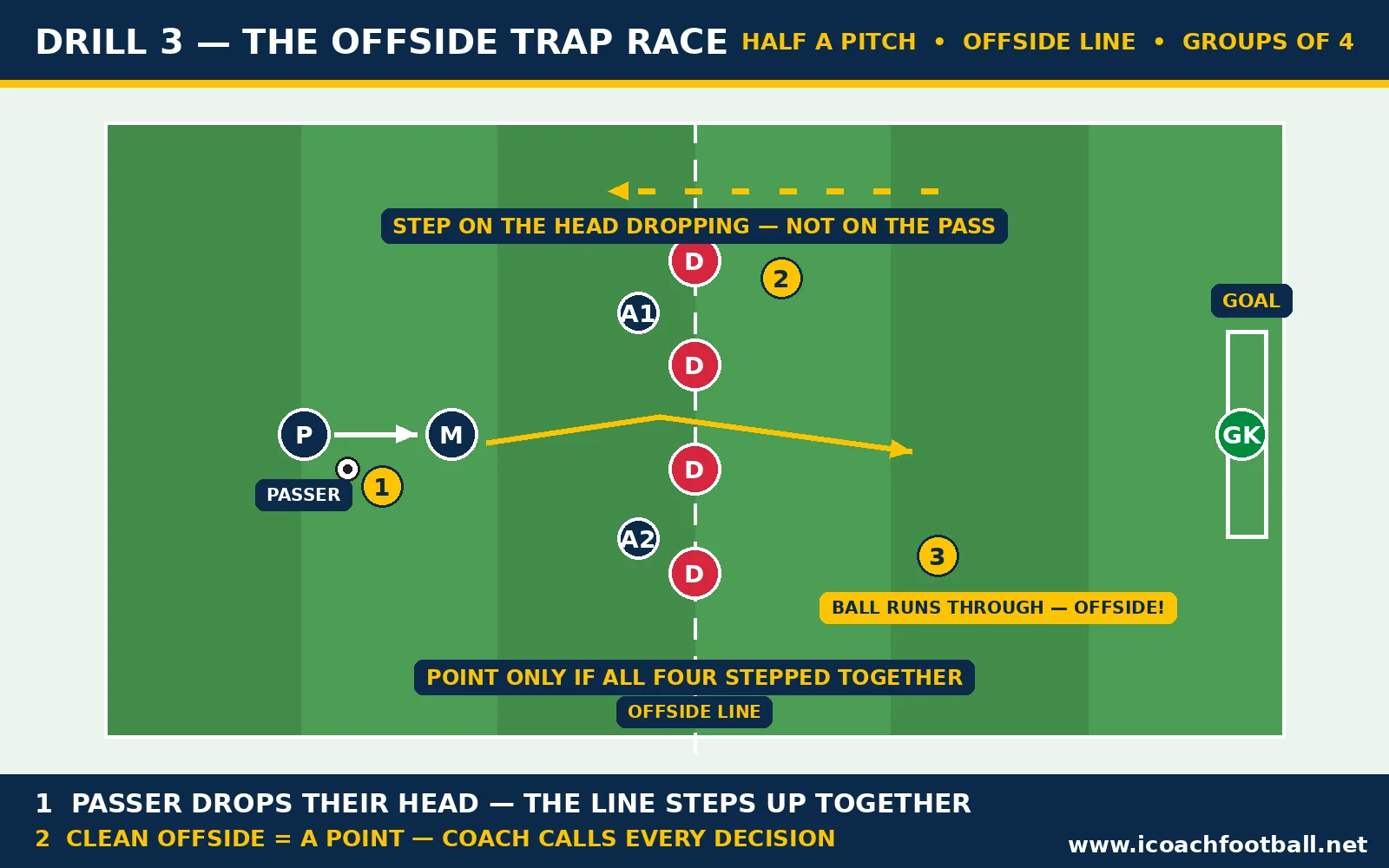
- The passer plays a short pass to a team-mate, and the back four watch the passer’s head and body shape.
- The moment the passer drops their head to play the through ball, the whole line steps up together — one movement, no stragglers.
- A point only counts if all four defenders stepped together and the attackers are caught offside — the coach calls every decision.
- Rotate the defenders and the attackers after every round, so all players learn both sides of the trap.
Coach’s note: “Step on the head dropping, not on the pass being played. If you step when the ball is already moving, you are already too late.”
Progressions: The attackers vary their runs — one checks short then spins behind — so the line must step on the pass, not on the run; the passer may fake the through ball, so the line must hold until the real cue; the goalkeeper must sweep every ball that beats the trap, so the line learns the trap is a risk, not a guarantee.
Drill 4 — Drop or Hold
The decision drill — the line reads the passer in a split second and chooses: drop when the passer has time and space facing forward, hold when pressure arrives on the ball, in line with The FA’s roles and responsibilities.
Setup
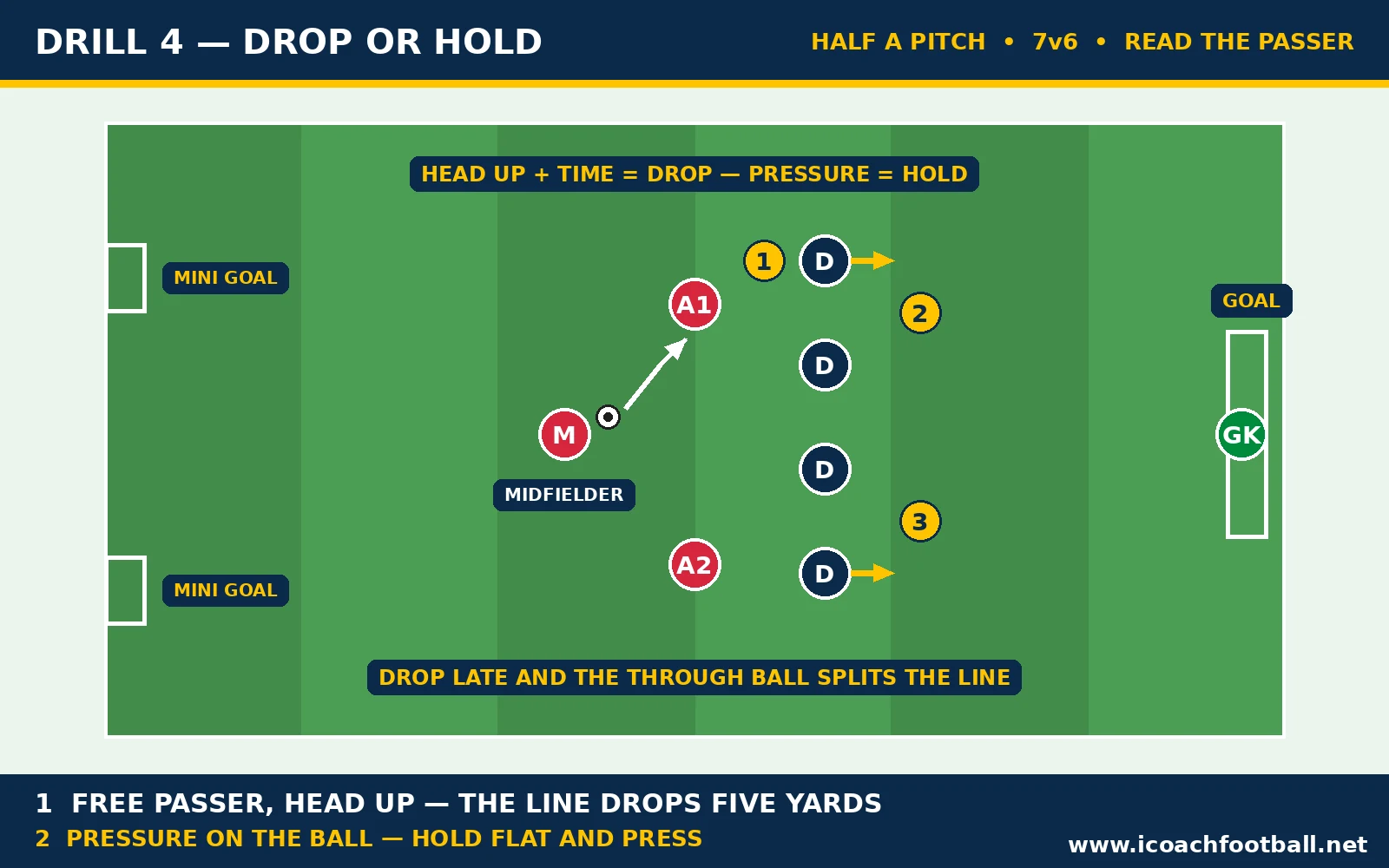
- Half a pitch, 1 full goal with a goalkeeper, 2 mini goals on the halfway line, 7v6.
- 10 minutes, then swap the teams.
How to Play
- Two teams play 7v6 on half a pitch, with the defending team holding a high line across the middle third.
- A midfielder receives the ball in front of the line — sometimes with time and space facing forward, sometimes under pressure.
- When the passer has time and space with their head up, the line drops five yards together — the centre-back calls “DROP!”
- When pressure arrives on the passer, the line holds flat and brave, and the nearest defender steps out to press.
- If the line drops late and a through ball splits it, the attackers score — the mistake is visible instantly.
- If the defending team win the ball, they must score in a mini goal within ten seconds — most goals wins.
Coach’s note: “Head up and time on the ball means drop — now. Head down and pressure on the ball means hold. Read the passer, not the ball.”
Progressions: The passer may receive on the half-turn, so the line must read body shape, not just pressure; the attackers add a second runner, so the far-side defender must drop first; the defending team score double if they win the ball in the opposition’s half, so the line must stay high even after dropping.
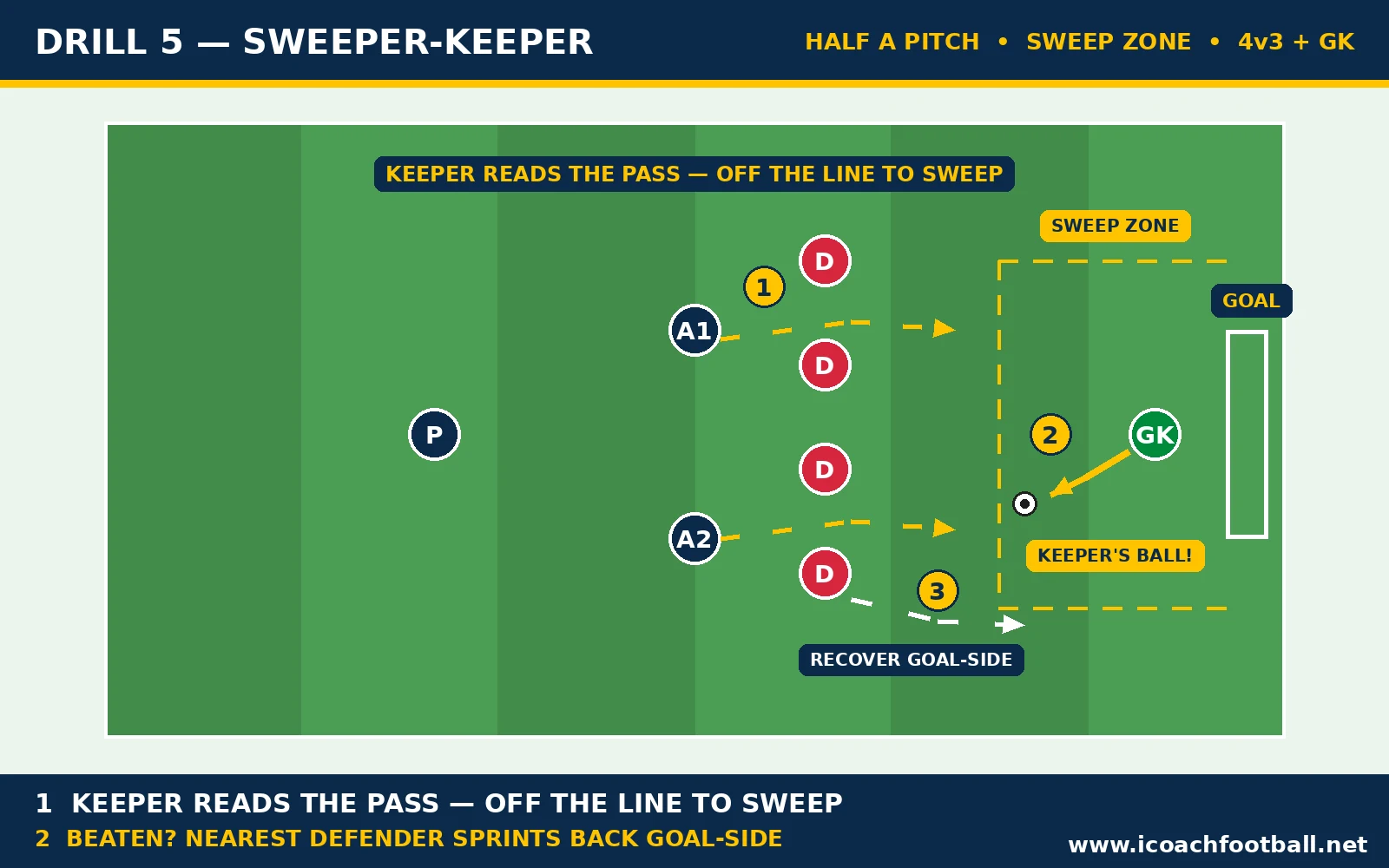
Drill 5 — Sweeper-Keeper and the Space Behind
The safety-net drill — the goalkeeper plays high off the line, sweeps every ball in behind, and the back four recover goal-side the moment the trap is beaten, exactly as the FIFA Training Centre’s Lehmann session demands constant goalkeeper-defender communication.
Setup
- Half a pitch, 1 full goal with a goalkeeper, a marked sweep zone 25 yards from goal, groups of 4 defenders and 3 attackers.
- 10 minutes, rotating the goalkeeper after every round.
How to Play
- A back four holds a high line 30 yards from goal, with the goalkeeper stationed at the edge of the penalty area, not on the goal line.
- A passer plays balls in behind the line — some for the attackers to chase, some for the goalkeeper to sweep.
- The goalkeeper reads the pass and comes off the line to clear every ball that lands inside the sweep zone.
- When a ball beats the line and the goalkeeper, the nearest defender sprints back goal-side and the other three drop to the penalty spot.
- The goalkeeper calls “KEEPER’S BALL!” or “AWAY!” on every ball in behind, so the defenders know whether to hold or recover.
- Rotate the goalkeeper after every round, so every defender learns what the keeper can and cannot reach.
Coach’s note: “The keeper is the fifth defender — if they are on their line, the space behind you is undefended. High, loud, and early off the line.”
Progressions: The passer plays the ball in behind first time, so the goalkeeper must read the pass before it is played; the attackers start onside and sprint in behind, so the recovery run is live; the goalkeeper must distribute to a team-mate within three seconds of sweeping, so the clearance starts the attack.
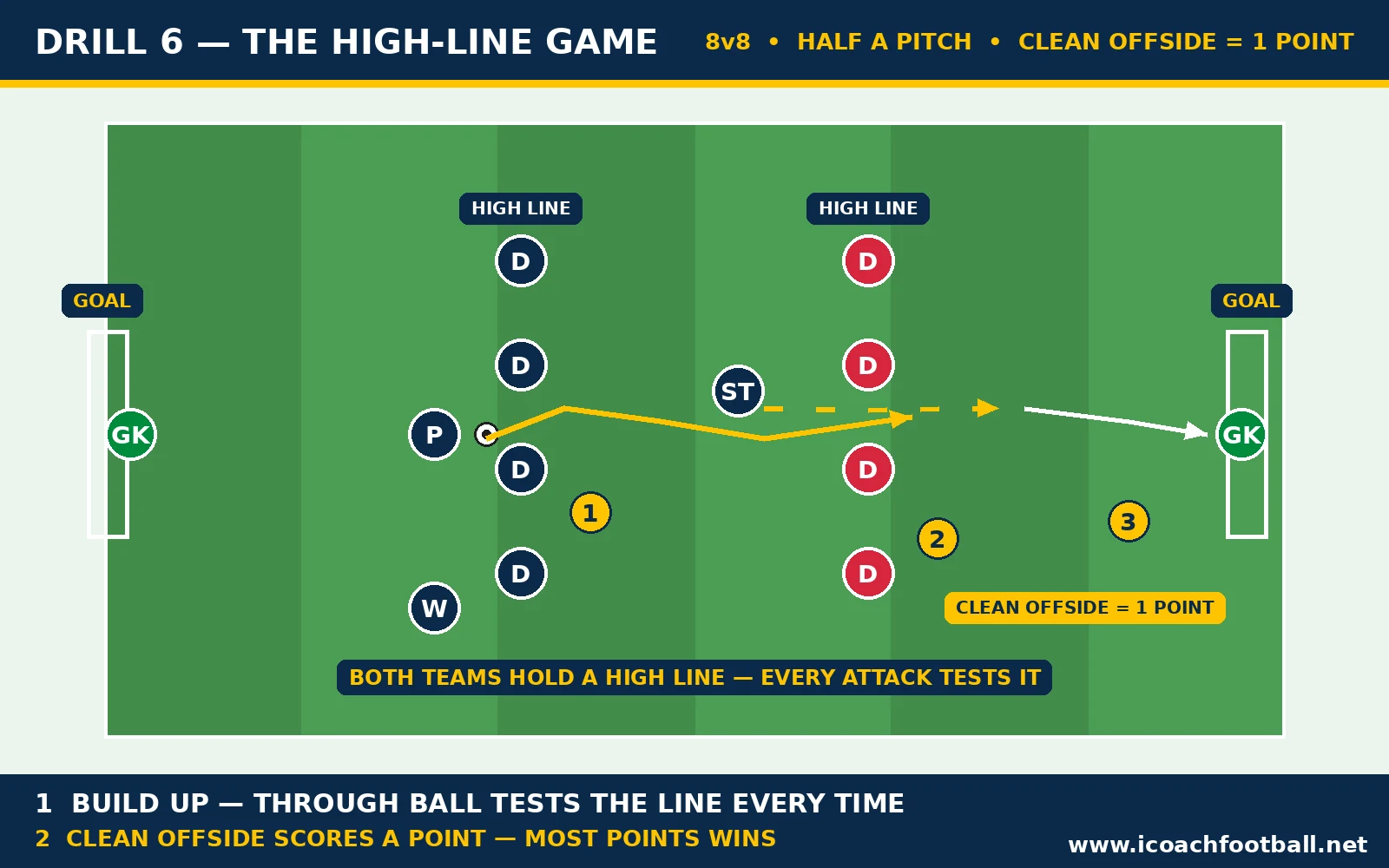
Drill 6 — The High-Line Game
The full game. An 8v8 game where both teams must play with a high defensive line, so every attack tests the line — and every clean offside scores a point.
Setup
- Half a pitch, 1 full goal at each end, 8v8.
- 12 minutes.
How to Play
- Two teams play 8v8 on half a pitch, with both defences instructed to hold a high line at the halfway line.
- The team in possession must build up and try to score, using the through ball and the run in behind from the earlier drills.
- A clean offside — the whole line stepping together — scores a point for the defending team, and the coach calls it out every time.
- The defending team must squeeze up the moment the ball goes backwards, keeping the line high and compact.
- If possession is won in the opposition’s half, the team must break in numbers with quick actions.
- Play for three minutes, then rotate the teams’ ends — the team with the most points after 12 minutes wins.
Coach’s note: “Every attack in this game is a test of your line. Step together, drop together, and let the keeper sweep what gets through.”
Progressions: A clean offside counts double in the last three minutes, so the timing has to hold under scoreboard pressure; the defending line must push up to the halfway line whenever the opposition are deep, so the space in behind is always there to defend; the goalkeepers must stay high to condense the pitch, so the whole team learns to play on the front foot.
Coaching points
- Move as one — four defenders, one decision. The line steps, holds and drops together; one defender a yard out of line is the gap the through ball finds.
- Stay six to eight metres apart. That distance closes the passing lanes without leaving the line stretched wide enough to play around.
- Step up on the trigger. Back pass, head down, heavy touch — the line moves on the cue, not on a feeling, and the centre-back calls it.
- Drop the instant the passer has time and space facing forward. A free passer with their head up is the one moment the line must go backwards, fast, together.
- One voice runs the line. The centre-back calls step, hold and drop; the other three obey first and discuss later.
- The goalkeeper is the fifth defender. High off the line, loud on every ball in behind, sweeping what the line cannot reach.
Common mistakes
| Mistake | Fix |
|---|---|
| One defender stepping up while the others hold, so the line is split | Step on the centre-back’s call only — Drill 3 only counts the point if all four stepped together |
| Dropping deeper every time the ball comes near, so the high line is pointless | Hold the line when pressure arrives on the passer — Drill 4 only counts the point if the line held flat |
| Holding the line when the passer has time and space facing forward | Drop five yards the instant the passer has their head up — Drill 4 scores the attackers if the drop is late |
| Gaps wider than eight metres between defenders, so the through ball threads them | Shuffle as a unit and squeeze the far side in — Drill 1 stops play and resets the line whenever a gap opens |
| The goalkeeper standing on the line, so the space behind is undefended | Play the keeper at the edge of the box and sweep every ball in the zone — Drill 5 only counts the rep if the keeper called it |
| Nobody talking, so four defenders move at four different speeds | Give the centre-back the call and make the others obey — Drill 2 rotates the caller so every player runs the line |
Age adaptations
| Age | Format | What changes |
|---|---|---|
| U11–U12 (ages 10–12) | Small areas, size 4 ball, offside line marked with cones, coach calls every decision | All six drills run with a marked offside line and the coach calling every step and drop, so the unit movement is learned before speed is added. Drill 1 runs at walking pace with the coach moving the ball, Drill 3 uses a walking start for the attackers, and Drill 5 keeps the goalkeeper at the edge of the box with no live sprinting, because the pattern is the lesson, not the pace |
| U13–U14 (ages 12–14) | Full areas, size 4 ball, offside line marked, defenders step up from the second round | All six drills run as written, with the defenders stepping up in Drill 3 from the second round. Drill 1 adds the fast switch of play, Drill 4 adds the second runner, and Drill 6 adds the double points for clean offsides. Players keep a simple count — “three clean offsides, two recoveries” is the habit that sticks |
| U15–U17 (ages 14–17) | Full areas, size 5 ball, full offside, full pressure from the first rep | Full pressure from the start. Drill 1 runs with the holding midfielder removed, Drill 3 uses a faked through ball, and Drill 5 plays with live onside runners sprinting in behind. Players are asked to call the trigger before each rep — “back pass, step!” or “head up, drop!” — so the decision becomes a conscious skill, not a lucky guess |
60-minute session plan
| Block | Time | Content |
|---|---|---|
| Arrival game | 0:00–0:05 | Line shuffle warm-up — the back four walk across the pitch as one unit, following the ball |
| The line shuffle | 0:05–0:13 | Drill 1 — The Line Shuffle |
| Step up on the back pass | 0:13–0:23 | Drill 2 — Step Up on the Back Pass |
| The offside trap race | 0:23–0:32 | Drill 3 — The Offside Trap Race |
| Drop or hold | 0:32–0:41 | Drill 4 — Drop or Hold |
| Sweeper-keeper and the space behind | 0:41–0:50 | Drill 5 — Sweeper-Keeper and the Space Behind |
| The high-line game | 0:50–1:00 | Drill 6 — The High-Line Game |
Keep building from here
The other side of the high line — how attackers time the run and finish in the space behind it — is our soccer drills for improving attacking against a high defensive line, and the through ball the line has to stop is our soccer through ball drills. The fast attacker the line must not let get away is our soccer drills for improving defending against pace, and the moment the line is beaten the team needs our football defensive transition drills and our soccer drills for improving recovery runs. The 3v2 overload the line must survive is our football defending 3v2 drills, and the crosses the line must deal with after it drops are our soccer drills for improving defending the back post and our soccer defending long balls drills. The marking that keeps runners honest is our soccer drills for improving marking, and the anticipation that reads the pass early is our soccer drills for improving interceptions. The positioning that keeps the unit compact is our soccer drills for improving defensive positioning. The small-sided games where the high line shows up most are our 25 small-sided games for soccer, and the session structure follows our U13 soccer practice plan. Defending a high line is high-intensity, high-repetition work — plan the week’s load with our training load calculator.
When should a team defend with a high line?
When the team presses high and the opposition build from the back. A high line only works as part of a compact team — if the forwards press and the line steps up behind them, the opposition have nowhere to play. If the forwards do not press, the line is on its own and the space behind it is free. Drill 2 teaches the step-up trigger, and Drill 6 trains the whole team to hold the line together.
How do you coach the offside trap without getting caught out?
Step on the passer’s cue, not on the pass. The line steps the moment the passer drops their head to play forward — if you wait for the ball to move, you are already too late. One centre-back calls the step, all four move as one, and the goalkeeper sweeps what gets through. Drill 3 scores only clean offsides, so players learn the timing in a handful of reps because the feedback is instant.
When should the line drop instead of stepping up?
The instant the passer has time and space facing forward with their head up. That is the one moment the through ball is on, and a line that holds is a line that gets beaten. When pressure arrives on the passer, hold flat and let the nearest defender press. Drill 4 trains the decision directly: drop on a free passer, hold on a pressured one, and the attackers score if the drop is late.
What should the goalkeeper do behind a high line?
Play high, talk constantly, and sweep every ball in behind. The keeper stands at the edge of the penalty area, not on the goal line, reads the passer’s body shape, and calls “KEEPER’S BALL!” or “AWAY!” on every ball over the top. Drill 5 trains exactly this, and its progressions add a first-time pass in behind and a live recovery run, so the keeper and the line learn to work as five, not four plus one.
Why does my back four keep getting split by one pass?
Because the line is not moving as one unit. Usually one defender steps up while the others hold, or the far-side defender stays wide while the ball is on the other side — either way a gap opens and the through ball threads it. Fix it with Drill 1: walk the shuffle until the unit moves as one, keep six to eight metres between defenders, and stop play and reset the line every time it breaks.
Sources
- FIFA Training Centre. “16) Defending with a back four (Lehmann)” — the FIFA Training Centre elite session in which former Arsenal goalkeeper and assistant coach Jens Lehmann trains a back four to move as a unit, stay six to eight metres apart, shuffle quickly across the pitch, push the line up and squeeze the space whenever the opposition play backward passes, keep a high line and force the opposition back, and communicate constantly with the goalkeeper: its first exercise is a 6v5 on a 25-by-50-metre pitch defending two goals, its second is a 6v4 on half a pitch with a full goal, and its third is a 7v6 in which the defending team adopt a 4-2 formation against a 5-2 attack. Verified live 2026-11-22 (HTTP 200, full text read). Drills 1, 3 and 5 are based on / in line with this session’s back-four principles.
- The FA. “How to defend like England: roles and responsibilities” — The FA’s Boot Room article on how England’s national teams defend: the closest player presses the ball, three supporting players provide cover, and three players away from the ball provide balance — and players are taught to recognise triggers, communicate who presses and who covers, and ask themselves when roles change as the ball moves. Verified live 2026-11-22 (HTTP 200, full text read). Drills 2, 4 and 6 are based on / in line with this article’s press, cover and balance principles.