Soccer Drills for Improving Defending the Half Space: 6 Games That Shut the Lane Every Team Attacks (U11–U17)
Quick answer
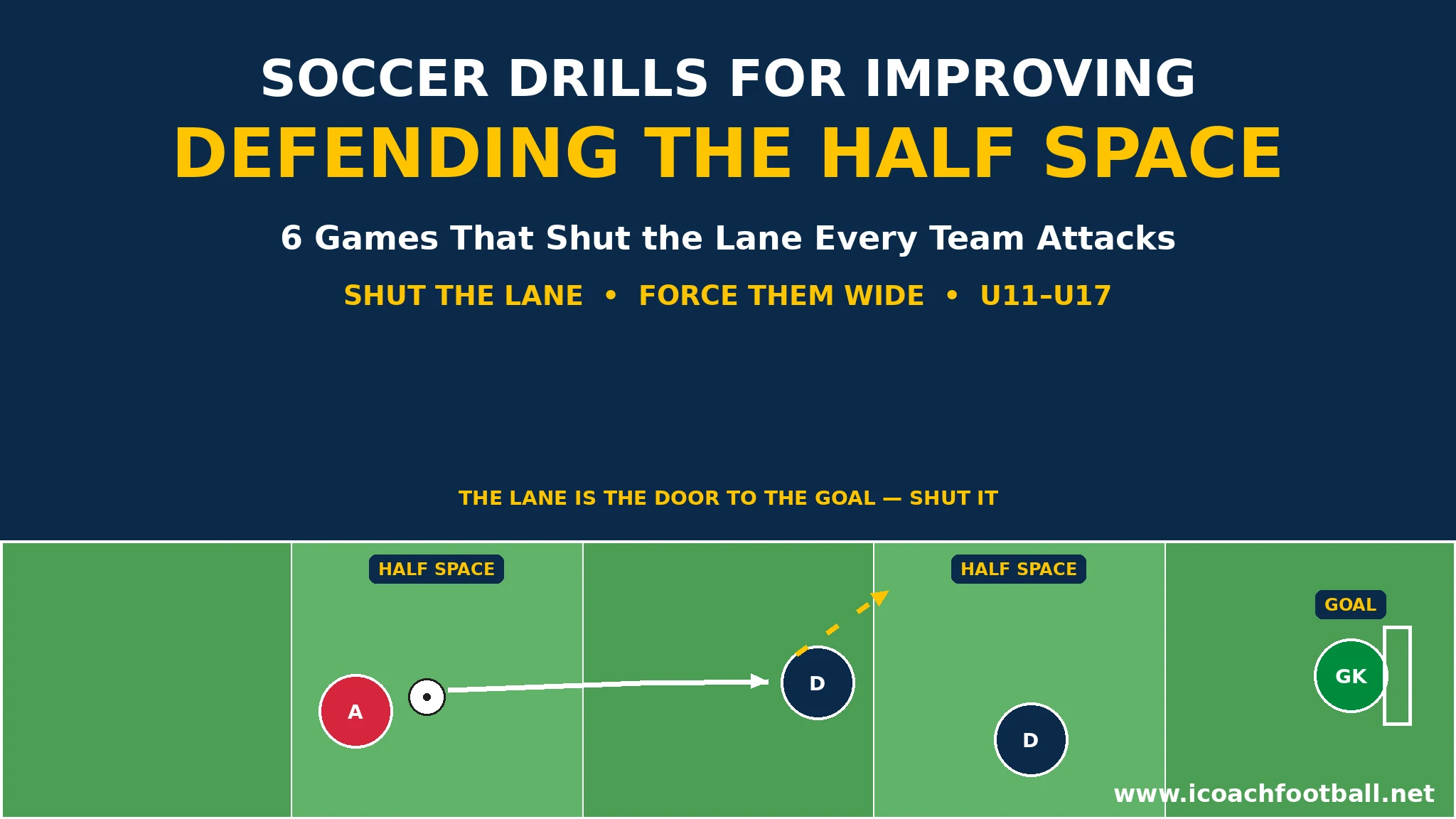
The half space is the vertical lane between the centre of the pitch and the touchline — the lane every good team attacks, because a player who receives there can see the goal, the winger and the striker at the same time. Most teams concede through it for the same three reasons: nobody owns the lane, the block gets dragged wide, or the late runner arrives unmarked. Defending the half space is a team job: shut the lane, force the ball wide, step out to the runner and get back, then track the late run. These six soccer drills for improving defending the half space train that job step by step: a lane game that teaches the block to protect the centre, a forcing-wide game, a step-out-and-recover drill, a recovery-run drill, a runner-tracking drill, and a full game where a stopped half-space entry is worth more than a goal.
Suitable for: U11–U17 (ages 10–17)
Session snapshot
- Players: 14–18
- Age: U11–U17 (ages 10–17)
- Area: Half a pitch, with 2 full goals
- Duration: 60 minutes
- Focus: Defending the half space — shutting the lane, forcing the ball wide, stepping out and recovering, the recovery run, tracking the late runner, and the half-space game
- Equipment: 14 balls, 30 cones, bibs, 2 full goals
Why these six games work
A team that attacks through the half space is not trying to beat one defender. It is trying to beat your shape. The winger holds the touchline to pin your full-back, the 10 drifts into the lane between your full-back and your centre-back, and the striker makes the run that pulls your centre-back out. One pass into that lane and your whole back line has a decision to make — and if nobody has practised the decision, the wrong one gets made. The half space is where attacks turn into goals because it is the one place on the pitch where the receiver can face forward, see the whole goal, and play in three directions at once.
The first drill fixes the shape: a lane game where four defenders protect the middle zone and learn that the ball must never go through them. The second drill fixes the direction: a game where the defence stays compact in the middle and forces the ball wide, because the touchline is the safest place on the pitch. The third drill fixes the step-out: a drill where a defender leaves the line to mark the runner between the lines, and sprints straight back the moment the danger passes. The fourth drill fixes the transition: a drill where the three nearest defenders sprint back to shut the lane before the counter reaches it. The fifth drill fixes the runner: a drill where the defender tracks the late arrival into the half space, goal-side, all the way. The last drill puts it all into a game where a stopped half-space entry is worth two points and a goal from a half-space receive is worth two as well, so both sides fight for the lane.
The drills are grounded in the FIFA/UEFA coaching community. Drills 1, 3 and 5 are based on / in line with the FIFA Training Centre session “23) Defending in a mid-block (Said)”, in which Saïd Chiba, former assistant coach of the Morocco national team, trains a mid-block that protects the central channel as a priority, prevents plays between the lines and in gaps, and steers the opposition out wide — starting with a rivière game in which four defenders protect a central zone, then a 10-a-side stop-ball game in which a defender steps out to mark a player between the lines while team-mates shuffle across to cover, and finishing with an 11-a-side match in which the block moves as one, in time with the ball. Drills 2, 4 and 6 are based on / in line with the England Football Learning article “How to defend like England: transition”, which sets out how the national teams defend when possession is lost: stay compact within the centre of the pitch, force the opposition out wide, sprint back to deny the space in behind, and recover the shape before the next attack arrives. In the UK the same session is football drills for improving defending the half space — the lane, the shuffle and the call are identical.
This is the defending side of the lane our attacking posts already teach players to find. Our football attacking the half space drills train the arrivals this session teaches defenders to stop, and our soccer drills for zonal marking train the zone habits — own your space, slide as one, hand the runner over with a call — that this session applies to the most dangerous zone on the pitch.
Six rules of defending the half space
- Protect the centre first — the half space is the door to it. If the ball goes through the lane, it is already a chance.
- Shut the lane, don’t chase the ball. Your body between the ball and the next zone is worth more than a tackle.
- Force the ball wide — the touchline is your extra defender. The wide lane is the safe lane. Let them have it, then trap them there.
- Step out to the runner, then get back — never stay out. The moment you stay out, the lane behind you is open.
- Shuffle as one — the block moves with the ball. Four players moving together close more space than one player sprinting.
- Track the runner into the lane — the late run is the goal. The runner who arrives unmarked is the one who scores.
Drill 1 — Shut the Lane
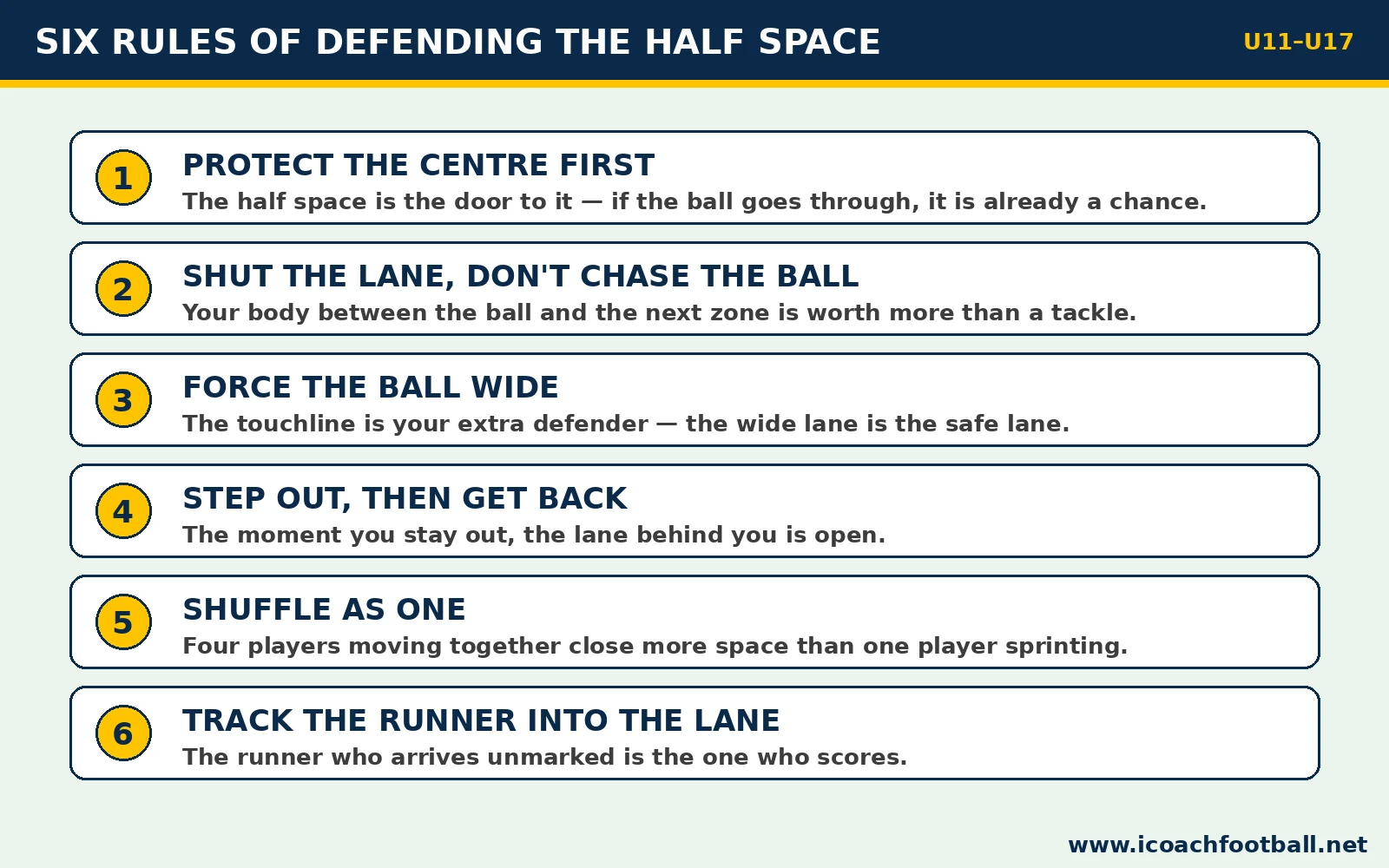
The shape drill — four defenders protect the middle zone of a three-zone area and learn that the ball must never go through them, in line with FIFA’s “Defending in a mid-block” session: the rivière game, in which four defenders protect the central zone and the nearest defender presses at the moment of the pass while the others move over as a unit to cover the diagonal lines.
Setup
- Area a 20 x 15-yard area split into three zones of equal width, marked with cones.
- 8 minutes, then swap the defending four.
How to Play
- Four defenders take the middle zone and three attackers take each outside zone.
- The ball always starts in one of the outside zones.
- The attackers pass between themselves, two touches maximum, ground passes only.
- The attackers try to pass the ball from one outside zone to the other, through the middle.
- The defender nearest the ball presses at the moment of the pass, and the others shuffle across to cover the diagonal lines.
- A pass through the middle that is intercepted scores the defence 2 points; a pass that gets through scores the attack 2.
Coach’s note: “The middle is yours. If the ball goes through you, it is already a chance — get your body between the ball and the next zone.”
Progressions: The attackers get three touches; a fourth attacker joins one outside zone; the defenders must win the ball and play it to a target to score.
Drill 2 — Force Them Wide
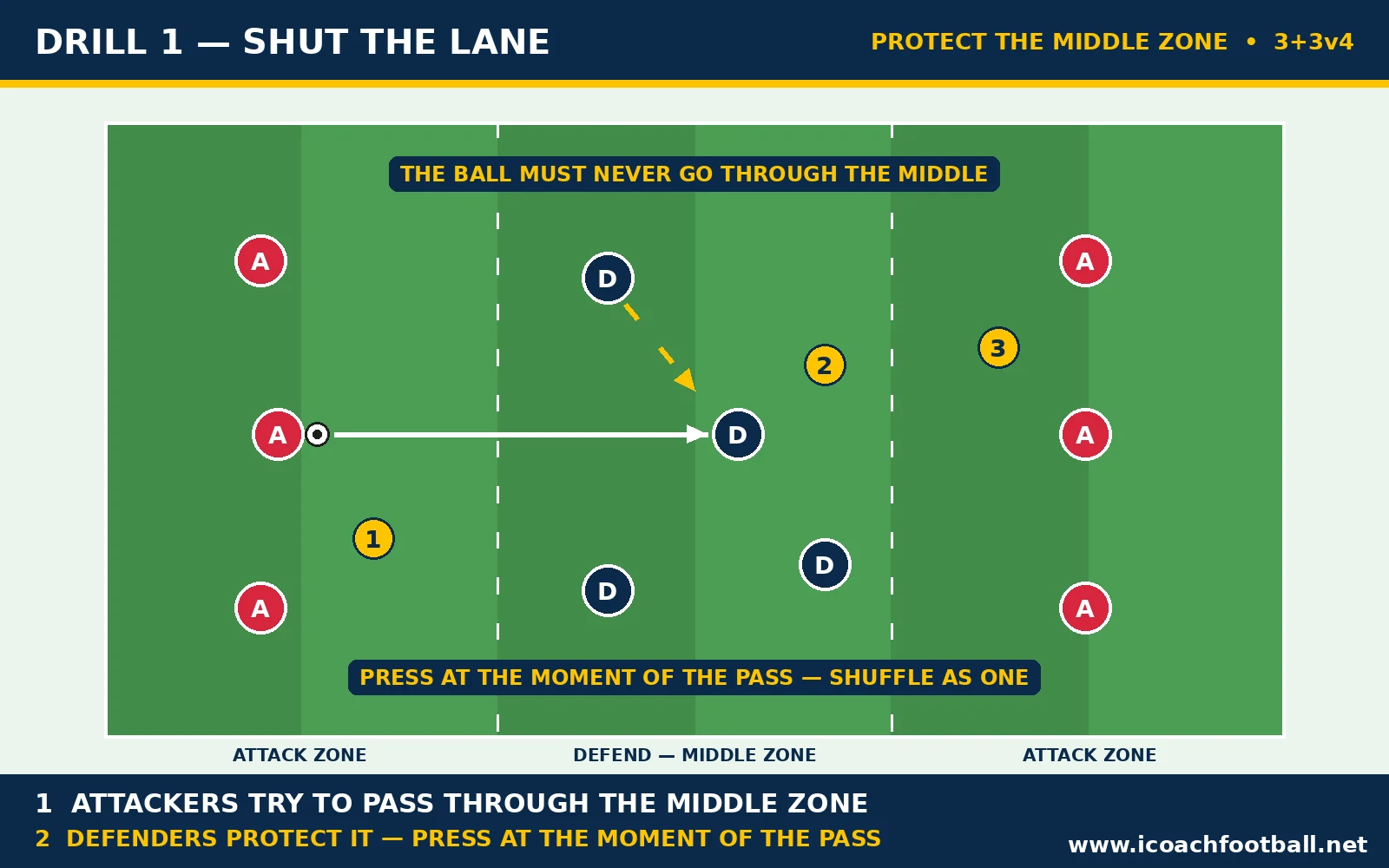
The direction drill — the defence stays compact in the middle three lanes and forces the ball into the wide lanes, where the touchline does the defending for them, in line with England Football Learning’s “How to defend like England: transition”: stay compact within the centre of the pitch and force the opposition out wide.
Setup
- Area a 40 x 30-yard area with five vertical lanes marked with cones, 2 mini goals.
- 9 minutes, then swap the teams.
How to Play
- Two teams play 4v4 in the area with a mini goal at each end.
- The five lanes are marked with cones along both end lines so everyone can see them.
- The defending team stays compact in the middle three lanes and leaves the two wide lanes open.
- When the ball goes wide, the nearest defender presses and the rest shuffle across to shut the half space.
- A goal scored from a half-space receive scores the attack 2 points; a goal from a wide cross scores 1.
- A ball forced wide and won back by the defence scores the defence 2 points.
Coach’s note: “Show them the touchline, not the goal. The wide lane is the safe lane — let them have it, then trap them there.”
Progressions: The attackers may only score after a pass through a half-space lane in the final three minutes; the defenders get a point for every ball forced wide and won; the wide lanes are narrowed by five yards, so the trap closes faster.
Drill 3 — Step Out, Get Back
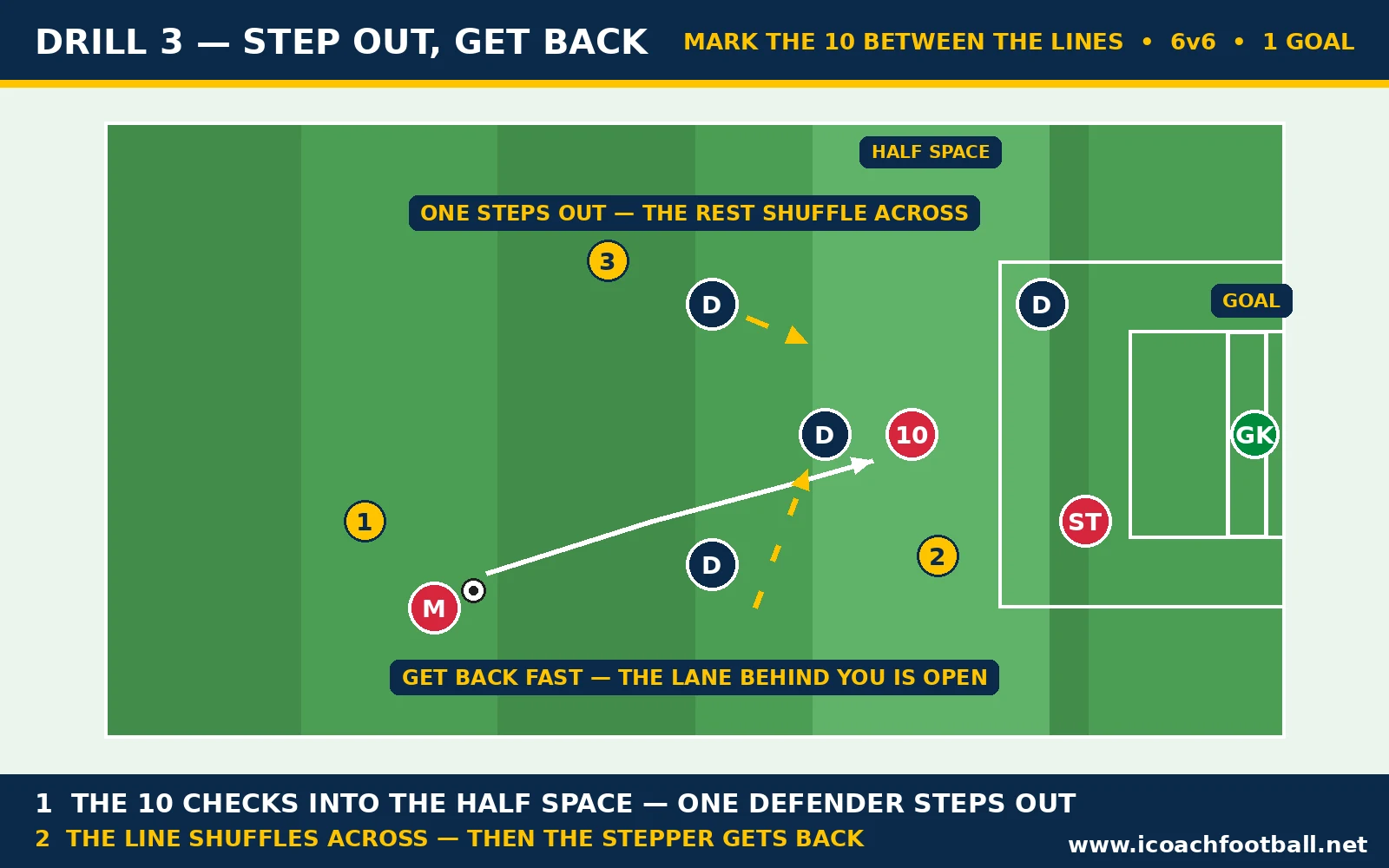
The step-out drill — a 10 arrives between the lines in the half space, the nearest defender steps out to mark them, and the rest of the line shuffles across to cover the gap, in line with FIFA’s “Defending in a mid-block” session: when an opposition player moves freely between the lines, a defender must step out to mark them while their team-mates shuffle across to cover the space, and the player who steps out must quickly get back into position to restore the line.
Setup
- Area a 40 x 30-yard area, one full goal with a goalkeeper, 6v6, a 10 waiting between the lines.
- 9 minutes, then swap the teams.
How to Play
- The attack builds from the back with a 10 waiting between the lines in the half space.
- The 10 checks into the half-space lane to receive, facing forward.
- The nearest defender steps out of the line to mark the 10, tight and goal-side.
- The other defenders shuffle across to cover the space the stepping defender left.
- The moment the ball moves away from the 10, the stepping defender sprints back into the line.
- A half-space receive denied or won back scores the defence 2 points; a turn in the half space scores the attack 2.
Coach’s note: “Step out fast, get back faster. The moment you stay out, the lane behind you is open — and that is the goal.”
Progressions: The 10 may spin and run in behind instead of checking short; two runners arrive between the lines at once; the step-out must win the ball, not just mark the runner.
Drill 4 — The Recovery Run
The transition drill — possession turns over high up the pitch, and the three nearest defenders sprint back to shut the half space before the counter reaches it, in line with England Football Learning’s “How to defend like England: transition”: when possession is lost, the central defenders sprint back to their own half to deny the space in behind, stay compact, and force the opposition wide — which gives the rest of the team time to make their recovery runs.
Setup
- Area half a pitch, 2 full goals with goalkeepers, 7v7, the attack starting high.
- 9 minutes, then swap the teams.
How to Play
- The attack starts in the final third with the ball, pushing high up the pitch.
- On the coach’s call — or a real interception — possession turns over.
- The three nearest defenders sprint back toward their own half to deny the space in behind.
- The recovering defenders pick up positions within the width of the goal and stay compact.
- The counter is forced wide by the recovering shape — the ball may not go through the centre.
- A counter stopped before the halfway line scores the defence 3 points; a counter that reaches the box scores the attack 2.
Coach’s note: “Sprint back first, organise second. A recovery run that starts late is a goal — the half space is where the counter lives.”
Progressions: The counter starts from a throw by the goalkeeper; only two defenders recover while the rest press the ball; the recovering defenders must win the ball within eight seconds of the turnover.

Drill 5 — Track the Runner
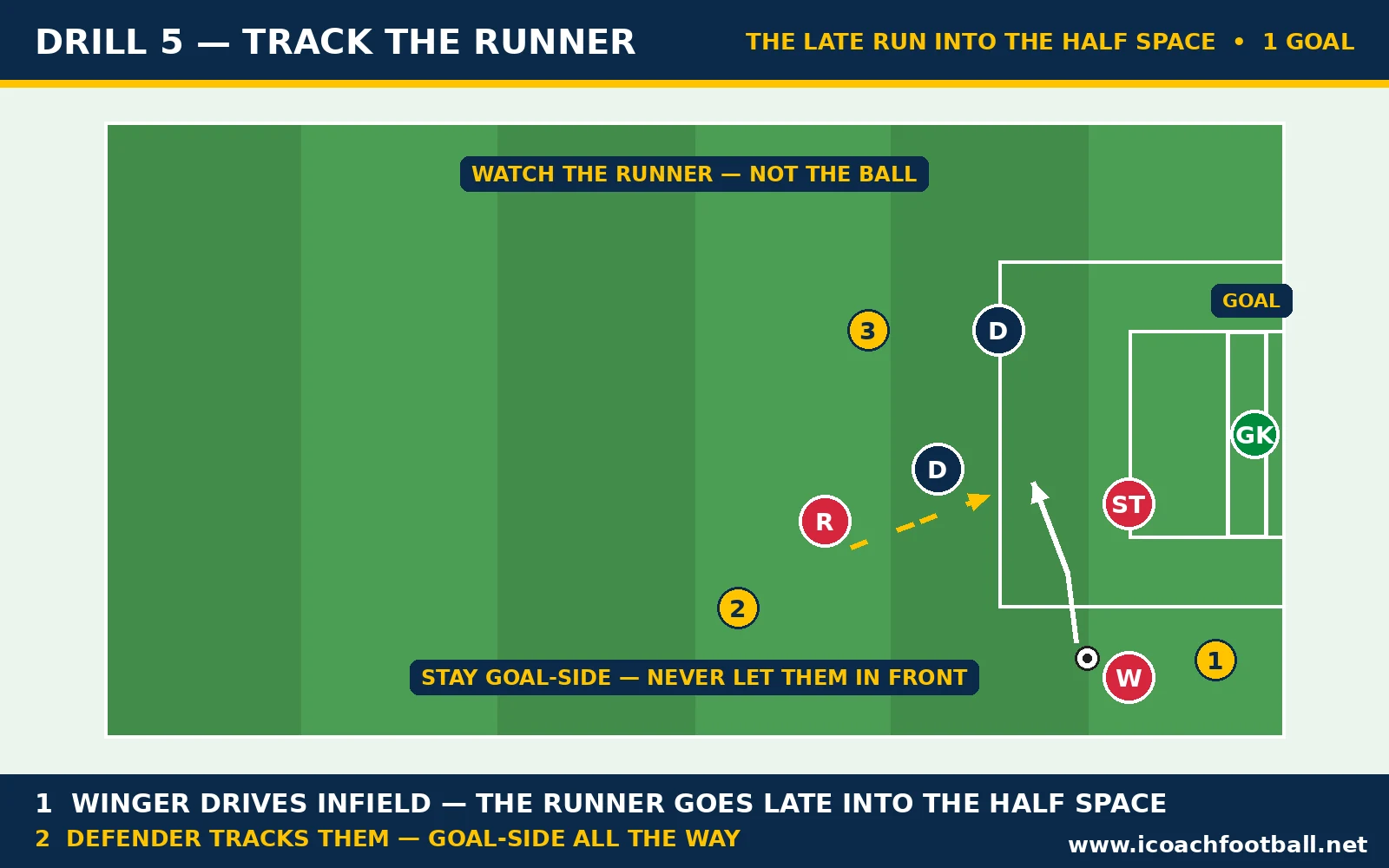
The tracking drill — a runner arrives late from deep into the half space, and the defender tracks them goal-side all the way, in line with FIFA’s “Defending in a mid-block” session: defend between the lines by pushing up to cover the spaces, step out to mark the player who moves freely, and shuffle across as a unit to maintain the compact block.
Setup
- Area the edge of the penalty box, a half-space lane marked with cones, 1 full goal with a goalkeeper.
- 10 minutes, then swap the wing and the defending pair.
How to Play
- A winger holds the ball wide right, 30 yards from goal, with a runner waiting 25 yards out.
- A defender starts goal-side of the runner, inside the half-space lane.
- On the coach’s call, the winger drives infield and the runner sprints late into the half space.
- The defender tracks the runner — stays goal-side, checks their shoulder, and never lets them get in front.
- The winger plays the ball into the half space for the runner to turn and shoot.
- A half-space turn denied scores the defence 2 points; a turn and shot scores the attack 2.
Coach’s note: “The runner is your player, not the ball’s. Watch their hips — the moment they go, you go, and you stay goal-side all the way.”
Progressions: Two runners arrive, one near and one far; the runner may spin in behind instead of checking short; the defender must hand the runner over with a call — “Yours!” — when they cross into a team-mate’s zone.
Drill 6 — The Half-Space Game
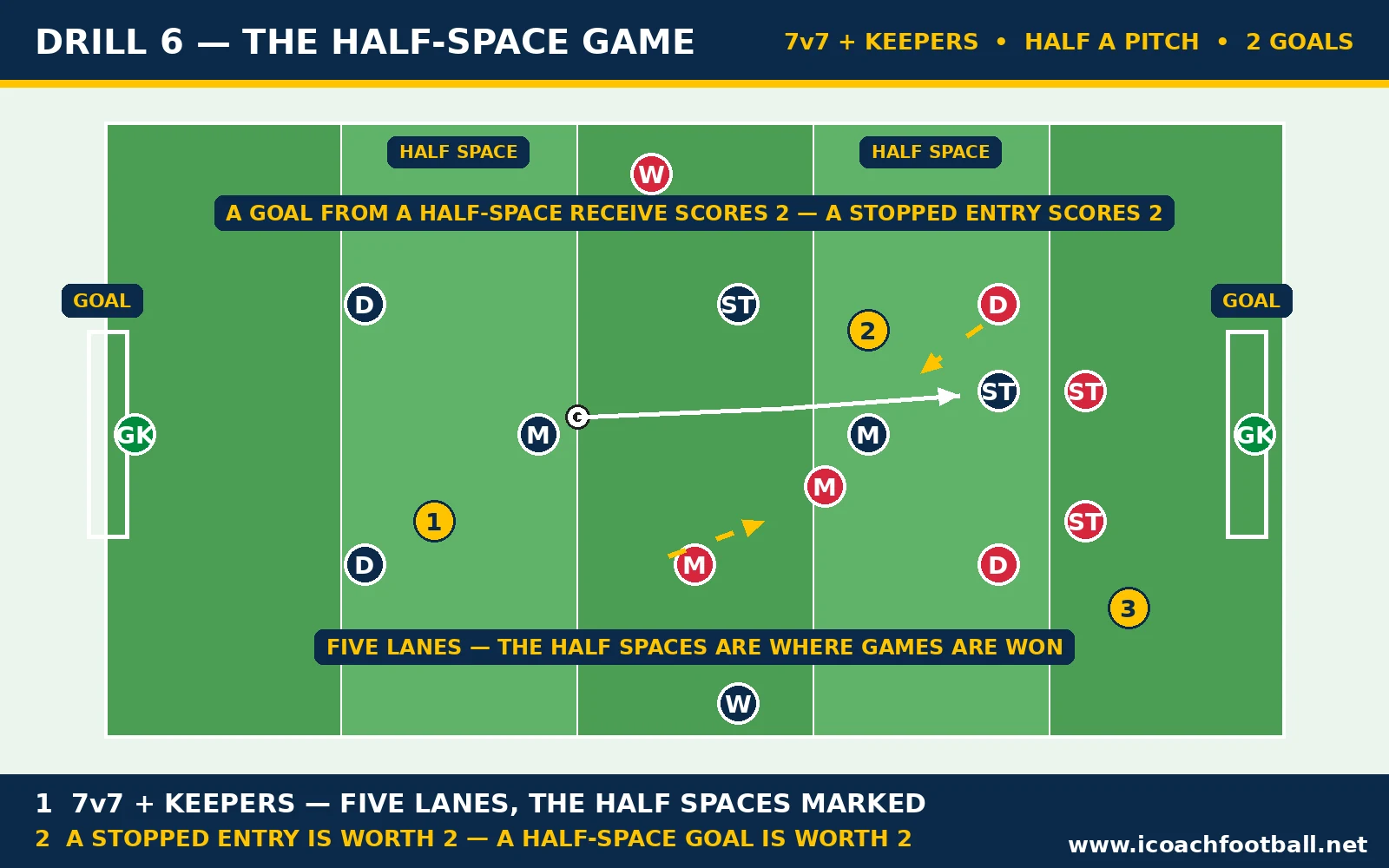
The full game. A 7v7 on half a pitch with five lanes marked, where a goal from a half-space receive scores 2 and a stopped half-space entry scores 2, so both sides fight for the lane, in line with England Football Learning’s “How to defend like England: transition” — compact in the centre, force the opposition wide, recover the shape — and with FIFA’s two-phase method, the principles first, then the game.
Setup
- Half a pitch, 2 full goals with goalkeepers, 7v7, five vertical lanes marked with cones.
- 10 minutes, teams swap ends at five minutes.
How to Play
- Two teams play 7v7 on half a pitch with a goalkeeper in each goal.
- Five vertical lanes are marked with cones so the half spaces are visible to everyone.
- A goal scored after a receive in a half space scores the attack 2 points; any other goal scores 1.
- A half-space entry stopped — interception, forced wide, or tackle in the lane — scores the defence 2 points.
- After a stopped entry, the defending team keeps the ball and attacks.
- The game runs for ten minutes; the team with the most points wins, and the teams swap ends at five minutes.
Coach’s note: “Two points for a stopped entry is not a gimmick — it is the club telling them that shutting the lane matters as much as scoring from it.”
Progressions: Only half-space entries count in the final three minutes; a stopped entry followed by a goal within ten seconds scores 4; the goalkeepers must start the next attack with a throw to a defender, so every attack builds from the back.
Coaching points
- Protect the centre first — the half space is the door to it. If the ball goes through the lane, it is already a chance.
- Shut the lane, don’t chase the ball. Your body between the ball and the next zone is worth more than a tackle.
- Force the ball wide — the touchline is your extra defender. The wide lane is the safe lane. Let them have it, then trap them there.
- Step out to the runner, then get back — never stay out. The moment you stay out, the lane behind you is open.
- Shuffle as one — the block moves with the ball. Four players moving together close more space than one player sprinting.
- Track the runner into the lane — the late run is the goal. The runner who arrives unmarked is the one who scores.
Common mistakes
| Mistake | Fix |
|---|---|
| Chasing the ball into the wide lane, so the half space opens behind you | Shut the lane first — Drill 1 only counts the interception if the defenders hold the middle zone |
| Letting the 10 turn in the half space because nobody stepped out | Step out to the runner — Drill 3 scores 0 for a turn allowed in the lane |
| Staying out after the step-out, so the lane behind you is open | Get back fast — Drill 3 only counts the rep if the defender sprints back into the line |
| Jogging back on the turnover, so the counter runs into the half space | Sprint back first — Drill 4 scores 3 for a counter stopped before the halfway line |
| Ball-watching while the runner arrives late, so they turn unmarked | Track the runner, not the ball — Drill 5 only counts the stop if the defender stays goal-side all the way |
| Two defenders stepping to the same runner, leaving the other lane open | Talk the lane — Drill 6 only counts a stopped entry if one defender calls it |
Age adaptations
| Age | Format | What changes |
|---|---|---|
| U11–U12 (ages 10–12) | Small areas, size 4 ball, lanes marked wide (8 yards), the ball played slowly, no full-pressure step-outs | All six drills run shorter and slower — the lanes are marked wide so the shape is easy to see, and the positions are the lesson. Drill 1 runs with three defenders in the middle zone instead of four, Drill 3 runs with the 10 walking into the lane so the step-out can be practised slowly, and Drill 6 counts every stopped entry, even a deflection, so the players learn to celebrate shutting the lane |
| U13–U14 (ages 12–14) | Full areas, size 4 ball, lanes marked at 6 yards, the 10 allowed to check and turn, step-outs at half pace | All six drills run as written, with the step-out introduced in Drill 3 only when the runner is in front of the defender and the cover is set. Drill 2 adds the final-three-minutes rule, Drill 4 adds the eight-second win-back, and Drill 6 adds the stopped-entry-then-goal bonus. Players keep a simple count — “six entries, four stopped” is the habit that sticks |
| U15–U17 (ages 14–17) | Full areas, size 5 ball, full pressure from the first rep, lanes marked at 5 yards, runners allowed to spin in behind | Full pressure from the start. Drill 1 runs with the attackers on three touches, Drill 3 requires the step-out to win the ball, and Drill 6 plays with the goalkeepers starting every attack with a throw to a defender. Players are asked to call the lane before each rep — “Mine! Half space!” — so the decision becomes a conscious skill, not a lucky guess |
60-minute session plan
| Block | Time | Content |
|---|---|---|
| Arrival game | 0:00–0:05 | Lane warm-up — pairs, one passes through the middle zone, one shuts the lane, no tackling yet |
| Shut the lane | 0:05–0:13 | Drill 1 — Shut the Lane |
| Force them wide | 0:13–0:22 | Drill 2 — Force Them Wide |
| Step out, get back | 0:22–0:31 | Drill 3 — Step Out, Get Back |
| The recovery run | 0:31–0:40 | Drill 4 — The Recovery Run |
| Track the runner | 0:40–0:50 | Drill 5 — Track the Runner |
| The half-space game | 0:50–1:00 | Drill 6 — The Half-Space Game |
Keep building from here
The arrivals this session teaches defenders to stop are our football attacking the half space drills, and the pocket between the lines where the 10 waits is our football playing between the lines drills. The zone habits this session applies to the most dangerous lane are our soccer drills for zonal marking, and the starting position that puts the defender goal-side early is our soccer drills for improving defensive positioning. The tight marking that denies the runner space is our soccer drills for improving marking, and the read that starts the whole sequence is our soccer drills for improving interceptions. The anticipation that gets the defender moving before the pass is our soccer drills for improving anticipation, and the transition that follows every stopped entry is our football defensive transition drills. The recovery run that gets a defender back to shut the lane is our soccer drills for improving defending against pace, and the high line that forces the ball wide in the first place is our soccer drills for improving defending a high defensive line. The far-post drop that follows a ball forced wide is our soccer drills for improving defending the back post, and the block that stops the shot after a half-space entry gets through is our soccer drills for improving blocking shots. The rest defence that keeps the team safe while it attacks is our football rest defence drills. Defending the half space is high-repetition, high-intensity work — plan the week’s load with our training load calculator.
What is the half space in soccer?
The half space is the vertical lane between the centre of the pitch and the touchline — one on each side. Divide the pitch into five vertical lanes and the two lanes between the central lane and the two wide lanes are the half spaces. A player who receives there can face forward, see the goal, and play to the winger, the striker or the far side, which is why every good team attacks through it.
How do you defend the half space?
Stay compact in the centre, shut the lane with your body, and force the ball wide. The nearest defender presses the ball while the rest of the block shuffles across to close the diagonal passing lines, and nobody chases the ball into the wide lane. Drill 1 trains the shape — four defenders protecting the middle zone — and Drill 2 trains the direction: the ball goes wide, the half space stays shut.
Should defenders step out to mark a player in the half space?
Yes — but only one defender, and only for a moment. When a runner arrives between the lines, the nearest defender steps out tight and goal-side while the rest of the line shuffles across to cover the gap. The moment the ball moves away from the runner, the stepping defender sprints straight back into the line. Drill 3 trains exactly this: a step-out that wins the ball scores, and a step-out that stays out concedes.
How do you stop a team playing through the half space?
Deny the first pass into the lane, not the shot that follows it. Keep the block narrow, keep the distances between defenders tight — around three metres in the line — and make the opposition play around you, not through you. If the ball does get into the lane, the defender nearest the receiver steps out while the cover shuffles across, and the recovery runs start the moment possession turns over. Drill 6 trains the full sequence in a game where a stopped entry is worth two points.
How do you coach defending the half space to U11s?
Start with the lanes marked wide — eight yards, not five — so the shape is easy to see, and play the ball slowly so the positions can be practised before the pressure arrives. Count every stopped entry, even a deflection, and celebrate shutting the lane like a goal, because for a U11 the habit matters more than the technique. Drill 1 runs with three defenders in the middle zone instead of four, Drill 3 runs with the 10 walking into the lane, and Drill 6 counts every stopped entry.
Sources
- FIFA Training Centre. “23) Defending in a mid-block (Said)” — Saïd Chiba, former assistant coach of the Morocco national team, trains a mid-block that protects the central channel as a priority, prevents plays between the lines and in gaps, and steers the opposition out wide: a rivière game in which four defenders protect a central zone, a 10-a-side stop-ball game in which a defender steps out to mark a player between the lines while team-mates shuffle across to cover, and an 11-a-side match in which the block moves as one, in time with the ball. Verified live 2026-11-23 (HTTP 200, full text read). Drills 1, 3 and 5 are based on / in line with this session.
- England Football Learning / The FA Boot Room. “How to defend like England: transition” — The FA’s article on how the national teams defend in transition: stay compact within the centre of the pitch, force the opposition out wide, sprint back to deny the space in behind, and recover the shape before the next attack arrives. Verified live 2026-11-23 (HTTP 200, full text read). Drills 2, 4 and 6 are based on / in line with this article.