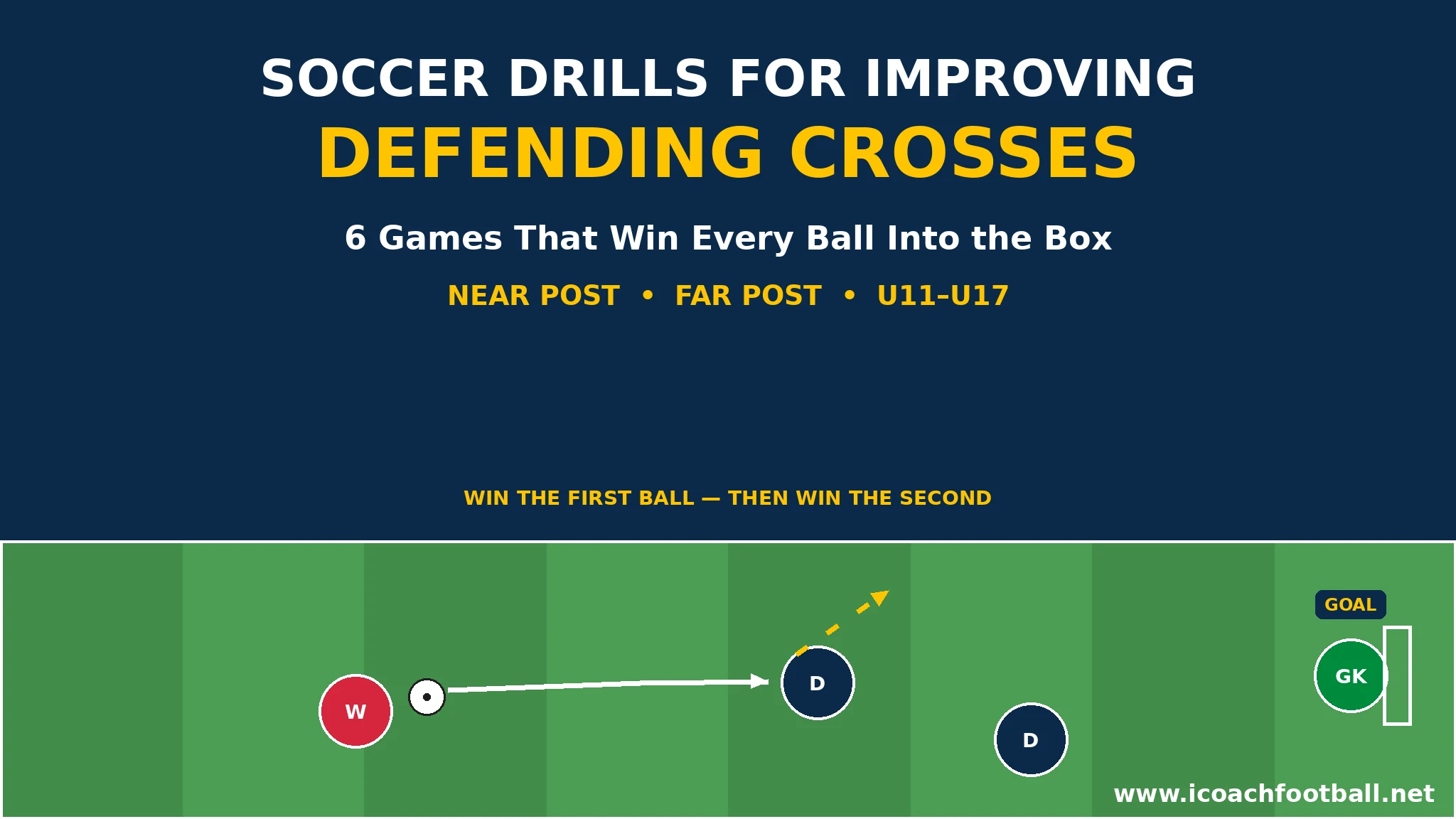
Soccer Drills for Improving Defending Crosses: 6 Games That Win Every Ball Into the Box (U11–U17)
Quick answer
Most goals from crosses are not scored by the winger who delivers the ball. They are scored because nobody attacked the first ball, nobody tracked the late runner, or the clearance dropped straight to an attacker on the edge of the box. Defending a cross is a sequence: see it early, own your zone, win the first ball, clear it long, then win the second ball. These six soccer drills for improving defending crosses train that sequence step by step: a near-post drill that teaches defenders to attack the first ball, a far-post drill that teaches them to track the late runner, a clearance drill that teaches height and distance, a block-and-recover drill that stops the cross at source, a second-ball drill that wins the ball after the clearance, and a full game where a defended cross is worth more than a goal.
Suitable for: U11–U17 (ages 10–17)
Session snapshot
- Players: 14–18
- Age: U11–U17 (ages 10–17)
- Area: Half a pitch, with 2 full goals
- Duration: 60 minutes
- Focus: Defending crosses — the near-post first ball, the far-post runner, first contact and the clearance, blocking the cross at source, the second ball, and the cross game
- Equipment: 14 balls, 24 cones, bibs, 2 full goals
Why these six games work
A cross is the most common way a youth team concedes from open play. The winger gets wide, the ball comes in, and three attackers arrive in the box while the defenders stand and watch it. The problem is rarely effort. The problem is that nobody taught the defenders what to do before the ball is crossed, while it is in the air, and after it is cleared. Defending a cross is not one action — it is a chain, and a chain breaks at its weakest link.
The first drill fixes the near post: a drill where the defender has to attack the first ball at its highest point, before the striker gets there. The second drill fixes the far post: a drill where the far-side defender tracks the late runner instead of ball-watching. The third drill fixes the clearance: a drill where the first contact only counts if it goes wide and long, never across the face of goal. The fourth drill fixes the source: a drill where the full-back blocks the cross before it is even delivered. The fifth drill fixes what happens next: a drill where the second ball on the edge of the box is owned by a defender, not an attacker. The last drill puts it all into a game where a defended cross is worth two points and a goal from a cross is worth two as well, so both sides fight for the ball in the air.
The drills are grounded in the FIFA/UEFA coaching community. Drills 1, 3 and 5 are based on / in line with the FIFA Training Centre session “Defending the penalty area”, in which FIFA Goalkeeping Coach Dean Santangelo trains goalkeepers to command the area and dominate the space around them — judging the flight of the ball, repositioning quickly, and dealing with cut-back crosses, aerial balls from deep and low crosses into all three parts of the penalty area, including the far post. The session is built in two phases: a controlled analytical phase that develops technical precision, then a situational phase that tests the skills in realistic, game-based contexts. Drills 2, 4 and 6 are based on / in line with the England Football Learning article “How to defend like England: crosses”, which sets out how the national teams defend crosses: stay compact, encourage the ball wide, defend 1v1 anywhere on the pitch, defend the space in behind and out wide, cope with moments of transition, and — above all — know who does what, and when. In the UK the same session is football drills for improving defending crosses — the near post, the far post and the call are identical.
This is the other side of the crossing session. Our soccer drills for improving crossing accuracy train the deliveries this session teaches defenders to stop, and our soccer drills for improving defending the back post train the far-post drop and the call that this session builds on.
Six rules of defending crosses
- See the cross before it is played. The ball-watching defender is already beaten — the cross is decided by the winger’s body shape, not by the ball leaving the foot.
- Own your zone — one name, one area. Near post, middle, far post, edge of the box. If nobody owns it, the runner owns it.
- Attack the ball at its highest point. Meet it, don’t wait for it. A defender who waits for the ball to drop is a defender the attacker jumps over.
- The keeper calls it — “MINE!” or “AWAY!”. One voice decides who takes the cross. Two voices, or no voice, is a goal.
- Clear it wide and long — never across your own goal. Height and distance. A clearance across the face of goal is a pass to their striker.
- Win the first ball, then win the second. The knock-down is the next goal.
Drill 1 — Near-Post First
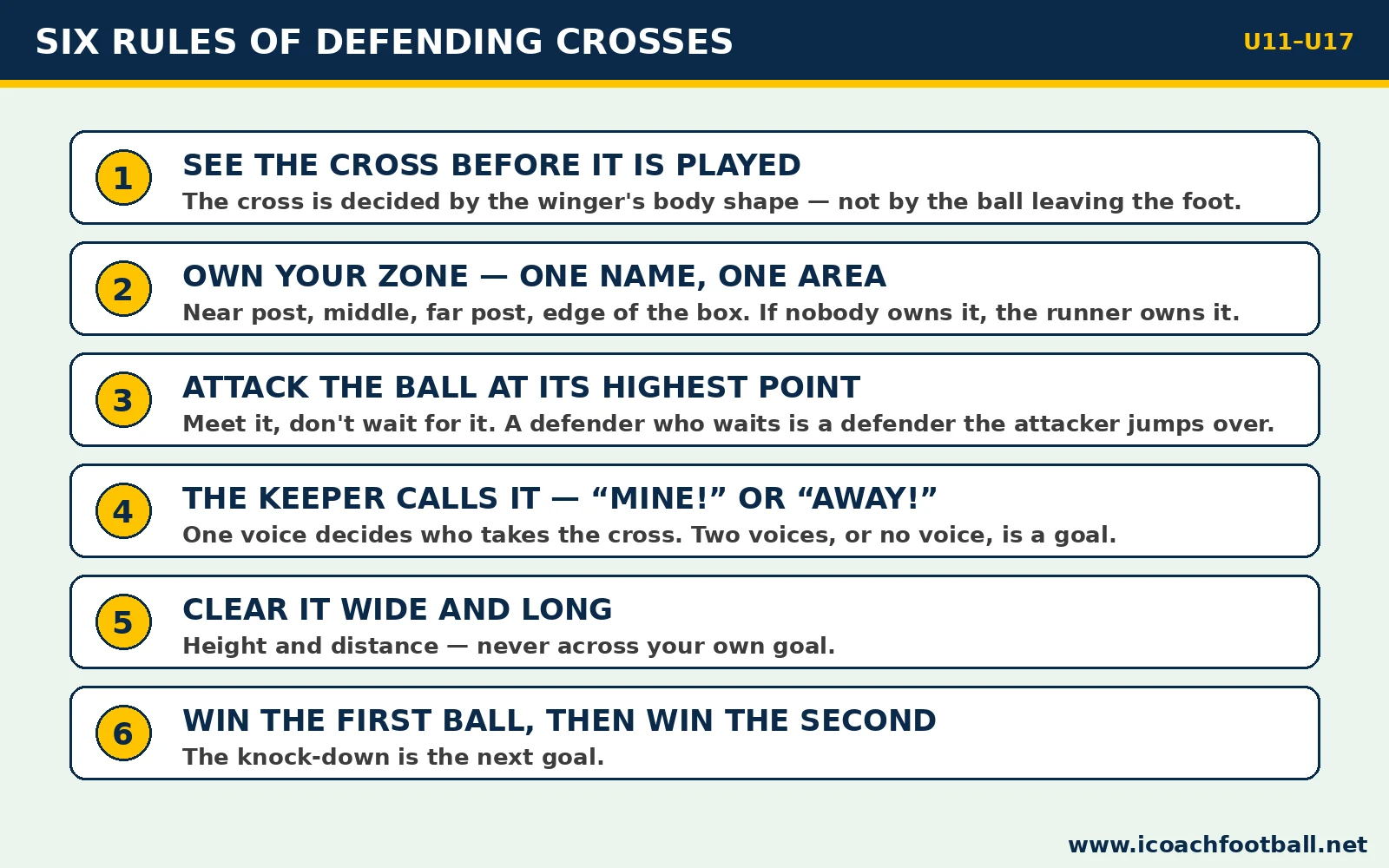
The first-ball drill — a defender reads the winger’s body shape, moves before the cross is struck, and attacks the near-post ball at its highest point, in line with FIFA’s “Defending the penalty area” session: judge the flight of the ball, reposition quickly, and deal with low crosses into all three parts of the penalty area.
Setup
- Area the penalty box, 1 full goal with a goalkeeper, winger wide right, striker at the near post.
- 8 minutes, then swap the wing and the defending pair.
How to Play
- The winger starts wide right, 25 yards from goal, with the ball.
- A striker waits at the near post and a defender starts goal-side of them.
- On the coach’s call, the winger drives forward and crosses to the near post.
- The defender reads the winger’s body shape and moves before the cross is struck.
- The defender attacks the ball at its highest point and heads it away from goal.
- A first contact won by the defence scores 2 points; a near-post finish scores the attack 2.
Coach’s note: “The near post is yours. If you wait for the ball to arrive, the striker gets there first — go and meet it.”
Progressions: The cross comes low and driven instead of high; a second striker arrives at the penalty spot; the winger may cross early or late, so the defender must read the body shape every time.
Drill 2 — The Far-Post Runner
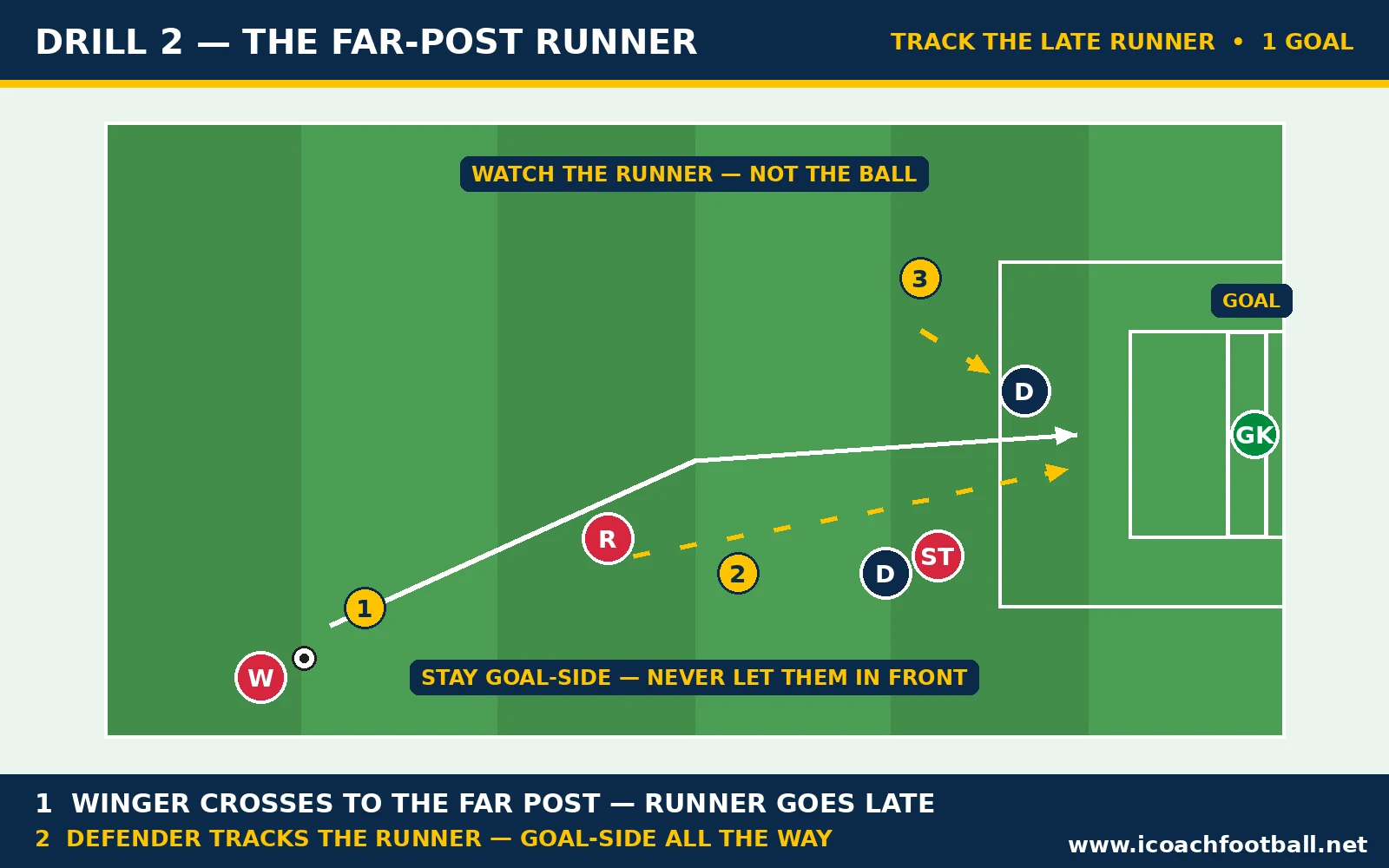
The tracking drill — the far-side defender watches the late runner, not the ball, and stays goal-side of them all the way to the far post, in line with England Football Learning’s “How to defend like England: crosses”: defend the space in behind and out wide, and know who does what, and when.
Setup
- Area the penalty box, 1 full goal with a goalkeeper, winger wide left, runner arriving late from the edge of the box.
- 9 minutes, then swap the wing and the defending pair.
How to Play
- The winger starts wide left with the ball and a runner waits 25 yards out.
- A far-side defender starts level with the six-yard box, watching the runner.
- On the coach’s call, the winger drives forward and crosses to the far post.
- The runner sprints late into the box toward the far post.
- The defender tracks the runner — stays goal-side, bumps them, and never lets them get in front.
- A far-post header won by the defence scores 2 points; a far-post goal scores the attack 2.
Coach’s note: “The runner is your player, not the ball’s. Watch the runner’s hips — the moment they go, you go.”
Progressions: The runner starts deeper, 30 yards out; two runners arrive, one near and one far; the cross is a cutback to the edge of the box instead of the far post.
Drill 3 — Clear It Long
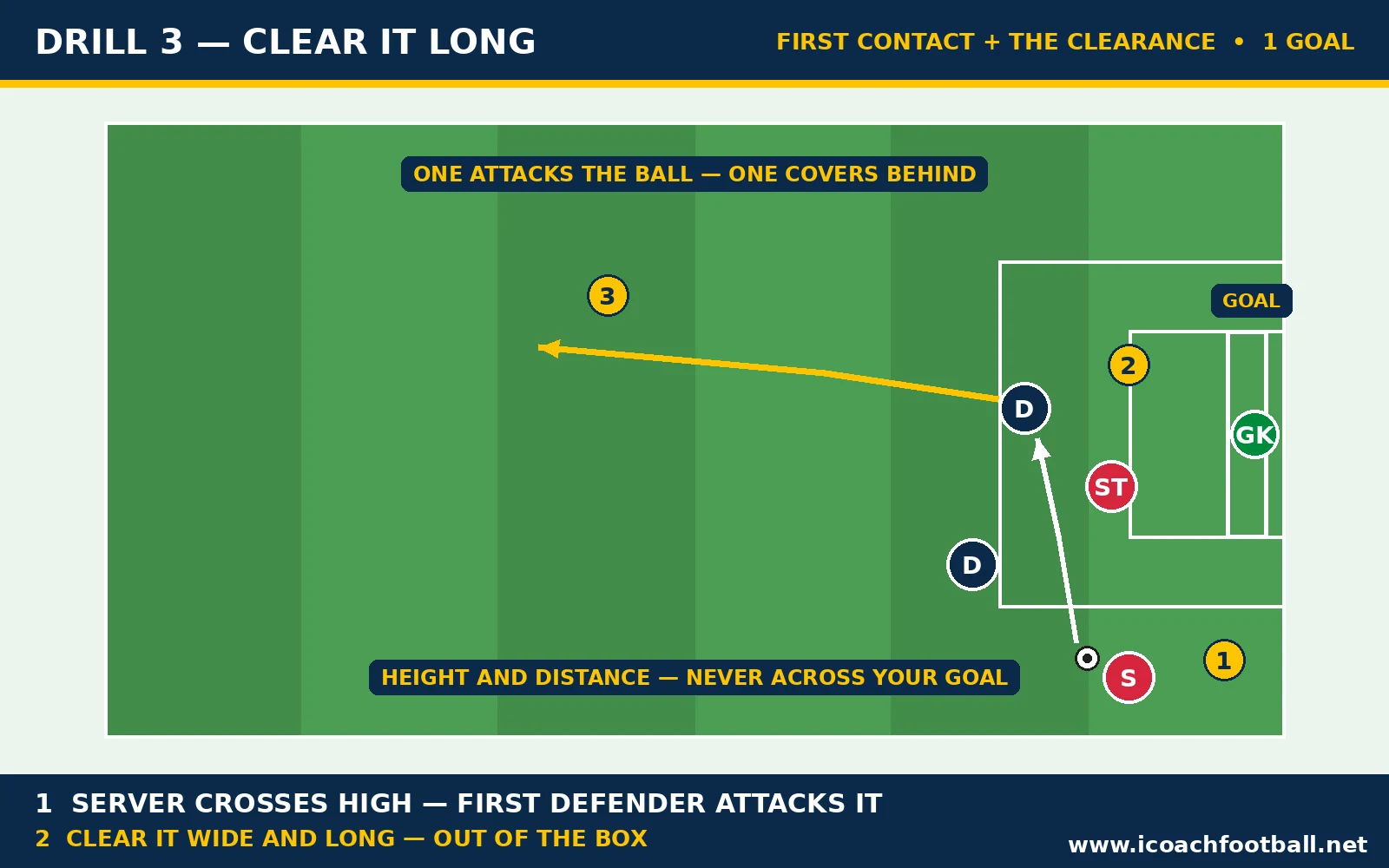
The clearance drill — the first defender attacks the ball and heads it wide and long, while the cover defender drops behind them, in line with FIFA’s “Defending the penalty area” session: command the area, dominate the space around you, and deal with aerial balls from deep and low crosses into the middle of the box.
Setup
- Area the edge of the penalty box, 1 full goal with a goalkeeper, server wide with balls, two defenders, one striker.
- 9 minutes, then swap the servers and the defending pair.
How to Play
- A server stands wide with balls and a striker waits in the box.
- Two defenders start in the box — one attacks the ball, one covers behind.
- The server crosses high into the middle of the box.
- The first defender attacks the ball at its highest point and heads it clear.
- The clearance must go wide and long — never across the face of goal.
- A clearance that leaves the box scores the defence 2 points; a header that drops inside the box scores 0.
Coach’s note: “Height and distance — that is the clearance. A header that drops at the penalty spot is just a pass to their striker.”
Progressions: The clearance must find a wide target zone to count; a second ball is served immediately after the clearance; the server varies the cross — high, low, near post, far post — so the first defender must adjust every time.
Drill 4 — Cross, Block, Recover
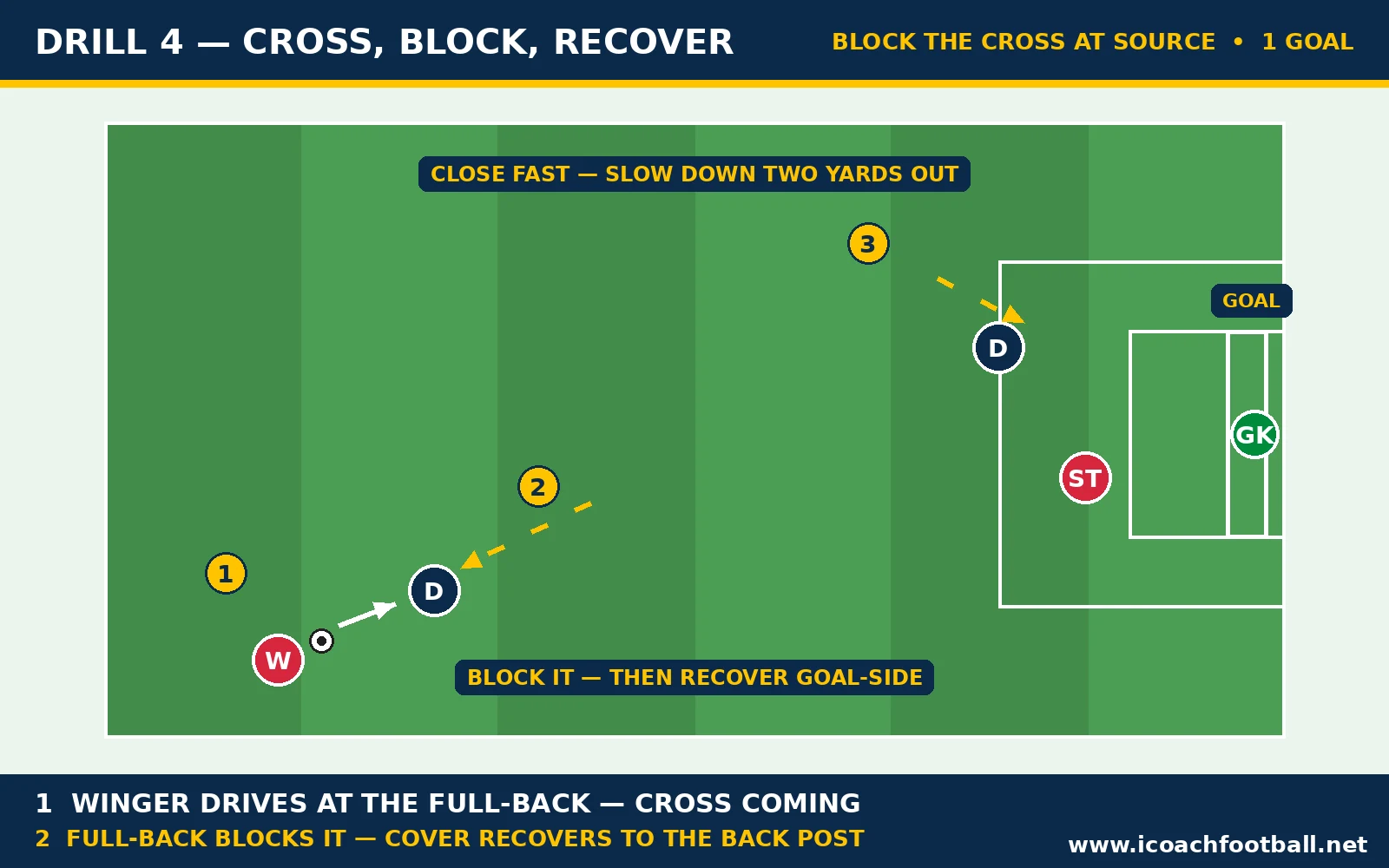
The block-at-source drill — the full-back closes the winger fast, slows down two yards out, shows them down the line and blocks the cross with the front foot, in line with England Football Learning’s “How to defend like England: crosses”: defend 1v1 anywhere on the pitch, and stay compact so the ball is forced wide.
Setup
- Area a wide channel 30 yards from goal, 1 full goal with a goalkeeper, winger on the touchline, full-back 5 yards away.
- 9 minutes, then swap the wing and the defending pair.
How to Play
- The winger starts on the touchline 30 yards from goal with the ball.
- The full-back starts 5 yards away, side-on, between the winger and the goal.
- On the coach’s call, the winger drives at the full-back to cross.
- The full-back closes fast, then slows two yards out and shows the winger down the line.
- The full-back blocks the cross with the front foot and recovers goal-side.
- A blocked cross scores the defence 2 points; a cross that reaches the box scores the attack 1.
Coach’s note: “Show them down the line, not inside. If they cut inside, the cross becomes a shot — and that is worse.”
Progressions: The winger may cut inside instead of crossing; the cover defender must recover to the back post on every rep; a blocked cross must be won by the cover defender, or the attack keeps the ball.
Drill 5 — The Second Ball
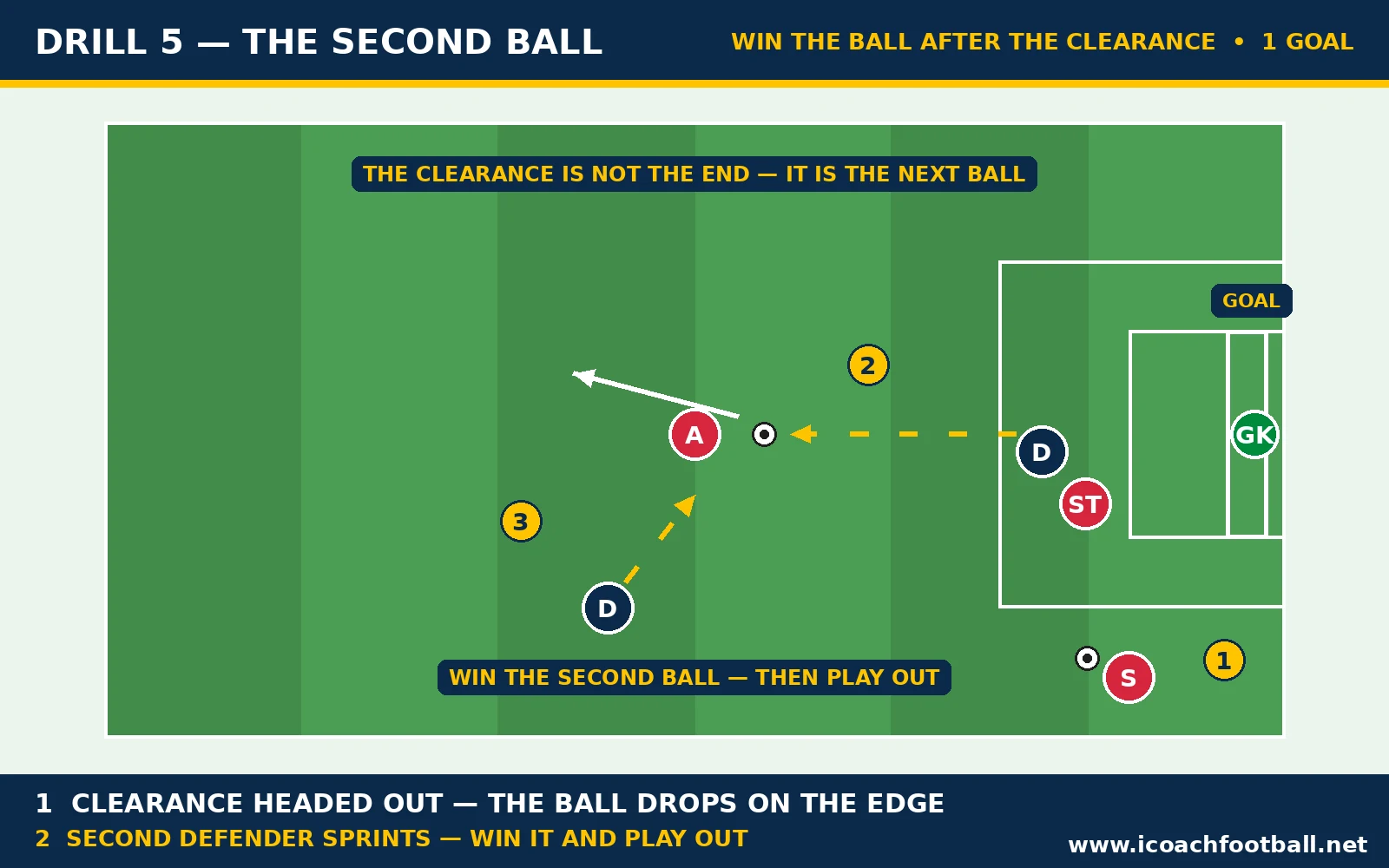
The second-ball drill — the clearance is headed out, and a second defender sprints to the edge of the box to win the ball before the attacker does, in line with FIFA’s “Defending the penalty area” session: the situational phase tests the skills in realistic, game-based contexts, where the ball after the clearance decides the next attack.
Setup
- Area the edge of the penalty box, 1 full goal with a goalkeeper, server wide, two defenders, one attacker on the edge of the box.
- 10 minutes, then swap the servers and the defending pair.
How to Play
- A server crosses from wide and a defender heads it clear to the edge of the box.
- An attacker waits on the edge of the box for the clearance to drop.
- A second defender starts 10 yards outside the box, facing the play.
- The moment the clearance leaves the box, the second defender sprints to the loose ball.
- The second defender wins the ball and plays it out to a team-mate, or clears it wide.
- A clearance won and played out scores the defence 3 points; a second ball won by the attack scores the attack 2.
Coach’s note: “The clearance is not the end — it is the start of the next ball. Someone has to own the edge of the box.”
Progressions: The clearance must be played out to a team-mate, not just cleared; the attackers get a second ball if the clearance is sloppy; the edge defender must win the ball first-time, with no extra touch.
Drill 6 — The Cross Game
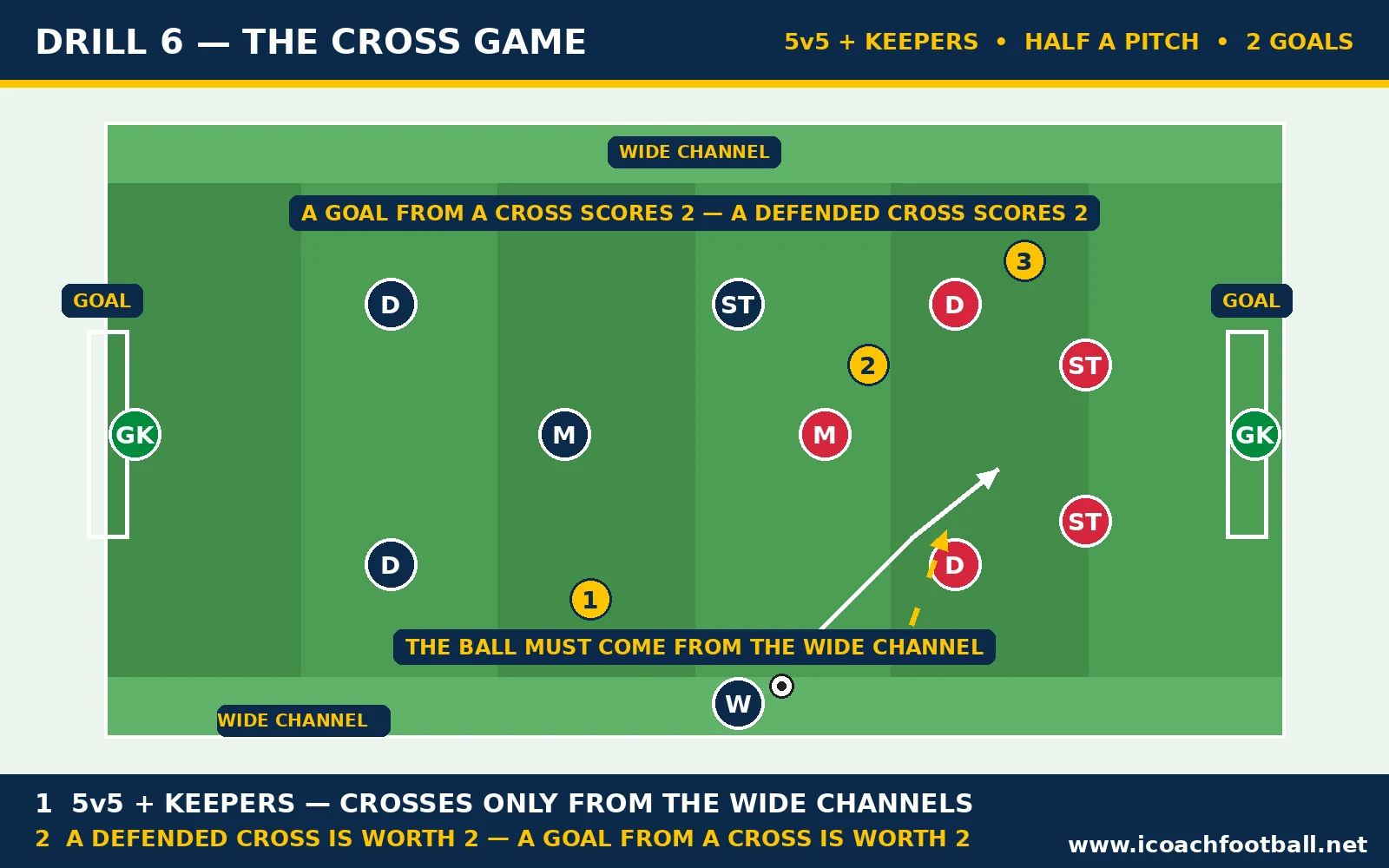
The full game. A 5v5 plus keepers with wide channels, where a goal from a cross scores 2 and a defended cross scores 2, so both sides fight for the ball in the air, in line with England Football Learning’s “How to defend like England: crosses”: stay compact, encourage the ball wide, and know who does what, and when — and with FIFA’s two-phase method, technical work first, then the game.
Setup
- Half a pitch, 2 full goals with goalkeepers, 5v5 plus keepers, wide channels marked on both flanks.
- 10 minutes, teams swap ends at five minutes.
How to Play
- Two teams play 5v5 on half a pitch with a goalkeeper in each goal.
- Wide channels are marked on both flanks — only the team in possession may use them.
- A goal from a cross scores 2 points; any other goal scores 1.
- A defended cross — first contact won, cleared wide, or blocked at source — scores the defence 2 points.
- After a defended cross, the defending team keeps the ball and attacks.
- The game runs for ten minutes; the team with the most points wins, and the teams swap ends at five minutes.
Coach’s note: “Two points for a defended cross is not a gimmick — it is the club telling them that stopping a cross matters as much as scoring from one.”
Progressions: Only crosses from the wide channels count in the final three minutes; a defended cross followed by a goal within ten seconds scores 4; the goalkeepers must start the next attack with a throw to a defender, so every attack builds from the back.
Coaching points
- See the cross before it is played. The ball-watching defender is already beaten — the cross is decided by the winger’s body shape.
- Own your zone — one name, one area. Near post, middle, far post, edge of the box. If nobody owns it, the runner owns it.
- Attack the ball at its highest point. Meet it, don’t wait for it. A defender who waits for the ball to drop is a defender the attacker jumps over.
- The keeper calls it — “MINE!” or “AWAY!”. One voice decides who takes the cross. Two voices, or no voice, is a goal.
- Clear it wide and long — never across your own goal. Height and distance. A clearance across the face of goal is a pass to their striker.
- Win the first ball, then win the second. The knock-down is the next goal.
Common mistakes
| Mistake | Fix |
|---|---|
| Ball-watching while the cross is delivered, so the striker gets a free run at the ball | Read the winger’s body shape and move before the cross — Drill 1 only counts the first ball if the defender moves on the trigger |
| Nobody owning the far post, so the late runner arrives unmarked | One name, one zone — Drill 2 only counts the header if the far-side defender tracks the runner all the way |
| Heading the clearance across the face of goal, straight to their striker | Clear it wide and long — Drill 3 scores 0 for a header that drops inside the box |
| Diving in on the winger, so they cut inside and the cross becomes a shot | Close fast, slow down two yards out — Drill 4 stops the rep if the full-back dives in |
| Watching the clearance and stopping, so the second ball falls to the attacker | Win the second ball — Drill 5 scores nothing for a clearance with no second-ball win |
| Two defenders going for the same ball, leaving the runner free | Talk the cross — Drill 6 only counts a defended cross if one defender calls it |
Age adaptations
| Age | Format | What changes |
|---|---|---|
| U11–U12 (ages 10–12) | Small areas, size 4 ball, crosses from 15–20 yards, no heading of high balls, first contact counted generously | All six drills run shorter and slower — crosses from 15–20 yards, not 25–30 — because the crossing power is not there yet and the positions are the lesson. Drill 1 runs with the ball chested or volleyed clear instead of headed, Drill 2 starts the runner 15 yards out, and Drill 6 counts every defended cross, even a deflection, so the players learn to celebrate defending the cross |
| U13–U14 (ages 12–14) | Full areas, size 4 ball, crosses from 20–25 yards, heading introduced in Drill 3 only when the ball is in the air and the defender is set | All six drills run as written, with heading introduced in Drill 3 only when the ball is in the air and the defender is set. Drill 2 adds the second runner arriving late, Drill 4 adds the cut-inside option, and Drill 6 adds the defended-cross-then-goal bonus. Players keep a simple count — “six crosses, four defended” is the habit that sticks |
| U15–U17 (ages 14–17) | Full areas, size 5 ball, full pressure from the first rep, crosses from 25–30 yards, defenders allowed to attack every ball | Full pressure from the start. Drill 1 runs with the winger allowed to cross early or late, Drill 3 requires the clearance to find a wide target zone, and Drill 6 plays with the goalkeepers starting every attack with a throw to a defender. Players are asked to call the cross before each rep — “Mine! Near post!” — so the decision becomes a conscious skill, not a lucky guess |
60-minute session plan
| Block | Time | Content |
|---|---|---|
| Arrival game | 0:00–0:05 | Cross warm-up — pairs, one crosses softly, one attacks the first ball, no heading for U11–U12 |
| Near-post first | 0:05–0:13 | Drill 1 — Near-Post First |
| The far-post runner | 0:13–0:22 | Drill 2 — The Far-Post Runner |
| Clear it long | 0:22–0:31 | Drill 3 — Clear It Long |
| Cross, block, recover | 0:31–0:40 | Drill 4 — Cross, Block, Recover |
| The second ball | 0:40–0:50 | Drill 5 — The Second Ball |
| The cross game | 0:50–1:00 | Drill 6 — The Cross Game |
Keep building from here
The far-post drop and the call that this session builds on are our soccer drills for improving defending the back post, and the block that stops the shot after a cross gets through is our soccer drills for improving blocking shots. The deliveries this session teaches defenders to stop are our soccer drills for improving crossing accuracy, and the goalkeeper who commands the area behind every cross is our soccer goalkeeper cross handling drills. The high line that forces the ball wide in the first place is our soccer drills for improving defending a high defensive line, and the transition that follows every clearance is our football defensive transition drills. The tight marking that denies the runner space is our soccer drills for improving marking, and the aerial duel that wins the first ball is our soccer drills for improving aerial duels. The starting position that puts the defender goal-side early is our soccer drills for improving defensive positioning, and the attacking side of the wide channel is our the wide channel game — crossing and finishing. The read that starts the whole sequence is our soccer drills for improving interceptions, and the anticipation that gets the defender moving before the cross is our soccer drills for improving anticipation. The recovery run that gets a defender back to the far post is our soccer drills for improving defending against pace. Defending crosses is high-repetition, high-intensity work — plan the week’s load with our training load calculator.
How do you teach defenders to defend a cross?
Start with a called cross from 20 yards, one attacker and one defender, so the defender knows exactly when the ball is coming and can practise the position first and the pressure second. Teach the three moves in order: see the cross early, own your zone, and attack the ball at its highest point. Drill 1 runs at walking pace for U11s with the coach calling the cross, and the speed only goes up once the position is automatic.
Who should attack the ball when a cross comes in?
The defender whose zone the ball is heading for — near post, middle or far post — and only that defender, while the others cover behind them. The goalkeeper calls it: “MINE!” means the keeper takes it, “AWAY!” means a defender attacks it. Drill 3 trains exactly this: one defender attacks the ball, one covers, and a clearance only counts if it goes wide and long.
Should defenders mark zonally or man-to-man on crosses?
Both, at the same time: each defender owns a zone — near post, middle, far post, edge of the box — and inside that zone they stay goal-side of the runner who arrives there. The zone tells you where to stand; the runner tells you who to stop. Drill 2 trains the hybrid: the far-side defender owns the far-post zone and tracks the runner who arrives in it.
What should a defender do with the ball after clearing a cross?
Clear it wide and long first — height and distance, never across the face of goal — and then win the second ball on the edge of the box. A clearance that drops at the penalty spot is a pass to their striker. Drill 5 trains the full sequence: the clearance leaves the box, the second defender sprints to the loose ball, and the defence only scores if the ball is won and played out.
How do you coach defending crosses to U11s?
Start shorter — crosses from 15–20 yards, not 25–30 — with a size 4 ball, no heading of high balls, and a called cross so the defender knows it is coming. Count every defended cross, even a deflection, and celebrate the first ball like a goal, because for a U11 the habit matters more than the technique. Drill 1 runs with the ball chested or volleyed clear instead of headed, Drill 2 starts the runner 15 yards out, and Drill 6 counts every defended cross.
Sources
- FIFA Training Centre. “Defending the penalty area” — FIFA Goalkeeping Coach Dean Santangelo trains goalkeepers to command the area and dominate the space around them: judging the flight of the ball, repositioning quickly, and dealing with cut-back crosses, aerial balls from deep and low crosses into all three parts of the penalty area, including the far post. The session runs in two phases: a controlled analytical phase that develops technical precision, then a situational phase that tests the skills in realistic, game-based contexts. Verified live 2026-11-23 (HTTP 200, full text read). Drills 1, 3 and 5 are based on / in line with this session.
- England Football Learning. “How to defend like England: crosses” — The FA’s article on how the national teams defend crosses: stay compact, encourage the ball wide, defend 1v1 within any area of the pitch, cope with moments of transition, defend the space in behind and out wide, and know who does what, and when. Verified live 2026-11-23 (HTTP 200, full text read). Drills 2, 4 and 6 are based on / in line with this article.