Soccer Drills for Zonal Marking: 6 Games That Teach Players to Defend Space, Not Shirts (U12–U18)
Quick answer
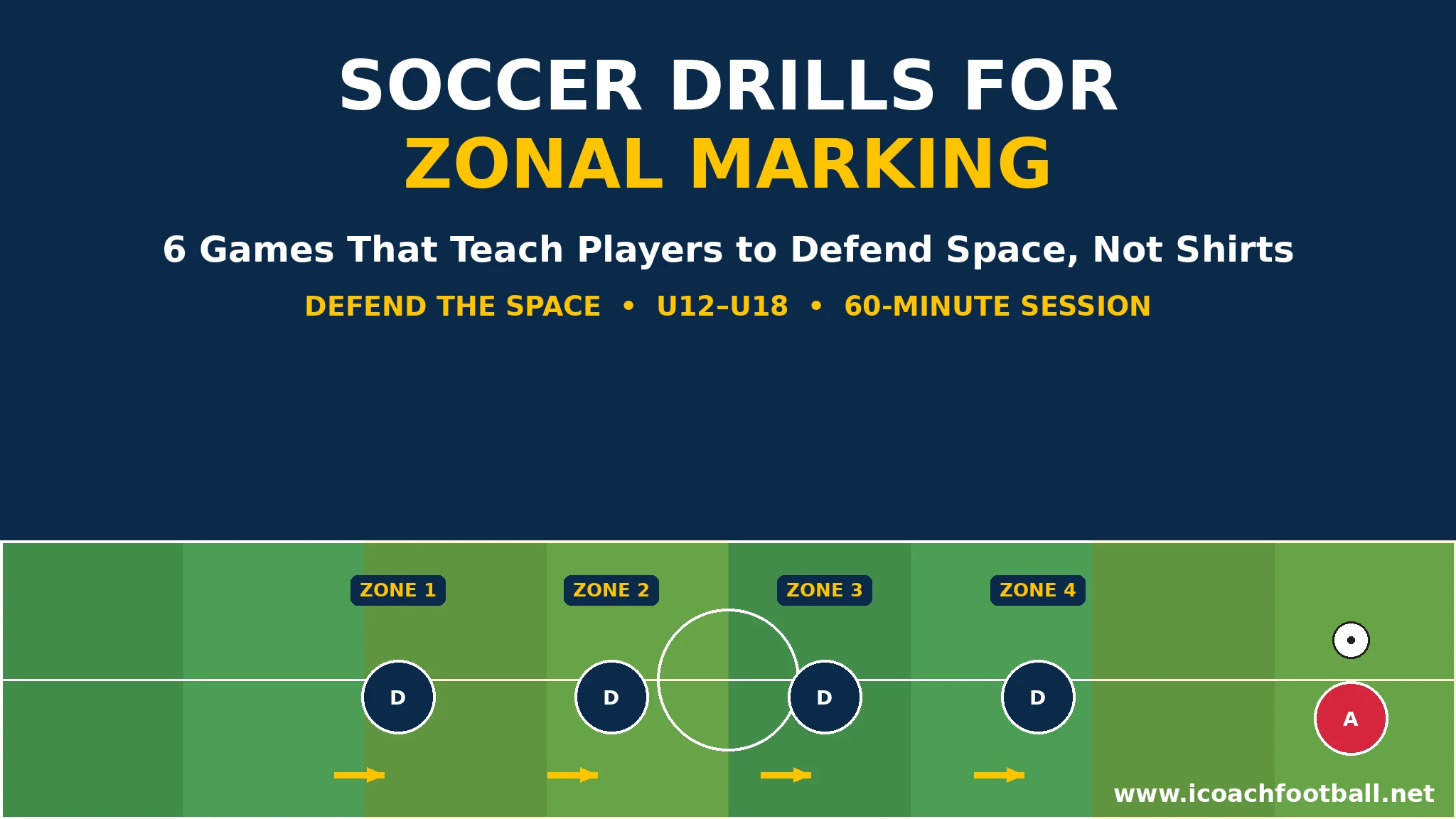
Zonal marking means each defender owns a patch of space, not a player. When the ball enters your zone, you defend it — when it leaves, you hand it over and hold your shape. These six games build that habit step by step: two-zone duels, sliding as one, loud handovers, zonal corners, a gate game and a full zonal match.
Suitable for: U12–U18 (ages 11–18)
Session snapshot
- Players: 12–16 (U12–U18)
- Area: 24 x 16-yard area expanding to a 50 x 35-yard game pitch
- Duration: 60 minutes
- Focus: Defending space as a unit — holding zones, sliding together, handing runners over with a call, and attacking the ball when it enters your zone
- Equipment: 8–10 balls, 24 cones, bibs, 2 mini goals, 1 full-size goal (or 2 mini goals for Drill 6)
Why these six games work
Man-marking and zonal marking are the two halves of defending, and they ask for opposite habits. In man-marking you follow a shirt wherever it goes; in zonal marking you guard a space and let the runner go when he leaves it. Our soccer drills for improving marking train the first half — this session trains the second, and a defender who can do both is the one coaches trust in big games.
Zonal marking fails when players chase the ball. It works when the whole unit moves together, so the first three drills in this session teach one idea each: own your zone (Drill 1), move as one line (Drill 2), and hand the runner over with a call (Drill 3). The last three drills put those habits under pressure: corners, a gate game, and a full match.
The drills are grounded in the FIFA/UEFA coaching community. Drill 1 is based on / in line with the FIFA Training Centre exercise “#22 Zonal marking”, in which two defenders each hold their half of the pitch and try to intercept before the attacker receives in their zone. Drills 2 and 3 are based on / in line with England Football Learning’s six-week “Marking and intercepting to defend” programme, which teaches players to mark an opponent or zone, scan for where the space may be, and communicate with teammates to defend effectively. The session builds on our soccer drills for improving defensive positioning — positioning puts a defender in the right place, and zonal marking tells him what to do once he is there. In the UK the same session is football zonal marking drills — the zones, the calls and the coaching points are identical.
Six rules of zonal marking
- Defend the space, not the shirt. Your zone is your job — the runner is only yours while he is inside it.
- Slide as one. When the ball moves, the whole line moves — the gaps between defenders stay the same.
- Eyes on the ball first, scan for runners. Watch the ball, then check your shoulder for the runner arriving in your zone.
- Hand over with a call. When a runner crosses your border, shout “Yours!” — a silent handover is a lost runner.
- Attack the ball when it enters your zone. Step out and meet it — waiting inside your zone lets the attacker turn.
- Hold your zone until the ball moves. Do not chase the ball into a teammate’s zone — that is how gaps appear.
Drill 1 — Two-Zone Duel
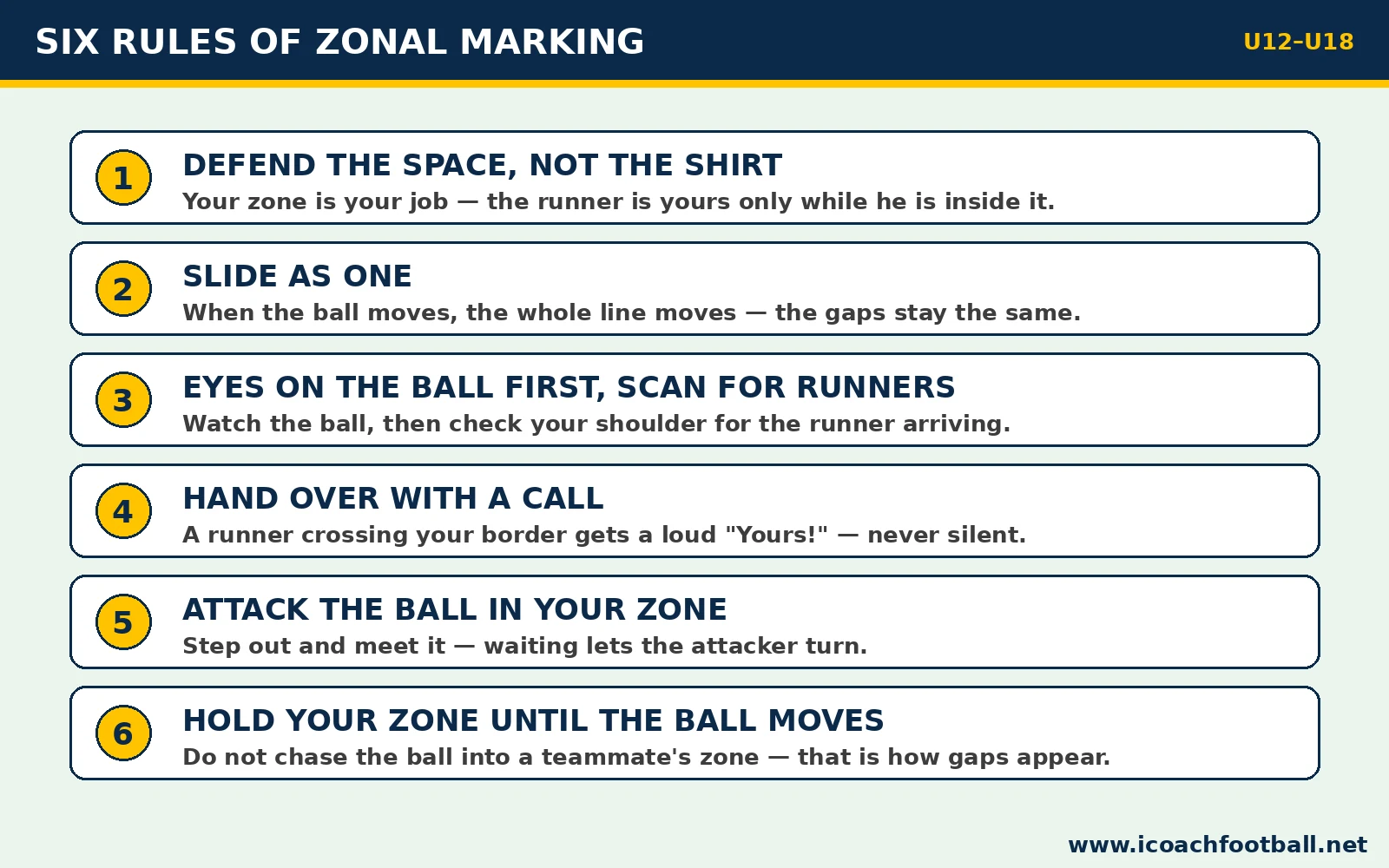
Two defenders, two zones, one attacker who keeps switching sides. The FIFA Training Centre exercise this drill is based on: each defender owns a half and intercepts before the attacker receives in their zone.
Setup
- 24 x 16-yard rectangle, split into two 12-yard halves by a line of cones.
- 2 defenders (one per half), 1 attacker moving between zones, 2 supporters — one at each end with a ball.
- 8 minutes, then rotate roles.
How to Play
- The attacker starts in one half and chooses an end to receive from.
- The supporter at that end plays the ball in firmly, first time.
- The defender in that zone steps up and tries to intercept before the attacker receives.
- If the defender wins the ball, they play it out to either supporter for 1 point.
- The attacker then moves to the other end to receive in the other defender’s zone.
- After 2 minutes, rotate — the attacker becomes a defender and a defender becomes the attacker.
Coach’s note: “Step out and meet the ball — if you wait for it to arrive, the attacker has already turned.”
Progressions: Add a second attacker so each defender has two runners to read; make the area 30 x 20 yards so the zones are bigger and the runs longer; defenders must play the ball out to a supporter on the far end for the point to count.
Drill 2 — Slide As One
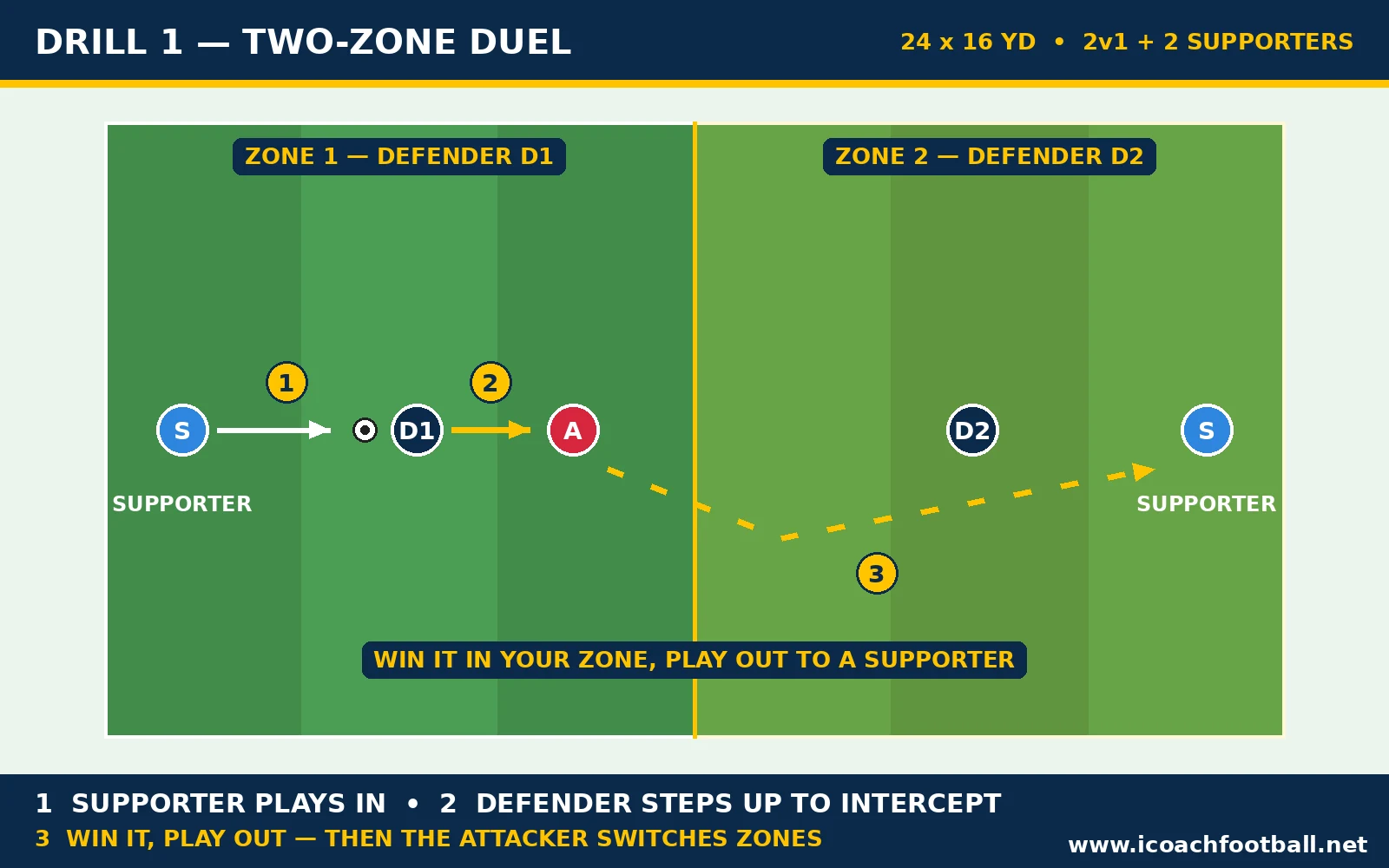
A back four tied together by an imaginary rope. The ball moves, the line moves — and the gaps between defenders never change.
Setup
- 30 x 20-yard area, one goal (or two mini goals) at each end.
- 4 defenders in a line, 4 attackers passing the ball around the outside, 1 ball.
- 8 minutes, then swap the units.
How to Play
- The back four set up 8 yards apart, level with each other, 15 yards from their goal.
- The attackers pass the ball slowly from side to side across the front of the line.
- The whole line slides toward the ball — the gaps between defenders stay at 8 yards.
- When the ball reaches the wide attacker, the nearest defender steps out to press.
- The other three tuck in behind, still level, still 8 yards apart.
- The coach freezes play twice and checks the gaps with a shout — “Show me the rope!”
Coach’s note: “Move as one — if the rope stretches, the gap is where they will play through.”
Progressions: The attackers speed up the passing so the line must slide faster; the ball switches sides on one pass so the line must sprint across; add a fifth attacker who runs in behind, forcing the line to drop together.
Drill 3 — The Handover
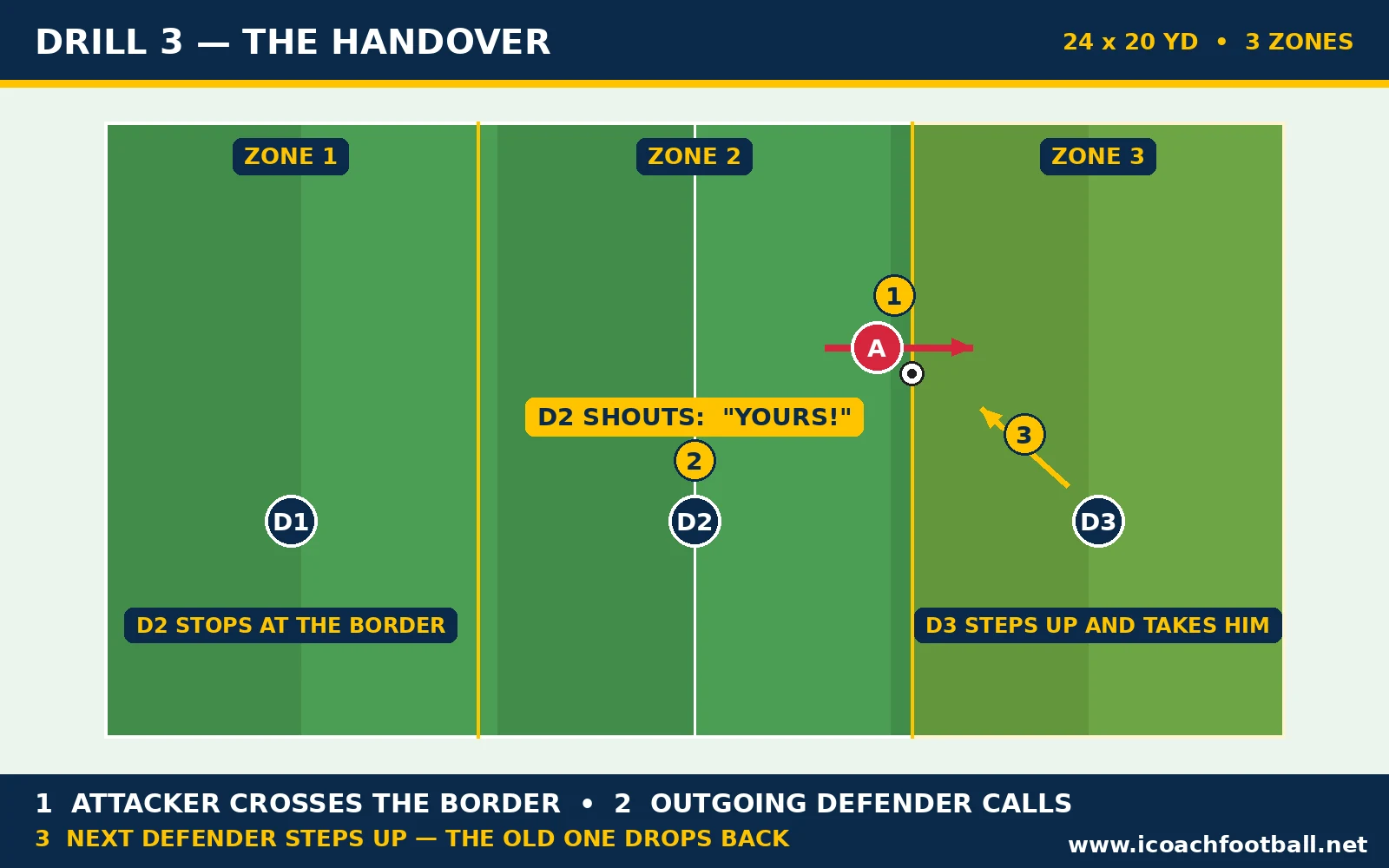
The hardest habit in zonal marking: letting a runner go. The attacker crosses a zone border, the outgoing defender calls “Yours!” and the next defender picks him up.
Setup
- 24 x 20-yard area split into three 8-yard vertical zones by cone lines.
- 3 defenders (one per zone), 3 attackers, 1 ball, 2 mini goals at the ends.
- 8 minutes, then rotate.
How to Play
- The attackers start in the middle zone with the ball, facing the defenders.
- One attacker dribbles across the border into the next zone.
- The outgoing defender stops at the border and shouts “Yours!” — loud enough for the whole pitch to hear.
- The defender in the new zone steps up and takes the attacker on.
- If two defenders chase the same attacker, the coach freezes play and resets.
- After 2 minutes, rotate so every defender practises both giving and taking a handover.
Coach’s note: “Shout the handover — ‘Yours!’ — a silent handover is a free run at goal.”
Progressions: The attacker crosses two borders in one run, so two handovers happen back to back; the attackers pass as they cross, so the handover must happen while the ball moves; the zones narrow to 6 yards so the handovers come faster.
Drill 4 — Zonal Corners
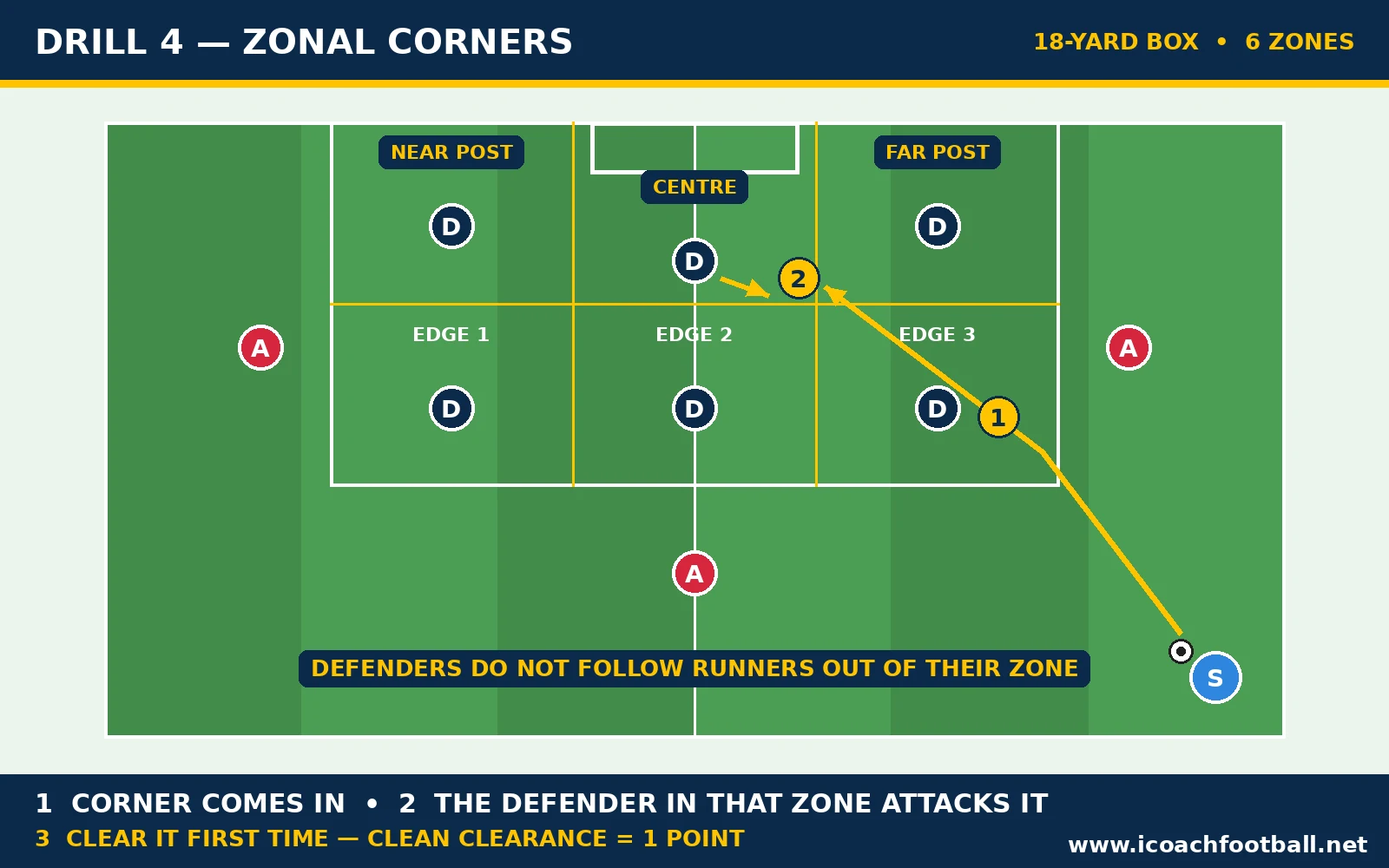
Six zones in the box, six defenders, one rule: attack the ball only when it enters your zone. The corner every team fears, turned into a drill.
Setup
- 18-yard box in front of one goal, six cones marking six zones across the box.
- 6 defenders (one per zone), 4 attackers making runs, 1 server taking corners.
- 8 minutes, 10 corners, then swap units.
How to Play
- Each defender stands in their zone — near post, two central zones, far post, and two edge-of-box zones.
- The server delivers a corner into the box from alternating sides.
- The defender whose zone the ball enters attacks it and clears it first time.
- Defenders do not follow a runner out of their zone — they trust the next zone.
- A clean clearance scores 1 point for the defenders; a goal scores 1 for the attackers.
- After 5 corners, the defenders swap zones so everyone defends the near post and the far post.
Coach’s note: “Attack the ball in YOUR zone — if you chase it into his zone, two of you are in one place and nobody is in yours.”
Progressions: The attackers make late runs from the edge of the box to test the edge zones; the server varies the delivery — near post, far post, flat, deep; the defenders must play the clearance out to a target player instead of just heading it away.
Drill 5 — The Gate Game
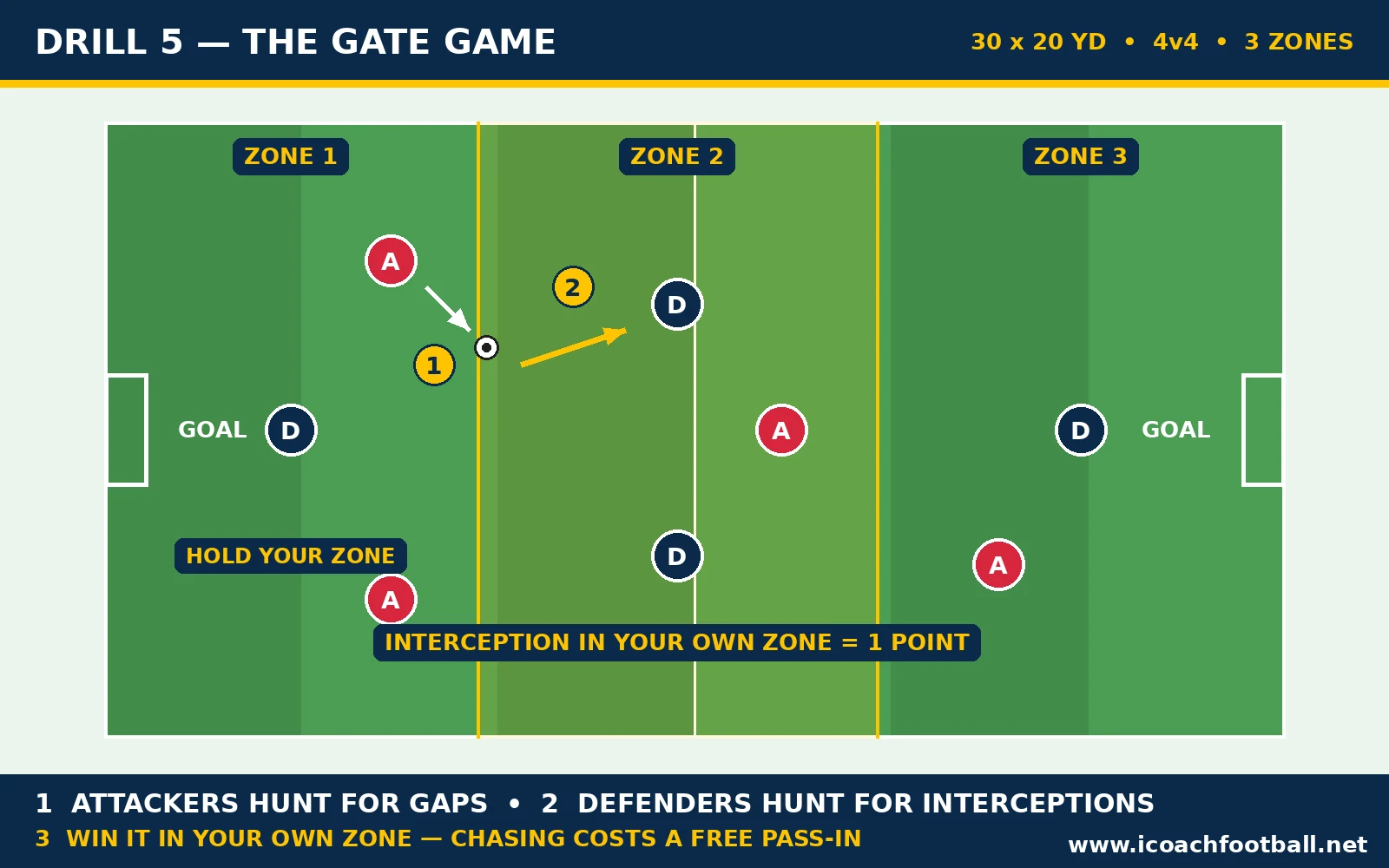
A small-sided game where defending your zone scores points. Attackers hunt for gaps; defenders hunt for interceptions — in their own zone only.
Setup
- 30 x 20-yard area split into three 10-yard zones, 2 mini goals at each end.
- 4v4, 1 ball, bibs.
- 8 minutes, two 4-minute halves.
How to Play
- Each team defends one end and attacks the other, 4v4 with no goalkeepers.
- The defending team must keep at least one player in each of the three zones.
- A defender wins 1 point for an interception made inside their own zone.
- The attacking team scores 1 point for a goal and 1 point for a pass that splits two zones.
- If a defender leaves their zone to chase the ball, the other team gets a free pass-in.
- After 4 minutes, swap ends and play again — most points wins.
Coach’s note: “Win it in your zone — an interception in your own space is worth more than a tackle in someone else’s.”
Progressions: Defenders score 2 points for an interception that leads to a goal within 5 seconds; attackers must complete 3 passes before they can shoot, so the defenders have time to set their zones; shrink the area to 24 x 16 yards so the zones are tighter and the interceptions come faster.
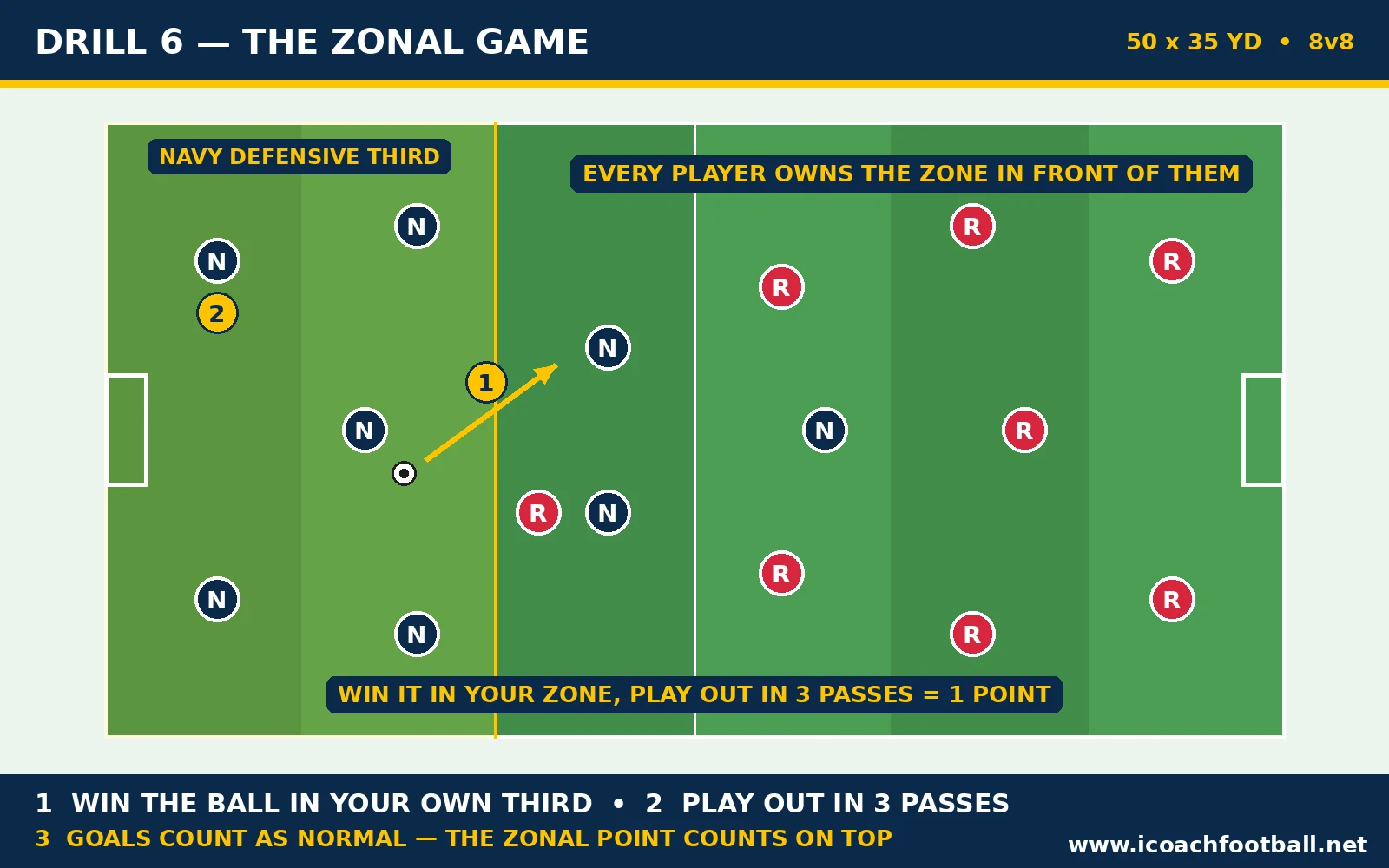
Drill 6 — The Zonal Game
The full game. Two teams, real goals, and one rule that changes everything: win the ball in your zone, then play out.
Setup
- 50 x 35-yard pitch, full-size goals (or 2 mini goals at each end), bibs.
- 8v8 (or 7v7 with 14 players), 1 ball.
- 15 minutes.
How to Play
- The game starts with a pass-in from the coach — no kick-offs, no corners.
- Each team defends in its own shape, with every player responsible for the zone in front of them.
- A team scores 1 point for winning the ball inside its own defensive third and playing out in 3 passes.
- Goals count as normal — 1 point each, and the zonal point still counts on top.
- The coach freezes play twice and asks one defender: “Whose zone is the ball in right now?”
- In the last 5 minutes, the coach removes the zonal point — the habits must survive without the reward.
Coach’s note: “Win it in your zone and play out — that is the whole system in one sentence.”
Progressions: Play 7v7 with a neutral player who always plays one touch and must be zoned, not marked; the team that wins the ball in its own third must score within 10 seconds for the zonal point to count; add an offside line 15 yards from each goal so the line must hold its height together.
Coaching points
- The ball is the reference, not the runner. Every defender’s first look is at the ball — the runner matters only when he enters their zone.
- Distances decide everything. Keep 8 yards between defenders in a line and 10 yards between lines — wider and the gaps open, tighter and one pass beats two players.
- The handover is a team skill, not a solo one. The call has to be loud, early, and named — “Yours, Sam!” beats a mumbled “yours” every time.
- Press the ball, cover the space behind. The nearest defender steps out; the next one drops 3 yards deeper and tucks in to cover.
- Stay goal-side in your zone. When the ball enters your zone, get between the attacker and your goal before you try to win it.
- Compact first, press second. Slide together, squeeze the space, and only then send a defender out — a press from a stretched shape is a free pass through.
Common mistakes
| Mistake | Fix |
|---|---|
| Chasing the ball into a teammate’s zone | Freeze the drill and ask: “Whose zone is that?” — the chaser jogs back and the right defender steps up |
| Two defenders marking the same runner | One calls “Mine!” and the other calls “Yours!” — the second defender drops back into their zone at once |
| A silent handover | No call, no handover — restart the rep and make the outgoing defender shout the name of the player taking over |
| The line splitting when the ball switches sides | The far-side defender sprints across first and the line follows — drill it in Drill 2 until the gaps stay at 8 yards |
| Waiting for the ball instead of attacking it | The defender in the zone steps out to meet the ball 2 yards before it arrives — practise it in Drill 1 until it is automatic |
| Ball-watching and losing the runner | “Check your shoulder” on every pass — the defender scans for the runner arriving in their zone before the ball does |
Age adaptations
| Age | Format | What changes |
|---|---|---|
| U12–U13 (ages 11–13) | 20 x 14-yard areas, size 4 ball, 2 zones only in Drill 1 | Keep the idea simple: two zones, one handover at a time. Drill 3 uses two zones instead of three, and Drill 4 uses four zones in the box instead of six. The coach calls the handover for the players until they start calling it themselves |
| U14–U15 (ages 13–15) | 24 x 16-yard areas, size 5 ball, 3 zones in Drill 3 | All six drills run as written. Drill 2 adds the attacker running in behind, and Drill 5 adds the 3-pass rule before shooting. Players name the teammate they are handing to — “Yours, Sam!” — instead of a generic shout |
| U16–U18 (ages 15–18) | Full areas, size 5 ball, 4 zones in Drill 3 | Drill 3 runs with four zones and two handovers per run. Drill 6 adds the offside line and the 10-second rule for the zonal point. The coach stops calling anything — the players run the communication, and the freeze questions come from the players, not the coach |
60-minute session plan
| Block | Time | Content |
|---|---|---|
| Arrival game | 0:00–0:05 | Free 4v4 — one rule only: no tackling outside your own half |
| Own your zone | 0:05–0:13 | Drill 1 — Two-Zone Duel |
| Slide as one | 0:13–0:21 | Drill 2 — Slide As One |
| The handover | 0:21–0:29 | Drill 3 — The Handover |
| Zonal corners | 0:29–0:37 | Drill 4 — Zonal Corners |
| The gate game | 0:37–0:45 | Drill 5 — The Gate Game |
| The zonal game | 0:45–1:00 | Drill 6 — The Zonal Game |
Keep building from here
Zonal marking is the second half of marking — the first half is our soccer drills for improving marking, which trains following a runner, and this session trains the opposite habit of defending the space he runs into. The positioning that makes a zone work is our soccer drills for improving defensive positioning, and the compact shape that holds it together is our the defensive block to teach compactness. The corner work in Drill 4 pairs with our football defending set pieces drills, and the aerial clearances it demands are trained in our soccer drills for improving aerial duels. The scanning that lets a defender spot the runner before he arrives is our soccer scanning drills, and the reading of the game that tells a defender when to step out is our soccer drills for improving anticipation. The 3v2 and 2v1 situations that follow a won interception are our football defending 3v2 drills and our soccer defending 2v1 drills, and the triggers that start the whole press are in our coaching soccer pressing triggers.
FAQ
What is the difference between zonal marking and man-marking?
In man-marking, each defender follows one opponent wherever he goes. In zonal marking, each defender owns a patch of space and defends whoever enters it, then hands the runner over when he leaves. Man-marking is safer against one dangerous player; zonal marking is safer against a team that moves and rotates, because the shape never gets dragged out of position.
What age should players start zonal marking?
From U12. Younger players do not yet have the tactical maturity to hold a zone while a runner moves — they chase the ball. At U12–U13, start with two zones and one handover at a time, as in Drill 1, and let the coach call the handover until the players start calling it themselves.
What happens when a runner crosses from one zone to another?
The outgoing defender stops at the border and shouts “Yours!” — loud and named, “Yours, Sam!” — and the defender in the new zone steps up to take the runner. The outgoing defender drops back into their own zone. A handover with no call is the most common way zonal marking breaks down, so Drill 3 trains it until the call is automatic.
How does zonal marking work at corners?
Each defender owns one zone in the box — near post, central zones, far post, edge of the box — and attacks the ball only when it enters their zone. They do not follow runners out of their zone. The system works because every dangerous space is covered, but it needs the defenders to be brave enough to attack the ball when it comes into their zone, as trained in Drill 4.
How do you stop players chasing the ball in a zonal system?
Freeze the drill the moment a player leaves their zone to chase, and ask: “Whose zone is that?” The chaser jogs back and the right defender steps up. In Drill 5, chasing costs the team a free pass-in for the opposition, so the habit corrects itself — the players learn that holding the zone wins more points than chasing the ball.
Sources
- FIFA Training Centre. “#22 Zonal marking” — Two defenders each hold their half of the pitch and try to intercept before the attacker receives in their zone, with variations for 4 defenders v 2 attackers and 4v1. Verified live 2026-11-19 (HTTP 200, full text read). Drill 1 is based on / in line with this exercise.
- England Football Learning. “Session programme: marking and intercepting to defend” — A six-week programme (June 2025) that helps players become positive defenders, make informed decisions of when to mark and when to intercept, and use scanning, movement and positioning skills to mark an opponent or zone, with communication to defend effectively. Verified live 2026-11-19 (HTTP 200, full text read, including the Week 2 “Defend as friends” session). Drills 2 and 3 are based on / in line with this programme.